Every mistake here was named by someone who has sat on the assessor's side of the table, not by a coaching blog. Where two of them disagree, both views are given. About 8,050 words, free, in full.
Read this in your languageHindi, Tamil, Telugu, Kannada, Marathi, Gujarati, Bengali, Punjabi, Malayalam, Odia
The whole guide, spoken, in nine minutes — the same fifteen sections, in order. Subtitles follow the language you chose above.
▶ Watch the explainer — The mistakes candidates actually make (full lesson)
A short narrated walkthrough. Tap to play, then work through the task below. Downloads are strictly prohibited.
1. How to use this
01
How to use this
Every mistake below was named by someone who has sat on the assessor's side of the table, not by a coaching blog. Where two of them disagree, both views are given.
This is written for a candidate preparing for the Personal Interview, and for an instructor running mock interviews. Read it once end to end, then use the self-check near the end in the week before your board.
One warning before you start. Nothing here is a script. The single most common failure in this material is a candidate delivering answers that sound prepared, and every assessor quoted says they can tell within minutes. Use these pages to find what is weak in your own life and fix it, not to memorise better sentences.
Each mistake is written the same way: what candidates do, why an assessor reads it as a problem, and what to do instead.
02
What the Interviewing Officer is actually assessing
The interview is a check on your whole personality, not on your suitability for one job.
A civil interviewer looks for the few qualities their role needs. Here the officer is asking whether you have it in you to lead, in any situation, and every answer is read for that.
It is one to one, and it is one of three independent assessments. Nobody publishes a fixed length. The officers here work to about forty to forty-five minutes, one of them says forty-five to seventy-five, and published guides commonly say thirty to sixty, longer for a repeater or a complicated record. Plan for forty-five and be ready to sit longer.
The officer has your PIQ in front of him and has read it before you walk in.
He has 45 minutes to know you inside out, so he reads far more into small statements than you expect.
Three assessors, the Interviewing Officer, the psychologist and the GTO, score you independently and do not discuss you until the conference on the last day.
That independence matters more than candidates realise. At the conference the three compare notes on each quality. Where two assessors saw a strength and the third saw a gap, the board questions the candidate on exactly that gap, and the answer decides it.
Four things underpin every good interview, in the words of one interviewing officer: the basics of your own subject, communication, physical fitness, and general awareness. He put it plainly. If those four are solid, there is nothing to be afraid of.
Nothing carries over between attempts, either. Every test at every board is taken fresh, so a previous recommendation counts for nothing, and candidates who relax because they cleared screening last time are the ones who fail it this time.
03
Why they keep asking about your past
Candidates find it strange that forty minutes are spent on school, college, friends and games when the job is soldiering. A Lieutenant General who served forty years and retired as a Director General gives the reason in one line: for an interviewing officer, what you have done in your past is a good guideline of what you are going to do in future.
He gives two examples of what that reasoning does to an otherwise strong candidate.
The candidate who cannot get up. A generation that does not fall asleep before eleven, he says, is a generation that will struggle at an academy where the day starts at four in the morning. Nobody asks you directly whether you can wake up early. It comes out of your routine, your games, your attendance, the hour you say you study.
The inconsistent performer. Back papers, a patchy record, a good year and then a bad one. He does not read that as low intelligence; he reads it as bunked classes, the wrong company and time given to something other than the course. And what it predicts is more of the same under pressure.
This is also why he is unmoved by the objection that the system is old. The officers who led in 1947, 1962, 1965, 1971 and Kargil were all selected by it, and in his words the children selected here are not letting the country down. You are not going to argue the method out of the room. You are going to be judged on your record, so the useful question is what your record actually says.
One practical consequence, and it is the reason this document says start early. Asked what a candidate should build first, he names knowledge of defence and of current affairs, and adds that you cannot read this at the last minute — knowledge develops gradually. The same is true of everything else on your form. A hobby begun a fortnight before the board reads exactly like a hobby begun a fortnight before the board.
04
Before you speak: the PIQ
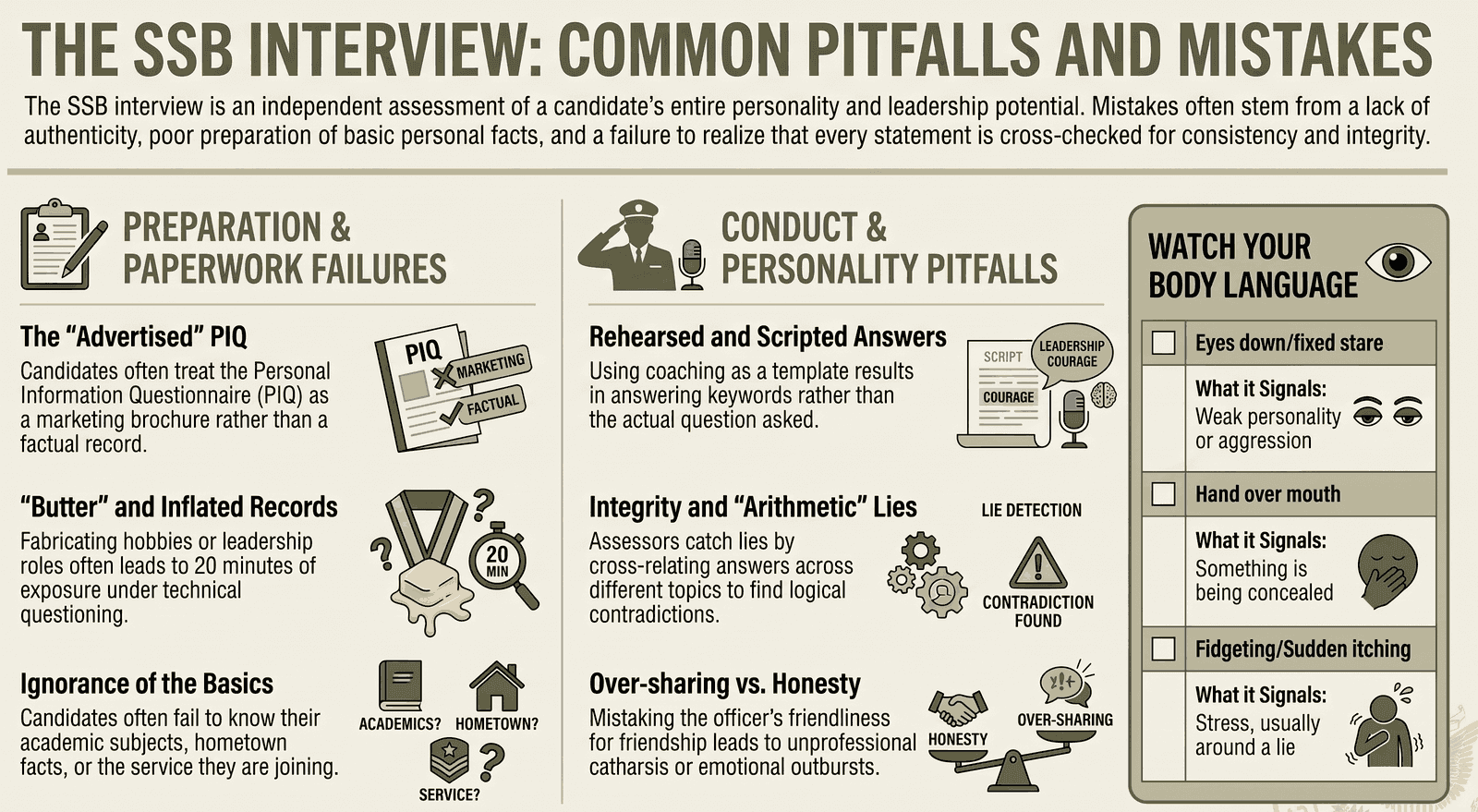
The PIQ is the question paper, and most candidates write it as an advertisement.
Almost every question traces back to something you entered on it, so a line you cannot defend becomes twenty minutes of exposure.
An ex-interviewing officer pushes the starting line back further still. He tells candidates the interview begins the moment they press submit on the online application form, because a copy of that form reaches him and he has read it before you walk in. What you wrote there, and the photograph you attached, are already part of the picture — he has seen candidates send in photographs in a slogan t-shirt, hair undone, looking as though the form was filled in a hurry between other things.
And the PIQ is not the only form. Candidates prepare for the PIQ and forget that every other sheet they fill at the board also lands on the interviewing officer’s desk. He reads all of them for the same three things: whether you are conscientious, whether your thinking is organised, and whether you can give the essentials of what was asked. A form filled carelessly answers those questions before you do.
Filling the form carelessly
The officer has your PIQ and your mark sheets, and nothing else. He does not know who your GTO or your psychologist is, and he will not see their marks until the conference. A general who commanded a Selection Board says he can read the candidate off the form before the candidate speaks.
Guessing your town's population. The careful candidate writes the figure, says which census it came from, and notes that he has added for growth since.
Leaving “brother / sister” uncut, so the reader cannot tell which you have.
Overwriting and scratching out. Strike a mistake through once and move on.
Giving your father's income per month when the form asks for the year.
Giving your height in feet when the form asks for centimetres.
“If you do not play the game, then do not write it.”
a general who commanded a Selection Board
His phrase for an inflated form is one made with a lot of butter, and he puts the chance of failure after that very high. Practise on a blank PIQ before you travel.
Treating it as a form rather than a catalogue
An ex-GTO who takes candidates through the PIQ line by line calls it your product catalogue, the SSB’s equivalent of a resume, and says candidates fill it the way they would fill any other form. His image for an inflated one: paint an iron coin gold and it is still iron, however many coats you give it.
Two mechanical facts worth knowing, because they change how you treat it:
You fill it on reporting day, and again after clearing screening. One copy goes to the interviewing officer and one to the psychologist. The GTO never sees it.
Your OIR rating from screening is entered on it, and carries into the second stage.
And a list of things on that form which candidates never think to prepare, each of which he has seen asked:
The meaning of your name, and who chose it.
Your date of birth and age worked out to the day.
Your authorised weight for your height, and how far from it you are.
The basics of your own religion. He expects a Hindu candidate to handle the difference between Hindu and Hinduism, a Muslim candidate Shia and Sunni, a Christian candidate Protestant and Catholic.
A balanced view on reservation, including when you are the one who benefits from it.
The city your board is in: what is there, and why the place matters.
Your star sign and what it is said to mean, which he says does get asked.
One small thing that costs more than it should: a childish email address on the application, of the loverboy-at-gmail variety. Either change it before you apply or be ready to explain it, because it reads as immaturity before you have spoken.
Writing hobbies you do not actually have
A colonel gave three real cases, and all three came apart the same way.
A candidate had captained his school cricket team, been vice captain at college and played for the university. Asked how he would keep score at a match, he said two notebooks, one per team. Asked whether he had ever seen a score sheet, he said it was not required.
A second wrote gardening, and mentioned his family farm repeatedly. He could not name the tools, could not say what was growing in June, and mixed up Rabi and Kharif crops entirely.
A third wrote cycling and answered smoothly until he was asked to plan a trip, and punctures were introduced one by one. He hid damaged cycles in the jungle and put three riders on one bicycle. Afterwards he admitted he had no hobby and thought he had to write something.
What to do instead: if you have no hobby, say so. One lie drags you into trouble.
Not knowing the difference between a hobby and an interest
An interest is something you enjoy passively. A hobby exercises your mind or your body, regularly, and costs you effort.
Running two kilometres in an hour, with breaks to chat, is not a hobby. Five kilometres most days is.
Five-minute blitz chess is not exercising the mind. A game of twenty to twenty-five minutes is.
Cooking only when your mother is unwell or away is a compulsion, not a hobby.
Travelling to another city for coaching, and seeing nothing of it, is not exploring new places.
Putting things in the PIQ that can only cost you
Watching films, listening to music, video games. No effort of mind or body, so no credit.
Diary writing. The next question is what you wrote yesterday, and the honest answer hands over a mistake you would never have volunteered.
Anything you have never done. You cannot claim an interest in something you have not once tried.
Books chosen to impress. One candidate claimed the Ramayana, Mahabharata and Gita, was asked who Jayadratha was, and could not answer even with hints.
If you have no hobby and no extracurricular record, leave that part empty. The PIQ is read against the opportunities you actually had: a village school, a town school and a metro school are not judged alike.
He adds the other half of that advice, which candidates miss. If a column is empty, do not pad it, but do not leave it empty forever either. From the day you decide you want this, take up an activity and stay with it, so that when you fill the form the entry is real.
Listing too many activities
A President of a Selection Board who conducted 3,600 interviews over five years puts about half the interview on the PIQ. That makes the form’s shape matter as much as its truthfulness.
His point is about arithmetic. The officer has a fixed amount of time and will cross-question every activity you list, because he has to find out whether you did it or merely wrote it. List ten and he divides the same minutes across ten, which means the one where you genuinely reached a level never gets the time it deserves, and you never get to show what you can do.
His instruction: keep it to three or four sports and three or four other activities, chosen for the level you actually reached.
Preparing the wrong things
Four things carry an interview: the basics of your own subject, communication, physical fitness and general awareness. A mechanical engineering student who cannot explain mechanical basics has a problem no rehearsed answer fixes.
On fitness, one interviewing officer is specific and unimpressed by the usual reply. A morning walk is not training. Running is.
05
The first two minutes
You are being read before you have answered anything.
Your build, height and features are irrelevant. How you present them is not, and appearance is the first of the ten mistakes the presiding officers agreed on.
Haircut. A decent, conventional haircut, done before you travel.
Grooming. Unshaven, uncut nails and an unwashed face say you did not think the day mattered.
Clothes. Clean, pressed, and loose enough to sit in for an hour. Tight trousers make you fidget, and fidgeting reads as nerves.
Shoes. Polished, and matched to the clothes.
Borrowed clothes. An officer spots them immediately.
Ask permission, greet with a smile, walk to the chair and stand straight beside it. Some officers deliberately begin questioning while you are still standing, to check whether the confidence is real or worn for the occasion.
Bring nothing you do not need. Candidates arrive with bags and folders, hold them against the chest, and spend the interview half attending to the object in their lap.
If there is a handshake, avoid both extremes. A limp hand reads as a weak personality; crushing the officer's hand reads as someone performing strength.
06
What candidates say
They are not testing your answers. They are testing whether the person giving them is real.
Rehearsed answers
Candidates memorise twenty or fifty question-and-answer pairs, then listen for a keyword and deliver the matching speech. The result is an answer to a question that was not asked.
A psychologist who assessed over 800 candidates makes the same point about the written tests. Coaching is not the problem, and he is emphatic about that. The problem is using coaching as a template, the way you would use a rule that two plus two is four.
Instead: listen to the whole question, answer that question, and stop.
Inflating your record
A candidate had played school football. His father told him to write that he was captain. The officer asked three or four questions about running a team, and the candidate admitted it. The damage was not the lie about football. It was that nothing else he said could be trusted.
A President of a Selection Board gives the sharper version. A candidate told him he had been a world champion swimmer. He asked for his timings, because timings are how you place a swimmer, and they showed a man who had not reached district level. His warning is that if you claim an activity, know its numbers: the current standards, your own times, what the thing actually involves. You cannot shoot arrows in the air.
Using quality words instead of evidence
Candidates announce that they are hardworking, honest, determined and intelligent. Judging your qualities is the assessor's job, and repeating those words signals the opposite of what you intend. Where the words keep recurring, the psychologist reads it as a candidate with no actual ideas.
Instead: describe what you did, with enough particulars that the quality is obvious without naming it.
Hiding weaknesses
Many candidates think admitting a shortcoming ends their chances. The psychologist disagrees flatly. A candidate who knows his weakness earns credit for the realisation, because realisation is where improvement starts. Assessors usually know already: your written tests have been in front of them for two days.
A President of a Selection Board describes the candidate who refuses to say anything negative about anything: not about a teacher, a subject, a friend, or himself. It does not read as positivity. He has raised children and lived a life, he says, and he knows a person is not made only of good parts. What follows is that he stops accepting the surface and starts prodding, and the rest of the interview is spent proving what you were hiding rather than showing what you are.
Overconfidence, and talking over the officer
A candidate who does not know an answer delivers it confidently anyway, then argues when the officer offers a hint. As one general puts it, you have come to give an interview, not to take one.
Two answers that mark you as the wrong fit
Speaking against the organisation. The forces need someone who argues his case inside the room and carries out the decision outside it. A candidate who would undermine a decision he disagreed with is describing someone who cannot be given a command.
Putting yourself above the team. Nobody wins a battle alone. Answers built around personal credit, where the group is missing, count against you even when the achievement is real.
07
How a lie actually gets caught
Not by the officer calling you a liar. By arithmetic, by a follow-up question two topics later, and by your own body.
An interviewing officer with over 3,000 interviews describes what he watches for the moment a candidate knows he is lying: the person becomes uncomfortable in the seat, the facial expression changes, the speech starts to tremble, the eyes give it away, the fingers start twiddling. Nervousness sets in, because the candidate is now working out answers to questions that have not been asked yet.
Then comes the part candidates do not expect. He usually does not challenge it there. He notes it, moves on, and somewhere later asks something innocuous that confirms it. Officers describe deliberately not embarrassing the candidate at the moment of the lie.
The marathon
Asked what he did for fitness, a candidate said he ran, and that he had run a marathon.
How many kilometres is a marathon? It is about 42.
He corrected himself: it was a half marathon.
How many kilometres is a half marathon? It came down to a race of about five kilometres.
What was your time? About five minutes.
Work out the speed. He did the mental arithmetic and answered 120 kilometres per hour.
The officer’s summary is the useful part. It showed three things at once: he had lied, his mental arithmetic was poor, and he had no concept of speed. Five kilometres in five minutes is 60 kilometres an hour, not 120, and the officer’s own remark was that 120 is three times what the candidate’s motorcycle does.
The typhoid
A candidate with a gap year was asked why he had not sat the examination. He said he had typhoid and had lost a year.
The next questions were which medicine he had been given, and how it was diagnosed. He was caught there. What he eventually admitted was that the lost year had been drugs.
The point is not the drugs. It is that an invented reason for a gap only has to survive two ordinary follow-up questions, and invented reasons rarely do.
The phone
A candidate described a very poor family, and the PIQ showed a very low family income. Asked, later and casually, what phone he carried, he named a handset costing thirty or forty thousand rupees.
The officer’s phrase for this is cross-relating: answers from one part of the interview are checked against another part, and the contradiction does the work.
The debate
A quieter version, used on anyone who claims an activity. A candidate said he had debated. The officer asked him to argue the opposite side of the motion he had held.
That single question tells the officer whether he actually took part, whether he listened to the other side, and whether he prepared. The same trick works on any claim: sudden death in football, the score sheet in cricket, the timings in swimming.
08
How candidates say it
Weak English is not what sinks candidates. Talking at length without arriving anywhere is.
Asked who his best friend is, a candidate starts with a friend from class three, moves to class six, then class ten, and never reaches the present. If the officer asks about one incident, stay on that incident.
A President of a Selection Board gives a usable limit: no answer longer than three or four sentences. He also explains why the interview is capped at about forty minutes, give or take five. Past that, he says, his own powers of observation fade and so does your focus.
The arithmetic follows. Every extra sentence you spend is one he cannot spend finding out something else about you, and he is blunt that the candidate who over-answers is eating his own interview. He is equally blunt about what it signals. Handing over an entire page and leaving him to locate the answer inside it shows you could not decide what the answer was, and deciding is the quality being measured. He calls it a lack of effective intelligence.
On English, the psychologist is blunt: you do not need to be Shashi Tharoor, and you do not need an Oxford vocabulary. He has seen fluent candidates fail and average speakers clear in large numbers. What you need is enough English to put an idea across.
The other half is equally clear. If your grammar obscures your meaning, your power of expression suffers, and that is an assessed quality. The GTO's own briefing says the language is English, and that if you get stuck you may use Hindi and return to English as soon as you can.
A general schooled in English puts the fairness question well. A village boy who had no English school until class five is not judged the way a candidate from one of the best schools in the country is judged. What impressed him about one farmer's son was not his English, which was broken, but that he was visibly trying to use it.
Instead: use your English, broken or not. When a point matters and you cannot get it out, ask politely whether you may answer that one in Hindi, make it well, and return to English.
Communication is the words. Power of expression is the words plus body language, voice modulation and facial expression, delivered confidently and to the point. That is what is scored.
Saying too much, and saying too little
The army’s own rule for communication, quoted by an ex-interviewing officer, is ABC: accurate, brief, clear. His gloss is the useful part — you need to know what to say, how much to say, and how to present it. Three separate decisions, and candidates usually get the middle one wrong.
They get it wrong in both directions. Asked about a subject they know, they empty the whole of it into the room. Asked about one they do not, they produce one sentence and stop.
His advice on the first is the most useful tactical suggestion in any of these interviews. The officer has only forty to forty-five minutes and must finish, so he cannot follow every thread. Give the bare essentials, and, in his phrase, hang out a few carrots — leave two or three specific things dangling in your answers that you would like to be asked about, on the subjects where you are strongest. The officer chooses what to pursue. You choose what is available to be pursued.
The exception he names is your own field. On your academic subject or the branch you have applied for, being able to speak at length is exactly right. Nowhere else.
09
Body language
Most of these are involuntary, which is exactly why officers watch them.
What you do
How it is read
Eyes down while answering
A weak personality, lacking confidence
Staring fixedly at the officer
Aggressive, equally wrong
Hand drifting to your hair
Nervous or uncomfortable
Hand over your mouth as you speak
Something is being concealed
Scratching, fidgeting, sudden itching
Stress, usually around an answer that is not wholly true
Hands tightly clasped
Anxiety, and the tighter the grip the more of it
Arms or legs crossed
Defensive, closed
Slouching
No alertness
Knees and feet moving
Stress leaking out, and very visible
Nodding at everything
Performing agreement
For the eyes, keep your gaze inside the inverted triangle formed by the two eyes and the nose, moving gently within it. Sit upright with a very slight lean forward, hands open, shoulders down.
Reading the officer
He stops taking notes and puts the pen down. A good officer writes as you speak, because your answers generate his next questions. When the pen goes down, the interview has drifted.
He loses eye contact. Usually you have started narrating at length. Get back to the point.
He folds his arms and looks puzzled. He cannot follow you, or cannot tell whether it is true.
10
The questions almost everyone is asked
“Who is your best friend?”
A best friend is someone you have known long enough to have shared things with, who knows you inside out, and who is the first person you think of when you are stuck. Naming your mother or your younger brother is not an answer. Relatives are geography, like the countries on your borders; friendship is chosen, and the choosing is what tells him something.
“The quality should be that he doesn't look too big on your shoulders. He should stand alone like a pillar — and that pillar shouldn't be on your shoulder.”
an interviewing officer
You say
What follows
What it says about you
“He is very supportive”
In what way? Candidates answer that he lends them money
Borrowing between personnel is prohibited, and you cannot manage your own money
“He guides me”
Guides you in what? Often in studies
An officer decides alone. If your friend scored 76 and you scored 88, the story collapses
“He motivates me”
When do you need motivating?
An officer is self-motivated, and a full routine leaves little room for feeling low
Safe ground is a quality that belongs to your friend and not to your dependence on him. He is focused. He plays football at district level.
“Whom do you like more, your mother or your father?”
“I like them both equally” is the standard reply and it is not an answer. The officer asked so that he could go somewhere next. If there is a mango and an orange in front of you and you may take one, you would take one. Choose, give your honest reason, and let him follow it.
“Why the armed forces?”
An interviewing officer says he can identify genuine passion within two minutes, because a candidate who wants it will have answers for everything that follows from it.
“What do you know about the service you are joining?”
Nobody expects tactics. They expect that an Air Force candidate knows the rank structure, which aircraft it flies, and roughly what the equipment does. It was your choice to apply.
A Lieutenant General who has assessed more than 10,000 candidates gives the exchange he has heard most often. Why do you want to join the Air Force? Because it was my childhood dream, my uncle was in the Air Force, I liked the uniform, I wanted to fly.
Then two questions:
What colour is the shirt, and the trousers? Silence.
Name three fighter aircraft in the Indian Air Force. Not one.
His comment: if that is your childhood dream and you cannot name a single aircraft, perhaps you are planning to fly Harry Potter’s broom.
The choices on your form, and why you made them
An ex-GTO who walks candidates through the PIQ line by line lists what he expects them to have settled before they sit down. Every one of these is a question waiting to be asked:
Why this entry, and not the other ones open to you.
How long the training is, and where it happens.
Why this service. If a parent or sibling is in one service and you have chosen another, why. If your father is a civil servant or a police officer, why this instead.
Why short service, or why permanent commission.
None of these have a right answer. They have an honest one, which you should have worked out rather than assembled in the chair.
“How did you get here?”
A question that looks like small talk and is not. One candidate could not name the train he arrived on, because his father had booked the ticket. Not the platform either, because he had been asleep. Each answer made the previous one worse.
Current affairs
You are not expected to explain the history of American foreign policy. You are expected to have noticed what is happening around you and thought about why. If farmers are demanding a guaranteed minimum support price, know what each side says, what it would cost, and where you stand.
11
A real interview, scored
A candidate on his ninth attempt was marked 88 out of 225, and 48 out of 100 — two separate scales the assessing officer used — and failed by two marks. The whole thing was recorded: the interview, the marking, and the officer’s written commentary. It is the clearest illustration in this document of everything above, so it is worth reading as a case rather than a list.
His record was six screenings out and three conference outs. Almost every mistake below is one this document has already named.
Four games on the form, none of them known
He had written football, cricket, chess and badminton. The officer went at football first, and said openly why: “I know you have no idea of football at all. That’s why I am asking.”
What is sudden death in football? No answer.
The height of the goalpost? “Absolutely not.”
The difference between the small D and the large D? No answer.
Moving to cricket: the height of the stump? Two and a half feet, then no idea in centimetres.
Where is gully? He described a slip position instead.
This is exactly the arithmetic a President of a Selection Board described. Four games listed meant four lines of questioning, and not one of them produced anything for him.
The subject he studied for four years
A civil engineering graduate. Asked what bleeding in concrete is, he said cement escaping through holes; it is water. He could not say who the father of civil engineering is, or why the discipline is called civil engineering. Asked the difference between a generator and a motor, he answered that a generator converts AC to DC and a motor runs on DC.
The officer’s response is the one to remember: these are things used every day, and a candidate is expected to know the basics of what he himself chose to study.
“I am intelligent”
Asked to describe himself, he offered curious, eager to perform, a good learner, and then intelligent. Asked for two reasons, he said he was good at maths and pointed to the two arithmetic questions he had just been given.
He had answered one of them 10,200 kilometres per hour. The correct answer was 10.2.
Guessing rather than saying he did not know
The officer names it four separate times: “You are again guessing.” Across the interview: the speed of light, quoted then fumbled; how long sunlight takes to reach the earth, given as twenty minutes against eight minutes nineteen seconds; the Indo-Nepal border dispute placed at the wrong river; GMT explained as “a European country, I think”; the International Date Line never heard of.
He had also been to the Air Force board three times, and his father serves in the Air Force, and he could name one Air Force command.
How it was marked
The officer grades each officer-like quality separately, from notes he writes throughout the interview. This is what that looked like:
Graded clear
Graded average
Graded borderline, failed
Reasoning ability, organising ability, determination, cooperation, sense of responsibility, initiative
Effective intelligence, power of expression, speed of decision, liveliness, courage, physical fitness
Confidence, ability to influence the group
Fourteen qualities are named there. The standard list has fifteen, grouped into four factors; the one missing here, social adaptability, is not read out in the recording, so it is left out rather than guessed at. Note also that the officer says physical fitness where the standard list says stamina.
General awareness was failed outright. His written commentary reads: smart but anxious, lacks clarity, comes under pressure, lacks listening ability, lacks focus, lacks boldness and assertiveness, but simple, sincere, dedicated, honest, a good friend and a good son.
Note what did not save him. He was graded clear on determination, cooperation, responsibility and initiative, and he still finished two marks short, because confidence and the ability to influence a group both failed.
What he was told to fix
The assessors’ list, which doubles as a checklist for anyone:
Open better. The first impression is the one that lasts, so arrive with some energy rather than settling into the chair.
Control your face when you do not know an answer.
Do not spend too long thinking before you speak.
Slow your speaking pace, so you have time to structure the answer as you give it.
Listen to the whole question before starting.
The longer-term advice was about the person rather than the interview. He had been book-bound and home-bound, sheltered, with no occasion to lead anything. The officer told him to take up activities where leadership is actually exercised, and to record himself speaking so he could watch his own delivery.
12
Under pressure
You will meet one of two officers, and each has its own trap.
The friendly one. He is so easy to talk to that candidates relax completely and reveal everything, including things they never meant to say.
The hard one. He cross-fires questions, and candidates freeze or become defensive, and never show what they actually are.
The same officer's advice covers both: be tactful, and be prepared. Decide beforehand what is yours to tell and what is not. That is not dishonesty. It is knowing your own story well enough that you are not improvising under pressure.
Assessors do not catch lies mainly by logic. They watch what happens when you start one: the eyes drop, the hands move, a pause arrives that was not there before. Then the questions narrow.
Saying you do not know is the cheapest recovery in the interview. Admit it, then reason aloud towards whatever you can work out. What destroys candidates is the alternative.
Do not use the interview to unburden yourself. If you are carrying something heavy, speak to a counsellor beforehand and arrive having already put it down. You came to clear an interview, not to be heard.
Oversharing, and the friendly room
It is the interviewing officer’s job to be pleasant and to build a room where you will open up. Candidates read that warmth as friendship, and start telling him things they would tell a friend. An ex-interviewing officer says the interview sometimes becomes cathartic for the candidate, and warns that this is where oversharing begins — personal matters, family troubles, grievances, laid out at length because the officer seemed kind.
Some candidates cry. His position on that is more careful than candidates expect. Crying is not in itself a sign of emotional weakness, provided there is a real and recent trigger — a loss in the family in the recent past, that kind of thing. He has seen candidates who lost someone very close and came to the interview holding themselves together, and he thinks well of them for it. What does count against a candidate is becoming overwhelmed by something that happened years ago.
The reason is the job, and he does not dress it up: battlefield conditions are nothing like the movies, there is nothing romantic about them, and a leader who cannot gather himself and take control of a situation is not a good fit. Emotional stability is not being asked of you as a manner. It is being asked of you as a qualification.
So answer what is asked, including about difficult things, and stop there. The difference between honesty and oversharing is whether the officer asked.
The conference
When two assessors have cleared you and the third has not, and your marks are near the line, the board calls you in and questions you on the exact quality in doubt. You will not know which one, and you will have seconds. Answer well and the doubt is recorded as cleared. Answer badly and you have confirmed it. Nobody's marks are changed either way; a remark is added.
Three further things candidates get wrong about it:
The odd questions are aimed. Expect to be asked what your backup plan is, whom among your group you would recommend, or to rate yourself out of ten. Each is chosen to test the quality that is in doubt.
Your first answer is the answer. It is decided on what you say instantly, with no time to construct anything.
A long wait means nothing. Candidates believe a long discussion means they are being argued for. It only means there is more to resolve, and a long conference that ends in a weak answer still ends in a no.
One structural point, since candidates ask: the President of the board is the administrative head. Inside the conference the three assessors carry equal weight, and each holds the same veto.
A good interview does not feel like one
The same officer remembers a candidate from a comfortable family who had drifted rather than used what he had. The officer let him talk, and he talked happily, at length, about everything he had been enjoying instead of preparing. At the end the candidate said he had loved the conversation and that whatever the result, the interview had been fantastic.
He was not recommended. An interview that felt warm is not evidence of anything. Sometimes it means the officer stopped steering and let you fill the time.
13
How the marks are actually made
Most of the mistakes in this document are mistakes of behaviour. A few are mistakes of arithmetic — candidates throw away marks because they do not know how the marks work. An interviewing officer with over eight thousand interviews behind him sets out the mechanics.
Screening: one minute decides most of it
On reporting day the boards are crowded and the clock is tight, so nobody gets a leisurely look at you. What you get is your OIR test and then roughly a minute of narration on the picture. His estimate: if you narrate well, eighty per cent of your battle is won.
The three letters that come out of screening are Y (yes), N (no) and D (doubtful), and he describes each one as an observable, not a judgement of character:
Y — a simple, practical story, narrated confidently, fluently and crisply, and then real involvement in the discussion.
D — reasonably confident, reasonably fluent, a reasonable impact, but in the discussion the group turns into what he calls a fish market, the candidate tries two or three times, cannot get in, and gives up. Most of the group lands here.
N — none of the above.
The practical lesson sits inside the D. What separates it from a Y is not the story. It is the two or three attempts at the discussion after which the candidate stopped trying.
Why the OIR matters more than candidates think
Candidates treat the OIR as a formality — verbal and non-verbal reasoning, difficulty he calls mediocre at best — and walk in unprepared. It is rated 1 to 5, and that rating is carried forward to the conference at the end of the whole assessment, where the psychologist, the GTO and the interviewing officer each state their view.
When those three are not unanimous and one of them is doubtful, the OIR rating is what breaks the tie. On his account, a single doubtful assessment goes your way at OIR 1, 2 or 3, and goes against you at OIR 4. At OIR 5 the bar is so high he says it effectively never happens. The SSB does not publish these combinations, so take it as one officer’s account of how it worked on his boards rather than a rule you can hold anyone to. What is not in doubt is the direction: a good OIR helps you everywhere, and a poor one leaves you no margin.
So the mantra he repeats is simply to attempt the maximum number of questions, guessing intelligently rather than leaving blanks: more attempts, more right answers, a better rating. An hour of practice buys a tie-breaker you will not know you needed until the conference.
The benefit of the doubt changes sides
This is the single most useful thing to understand about the two stages, and it explains a great deal of what otherwise looks arbitrary.
In stage one, the benefit of the doubt goes to the candidate. If you show a spark, they would rather test you than send you home. Very rarely, he says, is a candidate who could make the cut denied the chance.
In stage two, the benefit of the doubt goes to the organisation. If an assessor is in doubt, the answer is no, because the consequences of commissioning the wrong person are severe. His summary is blunt: a deserving candidate may occasionally get rejected, but a non-deserving candidate will never get selected.
At the conference the three assessors have an equal say, and he has sat as president believing a candidate deserved it while another assessor disagreed. Which means being liked by your interviewing officer is not enough. The case has to hold up in all three tests.
Your past performance has no bearing
He puts it twice, in the same words: your past performance has no bearing. It is that day’s performance, nothing else.
He has seen previously recommended candidates screened out, and names two NDA toppers — repeaters, both of whom were screened out on their first attempt. His analogy is cricket: a very good batsman can still be out early to a ball outside off stump.
This cuts both ways, and both are worth taking seriously. A recommendation last time buys you nothing this time, and overconfidence on that basis is a common way to lose. A failure last time also carries no mark against you. What it should produce is the reasonable person’s reaction he describes — working out which part you were not prepared for — rather than the conclusion that you have been judged and found wanting.
14
Repeat attempts, gap years and weak backgrounds
Treating a previous recommendation as credit
Every test at every board is taken fresh. A candidate who cleared screening last time prepares less for screening this time, and screening is now a much bigger hurdle simply because of the number of candidates appearing.
Not being able to account for a gap year
The question is not whether you took one. It is whether twelve months, which you could have spent in a job, produced anything: marks that improved, a routine you held to, self-discipline you can describe.
A President of a Selection Board gives the numbers he applies. Marks in physics, chemistry and maths that went from 60% to 65% across a dropped year: thumbs down. The whole year was aimed at that improvement, nothing else was demanded of the candidate, twelve to fourteen hours a day were available, and five percentage points came out of it. The same candidate going from 60% to 80%: thumbs up.
He is not judging you for dropping a year. He is judging what the year produced.
Over-coaching
The general who commanded a Selection Board says no candidate fails for not knowing about the SSB. They fail because they know too much about it. Coaching centres have built the board up into something where only the extraordinary are chosen, and candidates arrive frightened and convinced they are not good enough.
What the board is actually selecting, in his words, is a normal person: a good son or daughter, a decent student, a good friend, someone who is helpful, understands responsibility, plays something, and can use what he knows practically.
The psychologist's version is narrower. Coaching is not the problem; treating it as a template is. He adds a check: find out whether whoever assesses your mock interview is qualified at the Defence Institute of Psychological Research and has served on a board.
Believing that English, or background, decides it
A rural upbringing carries real advantages that candidates undersell. Farm work builds fitness a city candidate does not have. Walking kilometres to school and managing on little builds resourcefulness. Those are assessable qualities.
Believing that someone can influence the result
The three assessors do not know one another's identities while assessing you. An officer who knows a candidate personally has that candidate moved to another board, in writing. Asked by a senior officer to look favourably on two boys from his village, the general told him instead to tell the boys that capability gets selected, and that without it nothing he could do would help.
One more figure, and it is his own rough estimate rather than a published one: around 7 to 8 per cent of NDA candidates are recommended, and less for some other entries. Published estimates scatter from about five per cent to twenty, so no single number is worth leaning on. A rejection is not evidence that you are unfit for the forces.
15
The red flags, worst first
Ordered by what each one costs you, not by how often it happens. Nobody who described them quoted frequencies.
Red flag
Why it costs so much
Saying you fear heights, water or enclosed spaces
Close to self-elimination. Watermanship is compulsory in training and includes a dive nobody is excused, and an officer says a cadet fails every few years simply for refusing it
Being caught in a claim you inflated
The claim is small. What goes is the officer's ability to believe anything else you say
Signalling you would undermine a decision
Describes someone who cannot be given a command
Arguing past a hint the officer offers
He is steering you right. Refusing shows how you would take correction as an officer
“He guides me / motivates me / lends me money”
Dependence, poor self-motivation, or poor money management
Answers built only around yourself
No battle is won alone, and the absence of the team is noticed
Pouring out personal difficulties
You are there to be assessed, not heard
Not knowing the service you applied to
Contradicts your stated motivation more loudly than anything you say
Non-answers to direct personal questions
Closes the line of questioning, and reads as avoidance