Why this chapter matters. We found about 19 questions on this chapter in the 12 papers we hold, from 2017 to 2026. Ten of them are in the two newest papers: six in NDA II 2025 and four in NDA I 2026. So the weight of this chapter is rising, and so is the level: lung volumes, heart valves and the working pH of enzymes are Class 11 ideas. Almost every question is a single fact about one organ. Learn the heart and the blood first, then the tables of enzymes and of hormones.
What you will be able to do
- Follow food through the digestive system and say which juice or enzyme acts on what.
- Follow a drop of blood through the heart, naming the chambers, valves and vessels.
- Name the blood cells and their jobs, and say who can give blood to whom in the ABO system.
- Name the working unit of the kidney, the parts of the brain and what each controls, the main glands with their hormones, and the main bones and joints.
Before you start you should know what a tissue is, and the animal tissues (Chapter S1-1).
1. The digestive system
Digestion breaks large food molecules into small ones that the blood can carry. The food pipe from mouth to anus is the alimentary canal. Food is pushed along it by waves of muscle movement called peristalsis.
| Part | What is added | What happens |
|---|---|---|
| Mouth | Saliva, with the enzyme salivary amylase | Teeth grind the food; starch begins to change into sugar |
| Food pipe (oesophagus) | Nothing | Carries food to the stomach |
| Stomach | Gastric juice: hydrochloric acid, the enzyme pepsin, mucus | The acid kills germs and lets pepsin work; pepsin begins the digestion of proteins; mucus protects the stomach wall |
| Liver | Bile (stored in the gall bladder) | Bile has no enzyme. It makes the food alkaline and breaks fat into tiny drops (emulsification) |
| Pancreas | Pancreatic juice: trypsin (proteins), pancreatic amylase (starch), lipase (fats) | The same organ also makes the hormone insulin |
| Small intestine | Intestinal juice | Digestion is completed. Finger-like villi absorb the digested food into the blood |
| Large intestine | Nothing | Water is absorbed; the rest leaves as faeces |
End products: carbohydrates become glucose, proteins become amino acids, fats become fatty acids and glycerol.
Facts to hold:
- Pepsin works in acid, at a pH of about 2. Trypsin works in an alkaline medium, at a pH of about 8. NDA II 2025 asked exactly this pair.
- The liver is the largest gland of the body. The small intestine is the longest part of the canal.
- An adult has 32 teeth: 8 incisors, 4 canines, 8 premolars and 12 molars. Enamel, the outer cover of a tooth, is the hardest substance in the body. It is made of calcium phosphate.
2. The respiratory system
The path of air: nostrils, pharynx, larynx (voice box), trachea (windpipe), bronchi, bronchioles, alveoli (air sacs). Rings of cartilage keep the windpipe open.
Gases are exchanged only in the alveoli. The trachea and bronchi are only pipes. The alveoli suit the work because their walls are very thin, they are covered with a net of blood capillaries, and there are millions of them, giving a very large surface.
Breathing. To breathe in, the diaphragm contracts and flattens and the ribs move up and out. The chest becomes bigger and air is drawn in. To breathe out, they relax. A resting adult breathes about 12 to 16 times a minute.
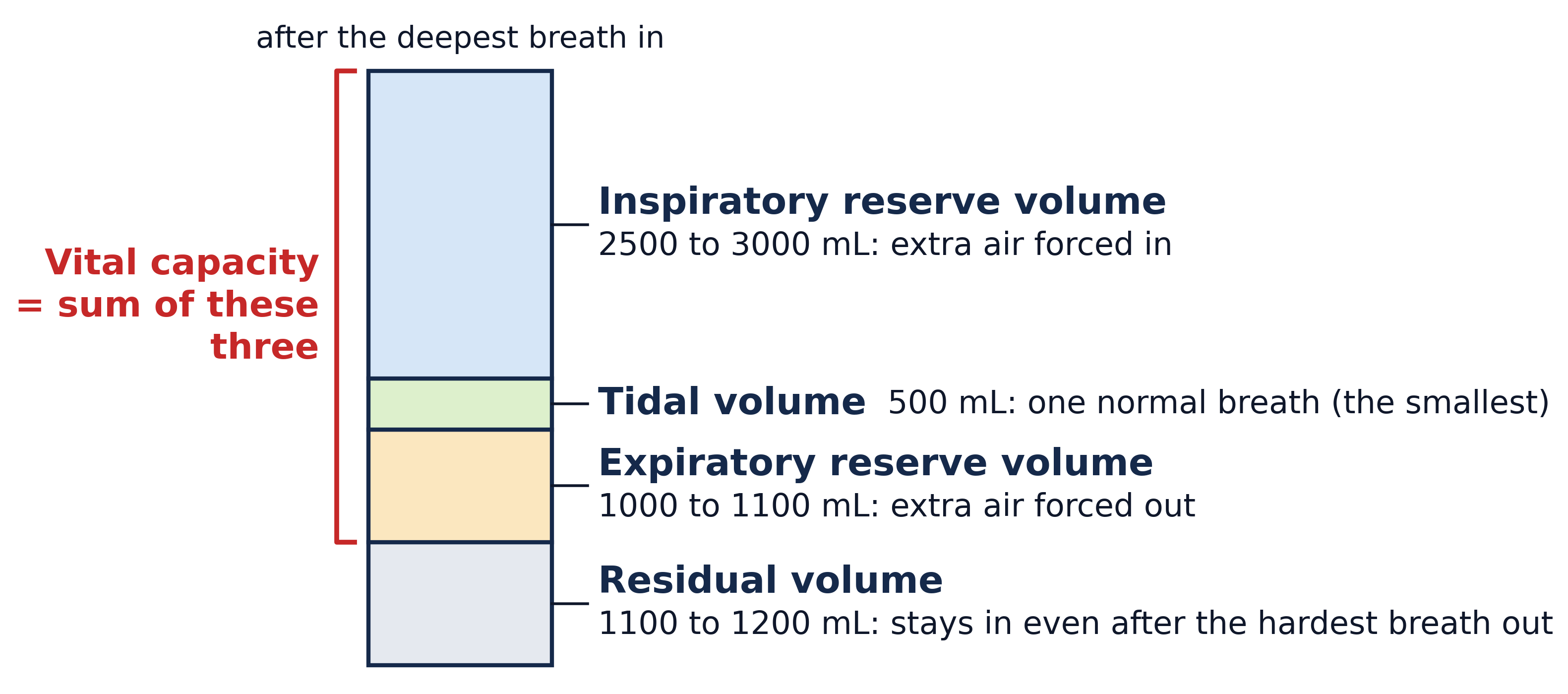
Lung volumes (NCERT Class 11 figures; asked in NDA II 2025 and NDA I 2026):
| Volume | What it is | About |
|---|---|---|
| Tidal volume | Air breathed in or out in one normal breath | 500 mL |
| Inspiratory reserve volume | Extra air that can be breathed in by force | 2500 to 3000 mL |
| Expiratory reserve volume | Extra air that can be breathed out by force | 1000 to 1100 mL |
| Residual volume | Air that stays in the lungs even after the hardest breathing out | 1100 to 1200 mL |
| Vital capacity | The most air a person can breathe out after the deepest breath in. It is the sum of the first three |
The tidal volume is the smallest of the four.
Respiration in the cell. Glucose is first broken into pyruvate in the cytoplasm. What happens next depends on oxygen.
| Where | Oxygen | Pyruvate becomes | Energy |
|---|---|---|---|
| Mitochondria of our cells | Present (aerobic) | Carbon dioxide and water | Much |
| Our muscle cells during hard exercise | Short (anaerobic) | Lactic acid, which causes cramps | Little |
| Yeast | Absent (anaerobic) | Ethanol and carbon dioxide | Little |
A recruit who gets cramps on a long run is feeling lactic acid collect in the leg muscles.
3. The heart and the blood vessels
The heart is a muscular pump about the size of a fist, with four chambers: two upper atria (auricles) that receive blood, and two lower ventricles that pump it out. The right side holds blood poor in oxygen; the left side holds blood rich in oxygen. A wall between them stops mixing.
The route of the blood:
- Body, through the venae cavae, to the right atrium.
- Right atrium, through the tricuspid valve, to the right ventricle.
- Right ventricle, through a semilunar valve, into the pulmonary artery, to the lungs.
- Lungs, through the pulmonary veins, to the left atrium.
- Left atrium, through the bicuspid (mitral) valve, to the left ventricle.
- Left ventricle, through a semilunar valve, into the aorta, to the whole body.
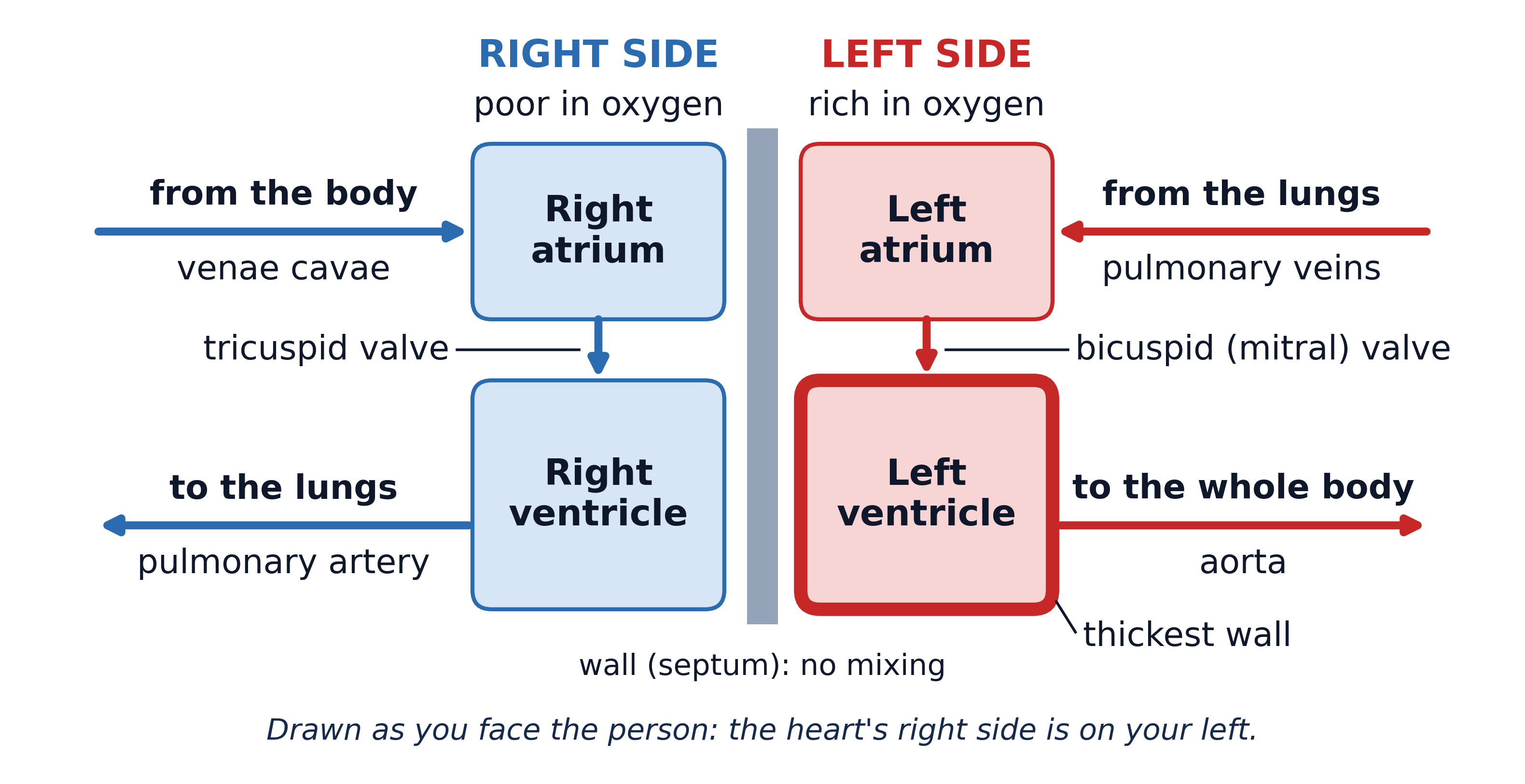
The blood passes through the heart twice in one full round. This is double circulation. The left ventricle has the thickest wall, because it pumps to the whole body. The valves let blood move one way only.
| Arteries | Veins | |
|---|---|---|
| Direction | Away from the heart | Towards the heart |
| Wall | Thick and elastic | Thin |
| Valves | None | Present |
| Blood | Rich in oxygen, except the pulmonary artery | Poor in oxygen, except the pulmonary veins |
Capillaries are the finest vessels, with walls one cell thick. Exchange between blood and tissues takes place through them.
Numbers and names: the heart of a resting adult beats about 72 times a minute. Normal blood pressure is about 120/80 mm of mercury, measured with a sphygmomanometer. The beat starts from the sino-atrial node, the natural pacemaker. An electrocardiogram (ECG) is a graph of the electrical activity of the heart.
4. Blood and blood groups
Blood is a liquid connective tissue: a pale yellow liquid, the plasma, with cells floating in it.
| Part | Other name | Job | Note |
|---|---|---|---|
| Red blood cells | Erythrocytes | Carry oxygen, with the red iron-containing protein haemoglobin | No nucleus when mature; made in red bone marrow; live about 120 days |
| White blood cells | Leucocytes | Defend the body | Lymphocytes make antibodies; some other kinds swallow germs |
| Platelets | Thrombocytes | Help the blood to clot | |
| Plasma | Carries food, wastes, hormones, carbon dioxide | Mostly water, with proteins |
Clotting. At a wound, platelets start a chain of reactions. The dissolved plasma protein fibrinogen changes into threads of fibrin. The threads trap blood cells and form the clot. Calcium and vitamin K are needed.
ABO blood groups were discovered by Karl Landsteiner. Red cells may carry antigen A, antigen B, both or neither. The plasma carries the antibody against the antigen that is absent.
| Group | Antigen on red cells | Antibody in plasma | Can give blood to | Can receive from |
|---|---|---|---|---|
| A | A | anti-B | A, AB | A, O |
| B | B | anti-A | B, AB | B, O |
| AB | A and B | none | AB | A, B, AB, O |
| O | none | anti-A and anti-B | A, B, AB, O | O |
So O is the universal donor and AB is the universal recipient. Blood is also Rh positive or Rh negative, and both the ABO group and the Rh group are matched before a transfusion.
5. The excretory system
The body's main nitrogen waste is urea. It is made in the liver and removed from the blood by the kidneys.
- The parts: two kidneys, two ureters, the urinary bladder, the urethra.
- The working unit of the kidney is the nephron. Each kidney has about a million.
- Filtration: a knot of capillaries, the glomerulus, sits in a cup, the Bowman's capsule. Blood is filtered here under pressure.
- Reabsorption: as the filtrate flows along the tubule, glucose, amino acids, salts and most of the water are taken back into the blood. What is left is urine.
- When both kidneys fail, the blood is cleaned by a machine. This is dialysis.
The lungs remove carbon dioxide and the skin removes some water and salts as sweat.
6. The nervous system
The neuron (nerve cell) is its unit: a cell body, short dendrites that receive, and one long axon that sends. The gap between two neurons is a synapse. The brain and the spinal cord form the central nervous system.
| Part of the brain | Includes | Controls |
|---|---|---|
| Forebrain | Cerebrum, the largest part | Thinking, memory, speech, sight, hearing, voluntary movement |
| Hypothalamus | Hunger, thirst, body temperature | |
| Midbrain | Some reflexes of the eye and ear | |
| Hindbrain | Cerebellum | Balance, posture, smooth and exact movement |
| Medulla, and the pons | Involuntary actions: heartbeat, breathing, blood pressure, salivation, vomiting |
A reflex action is a fast, automatic response, such as pulling the hand back from a hot plate. Its path, the reflex arc, runs through the spinal cord, so it does not wait for the brain to think.
7. The endocrine glands
Endocrine glands have no ducts. They pour chemical messengers, the hormones, straight into the blood.
| Gland | Hormone | Job | If it goes wrong |
|---|---|---|---|
| Pituitary, the "master gland", below the brain | Growth hormone, and hormones that control other glands | Growth of the body | Too little in childhood: dwarfism. Too much: gigantism |
| Thyroid, in the neck | Thyroxine, which needs iodine | Controls the rate of metabolism | Lack of iodine: goitre (swollen neck). Hence iodised salt |
| Pancreas | Insulin | Lowers the sugar level of the blood | Too little: diabetes |
| Adrenal, on top of each kidney | Adrenaline | Prepares the body for an emergency: faster heart, faster breathing | |
| Testes | Testosterone | Male features at puberty | |
| Ovaries | Oestrogen | Female features at puberty |
The pancreas is a double gland: it sends digestive juice through a duct and insulin into the blood.
8. Bones, joints and skin
| Fact | Answer |
|---|---|
| Bones in an adult | 206 |
| Longest and strongest bone | Femur (thigh bone) |
| Smallest bone | Stapes, in the middle ear |
| Ribs | 12 pairs |
| Bones of the backbone | 33 vertebrae in a child; some join later, giving 26 bones in an adult |
| Ball and socket joint | Shoulder, hip |
| Hinge joint | Elbow, knee |
| Pivot joint | Between the skull and the top of the backbone |
| Fixed joint | Bones of the skull |
Bones are joined to each other by ligaments and to muscles by tendons. The skin is the largest organ. Its dark pigment, melanin, protects the body from the ultraviolet rays of the sun.
What the papers have asked
| Paper | The idea asked | The answer in one line |
|---|---|---|
| NDA I 2026 | Valve between the right ventricle and the pulmonary artery | Semilunar valve |
| NDA I 2026 | The smallest lung volume | Tidal volume |
| NDA I 2026 | Where gases are not exchanged | In the bronchi; exchange is only in the alveoli |
| NDA II 2025 | Air moved in one normal breath | Tidal volume |
| NDA II 2025 | Wrong statement on arteries and veins | Pulmonary arteries carry blood poor in oxygen, pulmonary veins carry blood rich in oxygen |
| NDA II 2025 | Working pH of pepsin and trypsin | About 2 for pepsin, about 8 for trypsin |
| NDA II 2025 | Work of the hindbrain | Involuntary actions such as blood pressure, salivation and vomiting |
| NDA II 2025, NDA II 2019 | Thyroxine | Needs iodine; controls the metabolic rate |
| NDA II 2025, NDA I 2024 | Cells that make antibodies | Lymphocytes |
| NDA I 2025 | Clotting protein of the blood | Fibrinogen |
| NDA I 2025 | Source of lactic acid in muscle | Pyruvate |
| NDA II 2024 | Part of the nephron that filters blood | Bowman's capsule (with the glomerulus) |
| NDA I 2024 | Role of the pancreas in digestion | Secretes lipase, amylase and a protein-digesting enzyme |
| NDA I 2019 | What an ECG shows | The electrical activity of the heart |
| NDA II 2017 | What melanin protects against | Ultraviolet radiation |
Worked examples
Example 1. Which juice contains no enzyme and yet helps in the digestion of fats?
(a) Saliva (b) Gastric juice (c) Bile (d) Pancreatic juice
Solution. Bile, made by the liver, has no enzyme. It breaks fat into tiny drops so that lipase can act on a larger surface. Pancreatic juice is the tempting option because it does digest fat, but it does so with an enzyme, lipase. Answer (c).
Example 2. Consider the following statements:
- All arteries carry blood rich in oxygen.
- Veins have valves.
- The left ventricle pumps blood into the aorta.
Which of the statements given above are correct?
(a) 1 and 2 only (b) 2 and 3 only (c) 1 and 3 only (d) 1, 2 and 3
Solution. Statement 1 is wrong because of the word "all": the pulmonary artery carries blood poor in oxygen to the lungs. Statements 2 and 3 are correct. Answer (b).
Example 3. A patient of blood group B needs blood. In the ABO system, from which groups can he receive it?
(a) B only (b) B and AB (c) B and O (d) A, B, AB and O
Solution. His plasma has anti-A, so he cannot take any blood with antigen A: that rules out A and AB. He can take B (same group) and O (no antigen). Option (b) names the groups he can give to, not receive from. Answer (c).
Example 4. Match the lists.
List I: A. Cerebellum, B. Medulla, C. Cerebrum, D. Hypothalamus
List II: 1. Thinking and memory, 2. Hunger and thirst, 3. Balance of the body, 4. Heartbeat and breathing
(a) A-3, B-4, C-1, D-2 (b) A-4, B-3, C-1, D-2 (c) A-3, B-4, C-2, D-1 (d) A-1, B-2, C-3, D-4
Solution. The cerebellum keeps balance (A-3), the medulla runs the involuntary actions (B-4), the cerebrum thinks (C-1) and the hypothalamus controls hunger and thirst (D-2). Option (b) swaps the cerebellum and the medulla, the usual confusion. Answer (a).
Example 5. A person has a tidal volume of 500 mL, an inspiratory reserve volume of 2800 mL and an expiratory reserve volume of 1100 mL. What is the vital capacity?
(a) 3300 mL (b) 3900 mL (c) 4400 mL (d) 5500 mL
Solution. Vital capacity is the sum of the three: 500 + 2800 + 1100 = 4400 mL. The residual volume is not part of it, because that air can never be breathed out. Answer (c).
Mistakes that cost marks
- "Arteries carry pure blood." Define them by direction, not by oxygen: arteries carry blood away from the heart. The pulmonary artery and pulmonary veins are the exceptions on oxygen.
- Mixing the valves. Tricuspid is on the right (remember "tri" and "right" both have an r and an i). Bicuspid, also called mitral, is on the left. The semilunar valves are at the exits, where the pulmonary artery and the aorta begin.
- Saying bile is made in the gall bladder. It is made in the liver and only stored in the gall bladder.
- Cerebrum and cerebellum. The cerebrum thinks. The cerebellum balances.
Quick check
- Which enzyme begins the digestion of proteins in the stomach?
- Name the vessels that bring blood from the lungs to the heart.
- Which blood group is called the universal recipient?
- In which organ is urea made?
- Which gland makes adrenaline?
Read and watch more, free
| What | Where | Language |
|---|---|---|
| Textbook, the base | NCERT Class 10 Science: chapter 5 "Life Processes" and chapter 6 "Control and Coordination" | English; a Hindi edition is on the NCERT site |
| Textbook, a simpler start | NCERT Class 7 Curiosity: chapter 9 "Life Processes in Animals" | English; Hindi edition on the NCERT site |
| Textbook, for the harder questions | NCERT Class 11 Biology: chapters 14 (breathing, lung volumes), 15 (blood, heart, blood groups), 16, 17, 18 and 19 | English; Hindi edition on the NCERT site |
| Self-study notes | NIOS Science and Technology (212), lessons 22 and 23 | English, Hindi |
| Video, in English | Khan Academy India: Life processes, Class 10 | English |
| Video, small steps | Magnet Brains: Class 10 Biology | Hinglish |
| Video, NDA classes | Rojgar with Ankit Defence: NDA Biology Classes (has a class on blood groups) | Hindi |
The videos were chosen from their titles, length and views; they have not yet been watched by a teacher.
Answers to the quick check
- Pepsin.
- The pulmonary veins.
- AB.
- The liver.
- The adrenal gland.
Next chapter: Common diseases and epidemics: causes and prevention.