Why this chapter matters. We found about 36 questions on this chapter in the 12 papers we hold, from 2017 to 2026. That is about three in every paper, the largest share of the General Science section. Almost all are single-fact questions: which organelle does this job, which tissue is made of dead cells, which tissue joins bone to bone. A few are "consider the following statements" questions on what all cells have in common. Learn the organelle table in section 4 first, then the two tissue tables.
What you will be able to do
- Say what makes a thing living, and explain why a virus sits on the border.
- Name each part of a cell and its one main job, and tell a prokaryotic cell from a eukaryotic cell, and a plant cell from an animal cell.
- Name the plant tissues and the animal tissues, say which are living and which are dead, and give one place where each is found.
- Answer the "which statement is correct" questions on cells without being trapped by the word "all".
Before you start you need only Class 8 science: that living things are made of cells, and that a microscope is needed to see them.
1. Living and non-living
A stone and a seed may look alike, but the seed is alive. Living things show these features together:
| Feature | What it means | Example |
|---|---|---|
| Made of cells | One cell or many | A bacterium has one cell; a soldier has many million million |
| Nutrition | Takes in food or makes it | A plant makes food in its leaves |
| Respiration | Releases energy from food | Every living cell does this, day and night |
| Growth | Grows from inside, by making new cell material | A sapling becomes a tree |
| Response | Reacts to changes around it | A shoot bends towards light |
| Excretion | Removes its own wastes | Kidneys remove urea |
| Reproduction | Makes more of its own kind | Seeds, eggs, young ones |
Two points the papers like.
- Movement from place to place (locomotion) is not needed for life. A mango tree is alive but stays where it is. Plants show movement of parts only: a shoot grows up, a root grows down.
- A crystal also "grows", but only by adding material on the outside. A living thing grows from within.
Viruses are on the border between living and non-living. Outside a living cell a virus is inactive, like a chemical, and can even be made into crystals. It has no cell, no cytoplasm and no ribosomes. Inside a host cell it uses the cell's machinery to make copies of itself. So a virus can multiply only inside a living cell. Every virus is a parasite.
2. The cell and who discovered what
The cell is the smallest unit of life that can live on its own. It is the unit of structure and of function in every living thing.
| Year | Scientist | What he did |
|---|---|---|
| 1665 | Robert Hooke | Saw box-like spaces in a thin slice of cork and named them "cells" |
| 1674 | Antonie van Leeuwenhoek | First saw free-living cells, in pond water |
| 1831 | Robert Brown | Discovered the nucleus |
| 1838 to 1839 | Schleiden and Schwann | Cell theory: all plants and animals are made of cells |
| 1839 | Purkinje | Gave the name "protoplasm" to the living substance of the cell |
| 1855 | Rudolf Virchow | Added that every cell comes from an earlier cell |
Protoplasm is the word in the syllabus. It means all the living material of a cell: the cytoplasm and the nucleus together. Cytoplasm is the jelly-like part between the cell membrane and the nucleus, in which the organelles lie.
3. Two kinds of cell: prokaryotic and eukaryotic
| Prokaryotic cell | Eukaryotic cell | |
|---|---|---|
| Examples | Bacteria, blue-green algae | Plants, animals, fungi, Amoeba |
| Nucleus | No nuclear membrane. The DNA lies in a region called the nucleoid | True nucleus with a nuclear membrane |
| Chromosome | One, circular, not wound on histone proteins ("naked" DNA) | More than one, wound on histone proteins |
| Membrane-bound organelles (mitochondria, plastids, ER, Golgi) | Absent | Present |
| Ribosomes | Present (smaller) | Present |
| Size | Very small | Larger |
Ribosomes, a cell membrane, cytoplasm and DNA are found in every cell. A cell wall, a true nucleus and mitochondria are not. NDA I 2026 built a whole question on this.
4. The parts of a eukaryotic cell
| Part | What it is | Main job |
|---|---|---|
| Cell membrane (plasma membrane) | Thin, living, made of lipids and proteins | Lets some substances pass and not others: it is selectively permeable |
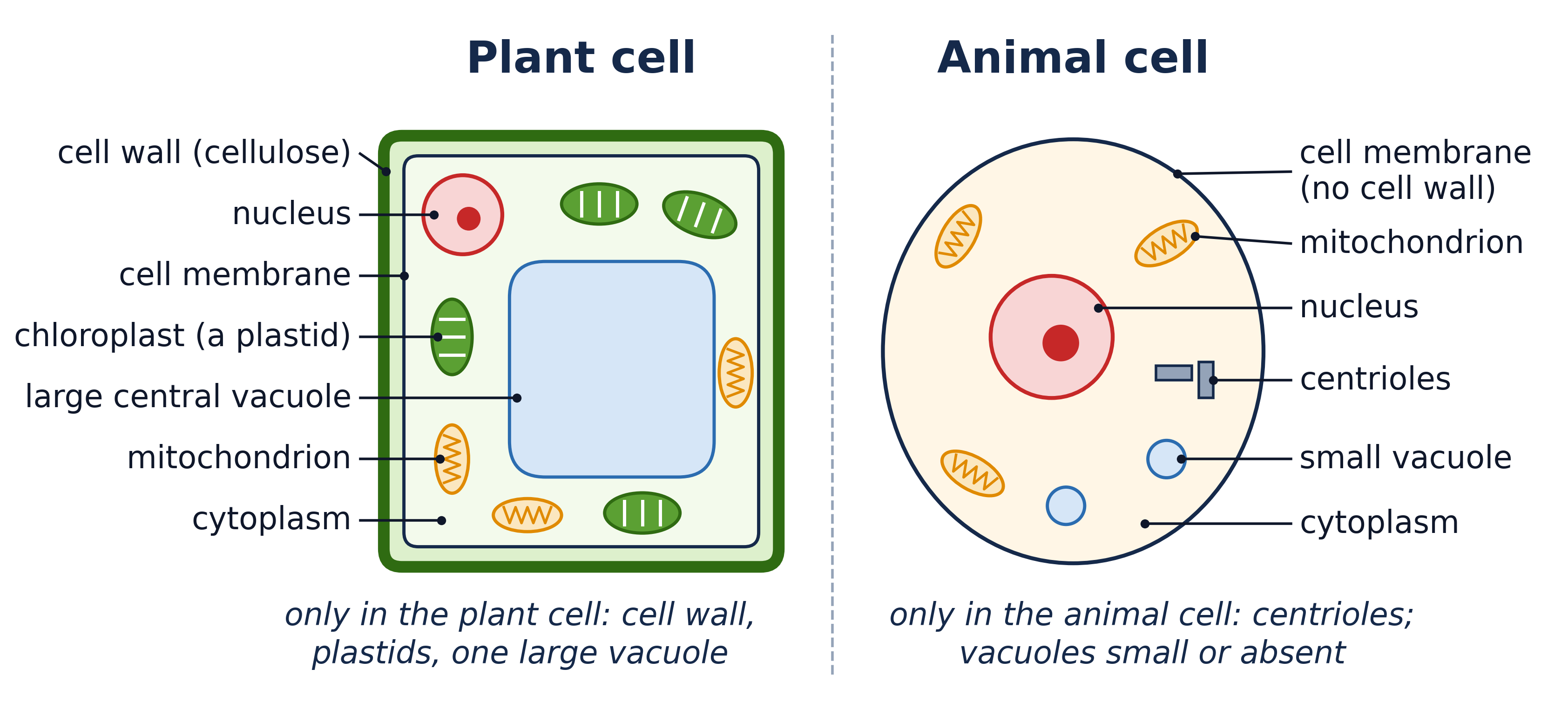
| Cell wall | Outside the membrane in plants; made mainly of cellulose; non-living | Shape and strength. Animal cells have none |
| Nucleus | Double membrane with pores; holds the chromosomes (DNA and protein) | Controls the cell; carries heredity. The nucleolus inside it makes ribosomes |
| Endoplasmic reticulum (ER) | A network of membrane tubes and sheets | Channels for moving materials inside the cell. Rough ER has ribosomes on it and makes proteins; smooth ER makes lipids |
| Ribosomes | Tiny grains of RNA and protein, with no membrane | Make proteins |
| Golgi apparatus | Stacks of flat sacs | Packs and sends out materials made in the ER; forms lysosomes |
| Lysosomes | Small bags of digestive (hydrolytic) enzymes | Digest worn-out parts and foreign material. Called "suicide bags" because they can digest their own cell |
| Mitochondria | Double membrane; the inner one is folded | Release energy from food and store it as ATP. Called the powerhouse. The ATP is made on the inner membrane |
| Plastids | Only in plant cells; double membrane | Chloroplasts (green, photosynthesis), chromoplasts (coloured), leucoplasts (colourless, store starch, oil, protein) |
| Vacuoles | Sacs of fluid | Storage. One large central vacuole in a mature plant cell; small or absent in animal cells. In Amoeba a vacuole throws out extra water |
| Centrioles | In animal cells | Help in cell division |
Three facts to hold together, because the papers have asked them five times in different words:
- Mitochondria and plastids have their own DNA and their own ribosomes. So they can make some of their own proteins.
- Ribosomes have no DNA of their own, though they contain RNA.
- ATP (adenosine triphosphate) is the energy currency of the cell.
Diffusion and osmosis. Diffusion is the movement of a substance from where it is more to where it is less. Osmosis is the movement of water through a selectively permeable membrane, from a dilute solution to a strong one. Put a raisin in water and it swells: water enters. Put a plant cell in strong salt water and it loses water; the contents shrink away from the cell wall. This is called plasmolysis.
Plant cell and animal cell
| Plant cell | Animal cell | |
|---|---|---|
| Cell wall | Present | Absent |
| Plastids | Present | Absent |
| Vacuole | One large central vacuole | Small or none |
| Centrioles | Absent in higher plants | Present |
5. Plant tissues
A tissue is a group of similar cells doing one job. The order of size is: cell, tissue, organ, organ system, organism.
Meristematic tissue is made of cells that keep dividing. The cells are small, with thin walls, dense cytoplasm and no large vacuole.
| Meristem | Where | What it does |
|---|---|---|
| Apical | Tips of the stem and root | Increases length |
| Intercalary | Base of leaves and of the nodes (grasses) | Regrowth of length, as in a cut lawn |
| Lateral (the cambium) | Along the sides of stem and root | Increases girth (thickness) |
When these cells stop dividing and take up a fixed shape and job, they form permanent tissue. This change is called differentiation.
| Permanent tissue | Living or dead | Feature | Job |
|---|---|---|---|
| Parenchyma | Living | Thin walls, spaces between cells | Storage and packing. With chlorophyll it is chlorenchyma; with air spaces it is aerenchyma (floating plants) |
| Collenchyma | Living | Walls thick at the corners | Bending without breaking: leaf stalks, young stems |
| Sclerenchyma | Dead | Thick walls with lignin, no living contents | Hardness and strength: coconut husk, shell of nuts |
| Xylem | Mostly dead | Tracheids, vessels, xylem fibres, xylem parenchyma. Only the xylem parenchyma is living | Carries water and minerals upward |
| Phloem | Mostly living | Sieve tubes, companion cells, phloem parenchyma, phloem fibres. Only the phloem fibres are dead | Carries food from the leaves, up and down |
Xylem and phloem are called complex tissues, because each has more than one kind of cell. Together they are the conducting (vascular) tissue. The outer layer of a plant is the epidermis. Small pores in it, the stomata, are each guarded by two guard cells.
6. Animal tissues
| Tissue | Kinds | Where found, and the job |
|---|---|---|
| Epithelial (covering) | Squamous (thin, flat) | Lining of the mouth, food pipe (oesophagus), blood vessels and air sacs of the lungs |
| Stratified squamous (many layers) | Skin | |
| Cuboidal | Kidney tubules, ducts of salivary glands | |
| Columnar | Lining of the intestine: absorption and secretion. Ciliated columnar lines the windpipe | |
| Connective (joining and supporting) | Blood | Plasma with red cells, white cells and platelets: transport |
| Bone | Hard, with calcium and phosphorus compounds: the frame of the body | |
| Cartilage | Firm but flexible: nose, ear, windpipe, voice box, ends of bones | |
| Ligament | Joins bone to bone; elastic | |
| Tendon | Joins muscle to bone; strong, made of the protein collagen | |
| Areolar and adipose | Fills space under the skin; adipose stores fat | |
| Muscular | Striated (skeletal) | Voluntary; long, unbranched, many nuclei; limbs |
| Smooth (unstriated) | Involuntary; spindle-shaped, one nucleus; food pipe, blood vessels | |
| Cardiac | Involuntary; striated and branched; only in the heart; never tires | |
| Nervous | Neurons | Cell body, dendrites and one long axon: carry messages |
Blood is a connective tissue, even though it is a liquid, because it connects all parts of the body.
What the papers have asked
| Paper | The idea asked | The answer in one line |
|---|---|---|
| NDA I 2026 | What every cell has | Ribosomes. Not every cell has a wall, a true nucleus or linear DNA |
| NDA I 2026, NDA 2020 | The plant tissue of dead cells | Sclerenchyma |
| NDA II 2025, NDA II 2024, NDA I 2019 | Organelles with their own DNA | Mitochondria and plastids (chloroplasts). Ribosomes have none |
| NDA I 2025, NDA II 2021 | Cambium and growth in girth | Cambium is a lateral meristem |
| NDA II 2024 | Tissue joining two bones | Ligament |
| NDA II 2024 | Energy currency of the cell | ATP |
| NDA I 2024 | Why bacterial DNA is "naked" | It is not wound on proteins |
| NDA I 2024 | Order of levels | Molecule, tissue, organ, organism in that order |
| NDA II 2023 | Found only in eukaryotic cells | Mitochondria |
| NDA I 2021 | Where ATP is made in the mitochondrion | On the inner membrane |
| NDA I 2021 | What moves materials inside the cell | Endoplasmic reticulum |
| NDA 2020 | Nuclear region of a prokaryote | Nucleoid |
| NDA 2020 | Organelle that expels extra water in one-celled organisms | Vacuole |
| NDA II 2019 | What kind of tissue blood is | Connective tissue |
| NDA I 2019 | Organelle rich in digestive enzymes | Lysosome |
Worked examples
Example 1. Which one of the following is present in a bacterial cell?
(a) Mitochondrion (b) Nuclear membrane (c) Ribosome (d) Golgi apparatus
Solution. A bacterium is a prokaryote. It has no membrane-bound organelles, so (a), (b) and (d) are out. It must still make proteins, so it has ribosomes. The tempting wrong option is the mitochondrion, because "every cell needs energy"; a bacterium releases energy without one. Answer (c).
Example 2. Consider the following statements:
- Xylem vessels are living cells.
- Sieve tubes belong to the phloem.
- Collenchyma gives flexibility to a leaf stalk.
Which of the statements given above are correct?
(a) 1 and 2 only (b) 2 and 3 only (c) 1 and 3 only (d) 1, 2 and 3
Solution. Statement 1 is wrong: vessels are dead, hollow tubes, and in xylem only the parenchyma is living. Statements 2 and 3 are correct. A student who remembers "xylem carries water, so it must be alive" picks (d). Answer (b).
Example 3. Match the lists.
List I: A. Lysosome, B. Ribosome, C. Leucoplast, D. Golgi apparatus
List II: 1. Storage of starch, 2. Packing of materials, 3. Digestion inside the cell, 4. Making of proteins
(a) A-3, B-4, C-1, D-2 (b) A-4, B-3, C-1, D-2 (c) A-3, B-4, C-2, D-1 (d) A-2, B-1, C-4, D-3
Solution. Lysosomes digest (A-3). Ribosomes make proteins (B-4). Leucoplasts are the colourless plastids that store starch (C-1). The Golgi apparatus packs (D-2). Option (c) swaps the last two. Answer (a).
Example 4. A fresh piece of potato is kept in a strong sugar solution for an hour. It becomes soft and smaller. Why?
(a) Sugar entered the cells (b) Water left the cells by osmosis (c) The cell walls dissolved (d) The cells divided
Solution. The solution outside is stronger than the cell sap. Water moves through the cell membrane from the dilute side (inside) to the strong side (outside). The cells lose water and the piece shrinks. Sugar does not pass freely through the membrane, so (a) is wrong. Answer (b).
Example 5. Which muscle is striated but not under the control of the will?
(a) Muscle of the arm (b) Muscle of the food pipe (c) Muscle of the heart (d) Muscle of the iris
Solution. Arm muscle is striated and voluntary. Food pipe and iris muscles are smooth and involuntary. Heart (cardiac) muscle alone is both striated and involuntary. Answer (c).
Mistakes that cost marks
- Reading "all cells" too quickly. Not all cells have a cell wall (animal cells do not) or a true nucleus (bacteria do not). All cells do have a membrane, cytoplasm, ribosomes and DNA.
- Mixing tendon and ligament. Tendon: muscle to bone. Ligament: bone to bone. Remember "L for link between bones".
- Calling xylem living or phloem dead. Xylem is mostly dead (only its parenchyma lives). Phloem is mostly living (only its fibres are dead).
- Saying ribosomes have their own genetic material. They contain RNA, but the organelles with their own DNA are only mitochondria and plastids (and, of course, the nucleus).
Quick check
- Who discovered the nucleus of the cell?
- Name the region where the DNA of a bacterium lies.
- Which meristem makes a tree trunk thicker each year?
- Name the living part of xylem.
- Which tissue lines the air sacs of the lungs?
Read and watch more, free
| What | Where | Language |
|---|---|---|
| Textbook, the base | NCERT Class 9 Exploration: chapter 2 "Cell: The Building Block of Life" and chapter 3 "Tissues in Action" | English; a Hindi edition is on the NCERT site |
| Textbook, living and non-living | NCERT Class 6 Curiosity: chapter 10 "Living Creatures: Exploring their Characteristics" | English; Hindi edition on the NCERT site |
| Textbook, for the harder questions | NCERT Class 11 Biology: chapters 6, 7 and 8 | English; Hindi edition on the NCERT site |
| Older textbook that matches most videos | Old NCERT Class 9 "The Fundamental Unit of Life" and "Tissues", kept by the Internet Archive | English |
| Self-study notes | NIOS Science and Technology (212), lesson 21; NIOS Biology (314), lessons 4 and 5 | English, Hindi |
| Video, NDA biology in syllabus order | Learn with Sumit: NDA Biology Preparation (four classes on the cell, three on tissues) | Hindi and Hinglish |
| Video, long classes | Defence Wallah: NDA Biology (cell and tissues) | Hinglish |
| Video, small steps | Magnet Brains: Class 9 Biology (follows the older book) | Hinglish |
The videos were chosen from their titles, length and views; they have not yet been watched by a teacher.
Answers to the quick check
- Robert Brown, in 1831.
- The nucleoid.
- The lateral meristem (cambium).
- Xylem parenchyma.
- Squamous epithelium.
Next chapter: Growth and reproduction in plants and animals.