Why this chapter matters. We found about 16 questions on this chapter in the 12 papers we hold, from 2017 to 2026. Five of them were in one paper, NDA I 2024. Most are "consider the following statements" on tropical cyclones, temperate cyclones, clouds and humidity, and each statement is a line from the NCERT Class 11 book with one word changed. Learn first the table in section 4 that sets the tropical cyclone beside the temperate cyclone.
What you will be able to do
- Tell a tropical cyclone from a temperate (extra-tropical) cyclone and from an anti-cyclone, and give the direction of the winds in each hemisphere.
- Give the conditions a tropical cyclone needs and its name in each ocean.
- Define absolute humidity, relative humidity and dew point, and name the forms of condensation and of precipitation.
- Classify clouds by height and explain the three kinds of rainfall.
Before you start you should know: pressure belts, the Coriolis force and the planetary winds (Chapter G2-2).
1. Air masses and fronts
An air mass is a very large body of air that has nearly the same temperature and moisture throughout. It forms when air stays for a long time over a uniform surface such as a wide ocean or a wide plain. That surface is its source region. Air masses are named from the source: maritime or continental, tropical or polar. A warm ocean gives a maritime tropical air mass; a cold land gives a continental polar one.
When two different air masses meet, they do not mix easily. The boundary between them is a front. Fronts are found in the middle latitudes. The weather changes sharply as a front passes, and the air forced upwards gives cloud and rain.
| Front | What happens | Weather |
|---|---|---|
| Cold front | Cold air advances and pushes under the warm air | A narrow belt of heavy showers, often with thunderstorms |
| Warm front | Warm air advances and rises over the cold air ahead of it | A wide belt of cloud and steady rain |
| Stationary front | Neither air mass moves | The front stays where it is |
| Occluded front | The cold front catches up with the warm front and lifts the warm air off the ground | The cyclone begins to die |
2. What a cyclone is
A cyclone is a system of winds blowing round a centre of low pressure. An anti-cyclone is a system of winds blowing round a centre of high pressure. The Coriolis force gives each its direction.
| System | Pressure at the centre | Northern Hemisphere | Southern Hemisphere | Weather |
|---|---|---|---|---|
| Cyclone | Low | Anticlockwise, inwards | Clockwise, inwards | Air rises: cloud, rain, strong winds |
| Anti-cyclone | High | Clockwise, outwards | Anticlockwise, outwards | Air sinks: clear sky, light winds, fair weather |
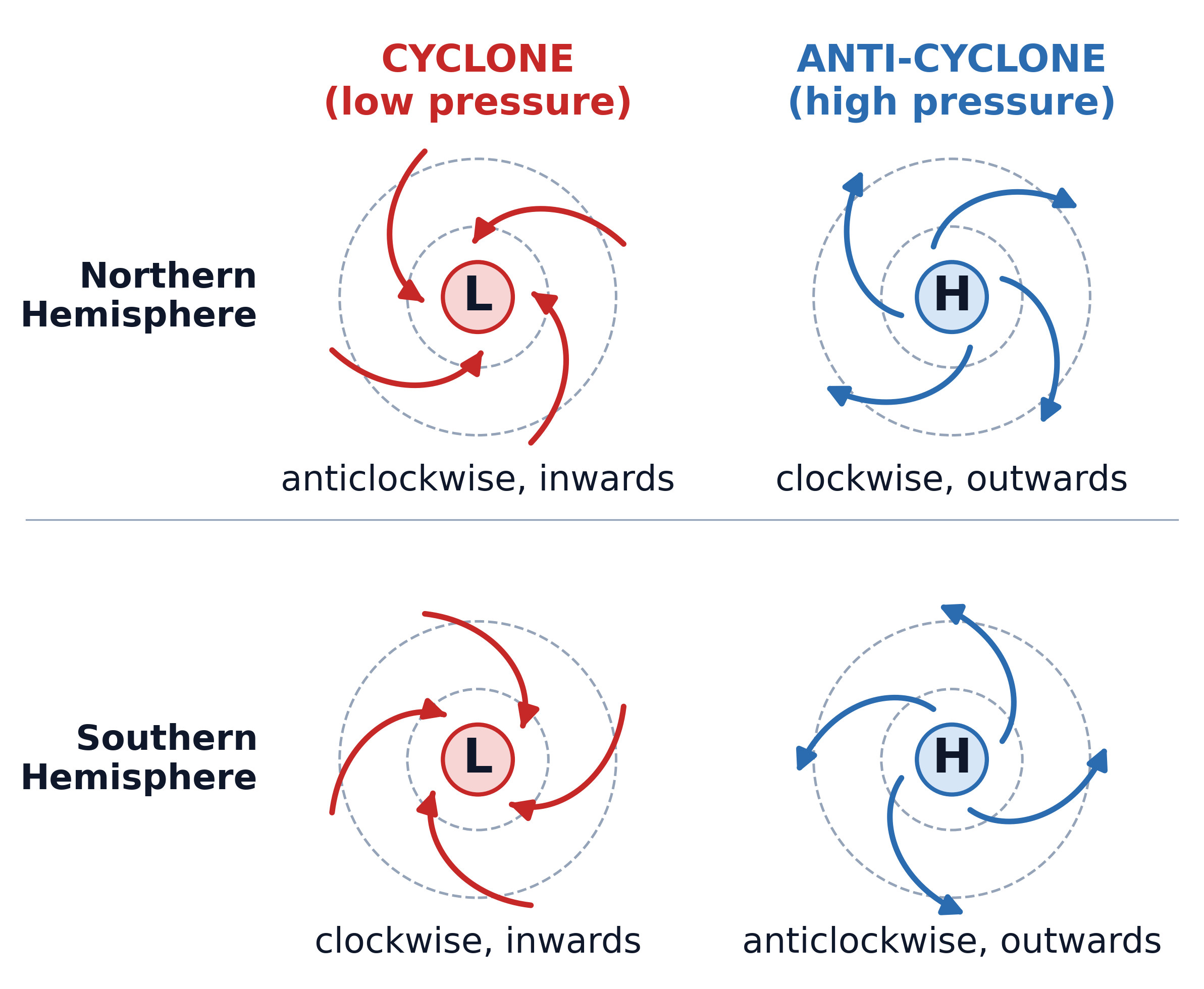
Learn one line and work out the rest: a cyclone in the Northern Hemisphere is anticlockwise. Change the hemisphere and the direction reverses; change cyclone to anti-cyclone and it reverses again.
3. Tropical cyclones
Tropical cyclones are violent storms that form over warm tropical oceans and move towards the coast. They bring very strong winds, very heavy rain and a storm surge, a rise of the sea that floods the coast. The cyclone that strikes Odisha or Andhra Pradesh from the Bay of Bengal is of this kind.
The conditions they need (NCERT gives five):
- a large sea surface with a temperature above 27°C;
- the presence of the Coriolis force (so they do not form at the Equator, where it is zero);
- small differences in wind speed with height;
- a weak low pressure area already present;
- air spreading outwards (divergence) high above the system.
How it works. Warm, moist air rises round the centre. The vapour condenses into towering cumulonimbus clouds and gives out latent heat. This heat is the fuel of the storm, and the sea keeps supplying the moisture. When the cyclone crosses the coast (landfall), the supply of moisture is cut off and the storm weakens and dies.
| Part | What it is like |
|---|---|
| Eye | The centre: calm, with sinking air and little or no rain |
| Eye wall | The ring round the eye: the strongest winds and the heaviest rain |
| Rain bands | Spiral bands of cloud and rain further out |
Names by region. The storm is the same; only the name changes.
| Name | Region |
|---|---|
| Cyclone | Indian Ocean (Bay of Bengal, Arabian Sea) |
| Hurricane | Atlantic Ocean and the Caribbean Sea (USA, West Indies) |
| Typhoon | Western Pacific Ocean and South China Sea (China, Japan) |
| Willy-willy | North-western Australia |
| Baguio | Philippines |
A tornado is a different and much smaller storm: a narrow, violently spinning funnel of air that comes down from a thunder cloud, mostly over land in the middle latitudes. Over the sea it is called a water spout.
4. Temperate cyclones, and the two kinds compared
Temperate cyclones are also called extra-tropical or mid-latitude cyclones. They form in the middle and high latitudes along the polar front, where warm air from the tropics meets cold air from the poles. This explanation is the Polar Front Theory. A wedge of warm air, the warm sector, is caught between a warm front ahead and a cold front behind. The cold front moves faster, overtakes the warm front, and the cyclone ends as an occluded front. The winter rain of north-west India comes from weak storms of this family, the western disturbances.
| Tropical cyclone | Temperate (extra-tropical) cyclone | |
|---|---|---|
| Where it forms | Over warm tropical seas only | In the middle and high latitudes, over land or sea |
| Fronts | None | A clear system of warm and cold fronts |
| Area covered | Smaller | Much larger |
| Wind speed | Much higher; more destructive | Lower |
| Direction of movement | From east to west | From west to east |
| Source of energy | Latent heat from condensation | The contrast between warm and cold air masses |
5. Humidity
Water vapour in the air is called humidity. It gets there by evaporation.
| Term | Meaning | Unit |
|---|---|---|
| Absolute humidity | The actual amount of water vapour in the air: the weight of vapour in a unit volume of air | Grams per cubic metre |
| Relative humidity | The vapour actually present as a percentage of the most the air can hold at that temperature | Per cent |
| Saturated air | Air holding all the vapour it can at that temperature | Relative humidity 100 per cent |
| Dew point | The temperature at which a sample of air becomes saturated | Degrees Celsius |
Warm air can hold more vapour than cold air. So, for the same amount of vapour:
- when the air is heated, its capacity rises and its relative humidity falls;
- when the air is cooled, its capacity falls and its relative humidity rises, until it reaches 100 per cent at the dew point.
For example, air that holds 10 g of vapour in each cubic metre and can hold 20 g at its present temperature has a relative humidity of \tfrac{10}{20} \times 100 = 50 per cent.
Relative humidity is greatest over the oceans and least over the continents. It is measured with a hygrometer. On a humid day sweat does not evaporate easily, and that is why a July afternoon in Mumbai feels more tiring than a hotter May afternoon in Jodhpur.
6. Condensation: dew, frost, fog and cloud
Condensation is the change of water vapour into water. It happens when moist air loses heat and is cooled to its dew point. The vapour needs something to settle on: tiny particles of dust, smoke and salt called hygroscopic condensation nuclei. Condensation is influenced by the volume of the air, its temperature, its pressure and its humidity.
| Form | Where and how |
|---|---|
| Dew | Water drops on cool solid surfaces such as grass and leaves. Needs a clear sky, calm air, high relative humidity and a long cold night. The dew point is above freezing point |
| Frost | Ice crystals in place of dew, when the dew point is at or below freezing point (0°C) |
| Fog | A cloud with its base at or very near the ground. Visibility becomes poor. Fog mixed with smoke is smog |
| Mist | Like fog, but NCERT says mist holds more moisture than fog; it is common over mountains |
| Cloud | A mass of tiny water drops or ice crystals formed by condensation high above the ground |
Note the difference between condensation and precipitation. Dew, frost, fog and cloud form in place. Rain, snow, sleet and hail fall. Sleet is not a form of condensation.
7. Clouds
Clouds are classified by their height and their form. There are four basic types.
| Type | What it looks like |
|---|---|
| Cirrus | High (8,000 to 12,000 m), thin, detached, feathery, always white |
| Cumulus | Like cotton wool, in patches, with a flat base |
| Stratus | Layers or sheets covering large parts of the sky |
| Nimbus | Black or dark grey, thick and shapeless, at middle levels or very near the ground; the rain-bearing cloud |
These combine to give the names used by weather offices.
| Group | Clouds |
|---|---|
| High clouds | Cirrus, cirrostratus, cirrocumulus |
| Middle clouds | Altostratus, altocumulus |
| Low clouds | Stratocumulus, nimbostratus |
| Clouds with great vertical development | Cumulus, cumulonimbus |
The cumulonimbus is the thunder cloud. It gives lightning, thunder, heavy showers and sometimes hail.
8. Precipitation and the three kinds of rainfall
When the drops or crystals in a cloud grow too heavy to stay up, they fall. This is precipitation.
| Form | What it is |
|---|---|
| Rain | Drops of water |
| Snow | Fine ice crystals, formed when the temperature is below 0°C |
| Sleet | Frozen raindrops and refrozen melted snow. It forms when a layer of air above freezing point lies over a layer below freezing point near the ground |
| Hail | Rounded lumps of ice made of several layers, one over the other, falling from thunder clouds |
Rain falls only when air rises and cools. There are three ways in which air is made to rise, and so three kinds of rainfall.
| Kind | How the air rises | Features | Where |
|---|---|---|---|
| Convectional | The ground heats the air and it rises in currents | Cumulus and cumulonimbus clouds; heavy but short showers with thunder and lightning, usually in the afternoon | The equatorial region; the interiors of continents in summer |
| Orographic (relief) | Moist wind meets a mountain and is forced up the slope | Heavy rain on the windward side; the leeward side stays dry and is called the rain shadow | The Western Ghats: heavy rain on the western slopes and coast, little in the rain shadow to the east |
| Cyclonic (frontal) | Warm air rises over cold air along a front, or air rises round a low pressure centre | Steady rain over a wide area along a warm front; showers along a cold front | The middle latitudes; tropical cyclones also bring it |
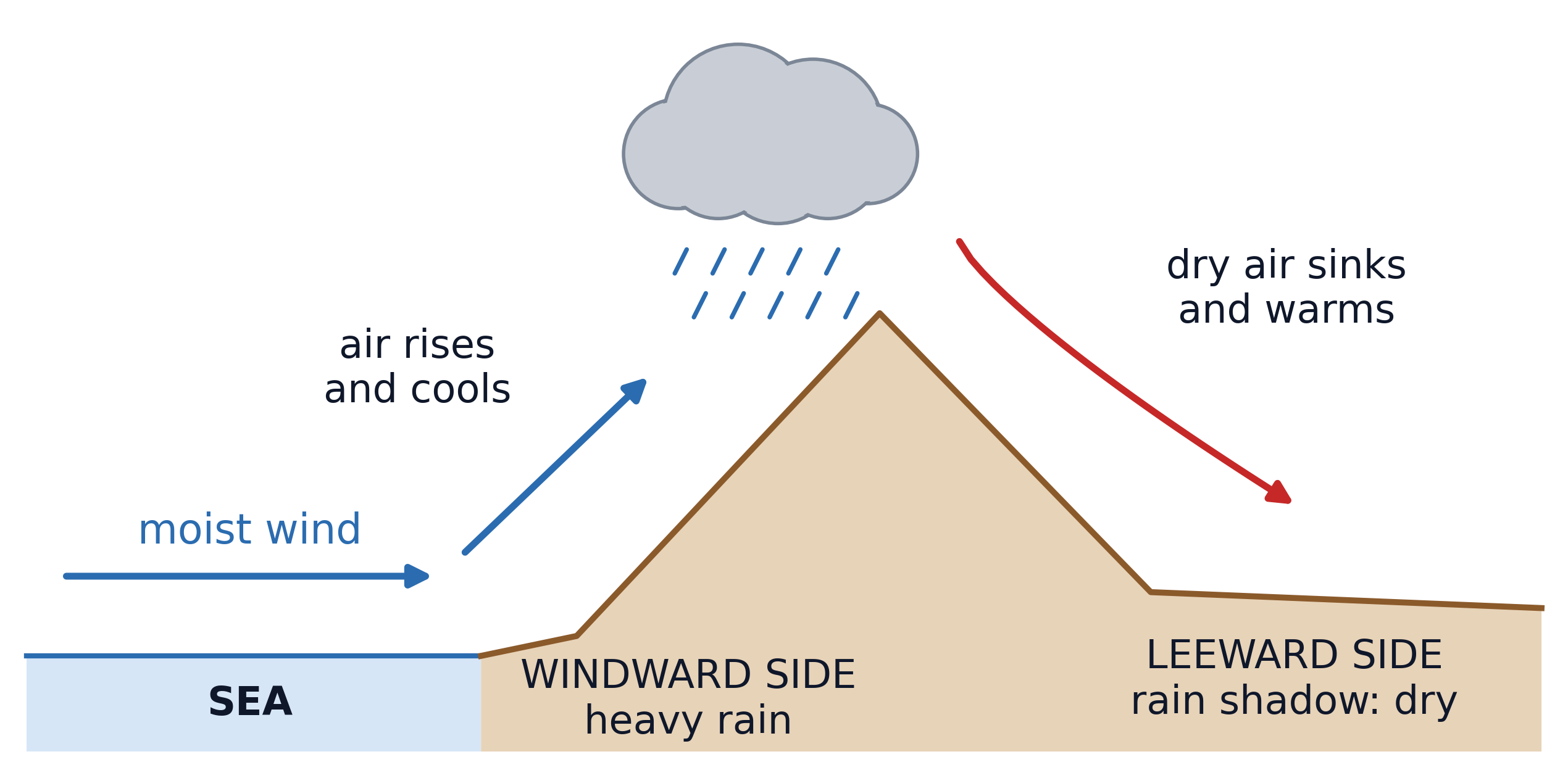
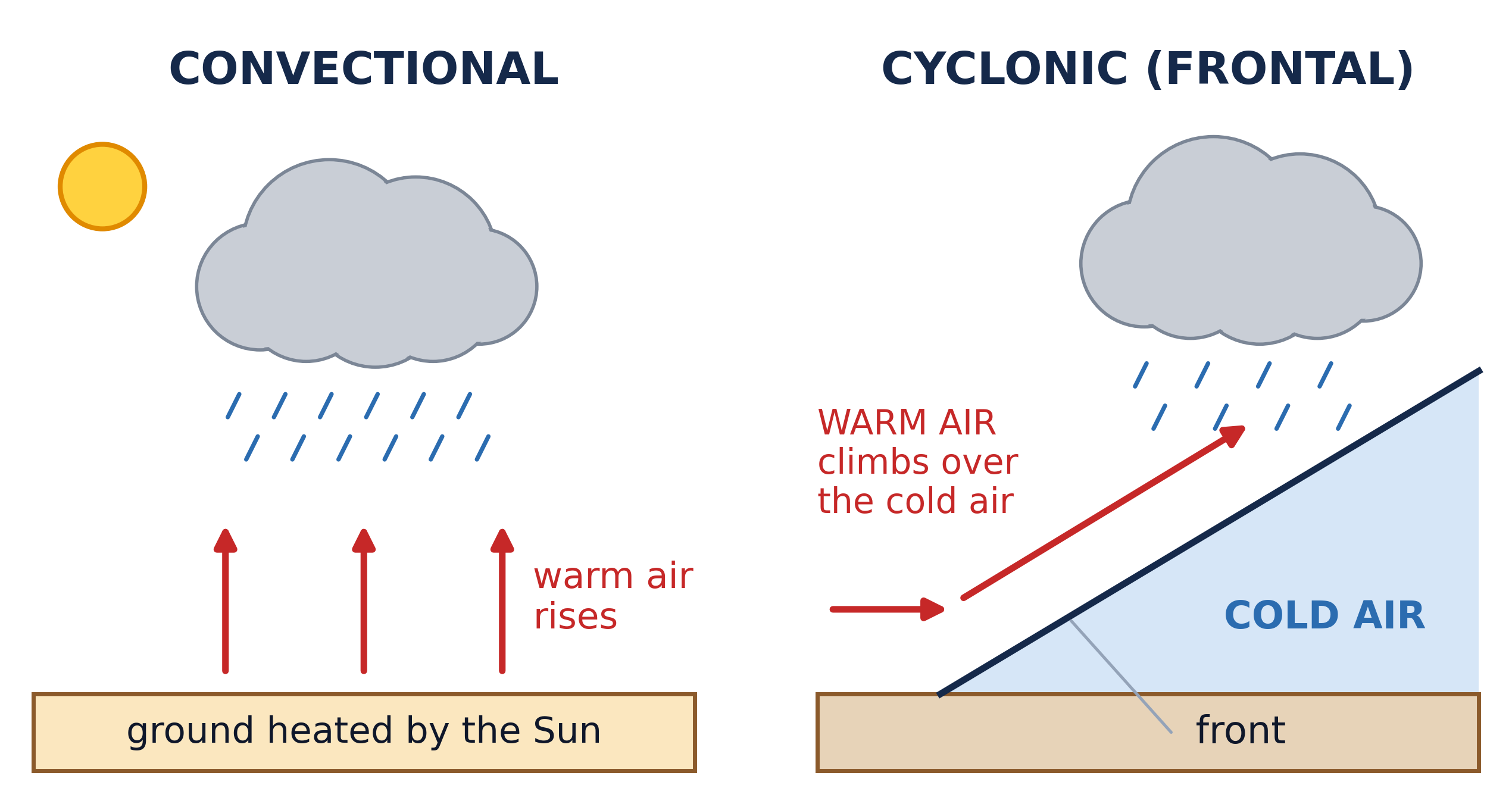
Rainfall is measured with a rain gauge. Taking the world as a whole, rainfall decreases from the Equator towards the poles, and coasts receive more than the interiors of continents.
What the papers have asked
| Paper | The idea asked | The answer in one line |
|---|---|---|
| NDA II 2017 | The stage of a tropical cyclone that needs a warm sea, moist air and unstable air | The stage of formation |
| NDA I 2019 | The system explained by the Polar Front Theory | The temperate cyclone |
| NDA I 2021 | Which of dew, fog, frost and sleet is not condensation | Sleet; it is a form of precipitation |
| NDA I 2021 | The rain-bearing cloud | Nimbus |
| NDA I 2024 | Which clouds are low clouds | Stratocumulus and nimbostratus are low clouds, not high clouds |
| NDA I 2024 | Statements on fronts | A front brings an abrupt change, not a slow one; cold fronts bring thunderstorms |
| NDA I 2024 | Relative humidity and temperature | For the same vapour, the higher the temperature, the lower the relative humidity |
| NDA I 2024 | Rotation of cyclones and anti-cyclones | Cyclones: anticlockwise in the north, clockwise in the south. Anti-cyclones: the reverse, with fair weather |
| NDA I 2024 | Names of tropical cyclones | Hurricane in the Atlantic, typhoon in the western Pacific, cyclone in the Indian Ocean |
| NDA II 2024 | Matching names with countries | Hurricane: USA; willy-willy: Australia; baguio: Philippines; typhoon: China |
| NDA I 2025 | What sleet is | Frozen raindrops and refrozen melted snow; warm air lies above freezing air, not below it |
| NDA I 2025 | What influences condensation | The volume of air, temperature, pressure and humidity |
| NDA II 2025 | Conditions for tropical storms | The Coriolis force and divergence aloft help; the difference in wind speed with height must be small, not large |
| NDA I 2026 | Statements on extra-tropical cyclones | They form in the middle and high latitudes, cover a larger area, and move from west to east |
Worked examples
Example 1. Tropical cyclones do not form within a few degrees of the Equator, although the sea there is warm. Why?
(a) The sea is too deep (b) The Coriolis force is absent (c) The trade winds are too strong (d) The air is too dry
Solution. A cyclone needs the air to spin round the low pressure centre, and it is the Coriolis force that makes it spin. At the Equator this force is zero, so the air flows straight into the low and fills it. The air there is very moist, so (d) is wrong. Answer (b).
Example 2. Consider the following statements:
- In the Southern Hemisphere, winds blow clockwise round a cyclone.
- An anti-cyclone usually brings cloudy, rainy weather.
Which of the statements given above is/are correct?
(a) 1 only (b) 2 only (c) Both 1 and 2 (d) Neither 1 nor 2
Solution. Statement 1 is right: cyclones are anticlockwise in the north and clockwise in the south. Statement 2 is wrong. In an anti-cyclone the air sinks, and sinking air warms and dries, so the sky is clear. Cloud and rain belong to the cyclone, where the air rises. Answer (a).
Example 3. At 30°C a cubic metre of air can hold about 30 g of water vapour. A sample at 30°C holds 12 g in each cubic metre. What is its relative humidity?
Solution. Relative humidity = \dfrac{\text{vapour present}}{\text{capacity}} \times 100 = \dfrac{12}{30} \times 100 = 40 per cent. The 12 g per cubic metre is the absolute humidity; do not give that as the answer. Answer: 40 per cent.
Example 4. On a winter morning the grass in a field is covered with white ice crystals, not with water drops. What does this tell you about the dew point of the air during the night?
(a) It was above 0°C (b) It was at or below 0°C (c) It was equal to the day's highest temperature (d) The air had no dew point
Solution. When air is cooled to a dew point that is above freezing, the vapour turns into water drops: dew. When the dew point is at or below freezing, it turns into ice crystals: frost. Answer (b).
Example 5. Match the kind of rainfall with its feature.
A. Convectional, B. Orographic, C. Cyclonic
- A dry rain shadow on one side, 2. Short, heavy afternoon showers with thunder, 3. Rain along a front between two air masses
(a) A-1, B-2, C-3 (b) A-2, B-1, C-3 (c) A-2, B-3, C-1 (d) A-3, B-1, C-2
Solution. Convectional rain comes from heated air rising and gives short thunder showers. Orographic rain is caused by a mountain and leaves a rain shadow on the leeward side. Cyclonic rain is frontal. Answer (b).
Mistakes that cost marks
- Giving the tropical cyclone's features to the temperate cyclone. Only the temperate cyclone has fronts, forms over land as well as sea, and moves from west to east. Only the tropical cyclone has an eye and moves from east to west.
- Reversing the layers for sleet. For sleet, the warm layer is above and the freezing layer is near the ground. Rain falls from the warm layer and freezes on the way down.
- Calling fog or dew "precipitation". They are forms of condensation. Precipitation falls: rain, snow, sleet, hail.
- Mixing up absolute and relative humidity. Absolute is an amount, in grams per cubic metre. Relative is a percentage, and it changes when the temperature changes even if no vapour is added.
Quick check
- In which direction do winds blow round an anti-cyclone in the Northern Hemisphere?
- What is a tropical cyclone called in the Philippines, and in north-western Australia?
- What is the relative humidity of saturated air?
- Name the two low clouds in the NCERT grouping.
- Which side of a mountain range is the rain shadow?
Read and watch more, free
| What | Where | Language |
|---|---|---|
| Textbook | NCERT Class 11 Fundamentals of Physical Geography: Atmospheric Circulation and Weather Systems (air masses, fronts, cyclones) · Water in the Atmosphere (humidity, clouds, rainfall) | English |
| Textbook in Hindi | The same book in Hindi has the code khgy2. Choose Class 11, Geography on the NCERT book index | Hindi |
| Self-study notes | NIOS Senior Secondary Geography (316), Lesson 11 (cyclones) and Lesson 12 (humidity and precipitation) | English, Hindi |
| Official site | India Meteorological Department, cyclone centre (how cyclones in the Indian Ocean are tracked and named) | English, Hindi |
| Video, made for NDA | Defence Wallah: Complete Geography, Fast Track Series (the lessons on humidity, clouds and precipitation, and on cyclones and tornadoes; about one hour each) | Hinglish |
| Video, short lessons | Amit Sengupta: NCERT Class 11 Geography | English |
| Video, the atmosphere block | Parcham Classes: Climatology | Hindi |
The videos were chosen from their titles, length and views; they have not yet been watched by a teacher.
Answers to the quick check
- Clockwise, and outwards from the centre.
- Baguio in the Philippines; willy-willy in north-western Australia.
- 100 per cent.
- Stratocumulus and nimbostratus.
- The leeward side, the side away from the wind.
Next chapter: Types of climate and the natural regions of the world