Why this chapter matters. We found about 23 questions on this chapter in the 12 papers we hold, from 2017 to 2026: close to two in a paper. About 13 are on the magnetic effect (the field of a wire and of a solenoid, the hand rules, the generator and the transformer). About 10 are on heating, lighting, power and the cost of electricity. Many are single facts, and the rest are short calculations with P = VI and the kilowatt-hour. Learn the four formulas for power and heat first, then the three hand rules.
What you will be able to do
- Calculate the heat produced by a current, the power of an appliance and the cost of running it.
- Name the materials used in heaters, bulbs and fuses, and say why each is chosen.
- Find the direction of the magnetic field of a current, and of the force on a current in a magnetic field, with the correct hand rule.
- Explain in a few lines how an electromagnet, a motor, a generator, a transformer and a household circuit work.
Before you start you should know: Q = It, V = IR and the rules for series and parallel resistors (Chapter P6-1), and the poles and field lines of a bar magnet (Chapter P5-1).
1. The heating effect and Joule's law
When a current flows through a resistor, the moving electrons collide with the atoms of the wire and give them energy. The wire becomes hot. All the electrical energy supplied to a pure resistor becomes heat.
Joule's law of heating: the heat produced is proportional to the square of the current, to the resistance, and to the time.
H = I^2Rt
Using V = IR, the same heat can be written in two more ways:
H = VIt = \frac{V^2}{R}\,t
H is in joules when I is in amperes, R in ohms, V in volts and t in seconds.
Example. A current of 2 A flows through a 50 Ω coil for 1 minute. H = I^2Rt = 2^2 \times 50 \times 60 = 12\,000 J.
Which formula to use. In a series circuit the current is the same, so use I^2Rt: the larger resistance gets hotter. In a parallel circuit the voltage is the same, so use \dfrac{V^2}{R}t: the smaller resistance gets hotter.
| Appliance or part | Material | Why |
|---|---|---|
| Heating element of an iron, heater, toaster, geyser | Nichrome (an alloy mainly of nickel and chromium) | High resistivity, high melting point, and it does not burn away (oxidise) easily when red hot |
| Filament of a bulb | Tungsten | Very high melting point, about 3380 °C, so it can glow white hot without melting |
| Connecting wires | Copper or aluminium | Very low resistivity, so little heat is wasted in them |
| Fuse wire | An alloy of low melting point | It must melt before the house wiring is damaged (see section 9 and Chapter P7-3) |
2. The lighting effect
| Lamp | How it gives light | Exam fact |
|---|---|---|
| Incandescent bulb | A thin tungsten filament is heated by the current until it glows | The bulb is filled with inactive gases, nitrogen and argon, so that the filament lasts longer. Most of the energy becomes heat, not light |
| Fluorescent tube and CFL | The current passes through mercury vapour, which gives out ultraviolet rays. A coating on the inside of the glass turns these into visible light | More light for the same power than a filament bulb |
| LED | A semiconductor device that gives light directly when a current passes through it | LED stands for Light Emitting Diode. It wastes the least energy as heat |
3. Electrical power
Power is the rate at which electrical energy is used.
P = \frac{W}{t} = VI = I^2R = \frac{V^2}{R}
The unit is the watt (W). One watt is one joule per second, and also one volt multiplied by one ampere. 1 kilowatt (kW) = 1000 W. One horsepower is 746 W.
Example. An iron takes 5 A on a 220 V supply. P = VI = 220 \times 5 = 1100 W.
Reading a rating. A bulb marked "220 V, 100 W" uses 100 W only when it is on 220 V. Its resistance is fixed by the rating:
R = \frac{V^2}{P} = \frac{220^2}{100} = 484\ \Omega
A "220 V, 25 W" bulb has R = \dfrac{220^2}{25} = 1936\ \Omega. So the bulb of lower wattage has the higher resistance.
- In parallel (as in a house) each bulb gets its rated voltage, and the 100 W bulb is brighter.
- In series the current is the same, and P = I^2R is larger for the larger resistance. The 25 W bulb is brighter.
4. The kilowatt-hour and the electricity bill
Energy is power multiplied by time. The joule is too small for a bill, so electrical energy is sold in kilowatt-hours (kWh). One kilowatt-hour is the energy used by a 1 kW appliance in 1 hour. It is called one unit.
1\ \text{kWh} = 1000\ \text{W} \times 3600\ \text{s} = 3.6 \times 10^{6}\ \text{J}
The kilowatt is a unit of power. The kilowatt-hour is a unit of energy.
\text{Units used} = \text{power in kW} \times \text{time in hours}, \qquad \text{cost} = \text{units} \times \text{rate}
Example. A 1.5 kW geyser is used for 2 hours a day for 30 days, and one unit costs Rs 6. Energy = 1.5 \times 2 \times 30 = 90 kWh. Cost = 90 \times 6 = Rs 540.
5. The magnetic effect of a current
In 1820 Hans Christian Oersted saw that a compass needle near a wire turned when a current was switched on. A current produces a magnetic field around it. Reverse the current and the needle turns the other way.
| Conductor | Shape of the field | Facts |
|---|---|---|
| Straight wire | Circles round the wire, with the wire at the centre | Stronger for a larger current. Weaker farther from the wire |
| Circular loop | Circles near the wire, nearly straight lines at the centre | Stronger for more turns and a larger current |
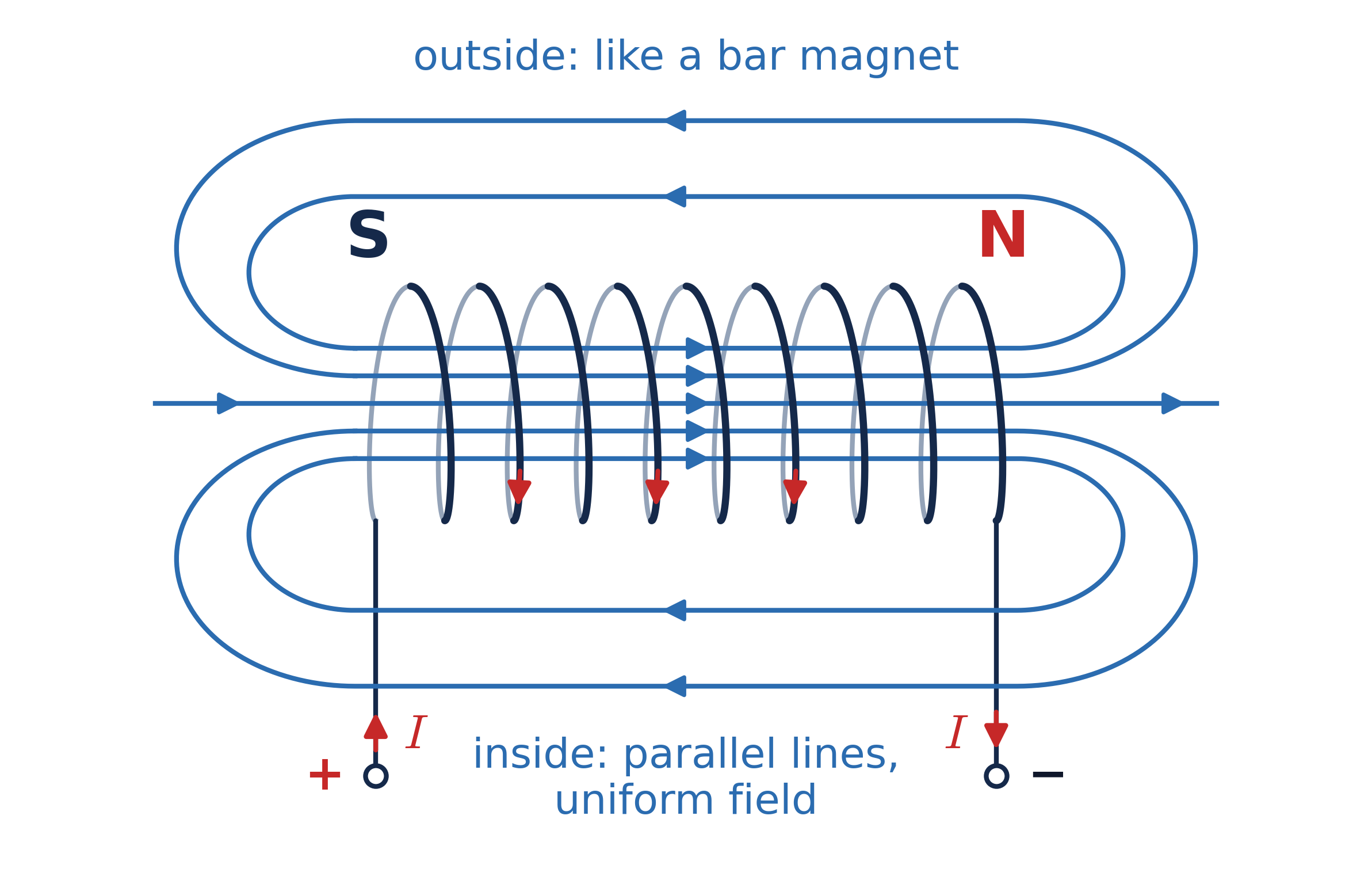
| Solenoid (a long coil of many close turns) | Like the field of a bar magnet. One end acts as a north pole, the other as a south pole | Inside a long solenoid the field is uniform: the lines are parallel and the field is the same at every point |
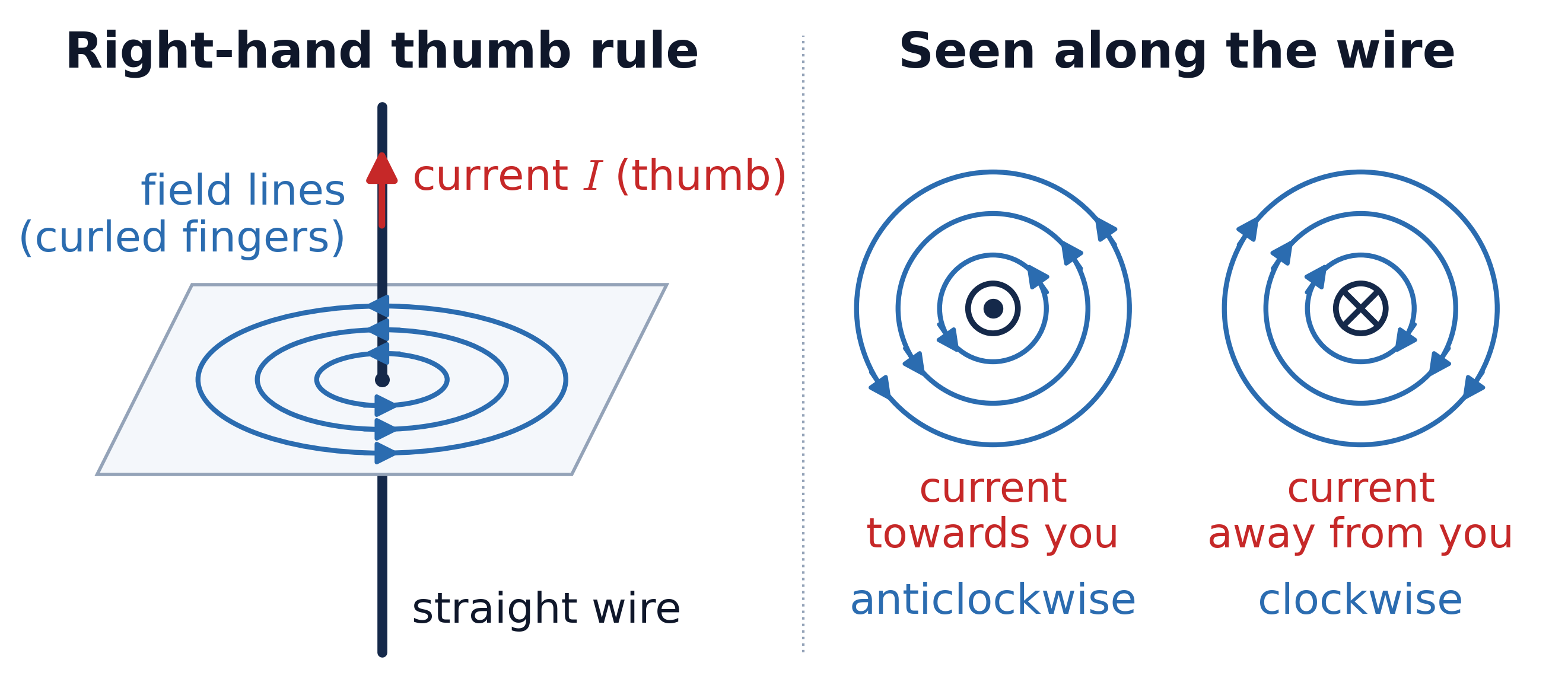
Right-hand thumb rule. Hold the wire in your right hand with the thumb pointing along the current. Your fingers curl round the wire in the direction of the magnetic field lines.
Example. A vertical wire carries current upwards. Seen from above, the field lines go anticlockwise. If the current is downwards, they go clockwise.
What the field of a long solenoid depends on: the number of turns in each unit of length, and the current. It does not depend on the diameter of the solenoid (asked in NDA I 2019).
6. The electromagnet
Put a rod of soft iron inside a solenoid and switch on the current. The iron becomes a strong magnet. Switch off, and it loses almost all its magnetism. This is an electromagnet.
| Electromagnet | Permanent magnet | |
|---|---|---|
| Core | Soft iron | Steel or a special alloy |
| Magnetism | Only while the current flows | Stays |
| Strength | Can be changed: raise the current or the number of turns | Fixed |
| Poles | Reverse when the current is reversed | Fixed |
| Used in | Electric bell, scrapyard crane, relay, telephone earpiece, loudspeaker | Compass needle, door catch |
7. Force on a current in a magnetic field, and the motor
A wire carrying a current across a magnetic field is pushed sideways. The force is greatest when the wire is at right angles to the field, and zero when the wire lies along the field.
Fleming's left-hand rule. Hold the forefinger, the middle finger and the thumb of the left hand at right angles to one another. Forefinger along the field, middle finger along the current: the thumb gives the direction of the force (the motion).
The same force acts on any moving charge. Positive and negative charges moving the same way across a field are pushed in opposite directions, so a mixed stream separates into two (asked in NDA II 2023). A charge at rest, or one moving along the field, feels no magnetic force.
The electric motor changes electrical energy into mechanical energy.
- A coil of wire sits between the poles of a magnet. Current flows through it.
- The two sides of the coil carry current in opposite directions, so one side is pushed up and the other down. The coil turns.
- After half a turn the split-ring commutator reverses the current in the coil, so the push keeps turning it the same way.
- Carbon brushes press on the commutator and carry the current to the turning coil.
8. Electromagnetic induction, the generator and the transformer
In 1831 Michael Faraday found the opposite effect. When the magnetic field through a coil changes, a current is induced in the coil. Move a magnet into a coil and a galvanometer joined to the coil shows a current. Hold the magnet still and the current stops. This is electromagnetic induction.
Fleming's right-hand rule gives the direction of the induced current: forefinger along the field, thumb along the motion of the conductor, and the middle finger gives the induced current.
| Rule | Hand | It gives |
|---|---|---|
| Right-hand thumb rule | Right | Direction of the magnetic field round a current |
| Fleming's left-hand rule | Left | Direction of the force on a current in a field: the motor rule |
| Fleming's right-hand rule | Right | Direction of the induced current: the generator rule |
The generator (dynamo) changes mechanical energy into electrical energy. A coil is turned between the poles of a magnet, the field through it keeps changing, and a current is induced.
| Motor | AC generator | DC generator | |
|---|---|---|---|
| Energy change | Electrical to mechanical | Mechanical to electrical | Mechanical to electrical |
| Rings | Split ring (commutator) | Two full slip rings | Split ring (commutator) |
| Output | Rotation | Current that reverses every half turn | Current in one direction only |
To change an AC generator into a DC generator, replace the slip rings with a split-ring commutator (asked in NDA II 2023).
The transformer changes the voltage of an alternating supply. It has two coils on one iron core and works by electromagnetic induction, so it does not work on steady direct current.
| Type | Turns | Voltage | Current |
|---|---|---|---|
| Step-up | More turns in the secondary coil | Raised | Lowered |
| Step-down | Fewer turns in the secondary coil | Lowered | Raised |
For an ideal transformer the voltages are in the ratio of the turns: \dfrac{V_s}{V_p} = \dfrac{N_s}{N_p}, where p is the primary (input) coil and s the secondary (output) coil.
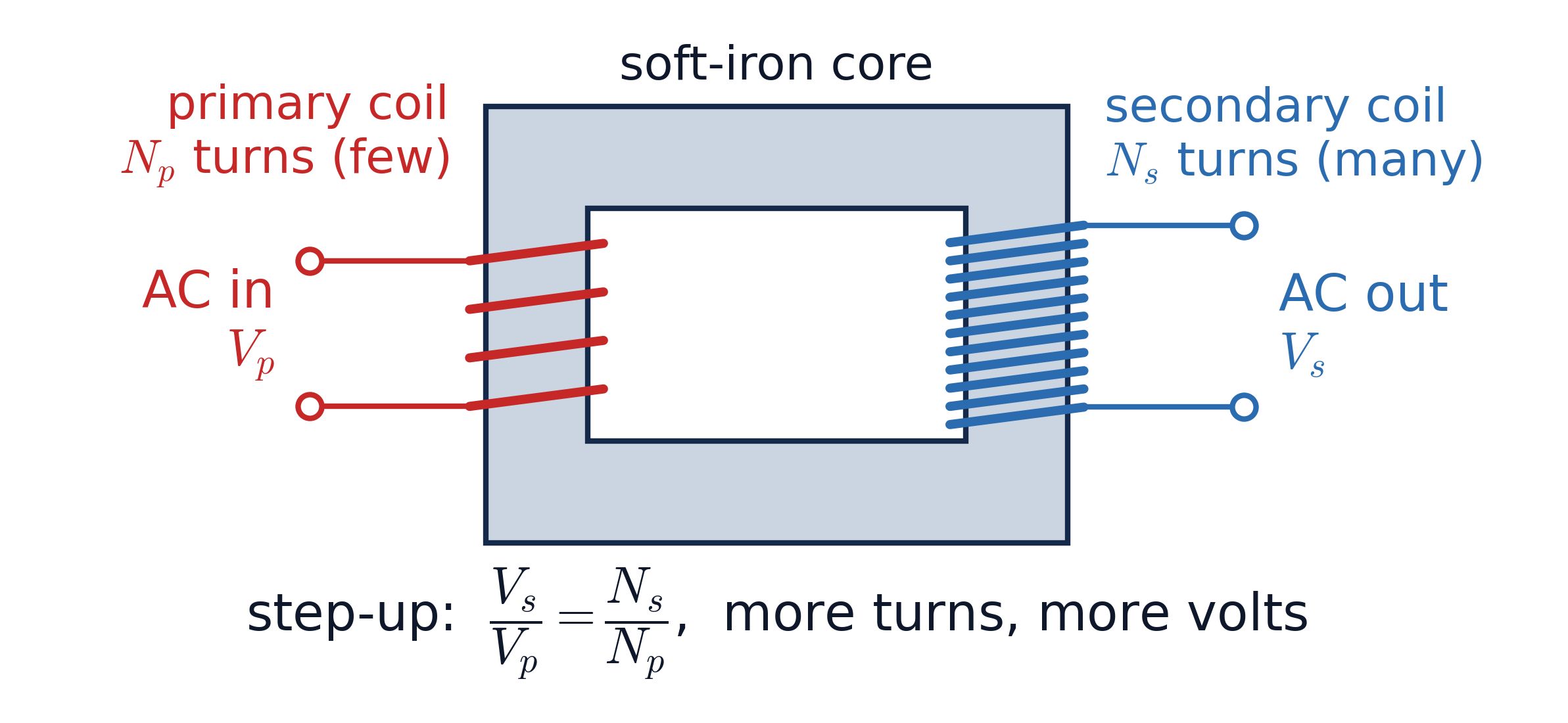
A transformer never increases power. An ideal one gives out the same power it takes in. Power stations step the voltage up for the long lines, because a high voltage means a small current and little heat lost in the wires. The SI unit of inductance is the henry (H), named after Joseph Henry.
9. AC, DC and the household circuit
Direct current (DC) flows one way all the time, as from a cell. Alternating current (AC) reverses its direction again and again. The mains supply in India is AC of 220 V and 50 Hz. In each cycle the current reverses twice, so it changes direction every \tfrac{1}{100} of a second. AC is used for the mains because its voltage can be changed easily with a transformer.
| Wire | Colour of insulation | Job |
|---|---|---|
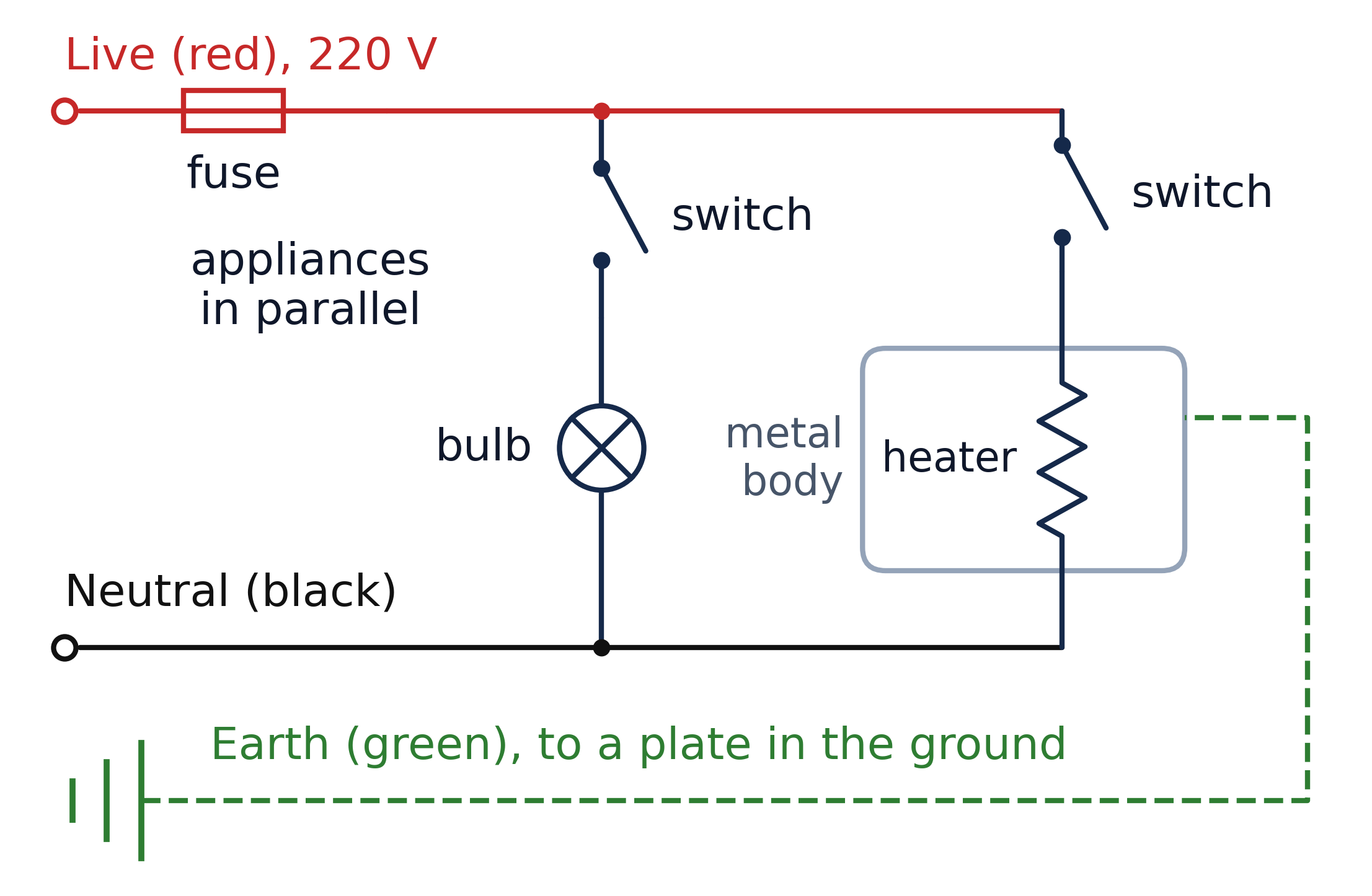
| Live | Red | At 220 V. Carries the current to the appliance |
| Neutral | Black | Completes the circuit. Near zero potential |
| Earth | Green | Joined to a metal plate buried in the ground. Connected to the metal body of an appliance for safety |
- All appliances are connected in parallel between live and neutral.
- The fuse and the switch are put in the live wire, in series with the appliance.
- A house has two kinds of circuit: one of 15 A rating for heaters, geysers and coolers, and one of 5 A rating for bulbs and fans.
- Short circuit: the live wire touches the neutral wire. The resistance falls to almost zero and the current rises suddenly to a very large value.
- Overloading: too many appliances on one socket draw more current than the wires can carry.
- In both cases the fuse melts and breaks the circuit. Many houses now use a switch that trips by itself, the miniature circuit breaker (MCB).
- Earthing: if the live wire touches the metal body of an iron, the current flows to the earth through the earth wire, the fuse blows, and the user does not get a shock.
What the papers have asked
| Paper | The idea asked | The answer in one line |
|---|---|---|
| NDA II 2017 | What a step-up transformer is used for | Increasing the voltage. It does not increase power |
| NDA I 2019 | Field of a solenoid depends on what | Turns per unit length and current, not the diameter |
| NDA II 2019 | Rise in temperature of water heated by a coil | Depends on the voltage, the current and the time: H = VIt |
| NDA 2020 | A 5 kW machine, 10 hours a day, 30 days | 5 \times 10 \times 30 = 1500 kWh, then multiply by the rate |
| NDA 2020 | Filament of a bulb | Tungsten |
| NDA 2020 | Current in a short circuit | Increases very much |
| NDA I 2021 | Which is not a formula for power | VI, I^2R and \dfrac{V^2}{R} are power. IR^2 is not |
| NDA II 2021 | Field lines anticlockwise round a straight wire | Right-hand thumb rule: the current is upwards, towards the viewer |
| NDA II 2021 | Device that produces current | Generator |
| NDA II 2023 | Heating element of an iron | Nichrome |
| NDA II 2023 | AC generator to DC generator | Use a split-ring commutator |
| NDA II 2024 | A bulb of 200 Ω carries 2 A for 10 hours, and 20% becomes light | P = I^2R = 800 W, energy 8 kWh, light 1.6 kWh, then multiply by the rate |
| NDA II 2024 | AC mains in India changes direction every | \tfrac{1}{100} s |
| NDA I 2025 | Heat in two equal wires, parallel compared with series, same voltage | 4 : 1 |
| NDA II 2025 | Rule for the force on a current in a field | Fleming's left-hand rule |
Worked examples
Example 1 (a short calculation). A room has four 60 W lamps that are on for 5 hours every day. What is the cost of running them for 30 days at Rs 5 a unit?
(a) Rs 45 (b) Rs 180 (c) Rs 1,800 (d) Rs 1,80,000
Solution. Power = 4 \times 60 = 240 W = 0.24 kW. Time = 5 \times 30 = 150 hours. Energy = 0.24 \times 150 = 36 kWh. Cost = 36 \times 5 = Rs 180. Option (a) is the cost for one lamp. Option (d) comes from leaving the power in watts. Answer (b).
Example 2. Two bulbs marked "220 V, 100 W" and "220 V, 25 W" are joined in series across a 220 V supply. Which is correct?
(a) The 100 W bulb is brighter (b) The 25 W bulb is brighter (c) Both are equally bright (d) Both glow at their full rated brightness
Solution. R = \dfrac{V^2}{P} gives 484 Ω for the 100 W bulb and 1936 Ω for the 25 W bulb. In series the same current flows in both, and P = I^2R is larger for the larger resistance. So the 25 W bulb is brighter. Option (a) is true only when each bulb gets its full 220 V, that is, in parallel. Option (d) is wrong because the bulbs share the 220 V between them. Answer (b).
Example 3 (statements). Consider the following statements about a long solenoid carrying a current:
- The magnetic field inside it is uniform.
- Its field becomes stronger if the current is increased.
- Its two ends behave like the two poles of a bar magnet.
Which of the statements given above are correct?
(a) 1 and 2 only (b) 2 and 3 only (c) 1 and 3 only (d) 1, 2 and 3
Solution. All three are standard facts. The field lines inside a long solenoid are parallel straight lines, so the field is uniform. The field grows with the current and with the number of turns per unit length. Outside, the pattern is that of a bar magnet. Answer (d).
Example 4. Two equal heating coils are joined first in series and then in parallel across the same supply. What is the ratio of the heat produced in a given time in series to that in parallel?
(a) 1 : 4 (b) 1 : 2 (c) 2 : 1 (d) 4 : 1
Solution. Let each coil be R. In series the total is 2R and in parallel it is \dfrac{R}{2}. The voltage is the same, so use H = \dfrac{V^2}{R}t: heat is inversely proportional to the resistance. Series to parallel = \dfrac{1}{2R} : \dfrac{2}{R} = 1 : 4. Option (d) is the ratio the other way round, parallel to series. Read which is asked first. Answer (a).
Example 5 (matching). Match each rule or law with what it gives.
| Rule or law | It gives |
|---|---|
| A. Right-hand thumb rule | 1. Heat produced in a resistor |
| B. Fleming's left-hand rule | 2. Direction of the induced current |
| C. Fleming's right-hand rule | 3. Direction of the field round a current |
| D. Joule's law | 4. Direction of the force on a current in a field |
(a) A-3, B-2, C-4, D-1 (b) A-4, B-3, C-2, D-1 (c) A-3, B-4, C-2, D-1 (d) A-2, B-4, C-3, D-1
Solution. The thumb rule gives the field of a current (3). The left-hand rule gives the force, as in a motor (4). The right-hand rule gives the induced current, as in a generator (2). Joule's law gives the heat (1). Option (a) exchanges the two Fleming rules, which is the usual slip. Answer (c).
Example 6 (statements). Consider the following statements about a household circuit:
- The fuse is connected in the neutral wire.
- The earth wire protects the user if the live wire touches the metal body of an appliance.
Which of the statements given above is/are correct?
(a) 1 only (b) 2 only (c) Both 1 and 2 (d) Neither 1 nor 2
Solution. The fuse is put in the live wire, so that when it melts the appliance is cut off from the 220 V wire. Statement 1 is wrong. Statement 2 is the purpose of earthing. Answer (b).
Mistakes that cost marks
- Kilowatt and kilowatt-hour. The kilowatt measures power. The kilowatt-hour measures energy and equals 3.6 \times 10^6 J. In a cost question change watts to kilowatts before multiplying by hours.
- Left hand and right hand. Left hand for the motor (force on a current). Right hand for the generator (induced current). The right-hand thumb rule is a third rule, for the field round a wire.
- "A step-up transformer increases power." It raises the voltage and lowers the current. The power does not increase.
- Using I^2R where the voltage is fixed. On the same supply voltage a smaller resistance gives more heat and more power, because P = \dfrac{V^2}{R}. A heater coil that is shortened gives more heat, not less.
Quick check
Do these without help. Answers are at the end.
- A 220 V heater takes a current of 10 A. What is its power in kilowatts?
- How many joules are there in 2 kWh?
- What is the resistance of a bulb marked "220 V, 40 W"?
- Which rule gives the direction of the force on a current-carrying wire in a magnetic field?
- Which part lets a DC motor keep turning in one direction, and what does it do?
Read and watch more, free
| What | Where | Language |
|---|---|---|
| Textbook, the two main chapters | NCERT Class 10 Science, Chapter 11, Electricity, and Chapter 12, Magnetic Effects of Electric Current | English (the Hindi edition is on the same NCERT site) |
| Textbook, a first read | NCERT Class 8 Curiosity, Chapter 4, Electricity: Magnetic and Heating Effects | English (the Hindi edition is on the same NCERT site) |
| Self-study notes | NIOS Science and Technology (212), Lesson 16, Electrical Energy, and Lesson 17, Magnetic Effect of Current | English, Hindi |
| Video, short lessons | Khan Academy India: Magnetic effects of electric current (18 videos) | English |
| Video, short lessons | Khan Academy India: Magnetic effects of electric current (13 videos) | Hindi |
| Video, with experiments | Science and Fun Education: Class 10 Science One Shot with Live Experiment (find the electricity and magnetism videos) | Hinglish |
The videos were chosen from their titles, length and views; they have not yet been watched by a teacher.
Answers to the quick check
- P = VI = 220 \times 10 = 2200 W = 2.2 kW.
- 2 \times 3.6 \times 10^6 = 7.2 \times 10^6 J.
- R = \dfrac{V^2}{P} = \dfrac{220^2}{40} = 1210\ \Omega.
- Fleming's left-hand rule.
- The split-ring commutator. It reverses the direction of the current in the coil every half turn.
Next chapter: Cells, batteries and X-rays.