Why this chapter matters. We found about 14 questions on this chapter in the 12 papers we hold, from 2017 to 2026: a little more than one in every paper. The most common kind is a temperature-scale question (change Fahrenheit to kelvin, find where two scales read the same). The others ask what heat is, how water behaves near 4 °C, and, in the harder papers, one-line ideas from thermodynamics. Learn first the three temperature scales in section 2; they have been asked in five of the twelve papers.
What you will be able to do
- Tell heat from temperature, and change a reading between the Celsius, Fahrenheit and Kelvin scales.
- Choose the right thermometer for a given job and say why.
- Explain the expansion of solids, liquids and gases, and the unusual behaviour of water between 0 °C and 4 °C.
- Use Q = mc\,\Delta T and "heat lost = heat gained" in short calculations.
Before you start you should know: energy and its unit, the joule (Chapter P1-7), and density (Chapter P1-1).
1. Heat and temperature are different things
The molecules of every body are always moving. When a body is heated, they move faster.
| Heat | Temperature | |
|---|---|---|
| What it is | Energy that passes from one body to another because of a difference in temperature | How hot or cold a body is. It measures the average kinetic energy of the molecules |
| SI unit | joule (J) | kelvin (K) |
| Other unit | calorie (1 cal is about 4.2 J) | degree Celsius (°C), degree Fahrenheit (°F) |
| Measured with | A calorimeter | A thermometer |
A bucket of warm water at 40 °C holds far more heat energy than a cup of boiling water at 100 °C, because it has far more water. But the cup has the higher temperature. If the two touch, heat flows from the cup to the bucket.
Heat flows by itself only from a hotter body to a colder body, never the other way. It stops when both reach the same temperature. They are then in thermal equilibrium. A thermometer works on this idea: it is left in contact with the body until both are at the same temperature.
2. The three temperature scales
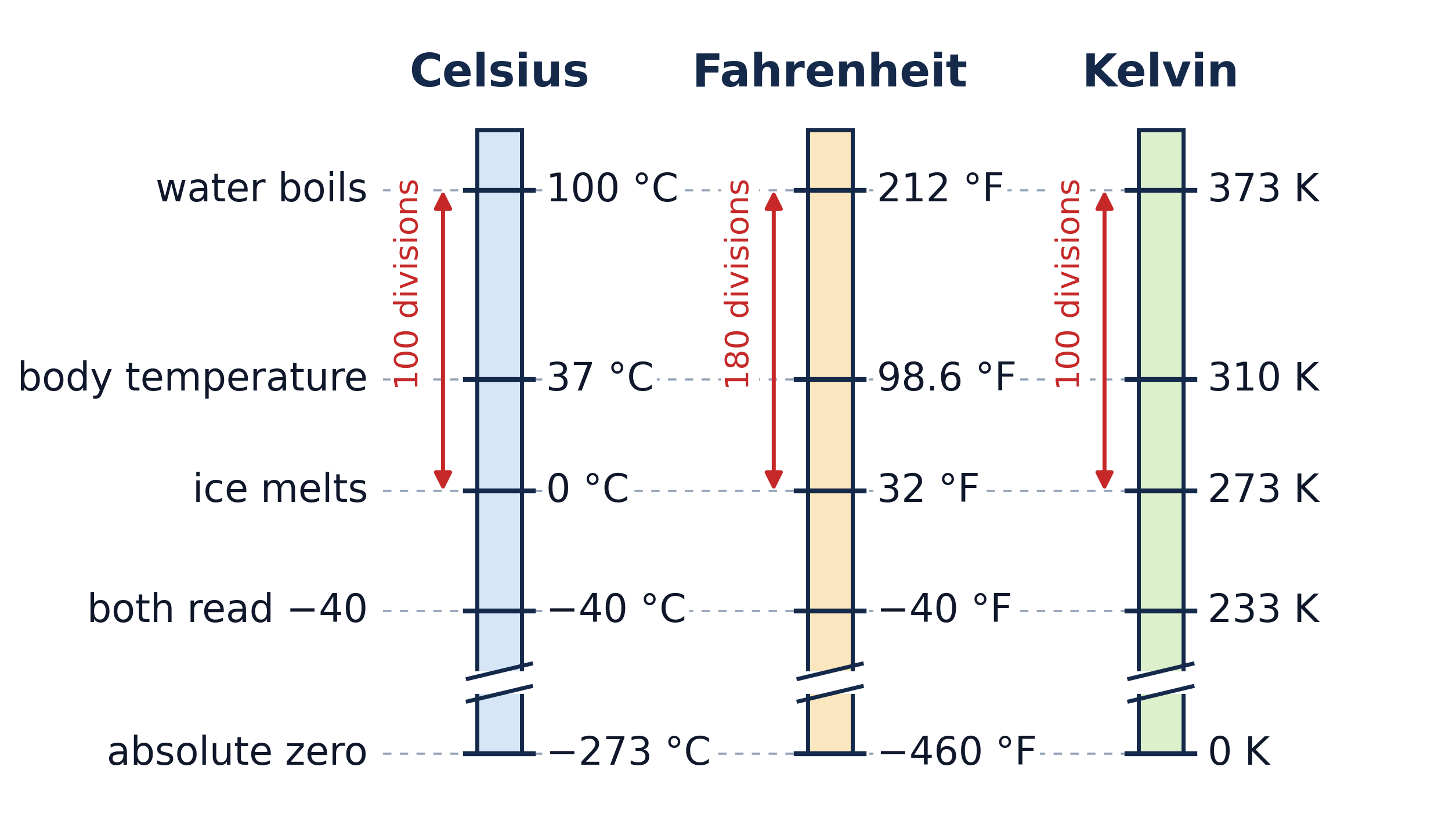
A scale needs two fixed points. They are the melting point of pure ice and the boiling point of pure water, both at normal atmospheric pressure.
| Celsius | Fahrenheit | Kelvin | |
|---|---|---|---|
| Ice melts | 0 °C | 32 °F | 273.15 K |
| Water boils | 100 °C | 212 °F | 373.15 K |
| Number of divisions between the two | 100 | 180 | 100 |
| Lowest possible temperature (absolute zero) | −273.15 °C | −459.67 °F | 0 K |
| Normal human body temperature | 37 °C | 98.6 °F | 310 K (about) |
The formulas:
F = \tfrac{9}{5}C + 32 \qquad C = \tfrac{5}{9}(F - 32) \qquad K = C + 273.15
In most questions 273 is used in place of 273.15.
Facts the papers have used:
- Absolute zero, 0 K or about −273 °C, is the lowest temperature possible. The Kelvin scale has no negative values, and a kelvin temperature is written without a degree sign: 300 K.
- The Celsius and Fahrenheit scales read the same at −40: −40 °C = −40 °F. (Put F = C in the formula: C = \tfrac{9}{5}C + 32 gives C = -40.)
- One division on the Celsius scale is the same size as one kelvin. So a rise of 30 K is a rise of 30 °C. A rise of 30 °C is a rise of 30 \times \tfrac{9}{5} = 54 °F. For a rise or fall, never add 32 or 273.
- To change Fahrenheit to kelvin, go through Celsius. For 113 °F: C = \tfrac{5}{9}(113 - 32) = 45 °C, and 45 + 273 = 318 K.
3. Thermometers
A thermometer uses some property that changes steadily with temperature: the length of a liquid thread, the pressure of a gas, the electrical resistance of a wire.
| Thermometer | How it works | Range or use | Point to remember |
|---|---|---|---|
| Clinical (mercury) | Mercury expands up a fine tube | About 35 °C to 42 °C; body temperature | A kink near the bulb stops the mercury from falling back, so it can be read after it is taken out |
| Laboratory (mercury) | Same | About −10 °C to 110 °C | It has no kink, so it must be read while it is still in the liquid |
| Alcohol | Coloured alcohol expands up the tube | Very cold places | Alcohol freezes at about −115 °C. Mercury freezes at about −39 °C, so it cannot be used in polar cold |
| Maximum and minimum | Records the highest and lowest temperature of the day | Weather stations | |
| Digital | An electronic sensor | Body temperature | Has no mercury, which is poisonous |
| Thermocouple | A voltage appears where two different metals join; it changes with temperature | A very wide range, from far below zero to above 1000 °C | The one to choose when both liquids in glass would freeze or boil |
| Pyrometer | Measures the radiation given out by a very hot body | Furnaces, molten metal | It does not touch the hot body |
Mercury is used because it shines and is easy to see, does not stick to glass, expands evenly and is a good conductor of heat. It boils at about 357 °C.
4. Effects of heat
When a body takes in heat, one or more of these happen.
| Effect | Example |
|---|---|
| Its temperature rises | Water warming on a stove |
| It expands | A railway line becomes longer in summer |
| It changes state | Ice melts; water boils (next chapter) |
| A chemical change takes place | Food cooks; paper burns |
5. Expansion of solids
Almost all solids expand when heated and contract when cooled. For a rod, the increase in length is
\Delta L = \alpha\,L\,\Delta T
where \alpha is the coefficient of linear expansion of the material. For the same material, the coefficient of area expansion is 2\alpha and that of volume expansion is 3\alpha.
Example. For steel, \alpha is about 1.2 \times 10^{-5} per °C. A steel rail 10 m long, when the temperature rises by 40 °C, becomes longer by 1.2 \times 10^{-5} \times 10 \times 40 = 0.0048 m, which is 4.8 mm.
| What we see | The reason |
|---|---|
| Small gaps are left between lengths of railway line | To give room for expansion in summer. Without them the track would bend |
| Electric and telephone wires hang loose in summer and are tight in winter | They are longer when hot and shorter when cold |
| An iron tyre is heated before it is fitted on a wooden cart wheel | Hot, it is larger and slips on. As it cools it shrinks and grips the wheel |
| A thick glass tumbler may crack when boiling water is poured in | The inside expands at once but the outside, still cold, does not. Glass is a poor conductor |
| Bridges have one end on rollers | To let the bridge grow and shrink freely |
| The metal lid of a glass jar opens after it is held in hot water | The metal expands more than the glass |
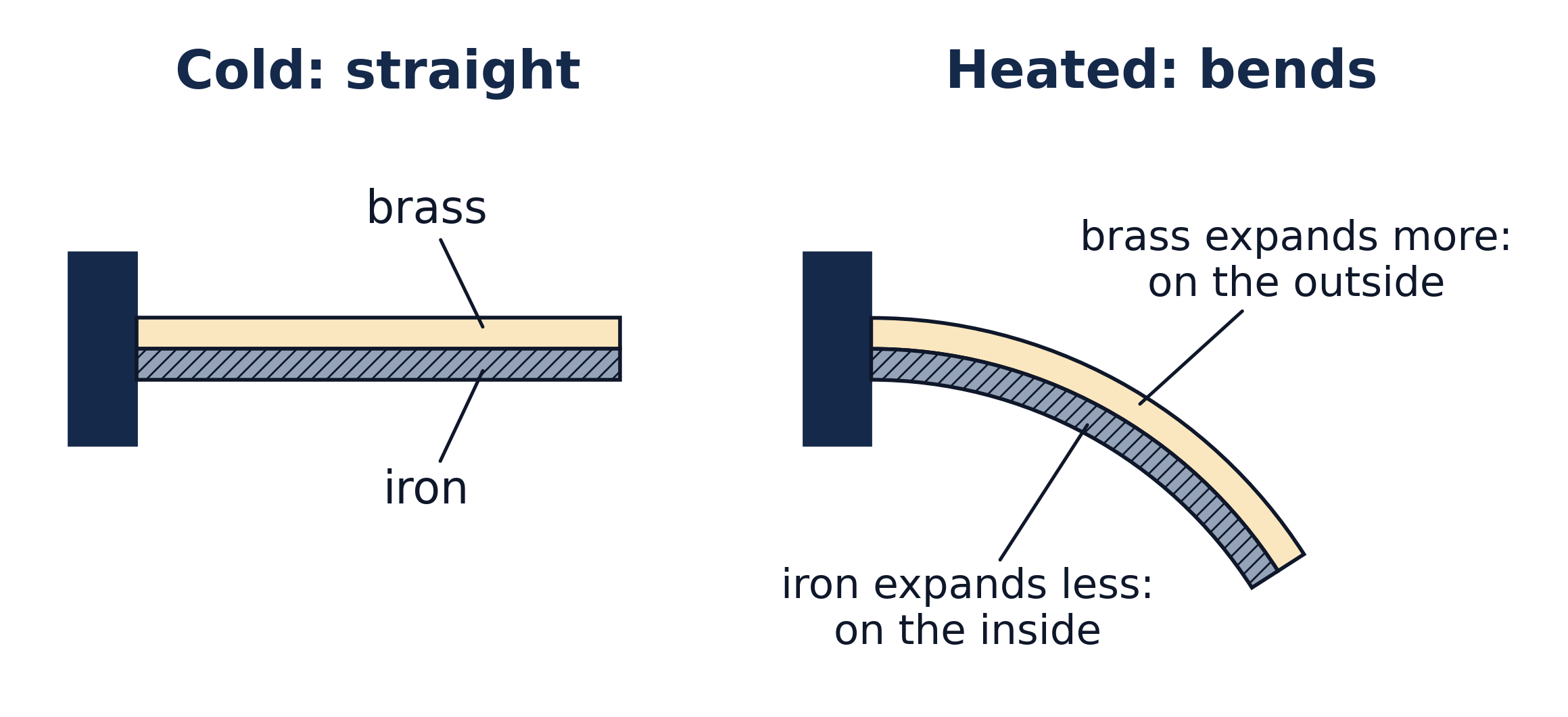
Two points for the exam. A hole in a metal plate becomes larger when the plate is heated, just as if the hole were filled with the metal. And a bimetallic strip, made of two metals joined along their length (for example brass and iron), bends when heated, because brass expands more than iron. The brass is on the outer side of the curve. Such strips switch the current on and off in an electric iron and in a fire alarm. The device is called a thermostat.
6. Expansion of liquids and gases, and the odd behaviour of water
For the same rise in temperature, liquids expand more than solids, and gases expand much more than liquids. All gases expand by the same fraction for the same rise in temperature if the pressure is kept constant (Charles's law): the volume of a fixed mass of gas is proportional to its kelvin temperature.
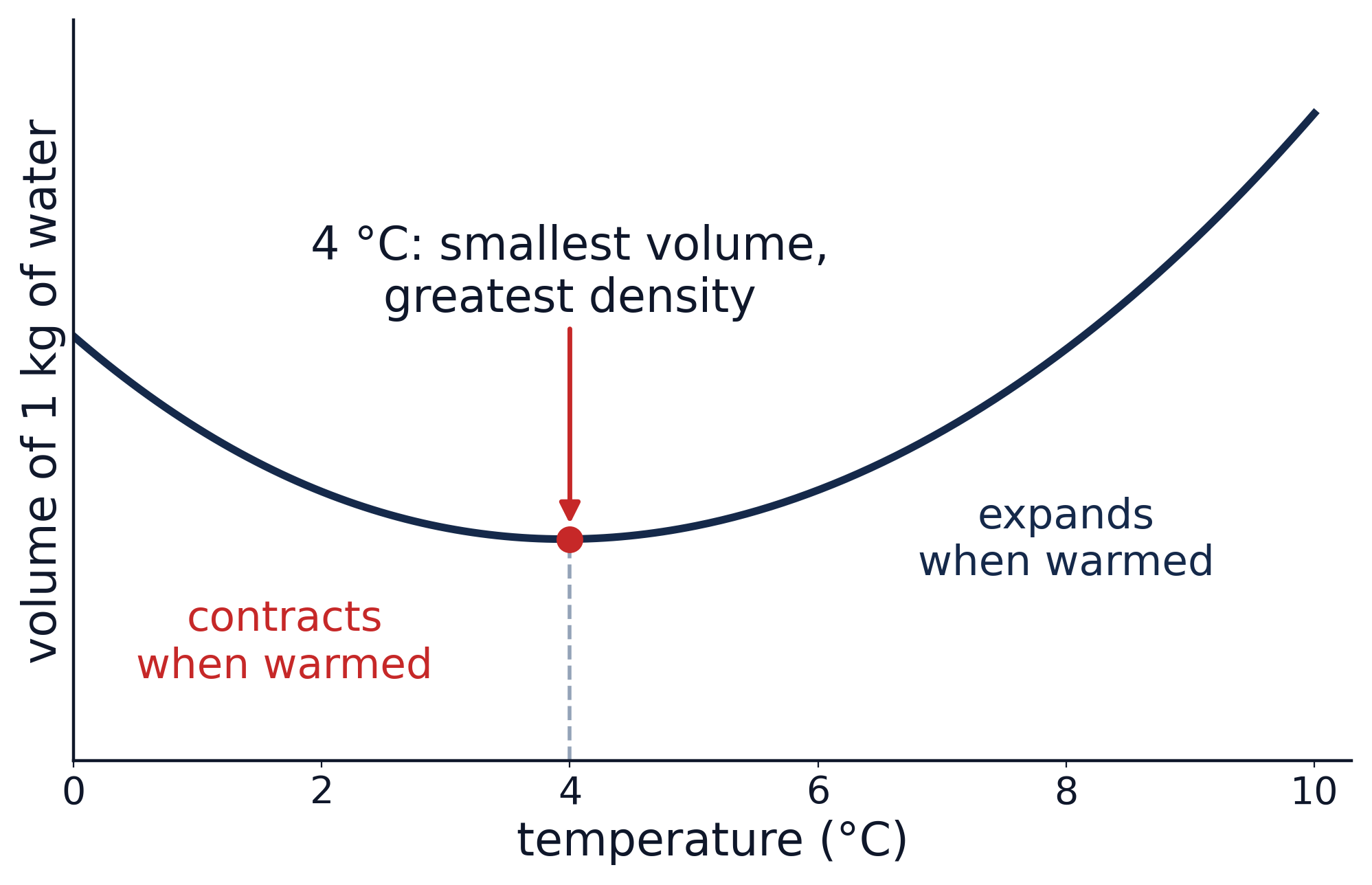
Water is an exception between 0 °C and 4 °C. When water at 0 °C is warmed, it contracts until 4 °C. Above 4 °C it expands like other liquids. So:
- water has its smallest volume and greatest density at 4 °C (277 K);
- water also expands when it freezes, so ice is less dense than water and floats.
| What we see | The reason |
|---|---|
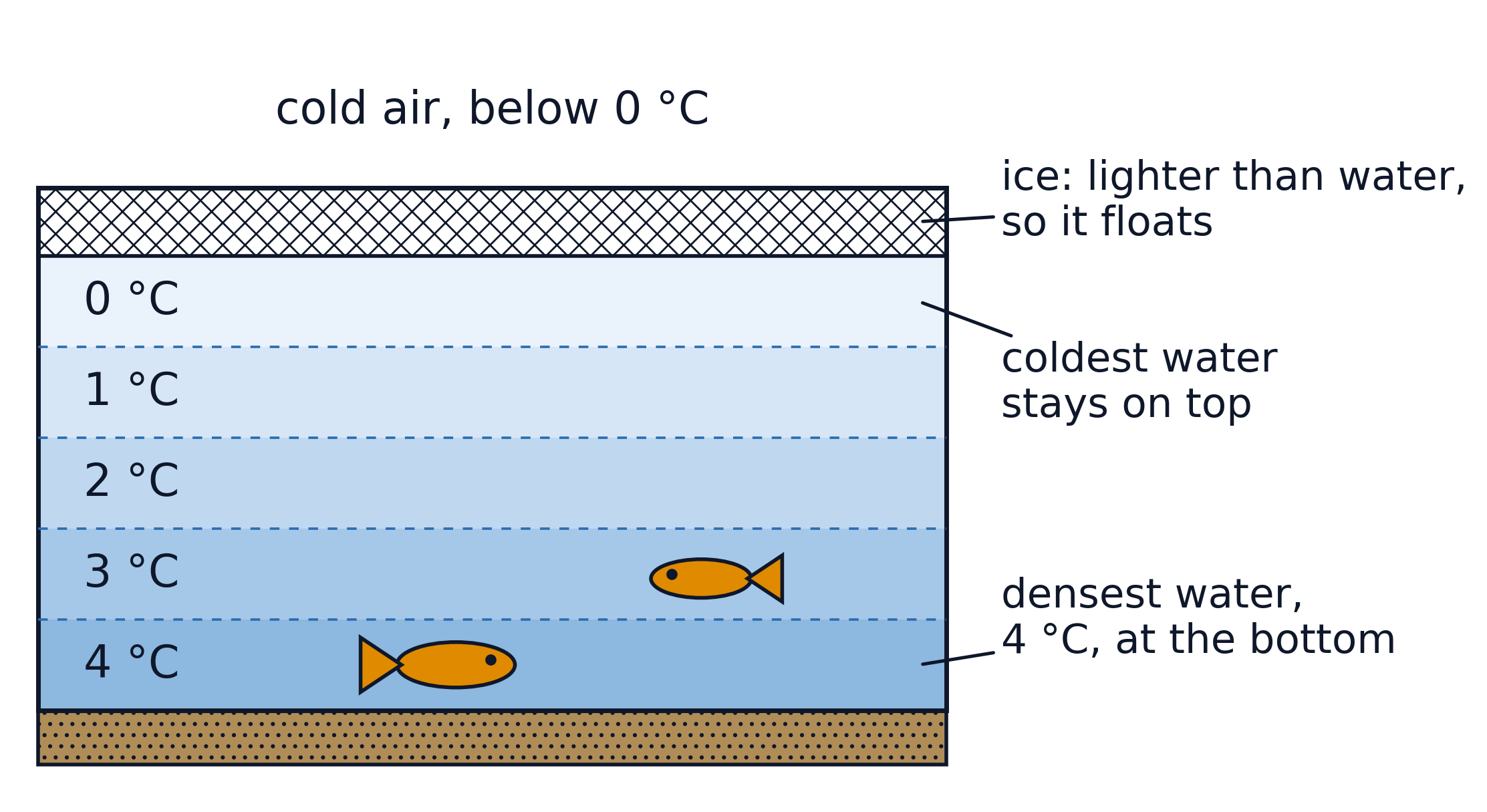
| A lake freezes from the top, and fish live through the winter | Water at 4 °C is the densest and sinks to the bottom. Colder water stays on top and freezes there. Ice is a poor conductor and protects the water below |
| Water pipes burst in very cold weather | Water expands when it turns to ice |
| A sealed glass bottle full of water cracks in a freezer | The same |
7. Specific heat capacity
Different substances need different amounts of heat for the same rise in temperature.
The specific heat capacity c of a substance is the heat needed to raise the temperature of 1 kg of it by 1 °C (or 1 K).
Q = m\,c\,\Delta T
| Quantity | Meaning | SI unit |
|---|---|---|
| Specific heat capacity, c | Heat for 1 kg and 1 K | J kg⁻¹ K⁻¹ |
| Heat capacity (thermal capacity), mc | Heat to raise the whole body by 1 K | J K⁻¹ |
| Specific heat of water | About 4200 J kg⁻¹ K⁻¹, which is 1 cal g⁻¹ °C⁻¹ |
Water has a very high specific heat, higher than almost every other common substance. Aluminium is about 900 and copper about 390 J kg⁻¹ K⁻¹. So water warms slowly and cools slowly, and it can carry away a great deal of heat. That is why
- water is the coolant in the radiator of a truck or a tank engine;
- hot-water bottles stay warm for a long time;
- places near the sea have a milder climate than places far inland, and land heats and cools faster than the sea.
Example. To heat 2 kg of water from 20 °C to 70 °C needs Q = 2 \times 4200 \times 50 = 420{,}000 J, or 420 kJ.
Mixing (the principle of calorimetry). When a hot body and a cold body are put together and no heat escapes, heat lost by the hot body = heat gained by the cold body.
Example. 200 g of water at 80 °C is mixed with 300 g of water at 30 °C. Let the final temperature be T. Then 200 \times (80 - T) = 300 \times (T - 30), so 16000 + 9000 = 500T and T = 50 °C. The specific heat cancels because both are water.
When the specific heat changes with temperature (NDA I 2026). If c is not constant, the heat is found by adding up small steps: Q = m\int c\,dT. For c = c_0 + aT this gives Q = m\left[c_0(T_2 - T_1) + \tfrac{a}{2}(T_2^2 - T_1^2)\right].
8. Four ideas from thermodynamics that the papers have used
These are Class 11 ideas. Learn the one line for each.
| Idea | In one line | Asked in |
|---|---|---|
| Second law of thermodynamics | Heat cannot flow by itself from a colder body to a hotter body | NDA II 2017 |
| First law of thermodynamics | Heat given to a system = rise in its internal energy + work done by the system. If no work is done, all the heat goes into internal energy | NDA II 2019 |
| Adiabatic process or system | No heat enters or leaves | NDA I 2025 |
| Ideal gas equation | PV = nRT, with T in kelvin. At constant volume the pressure is proportional to the temperature, and the molar heat capacity is then C_V | NDA I 2026 |
Other names in the same family: an isothermal process is one at constant temperature, an isobaric process is one at constant pressure and an isochoric process is one at constant volume.
What the papers have asked
| Paper | The idea asked | The answer in one line |
|---|---|---|
| NDA II 2017 | Which law says heat does not flow by itself from cold to hot? | The second law of thermodynamics |
| NDA I 2019 | The constant in F = X + 1.8C | 32 |
| NDA II 2019 | 113 °F on the Kelvin scale | 45 °C, which is 318 K |
| NDA II 2019 | A gas on which no work is done, and which does no work | The change in internal energy equals the heat that flows in or out |
| NDA I 2021 | The lowest possible temperature | −273 °C (absolute zero) |
| NDA I 2021 | Where Celsius and Fahrenheit read the same | −40 |
| NDA II 2024 | The best definition of heat | Energy transferred because of a difference in temperature |
| NDA II 2024 | The temperature at which water is densest | 4 °C, given in the paper as 277 K |
| NDA I 2025 | A system that does not exchange heat with its surroundings | Adiabatic |
| NDA II 2025 | A rise from 310 K to 340 K, in degrees Celsius | 30 °C, because the two divisions are the same size |
| NDA II 2025 | An instrument for measuring −250 °C | Of the choices given, only a thermocouple thermometer; mercury and alcohol would both be frozen |
| NDA I 2026 | Heat for a solid whose specific heat is c_0 + aT | m\left[c_0(T_2 - T_1) + \tfrac{a}{2}(T_2^2 - T_1^2)\right] |
| NDA I 2026 | An ideal gas with P \propto T: its molar heat capacity | The volume is constant, so it is C_V |
Worked examples
Example 1. A weather report gives the temperature of a town as 104 °F. What is this on the Celsius scale?
(a) 40 °C (b) 57.8 °C (c) 72 °C (d) 219.2 °C
Solution. C = \tfrac{5}{9}(F - 32) = \tfrac{5}{9} \times 72 = 40 °C. Option (c) subtracts 32 and stops. Option (b) multiplies by \tfrac{5}{9} without first subtracting 32. Answer (a).
Example 2. The temperature of a liquid falls by 20 °C. By how much does it fall on the Fahrenheit scale?
(a) 20 °F (b) 36 °F (c) 68 °F (d) 11.1 °F
Solution. This is a change in temperature, not a reading. 100 Celsius divisions equal 180 Fahrenheit divisions, so a change of 20 °C is 20 \times \tfrac{9}{5} = 36 °F. Option (c) is what you get by treating 20 °C as a reading and adding 32. Answer (b).
Example 3. Consider the following statements:
- Water has its greatest density at 0 °C.
- When water at 4 °C is cooled to 0 °C, its volume increases.
Which of the statements given above is/are correct?
(a) 1 only (b) 2 only (c) Both 1 and 2 (d) Neither 1 nor 2
Solution. Water is densest at 4 °C, not at 0 °C, so statement 1 is wrong. Between 4 °C and 0 °C water expands as it cools, so its volume increases and statement 2 is correct. Answer (b).
Example 4. How much heat is needed to raise the temperature of 0.5 kg of water from 30 °C to 50 °C? (Specific heat of water = 4200 J kg⁻¹ K⁻¹)
(a) 2100 J (b) 42 000 J (c) 84 000 J (d) 105 000 J
Solution. Q = mc\,\Delta T = 0.5 \times 4200 \times 20 = 42{,}000 J. Option (d) uses the final temperature, 50, in place of the rise, 20. Always use the change in temperature. Answer (b).
Example 5. Which one of the following thermometers is the right choice for measuring the temperature of molten iron in a furnace?
(a) A clinical thermometer (b) A mercury laboratory thermometer (c) An alcohol thermometer (d) A pyrometer
Solution. Iron melts at about 1500 °C. Mercury boils at about 357 °C and alcohol far below that, and a clinical thermometer reads only up to about 42 °C. A pyrometer measures the radiation from a very hot body without touching it. Answer (d).
Example 6. A bimetallic strip is made of brass and iron. Brass expands more than iron for the same rise in temperature. When the strip is heated, it
(a) stays straight and becomes longer (b) bends with the brass on the outer side of the curve (c) bends with the iron on the outer side of the curve (d) becomes shorter
Solution. The two metals are fixed together, so they cannot slide. Brass becomes longer than iron, and the only way a longer strip and a shorter strip can stay joined is for the strip to curve with the longer one, brass, on the outside. Answer (b).
Mistakes that cost marks
- Adding 32 or 273 to a change in temperature. A rise of 10 °C is a rise of 10 K and of 18 °F. The 32 and the 273 are only for readings.
- Saying water is densest at 0 °C. It is densest at 4 °C. Ice at 0 °C is less dense than water.
- Mixing up heat and temperature. Heat is energy, in joules. Temperature is a level of hotness, in kelvin. A large cold body can hold more heat energy than a small hot one.
- Writing "degree kelvin" or a negative kelvin value. It is 300 K, with no degree sign, and no temperature is below 0 K.
Quick check
Do these without help. Answers are at the end.
- Change 25 °C to the Fahrenheit scale and to the Kelvin scale.
- At what temperature do the Celsius and Fahrenheit scales give the same reading?
- Why is a small gap left between two lengths of railway line?
- How much heat is needed to warm 3 kg of water by 10 °C? (Specific heat of water = 4200 J kg⁻¹ K⁻¹)
- Why is mercury not used in a thermometer for the polar regions?
Read and watch more, free
| What | Where | Language |
|---|---|---|
| Textbook | NCERT Class 11 Physics Part II, Chapter 10 Thermal Properties of Matter (scales, expansion, specific heat). The Hindi edition is on the same site under the book code khph2 | English, Hindi |
| Easy first read | NCERT Class 6 Science, Curiosity, Chapter 7 Temperature and its Measurement | English, Hindi |
| Older textbook chapter | The old NCERT Class 7 chapter "Heat" (clinical and laboratory thermometers; it is no longer in the NCERT menu and may be removed) | English |
| Self-study notes | NIOS Science and Technology (212), Lesson 14 Thermal Energy | English, Hindi |
| Video, for NDA | Defence Wallah: Complete Physics, NDA Fast Track Series (the video on heat) | Hinglish |
| Video, school lessons | Magnet Brains: Class 11 Physics (the chapter Thermal Properties of Matter) | Hinglish |
| Video, school lessons | Magnet Brains Hindi Medium: Class 11 Physics | Hindi |
The videos were chosen from their titles, length and views; they have not yet been watched by a teacher.
Answers to the quick check
- F = \tfrac{9}{5} \times 25 + 32 = 77 °F. K = 25 + 273 = 298 K.
- At −40.
- To give the rails room to expand in hot weather, so that the track does not bend.
- Q = 3 \times 4200 \times 10 = 126{,}000 J.
- Mercury freezes at about −39 °C, and polar temperatures can go lower than that. Alcohol stays liquid down to about −115 °C.
Next chapter: Change of state, latent heat and how heat travels.