Why this chapter matters. Logarithms gave 7 questions in the 6 papers from CDS I 2024 to CDS II 2026. None came in the two papers of 2024; every paper since has had one or two. All seven use base 10. Three ask you to join or split logarithms with the three laws. Two ask for the number of digits of a large power, or the number of zeros after the decimal point of a small one. One is an equation solved by trying the options, and one is a pair of statements about the size of a logarithm. No question needed a printed table: where a value such as \log_{10} 2 is needed, the question gives it.
What you will be able to do
- Change a statement from power form to logarithm form and back.
- Use the three laws to join several logarithms into one, or to split one into known parts.
- Say between which two whole numbers a logarithm lies, without calculating it.
- Find the number of digits of a large power and the number of zeros after the decimal point of a small one.
Before you start you should know: the laws of powers, a^m \times a^n = a^{m+n}, (a^m)^n = a^{mn}, a^0 = 1 and a^{-n} = \dfrac{1}{a^n}, and prime factorisation (Chapter A1-3).
1. What a logarithm is
A logarithm is a power. The question "10 to what power gives 1000?" has the answer 3. We write this answer as \log_{10} 1000 = 3.
\log_{10} x = y \quad \text{means} \quad 10^y = x
The number 10 is called the base. A logarithm to base 10 is called a common logarithm. In this chapter \log x with no base shown means \log_{10} x.
| Power form | Logarithm form |
|---|---|
| 10^3 = 1000 | \log_{10} 1000 = 3 |
| 10^2 = 100 | \log_{10} 100 = 2 |
| 10^1 = 10 | \log_{10} 10 = 1 |
| 10^0 = 1 | \log_{10} 1 = 0 |
| 10^{-1} = 0.1 | \log_{10} 0.1 = -1 |
| 10^{-2} = 0.01 | \log_{10} 0.01 = -2 |
A power of 10 is always positive. So the logarithm of zero or of a negative number does not exist. In any question, the number inside a logarithm must be positive.
Other bases work in the same way: 2^3 = 8 means \log_2 8 = 3. The six papers used base 10 only.
2. The three laws
In each law x and y are positive.
| Law | In words | Example | |
|---|---|---|---|
| 1 | \log (xy) = \log x + \log y | the log of a product is the sum of the logs | \log 2 + \log 5 = \log 10 = 1 |
| 2 | \log \dfrac{x}{y} = \log x - \log y | the log of a quotient is the difference of the logs | \log 300 - \log 3 = \log 100 = 2 |
| 3 | \log x^n = n \log x | a power comes down as a multiplier | \log 1000^4 = 4 \log 1000 = 12 |
They are the laws of powers written in another way. Law 3 also covers roots: \log \sqrt{x} = \dfrac{1}{2} \log x.
Two directions. Read from right to left, the laws join several logarithms into one: 2 \log 5 + \log 8 - \log 2 = \log \dfrac{25 \times 8}{2} = \log 100 = 2. Read from left to right, they split one logarithm into known parts, as in section 3.
There is no law for \log (x + y) or for \log (x - y).
3. Working from \log 2 and \log 3
Questions give \log_{10} 2 = 0.301 and \log_{10} 3 = 0.477 and expect the rest from them. Write the number in powers of 2, 3 and 10.
| Number | Written as | Its logarithm |
|---|---|---|
| 4 | 2^2 | 2 \times 0.301 = 0.602 |
| 5 | \dfrac{10}{2} | 1 - 0.301 = 0.699 |
| 6 | 2 \times 3 | 0.301 + 0.477 = 0.778 |
| 8 | 2^3 | 3 \times 0.301 = 0.903 |
| 9 | 3^2 | 2 \times 0.477 = 0.954 |
The line for 5 is the one to remember: \log 5 = 1 - \log 2, because 5 = 10 \div 2. The number 7 cannot be made from 2, 3 and 10; if it is needed, the question gives it.
4. The size of a logarithm
A larger number has a larger logarithm. Since \log 100 = 2 and \log 1000 = 3, every number between 100 and 1000 has its logarithm between 2 and 3. Since \log 1 = 0, every positive number below 1 has a negative logarithm.
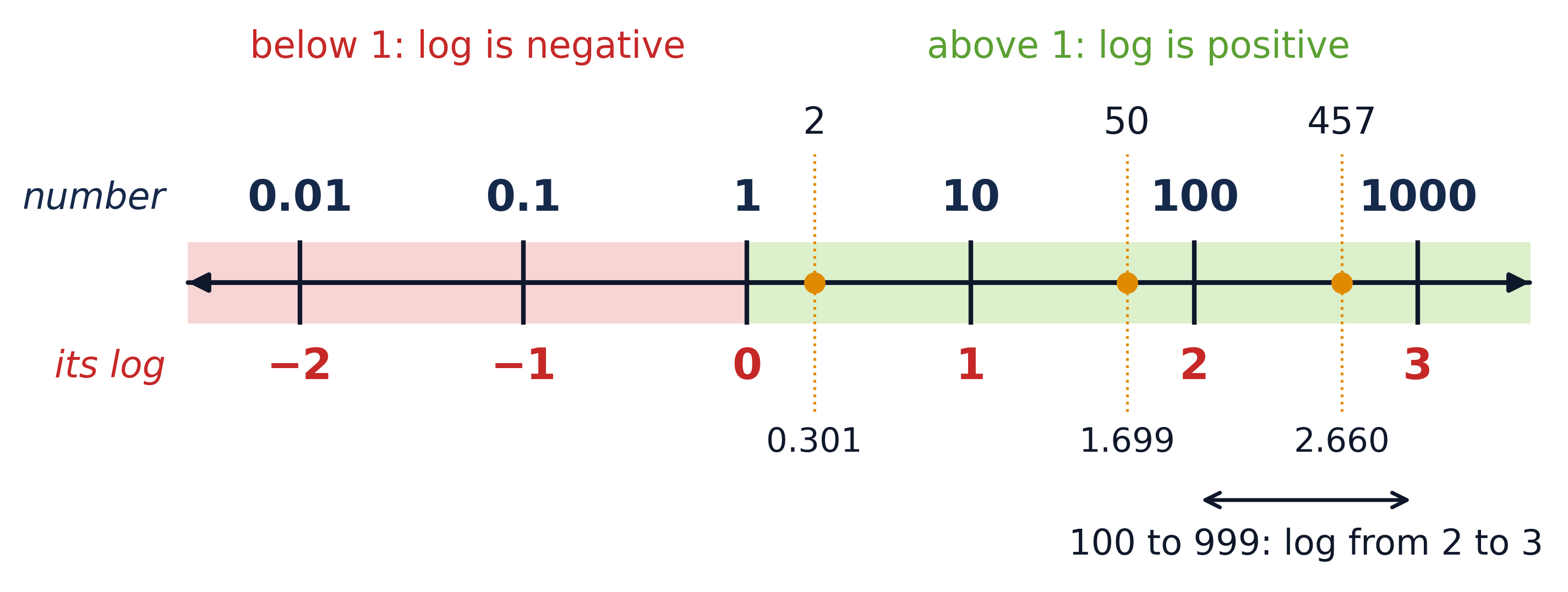
| The number is | Its logarithm is |
|---|---|
| more than 1 | positive |
| equal to 1 | 0 |
| between 0 and 1 | negative |
| between 10 and 100 | between 1 and 2 |
| between 100 and 1000 | between 2 and 3 |
5. Number of digits, and zeros after the decimal point
Digits of a large number. A 3-digit number lies from 100 to 999, so its logarithm is 2 point something. In general, for a whole number N:
number of digits of N = (whole-number part of \log_{10} N) + 1.
For 3^{40}: \log 3^{40} = 40 \times 0.477 = 19.08. The whole-number part is 19, so 3^{40} has 20 digits.
Zeros of a small number. Take 0.002. It has 2 zeros between the decimal point and the first non-zero digit. Its logarithm is \log 2 - 3 = -2.699, which lies between -3 and -2. In general, for a number between 0 and 1:
if \log_{10} N lies between -(m + 1) and -m, then N has m zeros just after the decimal point.
In practice: drop the minus sign and the decimal part. From -2.699 you get 2 zeros. (When the logarithm is an exact whole number the count is one less: \log 0.001 = -3, and 0.001 has 2 zeros. Questions with a decimal part do not meet this case.)
6. Equations with logarithms
- Join the logarithms on each side into one (section 2).
- Change to power form: \log_{10} A = k becomes A = 10^k.
- Solve, then check that every number inside a logarithm is positive. Throw away an answer that makes one of them zero or negative.
When the unknown is also in a power, such as 4^x, do not try algebra. Put the options into the equation one by one.
Worked examples
Example 1. Find \log_{10} 100000, \log_{10} 0.001 and \log_{10} \sqrt{10}.
100000 = 10^5, so the value is 5. 0.001 = 10^{-3}, so the value is -3. \sqrt{10} = 10^{1/2}, so the value is \dfrac{1}{2}.
Example 2. Given \log_{10} 2 = 0.301 and \log_{10} 3 = 0.477, find \log_{10} 72 and \log_{10} 15.
72 = 2^3 \times 3^2, so \log 72 = 3(0.301) + 2(0.477) = 0.903 + 0.954 = 1.857.
15 = \dfrac{3 \times 10}{2}, so \log 15 = 0.477 + 1 - 0.301 = 1.176.
Example 3. Take \log_{10} 2 = 0.301. How many zeros come just after the decimal point in (0.2)^{25}?
0.2 = \dfrac{2}{10}, so \log 0.2 = 0.301 - 1 = -0.699. Then \log (0.2)^{25} = 25 \times (-0.699) = -17.475. This lies between -18 and -17, so there are 17 zeros.
Example 4. Solve \log_{10} x + \log_{10} (x + 3) = 1.
By law 1, \log_{10} \left[x(x + 3)\right] = 1, so x(x + 3) = 10. Then x^2 + 3x - 10 = 0, that is (x + 5)(x - 2) = 0, so x = -5 or x = 2. Check: x = -5 would need \log_{10} (-5), which does not exist. The only solution is x = 2. (Indeed \log 2 + \log 5 = \log 10 = 1.)
From the real papers
The first three questions are from CDS I 2025 and CDS II 2025 (Series A), and the answers agree with the final official key. The last three are from the 2026 papers, where the official key is still provisional; our answers agree with it. Try each for 72 seconds before reading the solution.
CDS I 2025, Q19. What is \log_{10} 2000 + \log_{10} 400 + 4 \log_{10} 25 + 5 \log_{10} 20 equal to?
(a) 10 (b) 16 (c) 18 (d) 20
Solution. Join them: the sum is \log_{10} (2000 \times 400 \times 25^4 \times 20^5). Do not multiply. Count the primes: 2000 = 2^4 \times 5^3, 400 = 2^4 \times 5^2, 25^4 = 5^8 and 20^5 = 2^{10} \times 5^5. The 2s: 4 + 4 + 10 = 18. The 5s: 3 + 2 + 8 + 5 = 18. So the product is 2^{18} \times 5^{18} = 10^{18}, and its logarithm is 18. Answer (c).
CDS I 2025, Q20. If \frac{\log_{10}(100001 - 4^x)}{5 - x} = 1, then what is x equal to?
(a) 0 (b) 1 (c) 10 (d) 100
Solution. Multiply across and change to power form: 100001 - 4^x = 10^{5 - x}. Try the options. For x = 0: the left side is 100001 - 1 = 100000 and the right side is 10^5 = 100000. It fits. (For x = 1 the sides are 99997 and 10000. For x = 10 or 100 the bracket is negative, so its logarithm does not exist.) Answer (a).
CDS II 2025, Q10. If \log_{10} 2 = 0 \cdot 301 and \log_{10} 3 = 0 \cdot 477, then what is the number of digits in the expansion of 60^{60}?
(a) 105 (b) 106 (c) 107 (d) 108
Solution. 60 = 2 \times 3 \times 10, so \log 60 = 0.301 + 0.477 + 1 = 1.778. Then \log 60^{60} = 60 \times 1.778 = 106.68. The whole-number part is 106, so the number has 106 + 1 = 107 digits. Answer (c).
CDS I 2026, Q29. If \log_{10}(80) = p, \log_{10}(45) = q and \log_{10}(216) = r, then what is \log_{10}(384) equal to?
(a) p + q + r (b) p - q + r (c) p - q - r (d) p + q - r
Solution. Adding logs multiplies the numbers; subtracting divides. So look for 384 as a product and quotient of 80, 45 and 216. In primes, 384 = 2^7 \times 3, 80 = 2^4 \times 5, 45 = 3^2 \times 5 and 216 = 2^3 \times 3^3. The 5 must cancel, so 80 and 45 are on opposite sides: \dfrac{80 \times 216}{45} = \dfrac{2^7 \times 3^3 \times 5}{3^2 \times 5} = 2^7 \times 3 = 384. So \log 384 = p + r - q. Answer (b).
CDS II 2026, Q8. Consider the following statements in respect of common logarithms: I. The logarithm of a number greater than 100 but less than 1000 lies between 2 and 3. II. The logarithm of a positive number less than unity is negative. Which of the statements given above is/are correct?
(a) I only (b) II only (c) Both I and II (d) Neither I nor II
Solution. Both are the facts of section 4. \log 100 = 2 and \log 1000 = 3, so I is correct. \log 1 = 0, and a smaller number has a smaller logarithm, so II is correct. Answer (c).
CDS II 2026, Q9. What is the number of zeros immediately after the decimal point in (0.5)^{1000}? (Given that \log_{10} 2 = 0.30103)
(a) 300 (b) 301 (c) 302 (d) 303
Solution. 0.5 = \dfrac{1}{2}, so \log 0.5 = -\log 2. Then \log (0.5)^{1000} = -1000 \times 0.30103 = -301.03. This lies between -302 and -301, so there are 301 zeros (section 5). Answer (b).
In four of the six, the working was a count of prime powers or one multiplication. Do not work out the large number itself.
Mistakes that cost marks
- Writing \log (x + y) = \log x + \log y. The law is for a product. Check: \log (2 + 3) = \log 5, but \log 2 + \log 3 = \log 6.
- Writing \dfrac{\log x}{\log y} = \log \dfrac{x}{y}. Check: \dfrac{\log 1000}{\log 10} = \dfrac{3}{1} = 3, but \log \dfrac{1000}{10} = \log 100 = 2.
- Forgetting the "+ 1" for digits. A logarithm of 106.68 means 107 digits, not 106. Test the rule on 100: its logarithm is 2 and it has 3 digits.
- Keeping an answer that makes a logarithm impossible. In Example 4, x = -5 must be thrown away.
Quick check
Do these without help. Answers are at the end.
- Find \log_{10} 0.01.
- Find \log_{10} 4 + \log_{10} 25.
- Given \log_{10} 2 = 0.301, find \log_{10} 50.
- Given \log_{10} 2 = 0.301, how many digits does 2^{50} have?
- Solve \log_{10} (3x + 1) = 2.
Read and watch more, free
The NCERT books for Classes 6 to 10 have no chapter on logarithms, and NIOS Secondary Mathematics has none either. The chapter below gives the powers of 10 that logarithms are built on. For the rest, this lesson and the past papers are the material.
| What | Where | Language |
|---|---|---|
| Textbook, powers and powers of 10 | NCERT Class 8 Ganita Prakash Part I, Chapter 2 Power Play · Hindi edition | English, Hindi |
| The real papers | UPSC previous question papers | English, Hindi |
| The real papers as online tests | Examsnet: UPSC CDS previous year solved papers | English |
| Video, a full CDS course | R.S SIR: Maths Playlist for CDS 2025 (the lesson on logarithms, about 55 minutes) | Hindi and Hinglish |
| Video, numbered classes | Chandigarh Career Group: CDS advance maths by Sandeep Brar (the class on logarithm) | Hinglish |
| Video, one long lesson | Defence Wallah CDS / AFCAT: Maths for CDS 1, 2025 (the lesson on set theory, statistics and logarithm) | Hinglish |
The videos were chosen from their titles, length and views; they have not yet been watched by a teacher.
Answers to the quick check
- 0.01 = 10^{-2}, so the value is -2.
- \log_{10} (4 \times 25) = \log_{10} 100 = 2.
- 50 = \dfrac{100}{2}, so \log 50 = 2 - 0.301 = 1.699.
- 50 \times 0.301 = 15.05. The whole-number part is 15, so there are 16 digits.
- 3x + 1 = 10^2 = 100, so x = 33.
Next chapter: Percentages.