Why this chapter matters. This chapter gave 13 questions in the 6 papers from CDS I 2024 to CDS II 2026, about two in every paper. Ten of the 13 are digit problems: a 2-digit or 3-digit number is described by its digits, the digits are reversed, and you must find the number or count how many such numbers exist. The other three test what you know about integers: positive and negative, even and odd, larger and smaller. Five of the 13 came in the "is the statement enough" form. No question asked for a definition, but every question uses the words natural number, integer and digit exactly, and one wrong meaning loses the mark.
What you will be able to do
- Name the families of numbers, and tell a rational number from an irrational one.
- Decide the sign of a product and whether a sum or product is even or odd, without working it out.
- Write any number by its digits, as 10a + b or 100a + 10b + c, and turn a digit problem into a small equation.
- Use the two facts about reversed digits that the paper asks again and again.
Before you start you should know: the four operations on whole numbers and on negative numbers, and how to solve an equation such as 3a = 6b or 21a = 63. Nothing else. This is the first chapter of the course.
1. The families of numbers
| Family | Members | Note |
|---|---|---|
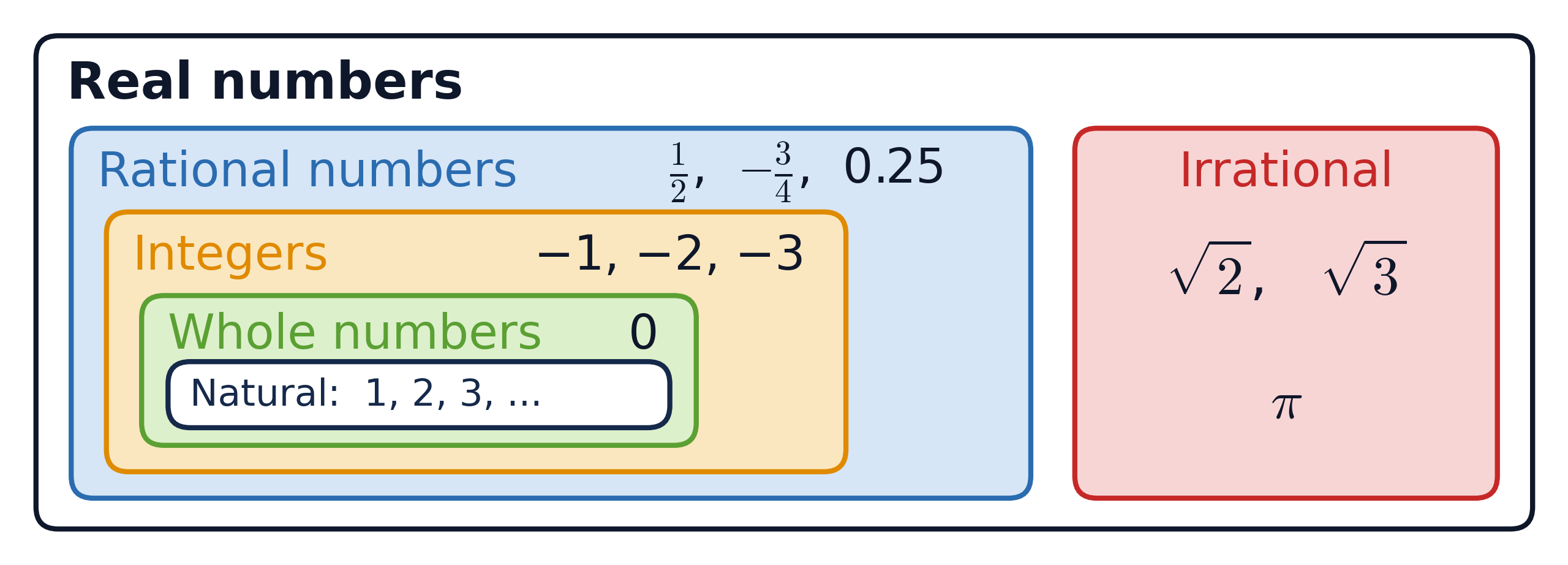
| Natural numbers | 1, 2, 3, \dots | the counting numbers; 0 is not one of them |
| Whole numbers | 0, 1, 2, 3, \dots | the natural numbers and 0 |
| Integers | \dots, -2, -1, 0, 1, 2, \dots | whole numbers and their negatives |
| Rational numbers | numbers that can be written as \dfrac{p}{q}, with p and q integers and q \ne 0 | every integer is rational: 5 = \dfrac{5}{1} |
| Irrational numbers | numbers that cannot be written as \dfrac{p}{q} | \sqrt{2}, \sqrt{3}, \pi |
| Real numbers | all rational and all irrational numbers together | every point on the number line |
Each family sits inside the next one. Every natural number is a whole number, every whole number is an integer, every integer is a rational number, and every rational number is a real number.
Four words in a question fix which numbers you may use. Read them every time.
| The question says | It allows |
|---|---|
| natural number | 1, 2, 3, \dots |
| positive integer | 1, 2, 3, \dots (the same as natural number) |
| non-negative integer, whole number | 0, 1, 2, 3, \dots |
| digit | 0, 1, 2, \dots, 9 only |
Zero is an integer and it is even. It is neither positive nor negative.
2. Rational or irrational?
Look at the decimal form.
- If the decimal ends (0.375) or repeats for ever (0.3333\ldots), the number is rational. Here 0.375 = \dfrac{3}{8} and 0.3333\ldots = \dfrac{1}{3}.
- If the decimal goes on for ever without repeating, the number is irrational.
Three rules cover almost every case:
- \sqrt{n} is irrational unless n is a perfect square. \sqrt{49} = 7 is rational; \sqrt{12} is irrational.
- Rational + irrational is always irrational. So 2 + \sqrt{3} is irrational.
- Irrational \times irrational can be either. \sqrt{2} \times \sqrt{2} = 2 is rational; \sqrt{2} \times \sqrt{3} = \sqrt{6} is irrational.
The number \dfrac{22}{7} is rational. It is only close to \pi, which is irrational. Chapter A1-2 shows how to change a repeating decimal into a fraction.
3. Sign, and even or odd
Statement questions about integers are settled by two small tables. You do not need the numbers themselves.
Sign of a product. Two numbers with the same sign give a positive product. Two numbers with different signs give a negative product. So (-3) \times (-4) = 12. A square is never negative. A cube keeps the sign of its number: (-2)^3 = -8. The same is true of a cube root.
Even or odd.
| Operation | Result |
|---|---|
| even \pm even, odd \pm odd | even |
| even \pm odd | odd |
| even \times any integer | even |
| odd \times odd | odd |
So a sum of two integers is even exactly when both are even or both are odd. A product is odd only when every factor is odd. A power keeps the nature of its base: 7^5 is odd, 12^3 is even.
For example, 7 + 12 is odd, 7 \times 12 is even and 7 \times 9 is odd.
Size. For positive integers, a product is never smaller than any of its factors. This fails for fractions: \dfrac{1}{2} \times \dfrac{1}{2} = \dfrac{1}{4}, which is smaller than \dfrac{1}{2}. So check whether the question says "integer" or only "number".
4. Writing a number by its digits
The value of a digit depends on its place. In 47 the digit 4 is worth 40. So
47 = 10 \times 4 + 7, \qquad 583 = 100 \times 5 + 10 \times 8 + 3
In general:
| Number | Digits | Value | The digits may be |
|---|---|---|---|
| 2-digit | tens a, units b | 10a + b | a from 1 to 9, b from 0 to 9 |
| 3-digit | hundreds a, tens b, units c | 100a + 10b + c | a from 1 to 9, b and c from 0 to 9 |
The first digit of a number is never 0. There are 90 two-digit numbers (10 to 99) and 900 three-digit numbers (100 to 999).
When a paper writes "the 3-digit number XYZ", it means the digits X, Y, Z side by side, that is 100X + 10Y + Z. It does not mean X \times Y \times Z.
Largest and smallest number from given digits. For the largest, write the digits in falling order. For the smallest, write them in rising order, but do not put 0 first: put the smallest non-zero digit first and 0 next. From 3, 0, 8, 5 the largest is 8530 and the smallest is 3058.
5. Reversing the digits
Two facts answer most of the real questions.
Two digits. The number is 10a + b and its reverse is 10b + a.
(10a + b) - (10b + a) = 9(a - b), \qquad (10a + b) + (10b + a) = 11(a + b)
So the difference of a 2-digit number and its reverse is 9 times the difference of the digits. Their sum is 11 times the sum of the digits. Check: 73 - 37 = 36 = 9 \times 4 and 73 + 37 = 110 = 11 \times 10.
Three digits. The number is 100X + 10Y + Z and its reverse is 100Z + 10Y + X. The middle digit cancels.
XYZ - ZYX = 99(X - Z)
So the difference is always a multiple of 99, whatever the middle digit is. Check: 842 - 248 = 594 = 99 \times 6.
The 3-digit multiples of 99 are 198, 297, 396, 495, 594, 693, 792 and 891. In each, the middle digit is 9 and the two outer digits add up to 9. (The same holds for 99 itself, written as 099.) The papers have used this fact directly.
6. The method for a digit problem
- Name the digits with letters and write the number by place value (section 4).
- Turn each sentence of the question into an equation.
- Simplify. You will usually get one small relation between the digits, such as b = 2a.
- List the digits that fit. Remember that each is a single digit from 0 to 9 and that the first digit is not 0.
- Answer what is asked: the number, a sum, a product, or how many such numbers there are.
Often the options or a short list are faster than algebra. If only three numbers fit the first condition, test the three.
A note on "is the statement enough" questions. Five of the 13 questions in this chapter have a Question and two Statements. You are not asked for the value. You are asked whether Statement I alone, Statement II alone, or both together fix one answer. Test each statement alone first, then both. Read option (d) with care: in some papers it says the Question cannot be answered even with both Statements, and in others it says the Question can be answered without any Statement. Chapter A8-1 treats this form fully.
Worked examples
Example 1. Which of these numbers are rational: \sqrt{49}, \sqrt{12}, 0.375, \dfrac{22}{7}, \pi, -5?
\sqrt{49} = 7 is rational. 12 is not a perfect square, so \sqrt{12} is irrational. 0.375 ends, so it is rational. \dfrac{22}{7} is a fraction of two integers, so it is rational. \pi is irrational. -5 = \dfrac{-5}{1} is rational. Four of the six are rational.
Example 2. x and y are integers and x + y is odd. Consider the statements: (1) xy is even. (2) x^2 + y^2 is odd. Which is correct?
A sum is odd only when one number is even and the other is odd. Then the product has an even factor, so xy is even: (1) is correct. A square keeps the nature of its number, so x^2 + y^2 is even + odd, which is odd: (2) is correct. Both are correct. Check with x = 2, y = 3: xy = 6 and x^2 + y^2 = 13.
Example 3. The sum of the digits of a 2-digit number is 12. When the digits are reversed, the number increases by 18. Find the number.
Let the number be 10a + b. Then a + b = 12. The reverse is larger by 18, so 9(b - a) = 18 and b - a = 2. Adding the two relations, 2b = 14, so b = 7 and a = 5. The number is 57. Check: 75 - 57 = 18.
Example 4. How many 2-digit numbers give a perfect square when added to the number formed by reversing their digits?
The sum is 11(a + b). For this to be a perfect square, a + b must supply another factor 11. Since a + b is at most 9 + 9 = 18, the only choice is a + b = 11, giving the square 121. The pairs are 2 and 9, 3 and 8, 4 and 7, 5 and 6, and the same pairs the other way round: 29, 38, 47, 56, 65, 74, 83, 92. There are 8 such numbers.
From the real papers
These six questions are from the Elementary Mathematics papers (Series A). The first four have a final official key and our answers agree with it. The last two are from the 2026 papers, where the official key is still provisional; our answers agree with that key. Try each for 72 seconds before reading the solution.
CDS II 2025, Q19. Let XYZ be a 3-digit number. Let D be the difference between XYZ and ZYX. What is the remainder when D is divided by 99?
(a) 0 (b) 1 (c) 7 (d) 9
Solution. By section 5, XYZ - ZYX = 99(X - Z). This is a multiple of 99 whatever the digits are. For example 731 - 137 = 594 = 99 \times 6. The remainder is 0. Answer (a).
CDS I 2025, Q9. Consider a 2-digit number N. Let P be the product of the digits of the number. If P is added to square of the digit in the tens place of N, we get 84. If P is added to the square of the digit in the unit place of N, we get 60. What is the value of P + N?
(a) 100 (b) 110 (c) 115 (d) 120
Solution. Let the tens digit be t and the units digit be u, so P = tu. Then tu + t^2 = 84 and tu + u^2 = 60. Take out the common factor: t(t + u) = 84 and u(t + u) = 60. Divide one by the other: \dfrac{t}{u} = \dfrac{84}{60} = \dfrac{7}{5}. Both are single digits, so t = 7 and u = 5. Check: 7 \times 12 = 84 and 5 \times 12 = 60. So N = 75, P = 35 and P + N = 110. Answer (b).
CDS I 2024, Q61. This item is one of ten that share the same instructions: each item contains a Question followed by two Statements. Let a, b, c and d be positive integers.
Question : Which one of a, b, c, d is closest to the product abcd?
Statement-I : a > b > c
Statement-II : c is not the smallest.
(a) The Question can be answered by one of the Statements alone, but not by the other. (b) The Question can be answered by either Statement alone. (c) The Question can be answered by using both the Statements together, but cannot be answered by using either Statement alone. (d) The Question cannot be answered even by using both Statements together.
Solution. All four are positive integers, so the product is at least as large as each of them (section 3). The number closest to the product is therefore the largest of the four. Statement I puts a above b and c but says nothing about d: with 3, 2, 1 and d = 1 the largest is a, and with d = 5 it is d. Not enough. Statement II only says that some number is smaller than c. Not enough. Together: among a, b, c the smallest is c, so the number smaller than c must be d. Then a is the largest of all four. Both statements are needed. Answer (c).
CDS II 2025, Q82. A Question is given followed by two Statements I and II. Consider the Question and the Statements.
Question: The product of a natural number N and the number M written by the same digits of N in the reverse order is 252. What is the number N?
Statement-I: N + M = 33
Statement-II: N > M
Which one of the following is correct in respect of the above Question and the Statements?
(a) The Question can be answered by using one of the Statements alone, but cannot be answered using the other Statement alone (b) The Question can be answered by using either Statement alone (c) The Question can be answered by using both the Statements together, but cannot be answered using either Statement alone (d) The Question can be answered even without using any of the Statements
Solution. Write 252 as a product of two numbers: 1 \times 252, 2 \times 126, 3 \times 84, 4 \times 63, 6 \times 42, 7 \times 36, 9 \times 28, 12 \times 21, 14 \times 18. Only 12 and 21 are reverses of each other. So N is 12 or 21, and the Question alone does not decide. Statement I gives N + M = 33, which is true in both cases. Not enough. Statement II gives N > M, so N = 21. Enough. One statement alone answers the Question and the other does not. Answer (a).
CDS I 2026, Q11. Seven times a two-digit positive number is equal to four times the number obtained by reversing the order of the digits. How many such two-digit numbers are there?
(a) 1 (b) 4 (c) 6 (d) 8
Solution. Let the number be 10a + b. Then 7(10a + b) = 4(10b + a), so 70a + 7b = 40b + 4a. This gives 66a = 33b, that is b = 2a. The units digit is twice the tens digit, and both are single digits: 12, 24, 36 and 48. Check one: 7 \times 12 = 84 = 4 \times 21. There are 4 such numbers. Answer (b).
CDS II 2026, Q26. N is a 3-digit number. The middle digit of N is equal to the sum of the other two digits and the sum of the digits is 10. How many such numbers (N) can be possible?
(a) 3 (b) 4 (c) 5 (d) 6
Solution. Let the digits be a, b, c with b = a + c. The sum of the digits is a + b + c = 2b = 10, so b = 5 and a + c = 5. The first digit cannot be 0, so a is 1, 2, 3, 4 or 5. The last digit may be 0. The numbers are 154, 253, 352, 451 and 550. There are 5. Answer (c).
Four of the six ended in a count or a choice between a few numbers. The equation was short each time; the mark was won by listing the digits with care.
Mistakes that cost marks
- Reading XYZ as a product. In a digit problem XYZ is the number 100X + 10Y + Z. Write it by place value before doing anything else.
- Letting the first digit be 0, or forgetting that the last digit can be 0. In CDS II 2026 Q26 the number 550 counts, but 055 does not. A student who drops 550 marks 4; one who adds 055 marks 6. Both wrong answers were among the options.
- Taking 0 as a natural number, or as positive. Natural numbers start from 1. Zero is not positive and not negative. "Is xy positive?" has the answer no when xy = 0.
- Counting only one order. In Example 4 both 29 and 92 fit. When a condition treats the two digits alike, count both orders.
Quick check
Do these without help. Answers are at the end.
- Which of these are irrational: \sqrt{81}, \sqrt{50}, 0.7777\ldots, 3.14, \pi?
- p is an odd integer and q is an even integer. Is p^2 + 3q even or odd?
- A 2-digit number is 7 times the sum of its digits. How many such numbers are there?
- The difference between a 3-digit number and the number with its digits reversed is 495. What is the difference between its first and last digits?
- Using each of the digits 0, 4 and 7 once, write the largest and the smallest 3-digit numbers. What is their difference?
Read and watch more, free
The textbooks teach the families of numbers well. Digit problems are in the Class 8 book and its practice book.
The videos were chosen from their titles, length and views; they have not yet been watched by a teacher.
Answers to the quick check
- \sqrt{50} and \pi. (\sqrt{81} = 9; 0.7777\ldots repeats and 3.14 ends, so both are rational.)
- Odd. p^2 is odd and 3q is even, and odd + even is odd.
- 10a + b = 7(a + b) gives 3a = 6b, so a = 2b. The numbers are 21, 42, 63 and 84: four numbers.
- 99(X - Z) = 495, so X - Z = 5.
- The largest is 740 and the smallest is 407 (0 cannot come first). The difference is 333.
Next chapter: Fractions, decimals, square roots and simplification.