Individual Obstacles (IO)
Ten obstacles, your effort, the clock
Ten obstacles of rising difficulty, each worth more points than the last, attempted alone against a clock (about three minutes). It tests stamina, courage, determination, and how smartly you use limited time.
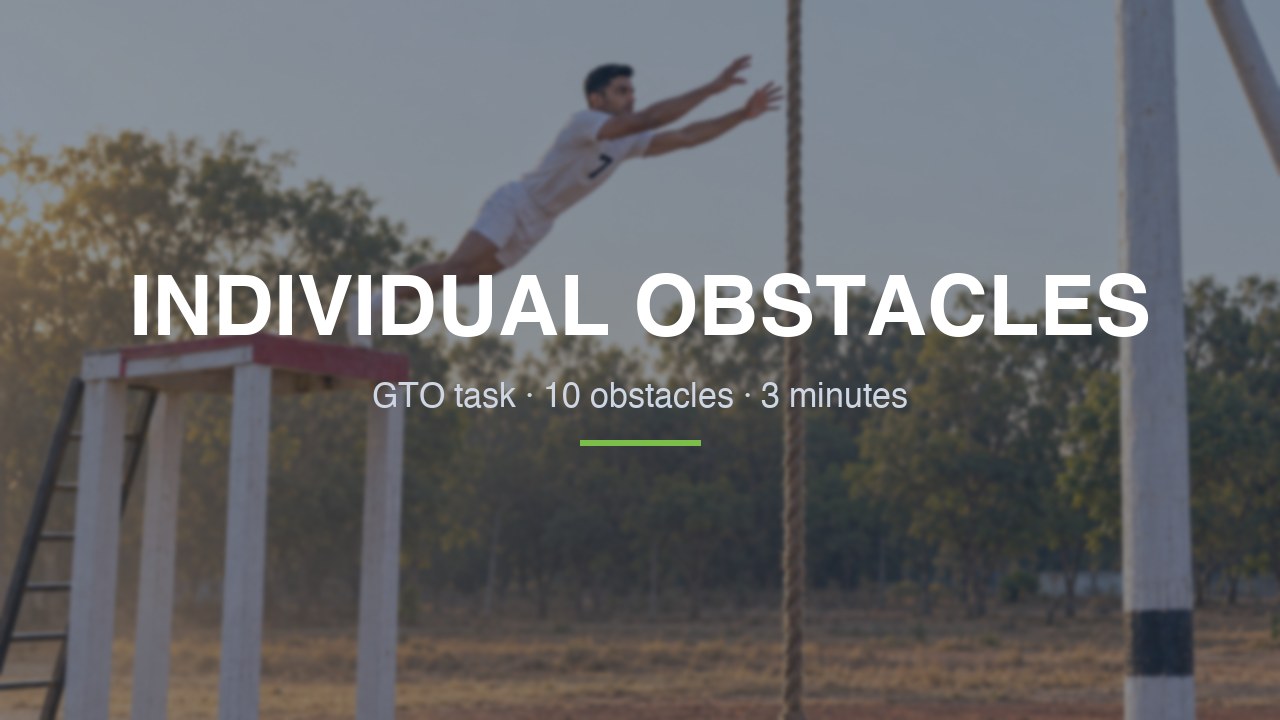
The complete video: all ten obstacles
Every obstacle shown being done, its marks, what to watch out for, and how to plan your three minutes. Free for members, with captions in eleven languages.
Scoring strategy — go for the high numbers
Higher-numbered obstacles are worth far more. Start with the high-value obstacles you can clear while you are fresh, and save the easy one-to-three-mark ones for the last seconds as insurance. Attempting a hard obstacle and not quite finishing still shows courage and determination.
A repeat scores again only after you have done all ten, and never the same obstacle twice in a row. So plan a route that takes all ten first, then repeat a high one near where you finish.
Courage is being scored, not just success
The GTO wants to see you commit to heights and jumps without hesitation. A bold, committed attempt that fails reads better than refusing to try. Hesitation at the take-off is the thing to train out.
Fitness underwrites all of it
You can't technique your way past poor stamina here. Basic running, pull-ups, and agility work in the weeks before make every obstacle easier and keep you scoring late in the three minutes.
The ten obstacles and what to watch for
Each obstacle is worth its own number in marks, 55 for all ten. A touch on red paint, or a slip, means doing that obstacle again.
1. Double Barrel: two drums lying end to end. Jump across them without touching.
2. Zig-Zag Beam: walk the whole beam with small, controlled steps. No getting down in between; a fall means starting the beam again.
3. Screen Jump: run up the ramp and jump the red cloth screen into the sand. Touch it and it falls: the jump does not count.
4. Burma Bridge: two ropes, one above the other. Walk the lower rope, hold the upper one, and look ahead, not down. It is the slowest of the ten.
5. Tarzan Swing: hold the rope high, fold your legs and land beyond the far chalk line. Landing short does not count.
6. Double Platform Jump: from the high platform down to the lower one, then into the sand, landing on your toes. Don't touch the red sides.
7. Double Ditch: catch the hanging rope in the jump, swing over the long ditch, then jump the short one. You may not take hold of the rope first.
8. Commando Walk: a narrow plank ten feet up, with a victory stand in the middle. Look ahead, not down.
9. Tiger Leap: leap off the high platform, catch the rope in the air and come down it. Commit to the leap.
10. Vertical Rope Climbing: climb with hands and feet to the blue mark, then come down under control. It counts only when you reach the mark.
Common mistakes to avoid
- ✗Burning the clock on low-value easy obstacles.
- ✗Hesitating at heights instead of committing.
- ✗Refusing to attempt the hard, high-scoring obstacles.
- ✗Arriving unfit and fading in the last minute.
Now practise it — free
Reading is step one. Create a free WishWas account to practise Individual Obstacles (IO) in a realistic simulator, get question banks and model answers, and study in your own language — all free.