Why this chapter matters. This is the most asked chapter of Chemistry. We found about 27 questions on it in the 12 papers we hold, from 2017 to 2026: more than two in a paper, and NDA II 2021 and NDA 2020 had five each. The questions are short. Count the electrons, protons and neutrons in an atom or an ion. Say who discovered what. Give the largest number of electrons a shell can hold. Find an average atomic mass from two isotopes. Learn first how to count the three particles from the atomic number and the mass number (section 3), because about half the questions need only that.
What you will be able to do
- Say what Thomson, Rutherford, Bohr and Chadwick each found, and what Rutherford's experiment did and did not show.
- Count protons, neutrons and electrons in any atom or ion, and spot species with the same number of electrons.
- Write the electron arrangement of the first 20 elements and read the valency from it.
- Tell isotopes from isobars, and work out an average atomic mass and an equivalent weight.
Before you start you should know symbols, valency in formulae, and molecular mass (Chapter C1-2).
1. The three particles inside the atom
Dalton thought the atom could not be divided. Experiments with electricity in gases at low pressure showed that it can.
When a high voltage is applied across a glass tube from which most of the air has been pumped out, rays travel from the cathode (the negative plate) to the anode. These cathode rays travel in straight lines, are bent by electric and magnetic fields, and are made of negative particles. J. J. Thomson showed that the particles are the same whatever gas or metal is used. They are electrons. The picture tube of an old television is a cathode ray tube.
| Particle | Charge | Mass | Where | Found by |
|---|---|---|---|---|
| Electron | −1 | About 1/1840 of a proton (school books often round this to 1/2000); taken as zero when counting mass | Outside the nucleus | J. J. Thomson, 1897 |
| Proton | +1 | 1 u | In the nucleus | From the positive "canal rays" seen by Goldstein in 1886; the particle was named by Rutherford |
| Neutron | 0 | 1 u (very slightly more than a proton) | In the nucleus | James Chadwick, 1932 |
Protons and neutrons together are called nucleons. The only common atom with no neutron is ordinary hydrogen.
2. Models of the atom
| Model | Picture | What it explained, and where it failed |
|---|---|---|
| Thomson (the "plum pudding" or watermelon model) | A ball of positive charge with electrons stuck in it like seeds in a watermelon | Explained why the atom is neutral. Could not explain Rutherford's result |
| Rutherford (the nuclear model, 1911) | A tiny, heavy, positive nucleus at the centre; electrons revolve around it; the rest is empty space | Explained the scattering of alpha particles. Could not explain why the atom is stable |
| Bohr (1913) | Electrons revolve only in certain fixed orbits (shells, or energy levels) and do not lose energy while they stay in them | Explained why the atom is stable |
Rutherford's gold foil experiment. Fast alpha particles (positive, mass 4 u) were fired at a very thin gold foil.
| What was seen | What it means |
|---|---|
| Most alpha particles passed straight through | Most of the atom is empty space |
| A few were turned through small angles | The positive charge takes up very little space |
| Very few, about 1 in 12,000, came almost straight back | All the positive charge and nearly all the mass are packed into a very small nucleus |
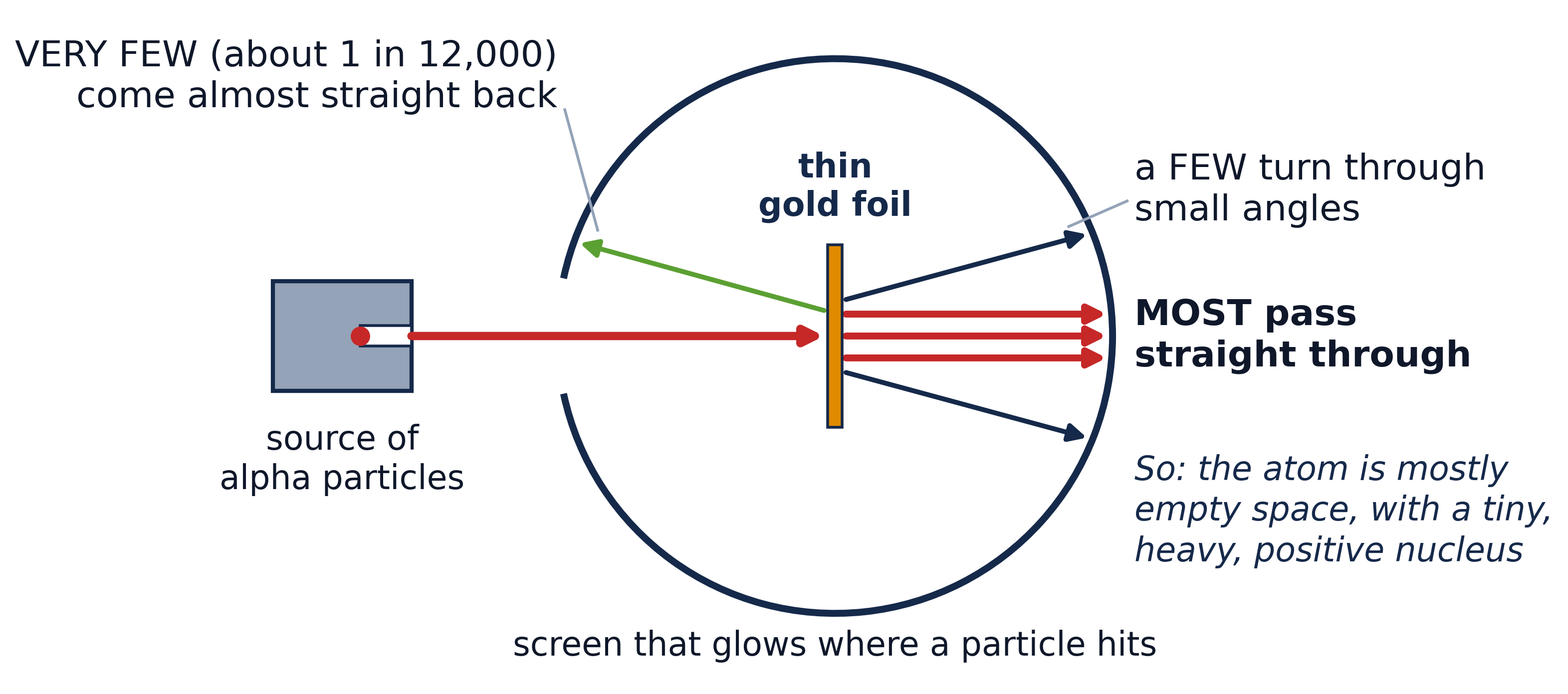
The radius of the nucleus is about 100,000 times (10⁵ times) smaller than the radius of the atom.
What Rutherford's experiment did not show. It did not find the neutron (that was Chadwick, 21 years later). It did not say that electrons move in orbits of fixed energy (that is Bohr). The nucleus it found is positive, not neutral. The papers have tested each of these three points.
The weakness of Rutherford's model. A charged particle moving in a circle should keep giving out energy, so the electron should spiral into the nucleus and the atom should collapse. Bohr answered this by saying that in its allowed orbits an electron does not radiate energy.
3. Atomic number and mass number
- Atomic number (Z) = number of protons. It fixes which element the atom is, so it is the most fundamental property of an element.
- Mass number (A) = number of protons + number of neutrons = number of nucleons.
- So the number of neutrons = A − Z.
- In a neutral atom, electrons = protons = Z.
- In an ion, electrons = Z − (charge). A positive ion has lost electrons; a negative ion has gained them.
The mass number is written at the top left of the symbol and the atomic number at the bottom left.
| Species | Z | A | Protons | Neutrons | Electrons |
|---|---|---|---|---|---|
| Aluminium atom, Al | 13 | 27 | 13 | 14 | 13 |
| Aluminium ion, Al³⁺ | 13 | 27 | 13 | 14 | 10 |
| Chlorine atom, Cl | 17 | 35 | 17 | 18 | 17 |
| Chloride ion, Cl⁻ | 17 | 35 | 17 | 18 | 18 |
| Sulphide ion, S²⁻ | 16 | 32 | 16 | 16 | 18 |
Isoelectronic species have the same number of electrons. Two sets are worth knowing:
- 10 electrons: N³⁻, O²⁻, F⁻, Ne, Na⁺, Mg²⁺, Al³⁺.
- 18 electrons: S²⁻, Cl⁻, Ar, K⁺, Ca²⁺.
4. Electron shells and valency
Electrons fill shells around the nucleus, starting from the one nearest to it. The shells are named K, L, M, N (n = 1, 2, 3, 4).
| Shell | n | Largest number of electrons, 2n² |
|---|---|---|
| K | 1 | 2 |
| L | 2 | 8 |
| M | 3 | 18 |
| N | 4 | 32 |
A second rule: the outermost shell never holds more than 8 electrons. So potassium (19 electrons) is 2, 8, 8, 1 and not 2, 8, 9.
The electrons in the outermost shell are the valence electrons. An atom is stable with 8 electrons in its outer shell (2 for helium). Valency is the number of electrons an atom loses, gains or shares to reach this. With 1, 2, 3 or 4 valence electrons the valency is that number. With 5, 6 or 7 it is 8 minus that number. With a full shell it is 0.
| Element | Z | Arrangement (K, L, M, N) | Valence electrons | Valency |
|---|---|---|---|---|
| Hydrogen | 1 | 1 | 1 | 1 |
| Helium | 2 | 2 | 2 | 0 |
| Carbon | 6 | 2, 4 | 4 | 4 |
| Nitrogen | 7 | 2, 5 | 5 | 3 |
| Oxygen | 8 | 2, 6 | 6 | 2 |
| Fluorine | 9 | 2, 7 | 7 | 1 |
| Neon | 10 | 2, 8 | 8 | 0 |
| Sodium | 11 | 2, 8, 1 | 1 | 1 |
| Magnesium | 12 | 2, 8, 2 | 2 | 2 |
| Aluminium | 13 | 2, 8, 3 | 3 | 3 |
| Silicon | 14 | 2, 8, 4 | 4 | 4 |
| Phosphorus | 15 | 2, 8, 5 | 5 | 3 |
| Sulphur | 16 | 2, 8, 6 | 6 | 2 |
| Chlorine | 17 | 2, 8, 7 | 7 | 1 |
| Argon | 18 | 2, 8, 8 | 8 | 0 |
| Potassium | 19 | 2, 8, 8, 1 | 1 | 1 |
| Calcium | 20 | 2, 8, 8, 2 | 2 | 2 |
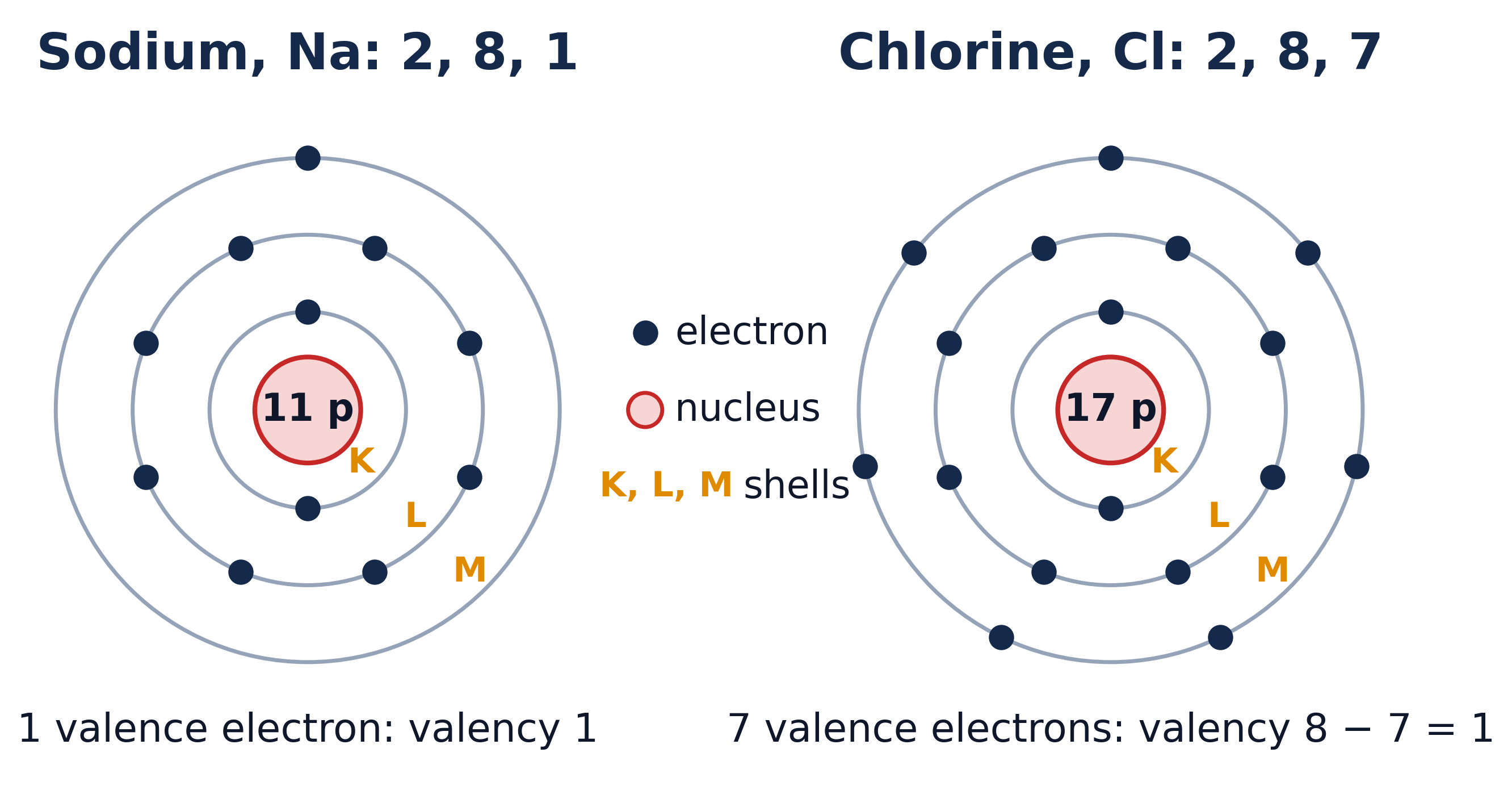
Elements in the same group of the periodic table have the same number of valence electrons and so the same valency. Sodium and potassium both have valency 1. Magnesium, calcium and barium all have valency 2. If an element X forms a chloride XCl₂, its valency is 2, so it belongs with magnesium and calcium.
5. Isotopes and isobars
| Isotopes | Isobars | |
|---|---|---|
| Meaning | Atoms of the same element with different mass numbers | Atoms of different elements with the same mass number |
| Same | Atomic number (protons) | Mass number |
| Different | Number of neutrons | Atomic number |
| Chemical properties | The same | Different |
| Examples | Hydrogen: protium (A = 1), deuterium (A = 2), tritium (A = 3). Carbon-12 and carbon-14. Chlorine-35 and chlorine-37 | Argon-40 (Z = 18) and calcium-40 (Z = 20) |
Uses of isotopes
| Isotope | Use |
|---|---|
| Uranium-235 | Fuel in nuclear reactors |
| Cobalt-60 | Treatment of cancer |
| Iodine-131 | Treatment of goitre (a disease of the thyroid gland) |
| Carbon-14 | Finding the age of old remains of plants and animals |
Average atomic mass. Most elements are a mixture of isotopes, so the atomic mass in the table is an average, weighted by how much of each isotope there is.
Chlorine is chlorine-35 and chlorine-37 in the ratio 3 : 1. Average = (3 × 35 + 1 × 37) ÷ 4 = 142 ÷ 4 = 35.5 u.
The reverse question: boron has isotopes of mass 10 and 11 and an average atomic mass of 10.81. Let the percentage of boron-10 be x. Then 10x + 11(100 − x) = 1081, so x = 19. Boron is about 19% boron-10 and 81% boron-11. A quick check without algebra: 10.81 is much nearer to 11 than to 10, so boron-11 must be the larger share.
6. Atomic, molecular and equivalent weights
The atomic mass unit (u) is one-twelfth of the mass of one atom of carbon-12. The atomic mass (older books say atomic weight) of an element is the average mass of its atoms in these units. The molecular mass is the sum of the atomic masses in the formula, as in Chapter C1-2.
The equivalent weight of a substance is the mass of it that combines with or displaces 1 part by mass of hydrogen (or 8 parts of oxygen). In practice it is found by a division.
| Kind of substance | Equivalent weight | Examples |
|---|---|---|
| Element | Atomic mass ÷ valency | Oxygen 16 ÷ 2 = 8. Magnesium 24 ÷ 2 = 12. Aluminium 27 ÷ 3 = 9 |
| Acid | Molecular mass ÷ basicity (the number of H⁺ ions one molecule can give) | HCl 36.5 ÷ 1 = 36.5. H₂SO₄ 98 ÷ 2 = 49 |
| Base | Molecular mass ÷ acidity (the number of OH⁻ ions one formula unit can give) | NaOH 40 ÷ 1 = 40. Ca(OH)₂ 74 ÷ 2 = 37 |
Crystals of oxalic acid have the formula H₂C₂O₄·2H₂O. The molecular mass is 90 + 36 = 126, and the acid can give two H⁺ ions, so its equivalent weight is 126 ÷ 2 = 63. NDA I 2019 asked this. The water of crystallisation must be counted in the mass.
What the papers have asked
| Paper | The idea asked | The answer in one line |
|---|---|---|
| NDA II 2017, NDA I 2019, NDA II 2021 | Which species have the same number of electrons | Count electrons = Z − charge. F⁻, Ne, Na⁺ and O²⁻ all have 10 |
| NDA I 2019 | Equivalent weight of crystalline oxalic acid | 126 ÷ 2 = 63 |
| NDA II 2019 | The false statement about cathode rays | They start from the cathode, not the anode |
| NDA 2020, NDA II 2021, NDA II 2024 | Largest number of electrons in a shell | K 2, L 8, M 18, N 32 |
| NDA 2020 | The most fundamental property of an element | Atomic number |
| NDA 2020, NDA I 2025 | Who discovered the neutron | James Chadwick |
| NDA 2020, NDA II 2021 | The element whose isotope treats cancer | Cobalt |
| NDA I 2021, NDA I 2025 | What does not follow from Rutherford's model | Orbits of fixed energy (Bohr); and the nucleus is positive, not neutral |
| NDA II 2021 | Average atomic mass of chlorine, isotopes 35 and 37 in the ratio 3 : 1 | 35.5 u |
| NDA I 2024 | Percentages of boron-10 and boron-11 from the average 10.81 | 19% and 81% |
| NDA I 2024 | Who proposed stable orbits in which electrons do not radiate | Niels Bohr |
| NDA I 2021, NDA II 2024 | Valency | Mg, Ca and Ba all have 2; nitrogen has 3; the nitride ion has 3 |
| NDA II 2024 | The false statement about aluminium (Z = 13, A = 27) | "Its valency is 2" is false; it is 3 |
| NDA I 2025 | The true statement among four | The mass of an electron is about 1/2000 of that of a proton |
| NDA I 2026 | Electrons and nucleons in the sulphide ion of mass number 32 | 18 electrons and 32 nucleons |
Worked examples
Example 1. An ion has 12 protons, 12 neutrons and 10 electrons. What are its mass number and its charge?
(a) 22 and +2 (b) 24 and −2 (c) 24 and +2 (d) 34 and +2
Solution. Mass number = protons + neutrons = 24. Electrons are never counted in it, which rules out 22 and 34. There are 2 more protons than electrons, so the charge is +2. The ion is Mg²⁺. Answer (c).
Example 2. Consider the following statements about Rutherford's alpha-particle scattering experiment:
Statement 1: Most alpha particles passed straight through the foil, which shows that most of the atom is empty space.
Statement 2: The experiment showed that electrons revolve in orbits of fixed energy.
Which of the statements given above is/are correct?
(a) 1 only (b) 2 only (c) Both 1 and 2 (d) Neither 1 nor 2
Solution. Statement 1 is the first conclusion of the experiment. Orbits of fixed energy are Bohr's idea, proposed later to explain why the atom is stable; nothing in the scattering experiment shows it. Answer (a).
Example 3. An element has two isotopes of mass 20 u and 22 u in the ratio 9 : 1. What is its average atomic mass?
(a) 20.2 u (b) 20.9 u (c) 21.0 u (d) 21.8 u
Solution. Average = (9 × 20 + 1 × 22) ÷ 10 = 202 ÷ 10 = 20.2 u. The plain middle value 21.0 would be right only if the two isotopes were equally common. Answer (a).
Example 4. Match the scientist with the contribution.
A. J. J. Thomson. B. Ernest Rutherford. C. James Chadwick. D. Niels Bohr.
Contributions: 1. Neutron. 2. Fixed energy levels for electrons. 3. Electron. 4. Nucleus.
(a) A-3, B-4, C-1, D-2 (b) A-4, B-3, C-1, D-2 (c) A-3, B-2, C-1, D-4 (d) A-1, B-4, C-3, D-2
Solution. Thomson found the electron, Rutherford the nucleus, Chadwick the neutron, and Bohr gave the fixed energy levels. Chadwick and the neutron is the surest pair; it leaves (a), (b) and (c). Thomson with the electron then leaves (a) and (c), and Rutherford with the nucleus leaves (a). Answer (a).
Example 5. Which one of the following pairs is isoelectronic? (Atomic numbers: Na 11, Mg 12, Cl 17, Ar 18, K 19)
(a) Na⁺ and Cl⁻ (b) K⁺ and Cl⁻ (c) Mg²⁺ and Ar (d) Na⁺ and K⁺
Solution. K⁺ has 19 − 1 = 18 electrons and Cl⁻ has 17 + 1 = 18. Na⁺ and Mg²⁺ have 10 each, so they do not match Cl⁻, Ar or K⁺. Option (a) is tempting because the two ions make common salt, but 10 is not 18. Answer (b).
Example 6. What is the equivalent weight of sulphuric acid, H₂SO₄? (H = 1, S = 32, O = 16)
(a) 24.5 (b) 49 (c) 98 (d) 196
Solution. Molecular mass = 2 + 32 + 64 = 98. One molecule can give two H⁺ ions, so the basicity is 2 and the equivalent weight is 98 ÷ 2 = 49. Option (c) forgets to divide. Answer (b).
Mistakes that cost marks
- Getting the sign wrong for an ion. A negative ion has extra electrons: add. A positive ion has lost electrons: subtract. S²⁻ has 16 + 2 = 18 electrons, not 14.
- Counting electrons in the mass number. The mass number counts only protons and neutrons.
- Filling the M shell to 18 too early. The M shell can hold 18, but the outermost shell stops at 8. Potassium is 2, 8, 8, 1 and calcium is 2, 8, 8, 2.
- Mixing up isotopes and isobars. Isotopes: same element, same Z. Isobars: same mass number, different elements.
Quick check
Do these without help. Answers are at the end.
- Q1. How many protons, neutrons and electrons are there in the ion Ca²⁺ (Z = 20, A = 40)?
- Q2. Write the electron arrangement of phosphorus (Z = 15) and give its valency.
- Q3. What is the largest number of electrons the N shell can hold?
- Q4. Argon-40 and calcium-40: are they isotopes or isobars?
- Q5. What is the equivalent weight of aluminium (atomic mass 27)?
Read and watch more, free
| What | Where | Language |
|---|---|---|
| Textbook, the atom | NCERT Class 9 Exploration, chapter 8 "Journey Inside the Atom" and chapter 9 "Atomic Foundations of Matter" | English; the Hindi edition (Anveshan) is on the NCERT textbook page |
| Textbook, the atom in full | NCERT Class 11 Chemistry Part I, chapter 2 "Structure of Atom" | English; Hindi edition on the same NCERT page |
| Older textbook chapter that most NDA classes follow | Old NCERT Class 9, "Structure of the Atom" (a saved copy of the withdrawn book) | English |
| Self-study notes | NIOS Science and Technology (212), lessons 3 "Atoms and Molecules" and 5 "Atomic Structure" | English and Hindi |
| Equivalent weight (not in NCERT) | NIOS Chemistry (313), lesson 7 "Solutions" · Wikipedia: Equivalent weight | English and Hindi (NIOS); English |
| Video, the unit for NDA | Defence Wallah: Complete Chemistry, NDA Fast Track Series (the class on atomic structure and chemical calculation) | Hinglish |
| Video, NDA classes | Learn with Sumit: NDA Chemistry Preparation (the basic chemistry classes) | Hindi and Hinglish |
| Video, the textbook chapter step by step | Magnet Brains: Class 9 Chemistry (follows the older Class 9 book) | Hinglish |
The videos were chosen from their titles, length and views; they have not yet been watched by a teacher.
Answers to the quick check
- Q1. 20 protons, 20 neutrons and 18 electrons.
- Q2. 2, 8, 5. Valency 8 − 5 = 3.
- Q3. 32 (2 × 4²).
- Q4. Isobars: the same mass number, but different elements (Z = 18 and Z = 20).
- Q5. 27 ÷ 3 = 9.
Next chapter: Air and water.