Why this chapter matters. We found about 19 questions on this chapter in the 12 papers we hold, from 2017 to 2026. That is more than one question in a paper, and NDA II 2023 alone had five. Almost all are single-fact questions: "which of these is a chemical change", "which of these is not a mixture", "which method separates these two". Since 2025 the "which statement is NOT correct" form is common. Learn the two tables in sections 1 and 5 first: they answer most of these questions.
What you will be able to do
- Decide in a few seconds whether a change is physical or chemical, and give the reason.
- Sort any substance into element, compound or mixture, and a mixture into solution, colloid or suspension.
- Choose the right method to separate a given mixture.
- Avoid the traps the papers set: ice, alloys, colloids and dissolving.
Before you start you should know the three states of matter (solid, liquid, gas) and the words melting, boiling, evaporation and condensation. Nothing else is needed. This is the first chapter of Chemistry.
1. Physical change and chemical change
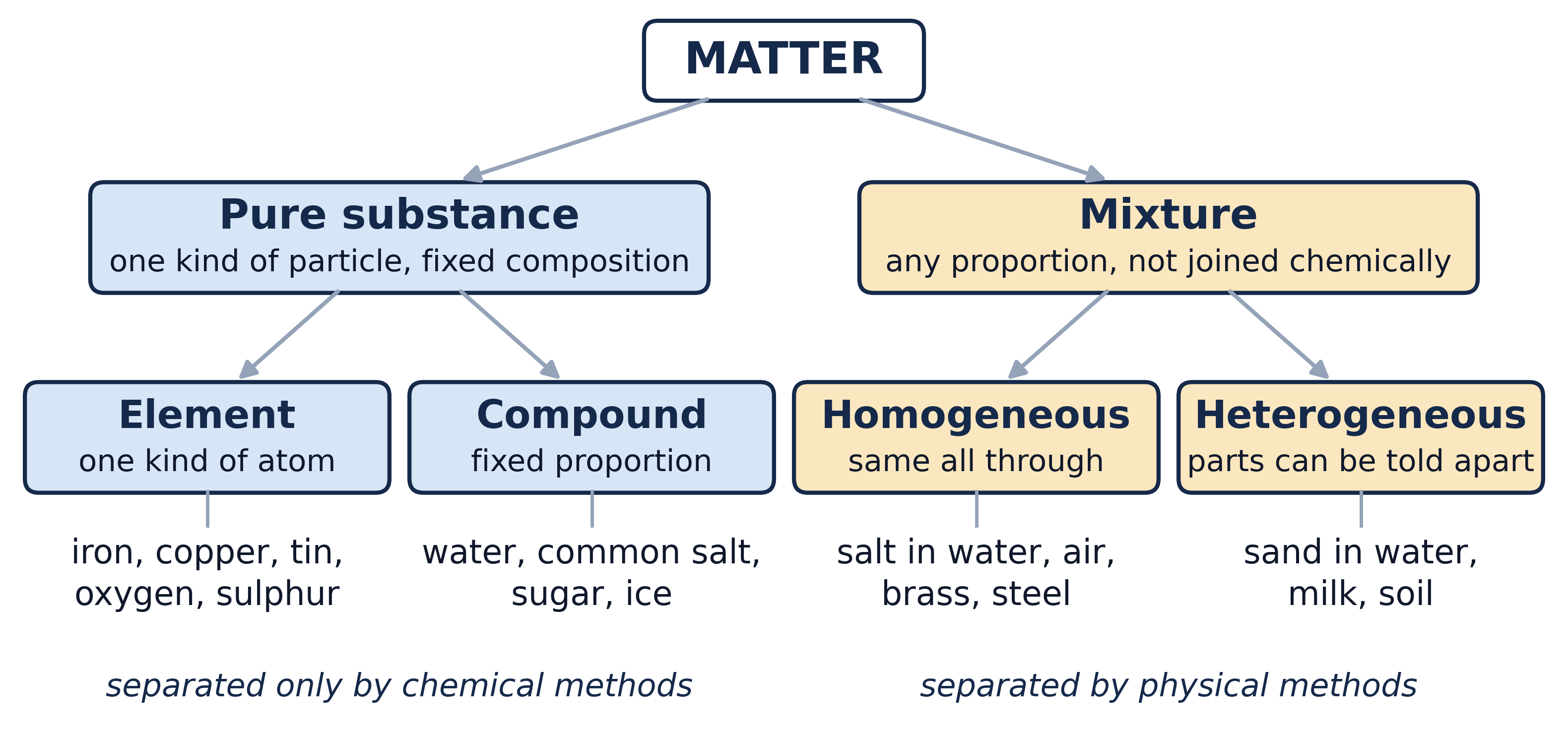
In a physical change the substance stays the same substance. Only its state, shape or size changes. Ice melts to water and water boils to steam, but all three are H₂O.
In a chemical change one or more new substances are formed. Iron rusts: the brown powder is not iron, it is a new substance, hydrated iron oxide (Fe₂O₃·xH₂O). A chemical change is also called a chemical reaction.
| Physical change | Chemical change | |
|---|---|---|
| New substance | None is formed | At least one is formed |
| Composition of the molecules | Does not change | Changes |
| Can it be reversed? | Usually, and easily | Usually not by simple means |
| Energy | Small amounts of heat taken in or given out | Often a lot of heat, light or sound |
| Examples | Melting, boiling, freezing, dissolving, sublimation, cutting, bending, heating an iron rod till it glows | Burning, rusting, cooking, digestion, souring of milk, ripening of fruit, an acid meeting a base |
Signs that a chemical change has happened: a gas is given off, the colour changes for good, a solid (a precipitate) appears in a liquid, or heat and light are produced. A soldier who leaves his rifle uncleaned in the monsoon sees one of these signs: the brown colour of rust.
Rusting needs both oxygen and water. Burning needs oxygen. When a magnesium ribbon burns with a white dazzling flame, the white ash is a new substance, magnesium oxide:
2Mg + O₂ → 2MgO
Cases the papers like
| Change | Type | Why |
|---|---|---|
| Dissolving salt or sugar in water | Physical | Evaporate the water and the salt comes back unchanged |
| Sublimation of camphor | Physical | Solid camphor becomes camphor vapour; no new substance |
| Heating an iron rod red hot | Physical | It cools back to the same iron |
| Greying of hair, ripening of fruit | Chemical | The body or the fruit makes or loses a substance (a pigment, a sugar) |
| A cut apple turning brown | Chemical | Substances in the apple react with oxygen |
| Mixing sodium hydroxide and hydrochloric acid | Chemical | Salt and water are formed: NaOH + HCl → NaCl + H₂O |
| Burning of a candle | Both | The wax melts (physical) and the wax burns to carbon dioxide and water (chemical) |
| Storing oxygen under pressure in a cylinder | Physical | Only the gas is squeezed into a smaller volume |
2. Pure substances: elements and compounds
A pure substance has only one kind of particle and a fixed composition. There are two kinds.
An element cannot be broken into anything simpler by a chemical reaction. It has only one kind of atom. Iron, copper, tin, oxygen, hydrogen and sulphur are elements. There are 118 known elements.
| Kind of element | Properties | Examples |
|---|---|---|
| Metals | Shiny, conduct heat and electricity, can be beaten into sheets and drawn into wires | Iron, copper, gold, sodium, mercury |
| Non-metals | Usually dull, poor conductors | Carbon, sulphur, oxygen, iodine, bromine |
| Metalloids | Properties in between | Boron, silicon, germanium |
Two elements are liquid at room temperature: mercury (a metal) and bromine (a non-metal). Gallium and caesium melt just above room temperature, at about 30 °C, so they are not counted.
A compound is made of two or more elements joined chemically in a fixed proportion by mass. Water is always 1 g of hydrogen to 8 g of oxygen. The compound does not behave like its elements: hydrogen burns and oxygen helps burning, but water puts out a fire. A compound can be broken up only by a chemical or electrochemical reaction, for example by passing electricity through water.
Because its composition is fixed, a compound is a pure substance. NDA I 2025 tested exactly this.
3. Mixtures
A mixture has two or more substances mixed in any proportion and not joined chemically. Each substance keeps its own properties, and the parts can be separated by physical methods.
The classic experiment: mix iron filings and sulphur powder. A magnet pulls the iron out, so it is a mixture. Now heat the mixture strongly. A black solid, iron sulphide (FeS), forms. A magnet no longer pulls out any iron. It is now a compound.
| Mixture | Compound | |
|---|---|---|
| Proportion of the parts | Any | Fixed |
| Properties | Those of its parts | New, unlike its elements |
| Separation | Physical methods | Only chemical or electrochemical methods |
| Energy change on making it | Usually none | Heat or light is usually given out or taken in |
| Melting and boiling point | Not sharp | Sharp and fixed |
| Examples | Air, sea water, soil, milk, brass, gunpowder | Water, common salt, sugar, carbon dioxide |
Homogeneous and heterogeneous. A mixture that is the same all through is homogeneous: salt in water, sugar in water, air. A mixture in which different parts can be seen or found is heterogeneous: sand in water, oil in water, a mixture of salt crystals and sugar crystals.
Alloys are mixtures. An alloy is a homogeneous mixture of metals, or of a metal with a non-metal. Brass is copper and zinc. Bronze is copper and tin. Steel is iron with a little carbon, so it is the common alloy that has a non-metal in it.
Common traps. Ice is only solid water, a pure compound, but ice-cream is a mixture. Air, honey, milk, soil and sea water are mixtures. Tin is an element. Gunpowder is a mixture of potassium nitrate, charcoal and sulphur.
4. Solutions, colloids and suspensions
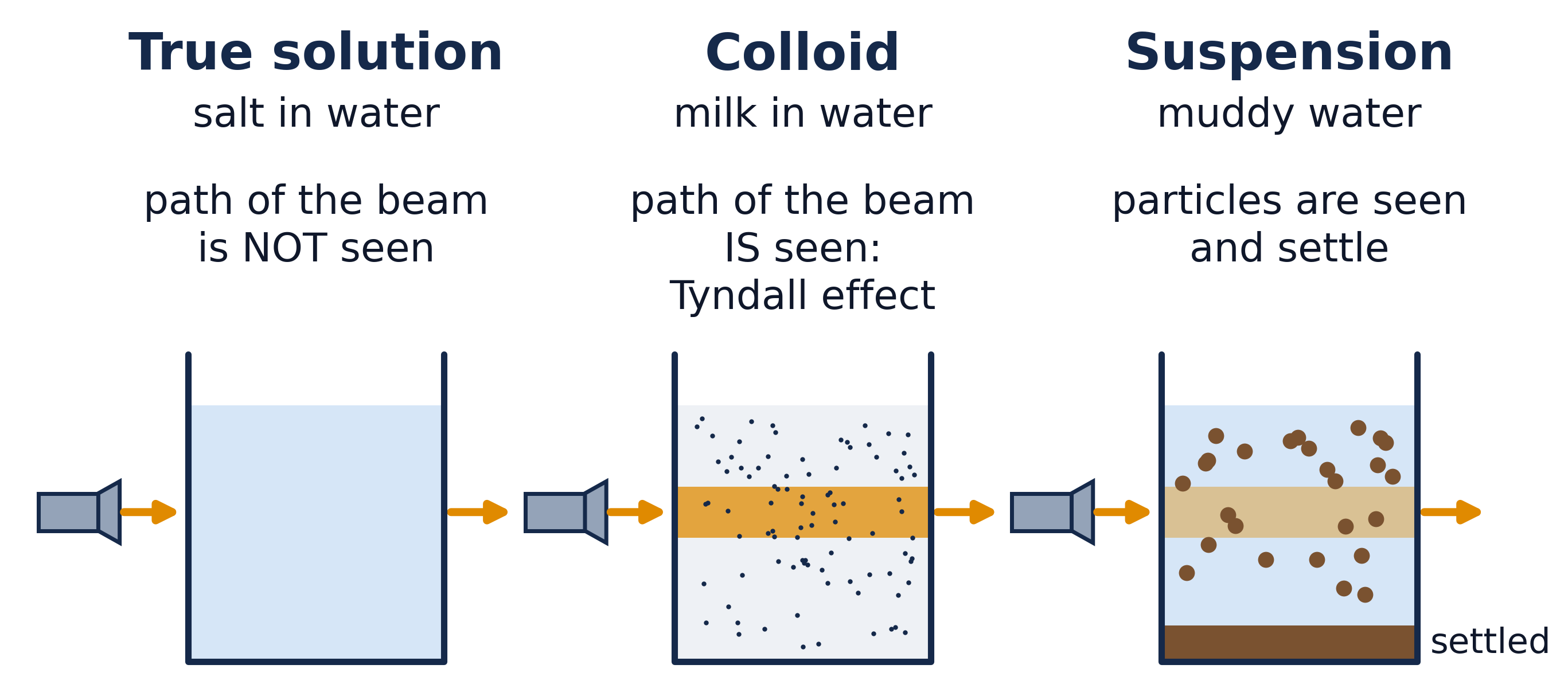
Mix a solid into a liquid and one of three things results. The difference is the size of the particles.
| True solution | Colloid | Suspension | |
|---|---|---|---|
| Example | Salt in water, copper sulphate in water | Milk, fog, smoke, starch in water | Muddy water, chalk powder in water |
| Particle size | Smaller than about 1 nm | In between, about 1 nm to 1000 nm | Larger |
| Can the particles be seen? | No | Not with the naked eye | Yes |
| Homogeneous? | Yes | No. It looks homogeneous but is heterogeneous | No, heterogeneous |
| Settles on standing? | No | No, it is stable | Yes |
| Passes through filter paper? | Yes | Yes | No, the solid stays on the paper |
| Scatters a beam of light (Tyndall effect)? | No | Yes | Yes, until the particles settle |
The Tyndall effect is the scattering of light by colloid particles, which makes the path of the beam visible. You see it when sunlight enters a dusty room through a small hole, or when the beam of a vehicle's headlight is seen in fog. Copper sulphate solution does not show it. Milk mixed with water does.
Colloid particles cannot be filtered out, but they can be separated by centrifugation.
| Type of colloid | What is spread in what | Examples |
|---|---|---|
| Aerosol | Liquid in gas | Fog, clouds, mist |
| Aerosol | Solid in gas | Smoke |
| Foam | Gas in liquid | Shaving cream |
| Emulsion | Liquid in liquid | Milk, face cream |
| Sol | Solid in liquid | Milk of magnesia, mud |
| Gel | Liquid in solid | Jelly, cheese, butter |
In a solution the substance that dissolves is the solute and the substance it dissolves in is the solvent. The same solute can behave differently in different solvents: sulphur does not dissolve in water (a heterogeneous mixture), but it dissolves in carbon disulphide to give a true, homogeneous solution. NDA II 2025 asked this.
5. Methods of separation
Each method uses one difference between the parts of the mixture.
| Method | Difference it uses | Typical use |
|---|---|---|
| Filtration | Solid does not dissolve in the liquid | Sand from water, tea leaves from tea |
| Sedimentation and decantation | Heavy solid settles | Mud from water |
| Evaporation | Solid does not turn to vapour, liquid does | Salt from sea water, dye from ink |
| Crystallisation | Pure solid forms crystals from a hot strong solution on cooling | Pure copper sulphate or alum from an impure sample |
| Distillation | Two miscible liquids with boiling points far apart (more than about 25 °C) | Acetone and water; pure water from salt water |
| Fractional distillation | Miscible liquids with boiling points close together | Petrol and kerosene, the parts of crude oil, the gases of liquid air |
| Separating funnel | Two liquids that do not mix; the heavier forms the lower layer | Oil and water, kerosene and water |
| Sublimation | One solid turns straight to vapour on heating | Ammonium chloride, camphor, naphthalene, anthracene or iodine from salt or sand |
| Chromatography | Substances move at different speeds through paper with a solvent | Colours in ink or dye, pigments in a plant extract |
| Centrifugation | Heavier particles move outward when spun fast | Cream from milk, blood and urine tests in laboratories, the dryer of a washing machine |
| Magnetic separation | One part is attracted by a magnet | Iron from sulphur or from scrap |
Three points are asked again and again.
- Evaporation or crystallisation? Both recover a dissolved solid that does not turn to vapour. Crystallisation is better for a pure product, because some solids (such as sugar) char on heating to dryness and because dissolved impurities stay behind in the liquid.
- Distillation or fractional distillation? Look at the boiling points. Far apart: simple distillation. Close together: fractional distillation, which uses a tall fractionating column.
- Gases from air. Air is cooled and compressed to a liquid, then warmed slowly in a fractionating column. Nitrogen (boiling point −196 °C) boils off first, then argon (−186 °C), then oxygen (−183 °C).
What the papers have asked
| Paper | The idea asked | The answer in one line |
|---|---|---|
| NDA II 2017 | Which everyday change is chemical | Greying of hair. Cutting hair or fruit is physical |
| NDA I 2019, NDA II 2019 | Which substance is not a mixture | Ice (a compound) in one paper, tin (an element) in the other |
| NDA II 2021 | Two elements that are liquid at room temperature | Mercury and bromine |
| NDA II 2021 | Separating a solid that sublimes from common salt | Sublimation |
| NDA II 2021 | What the Tyndall effect is | Scattering of light by colloid particles |
| NDA II 2023 | Matching mixtures with separation methods | Acetone and water: distillation. Kerosene and water: separating funnel. Cream from milk: centrifugation. Plant pigments: chromatography |
| NDA II 2023 | Separating petrol and kerosene | Fractional distillation |
| NDA II 2023 | The false statement about a colloid | "It is homogeneous" is false |
| NDA II 2023 | The alloy that contains a non-metal | Steel (it contains carbon) |
| NDA II 2024 | Separation technique used in blood tests | Centrifugation |
| NDA II 2024 | Which change is chemical | Mixing sodium hydroxide and hydrochloric acid |
| NDA I 2025 | The false statement about a compound | "A compound is an impure substance" is false |
| NDA II 2025 | The false statement about physical change | "The chemical composition changes" is false |
| NDA II 2025 | Which mixture is not heterogeneous | Sulphur in carbon disulphide, a true solution |
| NDA I 2026 | Getting a non-volatile solid out of a solution | Both evaporation and crystallisation work |
Worked examples
Example 1. Which one of the following is a chemical change?
(a) Dissolving sugar in tea (b) Souring of milk (c) Breaking of a glass tumbler (d) Melting of wax
Solution. In souring, the milk sugar is turned into a new substance, lactic acid, so it is a chemical change. Dissolving is the tempting wrong answer because the sugar "disappears", but the sugar is still there and can be got back. Answer (b).
Example 2. Consider the following statements:
Statement 1: Air is a homogeneous mixture.
Statement 2: Brass is a compound of copper and zinc.
Which of the statements given above is/are correct?
(a) 1 only (b) 2 only (c) Both 1 and 2 (d) Neither 1 nor 2
Solution. Air is the same all through, so statement 1 is correct. Brass is an alloy. The copper and zinc are mixed, not joined chemically, and their proportion can vary, so brass is a mixture and statement 2 is wrong. Answer (a).
Example 3. Match the mixture with the method used to separate it.
A. Iodine and sand. B. Mustard oil and water. C. The colours in black ink. D. Common salt from sea water.
Methods: 1. Chromatography. 2. Evaporation. 3. Sublimation. 4. Separating funnel.
(a) A-3, B-4, C-1, D-2 (b) A-3, B-1, C-4, D-2 (c) A-2, B-4, C-1, D-3 (d) A-4, B-3, C-2, D-1
Solution. Iodine sublimes and sand does not (3). Oil and water do not mix (4). Colours in ink travel at different speeds on paper (1). Salt is left when sea water evaporates (2). Start with the pair you are surest of: B-4 removes two options at once. Answer (a).
Example 4. Consider the following statements about a colloid:
Statement 1: A beam of light passing through it becomes visible.
Statement 2: Its particles settle down when it is left undisturbed.
Statement 3: It passes through an ordinary filter paper.
Which of the statements given above are correct?
(a) 1 and 2 only (b) 1 and 3 only (c) 2 and 3 only (d) 1, 2 and 3
Solution. Statement 1 is the Tyndall effect: correct. A colloid is stable and does not settle: statement 2 is wrong (that is a suspension). Colloid particles are small enough to pass through filter paper: statement 3 is correct. Answer (b).
Example 5. Ethanol boils at 78 °C and water at 100 °C. They mix completely. Which method separates them best?
(a) Separating funnel (b) Evaporation (c) Fractional distillation (d) Sublimation
Solution. The liquids mix, so a separating funnel is useless. The boiling points differ by only 22 °C, which is less than about 25 °C, so fractional distillation is needed. Evaporation would lose both liquids. Answer (c).
Mistakes that cost marks
- "Dissolving is a chemical change." It is physical. No new substance forms, and the solid comes back on evaporation.
- "A colloid is homogeneous because it looks uniform." A colloid is heterogeneous. Only a true solution is homogeneous.
- "Ice and water together make a mixture" or "ice is a mixture". Ice is water in the solid state, one pure compound.
- Mixing up the two liquid methods. Liquids that do not mix: separating funnel. Liquids that mix: distillation, and fractional distillation if the boiling points are close.
Quick check
Do these without help. Answers are at the end.
- Q1. Is the burning of a candle a physical change, a chemical change or both?
- Q2. Name the two elements that are liquid at room temperature.
- Q3. Which method separates cream from milk?
- Q4. Is milk a solution, a colloid or a suspension? Does it show the Tyndall effect?
- Q5. A mixture has ammonium chloride and common salt. Which method separates them?
Read and watch more, free
| What | Where | Language |
|---|---|---|
| Textbook, physical and chemical changes | NCERT Class 7 Curiosity, chapter 5 "Changes Around Us: Physical and Chemical" | English; the Hindi edition is on the NCERT textbook page |
| Textbook, elements, compounds and mixtures | NCERT Class 8 Curiosity, chapter 8 "Nature of Matter: Elements, Compounds, and Mixtures" | English; Hindi edition on the same NCERT page |
| Textbook, separation methods | NCERT Class 9 Exploration, chapter 5 "Exploring Mixtures and their Separation" | English; Hindi edition (Anveshan) on the same NCERT page |
| Older textbook chapter that most NDA classes follow | Old NCERT Class 9, "Is Matter Around Us Pure" (a saved copy of the withdrawn book) | English |
| Self-study notes | NIOS Science and Technology (212), lesson 2 "Matter" | English and Hindi |
| Video, the unit for NDA | Defence Wallah: Complete Chemistry, NDA Fast Track Series (the class on matter and its classification) | Hinglish |
| Video, NDA classes | Learn with Sumit: NDA Chemistry Preparation (the basic chemistry classes) | Hindi and Hinglish |
| Video, the textbook chapter step by step | Magnet Brains: Class 9 Chemistry (follows the older Class 9 book) | Hinglish |
The videos were chosen from their titles, length and views; they have not yet been watched by a teacher.
Answers to the quick check
- Q1. Both. Melting of the wax is physical; burning of the wax is chemical.
- Q2. Mercury and bromine.
- Q3. Centrifugation.
- Q4. A colloid (an emulsion). Yes, it shows the Tyndall effect.
- Q5. Sublimation. Ammonium chloride turns to vapour on heating and the salt stays behind.
Next chapter: Symbols, formulae, equations and the laws of chemical combination.