Why this chapter matters. We found about 18 questions on carbon in the 12 papers we hold, from 2017 to 2026. Ten of the twelve papers had at least one. More than half were on the allotropes: diamond, graphite, fullerene and graphene. The favourite form is "which one of the following statements is not correct". Learn the table of allotropes in section 2 first; it is worth a mark in almost every paper.
What you will be able to do
- Explain why carbon forms more compounds than all the other elements together.
- Compare diamond, graphite, fullerene and graphene: structure, properties and uses.
- Tell carbon monoxide from carbon dioxide, and a saturated hydrocarbon from an unsaturated one.
- Name the main gas in natural gas, CNG, LPG, biogas and water gas, and say what makes a fuel "clean".
Before you start you should know what valency and a covalent bond are (Chapter C1-3) and the properties of carbon dioxide (Chapter C2-2).
1. Why carbon is special
Carbon has atomic number 6. Its electrons are arranged 2, 4. It needs four more electrons to fill its outer shell, and it gets them by sharing. So carbon has a valency of four (it is tetravalent) and forms covalent bonds.
Three properties give carbon its millions of compounds:
| Property | What it means | Example |
|---|---|---|
| Catenation | carbon atoms join to one another in long chains, branched chains and rings | the chain of 4 carbon atoms in butane |
| Tetravalency | each carbon atom forms four bonds, with carbon or with H, O, N, Cl and other elements | CH₄, CCl₄, CO₂ |
| Multiple bonds | two carbon atoms can share one, two or three pairs of electrons: a single, a double or a triple bond | ethane, ethene, ethyne |
There is no bond of four between two carbon atoms. A triple bond is the most.
Isomerism adds still more compounds: the same molecular formula can have different structures. C₄H₁₀ can be a straight chain or a branched chain. These are two different substances.
2. The allotropes of carbon
Allotropes are different forms of the same element in the same physical state. The atoms are the same. Only the way they are joined is different. All the forms below are pure carbon.
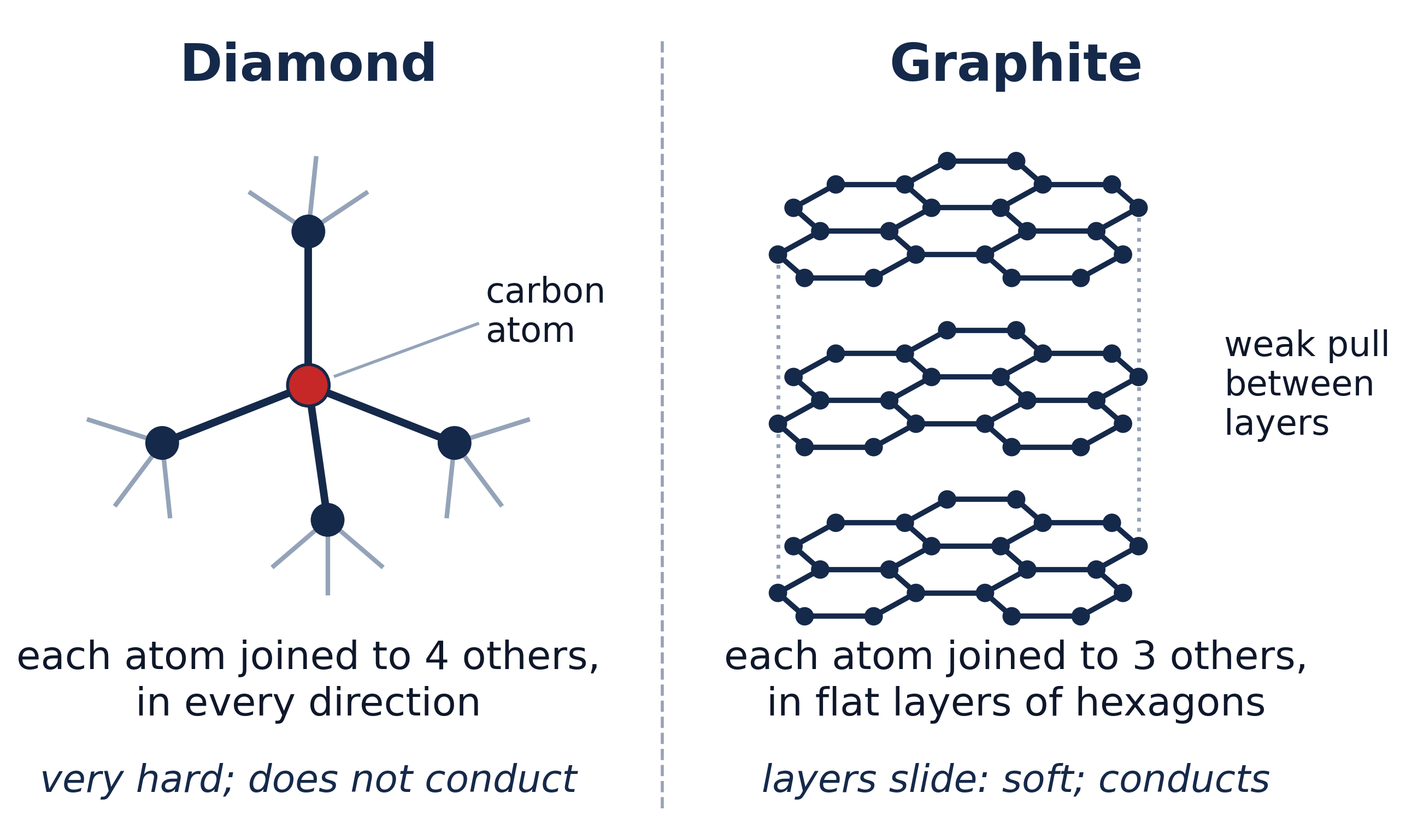
| Diamond | Graphite | Fullerene (C₆₀) | Graphene | |
|---|---|---|---|---|
| How the atoms are joined | each carbon atom is bonded to four others, in a tetrahedral, three-dimensional network | each carbon atom is bonded to three others, in flat layers of hexagons | 60 carbon atoms in a hollow cage shaped like a football: 20 six-membered and 12 five-membered rings | a single layer of graphite, one atom thick |
| Hardness | the hardest natural substance | soft and slippery; the layers slide over one another | soft solid | the thinnest material known, and very strong |
| Conducts electricity? | no: all four outer electrons are used in bonds | yes: the fourth electron of each atom is free to move | poorly | yes, very well |
| Look | transparent, sparkles | grey-black, opaque | dark solid | transparent sheet |
| Uses | cutting glass, drilling rock, jewellery | pencil "lead", electrodes, dry lubricant, moderator in nuclear reactors | research in medicine and materials | electronics, strong light materials |
Facts the papers return to:
- Diamond is hard because strong covalent bonds run through the whole crystal in every direction.
- Graphite is the only common non-metal that conducts electricity well. Diamond does not conduct electricity.
- Graphite is the most stable form of carbon under ordinary conditions (asked in NDA I 2026). Diamond is made from graphite only at very high pressure and temperature.
- The C₆₀ molecule is called buckminsterfullerene, after the architect Buckminster Fuller, whose domes it resembles.
- The physical properties of diamond and graphite are very different. Their chemical properties are the same: each burns in oxygen to give carbon dioxide and nothing else. C + O₂ → CO₂.
Other forms. Coal, coke, wood charcoal and lampblack (soot) are impure or finely divided forms of carbon. Fly ash, the fine ash from coal-burning power stations, is not an allotrope of carbon. It is mostly oxides of silicon, aluminium and iron.
3. The two oxides of carbon
| Carbon monoxide, CO | Carbon dioxide, CO₂ | |
|---|---|---|
| Formed when | carbon burns in too little air: 2C + O₂ → 2CO | carbon burns in plenty of air: C + O₂ → CO₂ |
| Nature of the oxide | neutral | acidic (gives carbonic acid with water) |
| Does it burn? | yes, with a blue flame: 2CO + O₂ → 2CO₂ | no |
| Effect on the body | very poisonous: it binds to the haemoglobin of the blood, which can then carry less oxygen | not poisonous in small amounts |
| Main use | reducing agent in the blast furnace: Fe₂O₃ + 3CO → 2Fe + 3CO₂ | fire extinguishers, fizzy drinks, dry ice |
Carbon monoxide has no colour and no smell. This is why a coal fire or a running engine in a closed room is dangerous.
Carbon as a reducing agent. Hot carbon removes oxygen from the oxides of metals of middle reactivity: ZnO + C → Zn + CO. Zinc, iron, tin and lead are obtained in this way. Very reactive metals such as aluminium and sodium hold oxygen too strongly; they are obtained by electrolysis.
4. Simple compounds of carbon
Compounds of carbon and hydrogen only are called hydrocarbons.
| Family | Bonds between carbon atoms | General formula | First members |
|---|---|---|---|
| Alkanes (saturated) | single only | CₙH₂ₙ₊₂ | methane CH₄, ethane C₂H₆, propane C₃H₈, butane C₄H₁₀ |
| Alkenes (unsaturated) | one double bond | CₙH₂ₙ | ethene C₂H₄, propene C₃H₆ |
| Alkynes (unsaturated) | one triple bond | CₙH₂ₙ₋₂ | ethyne C₂H₂ (acetylene) |
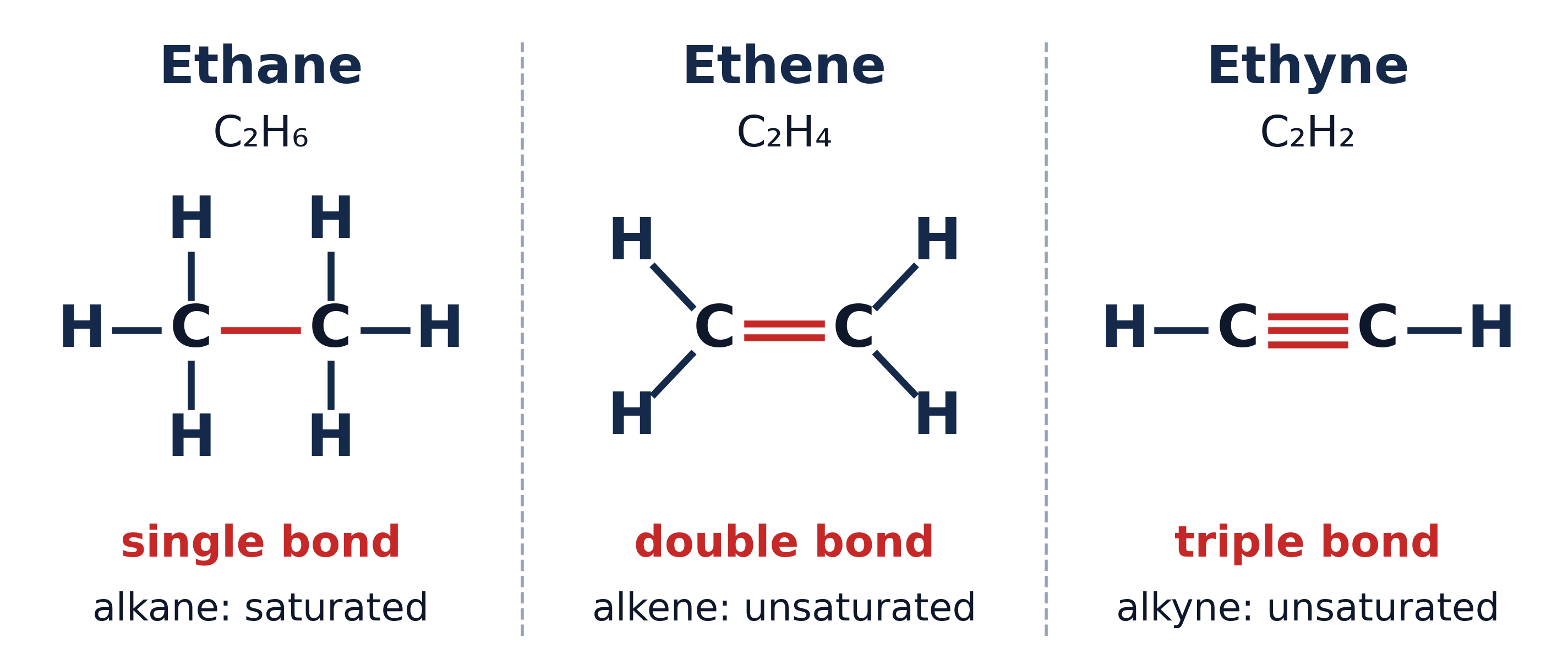
- Saturated compounds burn with a clean blue flame. Unsaturated compounds burn with a yellow, sooty flame.
- Unsaturated compounds take part in addition reactions. Hydrogen adds to vegetable oils in the presence of nickel and turns them into solid fat. Saturated compounds take part in substitution reactions, for example methane with chlorine in sunlight.
- Counting bonds. Draw the structure and count every line. Propane, C₃H₈, has 2 carbon-carbon bonds and 8 carbon-hydrogen bonds: 10 covalent bonds. If one hydrogen is replaced by chlorine the total is still 10.
Three more compounds to know.
| Compound | Formula | What to remember |
|---|---|---|
| Ethanol (alcohol) | C₂H₅OH | neutral to litmus; a fuel and a solvent |
| Ethanoic acid (acetic acid) | CH₃COOH | a weak acid; a 5 to 8 per cent solution in water is vinegar |
| Ester | acid + alcohol → ester + water | sweet, fruity smell; ethyl ethanoate (ethyl acetate) is the usual example |
Organic and inorganic. Compounds of carbon are called organic, but the oxides of carbon, carbonates, hydrogencarbonates and cyanates are counted as inorganic. In 1828 Wöhler made urea, an organic compound, by heating ammonium cyanate, an inorganic one. Methane is also called marsh gas, because it bubbles up from marshes.
5. Fuels
A fuel is a substance that gives useful heat when it burns. Most fuels are carbon or compounds of carbon.
| Fuel | What it is | Note |
|---|---|---|
| Coal | mostly carbon, formed from buried plants | in order of rising carbon content: peat, lignite, bituminous, anthracite |
| Coke | almost pure carbon | made by heating coal without air; used to make steel |
| Petroleum | a mixture of hydrocarbons | separated by fractional distillation into petroleum gas, petrol, kerosene, diesel, lubricating oil, paraffin wax and bitumen |
| Natural gas, CNG | mainly methane | CNG is compressed natural gas |
| LPG | mainly butane, with propane | a strong-smelling substance (ethyl mercaptan) is added so that leaks are noticed |
| Biogas (gobar gas) | mainly methane, with carbon dioxide | made when dung and plant waste rot without air |
| Water gas | CO + H₂ | steam over red-hot coke |
| Producer gas | CO + N₂ | air over red-hot coke |
Heating coal without air (destructive distillation) gives coke, coal tar and coal gas.
Calorific value is the heat given out when 1 kg of a fuel burns completely.
| Fuel | Calorific value, about (kJ/kg) |
|---|---|
| Wood | 17,000 to 22,000 |
| Coal | 25,000 to 33,000 |
| Biogas | 35,000 to 40,000 |
| Petrol, kerosene, diesel | 45,000 |
| Methane, CNG | 50,000 |
| LPG | 55,000 |
| Hydrogen | 150,000 |
So biogas is a good fuel, not a weak one: it gives more heat per kilogram than coal. Hydrogen gives the most heat of all.
A clean fuel burns completely and leaves no ash, smoke or poisonous gas. Gases such as propane, LPG, CNG and hydrogen are clean fuels. Coke, wax and coal are not, because they leave soot, ash or harmful gases.
The flame tells the story. With enough air a fuel burns with a blue flame and gives carbon dioxide and water. With too little air the flame is yellow and sooty, and poisonous carbon monoxide forms. A blackened cooking vessel means fuel is being wasted.
What the papers have asked
| Paper | The idea asked | The answer in one line |
|---|---|---|
| NDA I 2019 | A clean fuel | Propane; it burns completely and leaves no ash or smoke |
| NDA II 2019 | Wrong statement on diamond and graphite | Their chemical properties are the same; only the physical ones differ |
| NDA II 2019, NDA 2020 | Main gas in biogas | Methane |
| NDA 2020, NDA II 2025 | Wrong statement on allotropes | Diamond does not conduct electricity; graphite does |
| NDA 2020 | Covalent bonds in chloropropane | 10 |
| NDA 2020 | Wrong statement on biogas | Its heating value is high, not low |
| NDA I 2021 | Not an allotrope of carbon | Fly ash |
| NDA I 2021 | Hydrogenation of oils | An addition reaction, with nickel as catalyst |
| NDA II 2023 | Not an organic compound | Ammonium cyanate |
| NDA II 2023 | Statements on carbon | Tetravalent, shows catenation, forms covalent bonds; there is no fourfold bond |
| NDA I 2024 | Matching the allotropes | Graphite soft and slippery; diamond hardest; graphene thinnest and strongest |
| NDA II 2024 | Composition of diamond | Pure carbon |
| NDA I 2025 | A neutral oxide | Carbon monoxide |
| NDA I 2026 | Most stable form of carbon | Graphite |
Worked examples
Example 1. Which one of the following statements is not correct? (a) In diamond each carbon atom is bonded to four others. (b) Graphite is used as a dry lubricant. (c) Graphite is a non-conductor of electricity. (d) Diamond and graphite both give carbon dioxide when burnt.
Solution. (a) is true: that is the tetrahedral network. (b) is true: the layers slide. (d) is true: both are pure carbon. (c) is false: in graphite each atom uses only three electrons in bonds and the fourth is free, so graphite conducts. Answer (c).
Example 2. Consider the following statements:
- Carbon monoxide is an acidic oxide.
- Carbon monoxide burns in air with a blue flame.
Which of the statements given above is/are correct?
Solution. Carbon monoxide is a neutral oxide: it does not form an acid with water. Statement 1 is wrong; it is carbon dioxide that is acidic. Carbon monoxide does burn, with a blue flame, to carbon dioxide. Statement 2 is correct. Answer: 2 only.
Example 3. How many covalent bonds are there in a molecule of butane, C₄H₁₀?
Solution. A chain of four carbon atoms has 3 carbon-carbon bonds. Each of the 10 hydrogen atoms has one bond to carbon. Total: 3 + 10 = 13. For any alkane CₙH₂ₙ₊₂ the number is 3n + 1. The wrong answer 14 comes from adding the numbers of atoms. Answer: 13.
Example 4. Match the fuel with its main component: A. CNG, B. LPG, C. Water gas, D. Coke; 1. Carbon, 2. Butane, 3. Methane, 4. Carbon monoxide and hydrogen.
Solution. CNG is compressed natural gas, which is methane (A-3). LPG is mainly butane (B-2). Water gas is CO + H₂ (C-4). Coke is almost pure carbon (D-1). The pair most often swapped is CNG and LPG. Answer: A-3, B-2, C-4, D-1.
Example 5. A compound has the formula C₃H₆. Is it saturated or unsaturated, and what kind of flame does it give?
Solution. A saturated hydrocarbon with 3 carbon atoms would be C₃H₈ (CₙH₂ₙ₊₂). C₃H₆ fits CₙH₂ₙ, so it is an alkene (propene) with one double bond. It is unsaturated and burns with a yellow, sooty flame. Answer: unsaturated; yellow sooty flame.
Mistakes that cost marks
- "Diamond conducts electricity because it is so hard." Hardness and conduction are not linked. Diamond has no free electrons. Graphite conducts.
- "Diamond and graphite differ in chemical properties." They differ in physical properties only. Both burn to carbon dioxide.
- Calling carbon monoxide acidic. CO is neutral. CO₂ is acidic.
- Mixing up CNG and LPG. CNG and biogas are mainly methane. LPG is mainly butane.
Quick check
- How many other carbon atoms is each carbon atom bonded to in graphite?
- How many carbon atoms are there in one molecule of buckminsterfullerene?
- Which oxide of carbon is poisonous, and why?
- Give the general formula of the alkanes.
- Which fuel in the table of calorific values gives the most heat per kilogram?
Read and watch more, free
| What | Where | Language |
|---|---|---|
| Textbook, the main source | NCERT Class 10 Science, Chapter 4 Carbon and its Compounds | English (a Hindi edition is on the same site) |
| Self-study notes, allotropes in detail | NIOS Science and Technology (212), Lesson 28 Carbon and its compounds | English, Hindi |
| Fuels and flame | The old NCERT Class 8 Science book, Chapter 3 Coal and Petroleum and Chapter 4 Combustion and Flame. NCERT has withdrawn this book, so ask your teacher or a library for a copy | English, Hindi |
| Video, school lessons | Khan Academy India: Carbon and its compounds, Class 10 | English |
| Video, NDA course | Defence Wallah: Complete Chemistry, Fast Track Series (one video is on carbon and its compounds) | Hinglish |
| Video, NDA course | Rojgar with Ankit Defence: NDA Chemistry Classes (it has classes on carbon and on fuel) | Hindi |
The videos were chosen from their titles, length and views; they have not yet been watched by a teacher.
Answers to the quick check
- Three.
- Sixty.
- Carbon monoxide. It binds to haemoglobin, so the blood carries less oxygen.
- CₙH₂ₙ₊₂.
- Hydrogen, about 150,000 kJ/kg.
Next chapter: Fertilizers, soap and glass