Why this chapter matters. This is the richest chapter in Chemistry. We found about 44 questions in the 12 papers we hold, from 2017 to 2026: between one and seven in every paper. Most are single facts (a formula, a pH value, the acid in a food), and the rest ask you to say what is oxidised and what is reduced in an equation. Learn the table of common salts in section 7 first. It answered more questions than any other table in this course.
What you will be able to do
- Say what is oxidised, what is reduced, and which substance is the oxidising or the reducing agent in an equation.
- Find the oxidation number of an element in a compound.
- Use the three definitions of an acid (Arrhenius, Brønsted-Lowry, Lewis) and pick the Lewis acids from a list.
- Place common substances on the pH scale and give the colours of the common indicators.
- Give the name, formula and use of the salts the papers keep asking.
Before you start you should know how to balance an equation (Chapter C1-2) and what valency is (Chapter C1-3).
1. Oxidation and reduction
There are four ways of saying the same thing. Each new one covers more reactions than the one before.
| In terms of | Oxidation is | Reduction is |
|---|---|---|
| Oxygen | gain of oxygen | loss of oxygen |
| Hydrogen | loss of hydrogen | gain of hydrogen |
| Electrons | loss of electrons | gain of electrons |
| Oxidation number | a rise in oxidation number | a fall in oxidation number |
The two always happen together. If one substance is oxidised, another is reduced. Such a reaction is called a redox reaction.
The agents. This is where marks are lost.
- The oxidising agent (oxidant) oxidises the other substance. It is itself reduced.
- The reducing agent (reductant) reduces the other substance. It is itself oxidised.
Think of a soldier who hands his rifle to another. The giver ends up without it. In the same way the reducing agent gives away electrons and ends up oxidised.
Five reactions worth knowing.
| Reaction | Oxidised (the reducing agent) | Reduced (the oxidising agent) |
|---|---|---|
| CuO + H₂ → Cu + H₂O | H₂ | CuO |
| Fe + CuSO₄ → FeSO₄ + Cu | Fe | Cu²⁺ in CuSO₄ |
| Fe₂O₃ + 2Al → 2Fe + Al₂O₃ | Al | Fe₂O₃ |
| CH₄ + 2O₂ → CO₂ + 2H₂O | carbon in CH₄ | O₂ |
| Br₂ + 2I⁻ → 2Br⁻ + I₂ | I⁻ | Br₂ |
Notes on these:
- In the second reaction iron is more reactive than copper and pushes it out. The blue solution turns pale green. Iron is the reducing agent.
- The third is the thermite reaction. It gives out so much heat (it is highly exothermic) that the iron formed is molten. It is used to join railway tracks.
- In the fourth, the oxidation number of carbon rises from −4 to +4, so carbon is oxidised. Hydrogen stays at +1 on both sides. It is neither oxidised nor reduced.
Oxidation in daily life. Rusting of iron, burning of a fuel, breathing (respiration), the browning of a cut apple, and fats and oils turning rancid are all oxidation. Chips packets are filled with nitrogen to keep oxygen away from the oil. Potassium permanganate (KMnO₄) and bleaching powder purify water because they are strong oxidising agents.
2. Oxidation number
The oxidation number is the charge an atom would have if every bond were fully ionic. Four rules are enough here.
| Rule | Example |
|---|---|
| An element on its own has oxidation number 0 | Fe, H₂, O₂, Cl₂ are all 0 |
| Oxygen is −2 in almost all its compounds (it is −1 in peroxides such as H₂O₂) | H₂O, CO₂ |
| Hydrogen is +1 in its compounds with non-metals | HCl, H₂O, CH₄ |
| The numbers in a neutral compound add up to 0; in an ion they add up to the charge | see below |
Example. Vanadium in V₂O₅: let it be x. Then 2x + 5(-2) = 0, so x = +5.
Example. Manganese in KMnO₄: (+1) + x + 4(-2) = 0, so x = +7.
Mixed oxides. In Fe₃O₄, Pb₃O₄ and Mn₃O₄ the same metal is present in two oxidation states at once. Fe₃O₄ behaves as FeO·Fe₂O₃, with iron as +2 and +3. In Fe₂O₃ all the iron is +3. NDA II 2019 asked for the oxide with only one oxidation state.
3. Three ways to define an acid and a base
| Concept | An acid is | A base is | Example |
|---|---|---|---|
| Arrhenius | a substance that gives H⁺ ions in water | a substance that gives OH⁻ ions in water | HCl and NaOH |
| Brønsted-Lowry | a proton (H⁺) donor | a proton acceptor | HCl gives a proton to NH₃ |
| Lewis | an electron-pair acceptor | an electron-pair donor | BF₃ accepts a pair from NH₃ |
NDA I 2026 quoted the first definition and asked for its name.
Lewis acids at the level asked. A Lewis acid has room for a pair of electrons. The usual examples are compounds whose central atom has fewer than eight electrons, and positive ions: BF₃, AlCl₃, FeCl₃, H⁺. A Lewis base has a lone pair to give: NH₃, H₂O, OH⁻. So in the list AlCl₃, NH₃, BF₃, FeCl₃ there are three Lewis acids, and NH₃ is the Lewis base (asked in NDA I 2026).
4. How acids and bases behave
| Acids | Bases | |
|---|---|---|
| Taste and feel | sour | bitter, soapy to touch |
| Litmus | turn blue litmus red | turn red litmus blue |
| With a reactive metal | give hydrogen: Zn + 2HCl → ZnCl₂ + H₂ | |
| With a carbonate | give carbon dioxide: Na₂CO₃ + 2HCl → 2NaCl + H₂O + CO₂ | |
| With each other | acid + base → salt + water (neutralisation); heat is given out | |
| In water | conduct electricity, because they form ions | conduct electricity |
A base that dissolves in water is called an alkali: NaOH, KOH, Ca(OH)₂. All alkalis are bases, but not all bases are alkalis.
Strong and weak. A strong acid breaks up completely into ions in water: HCl, H₂SO₄, HNO₃. A weak acid breaks up only partly: acetic acid, carbonic acid. NaOH and KOH are strong bases; ammonium hydroxide is weak. "Strong" is not the same as "concentrated".
Mineral and organic acids. HCl, H₂SO₄ and HNO₃ are mineral acids, made from minerals. Organic acids come from plants and animals and contain carbon.
| Where it is found | Acid |
|---|---|
| Vinegar | acetic acid (ethanoic acid) |
| Lemon, orange | citric acid |
| Tamarind | tartaric acid |
| Tomato | oxalic acid |
| Sour milk, curd | lactic acid |
| Ant sting, nettle sting | methanoic acid (formic acid) |
| The stomach | hydrochloric acid |
Two more facts on acids: aqua regia, a mixture of three parts concentrated hydrochloric acid and one part concentrated nitric acid, dissolves gold; hydrofluoric acid (HF) attacks glass and is used to etch it.
5. The pH scale
pH measures how much H⁺ a solution holds. The "p" comes from potenz, the German word for power.
- The scale normally runs from 0 to 14.
- pH 7 is neutral. Below 7 is acidic. Above 7 is basic.
- More H⁺ means a lower pH. A change of one unit is a ten-fold change in H⁺.
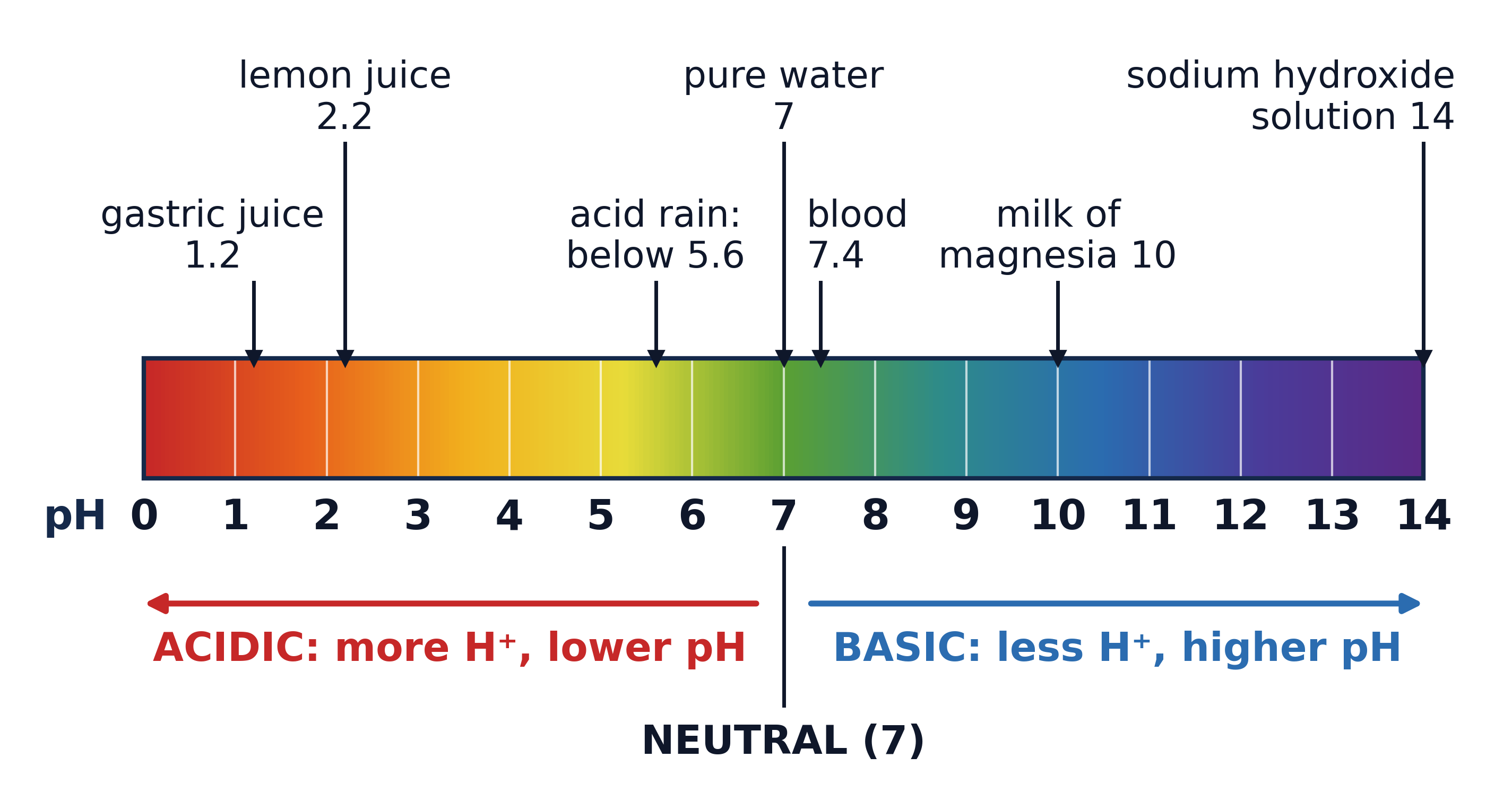
| Substance | pH, about |
|---|---|
| Gastric juice (stomach) | 1.2 |
| Lemon juice | 2.2 |
| Pure water | 7 |
| Blood | 7.4 |
| Milk of magnesia | 10 |
| Sodium hydroxide solution | 14 |
| Fact the papers have used | Value |
|---|---|
| The human body works within | pH 7.0 to 7.8 |
| Rain is called acid rain when its pH is below | 5.6 |
| Tooth enamel begins to be attacked when the pH in the mouth falls below | 5.5 |
| Desirable pH of drinking water | 6.5 to 8.5 |
Acid rain is caused mainly by sulphur dioxide and oxides of nitrogen from burning fuels. Tooth enamel is a calcium phosphate; bacteria make acid from sugar and the acid attacks it.
Antacids. Too much acid in the stomach causes indigestion. An antacid is a mild base that neutralises it: milk of magnesia, which is magnesium hydroxide, Mg(OH)₂, or baking soda. A bee sting contains acid, so baking soda soothes it.
6. Indicators
An indicator shows by its colour whether a solution is acidic or basic.
| Indicator | In acid | In base | Note |
|---|---|---|---|
| Litmus | red | blue | a purple dye obtained from lichens |
| Phenolphthalein | colourless | pink | |
| Methyl orange | red | yellow | |
| Turmeric | stays yellow | reddish brown | a curry stain turns reddish brown with soap and yellow again when rinsed with plenty of water |
Onion, vanilla and clove oil are olfactory indicators: their smell changes in a base. Ethanol and sugar solution are neutral and change neither litmus paper.
7. Salts
A salt forms when an acid is neutralised by a base. The nature of the salt depends on its parents.
| Parents | Solution of the salt is | Example |
|---|---|---|
| Strong acid + strong base | neutral, pH 7 | NaCl |
| Strong acid + weak base | acidic | NH₄Cl |
| Weak acid + strong base | basic | Na₂CO₃, CH₃COONa |
The salts and bases to learn by heart.
| Common name | Chemical name | Formula | Main uses |
|---|---|---|---|
| Common salt | sodium chloride | NaCl | food; raw material for the next four rows |
| Caustic soda | sodium hydroxide | NaOH | soap, paper, artificial fibres |
| Bleaching powder | calcium oxychloride | CaOCl₂ | bleaching cotton and paper; making water safe to drink; an oxidising agent |
| Baking soda | sodium hydrogencarbonate | NaHCO₃ | baking powder; antacid; soda-acid fire extinguisher |
| Washing soda | sodium carbonate decahydrate | Na₂CO₃·10H₂O | glass, soap and paper; cleaning; removing permanent hardness of water |
| Gypsum | calcium sulphate dihydrate | CaSO₄·2H₂O | cement; making plaster of Paris |
| Plaster of Paris | calcium sulphate hemihydrate | CaSO₄·½H₂O | plaster for broken bones; statues and casts |
| Limestone, chalk, marble | calcium carbonate | CaCO₃ | cement, lime, building |
| Quicklime | calcium oxide | CaO | making slaked lime and cement |
| Slaked lime | calcium hydroxide | Ca(OH)₂ | whitewash; its clear solution is lime water |
| Milk of magnesia | magnesium hydroxide | Mg(OH)₂ | antacid |
| Blue vitriol | copper sulphate pentahydrate | CuSO₄·5H₂O | fungicide; electroplating |
| Green vitriol | ferrous sulphate heptahydrate | FeSO₄·7H₂O | iron tablets; ink |
How four of them are made from common salt.
- Passing electricity through salt water (the chlor-alkali process): 2NaCl + 2H₂O → 2NaOH + Cl₂ + H₂.
- The chlorine acts on dry slaked lime to give bleaching powder: Ca(OH)₂ + Cl₂ → CaOCl₂ + H₂O.
- Baking soda: NaCl + H₂O + CO₂ + NH₃ → NH₄Cl + NaHCO₃.
- Heating baking soda gives sodium carbonate, which is crystallised as washing soda: 2NaHCO₃ → Na₂CO₃ + H₂O + CO₂.
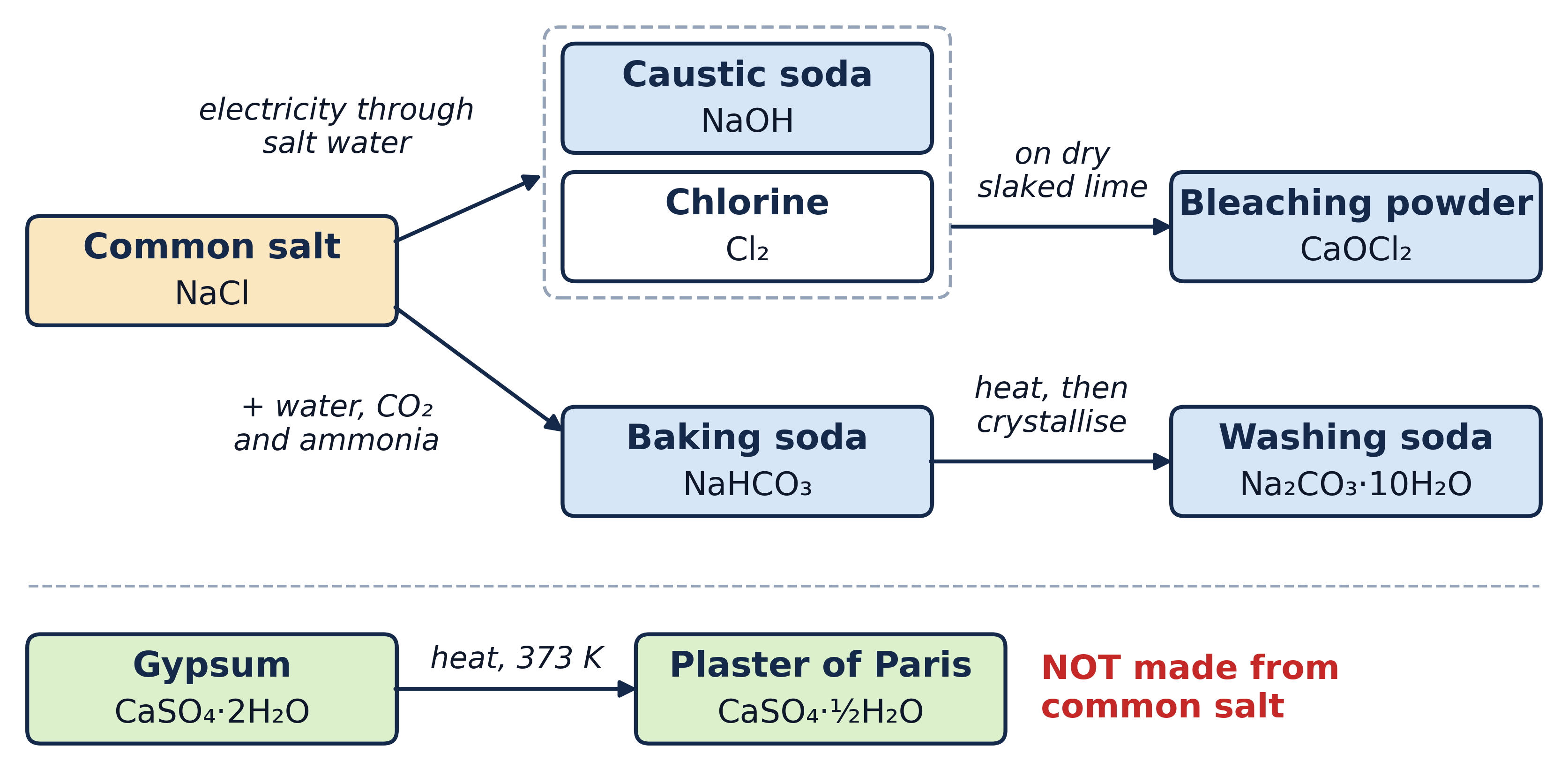
The carbon dioxide in the last equation is what makes a cake rise. Plaster of Paris is not made from common salt. It is made by heating gypsum at 373 K: CaSO₄·2H₂O → CaSO₄·½H₂O + 1½H₂O. Mixed with water it sets hard as gypsum again.
Water of crystallisation is the fixed number of water molecules in one formula unit of a salt: 5 in copper sulphate, 7 in ferrous sulphate, 10 in washing soda, 2 in gypsum. When blue copper sulphate crystals are heated they lose this water and turn white.
What the papers have asked
| Paper | The idea asked | The answer in one line |
|---|---|---|
| NDA II 2017, NDA I 2026 | What is oxidised when methane burns | The carbon of CH₄; hydrogen is unchanged at +1 |
| NDA I 2019 | Iron placed in copper sulphate solution | Iron is the more reactive metal and the reducing agent; the solution turns green |
| NDA II 2019 | Oxide with only one oxidation state of the metal | Fe₂O₃; Fe₃O₄, Pb₃O₄ and Mn₃O₄ are mixed oxides |
| NDA 2020, NDA II 2021 | Water of crystallisation | CuSO₄ 5, Na₂CO₃ 10, gypsum 2, FeSO₄ 7 |
| NDA 2020 | Turmeric stain washed with soap, then water | Yellow, reddish brown, yellow again |
| NDA I 2021 | Compound not made from common salt | Plaster of Paris |
| NDA II 2021, NDA I 2024 | Milk of magnesia | Magnesium hydroxide; pH about 10 |
| NDA II 2023 | Thermite reaction | Highly exothermic; Fe₂O₃ is the oxidising agent |
| NDA I 2024 | Source of litmus; oxidation state of V in V₂O₅ | Lichens; +5 |
| NDA I 2024 | pH range of the human body; acid in nettle | 7.0 to 7.8; methanoic acid |
| NDA I 2025 | Wrong statement about pH | More H⁺ means a lower pH, not a higher one |
| NDA I 2025 | Wrong definition of oxidation and reduction | Loss of hydrogen is oxidation, not reduction |
| NDA I 2025 | Acid rain | Rain with pH below 5.6 |
| NDA II 2025 | Reducing agent in N₂H₄ + 2H₂O₂ → N₂ + 4H₂O | N₂H₄ (hydrazine); it loses hydrogen |
| NDA I 2026 | Lewis acids among AlCl₃, NH₃, BF₃, FeCl₃ | Three; NH₃ is a Lewis base |
Worked examples
Example 1. In the reaction ZnO + C → Zn + CO, name the oxidising agent and the reducing agent.
Solution. Zinc oxide loses oxygen, so it is reduced. Carbon gains oxygen, so it is oxidised. The agent is always the other one: the substance that is reduced is the oxidising agent. So ZnO is the oxidising agent and carbon is the reducing agent. Calling carbon the oxidising agent "because it is oxidised" is the standard mistake. Answer: oxidising agent ZnO, reducing agent C.
Example 2. What is the oxidation number of chromium in K₂Cr₂O₇?
Solution. Potassium is +1 and oxygen is −2. Let chromium be x: 2(+1) + 2x + 7(-2) = 0, so 2x = 12 and x = +6. The answer +12 comes from forgetting to divide between the two chromium atoms. Answer: +6.
Example 3. Consider the following statements:
- A solution of pH 3 has a higher concentration of hydrogen ions than a solution of pH 5.
- A solution of sodium carbonate in water turns red litmus blue.
Which of the statements given above is/are correct?
Solution. A lower pH means more H⁺, so statement 1 is correct (in fact 100 times more). Sodium carbonate is the salt of a weak acid and a strong base, so its solution is basic and turns red litmus blue: statement 2 is correct. A student who thinks "all salts are neutral" marks 1 only. Answer: both 1 and 2.
Example 4. Match the common name with the formula: A. Baking soda, B. Washing soda, C. Plaster of Paris, D. Bleaching powder; 1. CaOCl₂, 2. NaHCO₃, 3. CaSO₄·½H₂O, 4. Na₂CO₃·10H₂O.
Solution. Baking soda is the hydrogencarbonate, NaHCO₃ (A-2). Washing soda is the carbonate with ten molecules of water (B-4). Plaster of Paris has half a molecule of water (C-3); the formula with two molecules of water is gypsum. Bleaching powder is CaOCl₂ (D-1). Answer: A-2, B-4, C-3, D-1.
Example 5. Which one of the following is a Lewis acid but not an Arrhenius acid: HCl, BF₃, NH₃ or NaOH?
Solution. BF₃ has only six electrons around boron, so it accepts an electron pair: it is a Lewis acid. It has no hydrogen to give as H⁺, so it is not an Arrhenius acid. HCl is the tempting option, but HCl is an acid under the Arrhenius definition. NH₃ and NaOH are bases. Answer: BF₃.
Mistakes that cost marks
- Mixing up the agent with what happens to it. The oxidising agent is reduced. The reducing agent is oxidised.
- "Higher pH means more acidic." It is the opposite. pH 1 is far more acidic than pH 6.
- Gypsum and plaster of Paris. Gypsum is CaSO₄·2H₂O. Plaster of Paris is CaSO₄·½H₂O. The papers print the wrong one on purpose.
- Baking soda and washing soda. Baking soda is NaHCO₃ (one sodium, used in food). Washing soda is Na₂CO₃·10H₂O.
Quick check
- In CuO + H₂ → Cu + H₂O, which substance is the reducing agent?
- What is the oxidation number of sulphur in H₂SO₄?
- What colour is phenolphthalein in a solution of sodium hydroxide?
- Give the formula of bleaching powder.
- Is a solution of ammonium chloride acidic, basic or neutral?
Read and watch more, free
| What | Where | Language |
|---|---|---|
| Textbook, the main source | NCERT Class 10 Science: Chapter 1 Chemical Reactions and Equations; Chapter 2 Acids, Bases and Salts | English (a Hindi edition is on the same site) |
| Textbook, oxidation number and Lewis acids | NCERT Class 11 Chemistry: Part I, Chapter 6 Equilibrium; Part II, Chapter 7 Redox Reactions | English (a Hindi edition is on the same site) |
| Self-study notes | NIOS Science and Technology (212): Lesson 4 Chemical reactions; Lesson 8 Acids, bases and salts | English, Hindi |
| Practice questions | NCERT Exemplar, Class 10, Chemical Reactions and Equations | English |
| Video, school lessons | Khan Academy India: Acids, bases and salts, Class 10 | English |
| Video, NDA course | Defence Wallah: Complete Chemistry, Fast Track Series (it has separate videos on oxidation and reduction and on acids, bases and salts) | Hinglish |
| Video, every textbook problem | Magnet Brains: Class 10 Chemistry | Hinglish |
The videos were chosen from their titles, length and views; they have not yet been watched by a teacher.
Answers to the quick check
- Hydrogen. It removes the oxygen from copper oxide and is itself oxidised to water.
- +6, because 2(+1) + x + 4(-2) = 0.
- Pink.
- CaOCl₂.
- Acidic. It is the salt of a strong acid (HCl) and a weak base (ammonium hydroxide).
Next chapter: Carbon and its forms