Why this chapter matters. We found about 15 questions on this chapter in the 12 papers we hold, from 2017 to 2026. They fall into three groups: the Sun's rays and the seasons (dates, the longest and shortest day), the origin of the Earth and the planets, and the layers inside the Earth. Since 2024 the papers have used "consider the following statements" for the layers. Learn the table of four dates in section 3 first.
What you will be able to do
- Tell rotation from revolution and give the effects of each.
- Explain why there are seasons, and give the dates and facts of the solstices and equinoxes.
- Name the main theories of the origin of the Earth and the two families of planets.
- Describe the crust, mantle and core, and say what the lithosphere and asthenosphere are.
Before you start you should know: the Equator, the two Tropics and the two polar circles (Chapter G1-1).
1. Two movements
The Earth has two movements at the same time. A spinning top that also moves round in a circle on the floor shows both.
| Rotation | Revolution | |
|---|---|---|
| What it is | The Earth spinning on its own axis | The Earth moving round the Sun in its orbit |
| Direction | West to east | Anticlockwise, seen from above the North Pole |
| Time taken | About 24 hours (one day) | About 365¼ days (one year) |
| Path | Round the axis, an imaginary line through the two poles | An ellipse (a slightly stretched circle) |
| Main effects | Day and night; the difference in time between places; the turning aside of winds and ocean currents; the daily rise and fall of tides | The seasons; the change in the length of day and night through the year |
The quarter day in the year is saved up. Every fourth year has one more day, 29 February, and is called a leap year.
The tilt. The axis of the Earth is not upright. It is tilted by 23½° from the vertical, so it makes an angle of 66½° with the plane of the orbit. The axis always points the same way in space, towards the Pole Star. This tilt, together with revolution, causes the seasons.
2. Effects of rotation
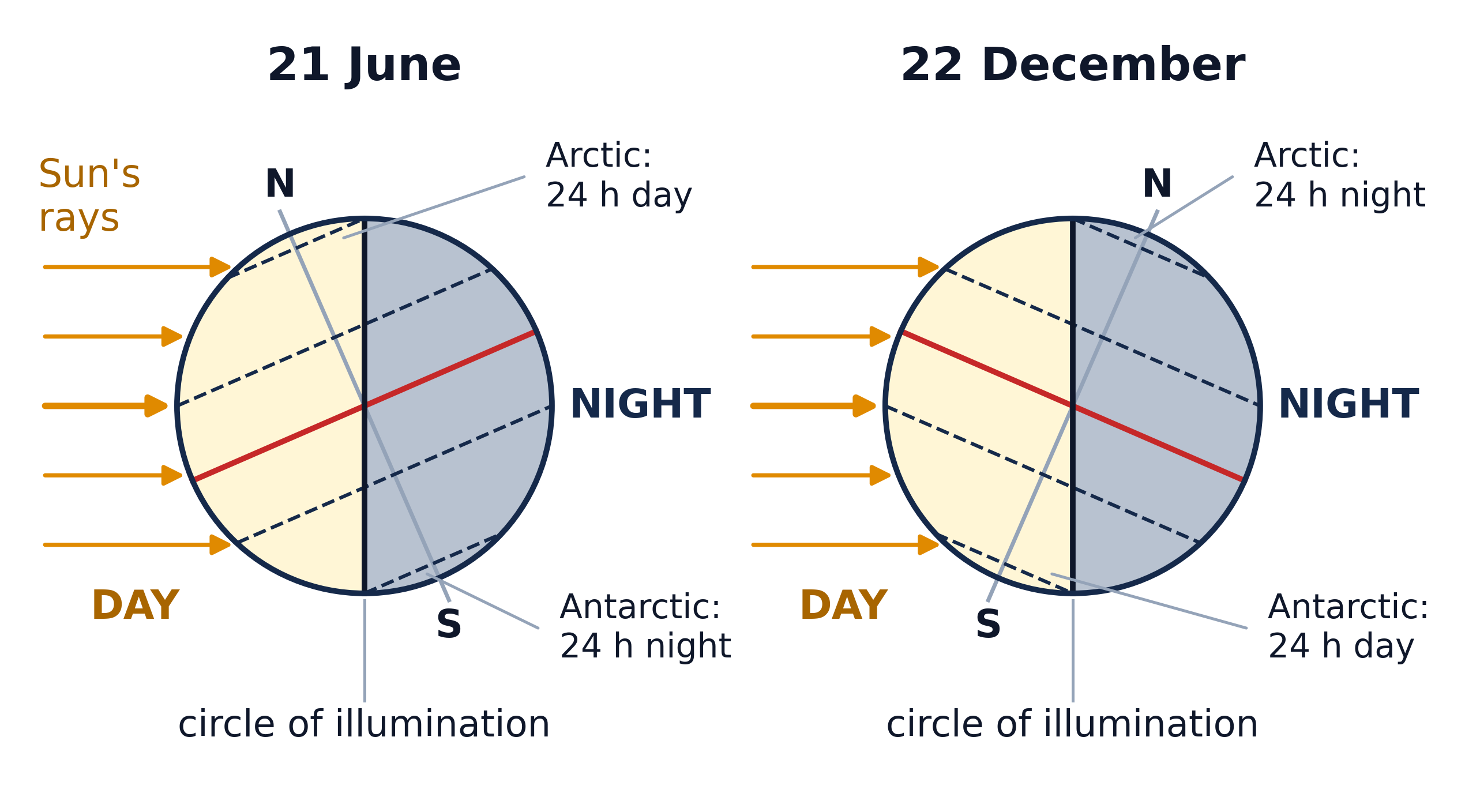
Day and night. The Sun lights only half of the Earth at one time. The line that divides the lit half from the dark half is called the circle of illumination. As the Earth spins, each place passes from light to dark and back once in 24 hours. Because the Earth spins from west to east, the Sun appears to rise in the east.
Time. Places to the east see the Sun earlier. This is the reason for the time rule of Chapter G1-1: 15° of longitude is one hour.
The Coriolis effect. Because the Earth spins, anything moving freely over it (wind, an ocean current, a long-range shell) is turned aside. It turns to the right in the Northern Hemisphere and to the left in the Southern Hemisphere. The effect is zero at the Equator and greatest at the poles. NDA II 2017 asked for its cause: the Earth's rotation.
The shape of the Earth. The spin makes the Earth bulge at the Equator and flatten at the poles.
Tides. The Moon's pull raises the tides, but it is the Earth's rotation that carries each coast through high water and low water every day (Chapter G2-1).
3. Revolution and the seasons
Because the axis is tilted and always points the same way, the Northern Hemisphere leans towards the Sun for one half of the year and away from it for the other half. The hemisphere that leans towards the Sun gets rays that are more direct and days that are longer. It has summer. The other hemisphere has winter at the same time. So the seasons in the two hemispheres are opposite: December is summer in Australia.
Four dates mark the year. Learn this table by heart.
| Date | Name (for the Northern Hemisphere) | The Sun is overhead at noon on | Day and night |
|---|---|---|---|
| 21 March | Spring equinox | The Equator | Equal everywhere |
| 21 June | Summer solstice | The Tropic of Cancer (23½° N) | Longest day in the north, shortest in the south |
| 23 September | Autumn equinox | The Equator | Equal everywhere |
| 22 December | Winter solstice | The Tropic of Capricorn (23½° S) | Shortest day in the north, longest in the south |
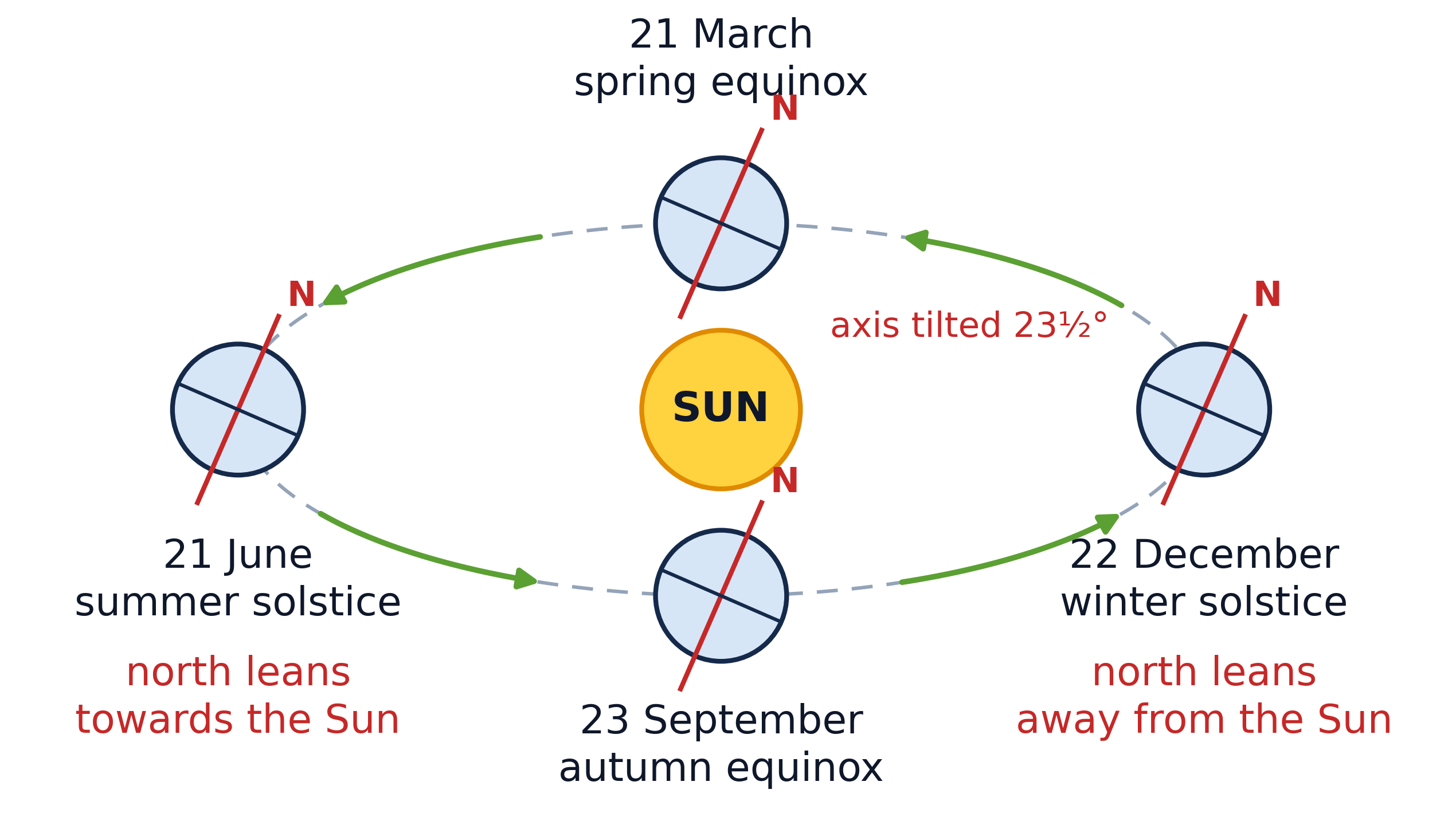
More facts that follow from the table:
- The Sun is overhead only between the two Tropics. North of the Tropic of Cancer and south of the Tropic of Capricorn the Sun's rays are never vertical. In India this is true of every place north of the Tropic of Cancer, for example the whole of Bihar, Punjab or Manipur.
- At the Equator, day and night are nearly equal all year.
- On 21 June the whole area north of the Arctic Circle has 24 hours of daylight, and the area south of the Antarctic Circle has 24 hours of darkness. On 22 December it is the other way round. Each pole has about six months of day and six months of night.
- The words: solstice means "the Sun stands still"; equinox means "equal night".
The height of the noon Sun. On any day the Sun is overhead at one latitude. At a place some degrees away from that latitude, the noon Sun is lower by the same number of degrees:
\text{angle of the noon Sun} = 90^\circ - (\text{difference in latitude between the place and the overhead Sun})
On 21 June the Sun is overhead at 23½° N. At the Equator the noon Sun stands at 90 - 23.5 = 66.5^\circ. At the Tropic of Capricorn, 47° away, it stands at only 90 - 47 = 43^\circ.
Distance is not the cause of the seasons. The Earth is nearest to the Sun (perihelion, about 147 million km) on about 3 January, in the northern winter. It is farthest (aphelion, about 152 million km) on about 4 July, in the northern summer.
4. The origin of the Earth
| Idea | Who | What it says |
|---|---|---|
| Nebular hypothesis | Immanuel Kant; revised by Laplace in 1796 | The planets formed out of a slowly turning cloud of material around the young Sun |
| A passing star | Chamberlain and Moulton, 1900; supported by James Jeans and Harold Jeffreys | A wandering star came near the Sun and its pull drew out a cigar-shaped mass of material, which later became the planets |
| Revised nebular hypothesis | Otto Schmidt and Carl Weizsäcker, 1950 | The Sun was surrounded by a solar nebula of hydrogen, helium and dust; the dust collected into a disc and then into planets |
| Big Bang theory (expanding universe) | Evidence from Edwin Hubble, 1920 | Explains the origin of the universe, not only of the Earth: all matter was in one tiny, very hot and dense point, which exploded about 13.7 billion years ago; the universe is still expanding |
The planets, with the Earth, formed about 4.6 billion years ago. The usual modern account of the Moon is the giant impact (also called "the big splat"): a body of about the size of Mars struck the young Earth and threw material into space, which collected to form the Moon.
Two families of planets
| Terrestrial (inner) planets | Jovian (outer) planets | |
|---|---|---|
| Which | Mercury, Venus, Earth, Mars | Jupiter, Saturn, Uranus, Neptune |
| Where | Between the Sun and the belt of asteroids | Beyond the belt of asteroids |
| Made of | Rock and metals | Mostly gases, with thick atmospheres of hydrogen and helium |
| Size and density | Small, but with high density | Large, but with low density |
| Why they lost their first gases | They are small, so their weak gravity could not hold the escaping gases, and the solar wind blew the gases away | They were far from the Sun and large enough to keep their gases |
Three facts asked in 2021: the Earth is the largest of the four inner planets, the Earth is the densest of all the planets, and Jupiter is the largest planet.
The early Earth. The young Earth was hot and partly molten. Heavy materials such as iron sank to the centre and lighter ones rose to the surface. In this way it separated into layers. Gases and water vapour came out from the interior (this is called degassing) and through volcanoes, and formed the atmosphere and later the oceans. The oldest and longest part of geological time is the Precambrian. After it come the Palaeozoic, the Mesozoic and the Cenozoic eras; we live in the Cenozoic.
5. Inside the Earth
Nobody has seen the inside of the Earth. Its radius is about 6,370 km, and the deepest hole ever drilled is only about 12 km. What we know comes mostly from earthquake waves, which change speed and direction as they pass through different layers (Chapter G1-3).
| Layer | Depth and thickness | What to remember |
|---|---|---|
| Crust | Oceanic crust: about 5 km thick on average. Continental crust: about 30 km, and up to about 70 km under the Himalaya | The outermost solid layer; brittle; thin under the oceans, thickest under high mountains. Oceanic crust is basalt and is denser than continental crust |
| Mantle | From the base of the crust to 2,900 km | The largest layer. Its upper part, down to about 400 km, is the asthenosphere: weak and able to flow slowly; the main source of magma |
| Outer core | From 2,900 km | Liquid |
| Inner core | To the centre | Solid. The core is made mainly of nickel and iron, so it is called "nife"; it is the densest layer |
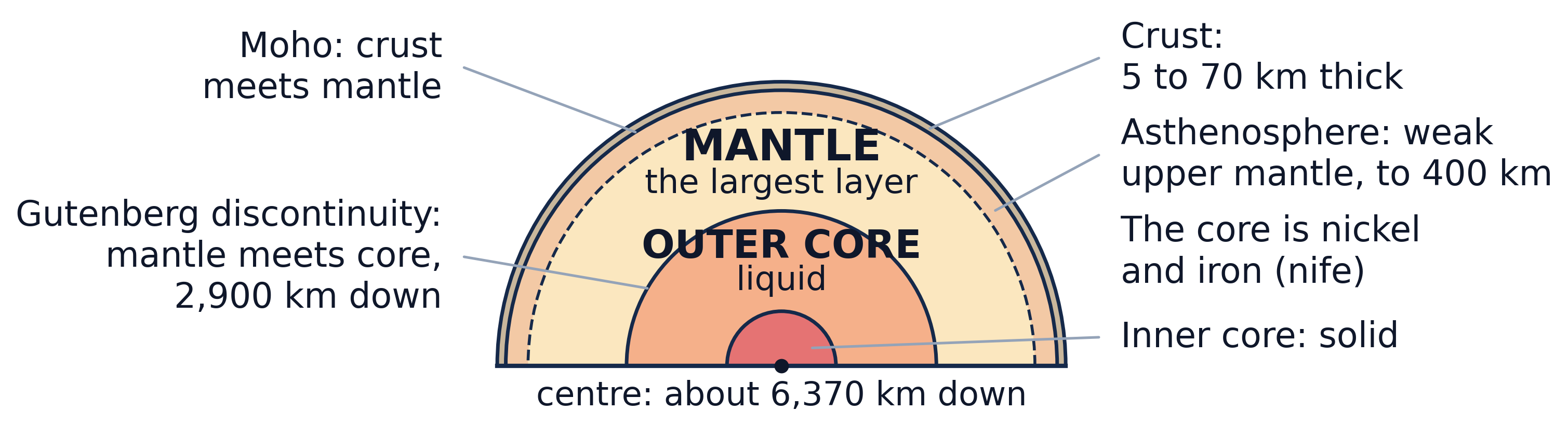
- The boundary between the crust and the mantle is the Mohorovičić discontinuity (Moho). The boundary between the mantle and the core is the Gutenberg discontinuity.
- The lithosphere is the crust together with the uppermost solid part of the mantle. It is 10 to 200 km thick, and thickest under mountain ranges such as the Himalaya. It is broken into plates, which move over the asthenosphere.
- Slow convection currents in the mantle (not in the crust) carry heat upwards and drive the plates.
- Temperature, pressure and density all increase with depth.
What the papers have asked
| Paper | The idea asked | The answer in one line |
|---|---|---|
| NDA II 2017 | The shortest day in the Northern Hemisphere | 22 December, the winter solstice |
| NDA I 2019 | Effects of the Earth's rotation | The daily rhythm of light and temperature, the sideways turning of winds and currents, and the daily movement of tides are all tied to rotation |
| NDA II 2019 | The theory of the origin of the universe | The Big Bang theory; the nebular and planetesimal ideas are about the planets only |
| NDA II 2019, NDA II 2021 | What the lithosphere is | The crust and the uppermost solid mantle |
| NDA I 2021 | The planet with the highest density | The Earth |
| NDA I 2021 | Where the lithosphere is thickest | Under the Himalayan mountains |
| NDA II 2023 | The oldest era of geological history | The Precambrian |
| NDA I 2024 | Statements on the Earth's interior | Oceanic crust is denser than continental crust; convection takes place in the mantle, not in the crust |
| NDA II 2024 | Indian states where the Sun is never overhead | States lying wholly north of the Tropic of Cancer, such as Bihar and Manipur |
| NDA I 2025 | The latitude with the lowest noon Sun on 21 June, out of four | The Tropic of Capricorn (43°), lower than the Arctic Circle (47°) |
| NDA I 2026 | Statements on the crust | It is brittle; it is thicker, not thinner, under fold mountains; oceanic crust is about 5 km thick |
| NDA I 2026 | Statements on terrestrial planets | They lie between the Sun and the asteroid belt; they have high density; their weak gravity could not hold gases |
Worked examples
Example 1 (a single fact). On which date is the Sun overhead at noon at the Tropic of Capricorn?
(a) 21 March (b) 21 June (c) 23 September (d) 22 December
Solution. The Tropic of Capricorn is the southern limit of the overhead Sun. The Sun reaches it on 22 December, the winter solstice of the Northern Hemisphere. On 21 June the Sun is over the Tropic of Cancer, the tempting wrong choice. Answer (d).
Example 2 (a short calculation). Delhi is at about 28½° N. How high is the Sun at noon in Delhi on 22 December?
(a) 85° (b) 61½° (c) 38° (d) 23½°
Solution. On 22 December the Sun is overhead at 23½° S. Delhi and the overhead Sun are on opposite sides of the Equator, so add: 28.5 + 23.5 = 52^\circ. The noon Sun stands at 90 - 52 = 38^\circ. The value 85° is the answer for 21 June (90 - 5), and 61½° is the answer for an equinox. Answer (c).
Example 3 (consider the following statements).
- The seasons are caused by the change in the distance between the Earth and the Sun.
- The Earth is nearest to the Sun in January.
Which of the statements given above is/are correct?
(a) 1 only (b) 2 only (c) Both 1 and 2 (d) Neither 1 nor 2
Solution. Statement 2 is correct: perihelion is on about 3 January. This is the northern winter, which shows that distance does not cause the seasons. They are caused by the tilt of the axis together with revolution. Statement 1 is wrong. Answer (b).
Example 4 (matching lists). Match the layer with its description.
List I: A. Asthenosphere B. Inner core C. Outer core D. Oceanic crust
List II: 1. Liquid nickel and iron 2. Thin layer of basalt 3. Weak upper part of the mantle 4. Solid nickel and iron
(a) A-3, B-4, C-1, D-2 (b) A-3, B-1, C-4, D-2 (c) A-2, B-4, C-1, D-3 (d) A-4, B-3, C-2, D-1
Solution. The asthenosphere is the weak upper mantle (3). The inner core is solid (4) and the outer core is liquid (1); option (b) has these two the wrong way round. Oceanic crust is a thin layer of basalt (2). Answer (a).
Example 5 (consider the following statements).
- The nebular hypothesis was first put forward by Kant and later revised by Laplace.
- The Big Bang theory explains how the universe began.
- The Jovian planets have a higher density than the terrestrial planets.
Which of the statements given above are correct?
(a) 1 and 2 only (b) 2 and 3 only (c) 1 and 3 only (d) 1, 2 and 3
Solution. Statements 1 and 2 are correct. Statement 3 is wrong: the Jovian planets are large but are made mostly of gas, so their density is low. The small rocky terrestrial planets are denser. Answer (a).
Mistakes that cost marks
- Giving rotation the credit for the seasons. Rotation gives day and night. Revolution with the tilted axis gives the seasons.
- Mixing up the two Tropics. June goes with Cancer (north). December goes with Capricorn (south).
- Calling the lithosphere "the crust". It is the crust and the uppermost solid mantle together. The asthenosphere lies below it and is part of the mantle.
- Swapping the two cores. The outer core is liquid. The inner core is solid.
Quick check
- In which direction does the Earth rotate?
- By how many degrees is the Earth's axis tilted from the vertical?
- On which two dates are day and night equal all over the world?
- Which is the largest layer of the Earth, and how deep does it go?
- Name the four terrestrial planets.
Read and watch more, free
| What | Where | Language |
|---|---|---|
| Older textbook chapter on rotation, revolution and seasons (archived edition) | NCERT Class 6, Motions of the Earth | English |
| Textbook, origin of the Earth | NCERT Class 11, The Origin and Evolution of the Earth | English |
| Textbook, inside the Earth | NCERT Class 11, Interior of the Earth | English |
| Textbook, the solstices and the Earth's distance from the Sun | NCERT Class 11, Solar Radiation, Heat Balance and Temperature | English |
| Self-study course | NIOS Senior Secondary Geography (316): lesson 2, Earth's Interior and its Material | English, Hindi |
| Video, class on the seasons of the Earth | Learn with Sumit: Geography for NDA | Hinglish |
| Video, lessons on the universe and the interior of the Earth | Defence Wallah: Complete Geography for NDA | Hinglish |
| Video, short lessons on the Class 11 book | Amit Sengupta: Fundamentals of Physical Geography | English |
The Hindi edition of the Class 11 book is on the NCERT website under the book code khgy2.
The videos were chosen from their titles, length and views; they have not yet been watched by a teacher.
Answers to the quick check
- From west to east.
- 23½°.
- 21 March and 23 September, the equinoxes.
- The mantle; it goes down to 2,900 km.
- Mercury, Venus, Earth and Mars.
Next chapter: Rocks, weathering, earthquakes and volcanoes