Why this chapter matters. We found about 32 questions on this chapter in the 12 papers we hold, from 2017 to 2026. It is the most asked chapter of physical geography, and it is growing: 8 of the 20 geography questions in NDA I 2026 came from it. Most questions are "consider the following statements" or matched pairs, taken closely from the Class 11 NCERT book. Learn the three families of rocks with their examples first, then the earthquake waves.
What you will be able to do
- Name the three families of rocks with examples, and follow a rock round the rock cycle.
- Tell mechanical weathering from chemical weathering and name the processes of each.
- Explain focus, epicentre, P waves, S waves, shadow zones and the two earthquake scales.
- Describe the kinds of volcanoes and where they are found, and the three kinds of plate boundary.
Before you start you should know: the crust, mantle, core, lithosphere and asthenosphere (Chapter G1-2).
1. Three families of rocks
A rock is a natural mass of one or more minerals. Rocks are grouped by the way they were formed.
| Family | How it forms | How to know it | Examples |
|---|---|---|---|
| Igneous ("of fire"); also called primary rocks | Molten material cools and becomes solid | Made of crystals; no layers; no fossils | Granite, gabbro, basalt, pegmatite |
| Sedimentary | Broken pieces of older rocks, remains of plants and animals, or salts from water are laid down in layers and harden | Layers (strata); may hold fossils | Sandstone, shale, conglomerate, limestone, chalk, coal, rock salt |
| Metamorphic ("changed form") | An older rock is changed by great heat or pressure, without melting | Hard; minerals often arranged in bands | Marble, quartzite, slate, schist, gneiss |
Two kinds of igneous rock. Molten rock is called magma while it is inside the Earth and lava when it reaches the surface.
- Intrusive (plutonic) rocks cool slowly, deep inside the crust. The crystals have time to grow, so the grains are large. Granite and gabbro are examples.
- Extrusive (volcanic) rocks cool quickly on the surface. The grains are very fine. Basalt is the example to remember. The Deccan Plateau is made of basalt.
Three kinds of sedimentary rock. The turning of loose sediment into hard rock, by pressing and cementing, is called lithification (asked in NDA I 2026). NCERT groups sedimentary rocks by the way the material was laid down:
| Group | Examples in the NCERT list |
|---|---|
| Mechanically formed (from broken pieces) | Sandstone, conglomerate, shale, loess |
| Organically formed (from living things) | Chalk, coal, limestone, geyserite |
| Chemically formed (from salts in water) | Chert, halite (rock salt), potash |
Parent rocks of metamorphic rocks. These pairs are asked directly.
| Original rock | Becomes |
|---|---|
| Limestone | Marble |
| Sandstone | Quartzite |
| Shale or clay | Slate |
| Granite | Gneiss |
Minerals of the crust. Oxygen is the most abundant element in the crust and silicon is second. Among minerals, feldspar makes up about half of the crust; it is light cream to salmon pink, and is used in ceramics and glass. Quartz is hard and does not dissolve in water. NCERT gives pyroxene as about 10 per cent of the crust, amphibole 7 per cent and mica 4 per cent. Pyroxene is common in meteorites. Mica is used in electrical instruments.
2. The rock cycle
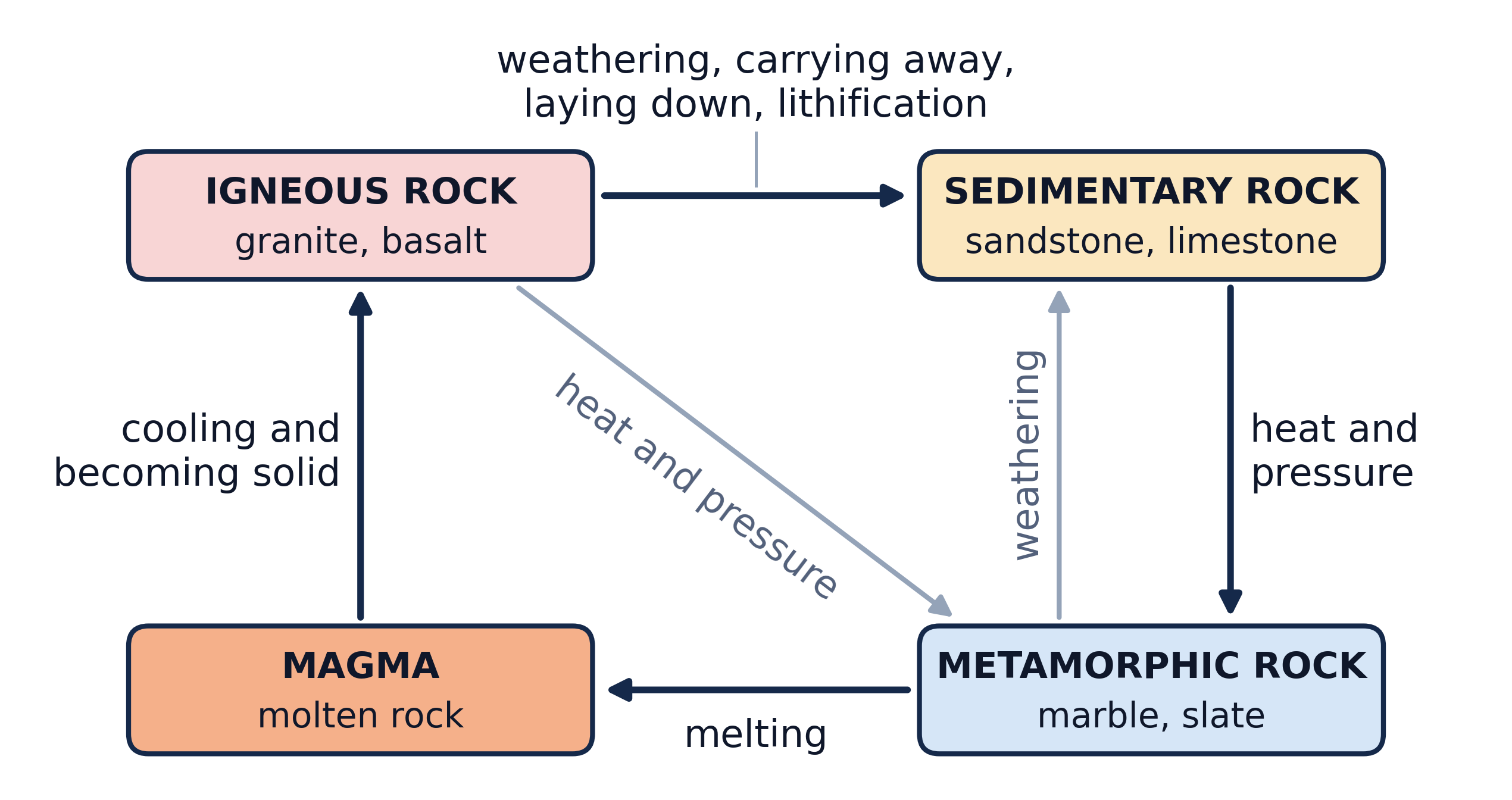
Rocks do not stay the same for ever. One family changes into another in an endless round called the rock cycle.
- Magma cools to form igneous rock. Igneous rocks are the primary rocks: the other two families are made from them.
- Any rock at the surface is broken down by weathering. The pieces are carried away, laid down and lithified into sedimentary rock.
- Any rock that is buried and put under great heat or pressure becomes metamorphic rock.
- Any rock that is carried deep into the mantle melts into magma, and the cycle begins again.
3. Weathering
Weathering is the breaking down of rocks where they lie, by the weather. There is little or no movement of the material. (Carrying the broken material away is erosion, a different process.)
| Kind | What happens | Processes to know |
|---|---|---|
| Mechanical (physical) | The rock breaks into smaller pieces. Its chemical make-up does not change | Unloading and expansion: sheets peel off the rock like the layers of an onion (exfoliation). Heating and cooling: common in deserts. Freezing and thawing (frost wedging): water freezes in cracks, expands and splits the rock. Salt crystal growth: salts crystallise in pores and push the grains apart |
| Chemical | The minerals of the rock are changed or dissolved. Water and warmth speed it up, so it is strongest in hot wet lands | Solution: minerals dissolve in water and are leached away. Carbonation: rain water with carbon dioxide forms a weak acid that attacks limestone and helps to break down feldspars. Hydration: minerals take up water and swell. Oxidation: iron in the rock combines with oxygen and the rock turns red or brown. Reduction: the opposite, in waterlogged ground |
| Biological | Plants and animals do the work | Roots widen cracks; burrowing animals expose fresh rock; decaying plants give acids |
NCERT names three groups of forces at work in mechanical weathering: gravitational forces, expansion forces and water pressures (asked in NDA I 2025).
4. Earthquakes
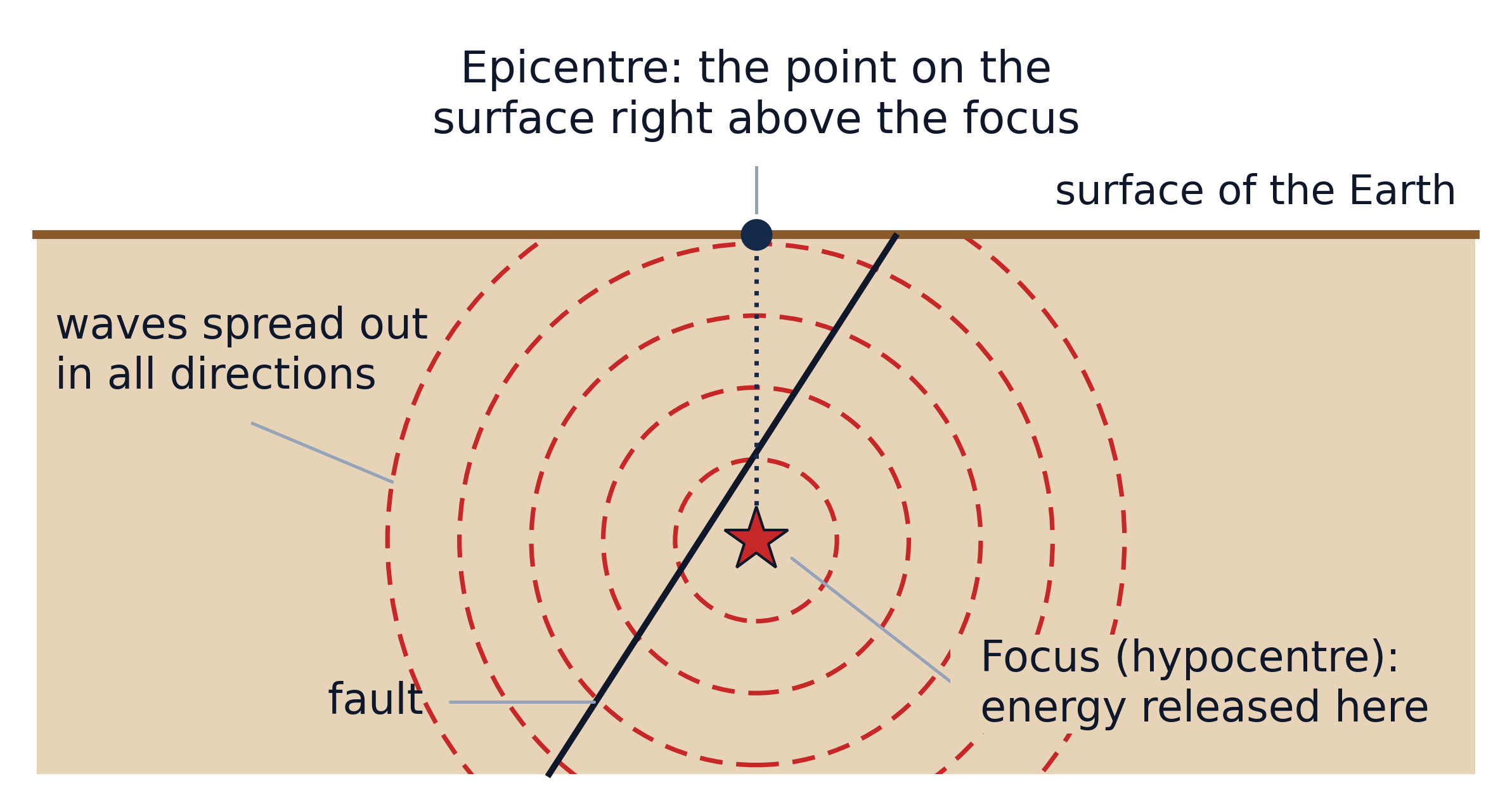
An earthquake is a shaking of the ground caused by a sudden release of energy, usually when rocks slip along a fault.
| Term | Meaning |
|---|---|
| Focus (hypocentre) | The point inside the Earth where the energy is released. It may be many kilometres deep |
| Epicentre | The point on the surface directly above the focus. It feels the waves first |
| Seismograph | The instrument that records earthquake waves |
The waves
| Wave | Kind | How the particles move | Passes through | Other facts |
|---|---|---|---|---|
| P waves (primary) | Body wave | To and fro, along the direction of the wave, like sound | Solids, liquids and gases | The fastest; they reach the seismograph first |
| S waves (secondary) | Body wave | Up and down, at right angles to the direction of the wave | Solids only | Slower; they cannot cross the liquid outer core |
| Surface waves (L waves) | Formed when body waves meet the surface rocks | Along the surface | The surface layers | The last to arrive and the most destructive |
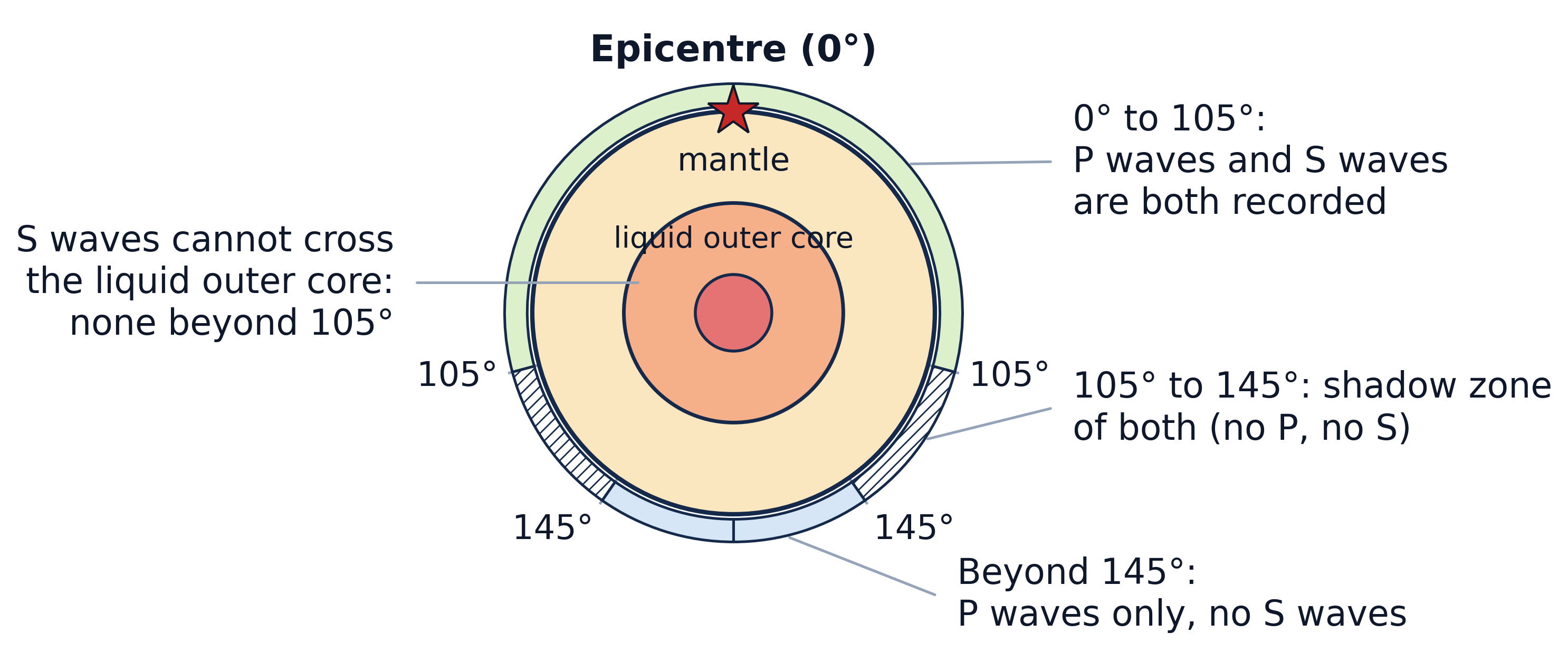
Shadow zones. Seismographs between 105° and 145° from the epicentre record neither P waves nor S waves. This belt is the shadow zone of both. Beyond 145° the P waves appear again but the S waves do not. So the shadow zone of S waves (everything beyond 105°) is much larger than that of P waves. This is how we know that the outer core is liquid.
Two scales
| Scale | Measures | Range |
|---|---|---|
| Richter scale (Charles Richter, 1935) | Magnitude: the energy released | NCERT gives 0 to 10 |
| Mercalli scale | Intensity: the visible damage | 1 to 12 |
A shallow-focus earthquake usually does more damage than a deep-focus one, because the energy has less rock to pass through. An earthquake under the sea may raise a tsunami.
5. Volcanoes
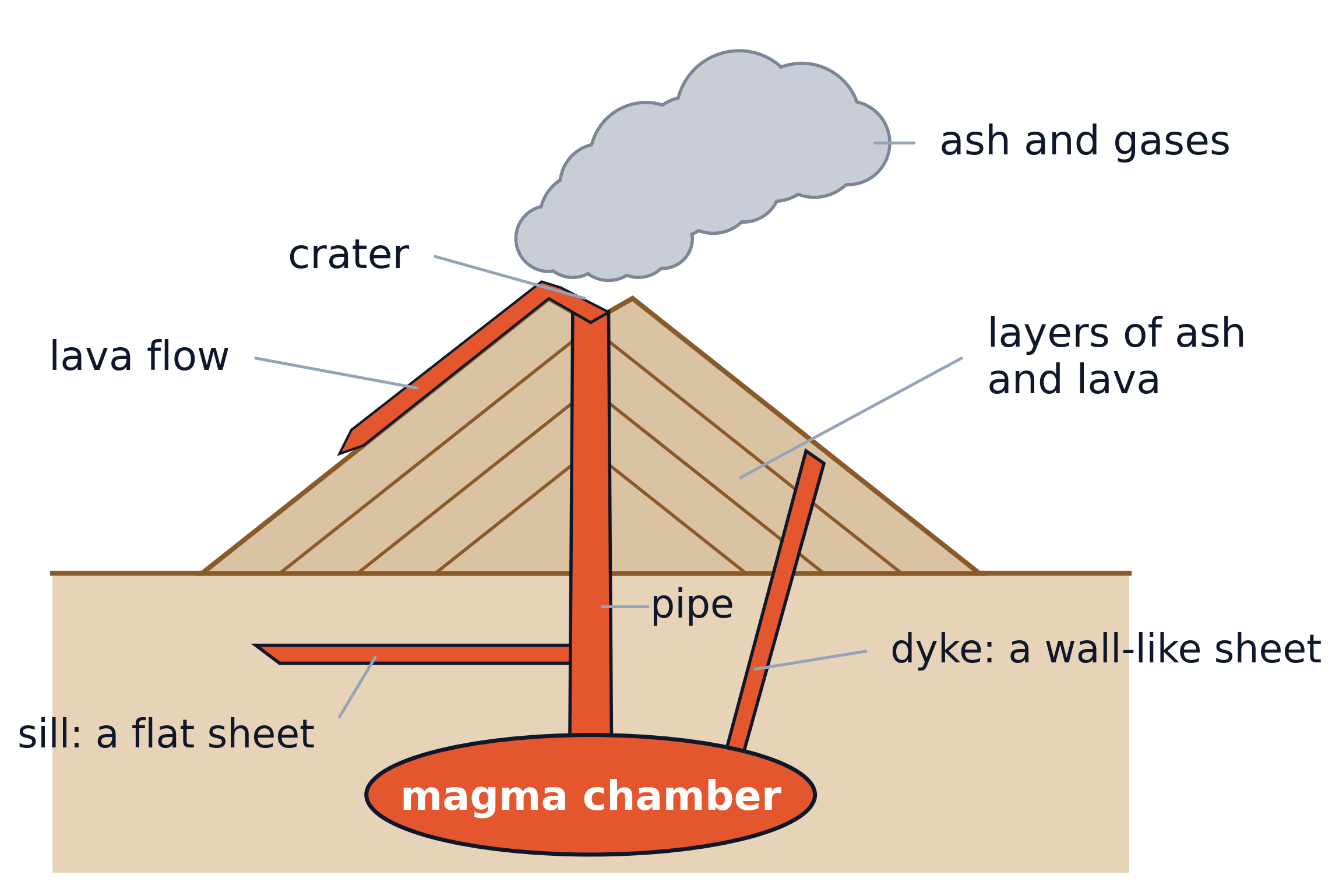
A volcano is an opening in the crust through which lava, ash and gases come out. Pieces of rock and ash thrown out are called pyroclastic material.
| Kind | Lava and eruption | Shape and example |
|---|---|---|
| Shield volcano | Basalt lava, very fluid; quiet eruptions | Very broad with gentle slopes; the largest volcanoes. Hawaii |
| Composite volcano | Cooler, thicker lava; explosive eruptions with much pyroclastic material and ash | The material piles up in layers near the vent and builds a tall cone. Mount Fuji in Japan |
| Caldera | The most explosive of all | The volcano collapses on itself and leaves a large hollow |
| Flood basalt | Very fluid lava flows over a huge area | Thick sheets of basalt. The Deccan Traps of India |
| Mid-ocean ridge volcanoes | Lava comes out along the ridges on the ocean floor | A ridge system more than 70,000 km long |
Where volcanoes are found. Most lie along plate boundaries. The belt round the Pacific Ocean, called the Ring of Fire, has the largest number, and many earthquakes too. Others lie along the mid-oceanic ridges (Iceland, the Azores, Ascension and Tristan da Cunha are on the Mid-Atlantic Ridge). The Hawaiian Islands are different: they lie in the middle of a plate, over a hot spot. India's only active volcano is on Barren Island in the Andaman and Nicobar Islands.
Magma that never reaches the surface cools inside the crust in shapes that have names:
| Form | Shape |
|---|---|
| Batholith | A very large body, cooled at great depth, in the form of large domes; usually granite |
| Laccolith | A large dome with a flat base, fed by a pipe from below |
| Lopolith | Saucer-shaped, hollow side up |
| Phacolith | A wavy mass at the top of an upfold or the bottom of a downfold |
| Sill | A flat, nearly horizontal sheet |
| Dyke | A wall-like, nearly vertical sheet |
6. Plate tectonics in brief
- Continental drift. Alfred Wegener said in 1912 that all the continents were once one land mass, Pangaea, surrounded by one ocean, Panthalassa. Pangaea broke into Laurasia in the north and Gondwanaland in the south.
- Sea-floor spreading. Harry Hess (1961): new ocean floor is made at the mid-oceanic ridges and spreads outwards.
- Plate tectonics (1967): the lithosphere is broken into plates that move slowly over the asthenosphere. NCERT lists seven major plates: the Pacific, North American, South American, Eurasian, African, Antarctic and India-Australia-New Zealand plates. Minor plates include the Cocos, Nazca, Arabian, Philippine and Caroline plates.
| Boundary | What the plates do | What it makes |
|---|---|---|
| Divergent | Move apart; new crust is made | Mid-oceanic ridges, such as the Mid-Atlantic Ridge |
| Convergent | Move together; one plate sinks under the other (subduction) and crust is destroyed | Ocean trenches, with active volcanoes and strong earthquakes; fold mountains such as the Himalaya, where the Indian plate meets the Eurasian plate |
| Transform | Slide past each other; crust is neither made nor destroyed | Earthquakes |
The Himalaya, the Alps, the Andes and the Rockies are fold mountains. Mount Fuji is a volcano, not a fold mountain.
What the papers have asked
| Paper | The idea asked | The answer in one line |
|---|---|---|
| NDA II 2017 | The rock that is not igneous, out of four | Dolomite, a sedimentary rock; gabbro, granite and basalt are igneous |
| NDA I 2019 | The weathering in which salt crystals grow | Physical (mechanical) weathering |
| NDA II 2019 | A sedimentary rock that is organically formed | Chalk |
| NDA II 2019, NDA I 2021 | Major and minor plates | The Pacific and Antarctic plates are major; Cocos, Nazca, Arabian, Philippine and Caroline are minor |
| NDA I 2021 | The point where an earthquake starts | The focus, also called the hypocentre |
| NDA I 2021 | A very large dome of magma cooled at depth | Batholith |
| NDA II 2023 | The mountain that is not a fold mountain | Mount Fuji, a volcano |
| NDA I 2024 | Statements on earthquakes | The epicentre is above the focus and body waves are P and S; deep-focus earthquakes do not do more damage than shallow ones |
| NDA II 2024 | The process that is not chemical weathering | Thawing, which is physical; solution, hydration and reduction are chemical |
| NDA I 2025 | Volcanic ash laid down in layers by running water | Tuff |
| NDA II 2025 | Shadow zones | 105° to 145° is the shadow zone of both waves; the S-wave shadow zone is the larger one |
| NDA II 2025 | The island chain not on a mid-oceanic ridge | The Hawaiian Islands |
| NDA I 2026 | The process that makes sedimentary rock from loose sediment | Lithification |
| NDA I 2026 | The parent rock of quartzite | Sandstone |
| NDA I 2026 | Features of composite volcanoes | Explosive eruptions, pyroclastic material, and layers of ash built up near the vent: all three |
Worked examples
Example 1 (a single fact). Which one of the following is a metamorphic rock?
(a) Basalt (b) Marble (c) Sandstone (d) Granite
Solution. Marble is limestone changed by heat and pressure. Basalt and granite are igneous. Sandstone is sedimentary; it is the parent of quartzite, not a metamorphic rock itself. Answer (b).
Example 2 (consider the following statements).
- P waves can travel through solids, liquids and gases.
- S waves reach a seismograph before P waves.
- Surface waves cause the most damage.
Which of the statements given above are correct?
(a) 1 and 2 only (b) 2 and 3 only (c) 1 and 3 only (d) 1, 2 and 3
Solution. Statements 1 and 3 are correct. Statement 2 is wrong: P waves are the fastest, which is why they are called primary. S waves come second. Answer (c).
Example 3 (matching lists). Match the weathering process with what it does.
List I: A. Oxidation B. Carbonation C. Frost wedging D. Hydration
List II: 1. Water freezing in cracks splits the rock 2. Minerals take up water and swell 3. Iron in the rock turns red or brown 4. A weak acid from rain water dissolves limestone
(a) A-3, B-4, C-1, D-2 (b) A-4, B-3, C-1, D-2 (c) A-3, B-4, C-2, D-1 (d) A-2, B-1, C-4, D-3
Solution. Oxidation is rusting of the iron in the rock (3). Carbonation is the work of carbonic acid on limestone (4). Frost wedging is the freezing of water in cracks (1); it is the only mechanical process in the list. Hydration is the taking up of water (2). Option (c) swaps the last two. Answer (a).
Example 4 (reasoning). Granite has large crystals and basalt has very fine grains. What is the reason?
(a) Granite is older than basalt (b) Granite cooled slowly at depth and basalt cooled quickly on the surface (c) Granite was formed under the sea (d) Basalt was changed by pressure
Solution. Crystals need time to grow. Granite is an intrusive rock that cooled slowly inside the crust. Basalt is an extrusive rock that cooled quickly as lava. Age has nothing to do with grain size. Answer (b).
Example 5 (consider the following statements).
- The Himalaya were formed at a convergent plate boundary.
- New crust is formed at a transform boundary.
Which of the statements given above is/are correct?
(a) 1 only (b) 2 only (c) Both 1 and 2 (d) Neither 1 nor 2
Solution. Statement 1 is correct: the Indian plate pushed against the Eurasian plate. Statement 2 is wrong: at a transform boundary plates slide past each other and crust is neither made nor destroyed. New crust is made at a divergent boundary. Answer (a).
Mistakes that cost marks
- Focus and epicentre exchanged. The focus is inside the Earth. The epicentre is on the surface, directly above it.
- Magnitude and intensity exchanged. Richter measures magnitude, the energy released. Mercalli measures intensity, the damage seen.
- Calling weathering "erosion". In weathering the rock breaks where it lies. In erosion the material is carried away.
- Putting limestone or dolomite among igneous rocks. Both are sedimentary. Only rocks that cooled from magma or lava are igneous.
Quick check
- Name the metamorphic rock formed from shale.
- Which earthquake waves cannot pass through a liquid?
- Is exfoliation a kind of mechanical weathering or chemical weathering?
- Which kind of volcano has the most fluid lava and the gentlest slopes?
- At which kind of plate boundary are mid-oceanic ridges formed?
Read and watch more, free
| What | Where | Language |
|---|---|---|
| Textbook, the three families of rocks | NCERT Class 7 (older book), Inside Our Earth | English |
| Textbook, weathering | NCERT Class 11, Geomorphic Processes | English |
| Textbook, earthquakes and volcanoes | NCERT Class 11, Interior of the Earth | English |
| Textbook, plates | NCERT Class 11, Distribution of Oceans and Continents | English |
| Textbook, a simpler start | NCERT Class 9, Shaping of the Earth's Surface | English |
| Self-study course | NIOS Senior Secondary Geography (316): lesson 2 for rocks and weathering, lesson 3 for earthquakes and volcanoes | English, Hindi |
| Video, lessons on plate tectonics, geomorphic processes, earthquakes and volcanoes | Defence Wallah: Complete Geography for NDA | Hinglish |
| Video, short lessons on the Class 11 book, including the chapter on minerals and rocks | Amit Sengupta: Fundamentals of Physical Geography | English |
| Video, one long lesson for each chapter | Magnet Brains: Class 11 Geography | Hinglish |
The Hindi edition of the Class 11 book is on the NCERT website under the book code khgy2.
The videos were chosen from their titles, length and views; they have not yet been watched by a teacher.
Answers to the quick check
- Slate.
- S waves (secondary waves).
- Mechanical weathering.
- A shield volcano.
- At a divergent boundary.
Next chapter: Oceans: currents and tides