Why this chapter matters. This chapter drew 3 real questions in the seven papers from NDA II 2023 to NDA II 2026: one on whether a system has a solution, one on Cramer's rule, and one on a system with letters in place of numbers. The count is small, but the chapter uses everything in this unit, and the question "how many solutions?" can be answered in seconds. Two of the real questions are solved in section 7, followed by three practice questions in the exam style.
What you will be able to do
- Write a system of linear equations as one matrix equation AX = B.
- Solve a system by Cramer's rule and by the matrix method.
- Say, without solving, whether a system has one solution, no solution or infinitely many.
- Find the value of a constant for which a homogeneous system has a non-zero solution.
Before you start you should know: how to find a determinant (Chapter M2-2) and the inverse of a matrix (Chapter M2-3).
1. A system as one matrix equation
Take the system 2x + 3y = 8, x - y = -1. Put the coefficients in a matrix A, the unknowns in a column X and the constants in a column B:
\begin{bmatrix} 2 & 3 \\ 1 & -1 \end{bmatrix} \begin{bmatrix} x \\ y \end{bmatrix} = \begin{bmatrix} 8 \\ -1 \end{bmatrix}, \quad \text{that is} \quad AX = B
A is called the coefficient matrix. Its determinant is written D (or \Delta). Before you read off A and B, write every equation with the unknowns on the left, in the same order, and the constant on the right.
A system is consistent if it has at least one solution, and inconsistent if it has none.
2. Cramer's rule
For three equations a_1x + b_1y + c_1z = d_1, a_2x + b_2y + c_2z = d_2, a_3x + b_3y + c_3z = d_3, make four determinants:
- D: the determinant of the coefficients.
- D_1: replace the first column of D (the x column) by the constants d_1, d_2, d_3.
- D_2: replace the second column (the y column) by the constants.
- D_3: replace the third column (the z column) by the constants.
If D \ne 0, the system has exactly one solution:
x = \frac{D_1}{D}, \qquad y = \frac{D_2}{D}, \qquad z = \frac{D_3}{D}
For two equations in two unknowns the rule is the same, with D, D_1 and D_2 of order 2. For the system in section 1:
D = \begin{vmatrix} 2 & 3 \\ 1 & -1 \end{vmatrix} = -5, D_1 = \begin{vmatrix} 8 & 3 \\ -1 & -1 \end{vmatrix} = -5, D_2 = \begin{vmatrix} 2 & 8 \\ 1 & -1 \end{vmatrix} = -10.
So x = \dfrac{-5}{-5} = 1 and y = \dfrac{-10}{-5} = 2. Check: 2 + 6 = 8 and 1 - 2 = -1.
3. The matrix method
If |A| \ne 0, multiply AX = B on the left by A^{-1}:
X = A^{-1}B
The order matters: it is A^{-1}B, never BA^{-1}.
For the same system, |A| = -5 and \operatorname{adj} A = \begin{bmatrix} -1 & -3 \\ -1 & 2 \end{bmatrix}. So
X = \frac{1}{-5} \begin{bmatrix} -1 & -3 \\ -1 & 2 \end{bmatrix} \begin{bmatrix} 8 \\ -1 \end{bmatrix} = \frac{1}{-5} \begin{bmatrix} -5 \\ -10 \end{bmatrix} = \begin{bmatrix} 1 \\ 2 \end{bmatrix}
Are Cramer's rule and the matrix method the same? They are two routes to the same answer. Cramer's rule finds each unknown on its own, as a ratio of two determinants. The matrix method finds all the unknowns together, as X = A^{-1}B. Since A^{-1} = \dfrac{\operatorname{adj} A}{|A|}, Cramer's rule is the matrix method written out one unknown at a time. Both need the same thing: the determinant of the coefficients must not be zero.
4. How many solutions?
| What you find | Number of solutions | The system is |
|---|---|---|
| D \ne 0 | Exactly one | Consistent |
| D = 0, and at least one of D_1, D_2, D_3 is not zero | None | Inconsistent |
| D = 0, and D_1 = D_2 = D_3 = 0 | Infinitely many, or in rare cases none. Look at the equations | Usually consistent |
An example of the rare case: x + y + z = 1, x + y + z = 2, x + y + z = 3. Every determinant is zero, but the equations contradict each other.
In the matrix method the same test reads: if |A| = 0, find (\operatorname{adj} A)B. If it is not the zero matrix, there is no solution. If it is the zero matrix, there are infinitely many solutions or none.
Two equations in two unknowns have a faster test. For a_1x + b_1y = c_1 and a_2x + b_2y = c_2, compare ratios:
| Ratios | Picture | Solutions |
|---|---|---|
| \dfrac{a_1}{a_2} \ne \dfrac{b_1}{b_2} | Two lines that cross | Exactly one |
| \dfrac{a_1}{a_2} = \dfrac{b_1}{b_2} \ne \dfrac{c_1}{c_2} | Two parallel lines | None |
| \dfrac{a_1}{a_2} = \dfrac{b_1}{b_2} = \dfrac{c_1}{c_2} | The same line twice | Infinitely many |
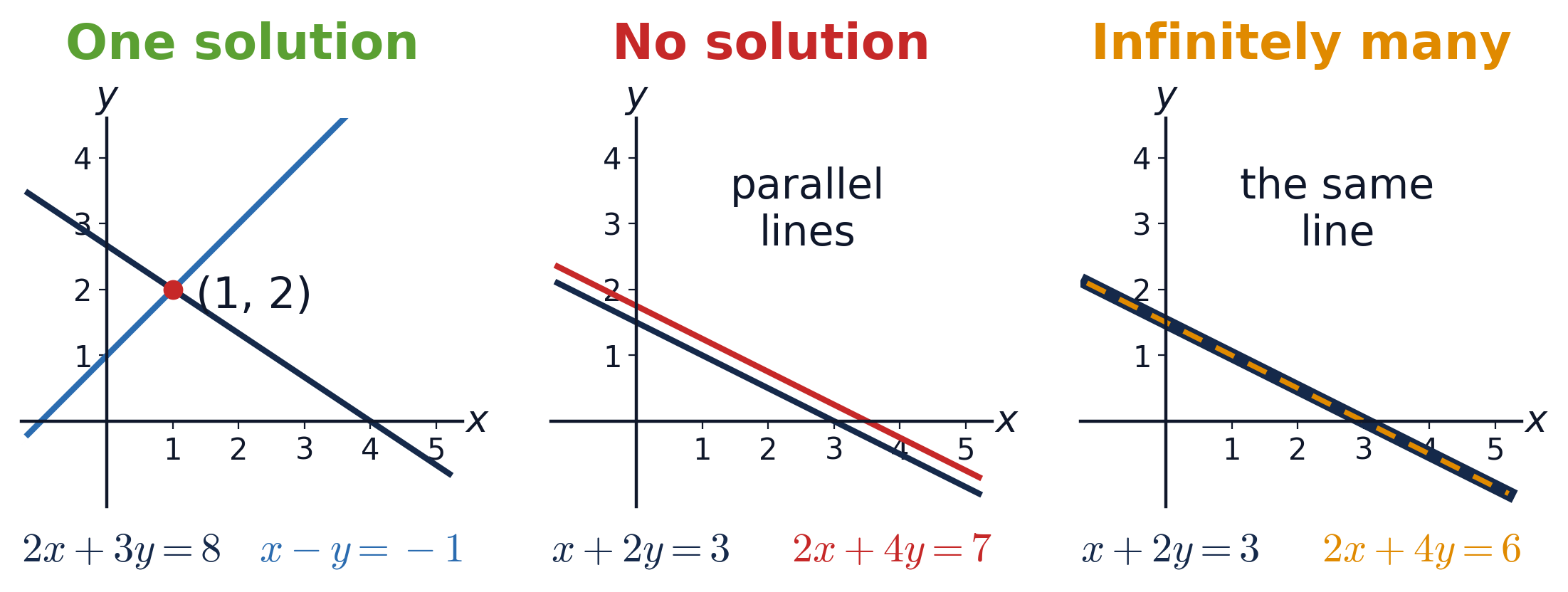
The picture shows one system of each kind. On the left, the system of section 1: the lines cross at (1, 2), which is its solution. In the middle and on the right, the systems of Example 3 below.
5. Homogeneous systems
A system is homogeneous when every constant on the right is zero: AX = O. Then x = y = z = 0 is always a solution. It is called the trivial solution. So a homogeneous system is always consistent, and the only question is whether it has other solutions:
- If |A| \ne 0, the trivial solution is the only one.
- If |A| = 0, there are infinitely many solutions, so there are non-zero (non-trivial) ones.
6. Worked examples
Example 1. Solve by Cramer's rule: x + y + z = 6, x - y + z = 2, 2x + y - z = 1.
D = \begin{vmatrix} 1 & 1 & 1 \\ 1 & -1 & 1 \\ 2 & 1 & -1 \end{vmatrix} = 1(1 - 1) - 1(-1 - 2) + 1(1 + 2) = 0 + 3 + 3 = 6.
D_1 = \begin{vmatrix} 6 & 1 & 1 \\ 2 & -1 & 1 \\ 1 & 1 & -1 \end{vmatrix} = 6(1 - 1) - 1(-2 - 1) + 1(2 + 1) = 6.
D_2 = \begin{vmatrix} 1 & 6 & 1 \\ 1 & 2 & 1 \\ 2 & 1 & -1 \end{vmatrix} = 1(-2 - 1) - 6(-1 - 2) + 1(1 - 4) = -3 + 18 - 3 = 12.
D_3 = \begin{vmatrix} 1 & 1 & 6 \\ 1 & -1 & 2 \\ 2 & 1 & 1 \end{vmatrix} = 1(-1 - 2) - 1(1 - 4) + 6(1 + 2) = -3 + 3 + 18 = 18.
So x = \dfrac{6}{6} = 1, y = \dfrac{12}{6} = 2, z = \dfrac{18}{6} = 3. Check in the third equation: 2 + 2 - 3 = 1.
Example 2. Solve by the matrix method: 5x + 2y = 4, 7x + 3y = 5.
A = \begin{bmatrix} 5 & 2 \\ 7 & 3 \end{bmatrix} and |A| = 15 - 14 = 1. So A^{-1} = \operatorname{adj} A = \begin{bmatrix} 3 & -2 \\ -7 & 5 \end{bmatrix}, and
X = A^{-1}B = \begin{bmatrix} 3 & -2 \\ -7 & 5 \end{bmatrix} \begin{bmatrix} 4 \\ 5 \end{bmatrix} = \begin{bmatrix} 12 - 10 \\ -28 + 25 \end{bmatrix} = \begin{bmatrix} 2 \\ -3 \end{bmatrix}
So x = 2 and y = -3. Check: 10 - 6 = 4 and 14 - 9 = 5.
Example 3. For what values of k does the system x + 2y = 3, 2x + ky = 6 have (i) exactly one solution, (ii) infinitely many solutions?
D = k - 4. (i) If k \ne 4, then D \ne 0 and there is exactly one solution. (ii) If k = 4, the ratios are \dfrac{1}{2} = \dfrac{2}{4} = \dfrac{3}{6}: the second equation is twice the first, so there are infinitely many solutions.
If the second equation were 2x + 4y = 7, the ratios would be \dfrac{1}{2} = \dfrac{2}{4} \ne \dfrac{3}{7} and there would be no solution.
Example 4. For what value of k does the system x + y + z = 0, x + 2y + 3z = 0, x + 3y + kz = 0 have a non-zero solution?
The system is homogeneous, so we need |A| = 0:
\begin{vmatrix} 1 & 1 & 1 \\ 1 & 2 & 3 \\ 1 & 3 & k \end{vmatrix} = 1(2k - 9) - 1(k - 3) + 1(3 - 2) = k - 5.
So k = 5.
7. From the real papers
Only two real questions are given here. The third question captured on this chapter (NDA II 2025, Q14, on Cramer's rule) has a slip in its printed wording, so practice question 1 below takes its place.
NDA II 2025, Q12. The system of equations 2x - 3y - 5 = 0, 15y - 10x + 50 = 0
(a) has a unique solution (b) has infinitely many solutions (c) is inconsistent (d) is consistent and has exactly two solutions
Solution. Write both in the same form: 2x - 3y = 5 and -10x + 15y = -50. The ratios are \dfrac{2}{-10} = \dfrac{-3}{15} = -\dfrac{1}{5}, but \dfrac{5}{-50} = -\dfrac{1}{10}. The first two ratios are equal and the third is different, so the lines are parallel and there is no solution. Answer (c).
NDA II 2026, Q39. If x + ay + a^2z = 1, x + by + b^2z = 1, x + cy + c^2z = 1 where a \ne b \ne c, then what is x + y + z equal to?
(a) 0 (b) 1 (c) 3 (d) a + b + c
Solution. Try x = 1, y = 0, z = 0: it satisfies all three equations. Is it the only solution? The coefficient determinant is \begin{vmatrix} 1 & a & a^2 \\ 1 & b & b^2 \\ 1 & c & c^2 \end{vmatrix} = (a-b)(b-c)(c-a) (Chapter M2-2, Example 3), which is not zero because a, b, c are different. So the solution is unique, and x + y + z = 1. Answer (b).
Practice questions in the exam style
These three questions are our own, written in the style of the paper. They are not from a real paper.
Practice 1. The system x + y + z = 6, x + 2y + 3z = 14, x + 4y + 9z = 36 is solved by Cramer's rule. What is the value of the determinant D_2, which is used to find y?
(a) 2 (b) 4 (c) 6 (d) 12
Solution. Replace the second column of D by the constants: D_2 = \begin{vmatrix} 1 & 6 & 1 \\ 1 & 14 & 3 \\ 1 & 36 & 9 \end{vmatrix} = 1(126 - 108) - 6(9 - 3) + 1(36 - 14) = 18 - 36 + 22 = 4. (Here D = 2, so y = \dfrac{4}{2} = 2.) Answer (b).
Practice 2. For what value of k does the system kx + y = 1, x + ky = 1 have no solution?
(a) -1 (b) 0 (c) 1 (d) 2
Solution. D = k^2 - 1, which is zero when k = 1 or k = -1. For k = 1 both equations are x + y = 1: infinitely many solutions. For k = -1 the equations are -x + y = 1 and x - y = 1, that is x - y = -1 and x - y = 1: no solution. Answer (a).
Practice 3. If A^{-1} = \begin{bmatrix} 1 & -1 \\ 2 & 0 \end{bmatrix} and AX = \begin{bmatrix} 3 \\ 1 \end{bmatrix}, what is X?
(a) \begin{bmatrix} 2 \\ 6 \end{bmatrix} (b) \begin{bmatrix} 4 \\ 2 \end{bmatrix} (c) \begin{bmatrix} 2 \\ 2 \end{bmatrix} (d) \begin{bmatrix} 3 \\ 1 \end{bmatrix}
Solution. X = A^{-1}B = \begin{bmatrix} 3 - 1 \\ 6 + 0 \end{bmatrix} = \begin{bmatrix} 2 \\ 6 \end{bmatrix}. Answer (a).
8. Mistakes that cost marks
- Turning Cramer's rule upside down. It is x = \dfrac{D_1}{D}, with D below. Not \dfrac{D}{D_1}.
- Reading the constants with the wrong sign. 2x - 3y - 5 = 0 means 2x - 3y = 5. Move the constant to the right before you write B, D_1, D_2 or the ratios.
- Writing X = BA^{-1}. The right version is X = A^{-1}B. The product BA^{-1} is not even defined, because B is a column.
- Saying "D = 0, so there is no solution". D = 0 only tells you that there is not exactly one solution. There may be none, or infinitely many. Check further.
9. Quick check
Do these without help. Answers are at the end.
- Solve by Cramer's rule: 3x + 2y = 7, x - y = 4.
- For what value of k does the system 2x + ky = 5, 3x + 6y = 1 not have a unique solution?
- How many solutions has the system x + 2y = 3, 2x + 4y = 6?
- For what value of k does the system x + 2y + 3z = 0, 2x + 3y + z = 0, 3x + 5y + kz = 0 have a non-zero solution?
- Solve: x + y = 5, y + z = 7, z + x = 6.
10. Read and watch more, free
| What | Where | Language |
|---|---|---|
| Textbook, the matrix method | NCERT Class 12 Mathematics, Chapter 4 Determinants (the last section) · Hindi edition | English, Hindi |
| Self-study notes | NIOS Mathematics, Lesson 22 Inverse of a Matrix and its Applications · Hindi edition | English, Hindi |
| Textbook, with Cramer's rule | OpenStax Algebra and Trigonometry 2e, from section 11.5 onwards | English |
| Video, the whole unit for NDA | Defence Wallah: Matrices and Determinants (first video of the playlist, about 5 hours) | Hinglish |
| Video, every textbook problem | Magnet Brains: Class 12 Maths, Chapter 4 | Hinglish |
| Video, short lessons | Khan Academy India: सारणिक | Hindi |
The videos were chosen from their titles, length and views; they have not yet been watched by a teacher.
Answers to the quick check
- D = -3 - 2 = -5, D_1 = -7 - 8 = -15, D_2 = 12 - 7 = 5. So x = 3 and y = -1.
- D = 12 - 3k = 0, so k = 4. (Then the ratios are \dfrac{2}{3} = \dfrac{4}{6} \ne \dfrac{5}{1}, so there is no solution at all.)
- Infinitely many: the second equation is twice the first.
- |A| = 1(3k - 5) - 2(2k - 3) + 3(10 - 9) = 4 - k, so k = 4.
- Add the three equations: 2(x + y + z) = 18, so x + y + z = 9. Then z = 9 - 5 = 4, x = 9 - 7 = 2, y = 9 - 6 = 3.
Next chapter: Angles: degrees and radians.