Why this chapter matters. In the seven papers from NDA II 2023 to NDA II 2026, no question was set on this chapter alone. But the six trigonometry chapters that follow drew 102 questions in those papers, and many of them give angles in radians, such as \frac{\pi}{6} or \frac{5\pi}{4}. A student who cannot change radians to degrees in a few seconds loses time in all of them. This is a short chapter: about 30 minutes.
What you will be able to do
- Change an angle from degrees to radians and from radians to degrees.
- Use l = r\theta to find the length of an arc, and \frac{1}{2}r^2\theta to find the area of a sector.
- Bring any large or negative angle back to an angle between 0^\circ and 360^\circ and name its quadrant.
- Find the angle between the hands of a clock.
Before you start you should know: the circumference of a circle is 2\pi r and its area is \pi r^2 (Class 10).
1. Two units for one angle
An angle measures how much a line has turned about a point. One full turn can be divided in two ways.
Degrees. One full turn is 360^\circ. One degree has 60 minutes (1^\circ = 60') and one minute has 60 seconds (1' = 60'').
Radians. Take a circle of radius r. Mark an arc whose length is also r. The angle this arc makes at the centre is 1 radian. The whole circumference is 2\pi r, so it holds 2\pi such arcs. One full turn is therefore 2\pi radians.
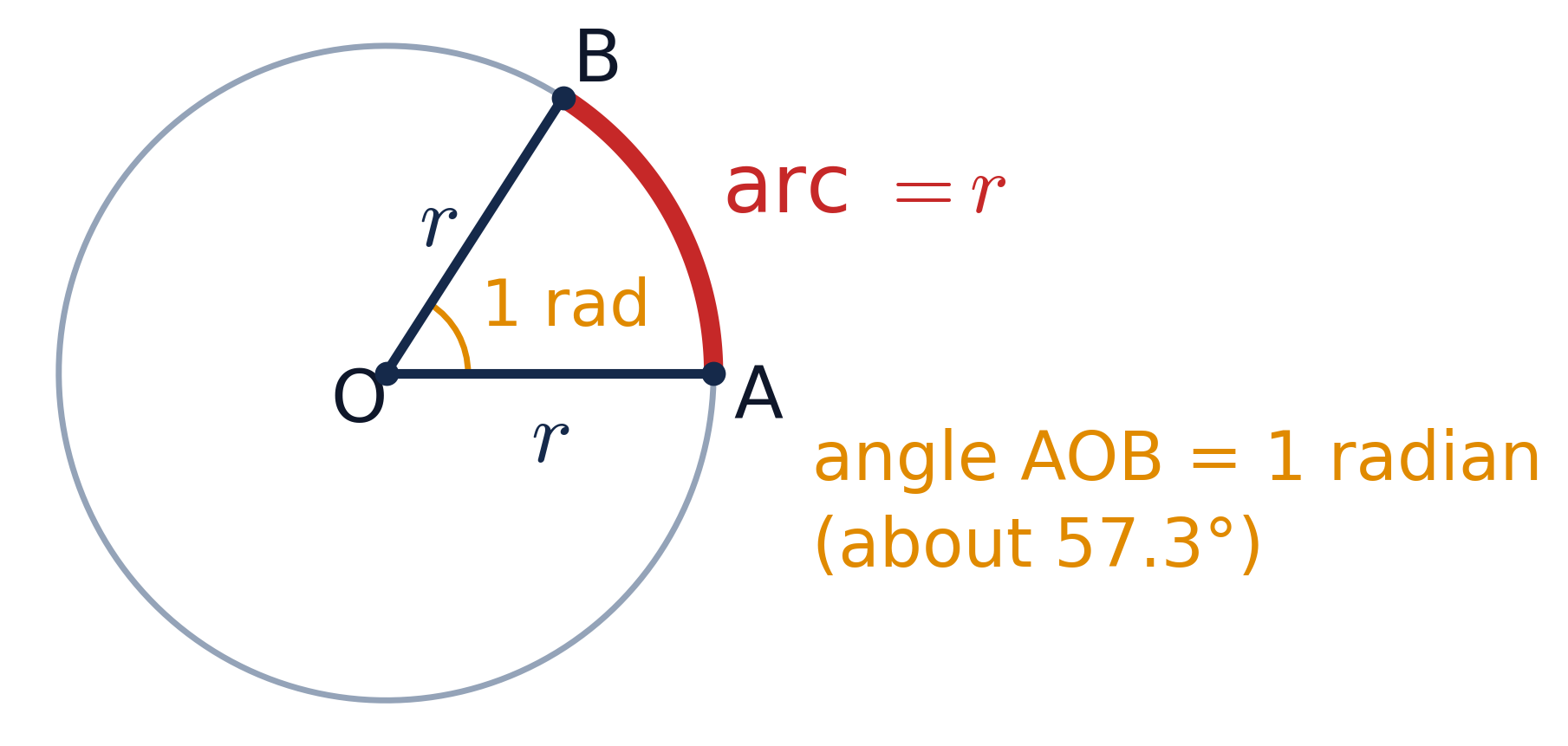
2\pi \text{ radians} = 360^\circ \qquad \text{so} \qquad \pi \text{ radians} = 180^\circ
When an angle is written with no unit, as in \sin\frac{\pi}{6}, the unit is radians.
2. Changing from one unit to the other
Everything comes from \pi radians = 180^\circ.
- Degrees to radians: multiply by \dfrac{\pi}{180}. For example, 75^\circ = 75 \times \dfrac{\pi}{180} = \dfrac{5\pi}{12}.
- Radians to degrees: multiply by \dfrac{180}{\pi}. For example, \dfrac{7\pi}{12} = \dfrac{7 \times 180^\circ}{12} = 105^\circ.
A quick way for radians to degrees: replace \pi by 180^\circ.
Learn this table. These angles come again and again.
| Degrees | 30^\circ | 45^\circ | 60^\circ | 90^\circ | 120^\circ | 135^\circ | 150^\circ | 180^\circ | 270^\circ | 360^\circ |
|---|---|---|---|---|---|---|---|---|---|---|
| Radians | \dfrac{\pi}{6} | \dfrac{\pi}{4} | \dfrac{\pi}{3} | \dfrac{\pi}{2} | \dfrac{2\pi}{3} | \dfrac{3\pi}{4} | \dfrac{5\pi}{6} | \pi | \dfrac{3\pi}{2} | 2\pi |
Two rough values are also useful: 1 radian is about 57.3^\circ, and 1^\circ is about 0.01745 radian.
3. Arc length and area of a sector
If an arc of length l makes an angle of \theta radians at the centre of a circle of radius r, then
l = r\theta \qquad \text{and} \qquad \text{area of the sector} = \frac{1}{2}r^2\theta
For example, in a circle of radius 6 cm an angle of 60^\circ = \frac{\pi}{3} cuts off an arc of length 6 \times \frac{\pi}{3} = 2\pi cm and a sector of area \frac{1}{2} \times 36 \times \frac{\pi}{3} = 6\pi square cm.
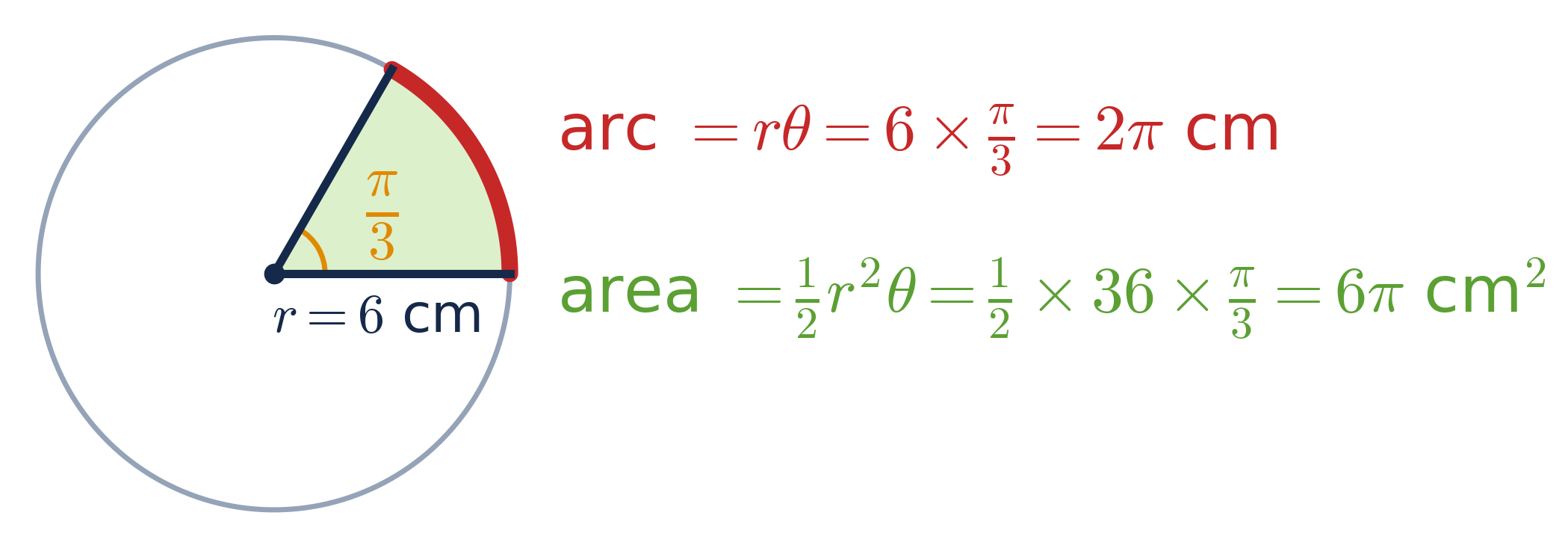
Both formulas need \theta in radians. If the angle is given in degrees, change it first.
4. Angles of any size
- An angle turned anticlockwise is positive. An angle turned clockwise is negative.
- An angle can be more than one full turn. Adding or taking away 360^\circ (or 2\pi) brings the line back to the same position. So 1125^\circ = 3 \times 360^\circ + 45^\circ ends where 45^\circ ends, and -200^\circ ends where -200^\circ + 360^\circ = 160^\circ ends.
- The two axes cut the plane into four quadrants. An angle between 0^\circ and 90^\circ ends in the first quadrant, between 90^\circ and 180^\circ in the second, between 180^\circ and 270^\circ in the third, and between 270^\circ and 360^\circ in the fourth.
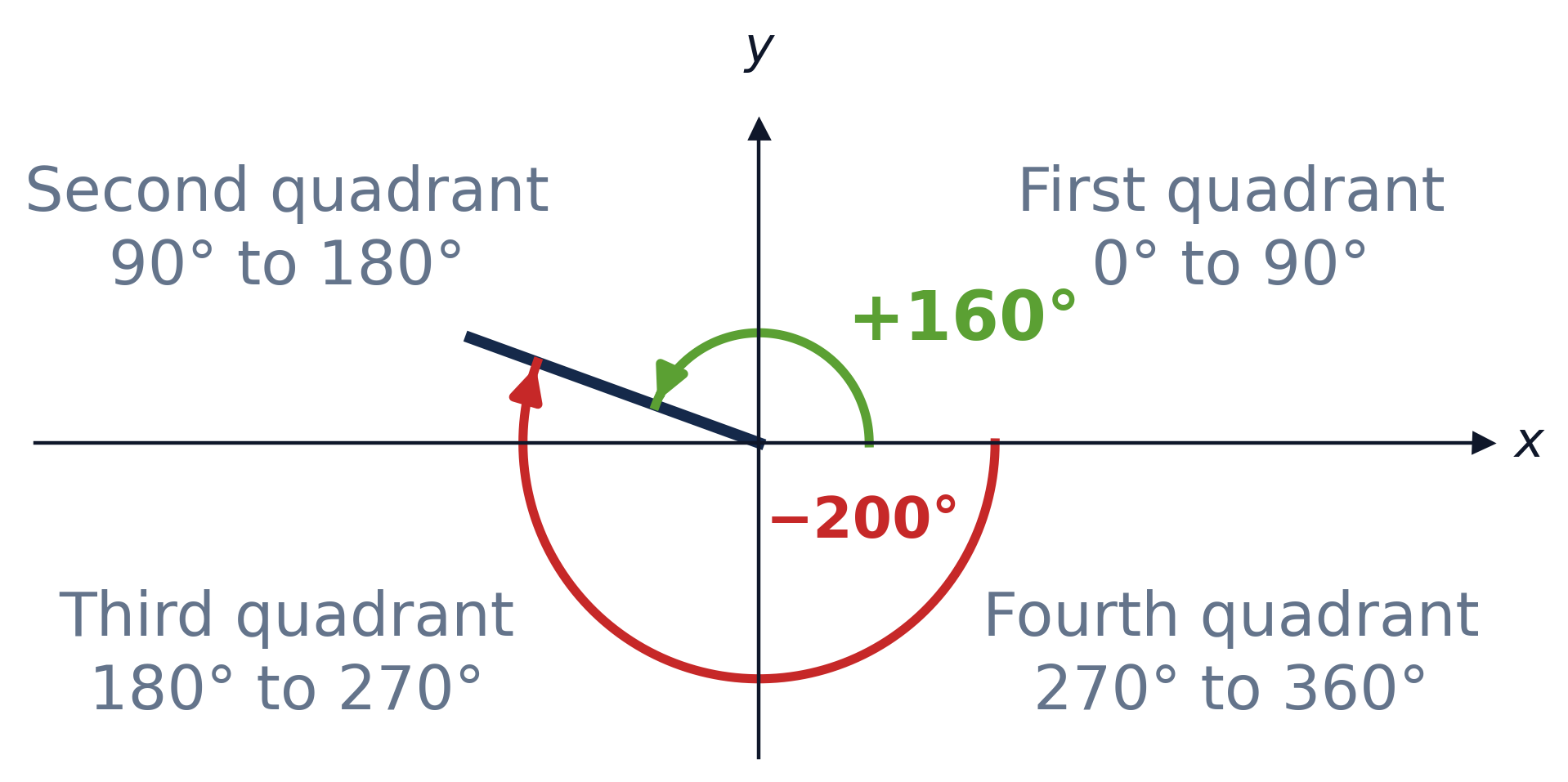
You will need this in the next chapter to find the sign of \sin, \cos and \tan.
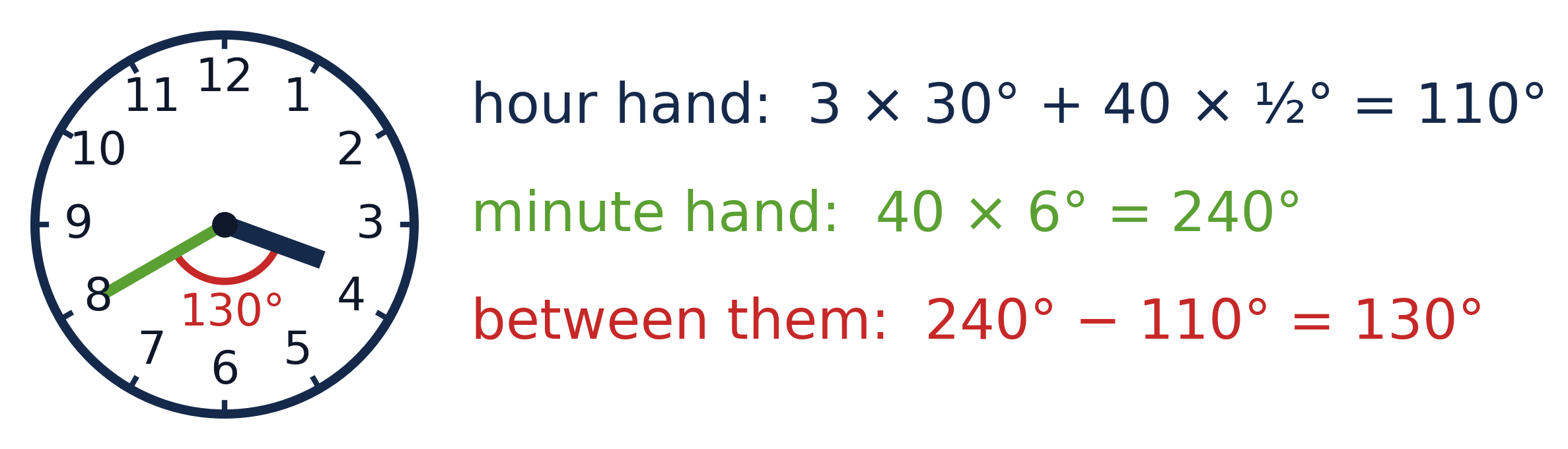
The hands of a clock. The minute hand turns 360^\circ in 60 minutes: 6^\circ each minute. The hour hand turns 30^\circ in one hour: \frac{1}{2}^\circ each minute.
5. Worked examples
Example 1. Change 40^\circ 20' to radians.
20' = \frac{20}{60}^\circ = \frac{1}{3}^\circ, so the angle is \frac{121}{3}^\circ. In radians: \frac{121}{3} \times \frac{\pi}{180} = \frac{121\pi}{540}.
Example 2. An arc of length 5\pi cm lies on a circle of radius 15 cm. What angle does it make at the centre?
\theta = \dfrac{l}{r} = \dfrac{5\pi}{15} = \dfrac{\pi}{3} radians, which is 60^\circ.
Example 3. The minute hand of a clock is 7 cm long. How far does its tip move in 20 minutes?
In 20 minutes the hand turns 20 \times 6^\circ = 120^\circ = \frac{2\pi}{3} radians. The tip moves l = r\theta = 7 \times \frac{2\pi}{3} = \frac{14\pi}{3} cm, about 14.7 cm.
Example 4. Find the angle between the hands of a clock at 3:40, in degrees and in radians.
Measure both hands from the 12 mark. The hour hand has moved for 3 hours and 40 minutes: 3 \times 30^\circ + 40 \times \frac{1}{2}^\circ = 110^\circ. The minute hand has moved 40 \times 6^\circ = 240^\circ. The angle between them is 240^\circ - 110^\circ = 130^\circ = \frac{13\pi}{18} radians.
Example 5. The angles of a triangle are in AP and the greatest is double the least. Find the angles in radians.
Let the angles be a - d, a, a + d. Their sum is 3a = 180^\circ, so a = 60^\circ. Also 60 + d = 2(60 - d), so d = 20^\circ. The angles are 40^\circ, 60^\circ, 80^\circ, that is \frac{2\pi}{9}, \frac{\pi}{3}, \frac{4\pi}{9}.
6. Practice questions in the exam style
No real question on this chapter alone is in the papers captured so far. The five questions below are our own, written in the style of the exam. They are not from a real paper. Try each for one minute.
Practice 1. What is \frac{7\pi}{12} radians in degrees?
(a) 75^\circ (b) 95^\circ (c) 105^\circ (d) 210^\circ
Solution. Replace \pi by 180^\circ: \frac{7 \times 180^\circ}{12} = 105^\circ. Answer (c).
Practice 2. A wheel makes 360 revolutions in one minute. Through how many radians does it turn in one second?
(a) 6\pi (b) 12\pi (c) 60\pi (d) 720\pi
Solution. In one second it makes \frac{360}{60} = 6 revolutions. Each revolution is 2\pi radians, so it turns 12\pi radians. Answer (b).
Practice 3. What is the angle between the hour hand and the minute hand of a clock at 7:20?
(a) \frac{4\pi}{9} (b) \frac{\pi}{2} (c) \frac{5\pi}{9} (d) \frac{11\pi}{18}
Solution. Hour hand: 7 \times 30^\circ + 20 \times \frac{1}{2}^\circ = 220^\circ. Minute hand: 20 \times 6^\circ = 120^\circ. The difference is 100^\circ = 100 \times \frac{\pi}{180} = \frac{5\pi}{9}. Answer (c).
Practice 4. In two circles, arcs of the same length make angles of 60^\circ and 75^\circ at the centres. What is the ratio of the radius of the first circle to that of the second?
(a) 4 : 5 (b) 5 : 4 (c) 16 : 25 (d) 25 : 16
Solution. The arc length is the same, so r_1\theta_1 = r_2\theta_2. Then \frac{r_1}{r_2} = \frac{\theta_2}{\theta_1} = \frac{75}{60} = \frac{5}{4}. (A ratio of two angles is the same in degrees as in radians.) Answer (b).
Practice 5. A sector of a circle of radius 6 cm has an area of 6\pi square cm. What is the angle of the sector?
(a) 30^\circ (b) 45^\circ (c) 60^\circ (d) 90^\circ
Solution. \frac{1}{2} \times 6^2 \times \theta = 6\pi gives \theta = \frac{\pi}{3} radians = 60^\circ. Answer (c).
7. Mistakes that cost marks
- Using l = r\theta with \theta in degrees. The formula works only in radians. For a 60^\circ angle use \theta = \frac{\pi}{3}, not 60.
- Writing "\pi = 180". The number \pi is always about 3.14. The correct statement is "\pi radians = 180^\circ".
- Forgetting that the hour hand also moves. At 3:40 the hour hand is not on the 3. It has moved a further 20^\circ.
- Taking 1^\circ = 100'. One degree has 60 minutes, so 40^\circ 20' is 40\frac{1}{3}^\circ, not 40.2^\circ.
8. Quick check
Do these without help. Answers are at the end.
- Change 150^\circ to radians.
- Change \frac{5\pi}{3} radians to degrees.
- A circle has radius 10 cm. Find the length of the arc that makes an angle of 36^\circ at the centre.
- In which quadrant does an angle of -200^\circ end?
- Find the angle between the hands of a clock at 4:30, in radians.
9. Read and watch more, free
| What | Where | Language |
|---|---|---|
| Textbook | NCERT Class 11 Mathematics, Chapter 3 Trigonometric Functions (the section on angles) · Hindi edition | English, Hindi |
| Self-study notes | NIOS Mathematics, Lesson 3 Trigonometric Functions-I · Hindi edition | English, Hindi |
| Video, short lessons | Khan Academy India: Trigonometry, Class 11 (India) (it covers radians and the unit circle) | Hindi (dubbed) |
| Video, short lessons | Khan Academy India, Hindi medium: कक्षा 11 - त्रिकोणमितीय फलन | Hindi |
| Video, the whole unit for NDA | Defence Wallah: Trigonometry for NDA 2026 (about 5 hours) | Hinglish |
The videos were chosen from their titles, length and views; they have not yet been watched by a teacher.
Answers to the quick check
- 150 \times \frac{\pi}{180} = \frac{5\pi}{6}.
- \frac{5 \times 180^\circ}{3} = 300^\circ.
- 36^\circ = \frac{\pi}{5} radians, so l = 10 \times \frac{\pi}{5} = 2\pi cm.
- -200^\circ + 360^\circ = 160^\circ, which is in the second quadrant.
- Hour hand: 4 \times 30^\circ + 30 \times \frac{1}{2}^\circ = 135^\circ. Minute hand: 180^\circ. Difference 45^\circ = \frac{\pi}{4}.
Next chapter: Trigonometric ratios and identities.