Why this chapter matters. This chapter drew 6 questions in the seven papers from NDA II 2023 to NDA II 2026, in three of those papers. Each one was a tower, a building, a chimney or an aircraft seen at an angle of 30^\circ, 45^\circ or 60^\circ, or at angles written as \alpha and \beta. Every one is solved with a clear drawing and the tangent of an angle. Five of the six are solved in section 5.
What you will be able to do
- Draw the figure for a height-and-distance question and mark the angle of elevation or depression in the right place.
- Find a height or a distance from one right triangle.
- Solve the standard two-triangle problems: two points on the same side, two points on opposite sides, and a tower seen from the top of a building.
Before you start you should know: the values of \sin, \cos and \tan for 30^\circ, 45^\circ and 60^\circ (Chapter M3-2). The harder questions also use \tan(A - B) (Chapter M3-3).
1. The words
- The line of sight is the straight line from the eye of the observer to the object.
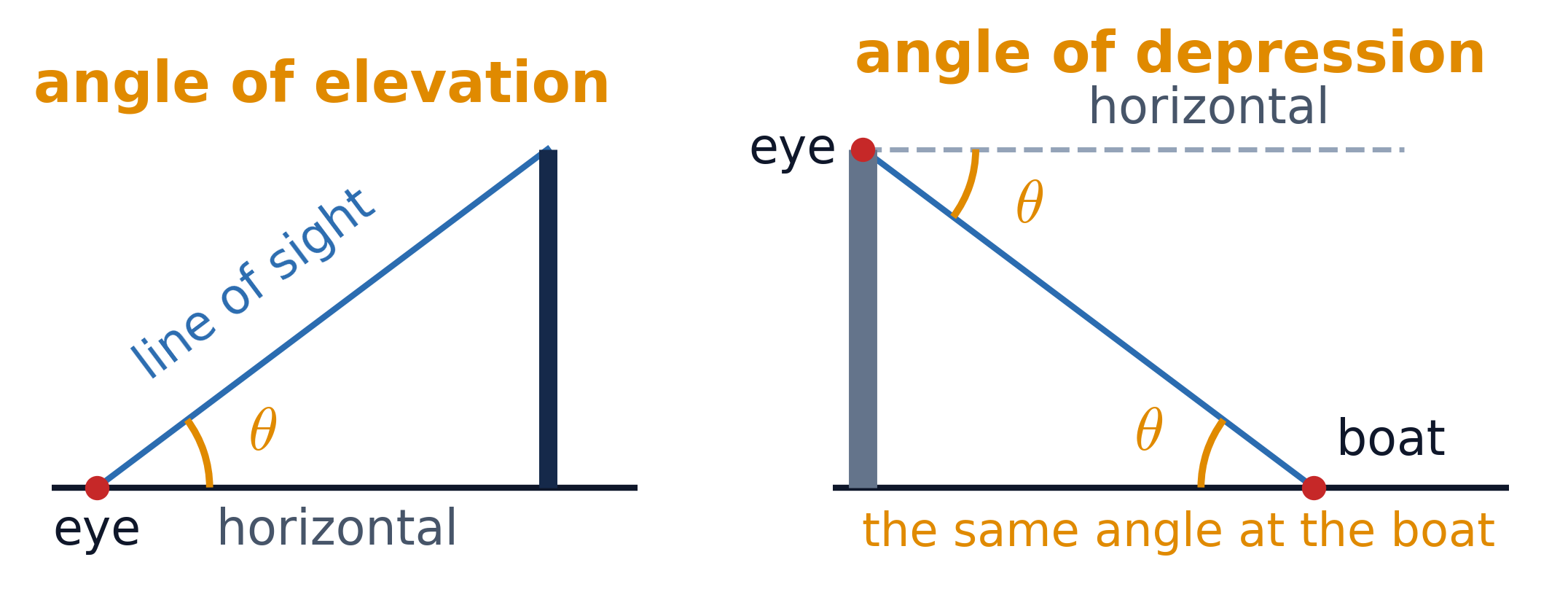
- The angle of elevation is the angle between the horizontal and the line of sight when the object is above the observer.
- The angle of depression is the angle between the horizontal and the line of sight when the object is below the observer.
Both angles are measured from the horizontal, never from the vertical.
One fact saves time. If A looks down at B with an angle of depression \theta, then B looks up at A with an angle of elevation \theta (alternate angles). So you can move an angle of depression from the top of the figure to the bottom.
2. The one tool
A vertical object, the level ground and the line of sight make a right-angled triangle. In it,
\tan\theta = \frac{\text{height}}{\text{horizontal distance}}
So height = distance \times \tan\theta, and distance = height \times \cot\theta.
| \theta | 15^\circ | 30^\circ | 45^\circ | 60^\circ | 75^\circ |
|---|---|---|---|---|---|
| \tan\theta | 2 - \sqrt{3} | \dfrac{1}{\sqrt{3}} | 1 | \sqrt{3} | 2 + \sqrt{3} |
If the question gives the slant length (the line of sight itself, a ladder, or the string of a kite), use sine: height = slant length \times \sin\theta.
3. The standard figures
Most questions are one of these five. Here h is the height of the tower.
| Figure | What is given | Result |
|---|---|---|
| One point | Distance d from the foot, elevation \theta | h = d\tan\theta |
| Two points on the same side, in line with the foot | They are d apart; elevations \alpha (far point) and \beta (near point) | h = \dfrac{d}{\cot\alpha - \cot\beta} |
| Two points on opposite sides | They are d apart; elevations \alpha and \beta | h = \dfrac{d}{\cot\alpha + \cot\beta} |
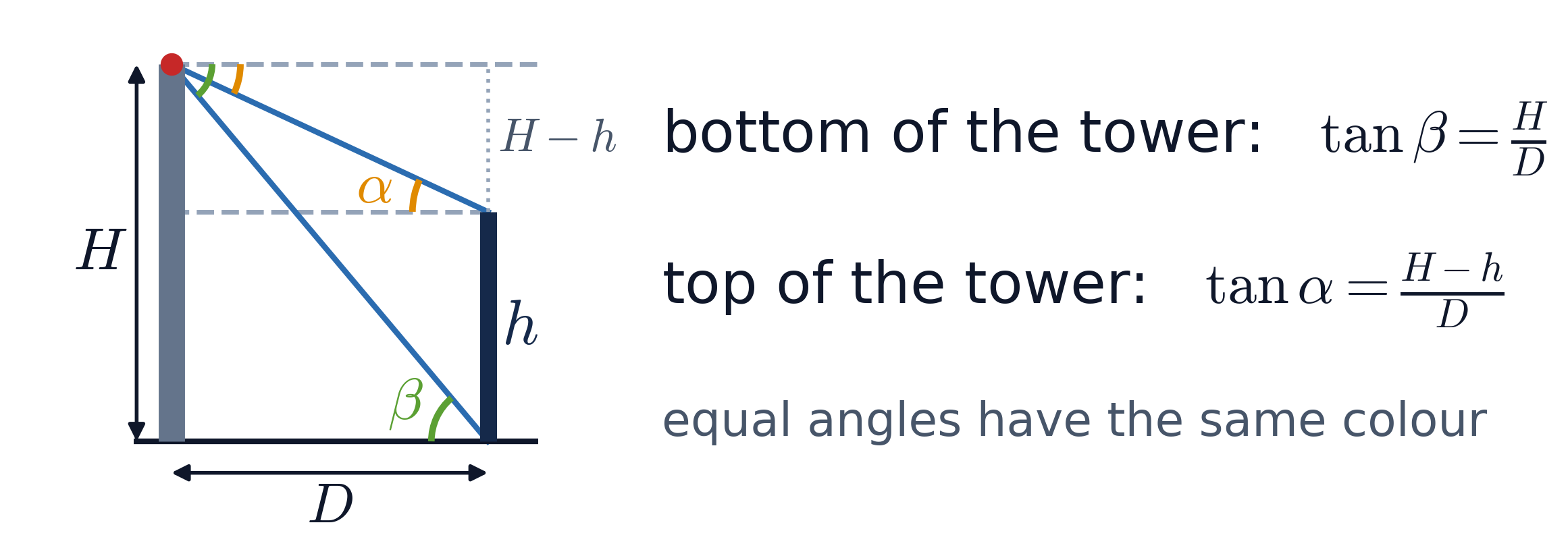
| Tower seen from the top of a building of height H, at horizontal distance D | Depression \alpha of the top and \beta of the bottom of the tower | \tan\beta = \dfrac{H}{D} and \tan\alpha = \dfrac{H - h}{D} |
| Two points at distances a and b from the foot, same line | The two elevations add up to 90^\circ | h = \sqrt{ab} |
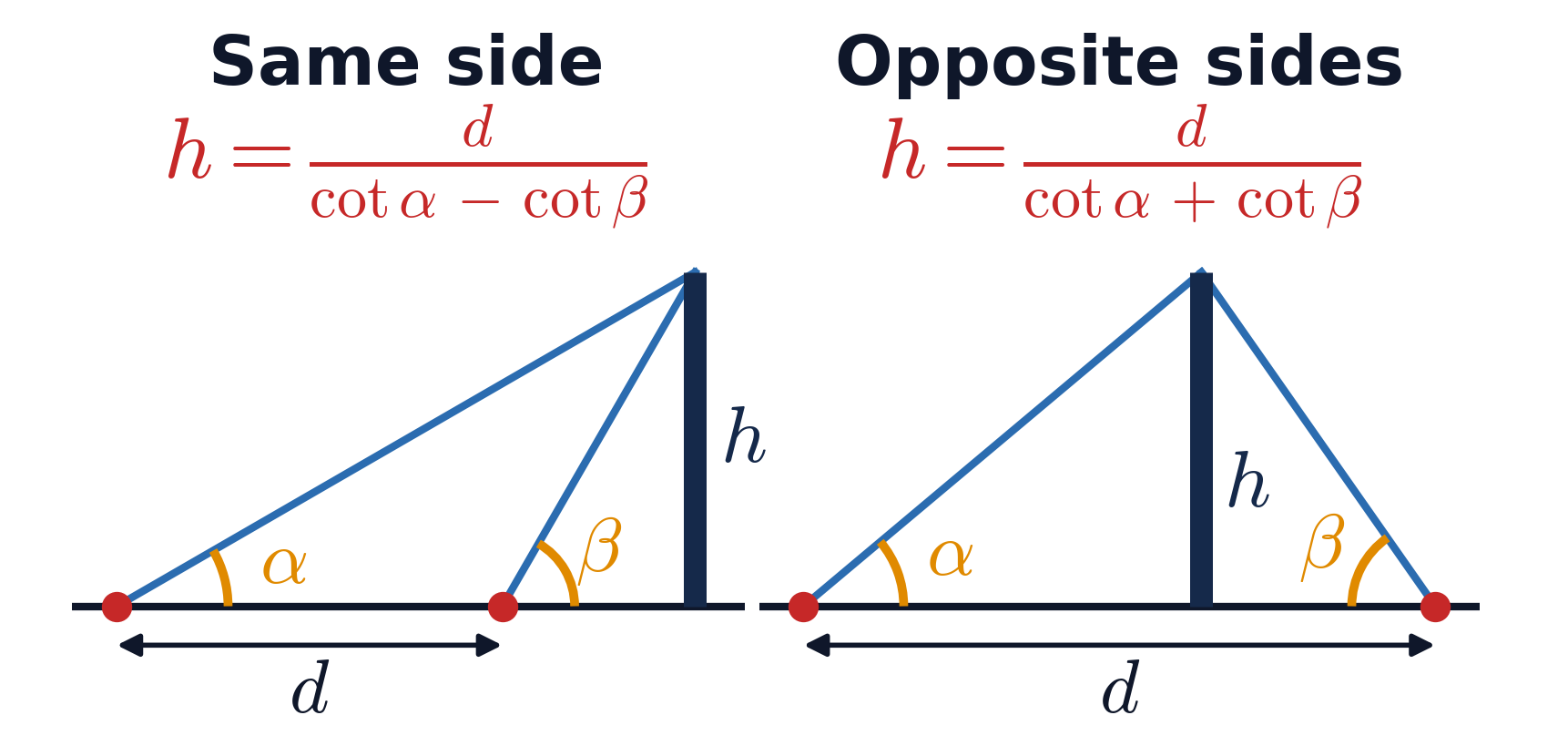
Each result comes from writing \tan in two right triangles. Knowing the second and third by heart saves a minute.
The method for every question. The question paper gives no figure, so draw your own first: the ground, each tower as a vertical line, a dotted horizontal line through the eye of the observer, and each angle marked from a horizontal line. Then write one \tan equation for each right triangle, and remove the length you do not want.
4. Worked examples
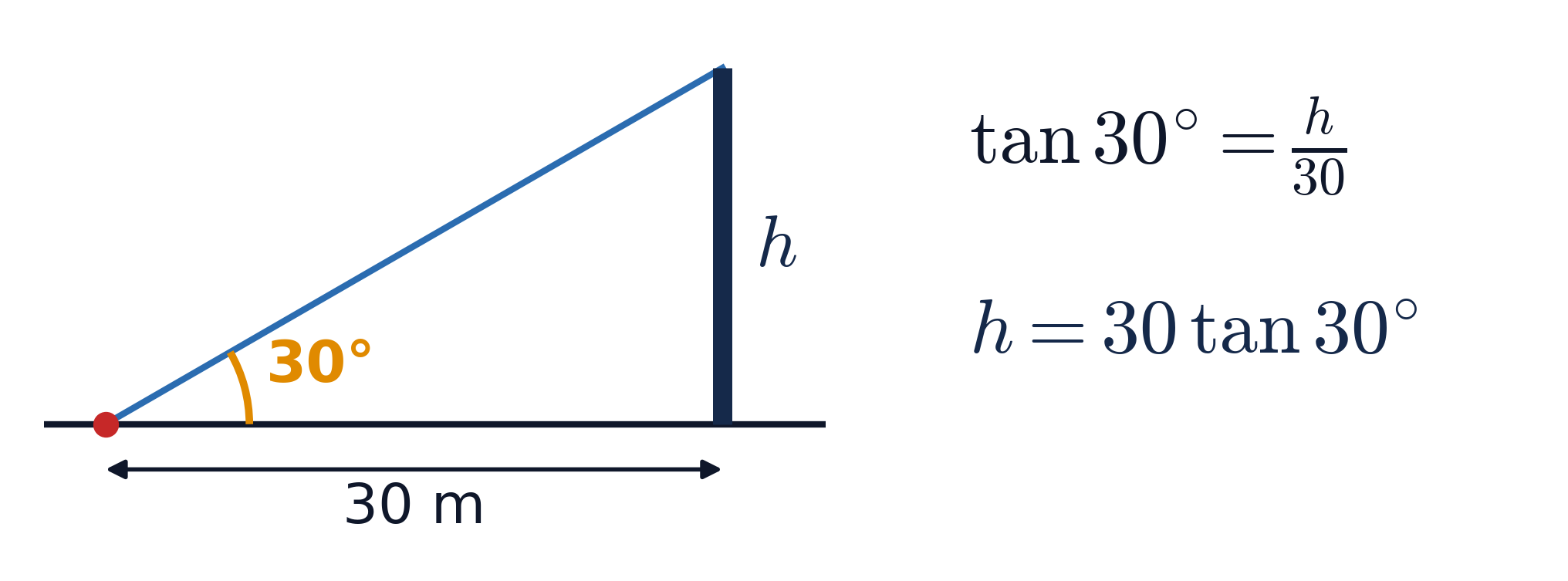
Example 1. From a point 30 m from the foot of a tower, the angle of elevation of its top is 30^\circ. Find the height.
h = 30\tan 30^\circ = \dfrac{30}{\sqrt{3}} = 10\sqrt{3} m.
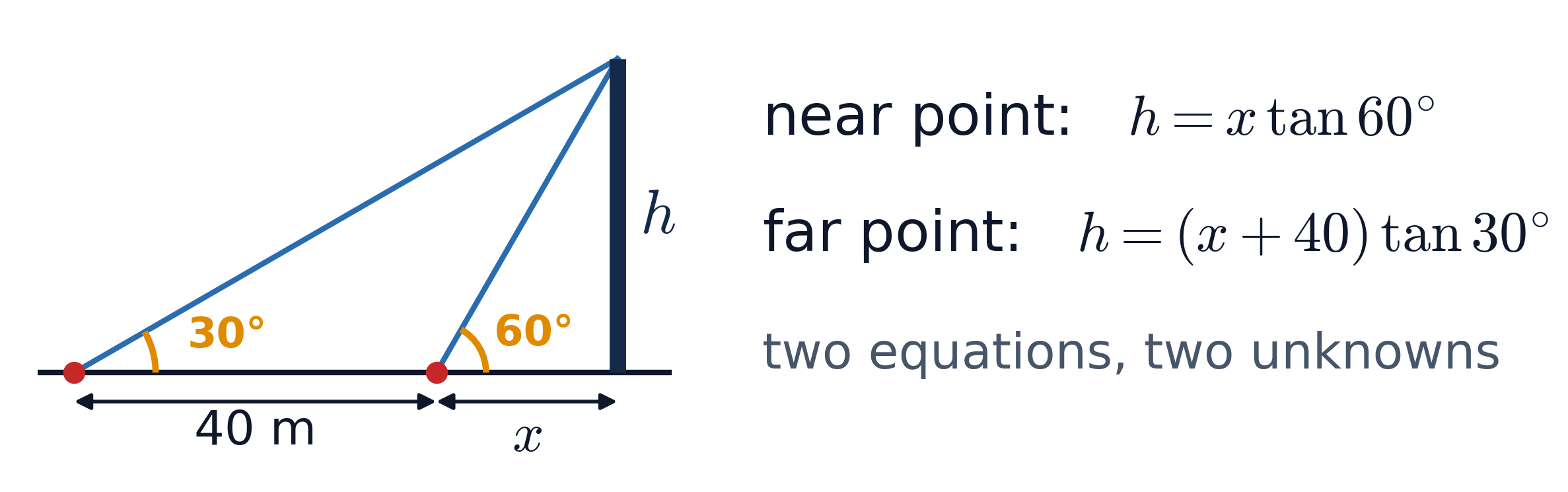
Example 2. The angle of elevation of the top of a tower is 30^\circ. After walking 40 m towards the tower, it is 60^\circ. Find the height.
Let the second point be x m from the foot. Then h = x\tan 60^\circ = \sqrt{3}x and h = (x + 40)\tan 30^\circ = \dfrac{x + 40}{\sqrt{3}}. So 3x = x + 40, x = 20 and h = 20\sqrt{3} m. The formula of section 3 gives the same: \dfrac{40}{\sqrt{3} - \frac{1}{\sqrt{3}}} = \dfrac{40\sqrt{3}}{2} = 20\sqrt{3}.
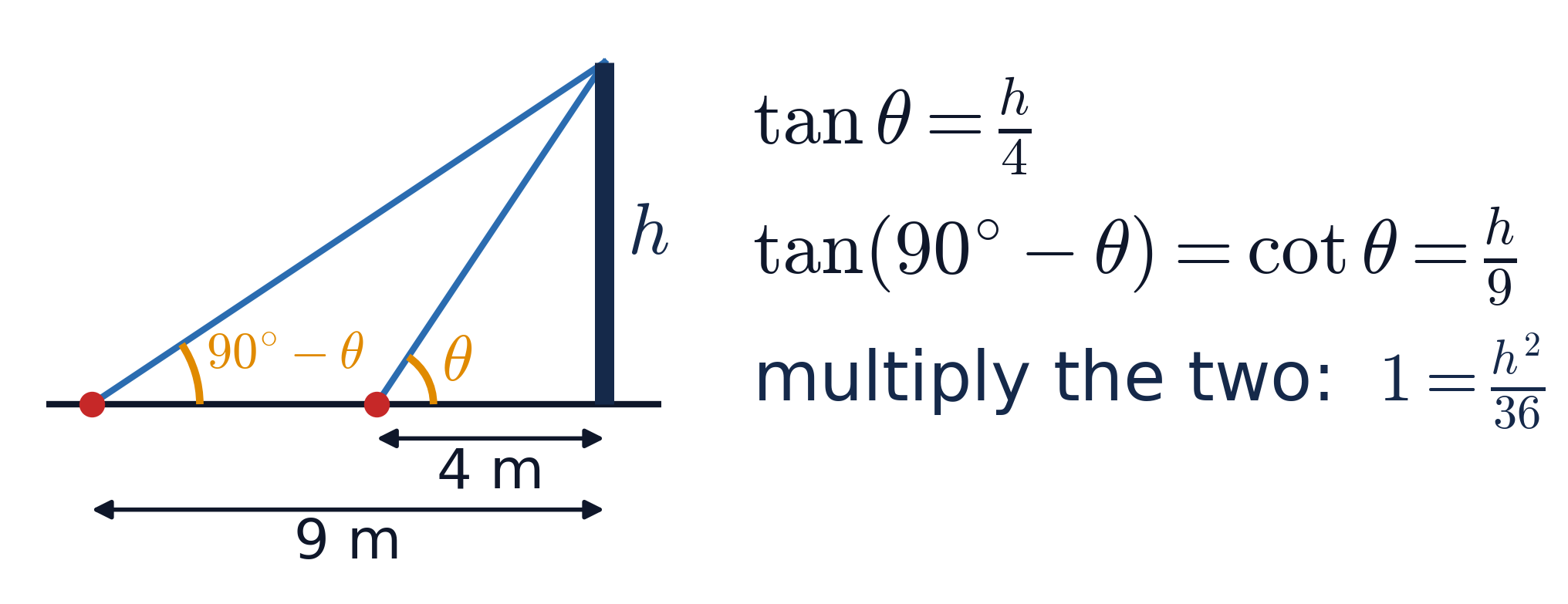
Example 3. From two points on the same line, 4 m and 9 m from the foot of a tower, the angles of elevation of the top add up to 90^\circ. Find the height.
Let the angles be \theta and 90^\circ - \theta. Then \tan\theta = \dfrac{h}{4} and \tan(90^\circ - \theta) = \cot\theta = \dfrac{h}{9}. Multiply: 1 = \dfrac{h^2}{36}. So h = 6 m.
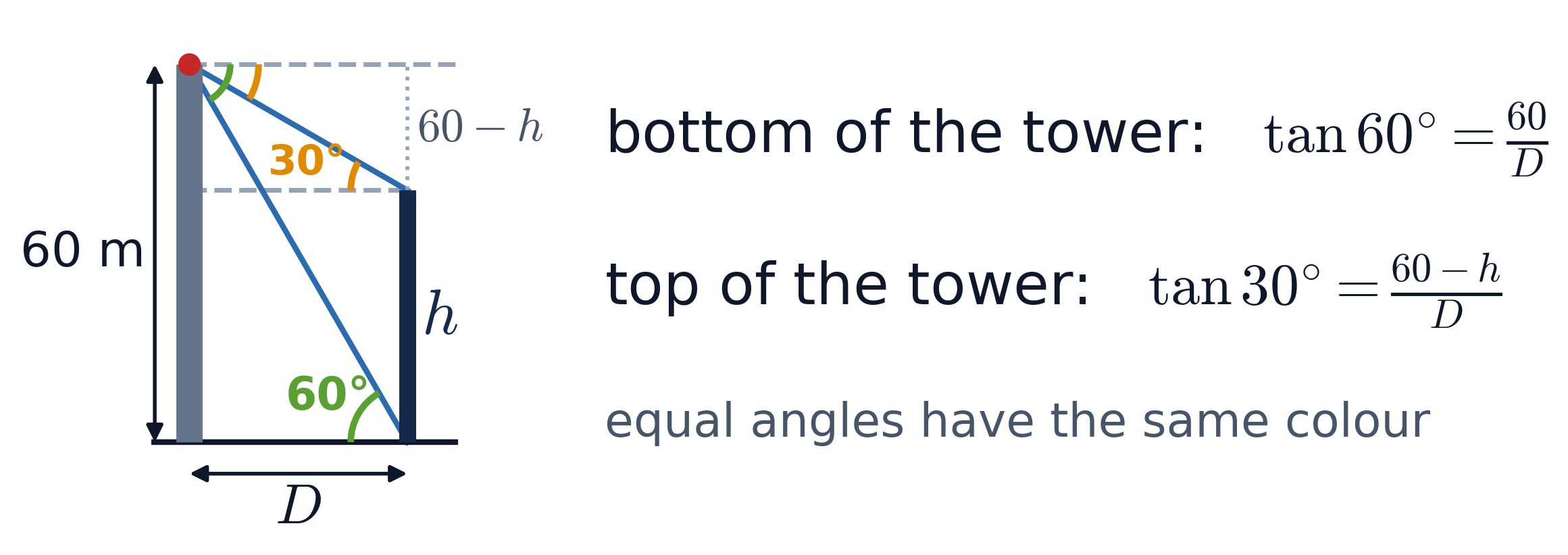
Example 4. From the top of a building 60 m high, the angles of depression of the top and the bottom of a tower are 30^\circ and 60^\circ. Find the height of the tower.
The bottom of the tower is 60 m below the observer: \tan 60^\circ = \dfrac{60}{D}, so D = \dfrac{60}{\sqrt{3}} = 20\sqrt{3} m. The top of the tower is 60 - h below the observer: 60 - h = D\tan 30^\circ = 20\sqrt{3} \times \dfrac{1}{\sqrt{3}} = 20. So h = 40 m.
5. From the real papers
Try each for 75 seconds before reading the solution.
NDA II 2026, Q2 (one of two questions on the same data). From the top of a building, the angles of depression of the top and bottom of a tower of height h are \alpha and \beta respectively. Let H be the height of the building and D be the horizontal distance between the building and the tower. If \alpha = 15^\circ and \beta = 45^\circ, then which one of the following is correct?
(a) H = \sqrt{2}D (b) D = \sqrt{2}H (c) 2H = \sqrt{3}D (d) H = D
Solution. The bottom of the tower is a depth H below the observer and a distance D away, so \tan\beta = \frac{H}{D}. With \beta = 45^\circ this gives H = D. The value of \alpha is not needed. Answer (d).
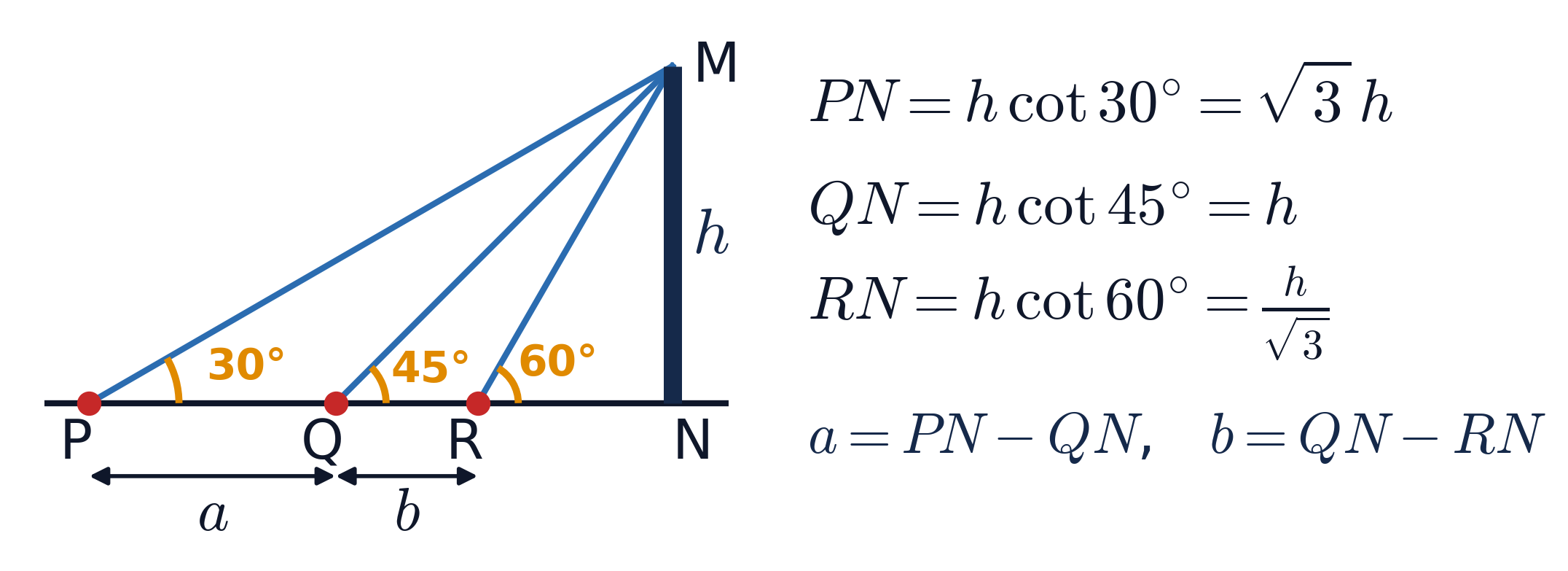
NDA I 2025, Q39 (one of two questions on the same data). The top (M) of a tower is observed from three points P, Q and R lying in a horizontal straight line which passes directly along the foot (N) of the tower. The angles of elevations of M from P, Q and R are 30^\circ, 45^\circ and 60^\circ respectively. Let PQ = a and QR = b. What is PN equal to?
(a) \left(\frac{3-\sqrt{3}}{2}\right)a (b) \left(\frac{3+\sqrt{3}}{2}\right)a (c) \left(\frac{3-\sqrt{3}}{4}\right)a (d) \left(\frac{3+\sqrt{3}}{4}\right)a
Solution. Take the three points on the same side of the tower, and let MN = h. Then PN = h\cot 30^\circ = \sqrt{3}h and QN = h\cot 45^\circ = h. So a = PN - QN = h(\sqrt{3} - 1), which gives h = \frac{a}{\sqrt{3} - 1} = \frac{a(\sqrt{3} + 1)}{2}. Then PN = \sqrt{3}h = \left(\frac{3 + \sqrt{3}}{2}\right)a. Answer (b).
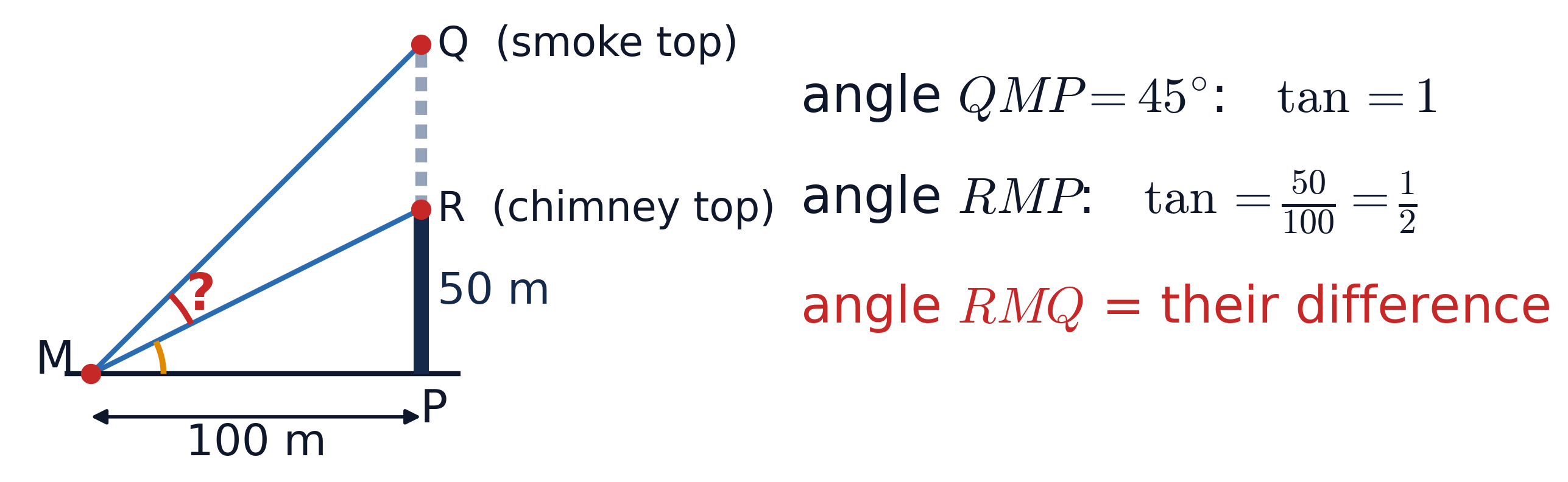
NDA I 2025, Q48. A man at M, standing 100 m away from the base (P) of a chimney of height 50 m, observes the angle of elevation of the highest point (Q) of the smoke to be 45^\circ. The highest point of the chimney is at R. Further P, R and Q are in a straight line and the straight line is perpendicular to PM. What is the angle RMQ equal to?
(a) \tan^{-1}\left(\frac{1}{2}\right) (b) \tan^{-1}\left(\frac{1}{3}\right) (c) \tan^{-1}\left(\frac{2}{3}\right) (d) \tan^{-1}\left(\frac{3}{4}\right)
Solution. P, R, Q are on one vertical line and PM = 100 m is horizontal. Angle QMP = 45^\circ, so its tangent is 1. Angle RMP has tangent \frac{PR}{PM} = \frac{50}{100} = \frac{1}{2}. Angle RMQ is the difference of the two, so \tan(RMQ) = \frac{1 - \frac{1}{2}}{1 + \frac{1}{2}} = \frac{1}{3}. Answer (b).
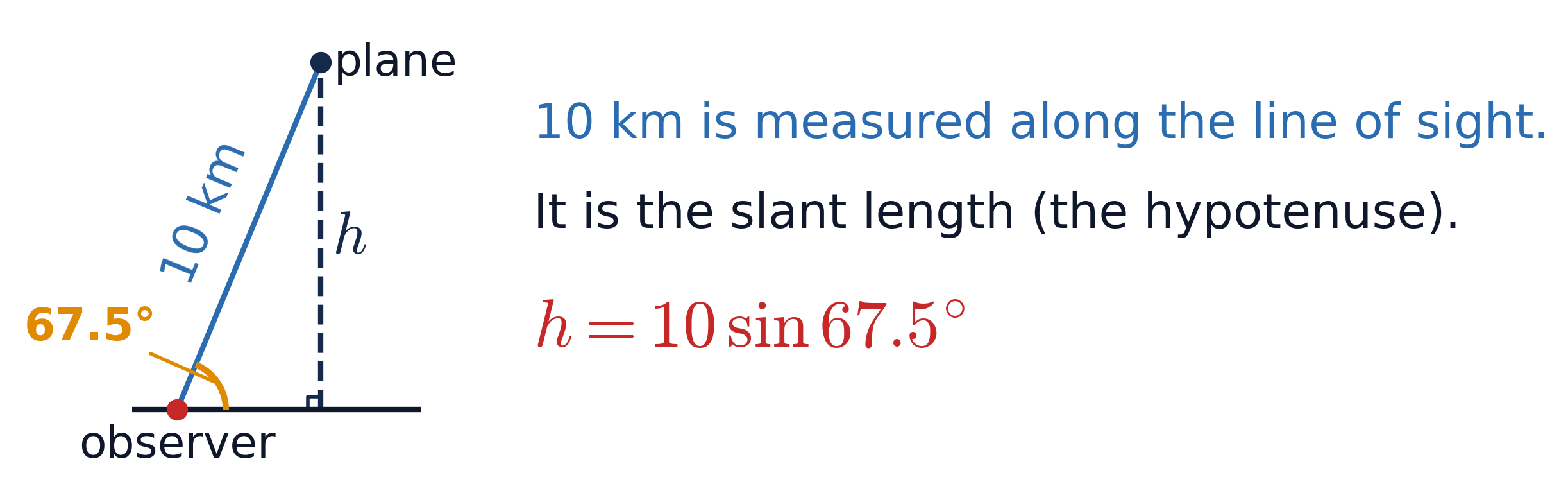
NDA I 2026, Q39. A plane is observed to be approaching the airport. It is at a distance of 10 km from the point of observation and makes an angle of elevation of 67.5^\circ. What is the height of the plane above the ground?
(a) 10\sqrt{2 + \sqrt{2}} km (b) 10\sqrt{2 - \sqrt{2}} km (c) 5\sqrt{2 + \sqrt{2}} km (d) 5\sqrt{2 - \sqrt{2}} km
Solution. The 10 km is the distance from the observer to the plane, so it is the slant length. The height is 10\sin 67.5^\circ = 10\cos 22.5^\circ. From Chapter M3-4, \cos 22.5^\circ = \frac{\sqrt{2 + \sqrt{2}}}{2}. So the height is 5\sqrt{2 + \sqrt{2}} km. Answer (c).
NDA II 2026, Q1 (the same data as Q2 above). What is H^2 + D^2 equal to?
(a) \frac{h^2 \cos^2 \alpha}{\sin^2(\beta - \alpha)} (b) \frac{h^2 \cos^2 \beta}{\sin^2(\beta - \alpha)} (c) \frac{h^2 \cos^2 \alpha}{\sin^2(\beta + \alpha)} (d) \frac{h^2 \cos^2 \beta}{\sin^2(\beta + \alpha)}
Solution. \tan\beta = \frac{H}{D} and \tan\alpha = \frac{H - h}{D}. Subtract: h = D(\tan\beta - \tan\alpha) = \frac{D\sin(\beta - \alpha)}{\cos\alpha\cos\beta}, so D = \frac{h\cos\alpha\cos\beta}{\sin(\beta - \alpha)}. Then H = D\tan\beta = \frac{h\cos\alpha\sin\beta}{\sin(\beta - \alpha)}. Square and add: H^2 + D^2 = \frac{h^2\cos^2\alpha(\sin^2\beta + \cos^2\beta)}{\sin^2(\beta - \alpha)} = \frac{h^2\cos^2\alpha}{\sin^2(\beta - \alpha)}. Answer (a).
Notice that the newer questions use letters (\alpha, \beta, a, b) in place of numbers. The method does not change.
6. Mistakes that cost marks
- Measuring the angle from the vertical. Elevation and depression are both measured from the horizontal. Draw the dotted horizontal line through the eye first.
- Using \tan when the slant length is given. "At a distance of 10 km from the observer" is the line of sight. Use \sin for the height.
- Subtracting when the points are on opposite sides. On the same side the distance between the points is the difference of the two distances from the foot. On opposite sides it is the sum.
- Forgetting the height of the eye. If the observer is 1.5 m tall, the triangle starts 1.5 m above the ground. Add 1.5 m at the end.
7. Quick check
Do these without help. Answers are at the end.
- A vertical pole 6 m high throws a shadow 2\sqrt{3} m long on level ground. Find the angle of elevation of the sun.
- A kite is flying on a string 100 m long. The string makes an angle of 30^\circ with the ground. Find the height of the kite.
- From the top of a cliff 50 m high, the angle of depression of a boat is 30^\circ. How far is the boat from the foot of the cliff?
- Two points on opposite sides of a tower 30 m high see its top at angles of elevation 45^\circ and 60^\circ. Find the distance between the two points.
- The angle of elevation of the top of a tower is 45^\circ. After walking 20 m towards the tower, it is 60^\circ. Find the height.
8. Read and watch more, free
The Class 11 and 12 NCERT books do not teach this topic. It is in the Class 10 book.
| What | Where | Language |
|---|---|---|
| Textbook | NCERT Class 10 Mathematics, Chapter 9 Some Applications of Trigonometry · Hindi edition | English, Hindi |
| Video, this chapter for NDA | Defence Wallah: Applications of Trigonometry (heights and distances) (about 1 hour 45 minutes; four years old) | Hinglish |
| Video, one class per NDA topic | Chandigarh Career Group: NDA Maths one shots (the Height and distance class, about 3 hours) | Hinglish |
| Past NDA questions for practice | ExamSIDE: Height and Distance (27 questions) | English |
The videos were chosen from their titles, length and views; they have not yet been watched by a teacher.
Answers to the quick check
- \tan\theta = \frac{6}{2\sqrt{3}} = \sqrt{3}, so \theta = 60^\circ.
- The string is the slant length: height = 100\sin 30^\circ = 50 m.
- 50\cot 30^\circ = 50\sqrt{3} m.
- 30\cot 45^\circ + 30\cot 60^\circ = 30 + 10\sqrt{3} m.
- h = \frac{20}{\cot 45^\circ - \cot 60^\circ} = \frac{20}{1 - \frac{1}{\sqrt{3}}} = \frac{20\sqrt{3}}{\sqrt{3} - 1} = 10\sqrt{3}(\sqrt{3} + 1) = 30 + 10\sqrt{3} m.
Next chapter: Properties of triangles.