Why this chapter matters. This chapter drew 17 questions in the seven papers from NDA II 2023 to NDA II 2026: two or three in every paper. Most ask for the value of an expression such as \sin(\tan^{-1} 0.75) or \tan^{-1}\frac{1}{2} + \tan^{-1}\frac{1}{3}. They need a right triangle, one table and four short rules. Six real questions are solved in section 6.
What you will be able to do
- Say what \sin^{-1}x, \cos^{-1}x and \tan^{-1}x mean and give their principal values.
- Find a ratio of an inverse function, such as \cos(\tan^{-1}x), by drawing a right triangle.
- Use the rules for -x, for complementary pairs, and for \tan^{-1}x \pm \tan^{-1}y.
Before you start you should know: the values and signs of the ratios (Chapter M3-2), \tan(A \pm B) (Chapter M3-3) and \tan 2A and the half-angle formulae (Chapter M3-4).
1. What an inverse function is
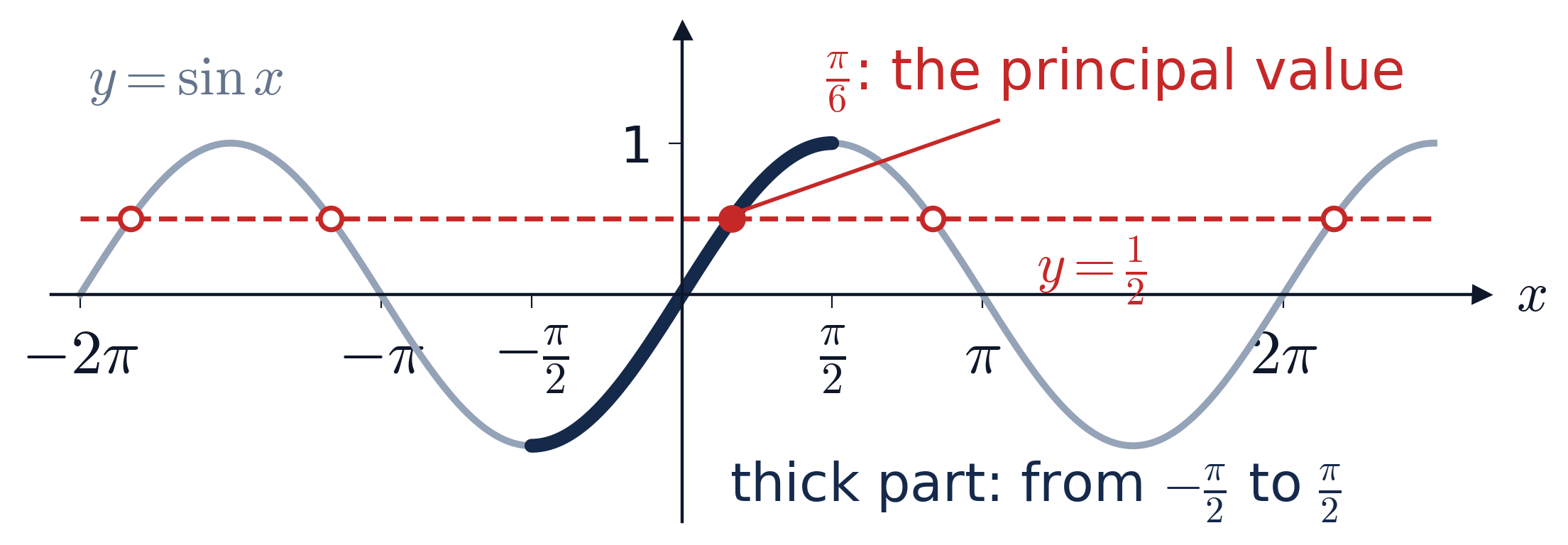
\sin^{-1}x means "the angle whose sine is x". So \sin^{-1}\frac{1}{2} = \frac{\pi}{6}, because \sin\frac{\pi}{6} = \frac{1}{2}. It does not mean \dfrac{1}{\sin x}.
Many angles have the same sine: \frac{\pi}{6}, \frac{5\pi}{6}, \frac{13\pi}{6} and so on. To make the answer a single angle, we agree on one interval for each function. The angle in that interval is the principal value.
| Function | x can be | The answer lies in |
|---|---|---|
| \sin^{-1}x | -1 \le x \le 1 | -\dfrac{\pi}{2} to \dfrac{\pi}{2} |
| \cos^{-1}x | -1 \le x \le 1 | 0 to \pi |
| \tan^{-1}x | any real number | between -\dfrac{\pi}{2} and \dfrac{\pi}{2} (ends not included) |
| \cot^{-1}x | any real number | between 0 and \pi (ends not included) |
| \sec^{-1}x | x \le -1 or x \ge 1 | 0 to \pi, except \dfrac{\pi}{2} |
| \operatorname{cosec}^{-1}x | x \le -1 or x \ge 1 | -\dfrac{\pi}{2} to \dfrac{\pi}{2}, except 0 |
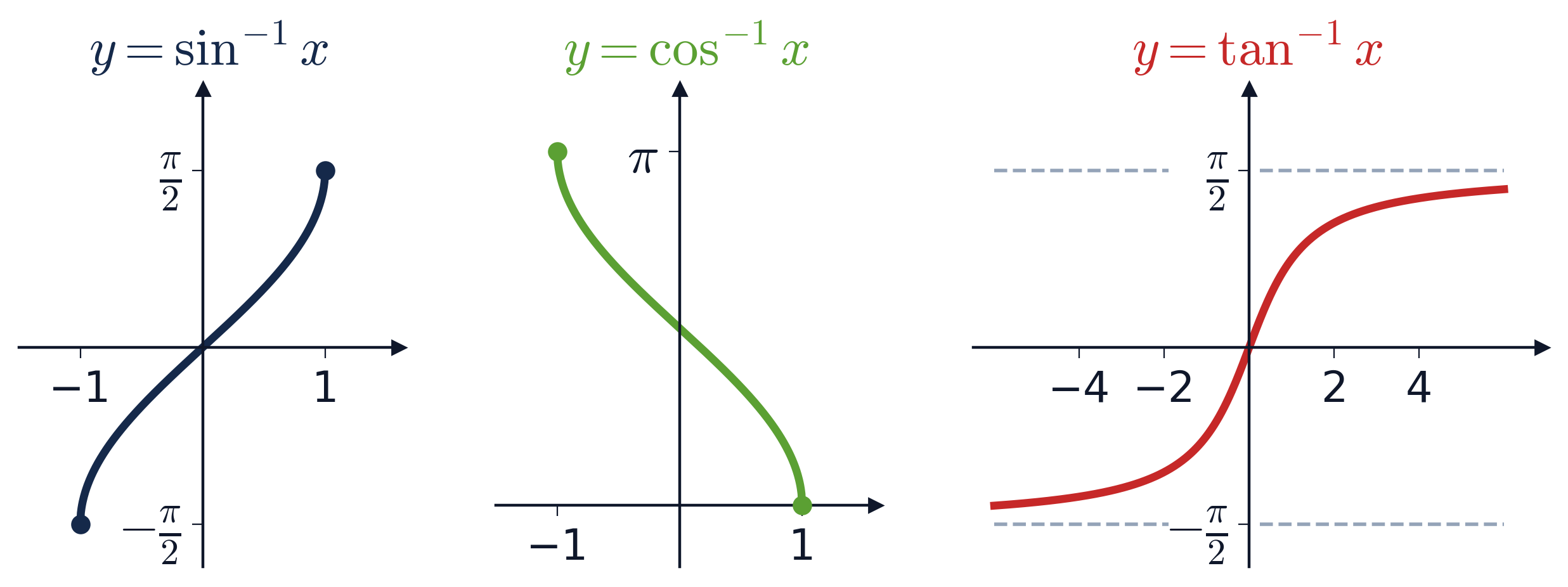
A way to remember: \sin^{-1}, \tan^{-1} and \operatorname{cosec}^{-1} use the first and fourth quadrants (a negative x gives a negative angle). \cos^{-1}, \cot^{-1} and \sec^{-1} use the first and second quadrants (a negative x gives an angle between \frac{\pi}{2} and \pi).
For example, \sin^{-1}\left(-\frac{1}{2}\right) = -\frac{\pi}{6}, but \cos^{-1}\left(-\frac{1}{2}\right) = \frac{2\pi}{3}.
2. Four groups of rules
Negative x.
\sin^{-1}(-x) = -\sin^{-1}x \qquad \tan^{-1}(-x) = -\tan^{-1}x \qquad \operatorname{cosec}^{-1}(-x) = -\operatorname{cosec}^{-1}x
\cos^{-1}(-x) = \pi - \cos^{-1}x \qquad \cot^{-1}(-x) = \pi - \cot^{-1}x \qquad \sec^{-1}(-x) = \pi - \sec^{-1}x
Reciprocals. \operatorname{cosec}^{-1}x = \sin^{-1}\dfrac{1}{x} and \sec^{-1}x = \cos^{-1}\dfrac{1}{x}. For x > 0, \cot^{-1}x = \tan^{-1}\dfrac{1}{x}.
Complementary pairs. Each pair adds up to a right angle:
\sin^{-1}x + \cos^{-1}x = \frac{\pi}{2} \qquad \tan^{-1}x + \cot^{-1}x = \frac{\pi}{2} \qquad \sec^{-1}x + \operatorname{cosec}^{-1}x = \frac{\pi}{2}
Sum and difference of two \tan^{-1}.
\tan^{-1}x + \tan^{-1}y = \tan^{-1}\frac{x + y}{1 - xy} \quad (xy < 1) \qquad \tan^{-1}x - \tan^{-1}y = \tan^{-1}\frac{x - y}{1 + xy} \quad (xy > -1)
2\tan^{-1}x = \tan^{-1}\frac{2x}{1 - x^2} \quad (-1 < x < 1)
These are the \tan(A \pm B) and \tan 2A formulae written backwards.
3. The right-triangle method
To find a ratio of an inverse function, name the angle and draw it.
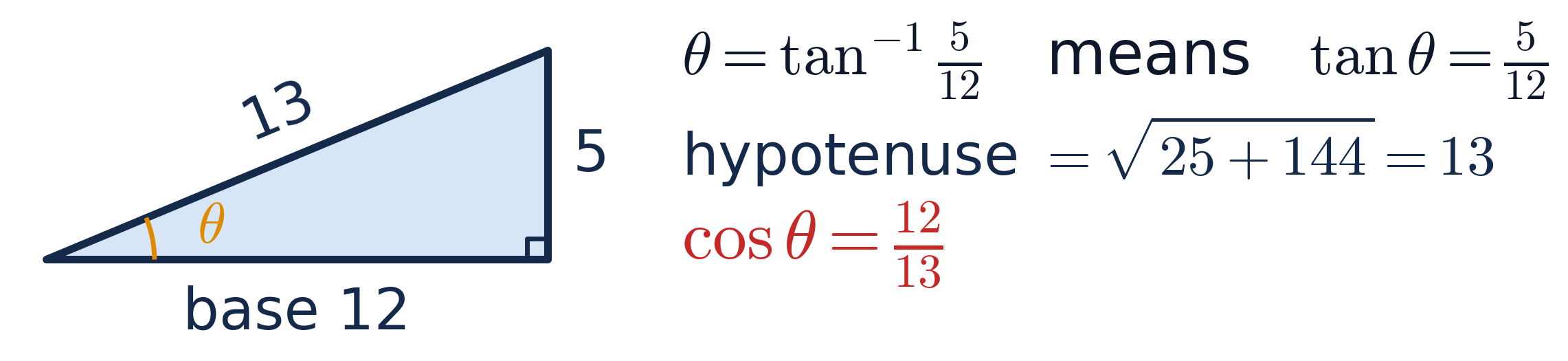
For example, find \cos\left(\tan^{-1}\frac{5}{12}\right). Let \theta = \tan^{-1}\frac{5}{12}, so \tan\theta = \frac{5}{12} and \theta is acute. Draw a right triangle with perpendicular 5 and base 12. The hypotenuse is \sqrt{25 + 144} = 13. So \cos\theta = \frac{12}{13}.
If x is negative, find the principal value first and take the sign from its quadrant.
4. Undoing a function
\sin(\sin^{-1}x) = x for every x from -1 to 1. But \sin^{-1}(\sin\theta) = \theta only if \theta lies in the principal interval, from -\frac{\pi}{2} to \frac{\pi}{2}. If it does not, first find an angle in that interval with the same sine.
For example, \sin^{-1}\left(\sin\frac{2\pi}{3}\right) is not \frac{2\pi}{3}. Since \sin\frac{2\pi}{3} = \sin\frac{\pi}{3}, the value is \frac{\pi}{3}.
5. Worked examples
Example 1. Find the principal values of \tan^{-1}(-1) and \cot^{-1}(-1).
\tan^{-1}(-1) = -\tan^{-1}1 = -\frac{\pi}{4}. And \cot^{-1}(-1) = \pi - \cot^{-1}1 = \pi - \frac{\pi}{4} = \frac{3\pi}{4}.
Example 2. Find \tan\left(\cos^{-1}\frac{4}{5}\right).
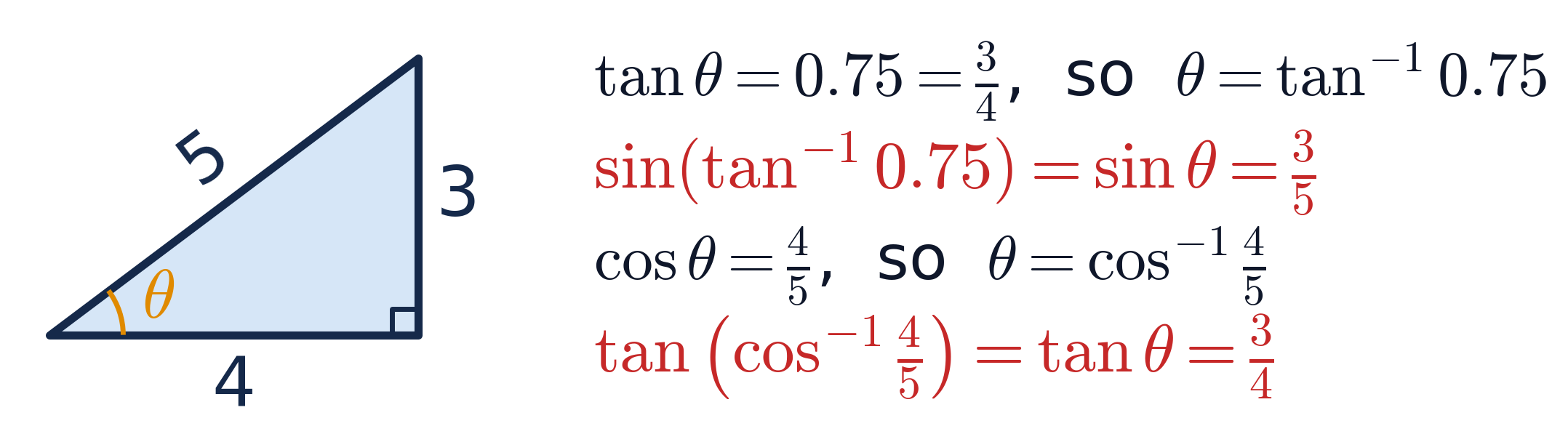
Let \theta = \cos^{-1}\frac{4}{5}. In a right triangle with base 4 and hypotenuse 5, the perpendicular is 3. So \tan\theta = \frac{3}{4}.
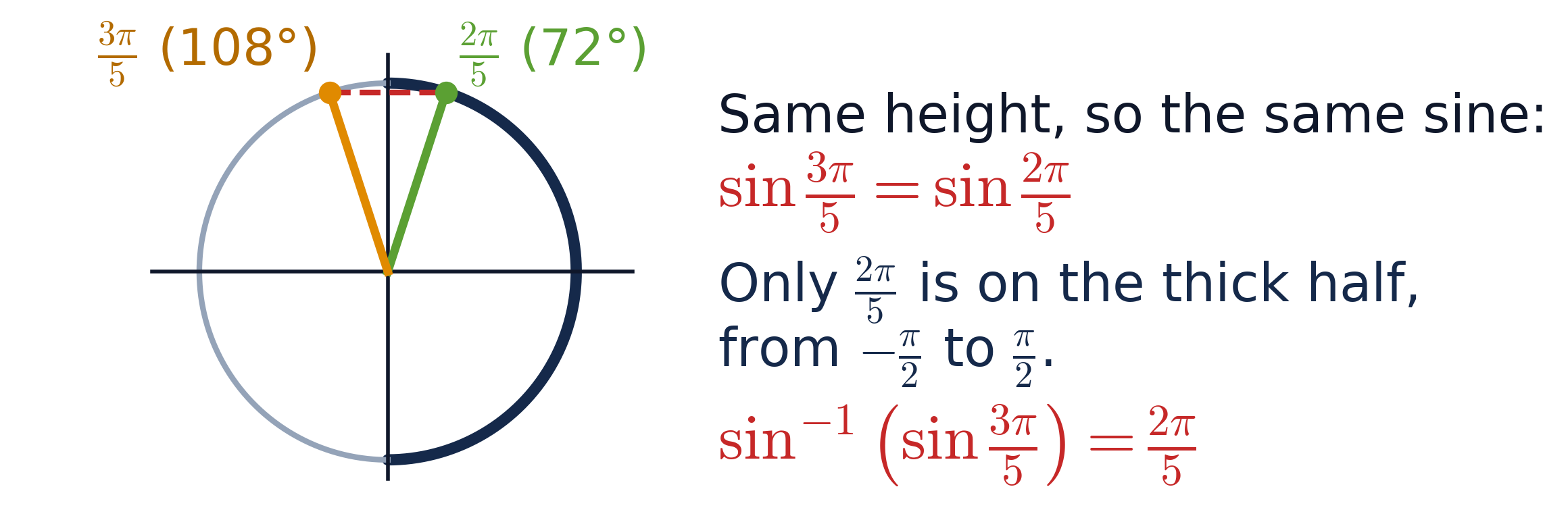
Example 3. Find \sin^{-1}\left(\sin\frac{3\pi}{5}\right).
\frac{3\pi}{5} is 108^\circ, outside the interval from -90^\circ to 90^\circ. But \sin\frac{3\pi}{5} = \sin\left(\pi - \frac{3\pi}{5}\right) = \sin\frac{2\pi}{5}, and \frac{2\pi}{5} is inside the interval. The value is \frac{2\pi}{5}.
Example 4. Find \tan^{-1}\frac{1}{2} + \tan^{-1}\frac{1}{3}.
Here xy = \frac{1}{6} < 1, so the sum is \tan^{-1}\dfrac{\frac{1}{2} + \frac{1}{3}}{1 - \frac{1}{6}} = \tan^{-1}\dfrac{5/6}{5/6} = \tan^{-1}1 = \dfrac{\pi}{4}.
Example 5. Find \tan^{-1}2 + \tan^{-1}3.
Here xy = 6, which is more than 1, so the formula cannot be used as it stands. Work with the angles. Let A = \tan^{-1}2 and B = \tan^{-1}3. Both lie between 45^\circ and 90^\circ, so A + B lies between 90^\circ and 180^\circ. Now \tan(A + B) = \frac{2 + 3}{1 - 6} = -1. The angle between 90^\circ and 180^\circ with tangent -1 is 135^\circ. So the sum is \frac{3\pi}{4}, not -\frac{\pi}{4}.
6. From the real papers
Try each for 75 seconds before reading the solution.
NDA II 2026, Q13. What is \sin(\tan^{-1} 0\cdot75) equal to?
(a) 1 (b) 4/5 (c) 3/5 (d) 1/2
Solution. Let \theta = \tan^{-1}\frac{3}{4}. In a right triangle with perpendicular 3 and base 4, the hypotenuse is 5. So \sin\theta = \frac{3}{5}. Answer (c).
NDA I 2026, Q34. Consider the following in respect of inverse circular functions : I. \sin^{-1}(-x) = -\sin^{-1} x II. \cos^{-1}(-x) = \cos^{-1} x III. \tan^{-1}(-x) = \pi - \tan^{-1} x IV. \cot^{-1}(-x) = \pi - \cot^{-1} x How many of the above are correct?
(a) One (b) Two (c) Three (d) All the four
Solution. Compare with the first group of rules in section 2. I is correct. II is wrong: the right side should be \pi - \cos^{-1}x. III is wrong: it should be -\tan^{-1}x. IV is correct. Two are correct. Answer (b).
NDA I 2024, Q39. If \cos^{-1}x = \sin^{-1}x, then which one of the following is correct?
(a) x = 1 (b) x = \frac{1}{2} (c) x = \frac{1}{\sqrt{2}} (d) x = \frac{1}{\sqrt{3}}
Solution. The two always add up to \frac{\pi}{2}. If they are equal, each is \frac{\pi}{4}. So x = \sin\frac{\pi}{4} = \frac{1}{\sqrt{2}}. Answer (c).
NDA I 2025, Q50. If \tan^{-1} k + \tan^{-1}\frac{1}{2} = \frac{\pi}{4}, then what is the value of k?
(a) 1 (b) 1/2 (c) 1/3 (d) 1/4
Solution. \tan^{-1}k = \frac{\pi}{4} - \tan^{-1}\frac{1}{2}. Take the tangent of both sides: k = \frac{1 - \frac{1}{2}}{1 + \frac{1}{2}} = \frac{1}{3}. Answer (c).
NDA II 2025, Q46. What is \cot^{-1} 9 + \operatorname{cosec}^{-1}\left(\frac{\sqrt{41}}{4}\right) equal to?
(a) \frac{\pi}{4} (b) \frac{\pi}{3} (c) \frac{\pi}{2} (d) \pi
Solution. Change both to \tan^{-1}. \cot^{-1}9 = \tan^{-1}\frac{1}{9}. For the second, a right triangle with hypotenuse \sqrt{41} and perpendicular 4 has base \sqrt{41 - 16} = 5, so the angle is \tan^{-1}\frac{4}{5}. The sum is \tan^{-1}\frac{\frac{1}{9} + \frac{4}{5}}{1 - \frac{4}{45}} = \tan^{-1}\frac{41/45}{41/45} = \tan^{-1}1 = \frac{\pi}{4}. Answer (a).
NDA II 2023, Q26. What is 2\cot\left(\frac{1}{2}\cos^{-1}\frac{\sqrt{5}}{3}\right) equal to?
(a) -1 (b) 1 (c) 3 + \sqrt{5} (d) 3 - \sqrt{5}
Solution. Let \theta = \cos^{-1}\frac{\sqrt{5}}{3}. Then \cos\theta = \frac{\sqrt{5}}{3} and \sin\theta = \sqrt{1 - \frac{5}{9}} = \frac{2}{3}. From the half-angle formula \tan\frac{\theta}{2} = \frac{\sin\theta}{1 + \cos\theta}, we get \cot\frac{\theta}{2} = \frac{1 + \cos\theta}{\sin\theta} = \frac{1 + \frac{\sqrt{5}}{3}}{\frac{2}{3}} = \frac{3 + \sqrt{5}}{2}. Twice this is 3 + \sqrt{5}. Answer (c).
Notice the pattern: name the angle, draw the triangle or use one rule, and the question is finished.
7. Mistakes that cost marks
- Reading \sin^{-1}x as \dfrac{1}{\sin x}. The reciprocal of \sin x is \operatorname{cosec}x. The inverse \sin^{-1}x is an angle.
- \cos^{-1}(-x) = -\cos^{-1}x is wrong. The answer of \cos^{-1} is never negative. The correct rule is \pi - \cos^{-1}x.
- \sin^{-1}(\sin\theta) = \theta for every \theta is wrong. It is true only inside the principal interval. See Example 3.
- Using the \tan^{-1}x + \tan^{-1}y formula when xy > 1. For positive x and y with xy > 1 you must add \pi to what the formula gives. See Example 5.
8. Quick check
Do these without help. Answers are at the end.
- Find the principal value of \cos^{-1}\left(-\frac{\sqrt{3}}{2}\right).
- Find \sin\left(\cos^{-1}\frac{3}{5}\right).
- Find \tan^{-1}\frac{1}{4} + \tan^{-1}\frac{3}{5}.
- Find \cos^{-1}\left(\cos\frac{7\pi}{6}\right).
- If 3\sin^{-1}x + \cos^{-1}x = \pi, find x.
9. Read and watch more, free
| What | Where | Language |
|---|---|---|
| Textbook | NCERT Class 12 Mathematics, Chapter 2 Inverse Trigonometric Functions · Hindi edition | English, Hindi |
| Self-study notes | NIOS Mathematics, Lesson 24 Inverse Trigonometric Functions · Hindi edition | English, Hindi |
| Video, this chapter for NDA | Defence Wallah: Inverse Trigonometry and Properties of Triangles (about 3 hours 25 minutes) | Hinglish |
| Video, one class per NDA topic | Chandigarh Career Group: NDA Maths one shots (the Inverse trigonometry class, about 2 hours) | Hinglish |
| Past NDA questions for practice | ExamSIDE: Inverse Trigonometric Function (39 questions) | English |
The videos were chosen from their titles, length and views; they have not yet been watched by a teacher.
Answers to the quick check
- \pi - \cos^{-1}\frac{\sqrt{3}}{2} = \pi - \frac{\pi}{6} = \frac{5\pi}{6}.
- Base 3, hypotenuse 5, perpendicular 4: the value is \frac{4}{5}.
- \tan^{-1}\frac{1/4 + 3/5}{1 - 3/20} = \tan^{-1}\frac{17/20}{17/20} = \tan^{-1}1 = \frac{\pi}{4}.
- \cos\frac{7\pi}{6} = -\frac{\sqrt{3}}{2}, and the angle from 0 to \pi with this cosine is \frac{5\pi}{6}.
- Write it as 2\sin^{-1}x + \left(\sin^{-1}x + \cos^{-1}x\right) = \pi. Then 2\sin^{-1}x = \frac{\pi}{2}, so \sin^{-1}x = \frac{\pi}{4} and x = \frac{1}{\sqrt{2}}.
Next chapter: Height and distance.