Why this chapter matters. This chapter drew 19 questions in the seven papers from NDA II 2023 to NDA II 2026. Three kinds come again and again: find \sin 2\theta or \cos 2\theta when one ratio of \theta is given; spot a double-angle or triple-angle formula hidden in an expression; and use the exact values for 18^\circ, 36^\circ and 22.5^\circ. Six real questions are solved in section 7.
What you will be able to do
- Write \sin 2A, \cos 2A and \tan 2A in all their forms, and the triple-angle formulae.
- Find the ratios of half an angle, such as 22.5^\circ, from the ratios of the angle.
- Recognise a double-angle or triple-angle formula inside a longer expression.
- Use the exact values of \sin 18^\circ and \cos 36^\circ.
Before you start you should know: the formulae for \sin(A + B), \cos(A + B) and \tan(A + B) (Chapter M3-3).
A multiple angle is 2A, 3A and so on. A sub-multiple angle is a part of an angle, such as \frac{A}{2}.
1. Double-angle formulae
Put B = A in the sum formulae of the last chapter.
\sin 2A = 2\sin A\cos A \qquad \tan 2A = \frac{2\tan A}{1 - \tan^2 A}
\cos 2A = \cos^2 A - \sin^2 A = 2\cos^2 A - 1 = 1 - 2\sin^2 A
The three forms of \cos 2A are equal because \sin^2 A + \cos^2 A = 1. Use the one that fits what is given.
When only \tan A is known, these two forms give the answer without finding the quadrant:
\sin 2A = \frac{2\tan A}{1 + \tan^2 A} \qquad \cos 2A = \frac{1 - \tan^2 A}{1 + \tan^2 A}
For example, if \tan A = \frac{1}{3} then \sin 2A = \dfrac{2/3}{10/9} = \dfrac{3}{5} and \cos 2A = \dfrac{8/9}{10/9} = \dfrac{4}{5}.
2. Squares in terms of the double angle
Turn the last two forms of \cos 2A round:
\sin^2 A = \frac{1 - \cos 2A}{2} \qquad \cos^2 A = \frac{1 + \cos 2A}{2} \qquad \tan^2 A = \frac{1 - \cos 2A}{1 + \cos 2A}
These remove a square. They are used whenever \sin^2 or \cos^2 of an unusual angle appears.
3. Triple-angle formulae
\sin 3A = 3\sin A - 4\sin^3 A \qquad \cos 3A = 4\cos^3 A - 3\cos A \qquad \tan 3A = \frac{3\tan A - \tan^3 A}{1 - 3\tan^2 A}
In the exam these usually appear from right to left. For example, 3\sin 10^\circ - 4\sin^3 10^\circ = \sin 30^\circ = \frac{1}{2}.
4. Half-angle formulae
Write \frac{A}{2} in place of A in sections 1 and 2:
\sin A = 2\sin\frac{A}{2}\cos\frac{A}{2} \qquad \cos A = 2\cos^2\frac{A}{2} - 1 = 1 - 2\sin^2\frac{A}{2}
\sin^2\frac{A}{2} = \frac{1 - \cos A}{2} \qquad \cos^2\frac{A}{2} = \frac{1 + \cos A}{2} \qquad \tan\frac{A}{2} = \frac{1 - \cos A}{\sin A} = \frac{\sin A}{1 + \cos A}
When you take a square root, choose the sign from the quadrant in which \frac{A}{2} lies.
5. Exact values worth remembering
| Angle | \sin | \cos | \tan |
|---|---|---|---|
| 15^\circ | \dfrac{\sqrt{6} - \sqrt{2}}{4} | \dfrac{\sqrt{6} + \sqrt{2}}{4} | 2 - \sqrt{3} |
| 22.5^\circ | \dfrac{\sqrt{2 - \sqrt{2}}}{2} | \dfrac{\sqrt{2 + \sqrt{2}}}{2} | \sqrt{2} - 1 |
| 75^\circ | \dfrac{\sqrt{6} + \sqrt{2}}{4} | \dfrac{\sqrt{6} - \sqrt{2}}{4} | 2 + \sqrt{3} |
Two more values are asked directly:
\sin 18^\circ = \frac{\sqrt{5} - 1}{4} \qquad \cos 36^\circ = \frac{\sqrt{5} + 1}{4}
Since 18^\circ + 72^\circ = 90^\circ and 36^\circ + 54^\circ = 90^\circ, these are also \cos 72^\circ and \sin 54^\circ.
6. Worked examples
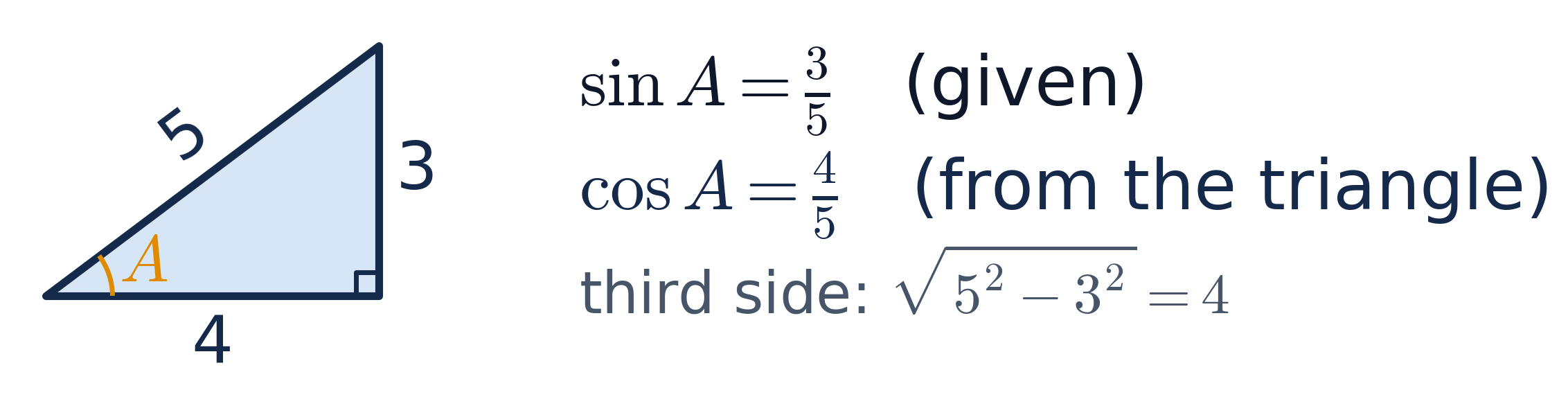
Example 1. \sin A = \frac{3}{5} and A is acute. Find \sin 2A, \cos 2A and \tan 2A.
\cos A = \frac{4}{5}. So \sin 2A = 2 \times \frac{3}{5} \times \frac{4}{5} = \frac{24}{25} and \cos 2A = 1 - 2 \times \frac{9}{25} = \frac{7}{25}. Then \tan 2A = \frac{24}{7}.
Example 2. Find \sin 22.5^\circ and \tan 22.5^\circ.
22.5^\circ is half of 45^\circ. \sin^2 22.5^\circ = \dfrac{1 - \cos 45^\circ}{2} = \dfrac{1 - \frac{1}{\sqrt{2}}}{2} = \dfrac{2 - \sqrt{2}}{4}, and the angle is acute, so \sin 22.5^\circ = \dfrac{\sqrt{2 - \sqrt{2}}}{2}. Next, \tan 22.5^\circ = \dfrac{1 - \cos 45^\circ}{\sin 45^\circ} = \dfrac{1 - \frac{1}{\sqrt{2}}}{\frac{1}{\sqrt{2}}} = \sqrt{2} - 1.
Example 3. Simplify \dfrac{1 - \cos 2A}{\sin 2A}.
Top: 1 - \cos 2A = 2\sin^2 A. Bottom: 2\sin A\cos A. The value is \dfrac{\sin A}{\cos A} = \tan A.
Example 4. Show that \sin 18^\circ = \dfrac{\sqrt{5} - 1}{4}.
Let A = 18^\circ. Then 5A = 90^\circ, so 2A = 90^\circ - 3A and \sin 2A = \cos 3A. That is 2\sin A\cos A = 4\cos^3 A - 3\cos A. Divide by \cos A (it is not zero): 2\sin A = 4\cos^2 A - 3 = 1 - 4\sin^2 A. So 4\sin^2 A + 2\sin A - 1 = 0, which gives \sin A = \dfrac{-1 \pm \sqrt{5}}{4}. The sine of 18^\circ is positive, so \sin 18^\circ = \dfrac{\sqrt{5} - 1}{4}.
Example 5. Find the value of \cos 20^\circ\cos 40^\circ\cos 80^\circ.
Each angle is double the one before. Multiply and divide by 2\sin 20^\circ, and use 2\sin\theta\cos\theta = \sin 2\theta three times:
\cos 20^\circ\cos 40^\circ\cos 80^\circ = \frac{\sin 40^\circ\cos 40^\circ\cos 80^\circ}{2\sin 20^\circ} = \frac{\sin 80^\circ\cos 80^\circ}{4\sin 20^\circ} = \frac{\sin 160^\circ}{8\sin 20^\circ} = \frac{1}{8}
The last step uses \sin 160^\circ = \sin(180^\circ - 20^\circ) = \sin 20^\circ.
7. From the real papers
Try each for 75 seconds before reading the solution.
NDA II 2026, Q11. What is 6\sin(\pi/18) - 8\sin^3(\pi/18) equal to?
(a) 1/4 (b) 1/2 (c) 1 (d) 2
Solution. Take out 2: the expression is 2(3\sin x - 4\sin^3 x) with x = \frac{\pi}{18}. The bracket is \sin 3x = \sin\frac{\pi}{6} = \frac{1}{2}. So the value is 1. Answer (c).
NDA II 2026, Q4 (one of two questions on the same data). The angles A, B and C of a triangle ABC are in the ratio 1 : 2 : 7. What is \sin A \cdot \cos B equal to?
(a) 1/4 (b) 1/2 (c) 1 (d) 2
Solution. The ten parts make 180^\circ, so A = 18^\circ and B = 36^\circ. Then \sin 18^\circ\cos 36^\circ = \frac{(\sqrt{5} - 1)(\sqrt{5} + 1)}{16} = \frac{5 - 1}{16} = \frac{1}{4}. Answer (a).
NDA I 2026, Q31. If \theta lies in the fourth quadrant and 3 \cot\theta + 4 = 0, then what is the value of \sin 2\theta + \cos 2\theta?
(a) -\frac{31}{25} (b) -\frac{17}{25} (c) 0 (d) 1
Solution. \tan\theta = -\frac{3}{4}. Use the forms with \tan: \sin 2\theta = \frac{2 \times (-3/4)}{1 + 9/16} = -\frac{24}{25} and \cos 2\theta = \frac{1 - 9/16}{1 + 9/16} = \frac{7}{25}. The sum is -\frac{17}{25}. Answer (b).
NDA II 2025, Q48. If x + \frac{1}{x} = 2\cos\theta, then what is x^3 + \frac{1}{x^3} equal to?
(a) \cos^3\theta (b) \cos 3\theta (c) 2\cos 3\theta (d) 3\cos 3\theta
Solution. x^3 + \frac{1}{x^3} = \left(x + \frac{1}{x}\right)^3 - 3\left(x + \frac{1}{x}\right) = 8\cos^3\theta - 6\cos\theta = 2(4\cos^3\theta - 3\cos\theta) = 2\cos 3\theta. Answer (c).
NDA I 2024, Q48. If \tan\alpha and \tan\beta are the roots of the equation x^2 - 6x + 8 = 0, then what is the value of \cos(2\alpha + 2\beta)?
(a) \frac{13}{75} (b) \frac{13}{85} (c) \frac{17}{85} (d) \frac{19}{85}
Solution. Sum of roots: \tan\alpha + \tan\beta = 6. Product: \tan\alpha\tan\beta = 8. So \tan(\alpha + \beta) = \frac{6}{1 - 8} = -\frac{6}{7}. Now \cos 2(\alpha + \beta) = \frac{1 - 36/49}{1 + 36/49} = \frac{13}{85}. Answer (b).
NDA II 2023, Q73 (one of two questions on the same data). Let p = \cos\left(\frac{\pi}{5}\right)\cos\left(\frac{2\pi}{5}\right) and q = \cos\left(\frac{4\pi}{5}\right)\cos\left(\frac{8\pi}{5}\right). What is the value of p + q?
(a) -\frac{1}{2} (b) -\frac{1}{4} (c) 0 (d) \frac{1}{2}
Solution. Multiply and divide p by 4\sin\frac{\pi}{5}, as in Example 5: p = \frac{\sin\frac{4\pi}{5}}{4\sin\frac{\pi}{5}} = \frac{1}{4}, because \sin\frac{4\pi}{5} = \sin\frac{\pi}{5}. For q: \cos\frac{4\pi}{5} = -\cos\frac{\pi}{5} and \cos\frac{8\pi}{5} = \cos\left(2\pi - \frac{2\pi}{5}\right) = \cos\frac{2\pi}{5}, so q = -p = -\frac{1}{4}. Hence p + q = 0. Answer (c).
Notice that NDA II 2026 Q11 and NDA II 2025 Q48 use the same idea: a triple-angle formula read from right to left.
8. Mistakes that cost marks
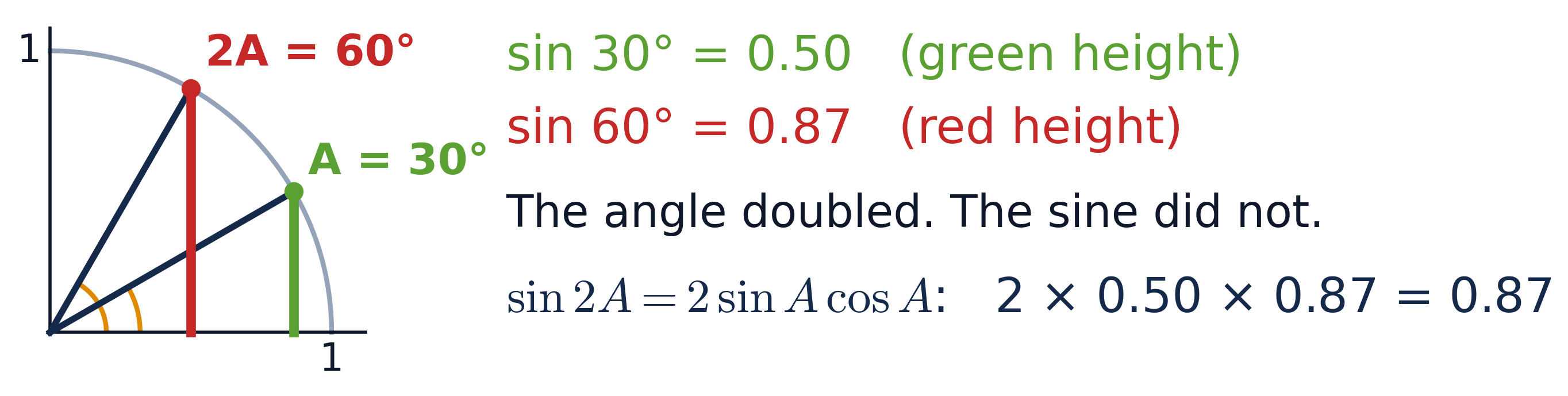
- \sin 2A = 2\sin A is wrong. The correct formula is 2\sin A\cos A. Try A = 30^\circ: \sin 60^\circ = \frac{\sqrt{3}}{2}, but 2\sin 30^\circ = 1.
- Mixing the two short forms of \cos 2A. It is 2\cos^2 A - 1 and 1 - 2\sin^2 A. Check with A = 0: both must give 1.
- The sign below the line. \tan 2A has 1 - \tan^2 A below; \sin 2A in terms of \tan A has 1 + \tan^2 A below.
- Forgetting the sign of a square root. \cos\frac{A}{2} = \pm\sqrt{\frac{1 + \cos A}{2}}. If \frac{A}{2} is in the second quadrant, the cosine is negative.
9. Quick check
Do these without help. Answers are at the end.
- \cos A = \frac{4}{5}. Find \cos 2A.
- \tan A = \frac{1}{2}. Find \tan 2A.
- Find the value of 8\cos^3 20^\circ - 6\cos 20^\circ.
- Find the value of \sin 15^\circ\cos 15^\circ.
- \cos\theta = \frac{7}{25} and \theta is acute. Find \sin\frac{\theta}{2}.
10. Read and watch more, free
| What | Where | Language |
|---|---|---|
| Textbook | NCERT Class 11 Mathematics, Chapter 3 Trigonometric Functions (the double-angle and triple-angle results follow the sum formulae) · Hindi edition | English, Hindi |
| Self-study notes | NIOS Mathematics, Lesson 4 Trigonometric Functions-II · Hindi edition | English, Hindi |
| Video, the whole unit for NDA | Defence Wallah: Trigonometry for NDA 2026 (about 5 hours) | Hinglish |
| Video, one class per NDA topic | Chandigarh Career Group: NDA Maths one shots (the Trigonometry class) | Hinglish |
| Video, short lessons on each identity | Mohit Tyagi: Trigonometry-1, Ratio and Identities (a little above NDA level) | Hinglish |
The videos were chosen from their titles, length and views; they have not yet been watched by a teacher.
Answers to the quick check
- 2 \times \frac{16}{25} - 1 = \frac{7}{25}.
- \frac{2 \times 1/2}{1 - 1/4} = \frac{4}{3}.
- 2(4\cos^3 20^\circ - 3\cos 20^\circ) = 2\cos 60^\circ = 1.
- \frac{1}{2}\sin 30^\circ = \frac{1}{4}.
- \sin^2\frac{\theta}{2} = \frac{1 - 7/25}{2} = \frac{9}{25}, so \sin\frac{\theta}{2} = \frac{3}{5}.
Next chapter: Inverse trigonometric functions.