Why this chapter matters. This chapter drew 24 questions in the seven papers from NDA II 2023 to NDA II 2026, more than any other chapter of trigonometry. The questions give two angles whose sum or difference is known (often 45^\circ, 60^\circ or 90^\circ) and ask for the value of an expression. Almost every one is a direct use of a formula in sections 1 to 4. Six real questions are solved in section 7.
What you will be able to do
- Expand \sin(A \pm B), \cos(A \pm B) and \tan(A \pm B), and use them to find ratios of 15^\circ, 75^\circ and 105^\circ.
- Change a product of sines and cosines into a sum, and a sum into a product.
- Find the largest and smallest value of a\cos x + b\sin x.
Before you start you should know: the values and signs of the ratios (Chapter M3-2) and the identity \sin^2\theta + \cos^2\theta = 1.
1. The four basic formulae
The sine or cosine of a sum is not the sum of the sines or cosines. The correct rules are:
\sin(A + B) = \sin A\cos B + \cos A\sin B \qquad \sin(A - B) = \sin A\cos B - \cos A\sin B
\cos(A + B) = \cos A\cos B - \sin A\sin B \qquad \cos(A - B) = \cos A\cos B + \sin A\sin B
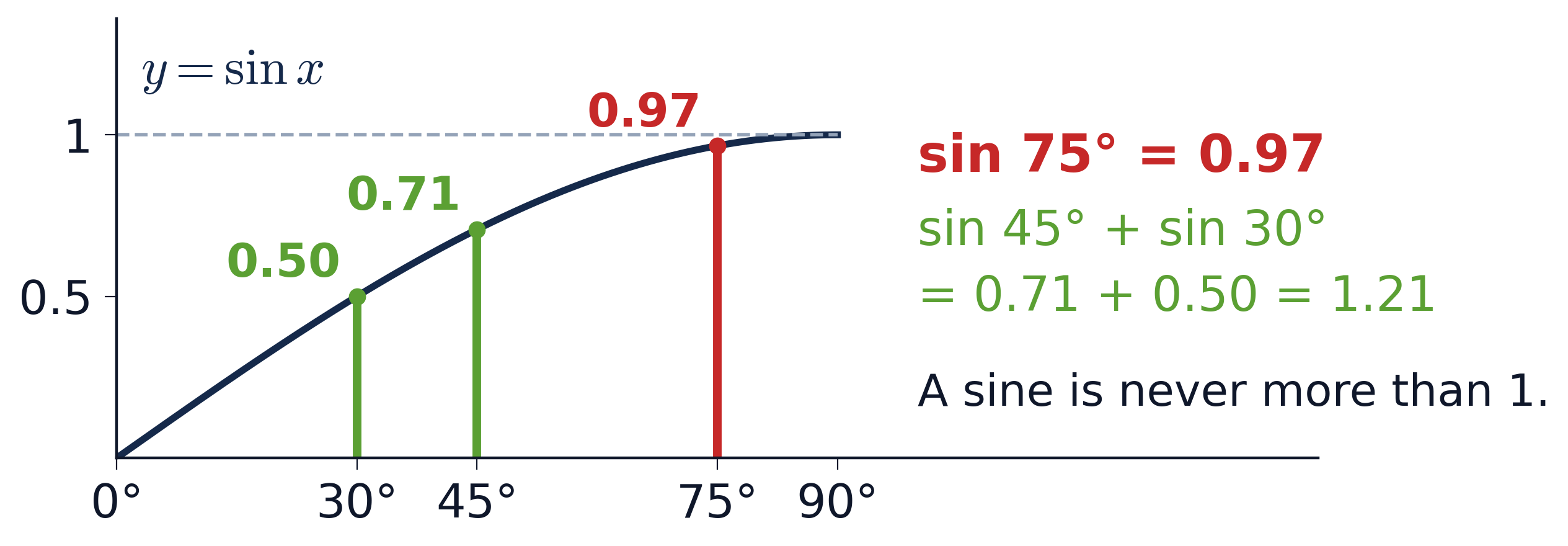
Notice the signs. In the sine formulae the sign in the middle is the same as the sign between A and B. In the cosine formulae it is the opposite.
For example, \sin 75^\circ = \sin(45^\circ + 30^\circ) = \dfrac{1}{\sqrt{2}} \times \dfrac{\sqrt{3}}{2} + \dfrac{1}{\sqrt{2}} \times \dfrac{1}{2} = \dfrac{\sqrt{6} + \sqrt{2}}{4}.
Two results follow by multiplying a pair of these formulae:
\sin(A + B)\sin(A - B) = \sin^2 A - \sin^2 B \qquad \cos(A + B)\cos(A - B) = \cos^2 A - \sin^2 B
2. The tangent and cotangent formulae
\tan(A + B) = \frac{\tan A + \tan B}{1 - \tan A\tan B} \qquad \tan(A - B) = \frac{\tan A - \tan B}{1 + \tan A\tan B} \qquad \cot(A + B) = \frac{\cot A\cot B - 1}{\cot A + \cot B}
For example, \tan 15^\circ = \tan(45^\circ - 30^\circ) = \dfrac{1 - \frac{1}{\sqrt{3}}}{1 + \frac{1}{\sqrt{3}}} = \dfrac{\sqrt{3} - 1}{\sqrt{3} + 1} = 2 - \sqrt{3}.
Two special cases are asked often.
- If A + B = 45^\circ, then \tan(A + B) = 1, which gives \tan A + \tan B + \tan A\tan B = 1. So (1 + \tan A)(1 + \tan B) = 2.
- If A, B, C are the angles of a triangle, then \tan A + \tan B + \tan C = \tan A\tan B\tan C.
Since \tan 45^\circ = 1, also \tan(45^\circ + \theta) = \dfrac{1 + \tan\theta}{1 - \tan\theta} and \tan(45^\circ - \theta) = \dfrac{1 - \tan\theta}{1 + \tan\theta}.
3. A product into a sum
Add or subtract the formulae of section 1 in pairs:
| Product | Sum |
|---|---|
| 2\sin A\cos B | \sin(A + B) + \sin(A - B) |
| 2\cos A\sin B | \sin(A + B) - \sin(A - B) |
| 2\cos A\cos B | \cos(A + B) + \cos(A - B) |
| 2\sin A\sin B | \cos(A - B) - \cos(A + B) |
For example, 2\sin 75^\circ\cos 15^\circ = \sin 90^\circ + \sin 60^\circ = 1 + \dfrac{\sqrt{3}}{2}.
4. A sum into a product
Reading the same table from right to left, with C = A + B and D = A - B:
| Sum | Product |
|---|---|
| \sin C + \sin D | 2\sin\dfrac{C + D}{2}\cos\dfrac{C - D}{2} |
| \sin C - \sin D | 2\cos\dfrac{C + D}{2}\sin\dfrac{C - D}{2} |
| \cos C + \cos D | 2\cos\dfrac{C + D}{2}\cos\dfrac{C - D}{2} |
| \cos C - \cos D | -2\sin\dfrac{C + D}{2}\sin\dfrac{C - D}{2} |
For example, \cos 75^\circ + \cos 15^\circ = 2\cos 45^\circ\cos 30^\circ = 2 \times \dfrac{1}{\sqrt{2}} \times \dfrac{\sqrt{3}}{2} = \dfrac{\sqrt{6}}{2}.
Use these when two sines or two cosines are added and their half-sum is a known angle.
5. The largest and smallest value of a\cos x + b\sin x
Let r = \sqrt{a^2 + b^2} and choose the angle \alpha with \cos\alpha = \dfrac{a}{r} and \sin\alpha = \dfrac{b}{r}. Then
a\cos x + b\sin x = r(\cos x\cos\alpha + \sin x\sin\alpha) = r\cos(x - \alpha)
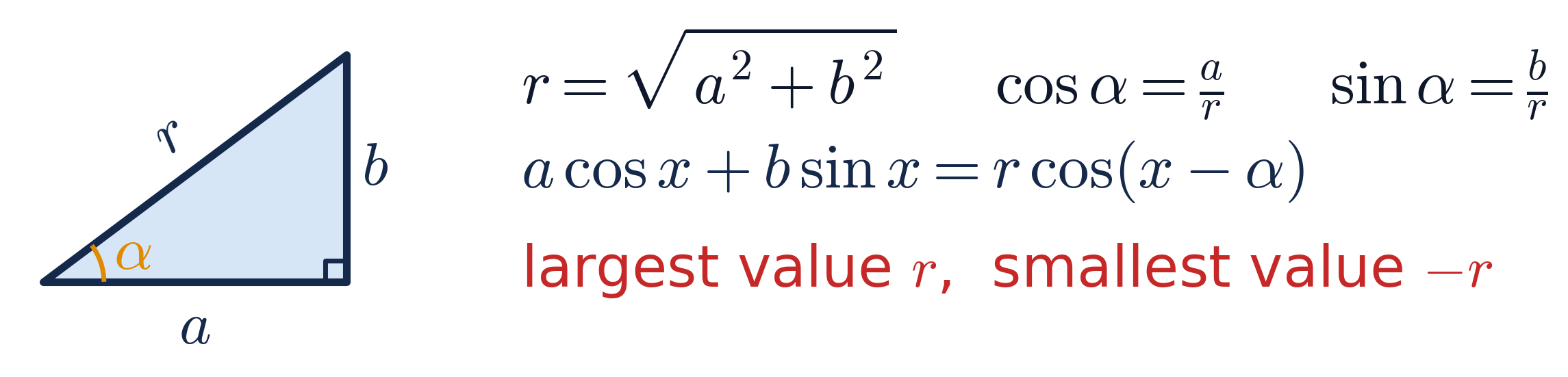
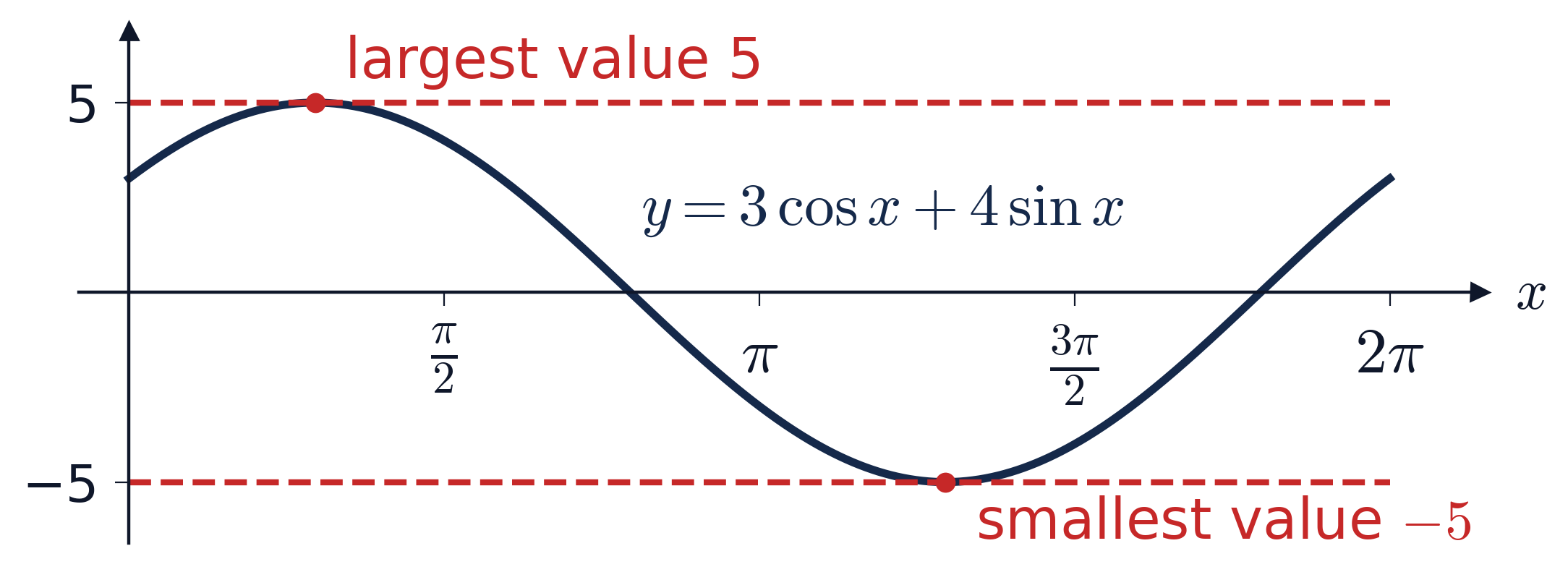
A cosine lies from -1 to 1. So the expression lies from -\sqrt{a^2 + b^2} to \sqrt{a^2 + b^2}, and it is largest when x = \alpha. For example, 3\cos x + 4\sin x lies from -5 to 5.
6. Worked examples
Example 1. \sin A = \frac{3}{5} and \cos B = \frac{5}{13}, where A and B are acute. Find \sin(A + B) and \cos(A + B).
\cos A = \frac{4}{5} and \sin B = \frac{12}{13}. So \sin(A + B) = \frac{3}{5} \times \frac{5}{13} + \frac{4}{5} \times \frac{12}{13} = \frac{63}{65}, and \cos(A + B) = \frac{4}{5} \times \frac{5}{13} - \frac{3}{5} \times \frac{12}{13} = -\frac{16}{65}. The cosine is negative, so A + B is more than 90^\circ.
Example 2. \tan A = \frac{1}{2} and \tan B = \frac{1}{3}, where A and B are acute. Find A + B.
\tan(A + B) = \dfrac{\frac{1}{2} + \frac{1}{3}}{1 - \frac{1}{6}} = \dfrac{5/6}{5/6} = 1. Both angles are acute and their sum has tangent 1, so A + B = 45^\circ.
Example 3. Simplify \dfrac{\sin 5x + \sin 3x}{\cos 5x + \cos 3x}.
Top: 2\sin 4x\cos x. Bottom: 2\cos 4x\cos x. The factor 2\cos x cancels and the value is \tan 4x.
Example 4. Find the value of \sin 20^\circ\cos 40^\circ + \cos 20^\circ\sin 40^\circ.
This is the right-hand side of the \sin(A + B) formula with A = 20^\circ and B = 40^\circ. So the value is \sin 60^\circ = \frac{\sqrt{3}}{2}. Reading a formula from right to left is a common exam step.
Example 5. Find the largest and smallest values of 5\cos x + 12\sin x + 7.
\sqrt{5^2 + 12^2} = 13, so 5\cos x + 12\sin x lies from -13 to 13. Adding 7, the largest value is 20 and the smallest is -6.
7. From the real papers
Try each for 75 seconds before reading the solution.
NDA II 2026, Q7 (one of two questions on the same data). Given that \tan\left(\frac{A}{2} + \frac{B}{2}\right) = p and \tan\left(\frac{A}{2} - \frac{B}{2}\right) = q, where pq \ne \pm 1. What is \tan A equal to?
(a) \frac{p-q}{1+pq} (b) \frac{p+q}{1-pq} (c) \frac{p+q}{1+pq} (d) \frac{p-q}{1-pq}
Solution. A is the sum of the two given angles: A = \left(\frac{A}{2} + \frac{B}{2}\right) + \left(\frac{A}{2} - \frac{B}{2}\right). By the \tan(X + Y) formula, \tan A = \frac{p + q}{1 - pq}. Answer (b).
NDA II 2026, Q9 (one of two questions on the same data). Let 4(A + B) = \pi. What is (1 + \tan A)(1 + \tan B) equal to?
(a) 1 (b) 2 (c) 4 (d) 6
Solution. A + B = \frac{\pi}{4}, so \frac{\tan A + \tan B}{1 - \tan A\tan B} = 1 and \tan A + \tan B + \tan A\tan B = 1. Then (1 + \tan A)(1 + \tan B) = 1 + \tan A + \tan B + \tan A\tan B = 2. Answer (b).
NDA II 2025, Q25 (one of two questions on the same data). Let \sin A + \sin B = p and \cos A + \cos B = q. What is \frac{p}{q} equal to?
(a) \tan\left(\frac{A-B}{2}\right) (b) \cot\left(\frac{A-B}{2}\right) (c) \tan\left(\frac{A+B}{2}\right) (d) \cot\left(\frac{A+B}{2}\right)
Solution. p = 2\sin\frac{A+B}{2}\cos\frac{A-B}{2} and q = 2\cos\frac{A+B}{2}\cos\frac{A-B}{2}. Dividing, the factor 2\cos\frac{A-B}{2} cancels and \frac{p}{q} = \tan\left(\frac{A+B}{2}\right). Answer (c).
NDA I 2024, Q41. ABC is a triangle such that angle C = 60^\circ, then what is \frac{\cos A + \cos B}{\cos\left(\frac{A - B}{2}\right)} equal to?
(a) 2 (b) \sqrt{2} (c) 1 (d) \frac{1}{\sqrt{2}}
Solution. A + B = 120^\circ, so \frac{A + B}{2} = 60^\circ. Then \cos A + \cos B = 2\cos 60^\circ\cos\left(\frac{A - B}{2}\right) = \cos\left(\frac{A - B}{2}\right). Dividing gives 1. Answer (c).
NDA I 2026, Q30. \cos x + \sqrt{3} \sin x is maximum when x is equal to
(a) \frac{\pi}{2} (b) \frac{\pi}{3} (c) \frac{\pi}{4} (d) \frac{\pi}{6}
Solution. Here r = \sqrt{1 + 3} = 2. So \cos x + \sqrt{3}\sin x = 2\left(\frac{1}{2}\cos x + \frac{\sqrt{3}}{2}\sin x\right) = 2\cos\left(x - \frac{\pi}{3}\right). It is largest when x - \frac{\pi}{3} = 0, that is x = \frac{\pi}{3}. Answer (b).
NDA I 2025, Q31 (one of three questions on the same data). Let p = \sin 35^\circ, q = \sin 25^\circ and r = \sin(-95^\circ). What is (p + q + r) equal to?
(a) -1 (b) 0 (c) 2\sin 5^\circ (d) 2\cos 5^\circ
Solution. p + q = 2\sin 30^\circ\cos 5^\circ = \cos 5^\circ. Next, r = -\sin 95^\circ = -\sin(90^\circ + 5^\circ) = -\cos 5^\circ. So p + q + r = 0. Answer (b).
Notice that not one of these six needed more than two lines. The work is in seeing which formula fits.
8. Mistakes that cost marks
- \sin(A + B) = \sin A + \sin B is wrong. Try A = 30^\circ, B = 60^\circ: \sin 90^\circ = 1, but \sin 30^\circ + \sin 60^\circ is about 1.37.
- The sign in the cosine formulae. \cos(A + B) has a minus sign and \cos(A - B) has a plus sign. Check with A = B: \cos 0 = \cos^2 A + \sin^2 A = 1.
- The minus sign in \cos C - \cos D. It is -2\sin\frac{C + D}{2}\sin\frac{C - D}{2}. The other three have no minus sign.
- The largest value of a\cos x + b\sin x is not a + b. It is \sqrt{a^2 + b^2}. The largest value of 3\cos x + 4\sin x is 5, not 7.
9. Quick check
Do these without help. Answers are at the end.
- Find \cos 105^\circ.
- Find \tan 75^\circ.
- Find \sin 75^\circ - \sin 15^\circ.
- \tan A = \frac{3}{4} and \tan B = \frac{1}{7}, where A and B are acute. Find A + B.
- What is the smallest value of \sin x - \cos x?
10. Read and watch more, free
| What | Where | Language |
|---|---|---|
| Textbook | NCERT Class 11 Mathematics, Chapter 3 Trigonometric Functions (the section on the sum and difference of two angles) · Hindi edition | English, Hindi |
| Self-study notes | NIOS Mathematics, Lesson 4 Trigonometric Functions-II · Hindi edition | English, Hindi |
| Video, the whole unit for NDA | Defence Wallah: Trigonometry for NDA 2026 (about 5 hours) | Hinglish |
| Video, short lessons on each identity | Mohit Tyagi: Trigonometry-1, Ratio and Identities (72 short lessons, a little above NDA level) | Hinglish |
| Video, worked examples | The Organic Chemistry Tutor: New Trigonometry Playlist | English |
The videos were chosen from their titles, length and views; they have not yet been watched by a teacher.
Answers to the quick check
- \cos(60^\circ + 45^\circ) = \frac{1}{2} \times \frac{1}{\sqrt{2}} - \frac{\sqrt{3}}{2} \times \frac{1}{\sqrt{2}} = \frac{\sqrt{2} - \sqrt{6}}{4}.
- \tan(45^\circ + 30^\circ) = \frac{\sqrt{3} + 1}{\sqrt{3} - 1} = 2 + \sqrt{3}.
- 2\cos 45^\circ\sin 30^\circ = \frac{1}{\sqrt{2}}.
- \tan(A + B) = \frac{3/4 + 1/7}{1 - 3/28} = \frac{25/28}{25/28} = 1, so A + B = 45^\circ.
- -\sqrt{1^2 + 1^2} = -\sqrt{2}.
Next chapter: Multiple and sub-multiple angles.