Why this chapter matters. This chapter drew 19 questions in the seven papers from NDA II 2023 to NDA II 2026. More than half of them are short trigonometric equations, often of the kind "how many values of \theta satisfy this?". The rest ask for the value of an expression, using the signs in the four quadrants and the three square identities. Six real questions are solved in section 6.
What you will be able to do
- Write the value of any ratio of 0^\circ, 30^\circ, 45^\circ, 60^\circ, 90^\circ and of the angles related to them, such as 150^\circ, 225^\circ or 1125^\circ, with the right sign.
- Use the three square identities to find one ratio from another and to simplify expressions.
- Solve a simple trigonometric equation and count its solutions in a given interval.
Before you start you should know: degrees, radians and the four quadrants (Chapter M3-1), and how to solve a quadratic equation (Chapter M1-7).
1. The six ratios
In a right-angled triangle, take one acute angle \theta. Call the side opposite to it the perpendicular (p), the side next to it the base (b), and the longest side the hypotenuse (h).
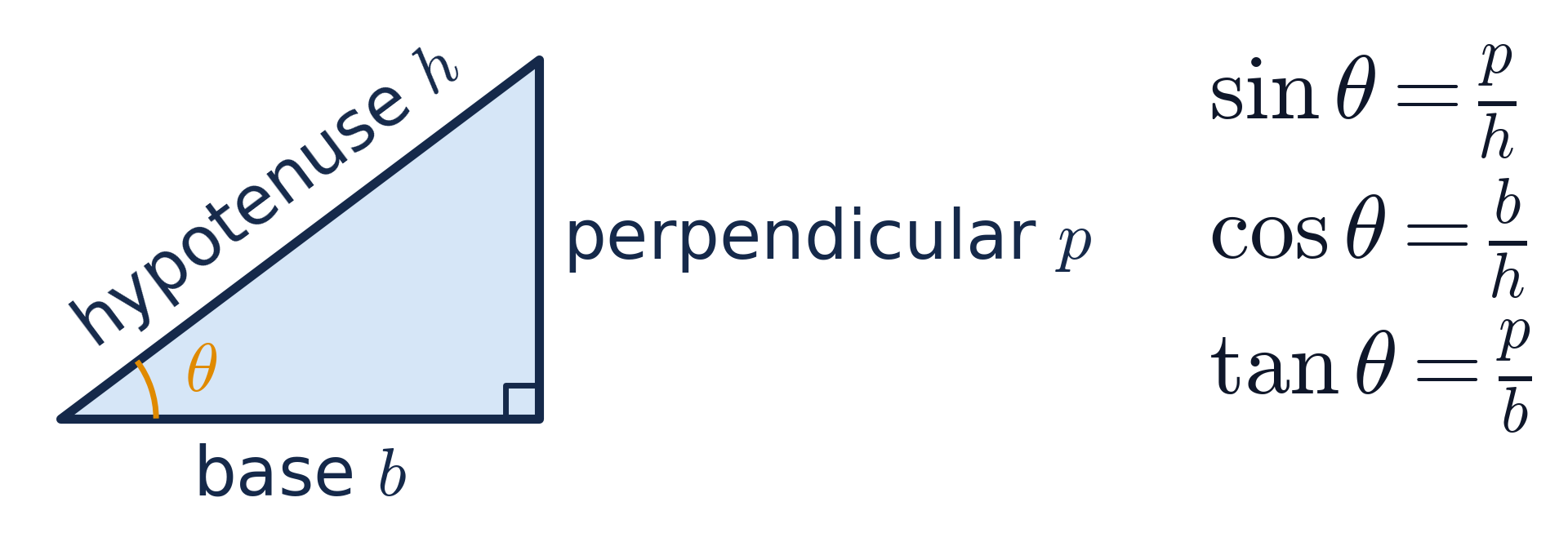
\sin\theta = \frac{p}{h} \qquad \cos\theta = \frac{b}{h} \qquad \tan\theta = \frac{p}{b} = \frac{\sin\theta}{\cos\theta}
The other three are the reciprocals: \operatorname{cosec}\theta = \dfrac{1}{\sin\theta}, \sec\theta = \dfrac{1}{\cos\theta}, \cot\theta = \dfrac{1}{\tan\theta}.
Learn this table by heart.
| \theta | 0^\circ | 30^\circ | 45^\circ | 60^\circ | 90^\circ |
|---|---|---|---|---|---|
| \sin\theta | 0 | \dfrac{1}{2} | \dfrac{1}{\sqrt{2}} | \dfrac{\sqrt{3}}{2} | 1 |
| \cos\theta | 1 | \dfrac{\sqrt{3}}{2} | \dfrac{1}{\sqrt{2}} | \dfrac{1}{2} | 0 |
| \tan\theta | 0 | \dfrac{1}{\sqrt{3}} | 1 | \sqrt{3} | not defined |
Complementary angles. Two angles that add up to 90^\circ exchange sine and cosine: \sin(90^\circ - \theta) = \cos\theta, \tan(90^\circ - \theta) = \cot\theta, \sec(90^\circ - \theta) = \operatorname{cosec}\theta. So \sin 70^\circ = \cos 20^\circ.
2. Angles of any size: the sign and the related angle
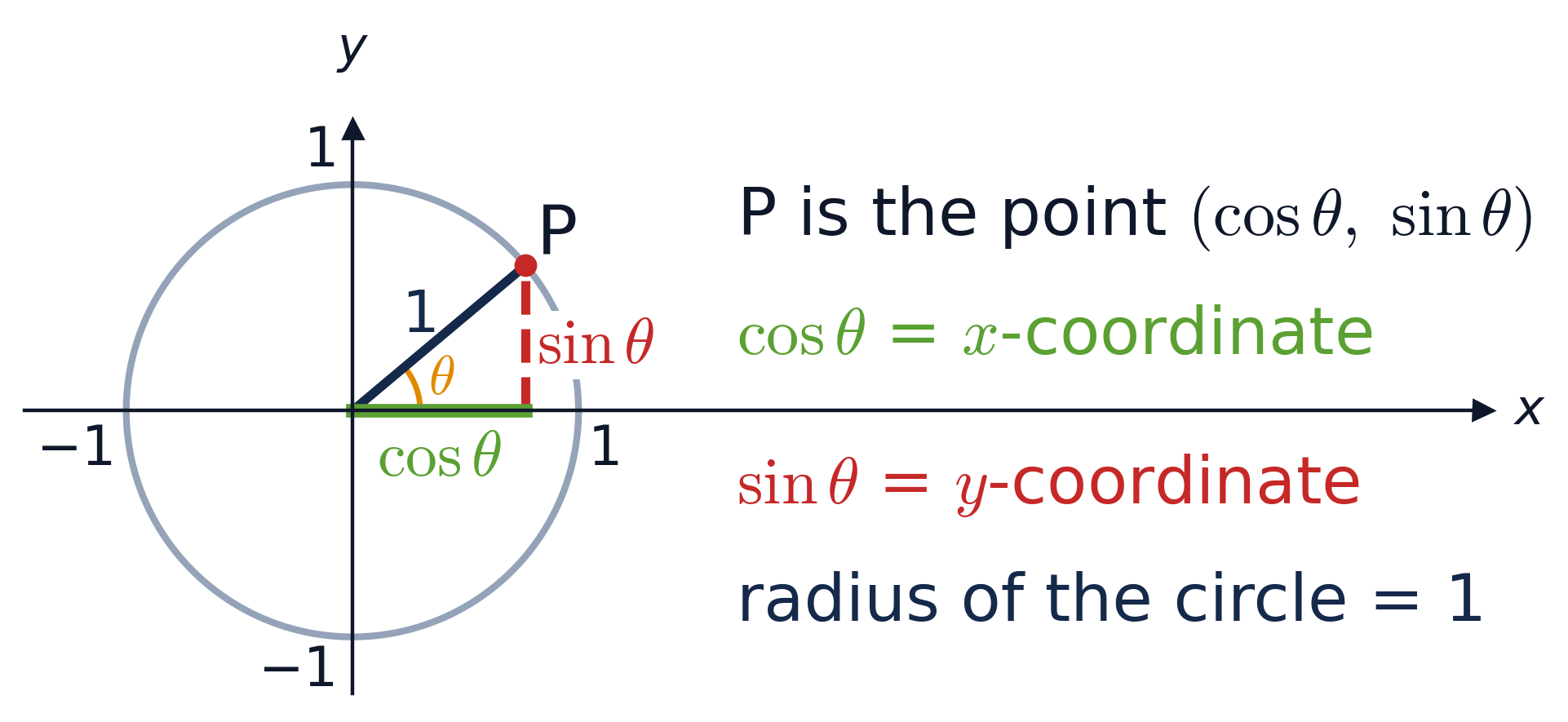
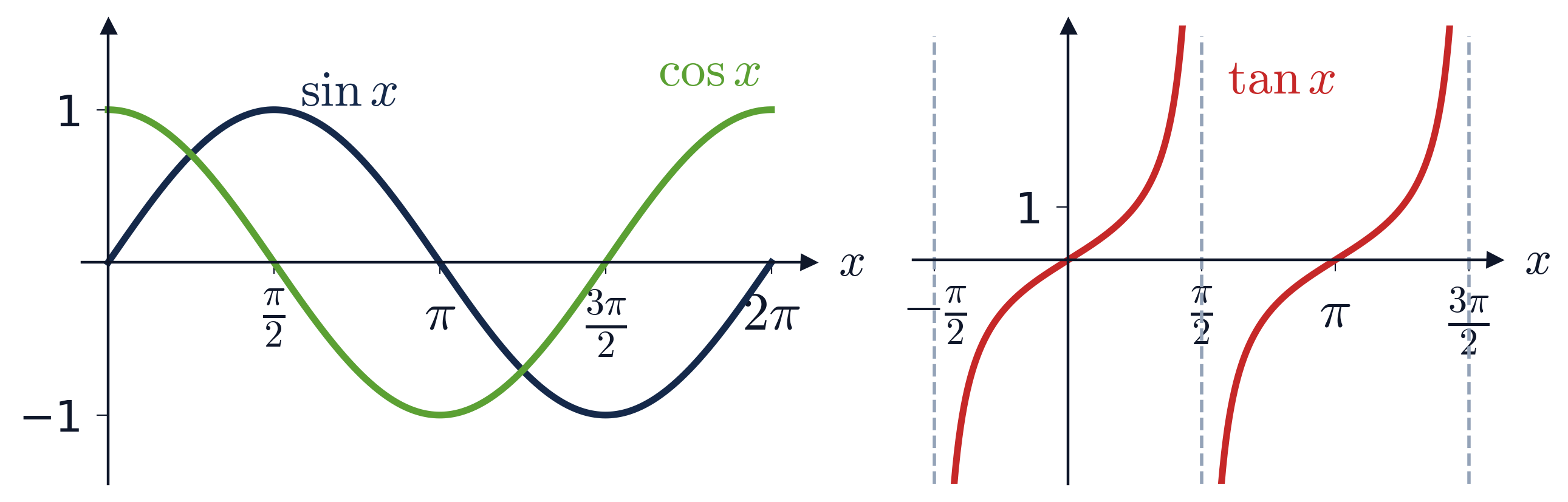
For an angle of any size, the ratios are defined on a circle of radius 1: \cos\theta is the x-coordinate and \sin\theta is the y-coordinate of the point where the angle ends. So the signs depend on the quadrant.
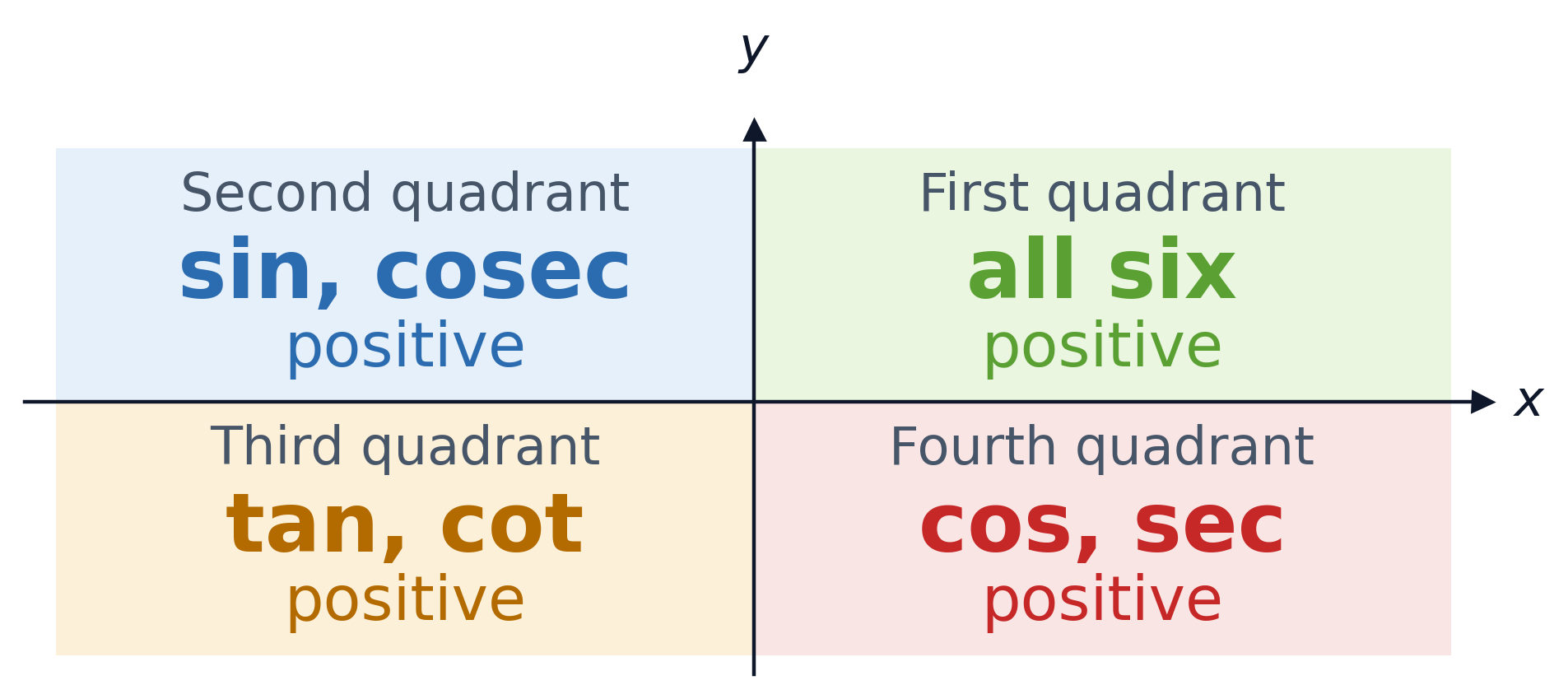
| Quadrant | First | Second | Third | Fourth |
|---|---|---|---|---|
| Positive ratios | all | \sin, \operatorname{cosec} | \tan, \cot | \cos, \sec |
To find a ratio of a large angle, follow three steps.
- Remove full turns. \sin and \cos repeat every 360^\circ; \tan and \cot repeat every 180^\circ. Also \sin(-\theta) = -\sin\theta, \cos(-\theta) = \cos\theta, \tan(-\theta) = -\tan\theta.
- Write the angle as 180^\circ \pm \alpha or 360^\circ - \alpha with \alpha acute. The ratio keeps its name.
- Give the sign of that ratio in the quadrant where the angle ends.
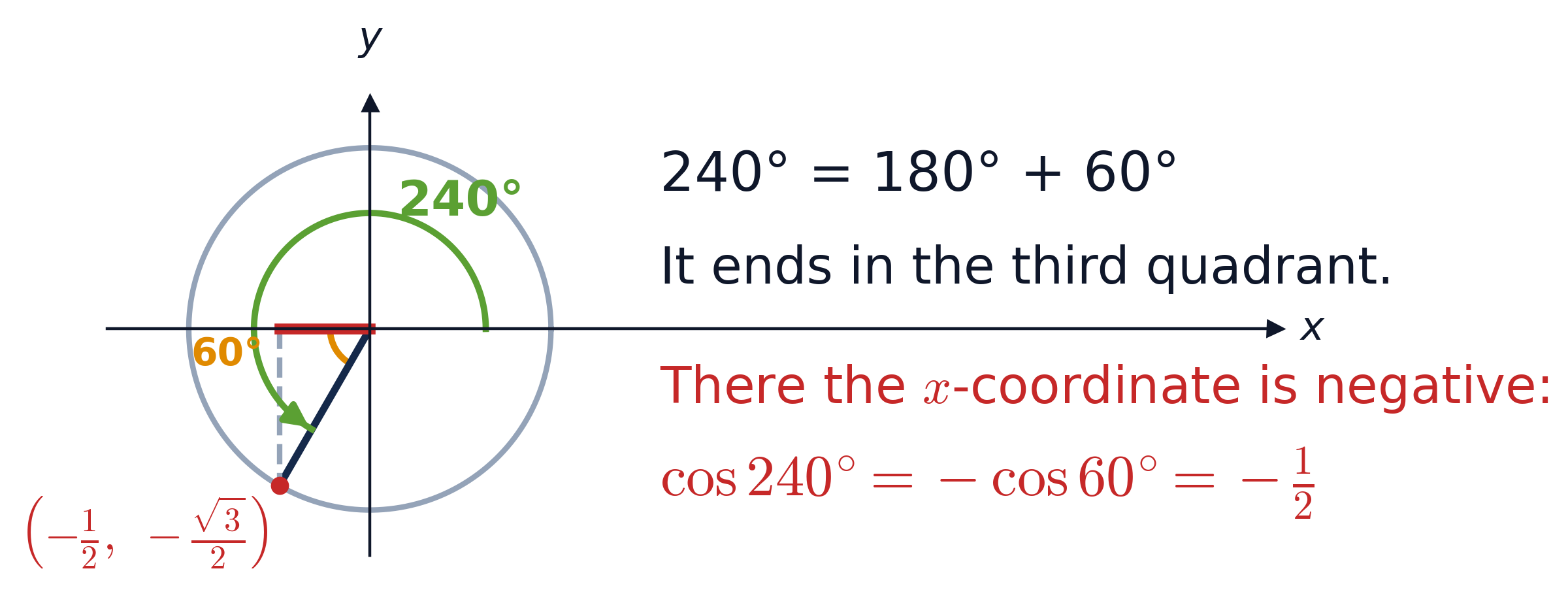
For example, \cos 240^\circ = \cos(180^\circ + 60^\circ). The third quadrant makes cosine negative, so \cos 240^\circ = -\cos 60^\circ = -\frac{1}{2}. In the same way \sin 150^\circ = +\sin 30^\circ = \frac{1}{2} and \tan 315^\circ = -\tan 45^\circ = -1.
If you write the angle as 90^\circ \pm \alpha or 270^\circ \pm \alpha instead, the ratio changes its name (\sin \leftrightarrow \cos, \tan \leftrightarrow \cot, \sec \leftrightarrow \operatorname{cosec}). For example \sin(90^\circ + \alpha) = \cos\alpha and \cos(90^\circ + \alpha) = -\sin\alpha.
3. The three square identities
These are true for every angle for which the ratios are defined.
\sin^2\theta + \cos^2\theta = 1 \qquad 1 + \tan^2\theta = \sec^2\theta \qquad 1 + \cot^2\theta = \operatorname{cosec}^2\theta
The second one can be written (\sec\theta - \tan\theta)(\sec\theta + \tan\theta) = 1. So if \sec\theta + \tan\theta = k, then \sec\theta - \tan\theta = \dfrac{1}{k}. The third gives (\operatorname{cosec}\theta - \cot\theta)(\operatorname{cosec}\theta + \cot\theta) = 1 in the same way.
Largest and smallest values. \sin\theta and \cos\theta always lie from -1 to 1. The expression a\cos x + b\sin x lies from -\sqrt{a^2 + b^2} to \sqrt{a^2 + b^2} (the reason is in Chapter M3-3). For example, 3\sin x + 4\cos x is never more than 5.
4. Simple trigonometric equations
A trigonometric equation has many solutions, because the ratios repeat. The list of all of them is the general solution. Here n is any integer.
| Equation | General solution |
|---|---|
| \sin\theta = 0 | \theta = n\pi |
| \cos\theta = 0 | \theta = (2n + 1)\dfrac{\pi}{2} |
| \tan\theta = 0 | \theta = n\pi |
| \sin\theta = \sin\alpha | \theta = n\pi + (-1)^n\alpha |
| \cos\theta = \cos\alpha | \theta = 2n\pi \pm \alpha |
| \tan\theta = \tan\alpha | \theta = n\pi + \alpha |
The exam usually asks for the solutions in an interval, or only for their number. The method:
- Bring the equation to one ratio, often by an identity. It becomes a linear or quadratic equation in that ratio.
- Solve for the ratio. Throw away impossible values such as \sin x = 2.
- For each value, list the angles in the given interval, quadrant by quadrant.
- Throw away any angle at which a term of the original equation is not defined (for example \tan x at x = \frac{\pi}{2}).
5. Worked examples
Example 1. \sin\theta = \frac{3}{5} and \theta lies in the second quadrant. Find \cos\theta and \tan\theta.
\cos^2\theta = 1 - \frac{9}{25} = \frac{16}{25}, so \cos\theta = \pm\frac{4}{5}. In the second quadrant cosine is negative: \cos\theta = -\frac{4}{5}. Then \tan\theta = \frac{3/5}{-4/5} = -\frac{3}{4}.
Example 2. Find \sin 765^\circ and \cos(-1110^\circ).
765^\circ = 2 \times 360^\circ + 45^\circ, so \sin 765^\circ = \sin 45^\circ = \frac{1}{\sqrt{2}}. Next, \cos(-1110^\circ) = \cos 1110^\circ, and 1110^\circ = 3 \times 360^\circ + 30^\circ, so the value is \cos 30^\circ = \frac{\sqrt{3}}{2}.
Example 3. If \sec\theta + \tan\theta = 3, find \sin\theta.
From section 3, \sec\theta - \tan\theta = \frac{1}{3}. Adding the two equations: 2\sec\theta = \frac{10}{3}, so \sec\theta = \frac{5}{3}. Subtracting: \tan\theta = \frac{4}{3}. Then \sin\theta = \dfrac{\tan\theta}{\sec\theta} = \dfrac{4}{5}.
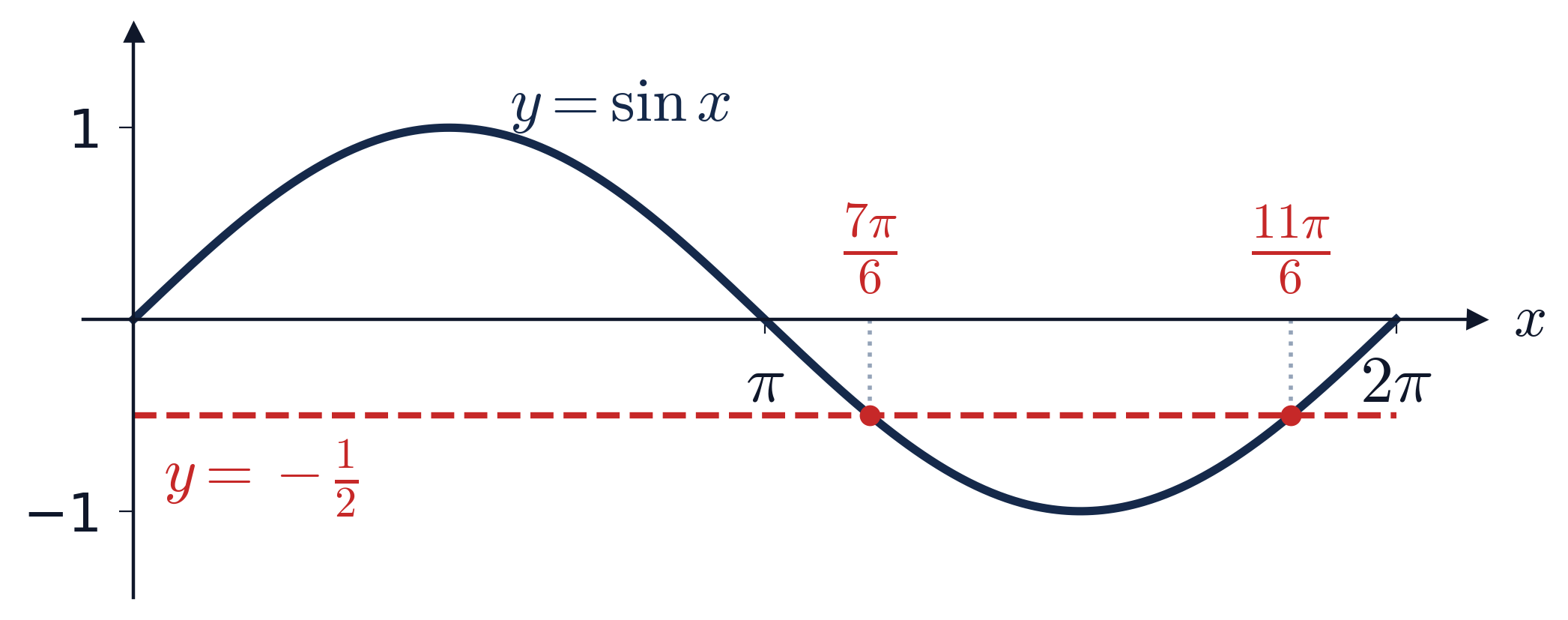
Example 4. Solve 2\cos^2 x + 3\sin x = 0 for 0 \le x < 2\pi.
Put \cos^2 x = 1 - \sin^2 x: 2 - 2\sin^2 x + 3\sin x = 0, that is 2\sin^2 x - 3\sin x - 2 = 0, or (2\sin x + 1)(\sin x - 2) = 0. \sin x = 2 is impossible. So \sin x = -\frac{1}{2}, which happens in the third and fourth quadrants: x = \pi + \frac{\pi}{6} = \frac{7\pi}{6} and x = 2\pi - \frac{\pi}{6} = \frac{11\pi}{6}.
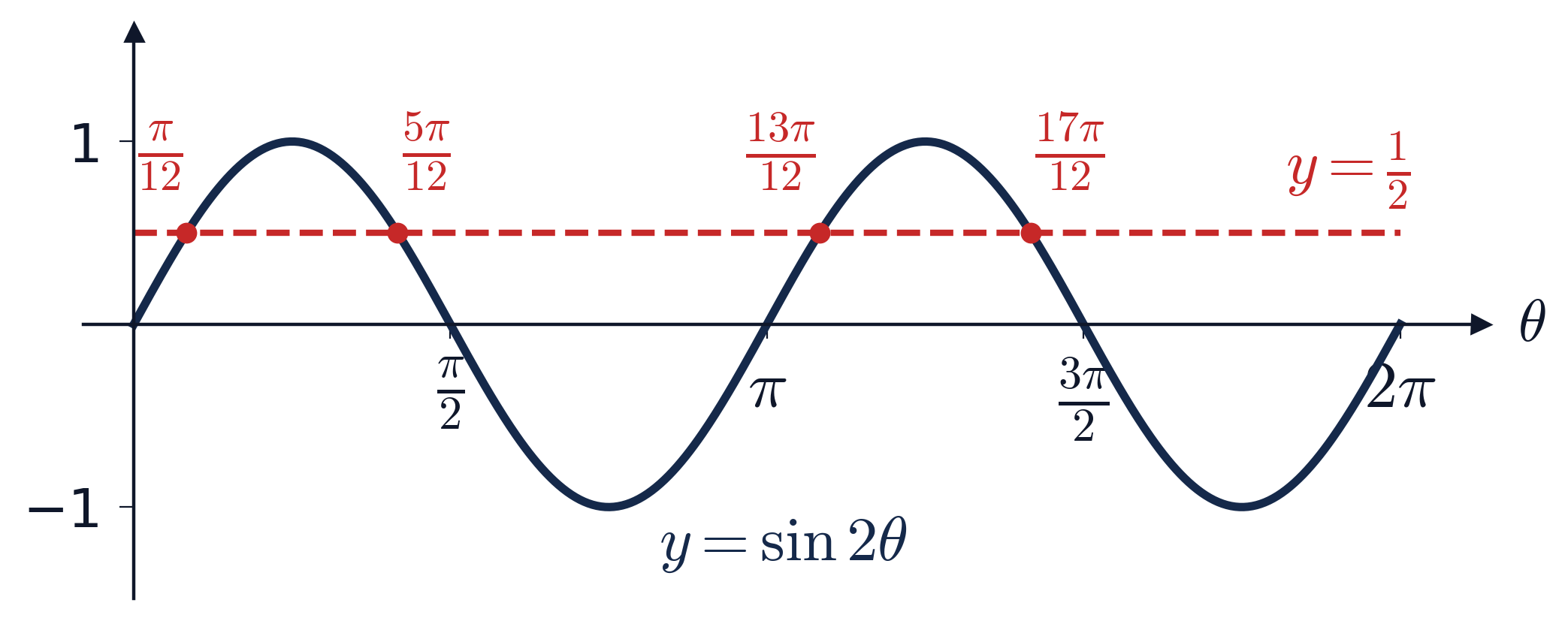
Example 5. How many values of \theta with 0 \le \theta < 2\pi satisfy \sin 2\theta = \frac{1}{2}?
As \theta goes from 0 to 2\pi, the angle 2\theta goes from 0 to 4\pi: two full turns. In each turn the sine is \frac{1}{2} twice. So 2\theta = \frac{\pi}{6}, \frac{5\pi}{6}, \frac{13\pi}{6}, \frac{17\pi}{6}, and \theta = \frac{\pi}{12}, \frac{5\pi}{12}, \frac{13\pi}{12}, \frac{17\pi}{12}. There are four values.
6. From the real papers
Try each for 75 seconds before reading the solution.
NDA II 2026, Q15. What is \tan(1125^\circ)\cot(405^\circ) + \tan(765^\circ)\cot(675^\circ) equal to?
(a) 2 (b) 1 (c) 0 (d) -2
Solution. Remove full turns. 1125^\circ = 3 \times 360^\circ + 45^\circ, 405^\circ = 360^\circ + 45^\circ and 765^\circ = 2 \times 360^\circ + 45^\circ, so the first three ratios are all 1. 675^\circ = 720^\circ - 45^\circ, so \cot 675^\circ = \cot(-45^\circ) = -1. The value is (1)(1) + (1)(-1) = 0. Answer (c).
NDA I 2026, Q27. If \alpha and \beta are complementary angles such that \alpha - \beta = \frac{\pi}{6} and m \tan \beta = n \tan \alpha, then what is \left(\frac{m+n}{m-n}\right) equal to?
(a) 2 (b) \frac{2}{\sqrt{3}} (c) 1 (d) \frac{1}{\sqrt{3}}
Solution. \alpha + \beta = 90^\circ and \alpha - \beta = 30^\circ, so \alpha = 60^\circ and \beta = 30^\circ. Then m \times \frac{1}{\sqrt{3}} = n \times \sqrt{3}, so m = 3n. Hence \frac{m+n}{m-n} = \frac{4n}{2n} = 2. Answer (a).
NDA II 2025, Q47. How many values of \theta, where -\pi < \theta < \pi, satisfy both the equations \cot\theta = -\sqrt{3} and \operatorname{cosec}\theta = -2 simultaneously?
(a) 4 (b) 2 (c) 1 (d) None
Solution. \operatorname{cosec}\theta = -2 means \sin\theta = -\frac{1}{2}: third or fourth quadrant. \cot\theta is negative in the second or fourth quadrant. Both hold only in the fourth quadrant, where \sin\theta = -\frac{1}{2} gives \theta = -\frac{\pi}{6}. Check: \cot\left(-\frac{\pi}{6}\right) = -\sqrt{3}. There is one value. Answer (c).
NDA I 2025, Q44 (one of two questions on the same data). Let 2\sin\alpha + \cos\alpha = 2, where 0 < \alpha < 90^\circ. What is \tan\alpha equal to?
(a) 1/2 (b) 1 (c) 3/4 (d) 2
Solution. \cos\alpha = 2(1 - \sin\alpha). Square: \cos^2\alpha = 4(1 - \sin\alpha)^2. But \cos^2\alpha = (1 - \sin\alpha)(1 + \sin\alpha), and \sin\alpha \ne 1 because \alpha < 90^\circ. Cancel (1 - \sin\alpha): 1 + \sin\alpha = 4(1 - \sin\alpha), so \sin\alpha = \frac{3}{5}. Then \cos\alpha = 2 - \frac{6}{5} = \frac{4}{5} and \tan\alpha = \frac{3}{4}. Answer (c).
NDA II 2025, Q49. If 0 \le x \le \frac{\pi}{2}, then what is the number of values of x satisfying the equation \tan x + \sec x = 2\cos x?
(a) 0 (b) 1 (c) 2 (d) 3
Solution. Write \frac{\sin x + 1}{\cos x} = 2\cos x, which needs \cos x \ne 0. Then 1 + \sin x = 2\cos^2 x = 2(1 - \sin^2 x), so 2\sin^2 x + \sin x - 1 = 0 and (2\sin x - 1)(\sin x + 1) = 0. In the interval, \sin x = -1 is impossible and \sin x = \frac{1}{2} gives only x = \frac{\pi}{6}. There is one value. Answer (b).
NDA II 2026, Q12. How many values of \theta satisfy the equation \tan^2\theta + \cot^2\theta = 2, where 0^\circ < \theta < 360^\circ?
(a) 1 (b) 2 (c) 4 (d) 8
Solution. Put t = \tan^2\theta. Then t + \frac{1}{t} = 2, so (t - 1)^2 = 0 and t = 1. Hence \tan\theta = \pm 1, which gives one angle in each quadrant: 45^\circ, 135^\circ, 225^\circ, 315^\circ. There are four values. Answer (c).
Notice that four of the six questions are equations, and three of those ask only for the number of solutions.
7. Mistakes that cost marks
- The wrong sign. \cos\theta = \pm\sqrt{1 - \sin^2\theta} has two signs. Choose by the quadrant. In the second quadrant only \sin and \operatorname{cosec} are positive.
- Dividing an equation by a ratio. In \sin x\cos x = \sin x, do not cancel \sin x. Write \sin x(\cos x - 1) = 0, so \sin x = 0 or \cos x = 1. Cancelling loses the solution x = \pi.
- Keeping an angle where the equation is not defined. If the equation has \tan x or \sec x, then x = \frac{\pi}{2} can never be a solution.
- Forgetting that a multiple angle makes more turns. For \sin 2\theta with 0 \le \theta < 2\pi, look for 2\theta from 0 to 4\pi.
8. Quick check
Do these without help. Answers are at the end.
- \tan\theta = -\frac{5}{12} and \theta lies in the fourth quadrant. Find \sin\theta.
- Find \sin 420^\circ\cos 390^\circ + \cos(-300^\circ)\sin(-330^\circ).
- If \sec\theta - \tan\theta = \frac{1}{2}, find \cos\theta.
- Write the general solution of \cos x = \frac{1}{2}.
- How many values of x with 0 < x < 2\pi satisfy 2\sin^2 x = 1?
9. Read and watch more, free
| What | Where | Language |
|---|---|---|
| Textbook | NCERT Class 11 Mathematics, Chapter 3 Trigonometric Functions · Hindi edition. For the ratios in a right triangle: NCERT Class 10, Chapter 8 · Hindi edition | English, Hindi |
| Self-study notes | NIOS Mathematics, Lesson 3 Trigonometric Functions-I · Hindi edition | English, Hindi |
| Self-study notes, trigonometric equations (the current NCERT book leaves these out) | NIOS Mathematics, Lesson 4 Trigonometric Functions-II · Hindi edition | English, Hindi |
| Video, the whole unit for NDA | Defence Wallah: Trigonometry for NDA 2026 (about 5 hours) | Hinglish |
| Video, one class per NDA topic | Chandigarh Career Group: NDA Maths one shots (the Trigonometry class, about 7 hours) | Hinglish |
| Video, short lessons | Khan Academy India, Hindi medium: कक्षा 11 - त्रिकोणमितीय फलन | Hindi |
The videos were chosen from their titles, length and views; they have not yet been watched by a teacher.
Answers to the quick check
- The triangle is 5, 12, 13, and sine is negative in the fourth quadrant: \sin\theta = -\frac{5}{13}.
- \sin 60^\circ\cos 30^\circ + \cos 60^\circ\sin 30^\circ = \frac{3}{4} + \frac{1}{4} = 1. (Here \cos(-300^\circ) = \cos 300^\circ = \frac{1}{2} and \sin(-330^\circ) = -\sin 330^\circ = \frac{1}{2}.)
- \sec\theta + \tan\theta = 2, so 2\sec\theta = \frac{5}{2}, \sec\theta = \frac{5}{4} and \cos\theta = \frac{4}{5}.
- x = 2n\pi \pm \frac{\pi}{3}, where n is any integer.
- \sin x = \pm\frac{1}{\sqrt{2}}: one angle in each quadrant, \frac{\pi}{4}, \frac{3\pi}{4}, \frac{5\pi}{4}, \frac{7\pi}{4}. Four values.
Next chapter: Sum and difference formulae.