Why this chapter matters. We found about 26 questions from this chapter in the 12 papers we hold, from 2017 to 2026: two a paper on average, and four or five in some papers. They are of three kinds. First, "where is the image and what is it like?" for a mirror or a lens. Second, a one-line calculation of the power of a lens. Third, facts about the eye and its defects, with myopia asked again and again. Learn the two image tables in sections 2 and 5 first; they answer the first kind without any calculation.
What you will be able to do
- Say where the image is, and whether it is real or virtual, erect or inverted, larger or smaller, for any position of an object before a concave mirror, a convex mirror, a convex lens and a concave lens.
- Use the sign convention, the mirror formula, the lens formula and the magnification correctly.
- Find the power of a lens in dioptres, and of two lenses used together.
- Name the parts of the eye and their work, and choose the lens that corrects each defect of vision.
Before you start you should know: the laws of reflection, refraction and the refractive index (Chapter P4-1).
1. Spherical mirrors: the words
A spherical mirror is a piece cut from a hollow sphere of glass and silvered on one side.
- A concave mirror reflects from its inner, hollow side (the inside of a spoon). It brings parallel rays together, so it is a converging mirror.
- A convex mirror reflects from its outer, bulging side (the back of a spoon). It spreads parallel rays apart, so it is a diverging mirror.
| Word | Meaning |
|---|---|
| Pole, P | the centre of the mirror's surface |
| Centre of curvature, C | the centre of the sphere of which the mirror is a part |
| Radius of curvature, R | the radius of that sphere: the distance PC |
| Principal axis | the straight line through P and C |
| Principal focus, F | the point on the principal axis where rays parallel to the axis meet after reflection (concave), or appear to come from (convex) |
| Focal length, f | the distance PF |
| Aperture | the width of the reflecting surface |
For a mirror of small aperture, the focus is halfway between the pole and the centre of curvature:
R = 2f
The focus of a concave mirror is in front of it and is real. The focus of a convex mirror is behind it and is virtual.
Four rays to remember (for either mirror).
- A ray parallel to the principal axis passes through F after reflection (concave), or appears to come from F (convex).
- A ray through F (or heading for F) is reflected parallel to the principal axis.
- A ray through C (or heading for C) strikes the mirror along the normal and is reflected back along its own path.
- A ray striking the pole is reflected at an equal angle on the other side of the principal axis.
Any two of these, drawn from the top of the object, fix the image.
Real and virtual. A real image is formed where reflected or refracted rays actually meet. It can be caught on a screen and is always inverted. A virtual image is where the rays only appear to come from. It cannot be caught on a screen and is always erect.
2. Where a mirror forms the image
Concave mirror. As the object comes in from far away, the image moves out from F.
| Position of the object | Position of the image | Size | Nature |
|---|---|---|---|
| At infinity | At F | Point-sized | Real, inverted |
| Beyond C | Between F and C | Smaller | Real, inverted |
| At C | At C | Same size | Real, inverted |
| Between C and F | Beyond C | Larger | Real, inverted |
| At F | At infinity | Very large | Real, inverted |
| Between F and P | Behind the mirror | Larger | Virtual, erect |
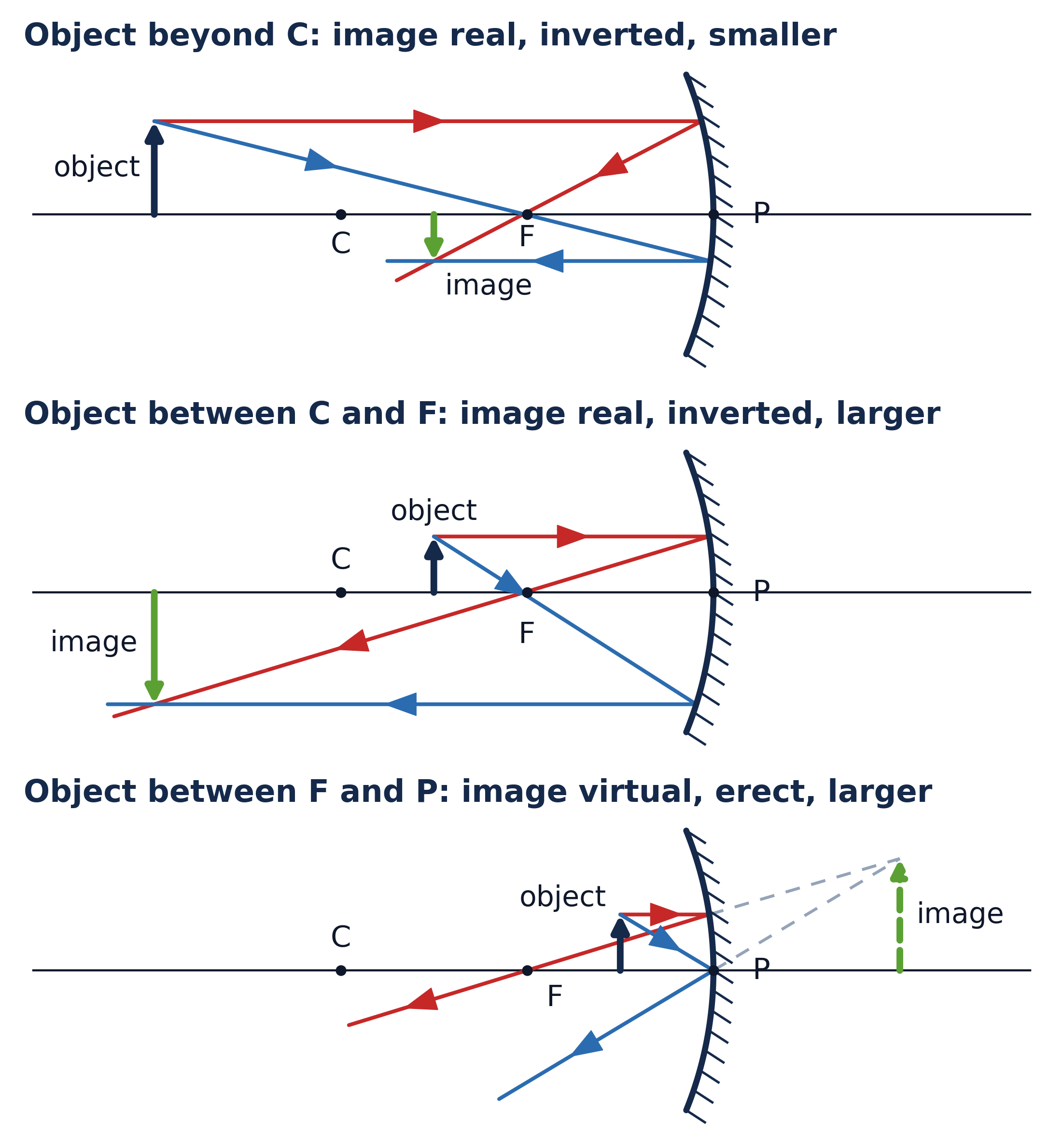
Convex mirror. Only two rows, and the nature never changes.
| Position of the object | Position of the image | Size | Nature |
|---|---|---|---|
| At infinity | At F, behind the mirror | Point-sized | Virtual, erect |
| Anywhere in front of the mirror | Between P and F, behind the mirror | Smaller | Virtual, erect |
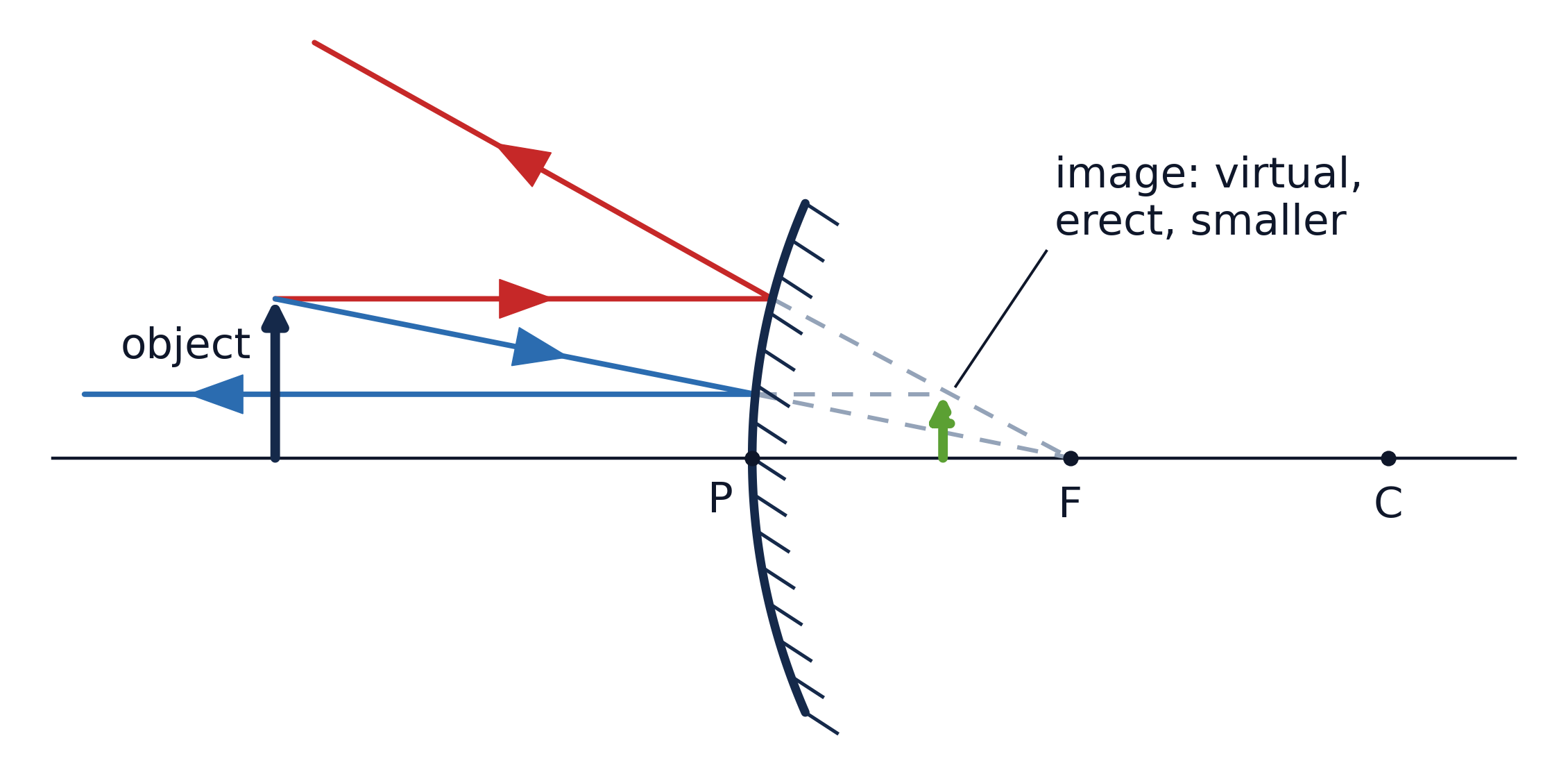
So a convex mirror always gives a virtual, erect, smaller image lying between the pole and the focus. NDA I 2025 and NDA I 2026 both asked this. A concave mirror gives a virtual image in one case only: when the object is closer than the focus.
Uses, with the reason.
| Mirror | Used as | Why |
|---|---|---|
| Concave | Reflector in torches, searchlights and vehicle headlights | A bulb at the focus gives a strong parallel beam (NDA II 2017) |
| Concave | Shaving mirror, dentist's mirror | The face or tooth is within the focus, so the image is erect and enlarged |
| Concave | Solar furnace | A large concave mirror brings sunlight to a focus and gives great heat |
| Convex | Rear-view (wing) mirror of vehicles; mirrors at road bends and in shops | The image is always erect, and the mirror curves outward so it gives a wider field of view than a plane mirror (NDA II 2017). The image is smaller, so vehicles look farther away than they are |
3. The sign convention and the mirror formula
NCERT uses the New Cartesian Sign Convention. Treat the pole as the origin of a graph and the principal axis as the x-axis.
- The object is always placed to the left of the mirror, so light travels from left to right.
- All distances are measured from the pole.
- Distances measured to the right of the pole (along the incident light) are positive; those to the left are negative.
- Heights measured upward from the principal axis are positive; downward are negative.
What follows from these rules:
| Quantity | Sign |
|---|---|
| Object distance u | always negative |
| Focal length of a concave mirror | negative |
| Focal length of a convex mirror | positive |
| Image distance v of a real image in a mirror (in front) | negative |
| Image distance v of a virtual image in a mirror (behind) | positive |
Mirror formula and magnification:
\frac{1}{v} + \frac{1}{u} = \frac{1}{f} \qquad\qquad m = \frac{h'}{h} = -\frac{v}{u}
Here h is the height of the object and h' the height of the image. A negative m means an inverted (real) image. A positive m means an erect (virtual) image. If the size of m is more than 1 the image is enlarged; if less than 1 it is smaller.
A small example. An object is 30 cm in front of a concave mirror of focal length 20 cm. Then u = -30 cm and f = -20 cm.
\dfrac{1}{v} = \dfrac{1}{f} - \dfrac{1}{u} = -\dfrac{1}{20} + \dfrac{1}{30} = -\dfrac{1}{60}, so v = -60 cm. The image is 60 cm in front of the mirror, so it is real. m = -\dfrac{v}{u} = -\dfrac{-60}{-30} = -2: inverted and twice the size. This agrees with the table: the object was between C (40 cm) and F (20 cm), and the image is beyond C.
A plane mirror is the limit of a spherical mirror whose radius, and so its focal length, becomes infinite. Then 1/f = 0 and the formula gives v = -u: the image is as far behind as the object is in front, and m = +1 (NDA II 2021).
4. Lenses: the words
A lens is a piece of transparent material with one or both surfaces curved.
- A convex lens is thicker in the middle than at the edges. It brings parallel rays together: a converging lens.
- A concave lens is thinner in the middle than at the edges. It spreads parallel rays apart: a diverging lens.
The centre of a lens is its optical centre, O. A ray through O goes straight on without bending. A lens has two principal foci, F_1 and F_2, one on each side at equal distances. The points at twice the focal length are written 2F_1 and 2F_2.
Three rays to remember.
- A ray parallel to the principal axis passes through the focus on the other side (convex), or appears to come from the focus on the same side (concave).
- A ray through the focus (convex), or heading for the focus on the far side (concave), comes out parallel to the principal axis.
- A ray through the optical centre goes straight on.
NDA II 2024 asked the student to pick the correct ray diagram. These three rules are all that is needed.
5. Where a lens forms the image
Convex lens. The object is on the left, on the side of F_1.
| Position of the object | Position of the image | Size | Nature |
|---|---|---|---|
| At infinity | At F_2 | Point-sized | Real, inverted |
| Beyond 2F_1 | Between F_2 and 2F_2 | Smaller | Real, inverted |
| At 2F_1 | At 2F_2 | Same size | Real, inverted |
| Between F_1 and 2F_1 | Beyond 2F_2 | Larger | Real, inverted |
| At F_1 | At infinity | Very large | Real, inverted |
| Between F_1 and O | On the same side as the object | Larger | Virtual, erect |
The last row is the magnifying glass: hold a convex lens closer to the page than its focal length.
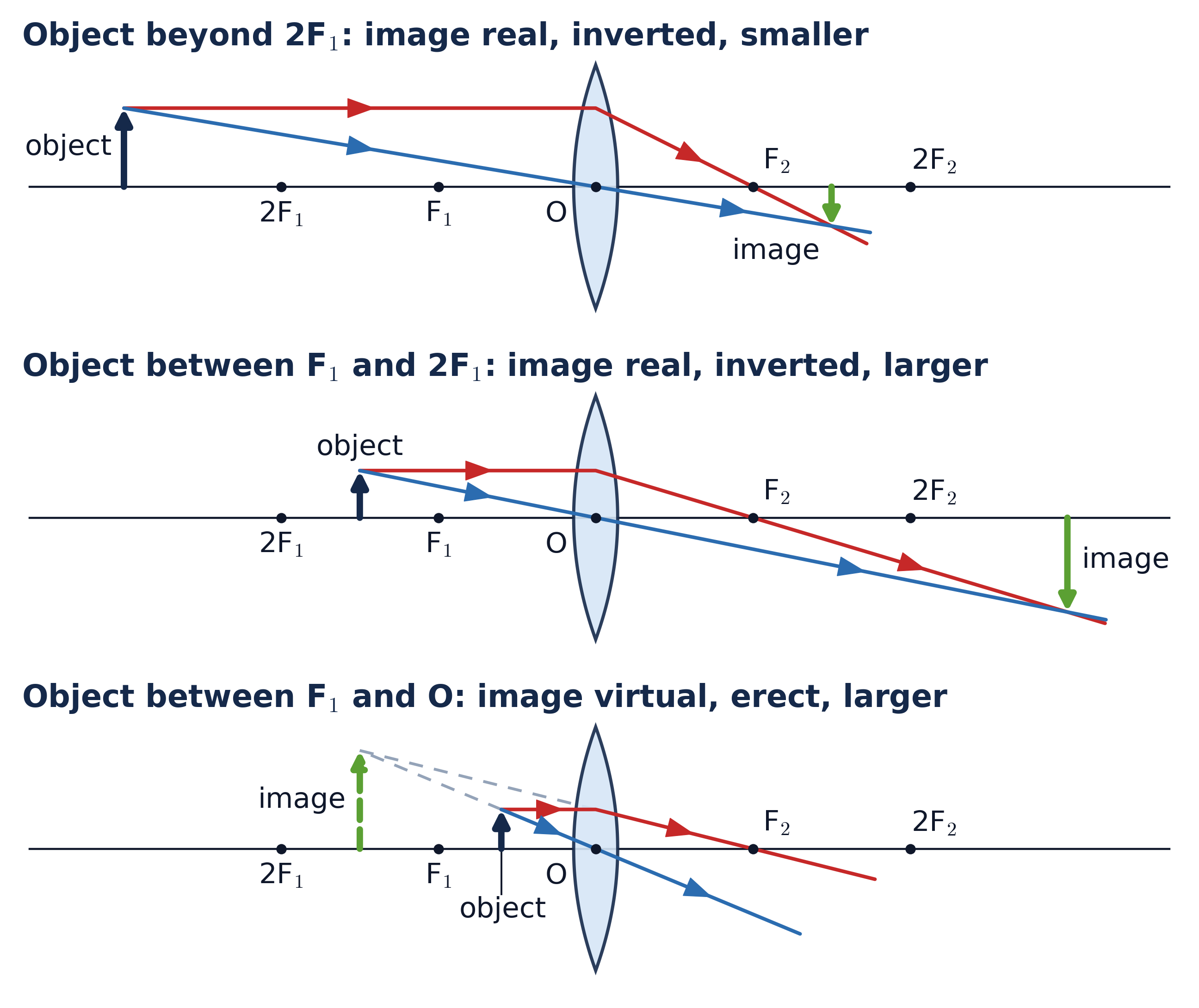
Concave lens.
| Position of the object | Position of the image | Size | Nature |
|---|---|---|---|
| At infinity | At F_1 | Point-sized | Virtual, erect |
| Anywhere in front of the lens | Between F_1 and O, on the same side as the object | Smaller | Virtual, erect |
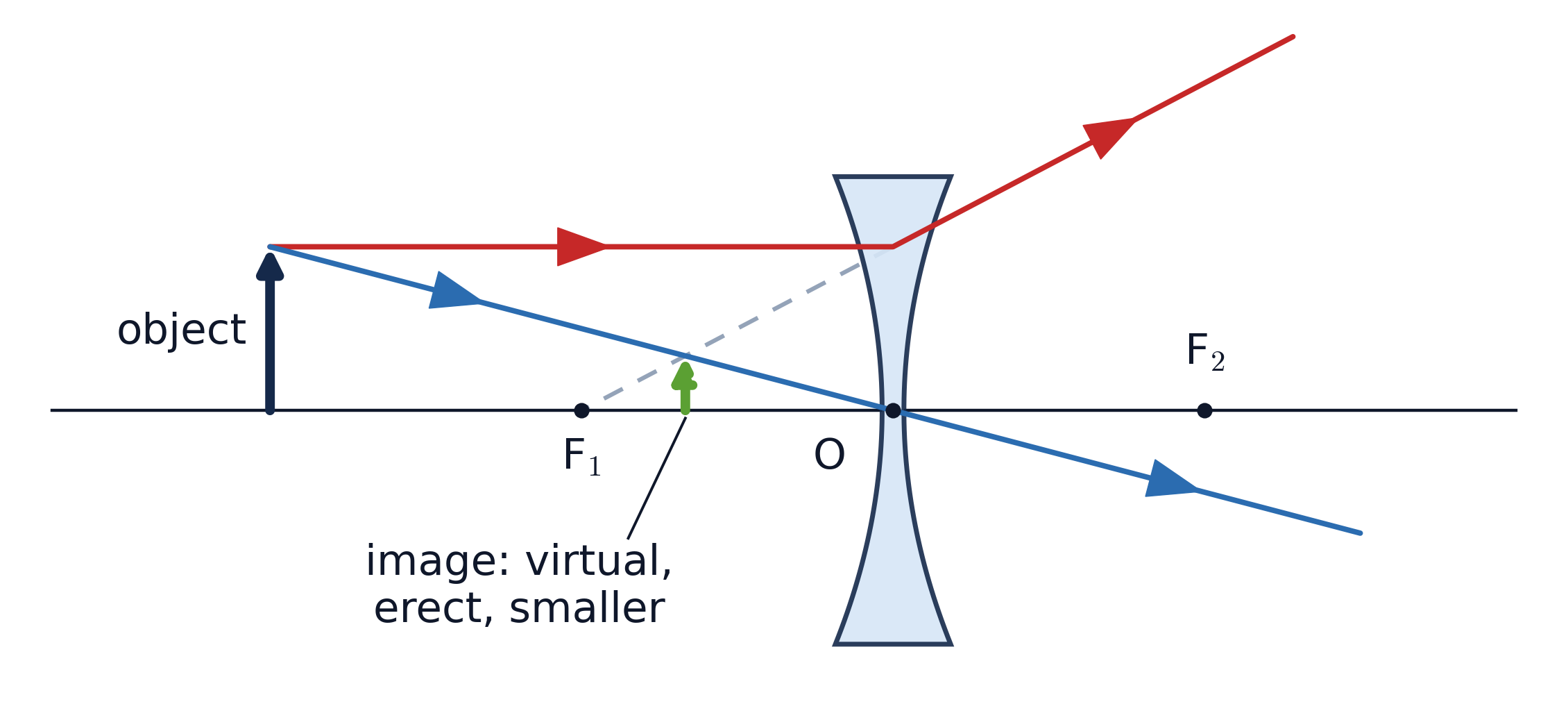
Compare the two pairs. A convex lens behaves like a concave mirror (both converge; both can give real or virtual images, of any size). A concave lens behaves like a convex mirror (both diverge; the image is always virtual, erect and smaller). NDA II 2019 tested exactly this: the statement "a concave lens produces both real and virtual images" is false.
6. The lens formula and power
The same sign convention is used, with distances measured from the optical centre. So u is always negative, the focal length of a convex lens is positive and that of a concave lens is negative.
Lens formula and magnification:
\frac{1}{v} - \frac{1}{u} = \frac{1}{f} \qquad\qquad m = \frac{h'}{h} = \frac{v}{u}
Set the two formulas side by side, because the exam mixes them:
| Formula | Magnification | |
|---|---|---|
| Spherical mirror | \dfrac{1}{v} + \dfrac{1}{u} = \dfrac{1}{f} | m = -\dfrac{v}{u} |
| Thin lens | \dfrac{1}{v} - \dfrac{1}{u} = \dfrac{1}{f} | m = \dfrac{v}{u} |
A small example. An object is 15 cm from a convex lens of focal length 10 cm. u = -15 cm, f = +10 cm.
\dfrac{1}{v} = \dfrac{1}{f} + \dfrac{1}{u} = \dfrac{1}{10} - \dfrac{1}{15} = \dfrac{1}{30}, so v = +30 cm: a real image 30 cm on the other side. m = \dfrac{v}{u} = \dfrac{30}{-15} = -2: inverted, twice the size.
Power of a lens. A lens of short focal length bends light strongly. Its power is
P = \frac{1}{f} \quad (f \text{ in metres})
The SI unit is the dioptre (D): 1 D is the power of a lens of focal length 1 m. The power of a convex lens is positive; that of a concave lens is negative.
| Lens | Focal length | Power |
|---|---|---|
| Convex | 25 cm = 0.25 m | +4 D |
| Convex | 50 cm = 0.5 m | +2 D |
| Concave | 50 cm, so f = -0.5 m | -2 D |
Lenses in contact add their powers: P = P_1 + P_2. Lenses of +2.5 D and -2.0 D together have a power of +0.5 D, so the pair acts as a convex lens of focal length 1 \div 0.5 = 2 m (NDA II 2024).
Uses of lenses. Convex: magnifying glass, camera, projector, microscope and telescope (Chapter P7-3), spectacles for long-sightedness. Concave: spectacles for short-sightedness, the peephole in a door.
7. The human eye
The eye works like a camera: a lens system forms a real, inverted image on a light-sensitive screen. The brain reads it the right way up.
| Part | What it is and does |
|---|---|
| Cornea | The clear, bulging front surface. Light enters the eye through it, and most of the bending of light happens here |
| Iris | The dark, coloured ring of muscle behind the cornea. It controls the size of the pupil |
| Pupil | The opening in the iris. It becomes small in bright light and wide in dim light, to control the amount of light entering |
| Eye lens | A soft, clear, convex lens. It does the fine focusing |
| Ciliary muscles | They hold the lens and change its curvature, and so its focal length |
| Retina | The light-sensitive screen at the back, where the image forms. Its cells, rods (dim light) and cones (bright light and colour), turn light into electrical signals |
| Optic nerve | Carries the signals to the brain |
| Aqueous humour, vitreous humour | The clear fluid in front of the lens, and the clear jelly that fills the eyeball behind it |
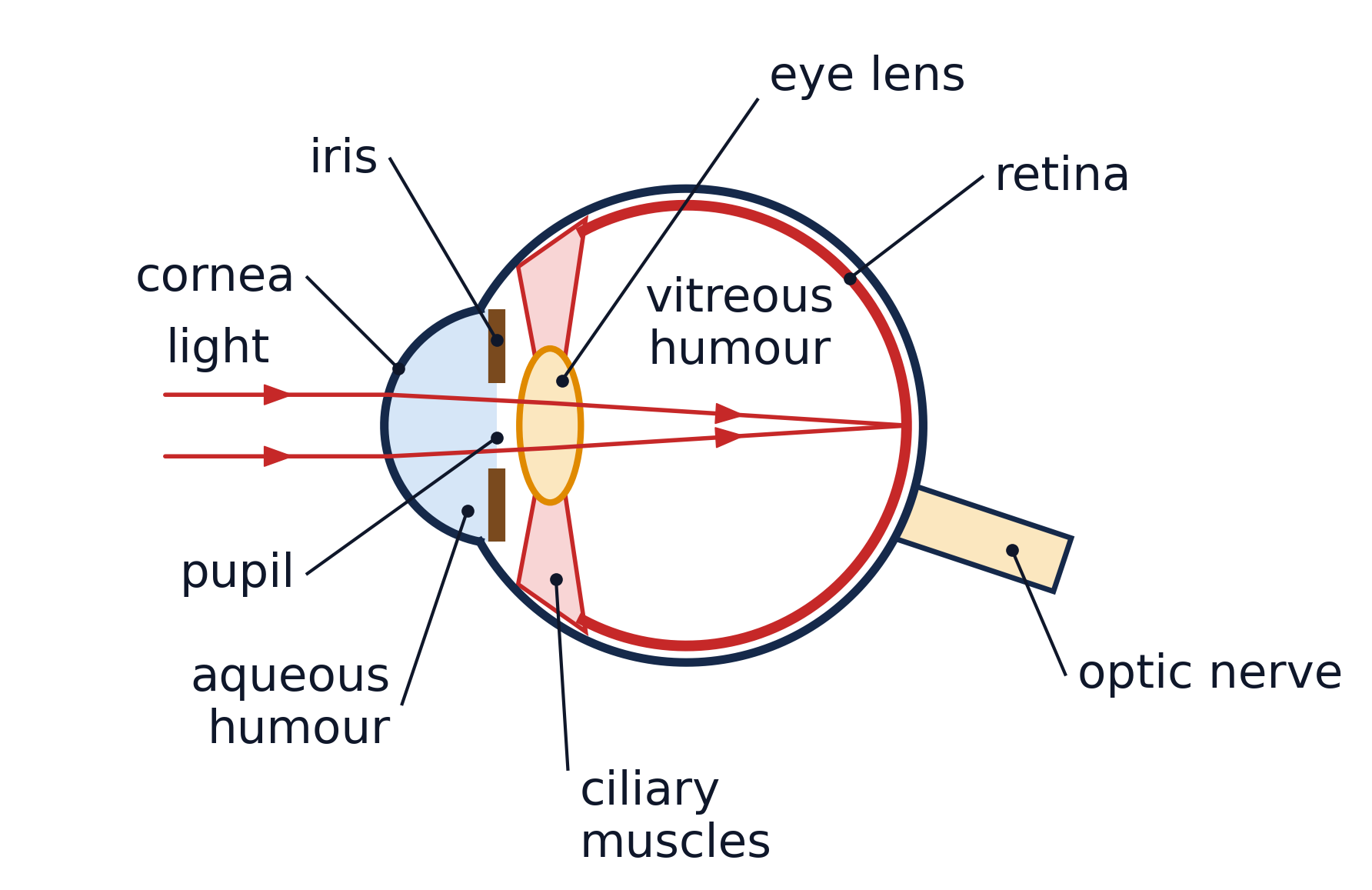
Accommodation. In a camera the lens is moved to focus. In the eye the distance from lens to retina is fixed, so the eye changes the focal length of its lens instead. For a distant object the ciliary muscles relax and the lens is thin (long focal length). For a near object they contract and the lens becomes thicker (short focal length). This ability is the power of accommodation. So the eye is like a camera with a variable focal length (the lens) and a variable aperture (the pupil), as NDA I 2024 asked.
For a normal young adult eye the near point is about 25 cm (the least distance of distinct vision) and the far point is at infinity.
We have two eyes because together they give a wider field of view and let us judge distance and depth.
Defects of vision.
| Defect | What the person finds | Where the image forms | Cause | Correction |
|---|---|---|---|---|
| Myopia (short-sightedness) | Near objects clear, distant objects blurred | In front of the retina | Eyeball too long, or eye lens too curved | Concave (diverging) lens, power negative |
| Hypermetropia (long-sightedness) | Distant objects clear, near objects blurred | Behind the retina | Eyeball too short, or focal length of the eye lens too long | Convex (converging) lens, power positive |
| Presbyopia | Near objects blurred, in old age | Ciliary muscles weaken and the lens loses flexibility, so the near point moves away | Convex lens for reading; bifocal lenses if the person is also myopic (upper part concave for distance, lower part convex for reading) | |
| Cataract | Vision becomes cloudy, and may be lost | The eye lens turns milky | Surgery to replace the lens | |
| Astigmatism | Lines in one direction look blurred | The cornea is not evenly curved | Cylindrical lens |
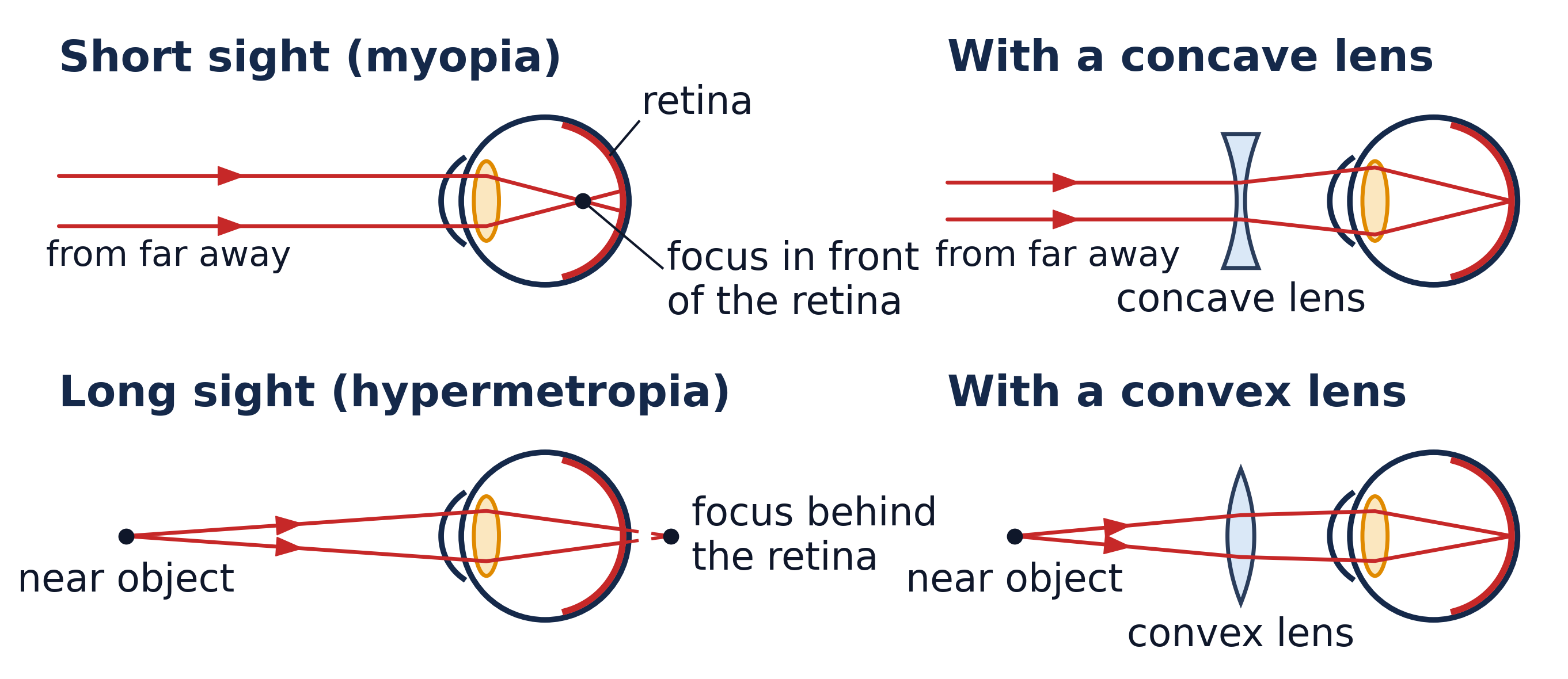
The power needed for a myopic eye. The lens must make a very distant object appear at the person's own far point. So its focal length equals the distance of the far point, with a negative sign. A person who cannot see clearly beyond 2 m needs f = -2 m, that is P = \dfrac{1}{-2} = -0.5 D (NDA II 2023).
The power needed for a hypermetropic eye. The lens must make an object at 25 cm appear at the person's own near point. If that near point is 1 m: u = -0.25 m, v = -1 m, and P = \dfrac{1}{f} = \dfrac{1}{v} - \dfrac{1}{u} = -1 + 4 = +3 D.
What the papers have asked
| Paper | The idea asked | The answer in one line |
|---|---|---|
| NDA II 2017 | The mirror used as a rear-view mirror | Convex |
| NDA II 2017 | Why a concave mirror is used in headlights | With the bulb at the focus it sends out parallel rays |
| NDA II 2017 | The false statement about the eye | That the eye contains a diverging lens. Its lens is converging |
| NDA II 2019 | The false statement about lenses | That a concave lens gives both real and virtual images. It gives only virtual ones |
| NDA 2020 | Relation between R and f of a spherical mirror | R = 2f |
| NDA 2020 | Where light enters the eye, and where the image forms | Through the cornea; on the retina |
| NDA 2020 | Concave mirror, object between F and P | The image is virtual, erect, enlarged and behind the mirror. It is not at infinity |
| NDA 2020, NDA II 2021, NDA II 2025 | Power of a lens from its focal length | P = 1/f with f in metres: 25 cm gives +4 D; a concave lens of 0.5 m gives -2 D |
| NDA II 2021 | When the mirror formula describes a plane mirror | When the focal length goes to infinity |
| NDA II 2021, NDA II 2024, NDA II 2025 | Myopia | Near objects are seen clearly; the image of a distant object forms in front of the retina |
| NDA II 2023 | Lens for an eye that cannot see beyond 2 m | Concave, -0.5 D |
| NDA II 2024 | Concave mirror, object at C | Image at C, real, inverted, same size |
| NDA II 2024 | Two lenses of +2.5 D and -2.0 D together | Power +0.5 D, focal length 2 m |
| NDA I 2025, NDA I 2026 | A mirror whose image is always between P and F | A convex mirror; the image is behind the mirror |
| NDA I 2026 | Concave mirror, object moving in from far away | The image moves from F towards C |
Worked examples
Example 1 (a single fact). A dentist wants an enlarged, erect image of a tooth. Which mirror should be used, and where should the tooth be?
(a) Convex mirror, tooth anywhere (b) Concave mirror, tooth beyond C (c) Concave mirror, tooth between F and P (d) Plane mirror, tooth close to it
Solution. Only a concave mirror can enlarge, and it gives an erect image only when the object is within the focal length. A convex mirror gives an erect image, but always a smaller one, so (a) is the trap. Answer (c).
Example 2 (a short calculation). An object is placed 30 cm in front of a convex mirror of focal length 15 cm. Where is the image, and what is the magnification?
Solution. u = -30 cm, f = +15 cm. \dfrac{1}{v} = \dfrac{1}{f} - \dfrac{1}{u} = \dfrac{1}{15} + \dfrac{1}{30} = \dfrac{3}{30}, so v = +10 cm. The image is 10 cm behind the mirror, between P and F, as the table says. m = -\dfrac{v}{u} = -\dfrac{10}{-30} = +\dfrac{1}{3}: erect and one-third the size. A student who puts f = -15 gets v = -30 cm, a real image, which a convex mirror cannot give. The sign of f is the whole question.
Example 3 (statements). Consider the following statements:
- A convex lens can form a virtual image.
- A concave lens can form a real image of a real object.
- A convex mirror always forms a diminished image of a real object.
Which of the statements given above are correct?
(a) 1 and 2 only (b) 1 and 3 only (c) 2 and 3 only (d) 1, 2 and 3
Solution. Statement 1 is correct: with the object inside the focal length a convex lens is a magnifying glass, and its image is virtual. Statement 2 is wrong: a concave lens always gives a virtual, erect, smaller image of a real object. Statement 3 is correct. Answer (b).
Example 4 (a short calculation). A doctor prescribes spectacles of power -2.5 D. What kind of lens is it, what is its focal length, and which defect does it correct?
Solution. The power is negative, so the lens is concave. f = \dfrac{1}{P} = \dfrac{1}{-2.5} = -0.4 m, that is 40 cm. A concave lens corrects myopia. The person's far point is 40 cm from the eye.
Example 5 (matching lists). Match each part of the eye with its work.
| List I | List II |
|---|---|
| A. Iris | 1. Changes the focal length of the eye lens |
| B. Ciliary muscles | 2. Carries signals to the brain |
| C. Retina | 3. Controls the size of the pupil |
| D. Optic nerve | 4. Screen on which the image is formed |
(a) A-3, B-1, C-4, D-2 (b) A-1, B-3, C-4, D-2 (c) A-3, B-1, C-2, D-4 (d) A-4, B-1, C-3, D-2
Solution. The iris controls the pupil (3). The ciliary muscles change the curvature of the lens (1). The retina is the screen (4). The optic nerve carries the signals (2). Option (b) exchanges the iris and the ciliary muscles: both are muscles, but one works on the pupil and the other on the lens. Answer (a).
Example 6 (two ideas). An object is placed 10 cm from a convex lens of focal length 20 cm. Describe the image.
Solution. The object is inside the focal length, so expect a virtual, erect, enlarged image. Check: u = -10 cm, f = +20 cm. \dfrac{1}{v} = \dfrac{1}{20} - \dfrac{1}{10} = -\dfrac{1}{20}, so v = -20 cm. The negative sign means the image is on the same side as the object: virtual. m = \dfrac{v}{u} = \dfrac{-20}{-10} = +2: erect and twice the size.
Mistakes that cost marks
- Using the mirror formula for a lens. Mirror: \dfrac{1}{v} + \dfrac{1}{u} = \dfrac{1}{f}. Lens: \dfrac{1}{v} - \dfrac{1}{u} = \dfrac{1}{f}. The magnifications also differ in sign.
- Wrong sign of the focal length. Concave mirror negative, convex mirror positive. Convex lens positive, concave lens negative. Notice that "convex" is positive in both.
- Finding power with the focal length in centimetres. Change to metres first. For 25 cm, P = 1 \div 0.25 = 4 D, not 1 \div 25.
- Reversing myopia and hypermetropia. Myopia: near is clear, far is blurred, image in front of the retina, concave lens. Hypermetropia is the opposite in every one of the four.
Quick check
Do these without help. Answers are at the end.
- A concave mirror has a radius of curvature of 30 cm. What is its focal length?
- Which mirror always gives an erect and smaller image?
- What is the power of a concave lens of focal length 20 cm?
- An object is placed at 2F_1 of a convex lens. Where is the image, and how large is it?
- A person can read a book but cannot read the blackboard. Name the defect and the lens that corrects it.
Read and watch more, free
| What | Where | Language |
|---|---|---|
| Textbook, the main chapters | NCERT Class 10 Science, Chapter 9, Light: Reflection and Refraction, and Chapter 10, The Human Eye and the Colourful World | English (the Hindi edition is on the same NCERT site) |
| Textbook, a simpler first read | NCERT Class 8 Curiosity, Chapter 10, Light: Mirrors and Lenses | English (the Hindi edition is on the same NCERT site) |
| Textbook, for harder questions | NCERT Class 12 Physics Part II, Chapter 9, Ray Optics and Optical Instruments | English |
| Self-study notes | NIOS Science and Technology (212), Lesson 15, Light Energy | English, Hindi |
| Practice questions | NCERT Exemplar, Class 10 Science: Light | English |
| Video, mirrors and lenses | Khan Academy India: Light (27 videos) · in Hindi (22 videos) | English, Hindi |
| Video, the eye | Khan Academy India: Human eye (14 videos) · in Hindi (11 videos) | English, Hindi |
| Video, with numericals | Magnet Brains: Class 10 Physics (the Light and Human Eye videos) | Hinglish |
The videos were chosen from their titles, length and views; they have not yet been watched by a teacher.
Answers to the quick check
- f = R/2 = 15 cm (with the sign convention, -15 cm).
- A convex mirror.
- f = -0.20 m, so P = \dfrac{1}{-0.20} = -5 D.
- At 2F_2 on the other side; real, inverted and the same size as the object.
- Myopia (short-sightedness). A concave lens.
Next chapter: Magnets and the Earth as a magnet.