Why this chapter matters. We found about 35 questions from this chapter in the 12 papers we hold, from 2017 to 2026. It is one of the most asked chapters in Physics: about three questions a paper, and ten in NDA I 2021 alone. Most are "which phenomenon explains this?" questions: why a star twinkles, why a pool looks shallow, why the setting Sun is red, which colour a prism bends most. A few are small calculations with the refractive index. Learn the table in section 6 first, then the rules of refraction in section 3.
What you will be able to do
- Explain shadows, eclipses and the pinhole camera from the straight-line travel of light.
- State the laws of reflection and describe the image in a plane mirror.
- Use the refractive index to compare the speed of light in two media and to say which way a ray bends.
- Give the two conditions for total internal reflection and name where it is used.
- Name the phenomenon behind the common sights of the sky: rainbow, twinkling, blue sky, red sunset, mirage.
Before you start you should know: speed = distance ÷ time (Chapter P1-3), and the words frequency and wavelength (Chapter P3-1).
1. Light travels in straight lines
In one uniform medium, light travels in straight lines. This is called the rectilinear propagation of light. You see it in the beam of a torch, in the beam of a searchlight, and in sunlight coming through gaps in the trees. (The beam itself is visible only because dust and smoke in the air scatter some light into your eyes, as NDA II 2023 asked.)
Three things follow from straight-line travel.
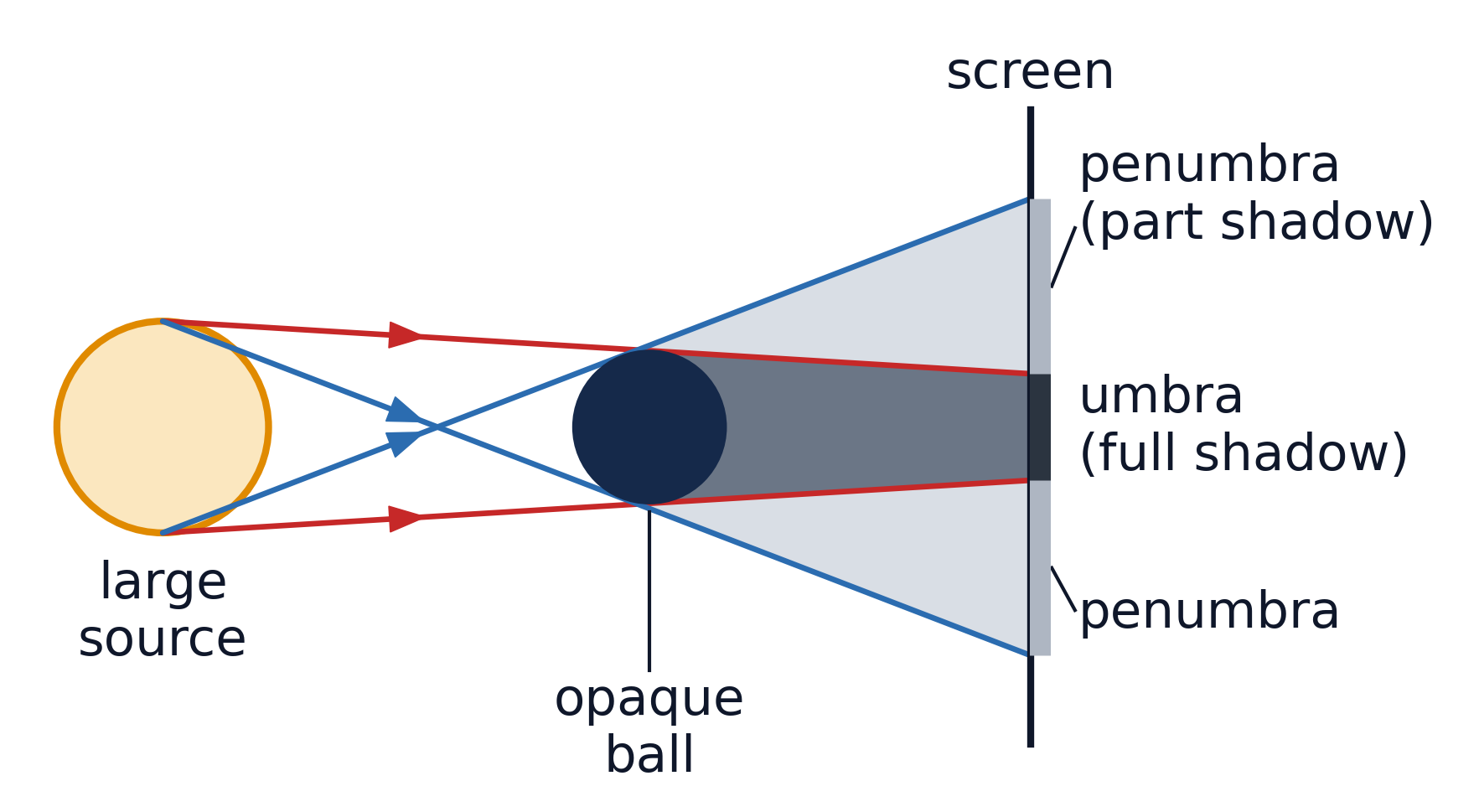
Shadows. An opaque object stops light, and the region behind it that light cannot reach is its shadow. A small (point) source gives a sharp shadow. A large source gives a dark central part, the umbra, where no light from the source reaches, and a lighter edge, the penumbra, where light from only a part of the source reaches.
Eclipses. An eclipse is a shadow on a very large scale.
| Eclipse | Order in the line | What happens | Phase of the Moon |
|---|---|---|---|
| Solar eclipse | Sun, Moon, Earth | The Moon's shadow falls on the Earth | New Moon |
| Lunar eclipse | Sun, Earth, Moon | The Earth's shadow falls on the Moon | Full Moon |
The pinhole camera. A closed box with a tiny hole in one side and a screen on the opposite side. Rays from the top of the object pass straight through the hole to the bottom of the screen, and rays from the bottom go to the top. So the image is inverted. It is also real, because it forms on a screen. Moving the screen farther from the hole makes the image larger.
The speed of light. In a vacuum light travels at about 3 \times 10^8 m/s (3 lakh kilometres a second). This is the highest speed possible. In air the speed is almost the same. Sunlight takes about 8 minutes (close to 500 s) to reach the Earth, as NDA II 2017 asked. A light year is the distance light travels in one year: it is a unit of distance, not of time.
2. Reflection and the plane mirror
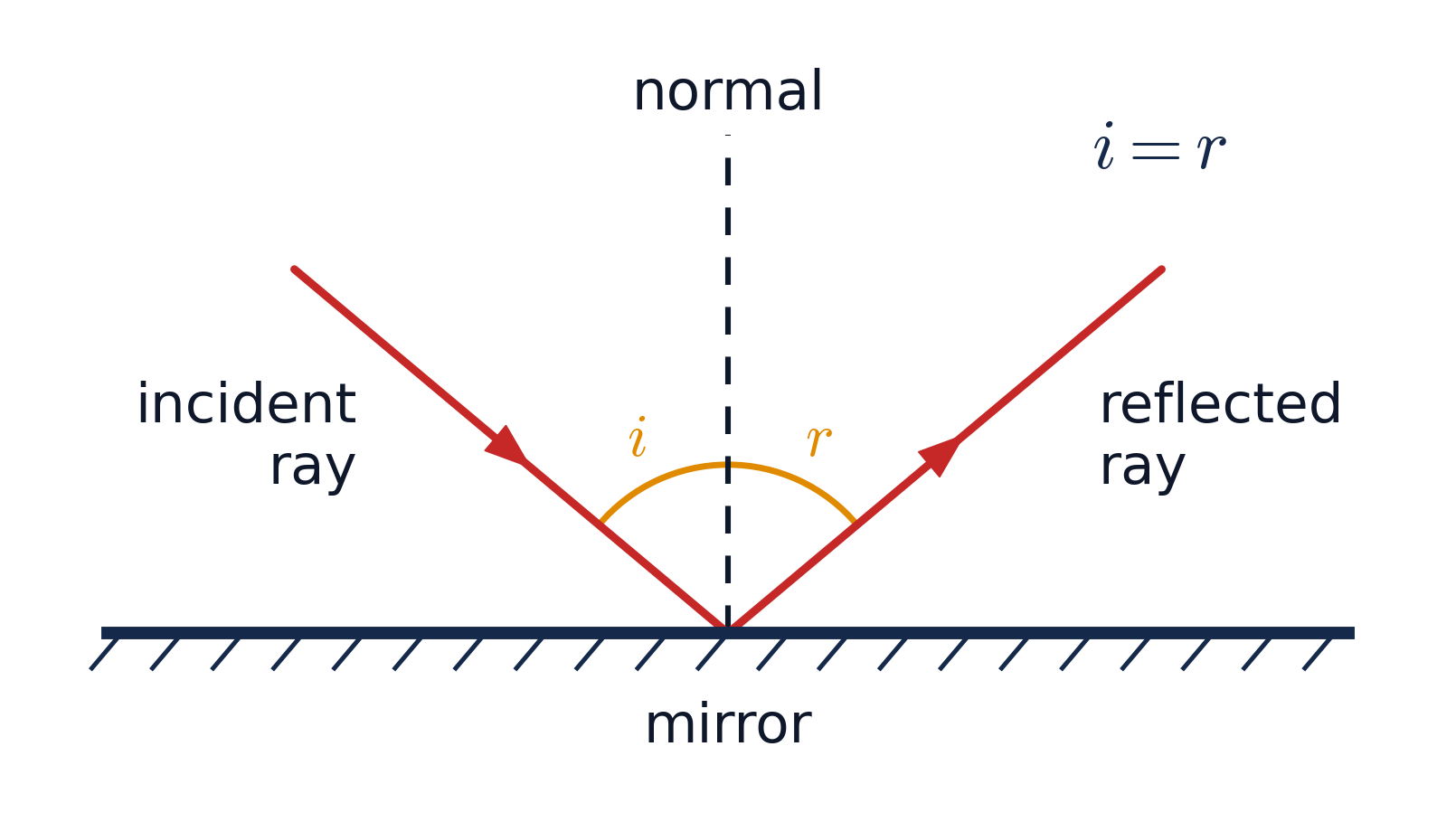
When light meets a surface and is turned back into the same medium, it is reflected. Draw the normal, a line at right angles to the surface at the point where the ray strikes. The angle of incidence i and the angle of reflection r are both measured from the normal, not from the surface.
The two laws of reflection:
- The angle of incidence equals the angle of reflection: i = r.
- The incident ray, the reflected ray and the normal all lie in one plane.
The laws hold for every reflecting surface, flat or curved, smooth or rough. A smooth surface such as a mirror reflects a parallel beam as a parallel beam (regular reflection). A rough surface such as paper or a wall sends the rays in many directions (diffuse reflection), because the normals at different points point different ways. Diffuse reflection is what lets us see ordinary objects from every side.
A ray that strikes a mirror along the normal (i = 0) is reflected straight back along its own path.
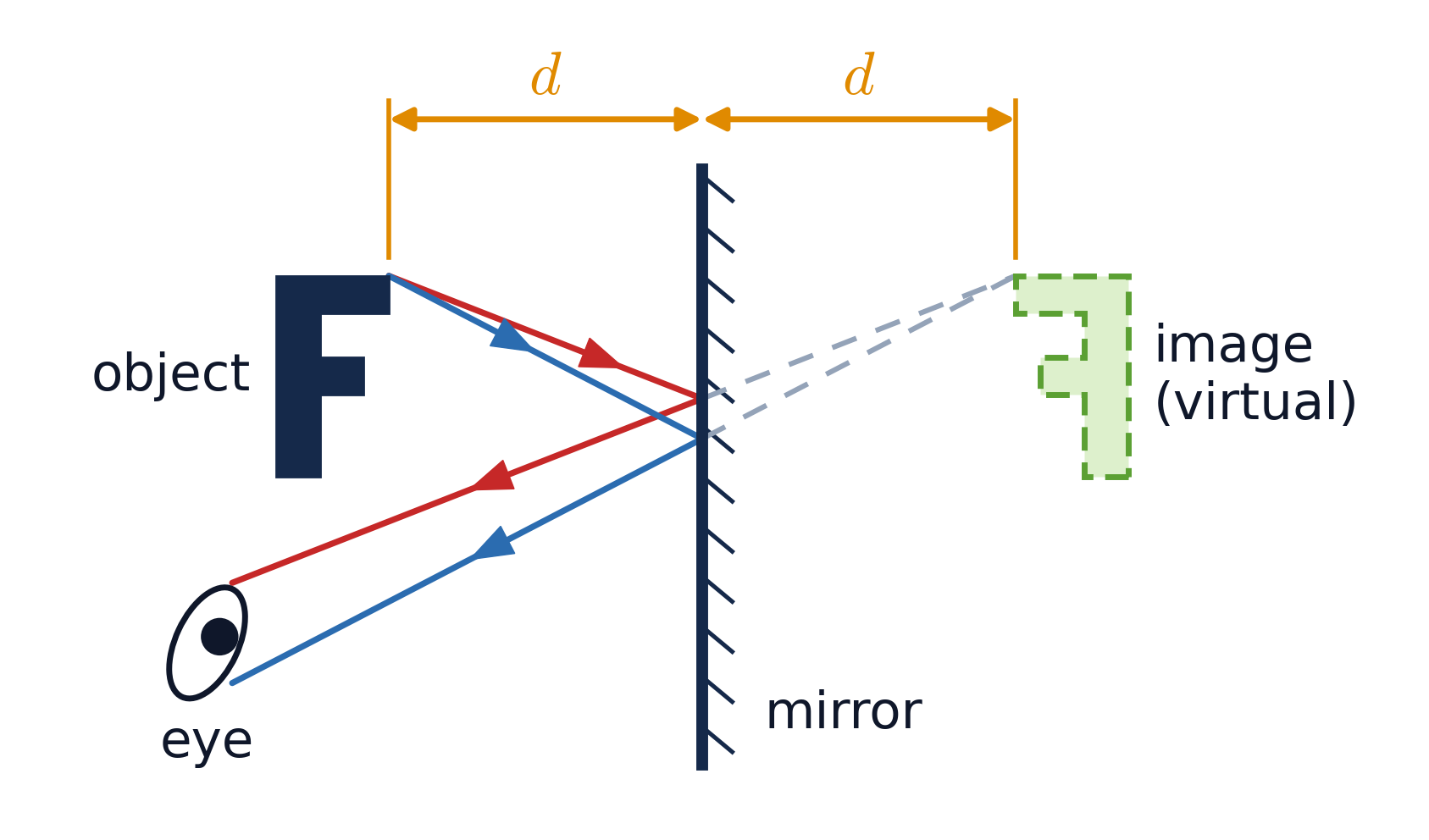
The image in a plane mirror.
| Property | The image in a plane mirror is |
|---|---|
| Nature | virtual: the rays only appear to come from it, and it cannot be caught on a screen |
| Position | as far behind the mirror as the object is in front |
| Size | the same size as the object |
| Way up | erect |
| Sideways | laterally inverted: left and right are exchanged. This is why AMBULANCE is painted reversed on the front of the vehicle, to be read correctly in a driver's mirror |
Three results the papers use:
- To see your full height in a plane mirror, the mirror needs to be only half your height, whatever your distance from it. A person 1.5 m tall needs a mirror 0.75 m high (NDA II 2023).
- If you walk towards a plane mirror at 1 m/s, your image also moves towards the mirror at 1 m/s, so it approaches you at 2 m/s.
- If a mirror is turned through an angle \theta, the reflected ray turns through 2\theta.
Two plane mirrors at right angles give three images of an object placed between them. Two parallel mirrors facing each other, as in a barber's shop, give an endless row of images. Two parallel mirrors at 45° to the tube make a periscope (Chapter P7-3).
3. Refraction: light bends when its speed changes
Light travels at different speeds in different transparent media. When a ray passes at a slant from one medium into another, the change of speed makes it change direction. This bending is refraction.
The laws of refraction:
- The incident ray, the refracted ray and the normal all lie in one plane.
- For a given pair of media and a given colour, \dfrac{\sin i}{\sin r} is a constant. This is Snell's law, and the constant is the refractive index of the second medium with respect to the first.
Refractive index. The (absolute) refractive index of a medium is
n = \frac{\text{speed of light in vacuum}}{\text{speed of light in the medium}} = \frac{c}{v}
It is a ratio of two speeds, so it has no unit. It is always greater than 1 for a material medium. The larger the refractive index, the slower light travels in the medium. A medium with a larger refractive index is called optically denser; one with a smaller index is optically rarer.
| Medium | Refractive index | Medium | Refractive index |
|---|---|---|---|
| Air | 1.0003 | Crown glass | 1.52 |
| Ice | 1.31 | Carbon disulphide | 1.63 |
| Water | 1.33 | Dense flint glass | 1.65 |
| Kerosene | 1.44 | Sapphire | 1.77 |
| Fused quartz | 1.46 | Diamond | 2.42 |
These are the NCERT Class 10 values. Two warnings come from the table. First, optical density is not mass density: kerosene floats on water, yet it is optically denser than water. Second, diamond has the highest index in the list, so light is slowest in diamond: v = \dfrac{3 \times 10^8}{2.42} \approx 1.24 \times 10^8 m/s.
Which way does the ray bend?
| The ray goes | Speed | The ray bends | Example |
|---|---|---|---|
| from rarer to denser (air to water, air to glass) | falls | towards the normal | NDA I 2025 |
| from denser to rarer (water to air, glass to air) | rises | away from the normal | |
| along the normal (i = 0), either way | changes | not at all: it goes straight | NDA I 2021 |
What changes and what does not. On refraction the speed and the wavelength change. The frequency does not change, because it is fixed by the source. So the colour of the light stays the same (NDA I 2021).
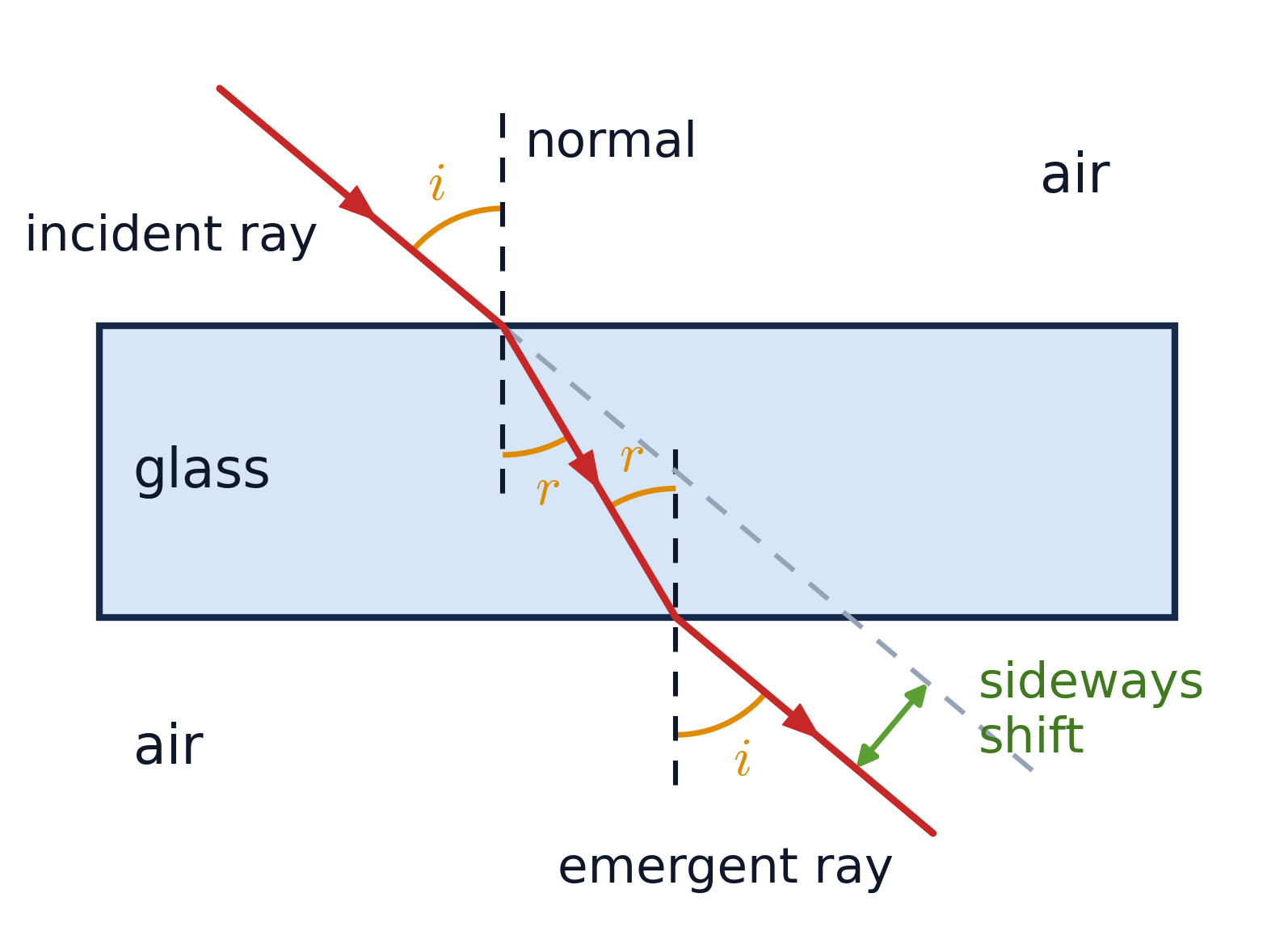
A glass slab. A ray passing through a slab with parallel faces bends towards the normal on entering and away from it on leaving, by the same amount. The emerging ray is parallel to the incident ray but shifted sideways. This is called lateral displacement.
What refraction makes us see.
- A pool, a tank or a bucket of water looks shallower than it is, and a coin at the bottom looks raised (NDA II 2025). Looking straight down, apparent depth = real depth ÷ refractive index. A pool 2 m deep looks about 2 \div 1.33 \approx 1.5 m deep.
- A pencil dipped at a slant in water looks bent at the surface.
- A lemon in a glass of water looks bigger than it is, seen from the side (NDA 2020).
- Stars look a little higher in the sky than they are.
4. Total internal reflection
Send a ray from a denser medium towards a rarer one, say from water up to the air. It bends away from the normal. Increase the angle of incidence, and the refracted ray leans closer and closer to the surface. At one angle of incidence the refracted ray runs along the surface: the angle of refraction is 90°. This angle of incidence is the critical angle C. For any larger angle no light gets out at all. All of it is reflected back into the denser medium. This is total internal reflection.
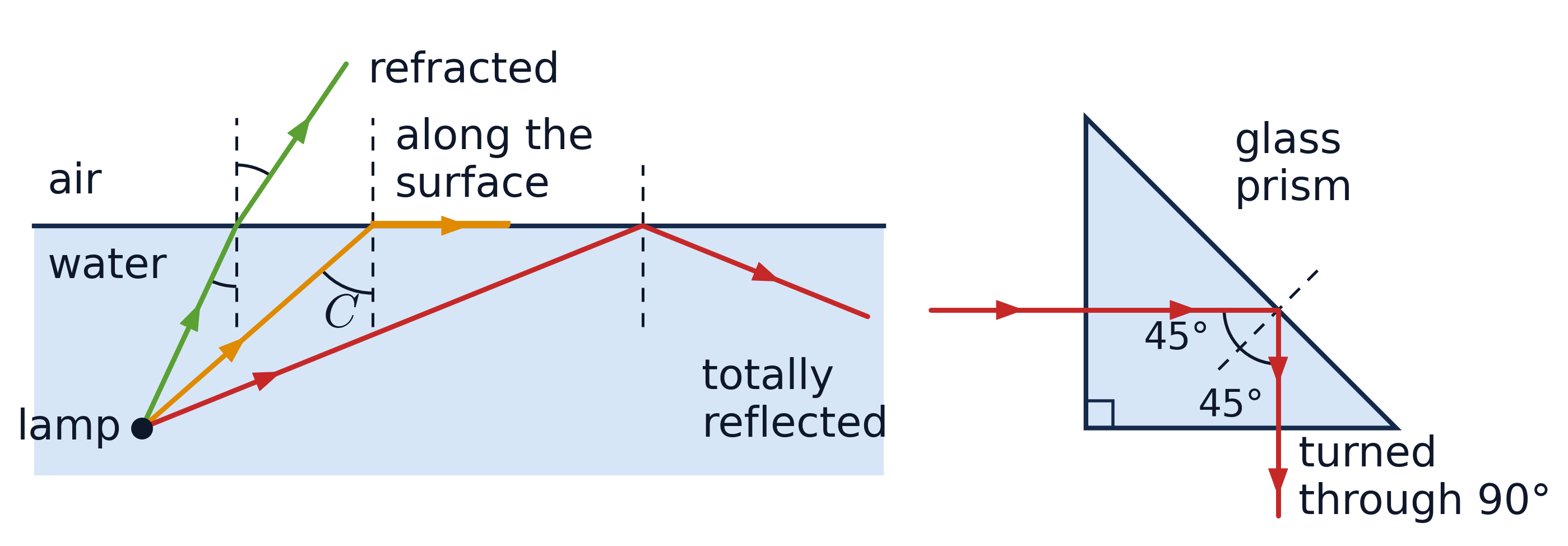
Two conditions, both needed:
- The light must be travelling from an optically denser medium towards a rarer one.
- The angle of incidence must be greater than the critical angle.
For a medium of refractive index n in air, \sin C = \dfrac{1}{n}. A larger refractive index gives a smaller critical angle.
| Medium (to air) | Critical angle, about |
|---|---|
| Water | 49° |
| Crown glass | 41° |
| Diamond | 24° |
Where it is seen and used.
| Example | How total internal reflection acts |
|---|---|
| Optical fibre | Light entering a thin glass fibre strikes its wall at a large angle again and again and is totally reflected each time, so it follows the fibre round bends (NDA II 2019). Used in telephone and internet cables and in the endoscope, with which a doctor looks inside the body |
| Sparkle of a diamond | The critical angle is only about 24°, so light inside a cut diamond is reflected many times before it leaves |
| Mirage | On a hot road or desert the air near the ground is hotter and optically rarer. Light from the sky bends more and more as it comes down and is at last totally reflected upward. The eye sees an image of the sky on the ground, which looks like water. A mirage needs both refraction and total internal reflection (NDA I 2021) |
| Totally reflecting prism | A right-angled glass prism with angles 45°, 90°, 45° turns a ray through 90° or 180°. The ray meets the long face at 45°, more than the critical angle of 41°. Used in binoculars and in good periscopes. NDA I 2026 set a ray-path question of this kind |
5. Dispersion: white light is a mixture of colours
When a narrow beam of white light passes through a glass prism it comes out as a band of seven colours: violet, indigo, blue, green, yellow, orange, red (VIBGYOR). The band is a spectrum, and the splitting is dispersion. Isaac Newton was the first to obtain the spectrum of sunlight with a glass prism (NDA 2020). He also showed that a second prism placed upside down joins the colours into white light again.
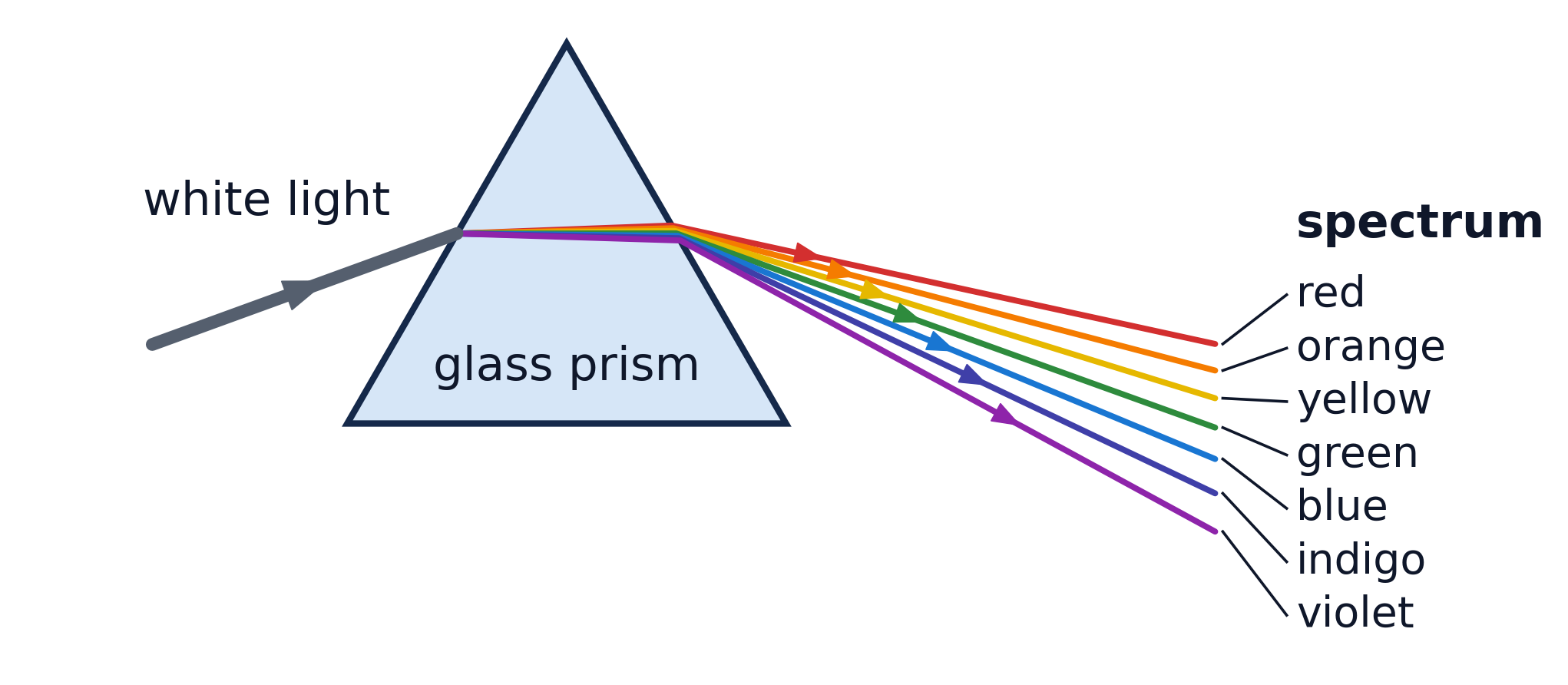
Why does it happen? In a vacuum all colours travel at the same speed. In glass they do not. Violet is slowest, so glass has the greatest refractive index for violet and bends it most. Red is fastest in glass and bends least.
| Red | Violet | |
|---|---|---|
| Wavelength | longest of the visible colours | shortest |
| Speed in glass | greatest | least |
| Refractive index of glass for it | least | greatest |
| Bending (deviation) by a prism | least | most |
A prism bends a ray towards its base, both on entering and on leaving. NDA II 2021 asked for the correct sketch of this path.
The rainbow. A rainbow is a natural spectrum. Raindrops act as tiny prisms. Sunlight is refracted and dispersed on entering a drop, reflected inside the drop, and refracted again on leaving. You see a rainbow only with the Sun behind you. In the common (primary) bow the light is reflected once inside each drop, and red is on the outer edge. A fainter secondary bow, outside the first, comes from two internal reflections, and its colours are in the reverse order.
Colours of light. Red, green and blue are the primary colours of light. Mixed in equal strength they give white. In pairs they give: red + green = yellow, red + blue = magenta, green + blue = cyan (both asked in NDA I 2021).
6. Light in the atmosphere: one table to learn
Atmospheric refraction. The air is denser near the ground and rarer higher up, so light from space bends gradually as it comes down.
Scattering. Very small particles, and the molecules of air themselves, send light out in all directions. They scatter the short wavelengths (blue) far more strongly than the long ones (red).
| What we see | Cause |
|---|---|
| Stars twinkle; planets do not | Atmospheric refraction. The air is never still, so the bending of the thin beam from a star keeps changing. A planet is near enough to act as many points, and the changes average out |
| The Sun is seen about 2 minutes before it actually rises and about 2 minutes after it sets | Atmospheric refraction |
| A pool looks shallow; a stick looks bent | Refraction |
| Rainbow; colours from a prism | Dispersion (with refraction and internal reflection in the drops) |
| Mirage; sparkle of a diamond; optical fibre | Total internal reflection |
| The sky is blue | Scattering: air molecules scatter blue light more than red |
| The Sun is red at sunrise and sunset | Scattering: the light passes through a long path of air, the blue is scattered away, and mostly red reaches the eye |
| Danger signals are red | Red is scattered least, so it is seen from far away even in fog |
| The sky is dark to an astronaut in space | No atmosphere, so no scattering |
| The path of a light beam is seen in a dusty room, in fog or in a colloid such as milk in water | Scattering by the particles: the Tyndall effect |
Two Class 12 facts have also been asked. In ordinary scattering the frequency of the light does not change. C. V. Raman found that a small part of the light scattered by molecules comes out with a changed frequency. This is the Raman effect, for which he received the Nobel Prize in 1930. And light can be polarised, which is possible only for transverse waves; this is the evidence that light is a transverse wave (NDA II 2023).
What the papers have asked
| Paper | The idea asked | The answer in one line |
|---|---|---|
| NDA II 2017 | Time for sunlight to reach the Earth | About 8 minutes |
| NDA I 2019 | Why the Sun is seen a little before sunrise and after sunset | Atmospheric refraction |
| NDA I 2019, NDA I 2021, NDA II 2021 | Which colour a prism bends least, and which most | Red least, violet most. Glass has the greatest refractive index for violet |
| NDA II 2019 | Why light follows a bent optical fibre | Repeated total internal reflection |
| NDA 2020 | Why the Sun looks red at sunrise and sunset | Scattering |
| NDA 2020, NDA I 2025 | Comparing the speed of light in two media | The medium with the larger refractive index has the smaller speed. Light is fastest in vacuum |
| NDA I 2021, NDA II 2021 | The image in a plane mirror | Virtual, erect, same size, laterally inverted |
| NDA I 2021 | What stays the same when light is refracted | The frequency |
| NDA I 2021, NDA II 2021 | Why stars twinkle | Atmospheric refraction |
| NDA I 2021 | What a mirage shows | Refraction together with total internal reflection |
| NDA II 2021 | The Tyndall effect | Scattering of light by colloidal particles |
| NDA II 2023 | The smallest mirror to see one's full height | Half the person's height |
| NDA I 2024 | How the primary rainbow forms | Refraction on entering the drop, one internal reflection, refraction on leaving |
| NDA I 2025 | A ray going from air into water at a slant | It bends towards the normal |
| NDA II 2025 | Why the bottom of a water tank looks raised | Refraction |
Worked examples
Example 1 (a single fact). A ray of light strikes a plane mirror making an angle of 30° with the surface of the mirror. What is the angle of reflection?
(a) 30° (b) 45° (c) 60° (d) 90°
Solution. Angles are measured from the normal. The angle of incidence is 90^\circ - 30^\circ = 60^\circ, and the angle of reflection equals it. Option (a) is the trap: 30° is the angle with the mirror, not with the normal. Answer (c).
Example 2 (a short calculation). The refractive index of a glass is 1.5. What is the speed of light in it? (Speed of light in vacuum = 3 \times 10^8 m/s)
(a) 1.5 \times 10^8 m/s (b) 2 \times 10^8 m/s (c) 3 \times 10^8 m/s (d) 4.5 \times 10^8 m/s
Solution. v = \dfrac{c}{n} = \dfrac{3 \times 10^8}{1.5} = 2 \times 10^8 m/s. Option (d) multiplies instead of dividing and gives a speed greater than that of light in vacuum, which is impossible. Answer (b).
Example 3 (statements). Consider the following statements:
- When light passes from air into glass, its frequency decreases.
- When light passes from air into glass, its wavelength decreases.
Which of the statements given above is/are correct?
(a) 1 only (b) 2 only (c) Both 1 and 2 (d) Neither 1 nor 2
Solution. The frequency is set by the source and does not change on refraction, so statement 1 is wrong. The speed falls in glass. Since speed = frequency × wavelength and the frequency is fixed, the wavelength falls in the same ratio, so statement 2 is correct. Answer (b).
Example 4 (two ideas). A ray of light travelling in air strikes the surface of water at 60° to the normal. Can it be totally internally reflected?
Solution. No, at any angle. Total internal reflection needs the light to start in the denser medium. Here it starts in the rarer medium, air. Part of the light is reflected and the rest is refracted into the water, bending towards the normal. A ray going the other way, from water to air, would be totally reflected at 60°, because 60° is more than the critical angle of water (about 49°).
Example 5 (matching lists). Match each sight with its main cause.
| List I | List II |
|---|---|
| A. Blue colour of the sky | 1. Total internal reflection |
| B. Twinkling of stars | 2. Dispersion |
| C. Spectrum from a prism | 3. Scattering |
| D. Light staying inside an optical fibre | 4. Atmospheric refraction |
(a) A-3, B-4, C-2, D-1 (b) A-4, B-3, C-2, D-1 (c) A-3, B-4, C-1, D-2 (d) A-2, B-4, C-3, D-1
Solution. The sky is blue because air scatters blue light most (3). Stars twinkle because of atmospheric refraction (4). A prism spreads white light into colours by dispersion (2). A fibre holds light by total internal reflection (1). Option (b) exchanges scattering and atmospheric refraction, the most common confusion. Answer (a).
Example 6 (a short calculation). A fish is 1.2 m below the surface of a pond. Seen from directly above, how deep does it appear? (Refractive index of water = 1.33)
Solution. Apparent depth = real depth ÷ refractive index = 1.2 \div 1.33 \approx 0.9 m. The fish looks nearer the surface than it is. Do not multiply: an object in a denser medium always looks nearer, never deeper.
Mistakes that cost marks
- Measuring angles from the surface. The angles of incidence, reflection and refraction are all measured from the normal.
- Mixing up scattering, dispersion and atmospheric refraction. Blue sky and red sunset: scattering. Rainbow and prism colours: dispersion. Twinkling and the early sunrise: atmospheric refraction. Use the table in section 6.
- Saying the frequency changes on refraction. Speed and wavelength change. Frequency does not.
- Forgetting the first condition for total internal reflection. It happens only when light goes from a denser medium towards a rarer one. It can never happen for light going from air into glass or water.
Quick check
Do these without help. Answers are at the end.
- A girl stands 2 m in front of a plane mirror. How far is her image from her?
- Which colour of white light is deviated most by a glass prism, and which least?
- The refractive index of water is 1.33 and that of kerosene is 1.44. In which does light travel faster?
- State the two conditions for total internal reflection.
- Name the phenomenon that makes the sky look blue.
Read and watch more, free
| What | Where | Language |
|---|---|---|
| Textbook, shadows and reflection | NCERT Class 7 Curiosity, Chapter 11, Light: Shadows and Reflections | English (the Hindi edition is on the same NCERT site) |
| Textbook, the main chapters | NCERT Class 10 Science, Chapter 9, Light: Reflection and Refraction, and Chapter 10, The Human Eye and the Colourful World | English (the Hindi edition is on the same NCERT site) |
| Textbook, total internal reflection and the prism | NCERT Class 12 Physics Part II, Chapter 9, Ray Optics and Optical Instruments | English |
| Self-study notes | NIOS Science and Technology (212), Lesson 15, Light Energy | English, Hindi |
| Practice questions | NCERT Exemplar, Class 10 Science: Light | English |
| Video, short lessons | Khan Academy India: Light (27 videos) | English |
| Video, short lessons | Khan Academy India: Light, in Hindi (22 videos) | Hindi |
| Video, for NDA | Defence Wallah: Complete Physics, Fast Track Series (the three videos on optics) | Hinglish |
The videos were chosen from their titles, length and views; they have not yet been watched by a teacher.
Answers to the quick check
- 4 m. The image is 2 m behind the mirror, and she is 2 m in front of it.
- Violet is deviated most and red least.
- In water. The smaller refractive index means the greater speed.
- The light must travel from a denser medium towards a rarer one, and the angle of incidence must be greater than the critical angle.
- Scattering of sunlight by the molecules of air.
Next chapter: Spherical mirrors, lenses and the human eye.