Why this chapter matters. This chapter gave 10 questions in the 6 papers from CDS I 2024 to CDS II 2026, and at least one in every paper. Nine of the ten were statement or ordering questions, not single facts. The papers came back three times to water vapour and the gases of the air, twice to inversion of temperature, and twice to the Hadley cell and the planetary winds. Most of the statements follow the NCERT Class 11 book almost word for word. So read sections 1, 5 and 8 slowly, and learn the exact claims: which gas is more, what inversion does to the air, what the wind pattern depends on.
What you will be able to do
- Name the gases of the air in order of their share, the layers of the atmosphere, and the three stages in which the atmosphere evolved.
- Explain how the Sun heats the Earth and how the Earth heats the air, using the heat budget.
- Say what inversion of temperature is, when it forms and what it does.
- Place the seven pressure belts on the globe, draw the three cells and the planetary winds, and recognise a local wind from its name.
Before you start you should know: latitude, the Equator, the tropics and the poles (Chapter K8-2), and the rotation of the Earth and the tilt of its axis (Chapter K8-3).
1. What the air is made of, and how it came to be
The atmosphere is the cover of air around the Earth. Gravity holds it. About 99 per cent of its mass lies within 32 km of the surface. It is a mixture of gases, water vapour and dust.
| Gas | Share of dry air by volume, per cent |
|---|---|
| Nitrogen (N₂) | 78.08 |
| Oxygen (O₂) | 20.95 |
| Argon (Ar) | 0.93 |
| Carbon dioxide (CO₂) | about 0.036 in the NCERT table (it is rising) |
| Neon (Ne) | 0.002 |
| Krypton (Kr) | 0.001 |
| Helium (He) | 0.0005 |
| Xenon (Xe) | 0.00009 |
| Hydrogen (H₂) | 0.00005 |
The gases whose share stays the same are called the permanent gases. CDS II 2025 asked for four of the trace gases in order, least first: hydrogen, xenon, helium, neon. A way to hold the order from the largest down: "Never Kill Helpless Xenon Hens" for neon, krypton, helium, xenon, hydrogen.
Three things in the air are small in amount but large in effect. Two papers built statements from these lines.
- Carbon dioxide lets the Sun's rays pass in but absorbs the heat the Earth sends out. This is the greenhouse effect. Carbon dioxide and water vapour are found only up to about 90 km. Oxygen is almost absent by 120 km.
- Water vapour is a variable gas. It decreases with altitude and from the Equator towards the poles. It is up to 4 per cent of the air in the warm, wet tropics and less than 1 per cent in the dry and cold areas of deserts and polar regions. It absorbs part of the insolation and holds the Earth's radiated heat, so it acts like a blanket that keeps the Earth from becoming too cold or too hot. It also adds to the stability and instability of the air.
- Dust particles (sea salt, fine soil, smoke, ash, pollen) are the centres around which water vapour condenses to make clouds. They are called hygroscopic nuclei. They are more in the subtropical and temperate regions than near the Equator or the poles.
Ozone (O₃) lies between about 10 km and 50 km above the surface. It absorbs the Sun's ultraviolet rays and so protects life.
How the present atmosphere evolved: three stages (asked in CDS II 2026).
| Stage | What happened |
|---|---|
| 1. Loss of the primordial atmosphere | The first atmosphere, of hydrogen and helium, was stripped off by the solar winds |
| 2. Gases from the hot interior | As the Earth cooled, water vapour and gases came out of the interior. This is degassing. Volcanoes added more. This early air had water vapour, nitrogen, carbon dioxide, methane and ammonia, and very little free oxygen |
| 3. Change by living things | Photosynthesis added oxygen, first to the oceans and then, about 2,000 million years ago, to the air |
2. The layers of the atmosphere
The atmosphere is divided into five layers by the way temperature changes with height. Think of a transport aircraft climbing out of Delhi: it starts in the weather, climbs through cloud, and levels out in calm, clear air near the top of the first layer.
| Layer | Height | Temperature as you go up | What happens here |
|---|---|---|---|
| Troposphere | Surface to about 13 km on average: 8 km at the poles, 18 km at the Equator | Falls, 1°C for every 165 m | All weather: cloud, rain, storms. Holds the dust and water vapour. The most important layer for life |
| Stratosphere | Up to 50 km | Rises (ozone absorbs ultraviolet rays) | The ozone layer. Calm and free of weather |
| Mesosphere | Up to 80 km | Falls, to about −100°C at 80 km | The coldest part of the atmosphere is at its top |
| Thermosphere (it contains the ionosphere, 80 to 400 km) | Above 80 km | Rises | Electrically charged particles called ions reflect radio waves back to the Earth |
| Exosphere | The outermost layer | Very thin air | Merges with space |
The boundaries are named after the layer below: tropopause, stratopause, mesopause.
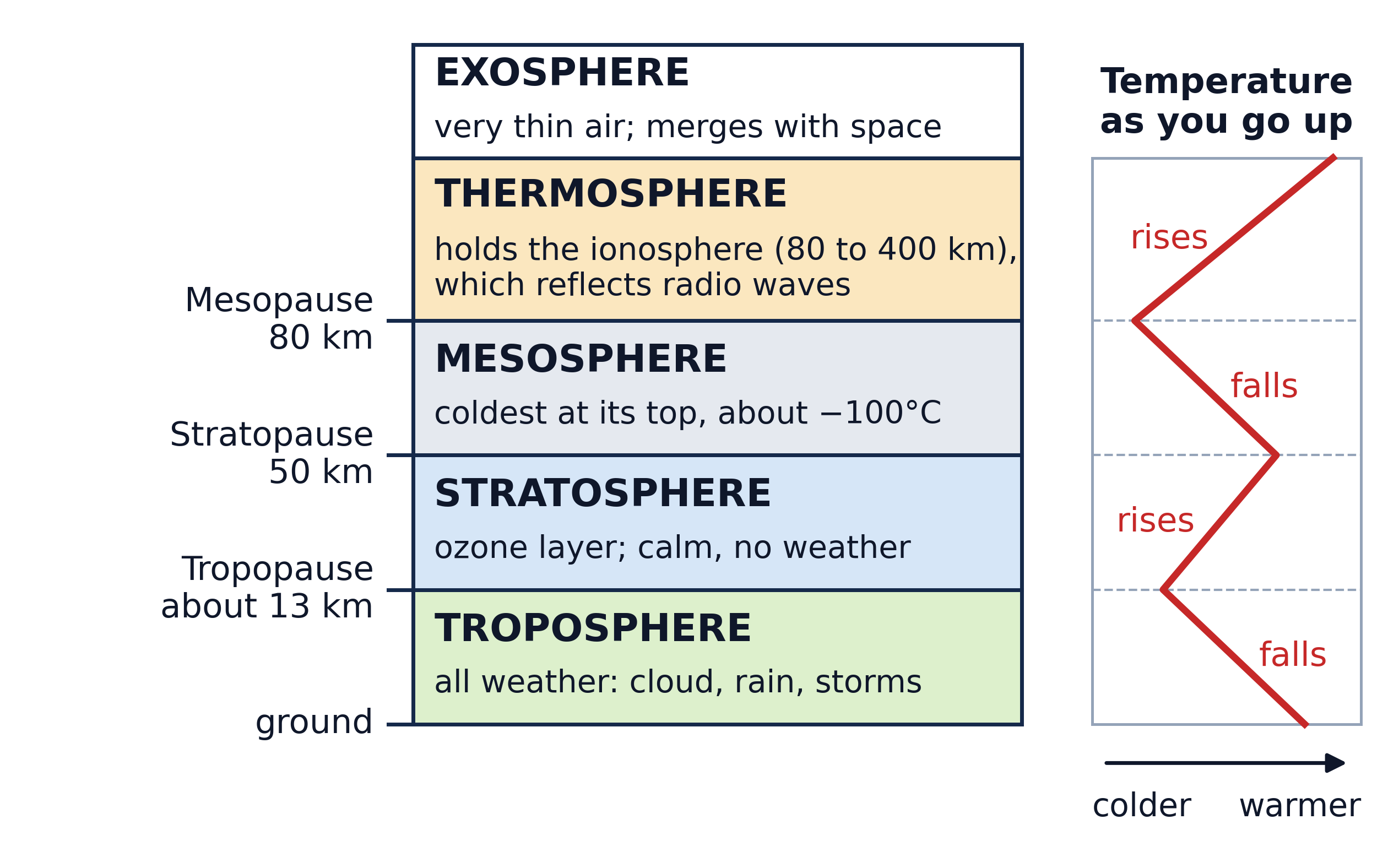
Three facts about the troposphere:
- It is thickest at the Equator because strong convection currents carry heat to great heights there.
- Its rate of fall of temperature is called the normal lapse rate: 1°C for every 165 m, or about 6.5°C for every 1,000 m. The fall stops at the tropopause.
- The tropopause is colder over the Equator (about −80°C) than over the poles (about −45°C), because over the Equator it is much higher.
3. Insolation: the energy that comes in
Insolation means incoming solar radiation. It reaches the Earth as short waves, most of it in and around the band of visible light, about 0.39 to 0.76 micrometre. The top of the atmosphere receives about 1.94 calories per square centimetre per minute.
Insolation is not spread evenly over the Earth. The Earth is a sphere, so the rays strike it at different angles. The amount at a place changes with:
- the rotation of the Earth on its axis;
- the angle at which the Sun's rays strike the ground (the higher the latitude, the more slanting the rays, and the less the heat);
- the length of the day;
- the transparency of the atmosphere (cloud, dust);
- the aspect of the land (which way a slope faces).
The Earth is nearest the Sun on 3 January (perihelion, 147 million km) and farthest on 4 July (aphelion, 152 million km). This changes the insolation only a little.
The greatest insolation is received over the subtropical deserts, where the sky has the least cloud. The Equator receives less than the tropics because it is cloudy.
4. How the air is heated, and the heat budget
The air is heated mainly from below. The ground absorbs the Sun's short waves, becomes warm, and sends the heat out as long waves. This is terrestrial radiation. Carbon dioxide and other greenhouse gases absorb it. So the Earth's surface, not the Sun directly, is the main heater of the air. This is why it is colder on a mountain than on the plain below.
| Way of heating | What it means |
|---|---|
| Conduction | The layer of air touching the warm ground is heated by contact |
| Convection | Warm air rises in currents and carries heat upwards. It is limited to the troposphere |
| Advection | Heat is carried sideways by moving air. The loo of north India is an example |
The heat budget. The Earth as a whole neither warms nor cools, because it loses as much heat as it gains. Take the insolation at the top of the atmosphere as 100 units.
| Units | |
|---|---|
| Reflected back to space before heating anything: 27 from clouds, 2 from snow and ice, 6 scattered by the air. This reflected share is the albedo of the Earth | 35 |
| Absorbed by the atmosphere | 14 |
| Absorbed by the Earth's surface | 51 |
| The surface gives back its 51: 17 straight to space, 34 to the atmosphere | 51 |
| The atmosphere sends its 14 + 34 back to space | 48 |
| Total lost to space as long waves, 17 + 48 | 65 |
So 35 units are reflected and 65 are absorbed and later radiated: the account balances.
The balance does not hold at each latitude. Between 40° North and 40° South there is more heat coming in than going out. Near the poles there is less. Winds and ocean currents carry the extra heat towards the poles. This is the reason the air and the oceans circulate at all.
5. Temperature: what controls it, and inversion
The temperature of a place depends on its latitude, its height above sea level, its distance from the sea, the air masses and ocean currents that reach it, and local features. A line on a map joining places of equal temperature is an isotherm.
Land heats and cools faster than water. So the yearly range of temperature is small near the sea and large deep inside a continent. The largest range, more than 60°C, is in north-eastern Eurasia.
Inversion of temperature. Normally the air gets colder as you climb. Sometimes the order is reversed: a cold layer lies near the ground with warmer air above it. The lapse rate is then negative: temperature rises with height. This is inversion. Two papers set statements on it.
| Point | What to remember |
|---|---|
| Other name | A surface (ground) inversion is also called a radiation inversion, because the ground cools by radiating its heat away at night |
| Ideal conditions | A long winter night, a clear sky and still air |
| How long it lasts | Usually a few hours, until the Sun comes up and warms the ground again |
| Effect on the air | It brings stability, not instability. Cold heavy air below warm air cannot rise |
| What you see | Smoke and dust are trapped under the inversion layer and spread sideways. Dense fog on winter mornings is common |
| Polar areas | Inversion is normal all through the year |
| Hills | Cold heavy air slides down the slopes at night and collects in the valley bottom, with warm air above. This is air drainage. It protects plants on the slopes from frost |
6. Pressure and the pressure belts
Air has weight. The weight of the column of air above a unit area is the atmospheric pressure. It is measured in millibars with a mercury barometer or an aneroid barometer. At sea level the average is 1,013.2 millibars. Pressure falls with height, by about 1 millibar for every 10 m near the ground. That is why a pressure cooker is needed in Leh.
A line joining places of equal pressure is an isobar. The rate at which pressure changes over distance is the pressure gradient. On a weather map, isobars close together show a strong gradient and a strong wind. Isobars far apart show a weak gradient and light wind.
There are seven pressure belts: one at the Equator and three in each hemisphere.
| Belt | Latitude | Why it forms | Other name |
|---|---|---|---|
| Equatorial low | Near the Equator | Strong heating makes the air rise | Doldrums, a belt of calm |
| Subtropical highs | About 30° N and 30° S | Air that rose at the Equator sinks here | Horse latitudes |
| Subpolar lows | About 60° N and 60° S | Warm and cold winds meet and the air rises | |
| Polar highs | Near the poles | Intense cold makes the air heavy and it sinks |
The belts are not fixed. They move north in the northern summer and south in the northern winter, following the Sun.
7. What makes the wind blow, and turn
Wind is air moving from high pressure to low pressure. Three forces act on it.
| Force | What it does |
|---|---|
| Pressure gradient force | Starts the wind and sets its speed. It acts from high to low pressure, at right angles to the isobars |
| Coriolis force | Caused by the rotation of the Earth. Turns the wind to the right in the Northern Hemisphere and to the left in the Southern Hemisphere. Zero at the Equator, greatest at the poles. Stronger when the wind is faster. It acts at right angles to the pressure gradient force |
| Friction | Slows the wind near the ground. Greatest over land, least over the sea |
At the Equator the Coriolis force is zero, so the wind blows straight across the isobars and fills the low pressure. This is why tropical cyclones do not form at the Equator.
High up, 2 to 3 km above the ground, there is no friction. Where the isobars are straight, the pressure gradient force and the Coriolis force balance, and the wind blows parallel to the isobars. This is the geostrophic wind.
8. The general circulation: cells and planetary winds
The pattern of the planetary winds is called the general circulation of the atmosphere. NCERT says it depends largely on five things. CDS II 2025 listed three of them and all three were right.
- The variation of heating with latitude.
- The pressure belts that this heating creates.
- The shifting of the belts with the apparent path of the Sun.
- The distribution of continents and oceans.
- The rotation of the Earth.
The three cells. The air moves in three loops in each hemisphere.
| Cell | Between | How it works |
|---|---|---|
| Hadley cell | Equator and 30° | The Equator is heated most. Air rises at the Inter Tropical Convergence Zone, flows towards the poles near the top of the troposphere, sinks at about 30° to make the subtropical high, and returns along the surface as the trade winds. It is a thermal circulation: heating drives it |
| Ferrel cell | 30° and 60° | Air sinking at 30° flows poleward along the surface as the westerlies and rises at about 60° |
| Polar cell | 60° and the pole | Cold dense air sinks at the pole and flows outward as the polar easterlies |
The Hadley cell is the key to the world's wind pattern, because the trade winds, the calm of the doldrums and the dry subtropical highs all belong to it.
The planetary winds blow all year from the high pressure belts to the low pressure belts. The Coriolis force turns them, so none of them blows due north or due south. A wind is named after the direction it comes from.
| Wind | From, to | Direction in the Northern Hemisphere | Direction in the Southern Hemisphere |
|---|---|---|---|
| Trade winds (easterlies) | Subtropical high to equatorial low | North-east trades | South-east trades |
| Westerlies | Subtropical high to subpolar low | South-westerly | North-westerly |
| Polar easterlies | Polar high to subpolar low | North-easterly | South-easterly |
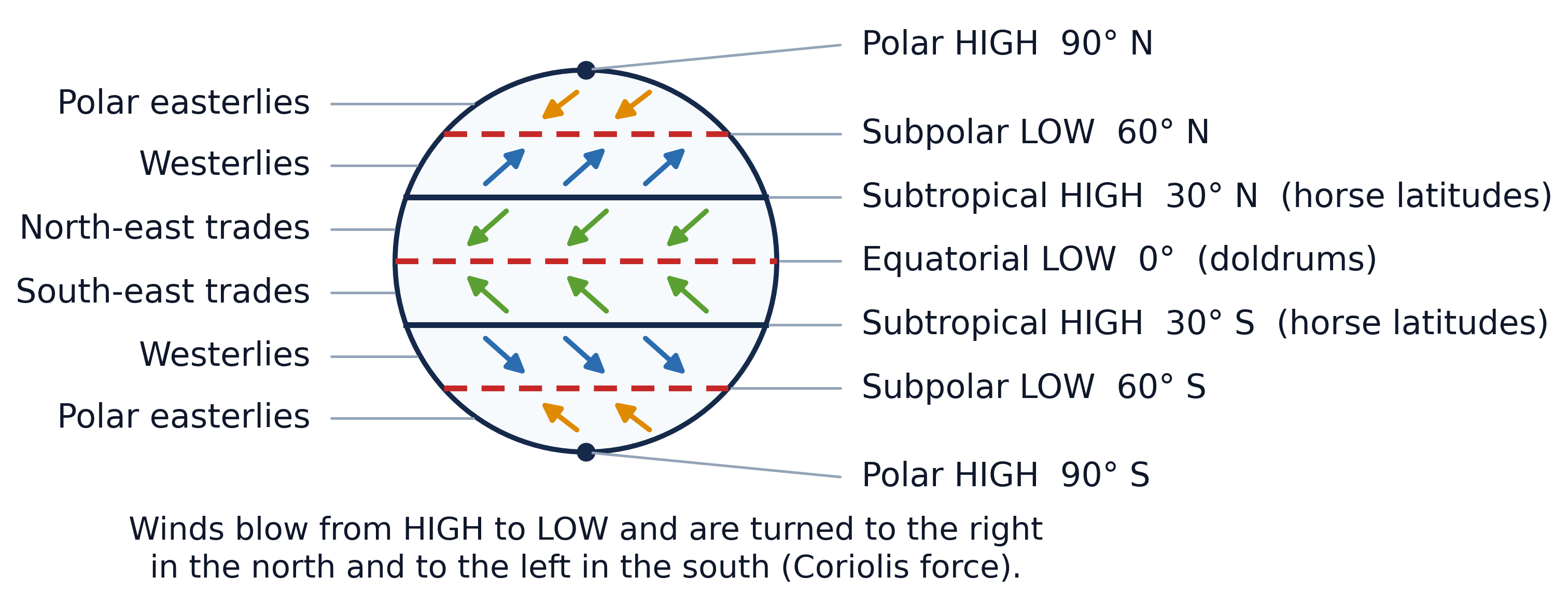
- The two trade winds meet near the Equator along the Inter Tropical Convergence Zone (ITCZ), where the air rises and gives heavy rain.
- The westerlies are stronger and steadier in the Southern Hemisphere, where there is little land to slow them. Sailors called them the Roaring Forties, the Furious Fifties and the Screaming Sixties after their latitudes.
- El Nino. In some years warm water of the central Pacific drifts towards South America and replaces the cool Peru Current. The pressure change over the Pacific that goes with it is the Southern Oscillation, and the two together are called ENSO. In a strong ENSO year the dry coast of Peru gets heavy rain, and drought may come to Australia and sometimes to India.
9. Land and sea breezes, and local winds
Some winds change with the time of day.
| Wind | When | Direction | Why |
|---|---|---|---|
| Sea breeze | Day | Sea to land | Land heats faster, so low pressure forms over the land |
| Land breeze | Night | Land to sea | Land cools faster, so high pressure forms over the land |
| Valley breeze | Day | Up the slope | The slopes heat up and the air rises |
| Mountain wind | Night | Down the slope | The slopes cool and the dense air flows down |
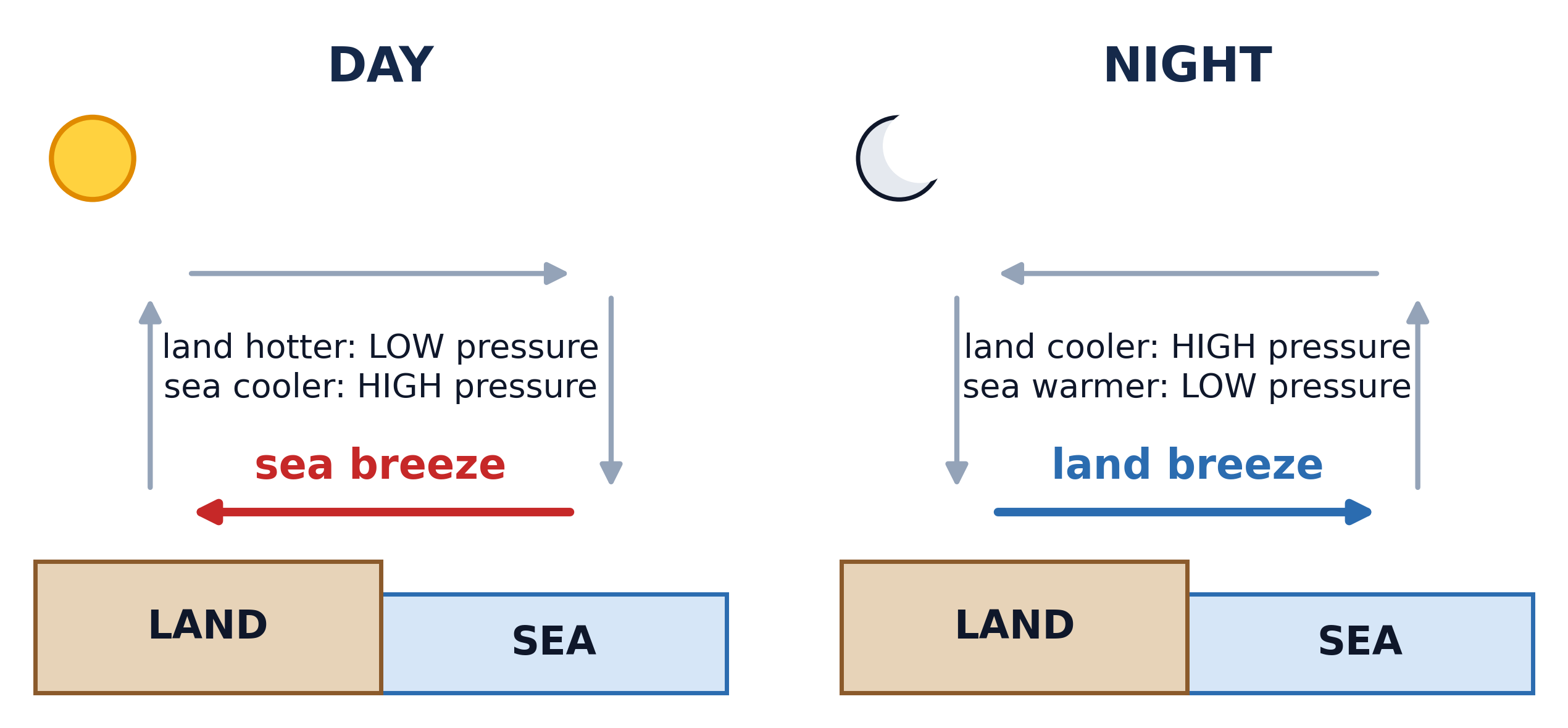
Other winds belong to one region. Learn the name, whether it is hot or cold, and the place.
| Local wind | Nature | Where it blows |
|---|---|---|
| Loo | Hot, dry | Northern plains of India and Pakistan, in May and June |
| Chinook | Warm, dry; melts snow quickly | Down the eastern slopes of the Rockies, USA and Canada |
| Foehn | Warm, dry | Down the northern slopes of the Alps |
| Santa Ana | Hot, dry | Southern California, USA; spreads wildfires |
| Sirocco | Hot | From the Sahara across the Mediterranean Sea to southern Europe |
| Khamsin | Hot, dry | Egypt |
| Harmattan | Hot, dry, dusty | From the Sahara to the coast of West Africa |
| Mistral | Cold | Down the Rhone valley of France to the Mediterranean Sea |
| Bora | Cold | Coast of the Adriatic Sea |
The chinook and the foehn are warm because air is compressed and heated as it comes down the sheltered side of a mountain.
What the papers have asked
| Paper | The idea asked | The answer in one line |
|---|---|---|
| CDS I 2024 | Two statements on insolation | It is short-wave radiation. It is not evenly distributed, because the Earth's surface is curved |
| CDS II 2024 | Two statements on Hadley cells | Both right: they are the key to the wind pattern, and they form because the Equator is heated most |
| CDS II 2024 | A strong pressure gradient on a weather map | Closely spaced isobars |
| CDS I 2025 | Two statements on surface inversion | It gives stability, not instability. It lasts a few hours, until the Sun comes up |
| CDS II 2025 | Helium, hydrogen, neon and xenon in ascending order | Hydrogen, xenon, helium, neon |
| CDS II 2025 | What the pattern of planetary winds depends on | Heating by latitude, the distribution of continents and oceans, and the Earth's rotation: all three |
| CDS II 2025 | Two statements on water vapour | Both right: it affects stability, and it acts like a blanket |
| CDS I 2026 | Two statements on ground surface inversion | Both right: it is also called radiation inversion, and a negative lapse rate is what makes it |
| CDS II 2026 | The three stages of evolution of the atmosphere | All three right: loss of the first atmosphere, gases from the hot interior, change by photosynthesis |
| CDS II 2026 | Two statements on water vapour | Both right: it falls with altitude, and it may be under one per cent in deserts and polar areas |
The answers for 2025 agree with the final UPSC key and those for 2026 with the provisional keys. No key was found for the 2024 papers; those answers are ours.
Worked examples
Example 1 (consider the following statements).
- Surface inversion of temperature makes the lower air unstable.
- A cloudy, windy night is the ideal condition for it.
- Smoke and dust collect beneath the inversion layer.
Which of the statements given above is/are correct?
(a) 1 and 2 only (b) 3 only (c) 2 and 3 only (d) 1, 2 and 3
Solution. Cold air under warm air cannot rise, so inversion brings stability: statement 1 is wrong. It needs a clear sky and still air, because cloud keeps the ground warm and wind mixes the layers: statement 2 is wrong. Statement 3 is right, and it is why winter mornings are smoky. Answer (b).
Example 2 (put in order). Arrange argon, carbon dioxide, neon and oxygen in descending order of their share in dry air.
(a) Oxygen, carbon dioxide, argon, neon (b) Oxygen, argon, neon, carbon dioxide (c) Oxygen, argon, carbon dioxide, neon (d) Argon, oxygen, carbon dioxide, neon
Solution. Oxygen is 20.95 per cent, argon 0.93, carbon dioxide about 0.036 and neon 0.002. The trap is option (a): carbon dioxide is talked about more than argon, but there is about 25 times more argon. Answer (c).
Example 3 (a short calculation). Out of 100 units of insolation, how many are absorbed by the Earth's surface, and how many does the atmosphere finally send back to space?
Solution. 35 units are reflected. Of the remaining 65, the atmosphere absorbs 14 and the surface 51. The surface later passes 34 of its 51 to the atmosphere and sends 17 straight to space. So the atmosphere sends out 14 + 34 = 48 units. Check: 17 + 48 = 65, and 65 + 35 = 100. Answer: 51 and 48.
Example 4 (reasoning). A wind starts from the subtropical high pressure belt of the Southern Hemisphere and blows towards the Equator. What is it called?
(a) North-east trade wind (b) South-east trade wind (c) North-westerly (d) South-westerly
Solution. A wind from the subtropical high to the equatorial low is a trade wind. In the Southern Hemisphere it starts by moving north and the Coriolis force turns it to the left, that is, towards the west. So it comes from the south-east. Answer (b).
Example 5 (how many are correct). Consider the following statements about the Hadley cell:
- Its rising limb is at the Inter Tropical Convergence Zone.
- Its sinking limb makes the subpolar low pressure belt.
- Its surface winds are the westerlies.
How many of the above statements are correct?
(a) Only one (b) Only two (c) All three (d) None
Solution. Statement 1 is right. The air sinks at about 30°, which makes the subtropical high, so statement 2 is wrong. The surface winds of the Hadley cell are the trade winds; the westerlies belong to the Ferrel cell, so statement 3 is wrong. Answer (a).
Mistakes that cost marks
- "The Sun heats the air directly." The air is heated mainly from below, by the long waves the ground sends out. This is why temperature falls as you climb in the troposphere.
- "Inversion makes the air unstable" or "inversion needs a cloudy night". It makes the air stable, and it needs a clear sky, still air and a long night.
- Naming a wind by where it goes. A wind is named by where it comes from. The westerlies blow from the west; the north-east trades come from the north-east.
- Putting helium above neon, or carbon dioxide above argon. Learn the table in section 1 in order. Ordering questions give no credit for knowing three of the four.
Quick check
- Which gas is the third most abundant in dry air?
- Which is more in the air, helium or xenon?
- What is the albedo of the Earth, in units out of 100?
- Does a surface inversion make the lower air stable or unstable?
- Between which latitudes does the Hadley cell lie, and what are its surface winds called?
Read and watch more, free
NCERT books are free on the NCERT website. Open the book menu and choose the class and the book. The papers follow this book closely, so read the three chapters themselves.
| What | Where | Language |
|---|---|---|
| Textbook, gases and layers | NCERT textbooks, the book menu: Class 11 Fundamentals of Physical Geography, Chapter 7 "Composition and Structure of Atmosphere" | English, Hindi |
| Textbook, insolation, heat budget, inversion | NCERT textbooks, the book menu: the same book, Chapter 8 "Solar Radiation, Heat Balance and Temperature" | English, Hindi |
| Textbook, pressure, winds, cells, El Nino | NCERT textbooks, the book menu: the same book, Chapter 9 "Atmospheric Circulation and Weather Systems" | English, Hindi |
| Textbook, how the atmosphere evolved | NCERT textbooks, the book menu: the same book, Chapter 2 "The Origin and Evolution of the Earth" | English, Hindi |
| Words of weather | India Meteorological Department: glossary of weather terms | English |
| The real papers | UPSC previous question papers (General Knowledge booklets of every CDS sitting) | English, Hindi |
| Video, topic by topic | CDS Wallah: CDS Exam Full Playlist (the geography videos) | Hinglish |
| Video, past questions | Reveal GK: CDS past questions by subject and topic (the geography parts) | Hinglish |
The videos were chosen from their titles, length and views; they have not yet been watched by a teacher.
Answers to the quick check
- Argon, 0.93 per cent.
- Helium (0.0005 per cent against 0.00009 per cent for xenon).
- 35 units.
- Stable.
- Between the Equator and about 30°. The trade winds.
Next chapter: Cyclones, humidity, condensation, rainfall