Why this chapter matters. This chapter gave 3 questions in the 6 papers from CDS I 2024 to CDS II 2026: one in every second paper, worth 0.83 marks each. All three were statement or pair questions, and all three came from the less-read corners of the chapter. CDS I 2024 asked how the speed of the Earth's spin differs from the Equator to the poles. CDS I 2026 asked who proposed which theory of the origin of the Earth. CDS II 2026 asked the three stages in which our atmosphere was formed. None asked the seasons, which every student knows. So learn the table of named theories and the three stages in section 4 first, and the two kinds of speed in section 2.
What you will be able to do
- Tell rotation from revolution, give the effects of each, and tell angular speed from the speed along the ground.
- Explain why there are seasons, and give the dates and facts of the solstices and equinoxes.
- Match each theory of the origin of the Earth with the scientist who proposed it, and give the three stages in which the atmosphere was formed.
- Describe the crust, mantle and core, name the boundaries between them, and say what the lithosphere and asthenosphere are.
Before you start you should know: the Equator, the two Tropics and the two polar circles (Chapter K8-2).
1. Two movements
The Earth has two movements at the same time. A spinning top that also moves round in a circle on the floor shows both.
| Rotation | Revolution | |
|---|---|---|
| What it is | The Earth spinning on its own axis | The Earth moving round the Sun in its orbit |
| Direction | West to east | Anticlockwise, seen from above the North Pole |
| Time taken | About 24 hours (one day) | About 365¼ days (one year) |
| Path | Round the axis, an imaginary line through the two poles | An ellipse (a slightly stretched circle) |
| Main effects | Day and night; the difference in time between places; the turning aside of winds and ocean currents; the daily rise and fall of tides | The seasons; the change in the length of day and night through the year |
The quarter day in the year is saved up. Every fourth year has one more day, 29 February, and is called a leap year.
The tilt. The axis of the Earth is not upright. It is tilted by 23½° from the vertical, so it makes an angle of 66½° with the plane of the orbit. The axis always points the same way in space, towards the Pole Star. This tilt, together with revolution, causes the seasons.
2. Effects of rotation
Day and night. The Sun lights only half of the Earth at one time. The line that divides the lit half from the dark half is called the circle of illumination. As the Earth spins, each place passes from light to dark and back once in 24 hours. Because the Earth spins from west to east, the Sun appears to rise in the east.
Time. Places to the east see the Sun earlier. This is the reason for the time rule of Chapter K8-2: 15° of longitude is one hour.
The Coriolis effect. Because the Earth spins, anything moving freely over it (wind, an ocean current, a long-range shell) is turned aside. It turns to the right in the Northern Hemisphere and to the left in the Southern Hemisphere. The effect is zero at the Equator and greatest at the poles. Its cause is the Earth's rotation.
The shape of the Earth. The spin makes the Earth bulge at the Equator and flatten at the poles.
Tides. The Moon's pull raises the tides, but it is the Earth's rotation that carries each coast through high water and low water every day (Chapter K8-6).
Two kinds of speed
Every point on the Earth turns through the same angle in the same time: 360° in 24 hours, which is 15° an hour. This is the angular speed (angular velocity), and it is the same at every latitude.
The linear speed is the distance along the ground covered in an hour. It depends on the size of the circle the place moves round. A place on the Equator goes round the largest circle, about 40,000 km in 24 hours. A place near a pole goes round a very small circle in the same time.
| Latitude | Circle travelled in one day (about) | Linear speed (about) |
|---|---|---|
| 0° (Equator) | 40,000 km | 1,670 km an hour |
| 60° | 20,000 km | 835 km an hour |
| 90° (pole) | A point | Zero |
So the angular speed is the same everywhere, while the linear speed is greatest at the Equator and falls to zero at the poles. CDS I 2024 set exactly these two points as two statements; both were correct. This is also why rockets are launched towards the east from places near the Equator: they start with the Earth's own speed.
3. Revolution and the seasons
Because the axis is tilted and always points the same way, the Northern Hemisphere leans towards the Sun for one half of the year and away from it for the other half. The hemisphere that leans towards the Sun gets rays that are more direct and days that are longer. It has summer. The other hemisphere has winter at the same time. So the seasons in the two hemispheres are opposite: December is summer in Australia.
Four dates mark the year. Learn this table by heart.
| Date | Name (for the Northern Hemisphere) | The Sun is overhead at noon on | Day and night |
|---|---|---|---|
| 21 March | Spring equinox | The Equator | Equal everywhere |
| 21 June | Summer solstice | The Tropic of Cancer (23½° N) | Longest day in the north, shortest in the south |
| 23 September | Autumn equinox | The Equator | Equal everywhere |
| 22 December | Winter solstice | The Tropic of Capricorn (23½° S) | Shortest day in the north, longest in the south |
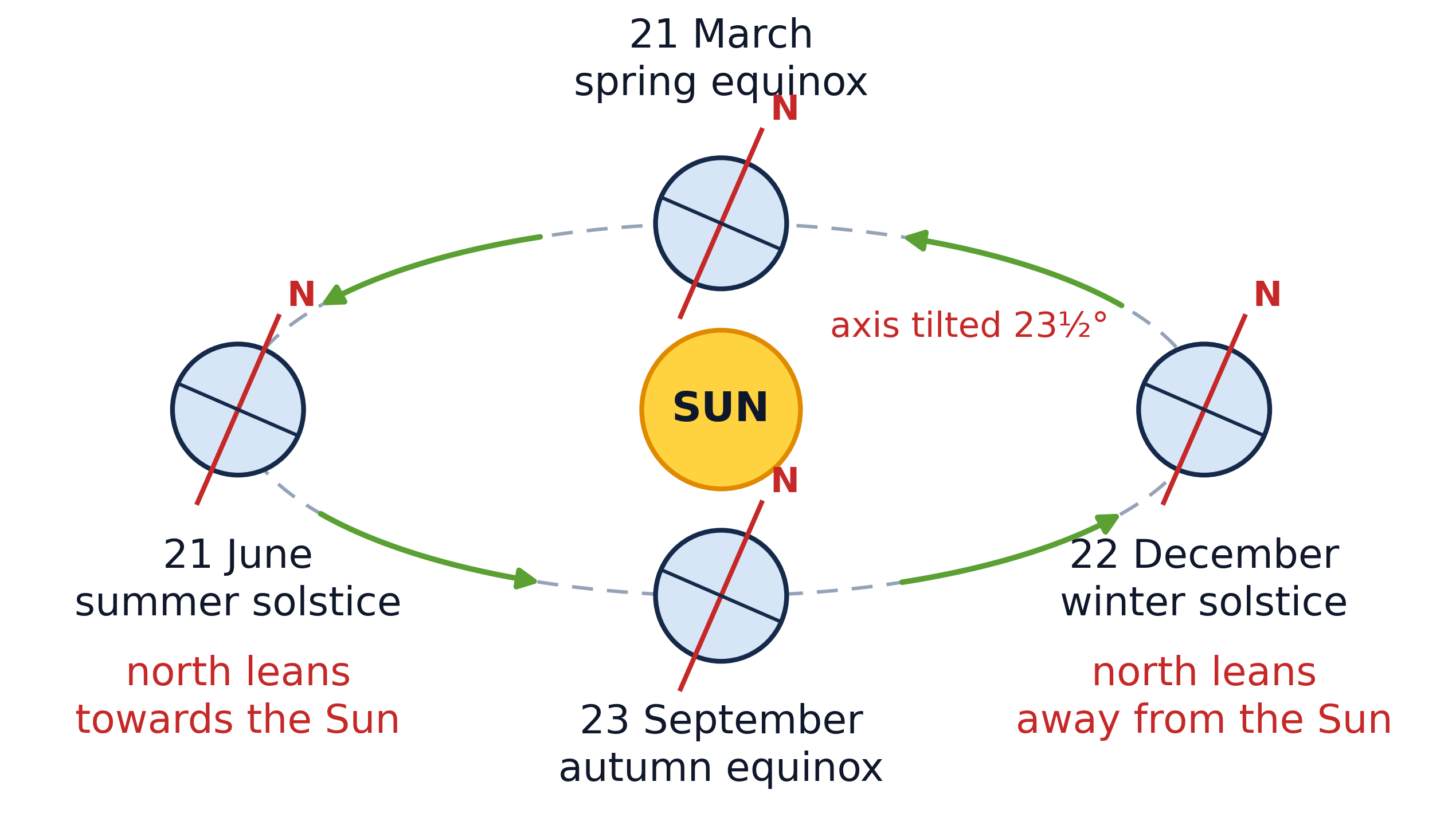
More facts that follow from the table:
- The Sun is overhead only between the two Tropics. North of the Tropic of Cancer and south of the Tropic of Capricorn the Sun's rays are never vertical. In India this is true of every place north of the Tropic of Cancer, for example the whole of Bihar, Punjab or Manipur.
- At the Equator, day and night are nearly equal all year.
- On 21 June the whole area north of the Arctic Circle has 24 hours of daylight, and the area south of the Antarctic Circle has 24 hours of darkness. On 22 December it is the other way round. Each pole has about six months of day and six months of night.
- The words: solstice means "the Sun stands still"; equinox means "equal night".
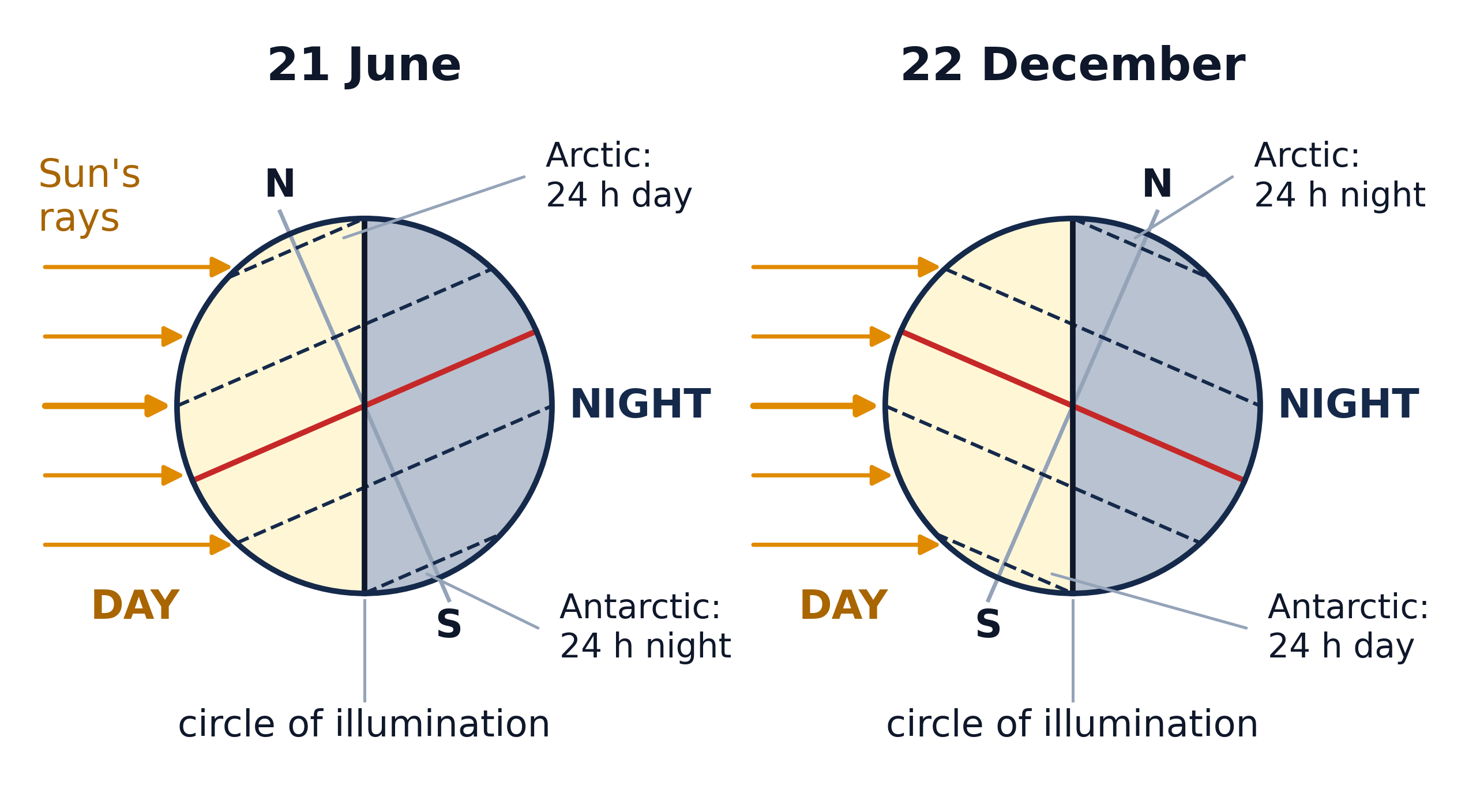
The height of the noon Sun. On any day the Sun is overhead at one latitude. At a place some degrees away from that latitude, the noon Sun is lower by the same number of degrees:
\text{angle of the noon Sun} = 90^\circ - (\text{difference in latitude between the place and the overhead Sun})
On 21 June the Sun is overhead at 23½° N. At the Equator the noon Sun stands at 90 - 23.5 = 66.5^\circ. At the Tropic of Capricorn, 47° away, it stands at only 90 - 47 = 43^\circ.
Distance is not the cause of the seasons. The Earth is nearest to the Sun (perihelion, about 147 million km) on about 3 January, in the northern winter. It is farthest (aphelion, about 152 million km) on about 4 July, in the northern summer. The Earth moves a little faster in its orbit when it is nearer the Sun (Kepler's second law, Chapter K1-6).
4. The origin of the Earth
Many thinkers tried to explain how the Earth and the other planets were formed. The paper asks them as pairs: the name of the theory and the name of the scientist. Learn this table as pairs.
| Theory | Who | What it says |
|---|---|---|
| Gaseous hypothesis | Immanuel Kant, 1755 | The planets formed out of a slowly turning cloud of material around the young Sun. This was the first form of the nebular idea |
| Nebular hypothesis | Laplace, 1796 | He revised Kant's idea: a hot, spinning cloud of gas (a nebula) cooled, shrank and threw off rings, which became the planets |
| Planetesimal hypothesis | Chamberlin and Moulton, about 1900 | A wandering star came near the Sun and its pull drew out a cigar-shaped mass of material. The material gathered into small solid bodies (planetesimals), which joined to make the planets |
| Tidal hypothesis | James Jeans, 1919; modified by Harold Jeffreys | A passing star raised a huge tide of gas on the Sun; the gas that was pulled out broke up into the planets |
| Binary star hypothesis | H. N. Russell, 1937 | The Sun once had a companion star. A third star came close to the companion, and the planets formed from the material pulled out of it |
| Revised nebular hypothesis | Otto Schmidt and Carl Weizsäcker, 1950 | The Sun was surrounded by a solar nebula of hydrogen, helium and dust; the dust collected into a disc and then into planets |
| Big Bang theory (expanding universe) | Evidence from Edwin Hubble in the 1920s | Explains the origin of the universe, not only of the Earth: all matter was in one tiny, very hot and dense point, which exploded about 13.7 billion years ago; the universe is still expanding |
Two notes on names. NCERT spells the first planetesimal author "Chamberlain"; the papers and most books write "Chamberlin". NCERT also speaks of the nebular hypothesis as Kant's idea revised by Laplace, while CDS I 2026 called Kant's own version the "gaseous hypothesis". Both are the same pairing: Kant, then Laplace.
A quick way to sort them: Kant and Laplace need only one body (the Sun's own cloud). Chamberlin and Moulton, and Jeans and Jeffreys, need two (the Sun and a passing star). Russell needs three (the Sun, its companion and a passing star).
The planets, with the Earth, formed about 4.6 billion years ago. The usual modern account of the Moon is the giant impact (also called "the big splat"): a body of about the size of Mars struck the young Earth and threw material into space, which collected to form the Moon.
Two families of planets
| Terrestrial (inner) planets | Jovian (outer) planets | |
|---|---|---|
| Which | Mercury, Venus, Earth, Mars | Jupiter, Saturn, Uranus, Neptune |
| Where | Between the Sun and the belt of asteroids | Beyond the belt of asteroids |
| Made of | Rock and metals | Mostly gases, with thick atmospheres of hydrogen and helium |
| Size and density | Small, but with high density | Large, but with low density |
| Why they lost their first gases | They are small, so their weak gravity could not hold the escaping gases, and the solar wind blew the gases away | They were far from the Sun and large enough to keep their gases |
Three facts to keep: the Earth is the largest of the four inner planets, the Earth is the densest of all the planets, and Jupiter is the largest planet. The planets one by one are in Chapter K8-1.
The early Earth. The young Earth was hot and partly molten. Heavy materials such as iron sank to the centre and lighter ones rose to the surface. In this way it separated into layers. This sorting by density is called differentiation.
How the atmosphere was formed: three stages. CDS II 2026 gave these three stages as three statements, and all three were correct.
| Stage | What happened |
|---|---|
| 1. Loss of the first atmosphere | The earliest (primordial) atmosphere was of hydrogen and helium. The solar wind stripped it away |
| 2. Gases from the hot interior | As the Earth cooled, gases and water vapour came out of its interior. This is called degassing. Volcanoes added more. The new atmosphere had mostly water vapour, nitrogen, carbon dioxide, methane and ammonia, and very little free oxygen |
| 3. Change by living things | Life began in the oceans. Through photosynthesis it added oxygen, first to the oceans and then to the air, and so made the atmosphere we breathe |
The oceans formed in the second stage. As the Earth cooled, the water vapour condensed and it rained for a very long time; the rain water collected in the hollows of the surface. So the oceans are nearly as old as the Earth, and the oxygen of the air is much younger than the oceans.
Geological time. The oldest and longest part of geological time is the Precambrian. After it come the Palaeozoic, the Mesozoic and the Cenozoic eras; we live in the Cenozoic.
5. Inside the Earth
Nobody has seen the inside of the Earth. Its radius is about 6,370 km, and the deepest hole ever drilled is only about 12 km. What we know comes mostly from earthquake waves, which change speed and direction as they pass through different layers (Chapter K8-4).
| Layer | Depth and thickness | What to remember |
|---|---|---|
| Crust | Oceanic crust: about 5 km thick on average. Continental crust: about 30 km, and up to about 70 km under the Himalaya | The outermost solid layer; brittle; thin under the oceans, thickest under high mountains. Oceanic crust is basalt and is denser than continental crust |
| Mantle | From the base of the crust to 2,900 km | The largest layer. Its upper part, down to about 400 km, is the asthenosphere: weak and able to flow slowly; the main source of magma |
| Outer core | From 2,900 km | Liquid |
| Inner core | To the centre | Solid. The core is made mainly of nickel and iron, so it is called "nife"; it is the densest layer |
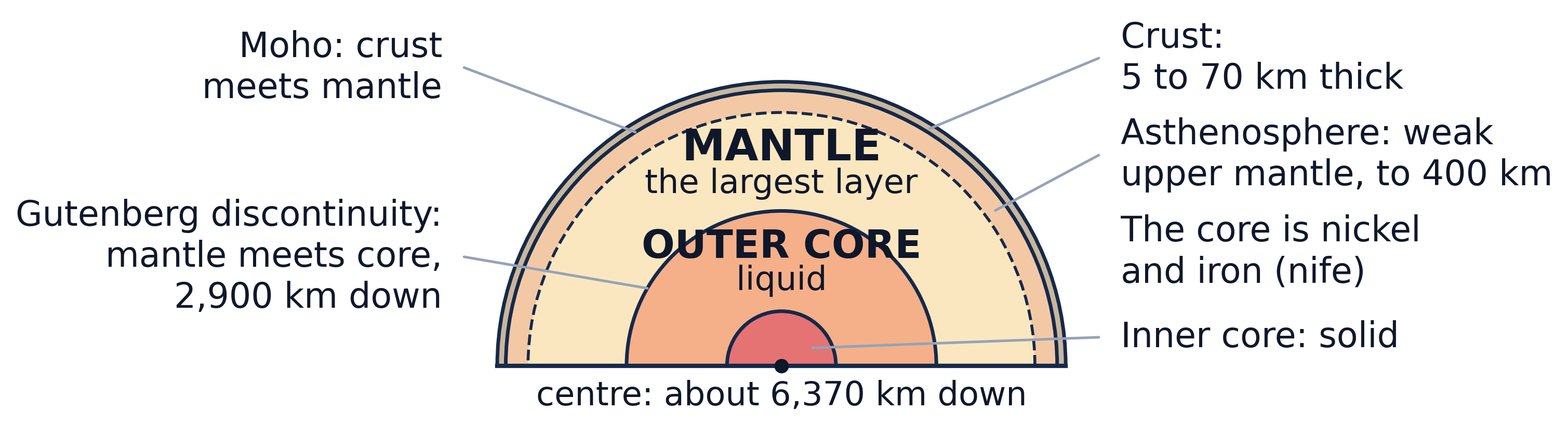
- The boundary between the crust and the mantle is the Mohorovičić discontinuity (Moho). The boundary between the mantle and the core is the Gutenberg discontinuity. The boundary between the outer core and the inner core is the Lehmann discontinuity.
- Older books name the layers by their main elements: sial (silica and aluminium) for the continental crust, sima (silica and magnesium) for the oceanic crust and the layer below, and nife (nickel and iron) for the core.
- The lithosphere is the crust together with the uppermost solid part of the mantle. It is 10 to 200 km thick, and thickest under mountain ranges such as the Himalaya. It is broken into plates, which move over the asthenosphere.
- Slow convection currents in the mantle (not in the crust) carry heat upwards and drive the plates.
- Temperature, pressure and density all increase with depth.
What the papers have asked
| Paper | The idea asked | The answer in one line |
|---|---|---|
| CDS I 2024 | Whether the angular speed of rotation is the same at all places while the linear speed changes | Yes. Every place turns 15° an hour, but the speed along the ground depends on latitude |
| CDS I 2024 | Where the linear speed of rotation is greatest and least | Greatest at the Equator, least (zero) at the poles |
| CDS I 2026 | Whether the gaseous hypothesis is correctly paired with Kant | Yes |
| CDS I 2026 | Whether the binary star hypothesis is correctly paired with Russell | Yes |
| CDS I 2026 | Whether the planetesimal hypothesis is correctly paired with Chamberlin | Yes, with Moulton |
| CDS II 2026 | The three stages in the evolution of the present atmosphere | Loss of the first atmosphere; gases from the hot interior; change by living things through photosynthesis |
| CDS II 2024 (counted in Chapter K8-4) | What earthquake waves tell us about the outer core | S-waves cannot pass through it, so it must be liquid |
Three questions gave these seven rows, because each was a set of statements or pairs. What this means for revision: the papers went past the seasons to the named theories, the stages and the exact terms. Read the tables of section 4 until you can cover the second column and say it.
Worked examples
Example 1 (a single fact). On which date is the Sun overhead at noon at the Tropic of Capricorn?
(a) 21 March (b) 21 June (c) 23 September (d) 22 December
Solution. The Tropic of Capricorn is the southern limit of the overhead Sun. The Sun reaches it on 22 December, the winter solstice of the Northern Hemisphere. On 21 June the Sun is over the Tropic of Cancer, the tempting wrong choice. Answer (d).
Example 2 (a short calculation). Delhi is at about 28½° N. How high is the Sun at noon in Delhi on 22 December?
(a) 85° (b) 61½° (c) 38° (d) 23½°
Solution. On 22 December the Sun is overhead at 23½° S. Delhi and the overhead Sun are on opposite sides of the Equator, so add: 28.5 + 23.5 = 52^\circ. The noon Sun stands at 90 - 52 = 38^\circ. The value 85° is the answer for 21 June (90 - 5), and 61½° is the answer for an equinox. Answer (c).
Example 3 (consider the following statements).
- The seasons are caused by the change in the distance between the Earth and the Sun.
- The Earth is nearest to the Sun in January.
Which of the statements given above is/are correct?
(a) 1 only (b) 2 only (c) Both 1 and 2 (d) Neither 1 nor 2
Solution. Statement 2 is correct: perihelion is on about 3 January. This is the northern winter, which shows that distance does not cause the seasons. They are caused by the tilt of the axis together with revolution. Statement 1 is wrong. Answer (b).
Example 4 (matching lists). Match the layer with its description.
List I: A. Asthenosphere B. Inner core C. Outer core D. Oceanic crust
List II: 1. Liquid nickel and iron 2. Thin layer of basalt 3. Weak upper part of the mantle 4. Solid nickel and iron
(a) A-3, B-4, C-1, D-2 (b) A-3, B-1, C-4, D-2 (c) A-2, B-4, C-1, D-3 (d) A-4, B-3, C-2, D-1
Solution. The asthenosphere is the weak upper mantle (3). The inner core is solid (4) and the outer core is liquid (1); option (b) has these two the wrong way round. Oceanic crust is a thin layer of basalt (2). Answer (a).
Example 5 (two kinds of speed). Consider the following statements about the rotation of the Earth:
- A place at 60° N turns through the same angle in one hour as a place on the Equator.
- A place at 60° N moves along the ground at the same speed as a place on the Equator.
- A person standing exactly at the North Pole is not carried along the ground at all by the rotation.
How many of the above statements are correct?
(a) Only one (b) Only two (c) All three (d) None
Solution. Statement 1 is correct: the angular speed is 15° an hour everywhere. Statement 2 is wrong: the circle of 60° N is only half as long as the Equator, so the speed along the ground is half. Statement 3 is correct: the pole is a point, so the person only turns on the spot. Answer (b).
Example 6 (consider the following statements).
- The nebular hypothesis was first put forward by Kant and later revised by Laplace.
- The Big Bang theory explains how the universe began.
- The binary star hypothesis was proposed by James Jeans.
Which of the statements given above are correct?
(a) 1 and 2 only (b) 2 and 3 only (c) 1 and 3 only (d) 1, 2 and 3
Solution. Statements 1 and 2 are correct. Statement 3 is wrong: the binary star hypothesis is H. N. Russell's. James Jeans proposed the tidal hypothesis, in which a single passing star pulls gas out of the Sun. The two are easy to mix because both use a passing star. Answer (a).
Mistakes that cost marks
- Giving rotation the credit for the seasons. Rotation gives day and night. Revolution with the tilted axis gives the seasons.
- Mixing up the two Tropics. June goes with Cancer (north). December goes with Capricorn (south).
- Calling the lithosphere "the crust". It is the crust and the uppermost solid mantle together. The asthenosphere lies below it and is part of the mantle.
- Swapping the two cores. The outer core is liquid. The inner core is solid.
- Saying the Earth spins faster at the Equator. It spins at the same rate everywhere. Only the speed along the ground is greater at the Equator.
Quick check
- In which direction does the Earth rotate?
- By how many degrees is the Earth's axis tilted from the vertical?
- On which two dates are day and night equal all over the world?
- Which is the largest layer of the Earth, and how deep does it go?
- Name the four terrestrial planets.
Read and watch more, free
NCERT and NIOS books are free on their own websites. The NIOS lesson is named in words, without a link.
| What | Where | Language |
|---|---|---|
| Textbook, origin of the Earth and of the atmosphere | NCERT textbooks, the book menu: Class 11 Fundamentals of Physical Geography, Chapter 2 "The Origin and Evolution of the Earth" (the three stages asked in CDS II 2026 are here) | English, Hindi |
| Textbook, inside the Earth | NCERT textbooks, the book menu: Class 11 Fundamentals of Physical Geography, Chapter 3 "Interior of the Earth" | English, Hindi |
| Textbook, the solstices and the Earth's distance from the Sun | NCERT textbooks, the book menu: Class 11 Fundamentals of Physical Geography, the chapter "Solar Radiation, Heat Balance and Temperature" | English, Hindi |
| Self-study lesson | NIOS Senior Secondary course, Geography (316), Lesson 2 "Earth's Interior and its Material", on the NIOS website under online course material | English, Hindi |
| The real papers | UPSC previous question papers (General Knowledge booklets of every CDS sitting) | English, Hindi |
| Video, topic by topic | CDS Wallah: CDS Exam Full Playlist (the geography videos) | Hinglish |
| Video, geography classes of 20 to 60 minutes | Adda247 Defence: CDS GK GS Classes (about two years old) | Hinglish |
| Video, past questions | Reveal GK: CDS past questions by subject and topic (the geography parts) | Hinglish |
The named theories other than those of Kant, Laplace, Chamberlin and Moulton, Jeans and Jeffreys are not in the NCERT book. They are in any standard college textbook of physical geography.
The videos were chosen from their titles, length and views; they have not yet been watched by a teacher.
Answers to the quick check
- From west to east.
- 23½°.
- 21 March and 23 September, the equinoxes.
- The mantle; it goes down to 2,900 km.
- Mercury, Venus, Earth and Mars.
Next chapter: Rocks, weathering, earthquakes, volcanoes.