Why this chapter matters. This chapter gave no direct question in the 6 papers from CDS I 2024 to CDS II 2026. That is an honest count, and it tells you how to use the chapter: read it once, learn the planet table, and move on. It still earns marks in three ways. Other questions lean on it: the kinds of tide (CDS I 2026) need the positions of the Sun, the Moon and the Earth; a history question (CDS I 2024) spoke of the phases of Venus; the space questions of 2024 used orbits and distances. Space missions come every time in the news questions. And a general knowledge paper can return to the planets at any sitting. Learn section 3 (the planets) and section 5 (eclipses) first.
What you will be able to do
- Name the eight planets in order and give the one fact each is known for.
- Tell the terrestrial planets from the giant planets, and say why Pluto is a dwarf planet.
- Explain the phases of the Moon, how solar and lunar eclipses happen, and why they do not happen every month.
- Tell an asteroid, a meteoroid, a meteor, a meteorite and a comet apart, and use the units of distance in space.
Before you start you should know: light travels in straight lines and an opaque body casts a shadow; gravitation keeps a body in orbit (Chapter K1-6). Telescopes, satellites and the Lagrange points are in Chapter K1-17.
1. What the solar system is
The solar system is the Sun and everything that moves around it under its gravity: eight planets, their moons, dwarf planets, asteroids, comets and dust. The Sun holds more than 99 per cent of the mass of the whole system.
The solar system is one small part of our galaxy, the Milky Way (Akash Ganga), a spiral galaxy with a very large number of stars. The solar system is about 4.6 billion years old. The nebular hypothesis explains its origin from a rotating cloud of gas and dust; the named theories are taught in Chapter K8-3. The Big Bang theory explains the origin of the universe itself, about 13.7 billion years ago by the figure in the NCERT Class 11 book.
2. The Sun
The Sun is a star: a hot ball of gas that gives out its own light. Planets and moons do not. They shine only by reflecting sunlight.
| Fact | Value |
|---|---|
| Made of | Mainly hydrogen, then helium |
| Source of energy | Nuclear fusion: hydrogen nuclei join to form helium |
| Temperature | About 6000 K at the surface; about 15 million K at the centre |
| Average distance from the Earth | About 150 million km. This distance is called 1 astronomical unit (AU) |
| Time for its light to reach the Earth | About 8 minutes 20 seconds (about 500 seconds) |
| Outer layers | Photosphere (the bright surface we see), chromosphere, corona |
| Sunspots | Darker, cooler patches on the surface. Their number rises and falls in a cycle of about 11 years |
The corona is the thin outer atmosphere of the Sun. It can be seen with the eye only during a total solar eclipse.
3. The eight planets
A planet moves around the Sun in an orbit that is an ellipse, almost a circle, with the Sun at one focus (Kepler's first law). Since 2006 the International Astronomical Union (IAU) counts eight planets. In order from the Sun:
Mercury, Venus, Earth, Mars, Jupiter, Saturn, Uranus, Neptune.
A sentence to remember the order: My Very Educated Mother Just Served Us Noodles.
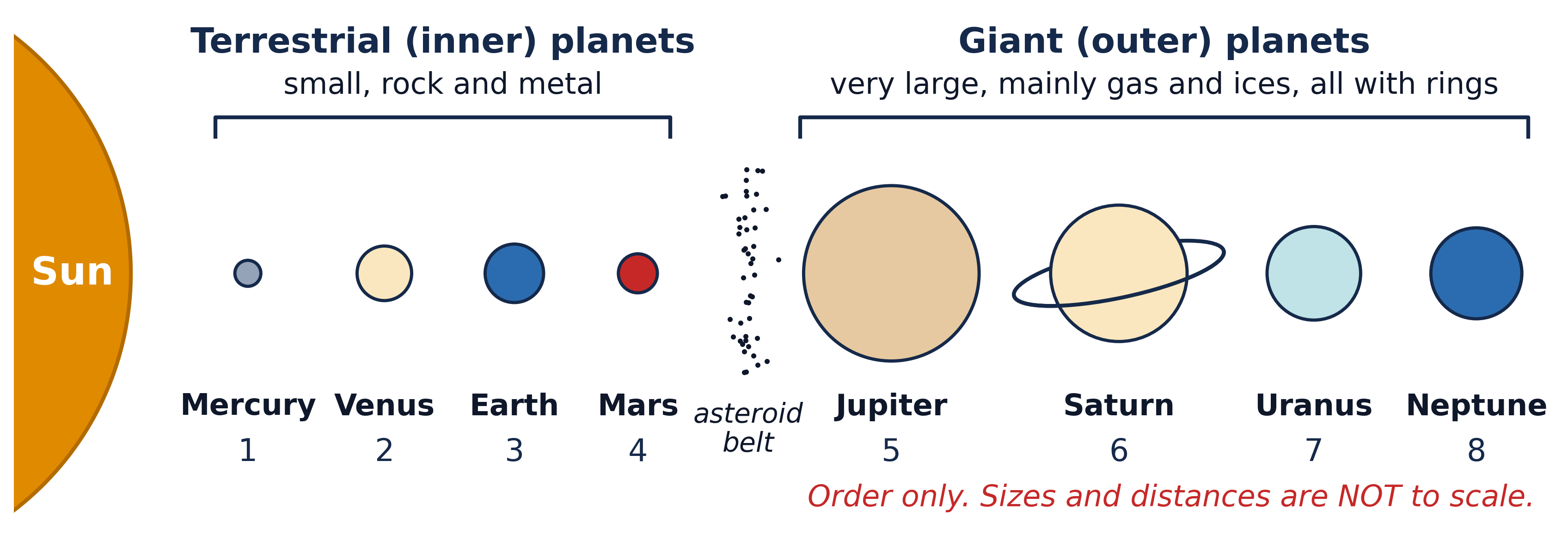
| Planet | One year (time to go round the Sun, about) | Notable facts |
|---|---|---|
| Mercury | 88 days | Smallest planet. Nearest to the Sun. Shortest year. No moon. Almost no atmosphere, so very hot days and very cold nights |
| Venus | 225 days | Hottest planet. Thick atmosphere of carbon dioxide with clouds of sulphuric acid. Brightest planet in our sky, called the morning star and the evening star. Spins from east to west, opposite to most planets, and so slowly that one spin (about 243 days) takes longer than its year. No moon. Nearly the size of the Earth |
| Earth | 365¼ days | The densest planet. The only one known to have life. One moon |
| Mars | 687 days | The red planet (its soil has iron oxide). Two small moons, Phobos and Deimos. Has Olympus Mons, the highest known volcano in the solar system |
| Jupiter | 12 years | Largest and heaviest planet. Fastest spin: one day is about 10 hours. The Great Red Spot is a giant storm. Its four large moons are Io, Europa, Ganymede and Callisto; Ganymede is the largest moon in the solar system |
| Saturn | 29½ years | The brightest and largest rings. The least dense planet: less dense than water. Its largest moon is Titan, which has a thick atmosphere |
| Uranus | 84 years | Spins lying on its side. Spins from east to west. Discovered with a telescope by William Herschel in 1781 |
| Neptune | 165 years | Farthest planet. Longest year. Has the strongest winds measured on any planet. Found in 1846 after its place was worked out by calculation |
The farther a planet is from the Sun, the longer its year. This is Kepler's third law, T^2 \propto a^3, taught in Chapter K1-6.
Moons. Mercury and Venus have none, the Earth has one and Mars has two. The four giant planets have many moons each, and new small ones are still being found, so do not learn a number for them.
Inferior planets. Mercury and Venus have orbits inside the Earth's orbit. Seen from the Earth they stay close to the Sun in the sky, and through a telescope they show phases like the Moon. Galileo saw the phases of Venus with his telescope. A history question in CDS I 2024 used this very phrase.
Two families of planets
| Terrestrial (inner) planets | Giant (outer, Jovian) planets | |
|---|---|---|
| Which | Mercury, Venus, Earth, Mars | Jupiter, Saturn, Uranus, Neptune |
| Where | Between the Sun and the asteroid belt | Beyond the asteroid belt |
| Made of | Rock and metal, with a solid surface | Mainly hydrogen and helium (Jupiter, Saturn); also ices such as water, ammonia and methane (Uranus, Neptune) |
| Size | Small | Very large |
| Density | High | Low |
| Moons and rings | Few or no moons, no rings | Many moons, and all four have rings |
The inner planets are small, so their gravity is weak. Being close to the Sun they are also hot. For both reasons they could not hold on to the light gases hydrogen and helium. This is a ready-made "consider the following statements" question.
Pluto and the dwarf planets
Pluto was discovered in 1930 and was called the ninth planet. In August 2006 the IAU defined a planet as a body that (1) goes round the Sun, (2) is massive enough to be nearly round, and (3) has cleared other bodies from the neighbourhood of its orbit. Pluto fails the third test, because it shares its region with many other icy bodies. It is now a dwarf planet. Other dwarf planets are Ceres, Eris, Haumea and Makemake.
The region of small icy bodies beyond Neptune, where Pluto lies, is the Kuiper belt.
4. The Moon
The Moon is the Earth's only natural satellite.
| Fact | Value |
|---|---|
| Average distance from the Earth | About 3,84,400 km. Light takes about 1.3 seconds to cross it |
| Nearest and farthest points of its orbit | Perigee (nearest) and apogee (farthest) |
| Size | Diameter about one-quarter of the Earth's |
| Gravity at the surface | About one-sixth of the Earth's |
| Time for one revolution round the Earth | About 27⅓ days |
| Time from one new moon to the next | About 29½ days |
| Time for one rotation on its axis | The same as one revolution, about 27⅓ days |
| Atmosphere | Practically none, so there is no sound and no weather |
Because the Moon rotates once in exactly the time it takes to go round the Earth, we always see the same face.
Why two different months? While the Moon goes once round the Earth (27⅓ days), the Earth has moved on along its own orbit. The Moon needs about two more days to come back in line with the Sun. So the month of the phases is 29½ days.
The first men landed on the Moon on 20 July 1969 in the American mission Apollo 11: Neil Armstrong, then Edwin (Buzz) Aldrin. India's Chandrayaan-3 landed near the Moon's south pole on 23 August 2023. Its lander was named Vikram and its rover Pragyan.
Phases of the Moon
Half of the Moon is always lit by the Sun. As the Moon goes round the Earth, we see a different part of the lit half each night. These changing shapes are the phases.
| Phase | Where the Moon is | What we see |
|---|---|---|
| New moon (amavasya) | Between the Earth and the Sun | The dark side faces us; no Moon is seen |
| First quarter | A quarter of the way round | Half the disc is lit |
| Full moon (purnima) | On the far side of the Earth from the Sun | The whole disc is lit |
| Last quarter | Three-quarters of the way round | The other half of the disc is lit |
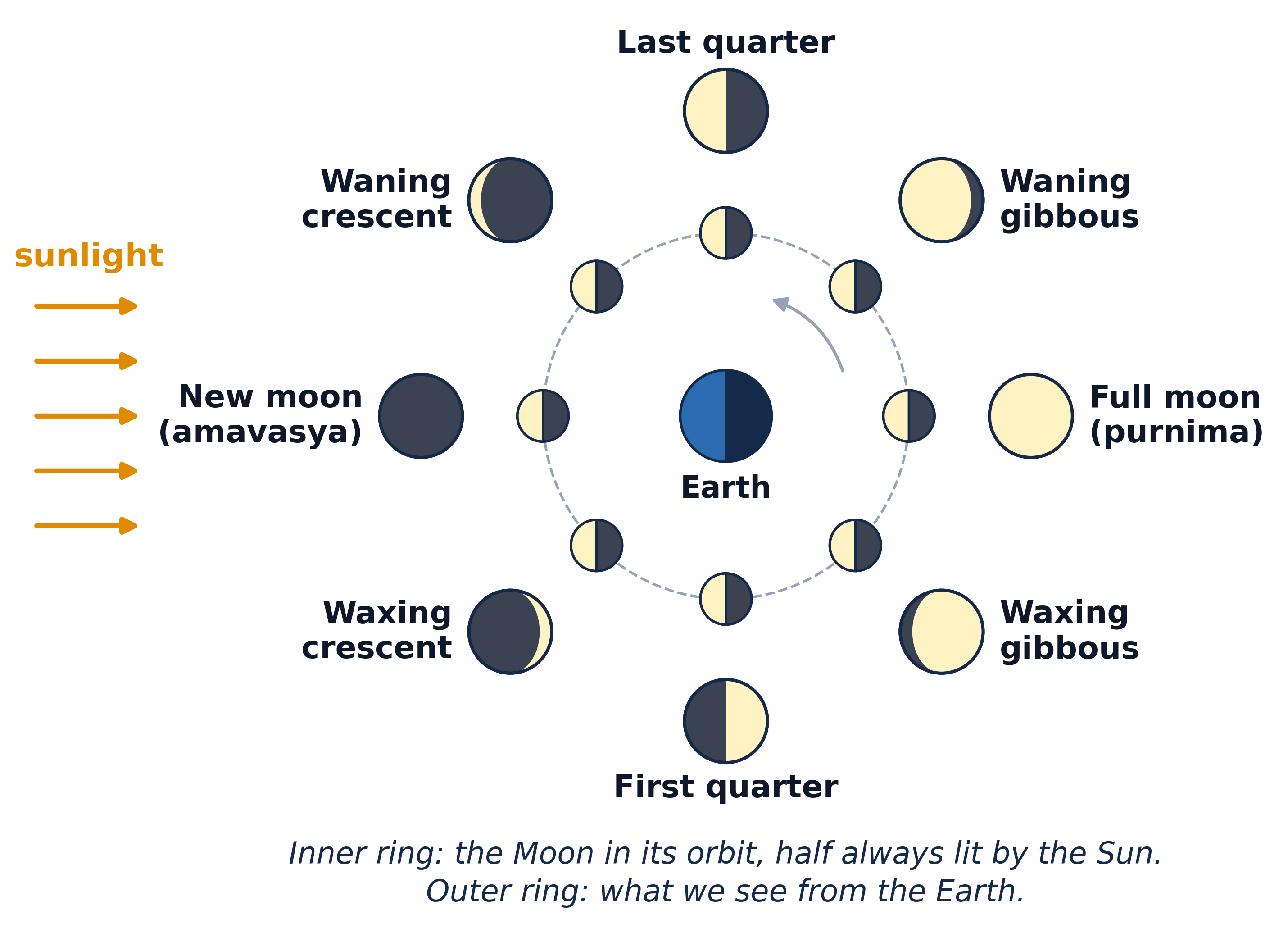
From new moon to full moon the lit part grows; the Moon is waxing. From full moon to new moon it shrinks; the Moon is waning. A shape thinner than half is a crescent, and a shape between half and full is gibbous.
The same positions set the tides (Chapter K8-6). At new moon and full moon the Sun, the Earth and the Moon are in one line and the tides are highest (spring tides). At the two quarters the Sun and the Moon pull at right angles and the tides are weakest (neap tides). CDS I 2026 set a matching question on this.
5. Eclipses
An eclipse is a play of shadows. The dark central part of a shadow, where the Sun is fully hidden, is the umbra. The lighter outer part, where the Sun is partly hidden, is the penumbra.
| Solar eclipse | Lunar eclipse | |
|---|---|---|
| Order in a line | Sun, Moon, Earth | Sun, Earth, Moon |
| What happens | The Moon's shadow falls on the Earth and hides the Sun | The Earth's shadow falls on the Moon |
| Day | Only on a new moon day | Only on a full moon night |
| Seen from | A narrow strip of the Earth | Every place where it is night |
| Kinds | Total, partial, annular | Total, partial, penumbral |
| How long the total stage lasts | A few minutes | It can last more than an hour |
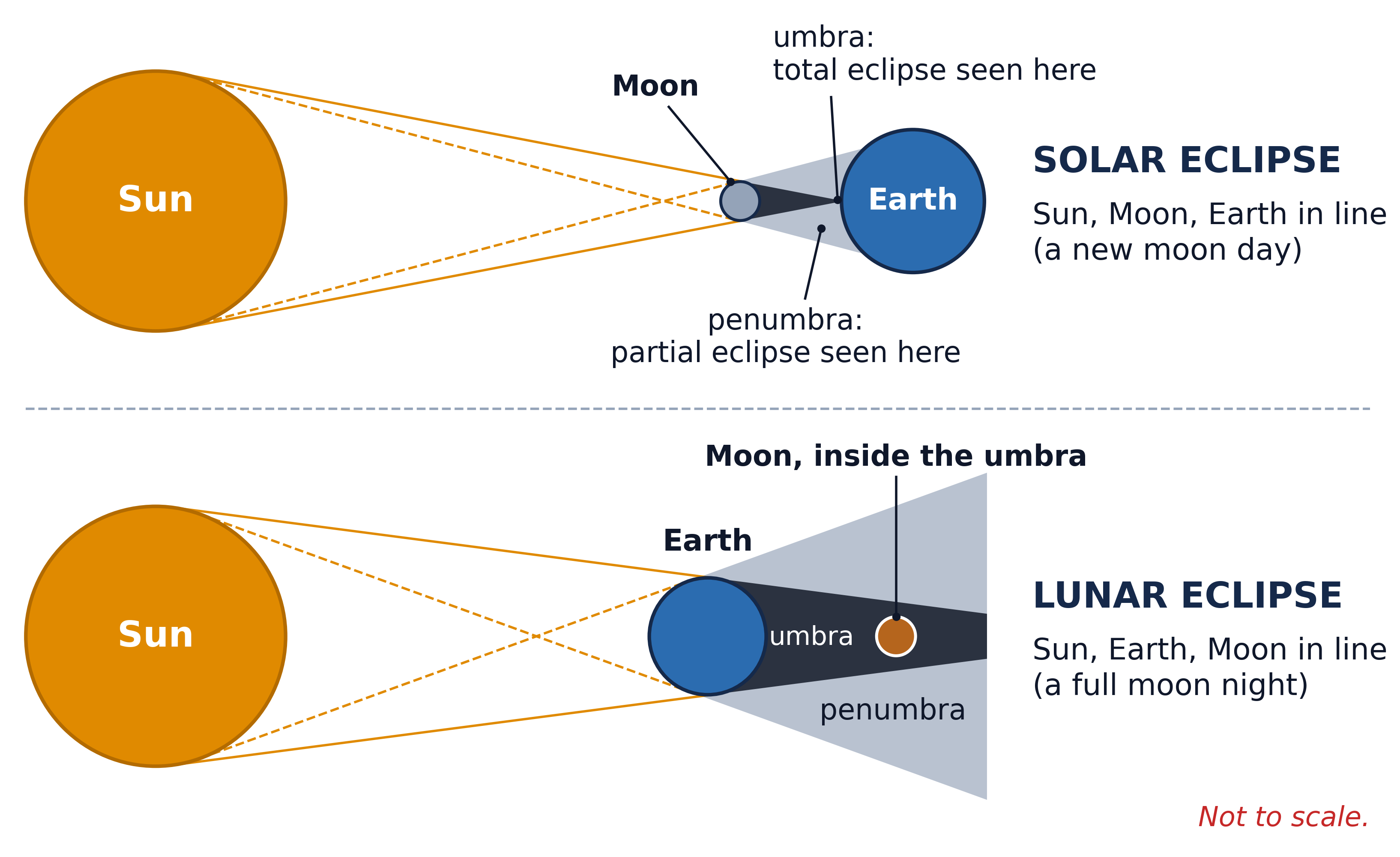
- In a total solar eclipse the Moon covers the whole disc of the Sun, and the corona appears.
- In an annular solar eclipse the Moon is near apogee, the far part of its orbit, and looks a little smaller than the Sun. A bright ring of the Sun stays visible around it.
- In a total lunar eclipse the Moon does not vanish. It turns a dull copper red, because the Earth's atmosphere bends some red sunlight into the shadow.
Why is there no eclipse every month? The Moon's orbit is tilted by about 5 degrees to the Earth's orbit. On most new moon and full moon days the three bodies are not in one straight line, and the shadows miss.
Never look at the Sun with bare eyes, even during an eclipse. A lunar eclipse is safe to watch.
6. Asteroids, meteors and comets
Asteroids are rocky bodies, much smaller than planets, that go round the Sun. Most of them lie in the asteroid belt between the orbits of Mars and Jupiter. Ceres, the largest body in the belt, was found in 1801 and is now classed as a dwarf planet.
Three words that sound alike:
| Word | What it is |
|---|---|
| Meteoroid | A small piece of rock or metal moving in space |
| Meteor | The streak of light seen when a meteoroid enters the Earth's atmosphere at high speed and burns up from the heat of friction with the air. People call it a "shooting star", but it is not a star |
| Meteorite | A piece that does not burn up completely and reaches the ground |
A large meteorite can dig a crater. Lonar Lake in Maharashtra lies in such a crater. A meteor shower is seen when the Earth passes through the dust left behind by a comet.
Comets are bodies of ice, dust and rock that go round the Sun in very long, stretched orbits. Far from the Sun a comet is a small frozen lump. Near the Sun its ice turns to gas and forms a glowing head and a long tail. The tail always points away from the Sun, because sunlight and the stream of particles from the Sun push it back. Halley's comet returns about every 76 years. It was last seen in 1986 and is expected again in 2061.
7. Measuring distance in space
| Unit | What it is | Size (about) |
|---|---|---|
| Astronomical unit (AU) | The average distance between the Earth and the Sun | 1.5 \times 10^{8} km |
| Light year | The distance light travels in one year | 9.46 \times 10^{12} km |
| Parsec | A larger unit used by astronomers | 3.26 light years, or about 2 \times 10^{5} AU |
A light year is a unit of distance, not of time. The nearest star after the Sun, Proxima Centauri, is a little over 4 light years away.
8. Stars and the universe, in brief
A star is born when a cloud of gas and dust (a nebula) falls inwards under its own gravity and becomes hot enough for fusion. What it becomes at the end depends on its mass.
| End of a star | When |
|---|---|
| White dwarf | A star like the Sun swells into a red giant, throws off its outer layers, and its core is left as a white dwarf |
| Neutron star | A much heavier star explodes as a supernova; the core left behind is a very dense neutron star |
| Black hole | The core left by the heaviest stars collapses further. Its gravity is so strong that not even light can escape |
The Chandrasekhar limit, about 1.4 times the mass of the Sun, is the greatest mass a white dwarf can have. It is named after the Indian-born physicist S. Chandrasekhar, who shared the Nobel Prize in Physics in 1983.
Galaxies are moving away from one another: the universe is expanding. Edwin Hubble gave the evidence for this in the 1920s, and it is the main support for the Big Bang theory.
What the papers have asked
No question in the six papers was set on this chapter alone. These are the questions that needed its ideas. Each is counted in another chapter's tally.
| Paper | The idea asked | The answer in one line |
|---|---|---|
| CDS I 2024 | What the James Webb Space Telescope goes round, and how far away it is | It goes round the Sun, about 15 lakh km from the Earth (Chapter K1-17) |
| CDS I 2024 | What the Giant Metrewave Radio Telescope is made of | Many parabolic dish antennas working together (Chapter K1-17) |
| CDS I 2024 | A history question on the astronomer-king Sawai Jai Singh that spoke of the phases of Venus | The idea from this chapter: Venus shows phases like the Moon, seen only through a telescope |
| CDS II 2024 | The figure made by the Sun, the Earth and the Lagrange point L4 | An equilateral triangle (Chapter K1-17) |
| CDS I 2026 | Matching the kinds of tide with their causes | Spring tides: Sun, Moon and Earth in one line. Neap tides: at right angles. Apogean tides: Moon farthest from the Earth (Chapter K8-6) |
| CDS I 2026 | Theories of the origin of the Earth and who proposed them | Kant: gaseous hypothesis; Chamberlin: planetesimal hypothesis (Chapter K8-3) |
| CDS II 2026 | A body floating on the Moon, where gravity is one-sixth | The part under the liquid stays the same (Chapter K1-1) |
What this means for revision: the planet table, the two eclipses and the units of distance are enough from this chapter. Follow India's space missions from the news chapters.
Worked examples
Example 1. Which one of the following planets takes the least time to go once round the Sun?
(a) Venus (b) Mercury (c) Mars (d) Jupiter
Solution. The nearer a planet is to the Sun, the shorter its year. Mercury is the nearest and takes only about 88 days. Jupiter tempts because it spins fastest, but a fast spin gives a short day, not a short year. Answer (b).
Example 2. Consider the following statements:
- A solar eclipse can occur only on a new moon day.
- A solar eclipse occurs on every new moon day.
Which of the statements given above is/are correct?
(a) 1 only (b) 2 only (c) Both 1 and 2 (d) Neither 1 nor 2
Solution. For the Moon's shadow to fall on the Earth, the Moon must be between the Sun and the Earth, and that is the new moon position. Statement 1 is correct. But the Moon's orbit is tilted by about 5 degrees, so on most new moon days its shadow passes above or below the Earth. Statement 2 is wrong. Answer (a).
Example 3. Match List I with List II.
| List I | List II |
|---|---|
| A. Largest planet | 1. Venus |
| B. Hottest planet | 2. Saturn |
| C. Least dense planet | 3. Mars |
| D. Red planet | 4. Jupiter |
(a) A-4, B-1, C-2, D-3 (b) A-4, B-3, C-2, D-1 (c) A-2, B-1, C-4, D-3 (d) A-4, B-2, C-1, D-3
Solution. Jupiter is the largest (A-4). Venus is the hottest because its thick carbon dioxide atmosphere traps heat (B-1); it is hotter than Mercury though Mercury is nearer the Sun. Saturn is less dense than water (C-2). Mars is the red planet (D-3). Answer (a).
Example 4. The Sun is about 1.5 \times 10^{8} km from the Earth and light travels at 3 \times 10^{5} km/s. About how long does sunlight take to reach the Earth?
(a) 50 seconds (b) 500 seconds (c) 5000 seconds (d) 8 hours
Solution. Time = distance ÷ speed = \dfrac{1.5 \times 10^{8}}{3 \times 10^{5}} = 500 seconds, which is 8 minutes 20 seconds. Option (d) has the right number, 8, with the wrong unit. Answer (b).
Example 5. Consider the following statements about the Moon:
- The Moon takes about 27⅓ days to go once round the Earth.
- The time from one full moon to the next is about 29½ days.
- The Moon turns on its axis once in about 24 hours.
How many of the above statements are correct?
(a) Only one (b) Only two (c) All three (d) None
Solution. Statements 1 and 2 are both correct: the two "months" differ because the Earth moves along its orbit while the Moon goes round it. Statement 3 is wrong. The Moon turns once in the same 27⅓ days, which is why one face always looks at us. In this form of question one wrong judgement loses the mark, so test each statement on its own. Answer (b).
Mistakes that cost marks
- Calling Mercury the hottest planet. Mercury is the nearest, but Venus is the hottest, because of its thick atmosphere of carbon dioxide.
- Calling the light year a unit of time. It is the distance light travels in a year.
- Mixing up the two eclipses. Solar: the Moon is in the middle, on a new moon day. Lunar: the Earth is in the middle, on a full moon night.
- Counting nine planets. There are eight. Pluto has been a dwarf planet since 2006.
Quick check
Do these without help. Answers are at the end.
- Name the planets that have no moon.
- Which planet is the densest, and which is the least dense?
- In a lunar eclipse, which body is in the middle?
- Between the orbits of which two planets does the asteroid belt lie?
- In which direction does the tail of a comet point?
Read and watch more, free
NCERT books are free on the NCERT website. Open the book menu and choose the class and the book.
| What | Where | Language |
|---|---|---|
| Textbook, planets and comets | NCERT textbooks, the book menu: Class 6 Science Curiosity, Chapter 12 "Beyond Earth" | English, Hindi |
| Textbook, eclipses and phases | NCERT textbooks, the book menu: Class 7 Science Curiosity, Chapter 12 "Earth, Moon, and the Sun"; Class 8 Science Curiosity, the chapter "Keeping Time with the Skies" | English, Hindi |
| Textbook, origin of the universe and the solar system | NCERT textbooks, the book menu: Class 11 Fundamentals of Physical Geography, Chapter 2 "The Origin and Evolution of the Earth" | English, Hindi |
| India's space missions | ISRO: missions accomplished (every launch and spacecraft, with dates) | English, Hindi |
| The real papers | UPSC previous question papers (General Knowledge booklets of every CDS sitting) | English, Hindi |
| Video, topic by topic | CDS Wallah: CDS Exam Full Playlist (the geography videos) | Hinglish |
| Video, past questions | Reveal GK: CDS past questions by subject and topic (the geography parts) | Hinglish |
The videos were chosen from their titles, length and views; they have not yet been watched by a teacher.
Answers to the quick check
- Mercury and Venus.
- The Earth is the densest. Saturn is the least dense.
- The Earth.
- Mars and Jupiter.
- Away from the Sun.
Next chapter: The Earth: shape, latitude, longitude, time.