Why this chapter matters. This chapter gave 16 questions in the 6 papers from CDS I 2024 to CDS II 2026. That is between two and three in every paper. Seven of the 16 ask for the greatest or least value of an expression, or whether an equation is possible at all. Four use the values of the ratios at 30^\circ, 45^\circ and 60^\circ. Four use complementary angles, the pair that adds up to 90^\circ. One compares \tan and \cot of the same angle. No question in these papers needed a trigonometric table, though the syllabus lists "use of trigonometric tables"; section 4 gives what is useful from it.
What you will be able to do
- Write the six ratios of 0^\circ, 30^\circ, 45^\circ, 60^\circ and 90^\circ from memory, and find the angle when a ratio is given.
- Use the complementary-angle rule: \sin(90^\circ - \theta) = \cos\theta and its two partners.
- Find the greatest and least value of an expression in \sin\theta and \cos\theta.
- Decide whether an equation such as \sin\theta = x + \frac{1}{x} is possible.
Before you start you should know: the six ratios in a right-angled triangle and how they change as the angle grows (Chapter A4-1), how to solve a quadratic equation (Chapter A3-7), and the rule that the arithmetic mean of two positive numbers is at least their geometric mean (Chapter A3-9).
1. The table of values
Two triangles give every value.
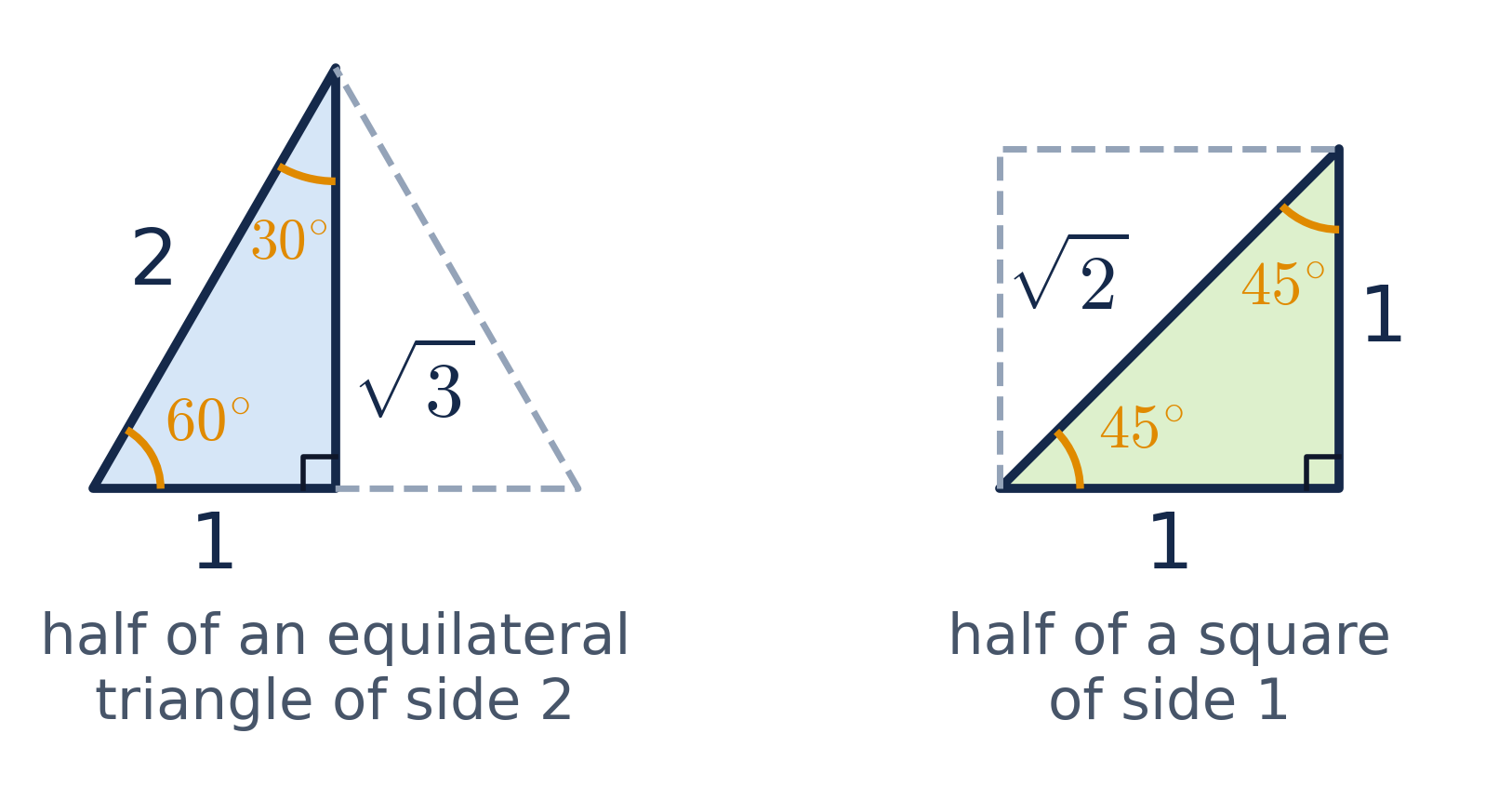
Cut an equilateral triangle of side 2 in half. The half has angles 30^\circ, 60^\circ, 90^\circ and sides 1, \sqrt{3}, 2. The shortest side, 1, is opposite the smallest angle, 30^\circ. So \sin 30^\circ = \frac{1}{2} and \tan 60^\circ = \frac{\sqrt{3}}{1} = \sqrt{3}.
Cut a square of side 1 along a diagonal. The half has angles 45^\circ, 45^\circ, 90^\circ and sides 1, 1, \sqrt{2}. So \sin 45^\circ = \cos 45^\circ = \frac{1}{\sqrt{2}} and \tan 45^\circ = 1.
At 0^\circ the perpendicular has shrunk to nothing, so \sin 0^\circ = 0 and \cos 0^\circ = 1. At 90^\circ the base has shrunk to nothing, so \sin 90^\circ = 1 and \cos 90^\circ = 0.
| \theta | 0^\circ | 30^\circ | 45^\circ | 60^\circ | 90^\circ |
|---|---|---|---|---|---|
| \sin\theta | 0 | \dfrac{1}{2} | \dfrac{1}{\sqrt{2}} | \dfrac{\sqrt{3}}{2} | 1 |
| \cos\theta | 1 | \dfrac{\sqrt{3}}{2} | \dfrac{1}{\sqrt{2}} | \dfrac{1}{2} | 0 |
| \tan\theta | 0 | \dfrac{1}{\sqrt{3}} | 1 | \sqrt{3} | not defined |
| \cot\theta | not defined | \sqrt{3} | 1 | \dfrac{1}{\sqrt{3}} | 0 |
| \sec\theta | 1 | \dfrac{2}{\sqrt{3}} | \sqrt{2} | 2 | not defined |
| \operatorname{cosec}\theta | not defined | 2 | \sqrt{2} | \dfrac{2}{\sqrt{3}} | 1 |
How to remember it. The sine row is \frac{\sqrt{0}}{2}, \frac{\sqrt{1}}{2}, \frac{\sqrt{2}}{2}, \frac{\sqrt{3}}{2}, \frac{\sqrt{4}}{2}. The cosine row is the sine row backwards. Then \tan = \frac{\sin}{\cos}, and the last three rows are the reciprocals of the first three. "Not defined" means a division by zero: \tan 90^\circ = \frac{1}{0} has no value.
Reading the table backwards. From 0^\circ to 90^\circ each ratio only rises or only falls (Chapter A4-1, section 6), so each value comes once. If \tan\theta = \sqrt{3} and \theta is acute, then \theta = 60^\circ and nothing else.
2. Complementary angles
Two angles are complementary when they add up to 90^\circ. The two acute angles of a right-angled triangle are complementary, and the perpendicular of one is the base of the other. So the ratios change partners:
\sin(90^\circ - \theta) = \cos\theta \qquad \tan(90^\circ - \theta) = \cot\theta
\sec(90^\circ - \theta) = \operatorname{cosec}\theta
Each also works the other way: \cos(90^\circ - \theta) = \sin\theta, and so on. For example \sin 35^\circ = \cos 55^\circ and \tan 20^\circ = \cot 70^\circ.
Three results come from this, and the paper asks all three.
- Equal ratios with changed names. If \sin A = \cos B, or \tan A = \cot B, and the angles are acute, then A + B = 90^\circ.
- A product equal to 1. If \tan A \tan B = 1 and the angles are acute, then \tan A = \cot B, so again A + B = 90^\circ. For example \tan 20^\circ \tan 70^\circ = 1.
- Squares that add to 1. \sin^2 25^\circ + \sin^2 65^\circ = \sin^2 25^\circ + \cos^2 25^\circ = 1, by the fact in the next section.
3. Greatest and least values
One fact from Pythagoras. In the right-angled triangle p^2 + b^2 = h^2. Divide by h^2:
\sin^2\theta + \cos^2\theta = 1
It is true for every angle. Chapter A4-3 studies it fully. Here we use it to change \cos^2\theta into 1 - \sin^2\theta.
The limits to know.
| Quantity | From 0^\circ to 90^\circ | For any angle at all |
|---|---|---|
| \sin\theta, \cos\theta | from 0 to 1 | from -1 to 1 |
| \sin^2\theta, \cos^2\theta | from 0 to 1 | from 0 to 1 |
| \sec\theta, \operatorname{cosec}\theta | 1 or more | never between -1 and 1 |
| \tan\theta, \cot\theta | 0 or more, with no upper limit | any value |
| \sin\theta + \cos\theta | from 1 to \sqrt{2} | from -\sqrt{2} to \sqrt{2} |
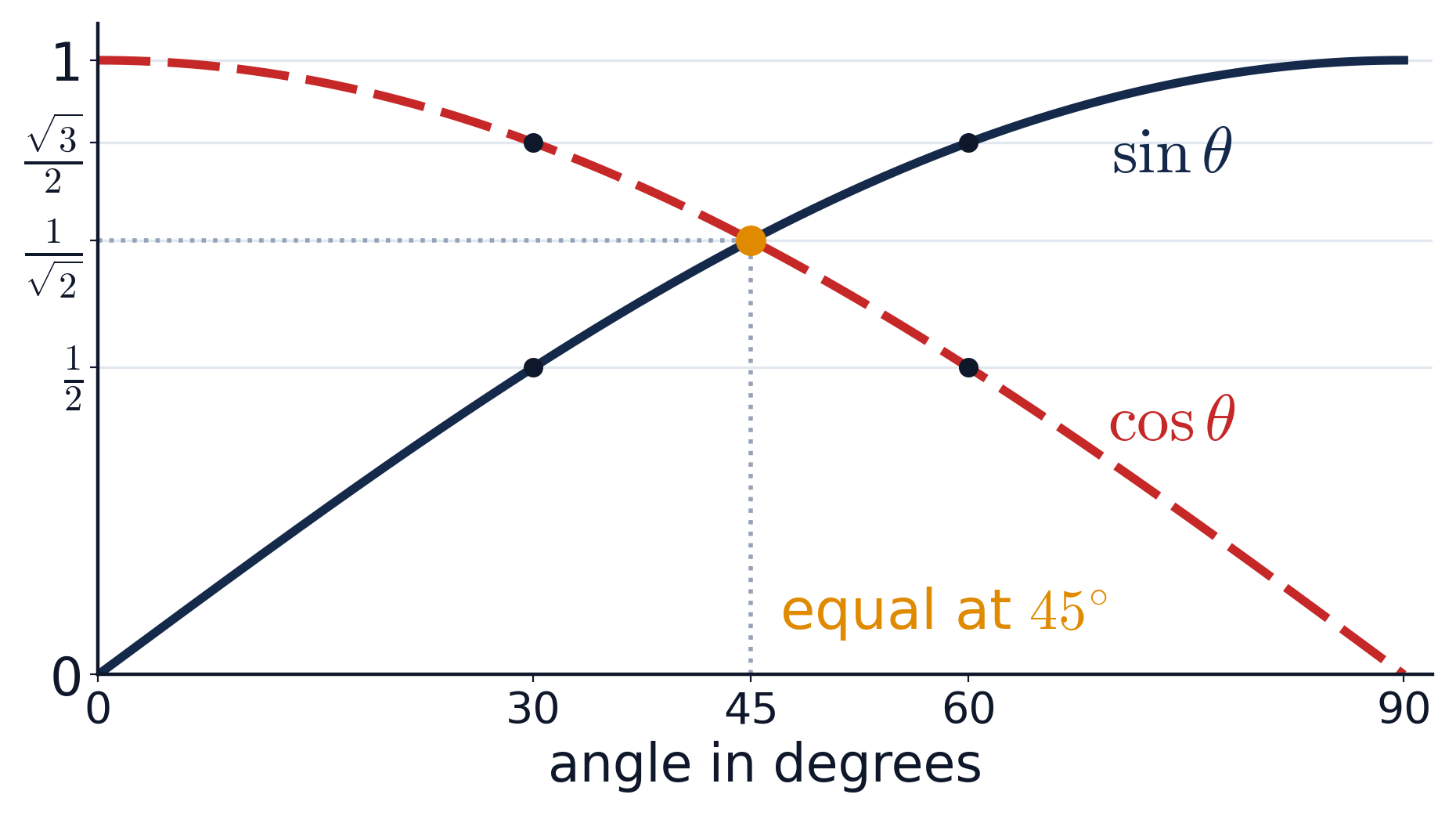
Most questions are one of four kinds.
Kind 1: squares of sine and cosine. Change everything to \sin^2\theta, which runs from 0 to 1. For example 2\sin^2\theta + 6\cos^2\theta = 2\sin^2\theta + 6(1 - \sin^2\theta) = 6 - 4\sin^2\theta. Its greatest value is 6 (when \sin^2\theta = 0) and its least value is 2 (when \sin^2\theta = 1). In short, a\sin^2\theta + b\cos^2\theta always lies between a and b.
Kind 2: a quadratic in \sin\theta. Write s = \sin\theta and complete the square, but remember that s cannot leave its range. Worked example 4 shows the trap.
Kind 3: a number plus its reciprocal. For a positive number x, the arithmetic mean of x and \frac{1}{x} is at least their geometric mean, which is 1. So
x + \frac{1}{x} \ge 2 \quad \text{with equality only when } x = 1
So for an acute angle \tan\theta + \cot\theta \ge 2 (equal at 45^\circ) and \sin\theta + \operatorname{cosec}\theta \ge 2 (equal at 90^\circ). The same rule for two positive numbers u and v reads u + v \ge 2\sqrt{uv}. So 4\tan^2\theta + 9\cot^2\theta \ge 2\sqrt{4 \times 9} = 12, because the two terms multiply to 36.
Kind 4: a\sin\theta + b\cos\theta. This is never more than \sqrt{a^2 + b^2}. The reason is one line of algebra:
(a\sin\theta + b\cos\theta)^2 + (b\sin\theta - a\cos\theta)^2 = a^2 + b^2
The second square is never negative, so the first is at most a^2 + b^2. With a = b = 1: \sin\theta + \cos\theta is at most \sqrt{2}, reached at 45^\circ. And 3\sin\theta + 4\cos\theta is never more than 5.
Is the equation possible? Compare the two sides with these limits. \sin\theta = \frac{5}{4} is impossible, and so is \sec\theta = \frac{1}{2}.
4. Trigonometric tables
A trigonometric table lists \sin, \cos and \tan for every angle from 0^\circ to 90^\circ, to four decimal places. It was the tool for angles outside the five in section 1 before calculators. None of the six papers studied printed a table, and none of their questions needed one. The exact values of section 1 were always enough. Two things from the table are still worth knowing.
- The decimal values of the standard ratios. \sqrt{2} \approx 1.414 and \sqrt{3} \approx 1.732, so \frac{1}{\sqrt{2}} \approx 0.707, \frac{\sqrt{3}}{2} \approx 0.866 and \frac{1}{\sqrt{3}} \approx 0.577.
- Placing an angle between two known ones. Since \tan rises with the angle, a value between two table values belongs to an angle between the two angles. If \tan\theta = \frac{4}{3} \approx 1.33, then 1 < 1.33 < 1.732, so \theta lies between 45^\circ and 60^\circ. CDS I 2024 Q97 asked exactly this, after a figure.
A table of sines is also a table of cosines read backwards, because \cos\theta = \sin(90^\circ - \theta).
Worked examples
Example 1. Find the value of 4\sin^2 60^\circ + 3\tan^2 30^\circ - 8\sin 45^\circ \cos 45^\circ.
\sin^2 60^\circ = \frac{3}{4}, \tan^2 30^\circ = \frac{1}{3} and \sin 45^\circ \cos 45^\circ = \frac{1}{\sqrt{2}} \times \frac{1}{\sqrt{2}} = \frac{1}{2}. The value is 4 \times \frac{3}{4} + 3 \times \frac{1}{3} - 8 \times \frac{1}{2} = 3 + 1 - 4 = 0.
Example 2. \sin(A + B) = 1 and \cos(A - B) = \frac{\sqrt{3}}{2}, where 0^\circ \le A - B \le A + B \le 90^\circ. Find A and B.
Read the table backwards. \sin(A + B) = 1 gives A + B = 90^\circ. \cos(A - B) = \frac{\sqrt{3}}{2} gives A - B = 30^\circ. Adding, 2A = 120^\circ. So A = 60^\circ and B = 30^\circ.
Example 3. (i) Find \sin^2 25^\circ + \sin^2 65^\circ + \tan 20^\circ \tan 70^\circ. (ii) If \sin 5\theta = \cos 4\theta, where 5\theta is acute, find \theta.
(i) 65^\circ = 90^\circ - 25^\circ, so \sin 65^\circ = \cos 25^\circ and the first two terms add to 1. 70^\circ = 90^\circ - 20^\circ, so \tan 70^\circ = \cot 20^\circ and the product is 1. The value is 1 + 1 = 2.
(ii) The names differ and the values are equal, so the angles add up to 90^\circ: 5\theta + 4\theta = 90^\circ and \theta = 10^\circ. Check: \sin 50^\circ = \cos 40^\circ.
Example 4. Find the least and greatest values of \sin^2\theta - 4\sin\theta + 5 for 0^\circ \le \theta \le 90^\circ.
Write s = \sin\theta. Then s^2 - 4s + 5 = (s - 2)^2 + 1. It is tempting to say "the least value is 1, when s = 2". But \sin\theta cannot be 2. Here s runs only from 0 to 1, and over that range (s - 2)^2 gets smaller as s gets nearer to 2. So the least value is at s = 1: (1 - 2)^2 + 1 = 2. The greatest is at s = 0: (0 - 2)^2 + 1 = 5.
From the real papers
These six questions are from the Elementary Mathematics papers of CDS I 2024, CDS I 2025 and CDS II 2025 (Series A). The answers agree with the final official key. Try each for 72 seconds before reading the solution.
CDS I 2024, Q12. What is the difference between the greatest value and the least value of \cos^2\theta + 3\sin^2\theta + 2?
(a) 4 (b) 3 (c) 2 (d) 1
Solution. Kind 1. Put \cos^2\theta = 1 - \sin^2\theta: the expression is 1 - \sin^2\theta + 3\sin^2\theta + 2 = 3 + 2\sin^2\theta. Since \sin^2\theta runs from 0 to 1, the least value is 3 and the greatest is 5. The difference is 2. Answer (c).
CDS I 2024, Q51. If \tan(3A) = \cot(A - 22°), where 3A is an acute angle, then what is the value of A?
(a) 25° (b) 27° (c) 28° (d) 30°
Solution. A tangent equals a cotangent, so the two angles add up to 90^\circ: 3A + A - 22^\circ = 90^\circ. Then 4A = 112^\circ and A = 28^\circ. Check: 3A = 84^\circ and A - 22^\circ = 6^\circ. Answer (c).
CDS I 2024, Q34. What is the minimum value of \frac{\sin^2 A + 5 \sin A + 1}{\sin A} for 0 < A \le \frac{\pi}{2}?
(a) 3 (b) 5 (c) 7 (d) 9
Solution. Divide each term by \sin A: the expression is \sin A + \frac{1}{\sin A} + 5. In the given range \sin A is positive. Kind 3: a positive number plus its reciprocal is at least 2, with equality when the number is 1. Here \sin A = 1 is allowed, at A = \frac{\pi}{2}. The minimum is 2 + 5 = 7. Answer (c).
CDS I 2025, Q28. If \cot^2 \theta - 3\sqrt{3} \cot \theta + 6 = 0, where \frac{\pi}{6} \le \theta < \frac{\pi}{2}, then what is a value of \sin \theta + \cos 2\theta?
(a) 0 (b) 1 (c) \sqrt{3} (d) 1 + \sqrt{2}
Solution. It is a quadratic in \cot\theta. By the formula, \cot\theta = \frac{3\sqrt{3} \pm \sqrt{27 - 24}}{2} = \frac{3\sqrt{3} \pm \sqrt{3}}{2}, so \cot\theta = 2\sqrt{3} or \sqrt{3}. Now use the range. \cot falls as the angle grows, and \cot 30^\circ = \sqrt{3}. So from 30^\circ upwards \cot\theta is at most \sqrt{3}, and 2\sqrt{3} is ruled out. Then \cot\theta = \sqrt{3} and \theta = 30^\circ. Here \cos 2\theta means the cosine of the angle 2\theta = 60^\circ. The value is \sin 30^\circ + \cos 60^\circ = \frac{1}{2} + \frac{1}{2} = 1. Answer (b).
CDS I 2025, Q29. Which of the following equations is/are possible?
I. \sin^2 \theta = \frac{(x + y)^2}{4xy}, where x, y are positive unequal real quantities.
II. \sin \theta + \cos \theta = x + \frac{1}{x}, where x is a positive real quantity.
Select the correct answer using the code given below :
(a) I only (b) II only (c) Both I and II (d) Neither I nor II
Solution. Compare the limits of the two sides. I. (x + y)^2 - 4xy = (x - y)^2, which is more than 0 when x \ne y. So (x + y)^2 > 4xy and the right side is more than 1. But \sin^2\theta is never more than 1. Not possible. II. The right side is at least 2 (Kind 3). The left side is at most \sqrt{2} \approx 1.414 (Kind 4). Not possible. Answer (d).
CDS II 2025, Q31. If \sqrt{2 + \sqrt{2 + \sqrt{2 + \sqrt{2 + \ldots}}}} = \operatorname{cosec}\theta, then what is \sin\theta equal to?
(a) 1 (b) \frac{\sqrt{3}}{2} (c) \frac{1}{\sqrt{2}} (d) \frac{1}{2}
Solution. Call the endless root y. What stands under the first root sign after "2 +" is the same endless root again. So y = \sqrt{2 + y}. Squaring, y^2 - y - 2 = 0, that is (y - 2)(y + 1) = 0. As y is positive, y = 2. So \operatorname{cosec}\theta = 2 and \sin\theta = \frac{1}{2}. Answer (d).
Four of the six were settled by a limit or by "the angles add up to 90^\circ". None needed a long calculation.
Mistakes that cost marks
- Exchanging the values at 30^\circ and 60^\circ. \sin 30^\circ = \frac{1}{2}, not \frac{\sqrt{3}}{2}. The smaller angle has the smaller sine. The triangle with sides 1, \sqrt{3}, 2 settles it in five seconds.
- Treating \sin as something to multiply out. \sin(A + B) is not \sin A + \sin B: \sin 60^\circ = \frac{\sqrt{3}}{2}, but \sin 30^\circ + \sin 30^\circ = 1. In the same way \sin 2\theta is not 2\sin\theta.
- Taking the least value where \sin\theta cannot go. (\sin\theta - 2)^2 + 1 is never 1, because \sin\theta is never 2. Check that the value of \sin\theta you need lies in the range.
- From \tan A \tan B = 1, writing A = B. The angles are complementary, A + B = 90^\circ. They are equal only when both are 45^\circ.
Quick check
Do these without help. Answers are at the end.
- Find the value of 2\tan^2 45^\circ + \cos^2 30^\circ - \sin^2 60^\circ.
- If \tan 2A = \cot(A - 18^\circ), where 2A is an acute angle, find A.
- Find the greatest and least values of 3\cos^2\theta + 5\sin^2\theta.
- For an acute angle \theta, what is the least value of 9\tan^2\theta + 4\cot^2\theta?
- Can \cos\theta = x + \frac{1}{x} be true for a positive number x?
Read and watch more, free
The NCERT and NIOS books teach the table of values. The questions on greatest and least values are not in those books; for them, this lesson and the past papers are the material.
| What | Where | Language |
|---|---|---|
| Textbook, ratios of specific angles | NCERT Class 10 Mathematics, Chapter 8 Introduction to Trigonometry · Hindi edition | English, Hindi |
| Self-study notes | NIOS Secondary Mathematics (211), Lesson 23 Trigonometric Ratios of Some Special Angles · Hindi edition | English, Hindi |
| Practice with answers | NCERT Exemplar Class 10, Unit 8 Trigonometry · Hindi edition | English, Hindi |
| Short videos with practice | Khan Academy, NCERT Math Class 10 (the trigonometry unit) · in Hindi | English, Hindi |
| The real papers | UPSC previous question papers | English, Hindi |
| Video, numbered classes | Chandigarh Career Group: CDS advance maths by Sandeep Brar (the ten trigonometry classes) | Hinglish |
| Video, a full CDS course | R.S SIR: Maths Playlist for CDS 2025 (the four trigonometry lessons, about 55 minutes each) | Hindi and Hinglish |
| Video, in Hindi | Rojgar with Ankit Defence: CDS 01 2025, Maths By Neeraj Baisla Sir (the trigonometry lessons) | Hindi |
The videos were chosen from their titles, length and views; they have not yet been watched by a teacher.
Answers to the quick check
- \cos^2 30^\circ and \sin^2 60^\circ are both \frac{3}{4}, so they cancel. The value is 2 \times 1 = 2.
- The angles add up to 90^\circ: 2A + A - 18^\circ = 90^\circ, so A = 36^\circ.
- 3(1 - \sin^2\theta) + 5\sin^2\theta = 3 + 2\sin^2\theta. The least value is 3 and the greatest is 5.
- 9\tan^2\theta + 4\cot^2\theta \ge 2\sqrt{9 \times 4} = 12. The least value is 12.
- No. For positive x the right side is at least 2, and \cos\theta is never more than 1.
Next chapter: Trigonometric identities: proving and simplifying.