Why this chapter matters. This chapter gave 8 questions in the 6 papers from CDS I 2024 to CDS II 2026. Two of them change radians to degrees or use the length of an arc. One compares two ratios of the same angle. The other five give a right-angled triangle, in words or in a printed figure, and ask for a ratio read from its sides. The chapter is also the base of the unit: the four trigonometry chapters after it gave 77 more questions in the same papers, and every one of them uses the six ratios taught here.
What you will be able to do
- Change an angle from degrees to radians and back, and use l = r\theta for the length of an arc.
- Write the six trigonometric ratios of an angle from the sides of a right-angled triangle.
- Find all six ratios when one of them is given.
- Say which of two ratios of the same angle is greater, without a table.
Before you start you should know: the theorem of Pythagoras (in a right-angled triangle, the square of the longest side is the sum of the squares of the other two; it is taught in full in Chapter A5-3), the circumference of a circle 2\pi r, and how to solve two linear equations (Chapter A3-5).
1. Two units for one angle
An angle measures how much a line has turned about a point. One full turn can be divided in two ways.
Degrees. One full turn is 360^\circ. A right angle is 90^\circ.
Radians. Take a circle of radius r. Mark an arc whose length is also r. The angle this arc makes at the centre is 1 radian. The whole circumference is 2\pi r, so it holds 2\pi such arcs. One full turn is therefore 2\pi radians.
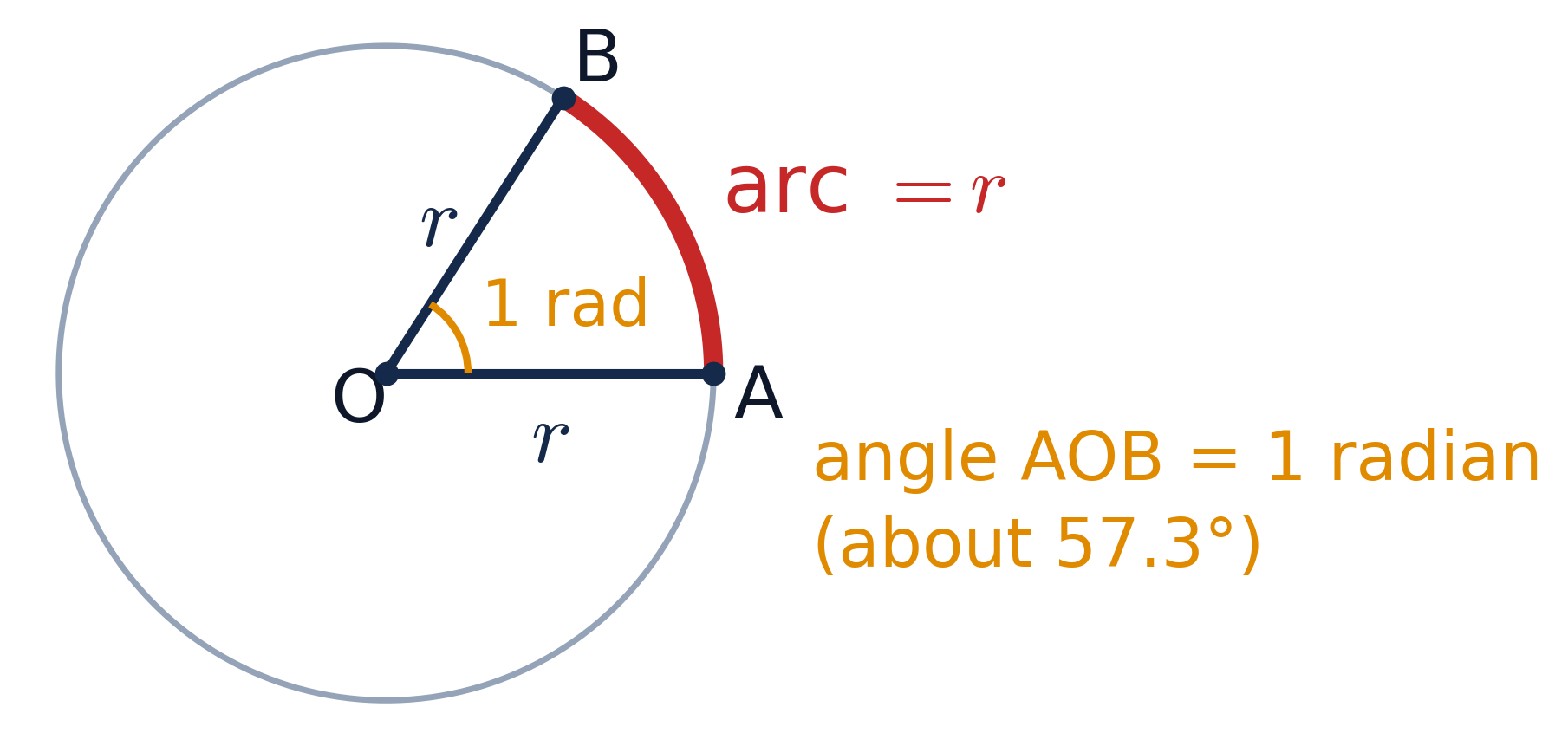
2\pi \text{ radians} = 360^\circ \qquad \text{so} \qquad \pi \text{ radians} = 180^\circ
The CDS paper writes many angles in radians. When an angle has no unit, as in 0 < \theta < \frac{\pi}{2}, the unit is radians. That line only means "\theta is between 0^\circ and 90^\circ".
2. Changing from one unit to the other
Everything comes from \pi radians = 180^\circ.
- Degrees to radians: multiply by \dfrac{\pi}{180}. For example, 75^\circ = 75 \times \dfrac{\pi}{180} = \dfrac{5\pi}{12}.
- Radians to degrees: replace \pi by 180^\circ. For example, \dfrac{7\pi}{12} = \dfrac{7 \times 180^\circ}{12} = 105^\circ.
Learn this table. These angles come again and again.
| Degrees | 15^\circ | 30^\circ | 45^\circ | 60^\circ | 90^\circ | 180^\circ | 360^\circ |
|---|---|---|---|---|---|---|---|
| Radians | \dfrac{\pi}{12} | \dfrac{\pi}{6} | \dfrac{\pi}{4} | \dfrac{\pi}{3} | \dfrac{\pi}{2} | \pi | 2\pi |
3. The length of an arc
If an arc of length l makes an angle of \theta radians at the centre of a circle of radius r, then
l = r\theta
This is only the definition of the radian used again: an arc of length r makes 1 radian, so an arc of length r\theta makes \theta radians.
For example, in a circle of radius 6 cm an angle of 60^\circ = \frac{\pi}{3} cuts off an arc of length 6 \times \frac{\pi}{3} = 2\pi cm. Check it the school way: 60^\circ is one sixth of a full turn, and one sixth of the circumference 12\pi is 2\pi.
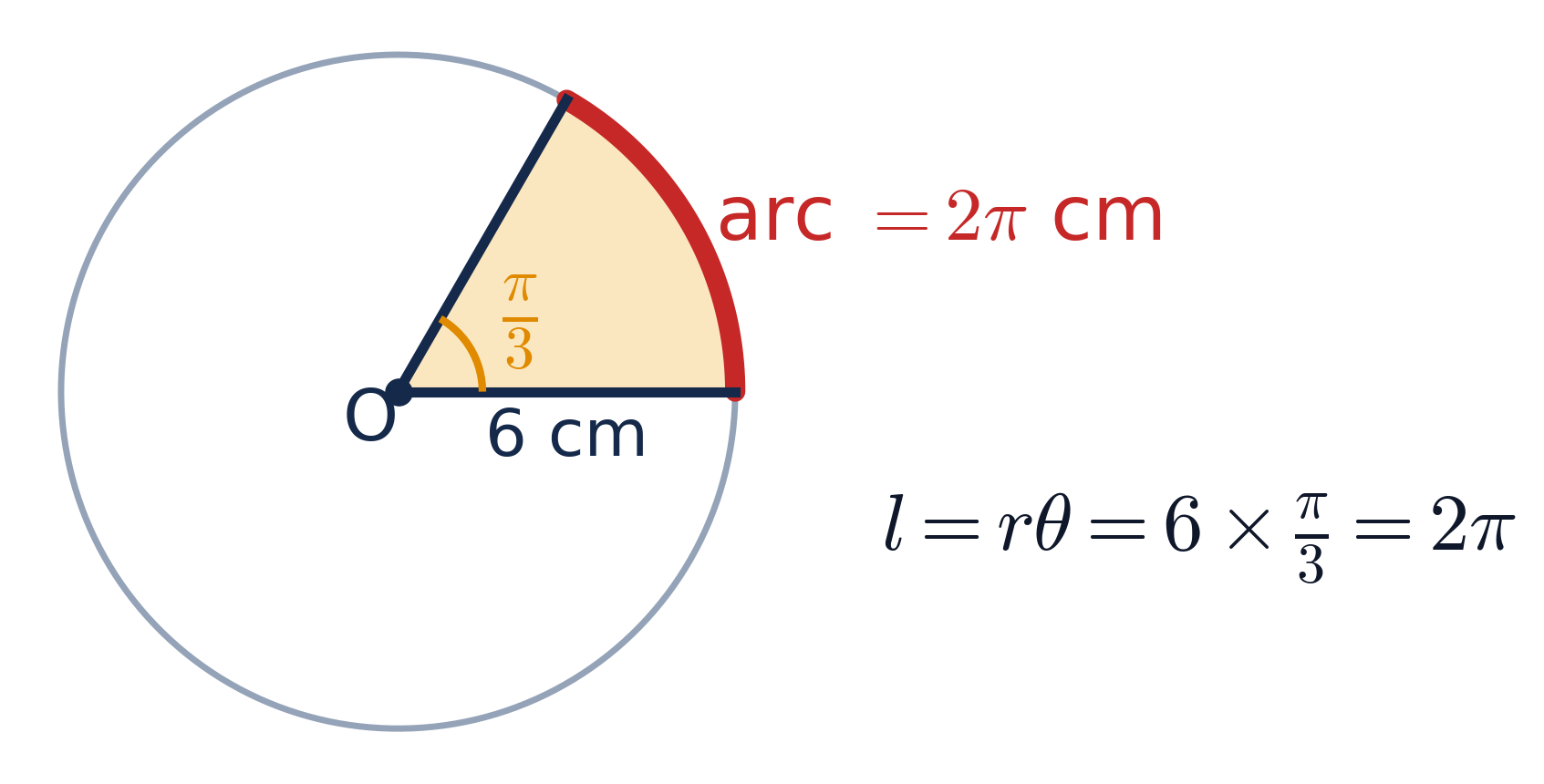
The formula needs \theta in radians. If the angle is given in degrees, change it first. (The area of a sector is in Chapter A6-3.)
4. The six ratios
Take a right-angled triangle and one of its acute angles, \theta. Name the sides from that angle:
- the side opposite \theta is the perpendicular, p;
- the side next to \theta (not the longest one) is the base, b;
- the side opposite the right angle, the longest, is the hypotenuse, h.
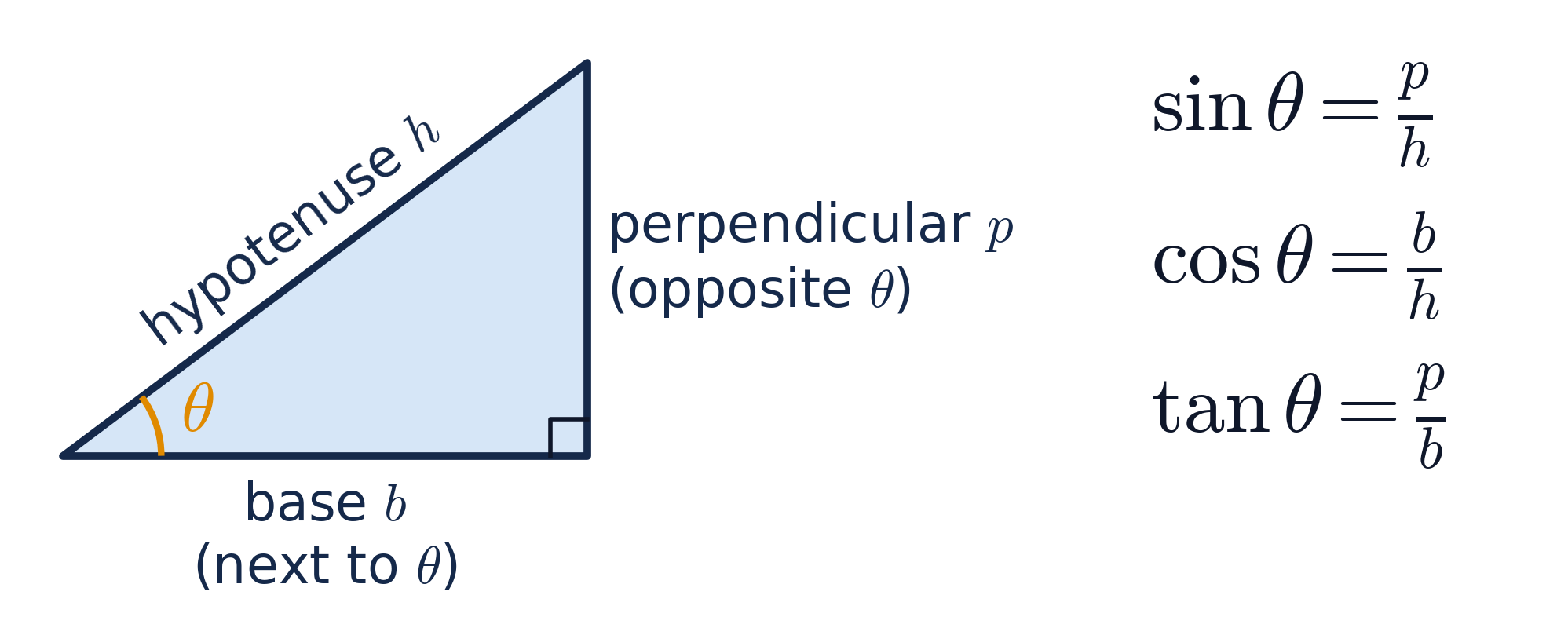
| Ratio | Meaning | Its reciprocal | Meaning |
|---|---|---|---|
| \sin\theta | \dfrac{p}{h} | \operatorname{cosec}\theta | \dfrac{h}{p} |
| \cos\theta | \dfrac{b}{h} | \sec\theta | \dfrac{h}{b} |
| \tan\theta | \dfrac{p}{b} | \cot\theta | \dfrac{b}{p} |
Two more links follow at once, by dividing: \tan\theta = \dfrac{\sin\theta}{\cos\theta} and \cot\theta = \dfrac{\cos\theta}{\sin\theta}.
Take the triangle with sides 3, 4 and 5 (it is right-angled because 3^2 + 4^2 = 5^2). For the angle opposite the side 3: \sin\theta = \frac{3}{5}, \cos\theta = \frac{4}{5}, \tan\theta = \frac{3}{4}, \operatorname{cosec}\theta = \frac{5}{3}, \sec\theta = \frac{5}{4}, \cot\theta = \frac{4}{3}.
Three facts to keep.
- The ratios belong to the angle, not to the size of the triangle. A triangle with sides 6, 8, 10 has the same shape, and \frac{6}{10} = \frac{3}{5} again.
- For the other acute angle, p and b change places. For the angle opposite the side 4, the sine is \frac{4}{5} and the cosine is \frac{3}{5}. The two acute angles of a right-angled triangle add up to 90^\circ. Chapter A4-2 builds on this.
- \sin\theta is one number. It is not "\sin times \theta". The square of \sin\theta is written \sin^2\theta.
In this course every angle is from 0^\circ to 90^\circ, so no ratio is negative. The paper calls this range "the first quadrant" or "\theta is acute".
5. From one ratio to all six
If one ratio is given, draw a right-angled triangle that fits it, find the third side by Pythagoras, and read the others.
Suppose \tan\theta = \frac{5}{12}. Take p = 5 and b = 12. Then h = \sqrt{25 + 144} = 13. So \sin\theta = \frac{5}{13}, \cos\theta = \frac{12}{13} and \sec\theta = \frac{13}{12}.
The third side is not always a whole number. If \sin\theta = \frac{2}{3}, take p = 2 and h = 3. Then b = \sqrt{9 - 4} = \sqrt{5}, so \cos\theta = \frac{\sqrt{5}}{3} and \tan\theta = \frac{2}{\sqrt{5}}.
The paper likes triangles whose three sides are whole numbers. Knowing these sets saves the square root: (3, 4, 5), (5, 12, 13), (8, 15, 17), (7, 24, 25), (20, 21, 29) and (9, 40, 41). Multiples work too, such as (6, 8, 10) and (9, 12, 15).
6. How the ratios change as the angle grows
Keep the hypotenuse fixed and let \theta grow from 0^\circ to 90^\circ. The perpendicular grows and the base shrinks. So:
- \sin\theta and \tan\theta increase; \cos\theta and \cot\theta decrease.
- \sin\theta and \cos\theta are never more than 1, because no side is longer than the hypotenuse. So \operatorname{cosec}\theta and \sec\theta are never less than 1.
- At 45^\circ the triangle has p = b, so \sin 45^\circ = \cos 45^\circ and \tan 45^\circ = \cot 45^\circ = 1.
| Angle | Sine and cosine | Tangent and cotangent |
|---|---|---|
| less than 45^\circ | \sin\theta < \cos\theta | \tan\theta < 1 < \cot\theta |
| 45^\circ | equal | both 1 |
| more than 45^\circ | \sin\theta > \cos\theta | \tan\theta > 1 > \cot\theta |
A reciprocal turns the order round: where \sin\theta < \cos\theta, we have \operatorname{cosec}\theta > \sec\theta.
Worked examples
Example 1. Change 75^\circ to radians and \frac{7\pi}{12} radians to degrees.
75 \times \dfrac{\pi}{180} = \dfrac{5\pi}{12}. For the second, replace \pi by 180^\circ: \dfrac{7 \times 180^\circ}{12} = 105^\circ.
Example 2. An arc of length 5\pi cm lies on a circle of radius 15 cm. What angle does it make at the centre?
\theta = \dfrac{l}{r} = \dfrac{5\pi}{15} = \dfrac{\pi}{3} radians, which is 60^\circ. Check: the circumference is 30\pi cm, and 5\pi is one sixth of it.
Example 3. \theta is acute and \cos\theta = \frac{8}{17}. Find \sin\theta, \tan\theta and \sec\theta + \tan\theta.
Take b = 8 and h = 17. Then p = \sqrt{17^2 - 8^2} = \sqrt{225} = 15. So \sin\theta = \frac{15}{17} and \tan\theta = \frac{15}{8}. Also \sec\theta = \frac{17}{8}, so \sec\theta + \tan\theta = \frac{17 + 15}{8} = 4.
Example 4. For an acute angle \alpha, consider the statements: (1) \sin\alpha is always less than \tan\alpha. (2) \sec\alpha is always greater than \tan\alpha. Which is correct?
Write each ratio with the sides. (1) \sin\alpha = \frac{p}{h} and \tan\alpha = \frac{p}{b}. The tops are the same and h > b, so \frac{p}{h} < \frac{p}{b}. Correct. (2) \sec\alpha = \frac{h}{b} and \tan\alpha = \frac{p}{b}. The bottoms are the same and h > p. Correct. Both statements are correct.
From the real papers
These three questions are from the Elementary Mathematics papers of CDS I 2025 and CDS II 2025 (Series A). The answers agree with the final official key. Try each for 72 seconds before reading the solution.
CDS I 2025, Q27. The length of an arc of a circle of radius 4 cm is \pi cm. What is the magnitude of the angle subtended by the arc at the centre?
(a) \pi (b) \pi/2 (c) \pi/3 (d) \pi/4
Solution. \theta = \dfrac{l}{r} = \dfrac{\pi}{4} radian. Check: the circumference is 8\pi cm, the arc is one eighth of it, and one eighth of 360^\circ is 45^\circ = \frac{\pi}{4}. Answer (d).
CDS II 2025, Q36. The difference between the two acute angles in a right-angled triangle is \frac{\pi}{12} radian. One of the acute angles of the triangle is
(a) 60^\circ (b) 57 \cdot 5^\circ (c) 52 \cdot 5^\circ (d) 47 \cdot 5^\circ
Solution. \frac{\pi}{12} radian is \frac{180^\circ}{12} = 15^\circ. The two acute angles of a right-angled triangle add up to 90^\circ. So A + B = 90^\circ and A - B = 15^\circ. Adding, 2A = 105^\circ, so A = 52.5^\circ and B = 37.5^\circ. (The paper prints the decimal point as a raised dot.) Answer (c).
CDS I 2025, Q24. Consider the following statements :
I. (\text{cosec}\, \alpha - \sec \alpha) is always positive in the first quadrant.
II. (\tan \alpha - \cot \alpha) is always negative in the first quadrant.
Which of the statements given above is/are correct?
(a) I only (b) II only (c) Both I and II (d) Neither I nor II
Solution. "Always" means that one angle that fails is enough. Use section 6 with an angle above 45^\circ. There \sin\alpha > \cos\alpha, so \operatorname{cosec}\alpha < \sec\alpha and the first difference is negative. Statement I is not correct. Above 45^\circ also \tan\alpha > 1 > \cot\alpha, so the second difference is positive. Statement II is not correct. (Each statement is true only below 45^\circ.) Answer (d).
From CDS II 2024: no official key was published; the answer is our own working
CDS II 2024, Q56. (One of two questions on these lines.) ABC is a triangle right-angled at B. Given that AC - AB = 2 cm and BC = 16 cm
If \angle BAC = \theta then what is \sin\theta + \cos\theta equal to?
(a) 1 (b) \frac{71}{65} (c) \frac{73}{65} (d) \frac{79}{65}
Solution. AC is the hypotenuse. By Pythagoras AC^2 - AB^2 = BC^2 = 256. The left side is (AC - AB)(AC + AB) and AC - AB = 2, so AC + AB = 128. Adding and subtracting the two, AC = 65 and AB = 63. For the angle at A the opposite side is BC = 16 and the base is AB = 63. So \sin\theta = \frac{16}{65}, \cos\theta = \frac{63}{65}, and the sum is \frac{79}{65}. Answer (d).
CDS II 2024, Q52. (One of three questions on these lines.) Let ABC be a triangle right-angled at B. Let P be the point on BC such that BP = PC. If AB = 10 cm, \angle BAP = 45^\circ and \angle CAP = \theta \left(\text{use } \tan(\alpha + \beta) = \frac{\tan\alpha + \tan\beta}{1 - \tan\alpha\tan\beta}\right)
If \angle ACP = \gamma, then what is \tan\gamma equal to?
(a) \frac{1}{2} (b) \frac{1}{3} (c) \frac{2}{3} (d) 1
Solution. In the right-angled triangle ABP the angle at A is 45^\circ, so \tan 45^\circ = \frac{BP}{AB} = 1 and BP = 10 cm. As BP = PC, BC = 20 cm. P lies on BC, so the angle ACP is the angle C of the triangle ABC. For that angle the opposite side is AB = 10 and the base is BC = 20. So \tan\gamma = \frac{10}{20} = \frac{1}{2}. The formula in the bracket is not needed for this part. Answer (a).
All five needed only the definitions and one small fact. The work is in naming the sides correctly for the angle that is asked.
Mistakes that cost marks
- Using l = r\theta with \theta in degrees. The formula works only in radians. For a 60^\circ angle use \theta = \frac{\pi}{3}, not 60.
- Writing "\pi = 180". The number \pi is always about 3.14. The correct statement is "\pi radians = 180^\circ".
- Keeping the same perpendicular for both acute angles. The perpendicular is the side opposite the angle you are working with. Change the angle and it changes. Only the hypotenuse stays.
- Testing an "always" statement with one easy angle. Statements such as those in CDS I 2025 Q24 are true on one side of 45^\circ and false on the other. Test one angle below 45^\circ and one above.
Quick check
Do these without help. Answers are at the end.
- Change 54^\circ to radians.
- A circle has radius 10 cm. Find the length of the arc that makes an angle of 36^\circ at the centre.
- \theta is acute and \sin\theta = \frac{7}{25}. Find \cos\theta and \tan\theta.
- The two acute angles of a right-angled triangle differ by \frac{\pi}{6} radian. Find the larger one in degrees.
- For \theta = 20^\circ, which is greater: \sin\theta or \cos\theta? \tan\theta or \cot\theta?
Read and watch more, free
The NCERT and NIOS books teach the six ratios well. NCERT Class 10 does not teach radians or the arc formula; for those, this lesson and the past papers are the material.
| What | Where | Language |
|---|---|---|
| Textbook, the six ratios | NCERT Class 10 Mathematics, Chapter 8 Introduction to Trigonometry · Hindi edition | English, Hindi |
| Self-study notes | NIOS Secondary Mathematics (211), Lesson 22 Introduction to Trigonometry · Hindi edition | English, Hindi |
| Practice with answers | NCERT Exemplar Class 10, Unit 8 Trigonometry · Hindi edition | English, Hindi |
| Short videos with practice | Khan Academy, NCERT Math Class 10 (the trigonometry unit) · in Hindi | English, Hindi |
| The real papers | UPSC previous question papers | English, Hindi |
| Video, numbered classes | Chandigarh Career Group: CDS advance maths by Sandeep Brar (the ten trigonometry classes) | Hinglish |
| Video, a full CDS course | R.S SIR: Maths Playlist for CDS 2025 (the four trigonometry lessons, about 55 minutes each) | Hindi and Hinglish |
| Video, in Hindi | Rojgar with Ankit Defence: CDS 01 2025, Maths By Neeraj Baisla Sir (the trigonometry lessons) | Hindi |
The videos were chosen from their titles, length and views; they have not yet been watched by a teacher.
Answers to the quick check
- 54 \times \frac{\pi}{180} = \frac{3\pi}{10}.
- 36^\circ = \frac{\pi}{5} radians, so l = 10 \times \frac{\pi}{5} = 2\pi cm.
- b = \sqrt{25^2 - 7^2} = \sqrt{576} = 24. So \cos\theta = \frac{24}{25} and \tan\theta = \frac{7}{24}.
- \frac{\pi}{6} radian is 30^\circ. A + B = 90^\circ and A - B = 30^\circ give A = 60^\circ.
- 20^\circ is less than 45^\circ, so \cos\theta is greater than \sin\theta, and \cot\theta is greater than \tan\theta.
Next chapter: Values at 0, 30, 45, 60, 90 degrees; complementary angles; greatest and least values; tables.