Why this chapter matters. This chapter gave 6 questions in the 6 papers from CDS I 2024 to CDS II 2026: four in CDS I 2024 and two in CDS I 2025. The other four papers had none. The syllabus does not name sequences, but the paper asks them all the same. Two of the six ask for the sum of an arithmetic progression that you must first find inside a word question. Three use the arithmetic mean and the geometric mean of numbers. One is a sum whose terms cancel in pairs.
What you will be able to do
- Find any term, the number of terms and the sum of an arithmetic progression (AP).
- Find any term and the sum of a geometric progression (GP).
- Find the arithmetic, geometric and harmonic means, and use the fact that the arithmetic mean is never less than the geometric mean.
- Find the nth term when the sum of n terms is given.
Before you start you should know: how to work with fractions and powers (Chapter A3-4), how to solve two linear equations together (Chapter A3-5), and the identity (a - b)^2 = (a + b)^2 - 4ab (Chapter A3-1).
1. Sequences
A sequence is a list of numbers in a fixed order: a_1, a_2, a_3, \dots The number a_n is called the nth term. A progression is a sequence whose terms follow one fixed rule.
S_n means the sum of the first n terms: S_n = a_1 + a_2 + \dots + a_n.
If you take the sum of the first n - 1 terms away from the sum of the first n terms, only the nth term is left:
a_n = S_n - S_{n-1}
For example, if S_n = n^2, then a_n = n^2 - (n-1)^2 = 2n - 1. The terms are 1, 3, 5, \dots
2. Arithmetic progression (AP)
In an AP each term is the term before it plus a fixed number d, called the common difference. With first term a, the AP is a,\; a + d,\; a + 2d,\; \dots
a_n = a + (n-1)d \qquad\qquad S_n = \frac{n}{2}\left[2a + (n-1)d\right] = \frac{n}{2}(a + l)
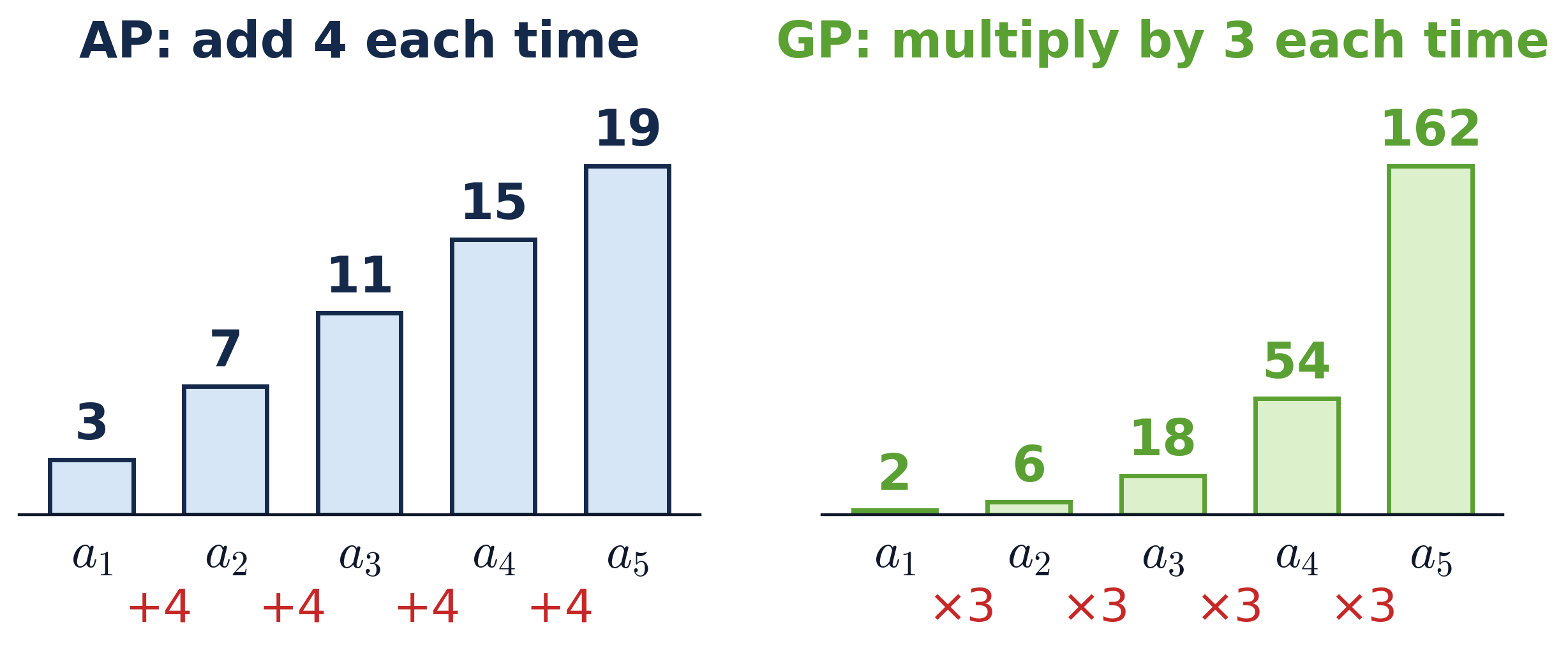
Here l is the last term. In 3, 7, 11, \dots we have a = 3 and d = 4. The 20th term is 3 + 19 \times 4 = 79. The sum of 20 terms is \frac{20}{2}(3 + 79) = 820.
The second form of the sum says: number of terms, times the average of the first and the last. It is the faster form whenever the last term is known.
Counting the terms. When the first and last terms are known,
n = \frac{\text{last} - \text{first}}{d} + 1
The list 12, 15, 18, \dots, 99 has \frac{99 - 12}{3} + 1 = 30 terms. Do not forget the +1.
Three more facts about an AP:
- a, b, c are in AP exactly when 2b = a + c.
- Terms at equal distance from the two ends have the same sum. In 2, 5, 8, 11, 14, 17: 2 + 17 = 5 + 14 = 8 + 11 = 19.
- When is the sum greatest? If d is negative, the terms fall. The sum grows while the terms are positive and falls once they are negative. So add up to the last positive term. For 20, 16, 12, 8, 4, 0, -4, \dots the greatest sum is 20 + 16 + 12 + 8 + 4 = 60.
3. Geometric progression (GP)
In a GP each term is the term before it multiplied by a fixed number r, called the common ratio. With first term a, the GP is a,\; ar,\; ar^2,\; \dots
a_n = ar^{n-1} \qquad\qquad S_n = \frac{a(r^n - 1)}{r - 1} \quad (r \ne 1)
In 2, 6, 18, \dots we have a = 2 and r = 3. The 6th term is 2 \times 3^5 = 486. The sum of 6 terms is \dfrac{2(3^6 - 1)}{3 - 1} = 728.
a, b, c are in GP exactly when b^2 = ac. Check: 6^2 = 2 \times 18.
The picture shows the AP of section 2 and this GP side by side. An AP grows by equal steps. A GP grows by equal multiples.
4. The three means
For two positive numbers a and b:
| Mean | Formula | For 4 and 16 |
|---|---|---|
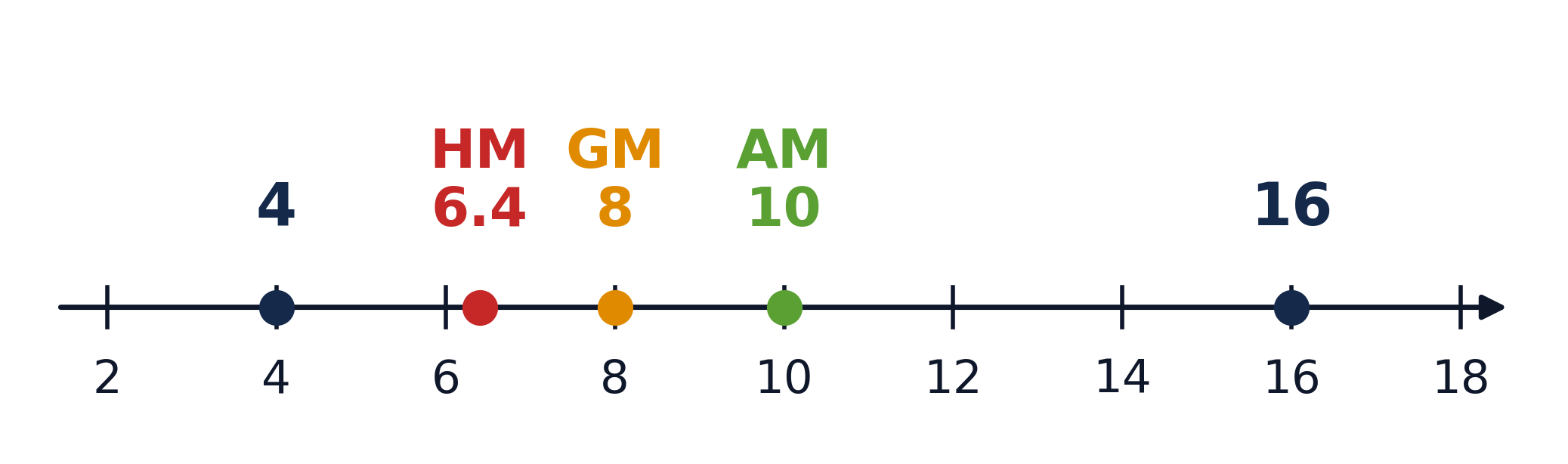
| Arithmetic mean (AM) | A = \dfrac{a + b}{2} | 10 |
| Geometric mean (GM) | G = \sqrt{ab} | 8 |
| Harmonic mean (HM) | H = \dfrac{2ab}{a + b} | 6.4 |
The AM is the middle term of the AP a, A, b. The GM is the middle term of the GP a, G, b.
Three facts are asked:
- A \ge G \ge H. They are all equal only when a = b.
- G^2 = AH. Check: 8^2 = 64 = 10 \times 6.4.
- If you know the AM and the GM, you know the sum and the product: a + b = 2A and ab = G^2.
More than two numbers. The AM of n numbers is their sum divided by n. The GM of n positive numbers is the nth root of their product. So if the GM of n numbers is G, their product is G^n. For example, the GM of 2, 4, 8 is \sqrt[3]{64} = 4.
The most useful result of AM \ge GM. Take a positive number x and its reciprocal \dfrac{1}{x}. Their AM is at least their GM, and their GM is \sqrt{x \times \frac{1}{x}} = 1. So
x + \frac{1}{x} \ge 2 \qquad (x > 0)
The value 2 is reached when x = 1. This rule holds for positive numbers only.
5. The formulas in one place
| AP | GP | |
|---|---|---|
| Rule | add d each time | multiply by r each time |
| nth term | a + (n-1)d | ar^{n-1} |
| Sum of n terms | \dfrac{n}{2}\left[2a + (n-1)d\right] or \dfrac{n}{2}(a + l) | \dfrac{a(r^n - 1)}{r - 1} |
| a, b, c are in it when | 2b = a + c | b^2 = ac |
Four sums to remember:
| Sum | Value |
|---|---|
| 1 + 2 + 3 + \dots + n | \dfrac{n(n+1)}{2} |
| 1^2 + 2^2 + 3^2 + \dots + n^2 | \dfrac{n(n+1)(2n+1)}{6} |
| 1^3 + 2^3 + 3^3 + \dots + n^3 | \left[\dfrac{n(n+1)}{2}\right]^2 |
| 1 + 3 + 5 + \dots to n terms (the first n odd numbers) | n^2 |
6. A sum whose terms cancel
Some sums are neither AP nor GP, but each term can be written as a difference. Then the middle parts cancel in pairs. For example,
\frac{1}{n(n+1)} = \frac{1}{n} - \frac{1}{n+1}
So \dfrac{1}{1 \times 2} + \dfrac{1}{2 \times 3} + \dots + \dfrac{1}{9 \times 10} = \left(1 - \dfrac{1}{2}\right) + \left(\dfrac{1}{2} - \dfrac{1}{3}\right) + \dots + \left(\dfrac{1}{9} - \dfrac{1}{10}\right) = 1 - \dfrac{1}{10} = \dfrac{9}{10}.
Only the first and the last parts are left. When you see a sum of fractions with products below, try to split each term this way.
Worked examples
Example 1. The 5th term of an AP is 17 and the 12th term is 38. Find the first term, the common difference and the sum of the first 20 terms.
a + 4d = 17 and a + 11d = 38. Subtract: 7d = 21, so d = 3. Then a = 17 - 12 = 5.
S_{20} = \frac{20}{2}\left[2 \times 5 + 19 \times 3\right] = 10 \times 67 = 670.
Example 2. The sum of the first n terms of a sequence is 2n^2 + 3n. Find the nth term.
a_n = S_n - S_{n-1} = (2n^2 + 3n) - \left[2(n-1)^2 + 3(n-1)\right] = (2n^2 + 3n) - (2n^2 - n - 1) = 4n + 1.
Check with n = 1: a_1 = 5 and S_1 = 2 + 3 = 5. The terms are 5, 9, 13, \dots, an AP with d = 4.
Example 3. How many multiples of 7 lie between 100 and 300? What is their sum?
The first is 105 and the last is 294. They form an AP with d = 7. Number of terms = \frac{294 - 105}{7} + 1 = 28. Sum = \frac{28}{2}(105 + 294) = 14 \times 399 = 5586.
Example 4. The 3rd term of a GP is 12 and the 6th term is 96. Find the sum of the first 8 terms.
ar^2 = 12 and ar^5 = 96. Divide: r^3 = 8, so r = 2. Then a = \frac{12}{4} = 3.
S_8 = \dfrac{3(2^8 - 1)}{2 - 1} = 3 \times 255 = 765.
Example 5. The AM of two positive numbers is 10 and their GM is 8. Find the numbers and their HM.
a + b = 2 \times 10 = 20 and ab = 8^2 = 64. Two numbers with sum 20 and product 64 are 16 and 4.
H = \dfrac{G^2}{A} = \dfrac{64}{10} = 6.4.
From the real papers
These five questions are from the Elementary Mathematics papers of CDS I 2024 and CDS I 2025 (Series A). The answers agree with the final official key. Try each for 72 seconds before reading the solution.
CDS I 2025, Q2. What is the sum of all 3-digit numbers that give a remainder of 5 when they are divided by 50?
(a) 9005 (b) 9540 (c) 9600 (d) 9640
Solution. The numbers are 5 more than a multiple of 50. The 3-digit ones are 105, 155, 205, ..., 955: an AP with d = 50. Number of terms = \frac{955 - 105}{50} + 1 = 18. Sum = \frac{18}{2}(105 + 955) = 9 \times 1060 = 9540. Answer (b).
CDS I 2025, Q42. What is the maximum value of the sum of the numbers 36, 33, 30, 27, 24, ...?
(a) 240 (b) 237 (c) 234 (d) 231
Solution. This is an AP with a = 36 and d = -3. The sum grows while the terms are positive. The nth term is 36 - 3(n - 1). It is 3 when n = 12 and 0 when n = 13; after that the terms are negative. So the greatest sum is the sum of the first 12 terms: \frac{12}{2}(36 + 3) = 6 \times 39 = 234. (Adding the 13th term, 0, changes nothing.) Answer (c).
CDS I 2024, Q28. The sum of two positive numbers is 40. If the GM of these two numbers is lower than their AM by 20%, then what is the difference between the two numbers?
(a) 12 (b) 18 (c) 24 (d) 28
Solution. The AM is \frac{40}{2} = 20. The GM is 20% lower: 0.8 \times 20 = 16. So the product of the numbers is 16^2 = 256. Now (a - b)^2 = (a + b)^2 - 4ab = 1600 - 1024 = 576, so a - b = 24. (The numbers are 32 and 8.) Answer (c).
CDS I 2024, Q60. What is the minimum value of \left(\frac{a^2 + 3a + 1}{a}\right) \left(\frac{b^2 + 3b + 1}{b}\right) for a, b > 0?
(a) 1 (b) 9 (c) 16 (d) 25
Solution. Divide out the first bracket: \dfrac{a^2 + 3a + 1}{a} = a + \dfrac{1}{a} + 3. For a positive number, a + \dfrac{1}{a} \ge 2, with equality at a = 1. So the first bracket is at least 5. The second bracket is at least 5 in the same way. Both reach 5 together, at a = b = 1, so the least value of the product is 5 \times 5 = 25. Answer (d).
CDS I 2024, Q42. Let the positive numbers a_1, a_2, a_3, ...., a_{3n} be in GP. If P is the GM of a_1, a_2, a_3, ...., a_n and Q is the GM of a_{n+1}, a_{n+2}, a_{n+3}, ...., a_{3n}, then what is the GM of 3n numbers?
(a) P^2Q (b) PQ^2 (c) \sqrt{PQ} (d) P^{1/3} Q^{2/3}
Solution. The GM of k numbers is the kth root of their product. The first group has n numbers, so its product is P^n. The second group runs from a_{n+1} to a_{3n}. That is 2n numbers, so its product is Q^{2n}. The product of all 3n numbers is P^n Q^{2n}. Its 3nth root is P^{n/3n}\, Q^{2n/3n} = P^{1/3} Q^{2/3}. (The fact that the numbers are in GP is not needed.) Answer (d).
Two of the five were sums of an AP hidden inside a word question. Three needed only the meaning of AM and GM.
Mistakes that cost marks
- Forgetting the +1 when counting terms. From 105 to 955 in steps of 50 there are \frac{850}{50} + 1 = 18 numbers, not 17.
- Using the formula for S_n as if it were a_n. If S_n = 3n^2 + 5n, the 4th term is not 3 \times 16 + 20. It is S_4 - S_3 = 68 - 42 = 26.
- Mixing up the means. The HM of a and b is \dfrac{2ab}{a + b}. It is not the reciprocal of the AM. For 3 and 12 the HM is 4.8.
- Using AM \ge GM for negative numbers. The rule x + \dfrac{1}{x} \ge 2 needs x > 0. Look for the words "positive" or "a, b > 0" in the question.
Quick check
Do these without help. Answers are at the end.
- Find the 25th term of the AP 7, 10, 13, \dots
- Find the sum of the first 30 terms of the AP 2, 5, 8, \dots
- Find the 6th term of the GP 2, 6, 18, \dots
- How many two-digit numbers are divisible by 6?
- Find the harmonic mean of 3 and 12.
Read and watch more, free
The NCERT books teach AP fully and GP in outline. They do not teach the three means together; for that, this lesson and the past papers are the material.
| What | Where | Language |
|---|---|---|
| Textbook, AP | NCERT Class 10 Mathematics, Chapter 5 Arithmetic Progressions · Hindi edition | English, Hindi |
| Textbook, AP and GP | NCERT Class 9 Ganita Manjari, Chapter 8 Exploring Sequences and Progressions · Hindi edition | English, Hindi |
| Self-study notes, AP | NIOS Secondary Mathematics, Lesson 7 Arithmetic Progressions · Hindi edition | English, Hindi |
| Practice with answers | NCERT Exemplar Class 10, Unit 5 Arithmetic Progressions · Hindi edition | English, Hindi |
| Lessons with exercises | Khan Academy, NCERT Math Class 10: English · Hindi (the unit on arithmetic progressions) | English, Hindi |
| The real papers | UPSC previous question papers | English, Hindi |
| Video, a full CDS course | R.S SIR: Maths Playlist for CDS 2025 (the lessons on progressions, about 55 minutes each) | Hindi and Hinglish |
| Video, numbered classes | Chandigarh Career Group: CDS advance maths by Sandeep Brar (the seven algebra classes; their titles do not name progressions) | Hinglish |
The videos were chosen from their titles, length and views; they have not yet been watched by a teacher.
Answers to the quick check
- 7 + 24 \times 3 = 79.
- The 30th term is 2 + 29 \times 3 = 89. Sum = \frac{30}{2}(2 + 89) = 1365.
- 2 \times 3^5 = 486.
- They run from 12 to 96 in steps of 6: \frac{96 - 12}{6} + 1 = 15.
- \dfrac{2 \times 3 \times 12}{3 + 12} = \dfrac{72}{15} = 4.8.
Next chapter: Angles and the trigonometric ratios; degrees and radians.