Why this chapter matters. This chapter gave only 1 question in the 6 papers from CDS I 2024 to CDS II 2026. That question asked for the value of k for which a pair of equations has no solution. The count is low, but the official syllabus lists the topic by name: "Simultaneous linear equations in two unknowns: analytical and graphical solutions", and practical problems that lead to them. So a question can come in any paper. The skill is also used inside other chapters. Questions on ages, prices, boats and the factor theorem often end in two equations with two unknowns. Learn it for speed, not for its own count.
What you will be able to do
- Solve a pair of linear equations by elimination and by substitution.
- Say what the graph of each equation is, and read the solution from the graph.
- Decide from the coefficients whether a pair has one solution, no solution or infinitely many.
- Turn a word problem into two equations and solve it.
Before you start you should know: how to solve an equation in one unknown, such as 3x - 5 = 7, and how to work with ratios (Chapter A2-5).
1. One equation, two unknowns: a line
An equation such as x + y = 5 is linear: each unknown has power 1 and no two unknowns are multiplied together. Its general form is ax + by = c.
One such equation has many solutions. For x + y = 5: (0, 5), (5, 0), (1, 4), (3, 2) and so on. Plot these pairs as points and they lie on one straight line. The graph of a linear equation in two unknowns is a straight line, and every point on the line is a solution.
To draw the line, two points are enough. The quickest are where it cuts the axes: put x = 0, then put y = 0.
2. Two equations: where the lines meet
A pair of linear equations asks for values of x and y that satisfy both at once. On a graph, that is the point common to both lines.
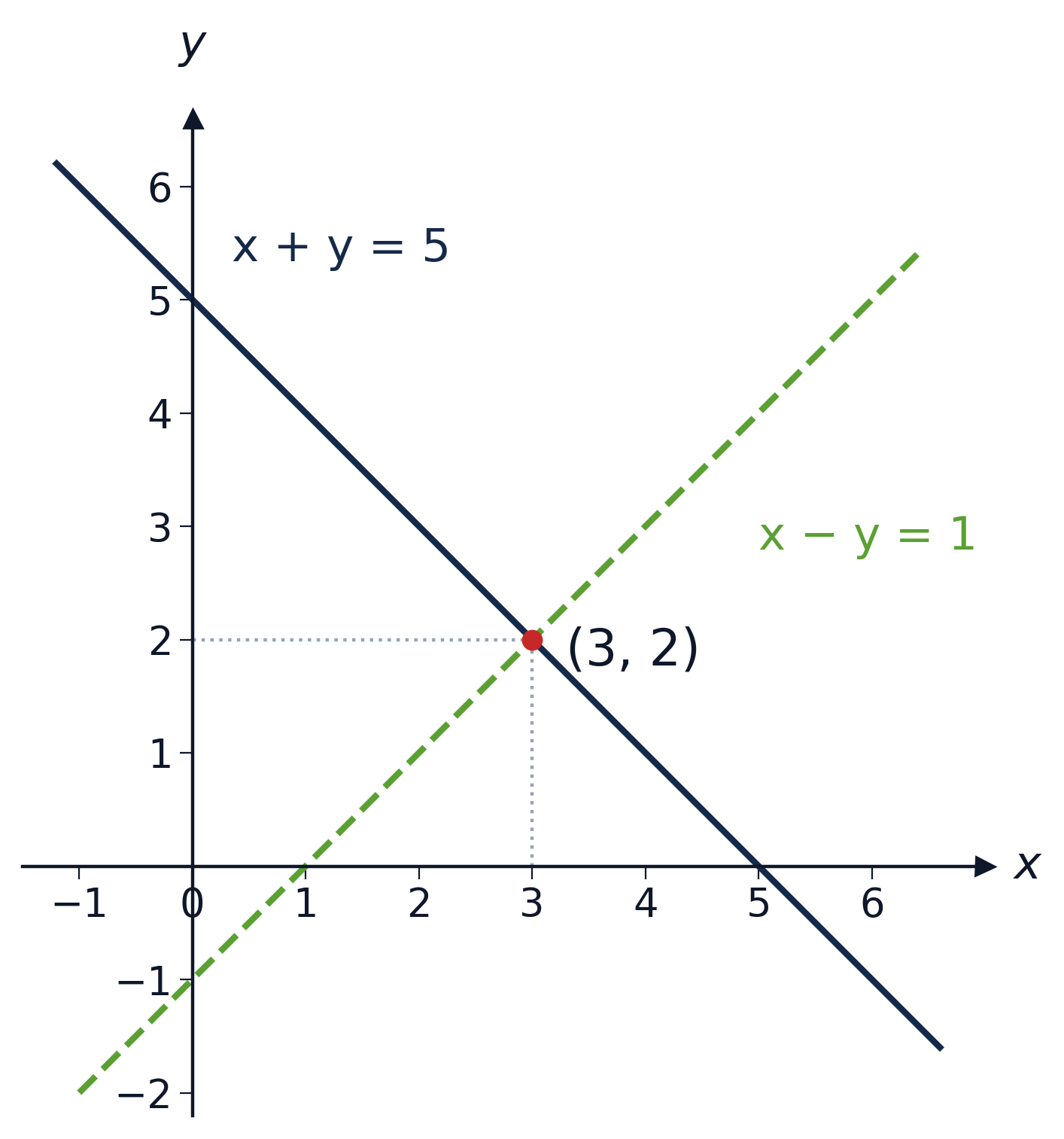
The figure shows x + y = 5 and x - y = 1. They cross at (3, 2). Check: 3 + 2 = 5 and 3 - 2 = 1. This is the graphical solution. It explains what a solution is, but in the exam the algebraic methods are faster.
3. Solving by algebra
Elimination is the method to use first. Make the coefficients of one unknown equal in size, then add or subtract the equations so that it disappears.
Solve x + 2y = 8 and 3x - y = 3. Multiply the second equation by 2: 6x - 2y = 6. Add it to the first: 7x = 14, so x = 2. Put this back in the first: 2 + 2y = 8, so y = 3.
Substitution is handy when one unknown stands alone. From the first equation, x = 8 - 2y. Put this in the second: 3(8 - 2y) - y = 3, so 24 - 7y = 3 and y = 3. Then x = 8 - 6 = 2.
Always put both values into the equation you did not use last. It takes five seconds and catches sign errors.
4. One solution, none, or infinitely many
Two lines in a plane can cross once, be parallel, or be the same line.
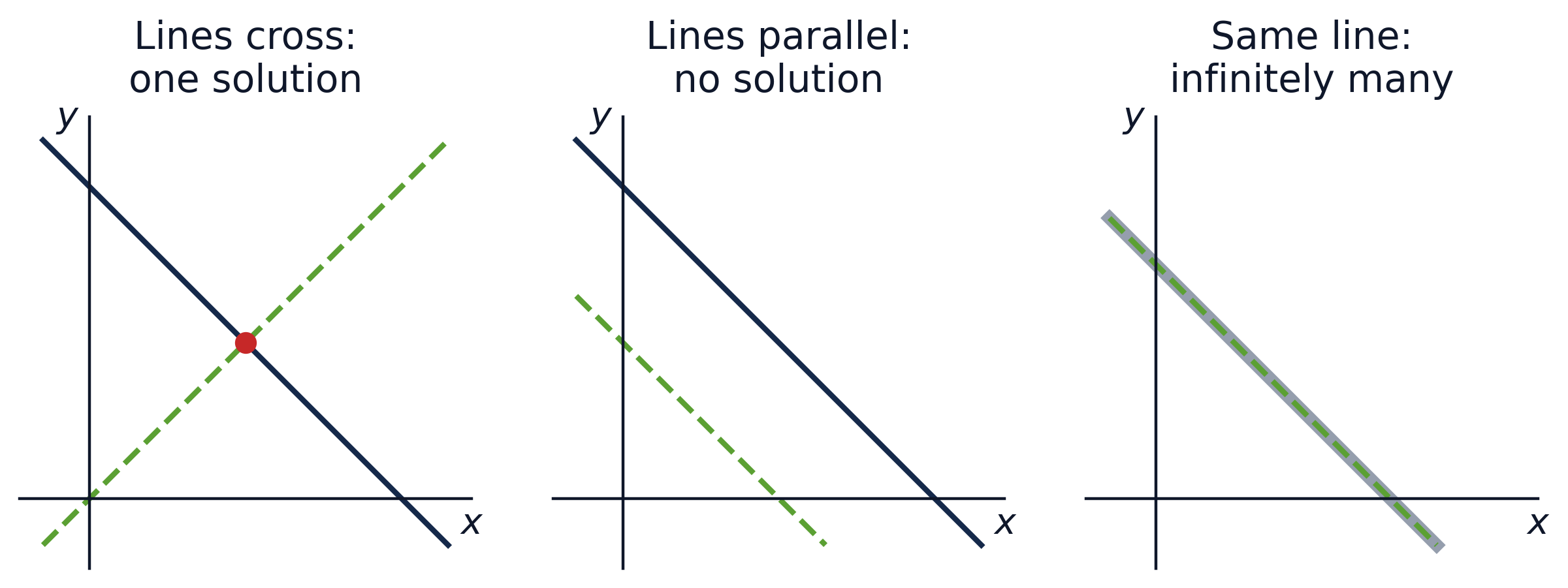
You can tell which case you have without drawing. Write both equations in the same form, a_1x + b_1y = c_1 and a_2x + b_2y = c_2, and compare the ratios of the coefficients.
| Ratios | The lines | Solutions | Example |
|---|---|---|---|
| \frac{a_1}{a_2} \ne \frac{b_1}{b_2} | cross at one point | exactly one | 2x + 3y = 7 and 4x + 5y = 10 |
| \frac{a_1}{a_2} = \frac{b_1}{b_2} \ne \frac{c_1}{c_2} | are parallel | none | 2x + 3y = 7 and 4x + 6y = 10 |
| \frac{a_1}{a_2} = \frac{b_1}{b_2} = \frac{c_1}{c_2} | are the same line | infinitely many | 2x + 3y = 7 and 4x + 6y = 14 |
The reason is simple. In the third row the second equation is the first one doubled, so it says nothing new. In the second row the left side is doubled but the right side is not, so the two cannot both be true.
A pair with at least one solution is called consistent. A pair with no solution is inconsistent.
5. Equations that become linear
If the unknowns appear as \frac{1}{x} and \frac{1}{y}, give these new names. For
\frac{2}{x} + \frac{3}{y} = 13, \qquad \frac{5}{x} - \frac{4}{y} = -2
put u = \frac{1}{x} and v = \frac{1}{y}. Then 2u + 3v = 13 and 5u - 4v = -2. Elimination gives u = 2 and v = 3, so x = \frac{1}{2} and y = \frac{1}{3}. Boat and stream questions have this form, with \frac{1}{\text{speed}} as the unknown.
6. Word problems
Three steps: name the two unknowns, write one equation for each fact, solve.
| The problem says | Write |
|---|---|
| a two-digit number with tens digit a and units digit b | the number is 10a + b; reversed it is 10b + a |
| ages now f and s; "in 10 years" | f + 10 and s + 10 |
| a fraction | \frac{x}{y}, with x and y as the unknowns |
| a boat at x km/h in still water, stream at y km/h | downstream speed x + y, upstream speed x - y |
| a fixed charge and a charge per unit | total = x + (\text{number of units}) \times y |
Worked examples
Example 1. Solve 3x + 2y = 12 and 5x - 2y = 4.
The y terms are already equal and opposite. Add: 8x = 16, so x = 2. Then 6 + 2y = 12, so y = 3. Check in the second: 10 - 6 = 4.
Example 2. Solve 2x + 3y = 12 and 3x - 2y = 5.
Multiply the first by 2 and the second by 3, so that y has the coefficient 6 in both: 4x + 6y = 24 and 9x - 6y = 15. Add: 13x = 39, so x = 3. Then 6 + 3y = 12, so y = 2.
Example 3. For what value of k does the pair kx + 3y = k - 3 and 12x + ky = k have (i) infinitely many solutions, (ii) no solution?
For either case the first two ratios must be equal: \frac{k}{12} = \frac{3}{k}, so k^2 = 36 and k = 6 or -6.
For k = 6: the ratios are \frac{6}{12}, \frac{3}{6} and \frac{k - 3}{k} = \frac{3}{6}. All three are \frac{1}{2}. Infinitely many solutions.
For k = -6: the first two ratios are -\frac{1}{2}, but the third is \frac{-9}{-6} = \frac{3}{2}. No solution.
Example 4. A two-digit number is 4 times the sum of its digits. If its digits are reversed, the new number is 27 more than the first. Find the number.
Let the tens digit be a and the units digit b. First fact: 10a + b = 4(a + b), which simplifies to b = 2a. Second fact: (10b + a) - (10a + b) = 27, which simplifies to b - a = 3. So 2a - a = 3: a = 3 and b = 6. The number is 36. Check: 36 = 4 \times 9 and 63 - 36 = 27.
Example 5. 5 pens and 3 notebooks cost Rs 96. 3 pens and 5 notebooks cost Rs 128. Find the price of each.
5p + 3n = 96 and 3p + 5n = 128. The coefficients are swapped, so add and subtract instead of eliminating. Adding: 8p + 8n = 224, so p + n = 28. Subtracting the first from the second: 2n - 2p = 32, so n - p = 16. Hence n = 22 and p = 6. A pen costs Rs 6 and a notebook Rs 22.
From the real papers
The six papers have one question on this chapter. It is from CDS I 2026, whose answer key is still provisional. Our working agrees with that key.
CDS I 2026, Q10. For what integral value of k, the system of equations kx - 5y + 6 = 0 and 4(k - 1)y - 12x + 3 = 0 has no solution?
(a) 4 (b) 3 (c) 1 (d) No such value exists
Solution. First put both in the same order. The second is -12x + 4(k - 1)y + 3 = 0. For no solution the first two ratios must be equal: \frac{k}{-12} = \frac{-5}{4(k - 1)}. Cross-multiply: 4k(k - 1) = 60, so k^2 - k - 15 = 0. Two whole numbers with product -15 and sum -1 do not exist, so this has no integer root. (Its roots are \frac{1 \pm \sqrt{61}}{2}.) For every integer k the ratios differ, and the pair has exactly one solution. Answer (d).
Notice the trap: the second equation is printed with the y term first.
Practice questions in the exam style
These three are our own, written in the pattern of the paper. They are not from a real paper.
Practice 1. For what value of k does the pair 2x + 3y = 7 and 4x + 6y = k have infinitely many solutions?
(a) 7 (b) 14 (c) 21 (d) No such value exists
Solution. \frac{2}{4} = \frac{3}{6} = \frac{1}{2}, so the third ratio must also be \frac{1}{2}: \frac{7}{k} = \frac{1}{2} and k = 14. Answer (b).
Practice 2. A boat goes 24 km upstream and 50 km downstream in 11 hours. It goes 36 km upstream and 30 km downstream in 12 hours. What is the speed of the stream?
(a) 2 km/h (b) 3 km/h (c) 4 km/h (d) 7 km/h
Solution. Let u = \frac{1}{\text{upstream speed}} and v = \frac{1}{\text{downstream speed}}. Then 24u + 50v = 11 and 36u + 30v = 12. Multiply the first by 3 and the second by 2: 72u + 150v = 33 and 72u + 60v = 24. Subtract: 90v = 9, so v = \frac{1}{10}, and then u = \frac{1}{4}. The upstream speed is 4 km/h and the downstream speed is 10 km/h. So x - y = 4 and x + y = 10: the boat does 7 km/h and the stream 3 km/h. Answer (b).
Practice 3. A Question is followed by two Statements.
Question: What are the values of x and y?
Statement-I: 2x + 3y = 12
Statement-II: 4x + 6y = 24
(a) The Question can be answered by one of the Statements alone, but not by the other. (b) The Question can be answered by either Statement alone. (c) The Question can be answered by using both the Statements together, but cannot be answered by using either Statement alone. (d) The Question cannot be answered even by using both Statements together.
Solution. One equation in two unknowns has many solutions, so neither statement alone is enough. Together they look like two equations, but the second is the first doubled: all three ratios are \frac{1}{2}. It is the same line, with infinitely many solutions. Answer (d).
Mistakes that cost marks
- Multiplying only the left side. When you multiply an equation by 3, multiply every term, the right side too. 2x + 3y = 12 becomes 6x + 9y = 36, not 6x + 9y = 12.
- Comparing ratios before the equations are in the same order. Write both as ax + by = c with x first, then compare. The real question above depends on this.
- Stopping at \frac{a_1}{a_2} = \frac{b_1}{b_2}. That only says the lines do not cross. Check the third ratio to tell "no solution" from "infinitely many".
- Counting equations without looking at them. Two equations do not always fix two unknowns. If one is a multiple of the other, there is really only one.
Quick check
Do these without help. Answers are at the end.
- Solve x + y = 9 and x - y = 3.
- Solve 2x + y = 7 and 3x - 2y = 0.
- How many solutions does the pair 3x - 2y = 5 and 6x - 4y = 7 have?
- For what value of k does the pair x + 2y = 3 and 2x + ky = 7 have no solution?
- A father is three times as old as his son. In 10 years he will be twice as old as his son. Find their ages now.
Read and watch more, free
| What | Where | Language |
|---|---|---|
| Textbook, the whole chapter | NCERT Class 10 Mathematics, Chapter 3 Pair of Linear Equations in Two Variables · Hindi edition | English, Hindi |
| Textbook, the line and its graph | NCERT Class 9 Ganita Manjari Part II, Chapter 13 Two Variables, One Line | English |
| Textbook, with word problems | NIOS Secondary Mathematics (211), Lesson 5 Linear Equations · Hindi edition | English, Hindi |
| Practice with answers | NCERT Exemplar Class 10, Unit 3 Linear Equations · Hindi edition | English, Hindi |
| The real papers | UPSC previous question papers | English, Hindi |
| Video and practice by NCERT chapter | Khan Academy, NCERT Math Class 10 (the unit on linear equations) · in Hindi | English, Hindi |
| Video, numbered classes | Chandigarh Career Group: CDS advance maths by Sandeep Brar (the eight classes on equations) | Hinglish |
| Video, a full CDS course | R.S SIR: Maths Playlist for CDS 2025 (the algebra lessons, about 55 minutes each) | Hindi and Hinglish |
The videos were chosen from their titles, length and views; they have not yet been watched by a teacher.
Answers to the quick check
- Add: 2x = 12, so x = 6 and y = 3.
- From the first, y = 7 - 2x. Then 3x - 2(7 - 2x) = 0 gives 7x = 14, so x = 2 and y = 3.
- None. \frac{3}{6} = \frac{-2}{-4} = \frac{1}{2} but \frac{5}{7} is different: the lines are parallel.
- \frac{1}{2} = \frac{2}{k} gives k = 4. The third ratio is \frac{3}{7}, which is different, so there is no solution.
- f = 3s and f + 10 = 2(s + 10). So 3s + 10 = 2s + 20: the son is 10 and the father is 30.
Next chapter: Linear inequations in two variables.