Why this chapter matters. This is a small chapter. It gave 1 question in the 6 papers from CDS I 2024 to CDS II 2026 (CDS II 2025, Q59). That question gave two inequations in one unknown and asked for the values that satisfy both. No question in the six papers used two variables or a graph. But the syllabus lists "simultaneous linear inequations in two variables and their solutions" and practical problems on them, so a question can come in any paper. The method is short. The real question is solved below, and five practice questions in the same style follow it.
What you will be able to do
- Solve a linear inequation in one unknown, and know when the sign turns round.
- Find the values that satisfy two inequations together, and show them on a number line.
- Show the solution of an inequation in two variables as one side of a line.
- Find the common region of two or more inequations and its corner points, or test a point without drawing.
Before you start you should know: how to solve a linear equation, how to draw a line such as x + y = 4 from two points, and how to solve two linear equations together (Chapter A3-5).
1. Inequations and their three rules
An inequation (also called an inequality) is a statement with one of the signs <, >, \le, \ge. A solution is a value that makes the statement true.
You may work on an inequation almost as on an equation.
| Rule | What you may do | What happens to the sign |
|---|---|---|
| 1 | Add the same number to both sides, or take it away | stays the same |
| 2 | Multiply or divide both sides by the same positive number | stays the same |
| 3 | Multiply or divide both sides by the same negative number | turns round |
For example, -3x \ge 12. Divide by -3 and turn the sign: x \le -4.
A quick check of rule 3: 2 < 5 is true. Multiply both sides by -1. Now -2 is the larger number, so we must write -2 > -5.
To avoid rule 3, move the x terms to the side where the number in front of x becomes positive. This is the safest habit in the exam.
2. One unknown, and two inequations together
Solve 2x + 3 > 1. Take 3 from both sides: 2x > -2. Divide by 2: x > -1. The solution is not one number. It is every number greater than -1.
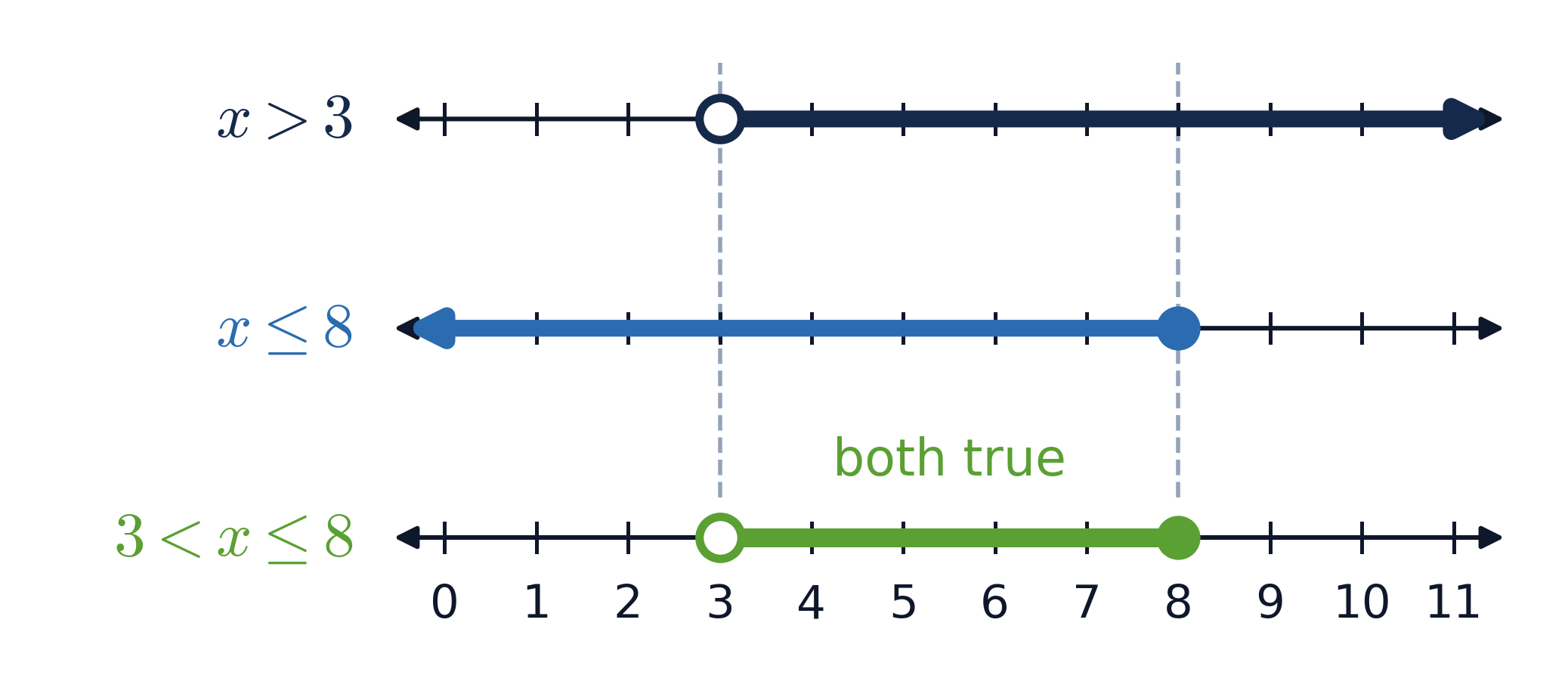
On a number line, the solution is a ray. Draw an open dot when the end value is not included (< or >). Draw a closed dot when it is included (\le or \ge).
When two inequations must both be true, solve each one alone. Then keep the values that satisfy both: the part of the number line where the two rays overlap.
Take 3x - 2 > 7 and x + 5 \le 13. The first gives 3x > 9, so x > 3. The second gives x \le 8. Both are true when 3 < x \le 8.
Two words decide the answer.
- "and" means both must be true. Take the overlap. The answer usually has the form a < x < b.
- "or" means at least one is true. Take everything covered by either ray. An answer such as "x < 3 or x > 5" is of this kind.
If the two rays do not overlap, as with x > 5 and x < 2, no value satisfies both. The solution is empty.
3. One inequation in two variables
A linear inequation in two variables looks like ax + by \le c (or with <, >, \ge). A solution is a pair (x, y). For example, (1, 2) is a solution of 2x + y \le 6 because 2 + 2 = 4 and 4 \le 6.
There are too many solutions to list, so we show them on a graph. The line ax + by = c cuts the plane into two half planes. All the points on one side satisfy ax + by < c. All the points on the other side satisfy ax + by > c. So the solution is one whole side of the line.
| Step | What to do |
|---|---|
| 1 | Write the sign as = and draw that line. The two points where it cuts the axes are the easiest |
| 2 | Draw the line solid for \le or \ge (points on the line are solutions). Draw it dashed for < or > (they are not) |
| 3 | Take a test point that is not on the line. The origin (0, 0) is the easiest. Put it in the inequation |
| 4 | If the statement is true, shade the side with the test point. If it is false, shade the other side |
If the line passes through the origin, use (1, 0) or (0, 1) as the test point.
4. Two or more inequations: the common region
A system is two or more inequations that must all be true together. This is what the syllabus calls simultaneous inequations. Shade the half plane for each one. The solution is the part shaded every time: the common region.
Two inequations come very often in practical problems, because a count or a length cannot be negative:
- x \ge 0 means "on the y-axis or to its right".
- y \ge 0 means "on the x-axis or above it".
Together they keep only the first quadrant and its edges.
A corner point of the region is a point where two boundary lines meet. Find it by solving the two equations together, as in Chapter A3-5.
If no point satisfies all the inequations, the solution is empty.
5. Answering without a drawing
The exam gives 72 seconds a question. There is no time for a careful graph.
- Test the options. If the options are points, put each point in every inequation. If the options are ranges of x, pick one value inside a range and one outside it.
- Make y the subject. x + y \ge 5 is y \ge 5 - x, which means "on or above the line". A rough sketch is then enough.
Worked examples
Example 1. Solve 7 - 2x \le 3x - 8.
Move the x terms to the right, where the number in front of x stays positive: 7 + 8 \le 3x + 2x, so 15 \le 5x and 3 \le x. The solution is x \ge 3.
Example 2. How many integers satisfy both 2x + 1 \ge 7 and 4x - 3 < 21?
The first gives 2x \ge 6, so x \ge 3. The second gives 4x < 24, so x < 6. Together 3 \le x < 6. The integers are 3, 4 and 5. There are three. (3 is included; 6 is not.)
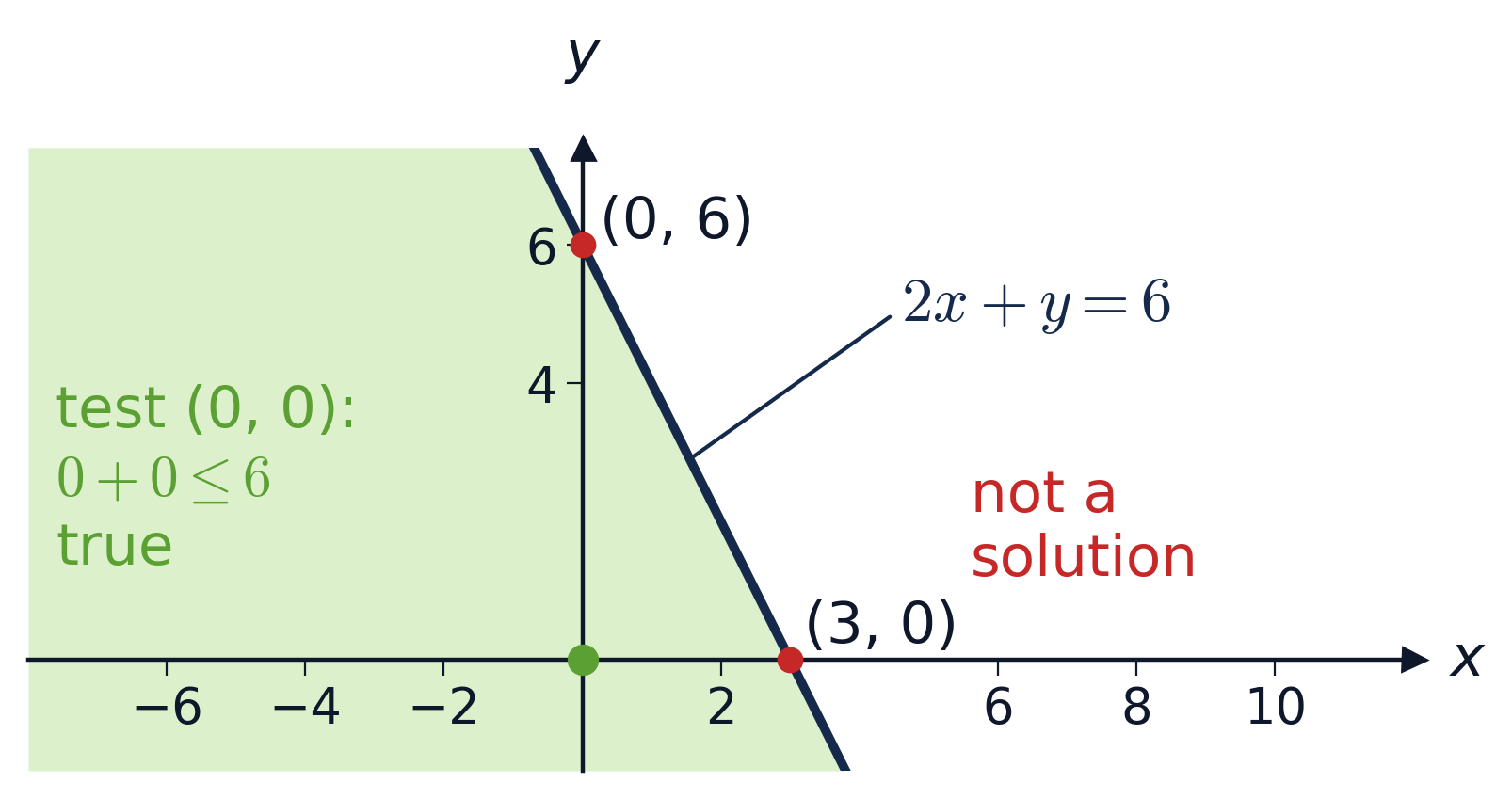
Example 3. Show the solution of 2x + y \le 6.
The line 2x + y = 6 cuts the axes at (3, 0) and (0, 6). The sign is \le, so the line is solid. Test the origin: 0 + 0 \le 6 is true. Shade the side of the line that contains the origin.
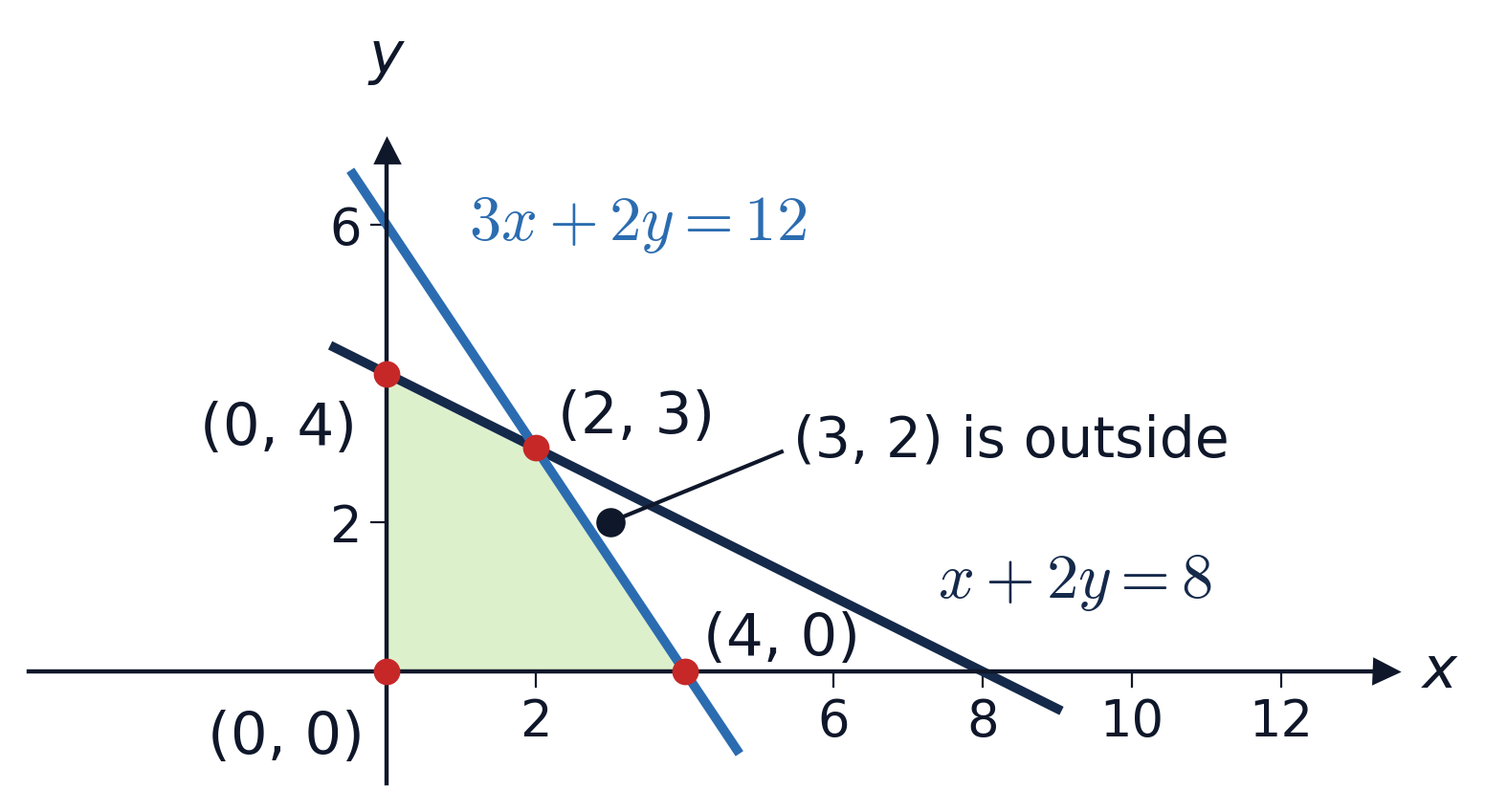
Example 4. Find the corner points of the region x + 2y \le 8, 3x + 2y \le 12, x \ge 0, y \ge 0. Is (3, 2) in the region?
The first line cuts the axes at (8, 0) and (0, 4). The second cuts them at (4, 0) and (0, 6). The origin satisfies both, so the region is on the origin side of both lines, in the first quadrant.
The two lines meet where x + 2y = 8 and 3x + 2y = 12. Subtract: 2x = 4, so x = 2 and y = 3.
The corner points are (0, 0), (4, 0), (2, 3) and (0, 4). The points (8, 0) and (0, 6) are not corners, because each fails one of the inequations.
For (3, 2): 3 + 4 = 7 \le 8 is true, but 9 + 4 = 13 \le 12 is false. So (3, 2) is not in the region. A point must satisfy every inequation.
From the real papers
Only one question on this chapter is in the six papers captured so far. It is from CDS II 2025 (Series A) and the answer agrees with the final official key. Try it for 72 seconds before reading the solution.
CDS II 2025, Q59. What is the solution of the inequalities 5x + 3 < 8x - 9 and 2x + 20 > 5x + 2?
(a) 4 < x < 6 (b) 3 < x < 5 (c) x < 3 or x > 5 (d) x < 4 or x > 6
Solution. Solve each one alone, moving the x terms to the side where they stay positive. First: 3 + 9 < 8x - 5x, so 12 < 3x and x > 4. Second: 20 - 2 > 5x - 2x, so 18 > 3x and x < 6. Both must be true, so 4 < x < 6. Check with x = 5: 28 < 31 and 30 > 27, both true. Answer (a).
A faster way under exam pressure: the options differ at x = 5 and at x = 3.5. The value 5 works, which removes (c) and (d). The value 3.5 gives 20.5 < 19 in the first inequation, which is false. That removes (b).
Practice questions in the exam style
These five questions are our own. They are not from a real paper. They cover the part of the syllabus that the six papers did not ask.
Practice 1. What is the solution of the inequalities 3 - 2x < 9 and 4x - 1 \le 11?
(a) -3 < x \le 3 (b) -3 \le x < 3 (c) x < -3 or x \ge 3 (d) x > 3
Solution. First: 3 - 9 < 2x, so -6 < 2x and x > -3. Second: 4x \le 12, so x \le 3. Together, -3 < x \le 3. Answer (a).
Practice 2. Which one of the following points lies in the solution region of 2x + 3y \le 12 and x - y \ge 1?
(a) (1, 3) (b) (3, 1) (c) (0, 0) (d) (4, 2)
Solution. Test each point in both. (1, 3): 1 - 3 = -2, which is not \ge 1. (3, 1): 6 + 3 = 9 \le 12 and 3 - 1 = 2 \ge 1, both true. (0, 0): 0 \ge 1 is false. (4, 2): 8 + 6 = 14, which is not \le 12. Answer (b).
Practice 3. What is the area of the region given by x + y \le 6, x \ge 0, y \ge 0?
(a) 12 square units (b) 18 square units (c) 24 square units (d) 36 square units
Solution. The region is a triangle with corners (0, 0), (6, 0) and (0, 6). It has a right angle at the origin. Area = \frac{1}{2} \times 6 \times 6 = 18. Answer (b).
Practice 4. The solution region of the system x + y \ge 4 and x + y \le 2 is
(a) a triangle (b) a region between two parallel lines (c) a straight line (d) empty
Solution. No number x + y can be at least 4 and at most 2 at the same time. The two half planes have no common point. Answer (d).
Practice 5. A pen costs ₹10 and a notebook costs ₹30. A student has ₹120 and must buy at least 2 notebooks. What is the greatest number of pens the student can buy?
(a) 4 (b) 5 (c) 6 (d) 9
Solution. Let the student buy x pens and y notebooks. Then 10x + 30y \le 120 and y \ge 2. Pens are most when notebooks are fewest, so take y = 2: 10x + 60 \le 120, so x \le 6. Answer (c).
Mistakes that cost marks
- Not turning the sign. Dividing -2x > 6 by -2 gives x < -3, not x > -3. If you move the x terms so that the number in front of x is positive, this mistake cannot happen.
- Reading "and" as "or". Two inequations given together must both be true. For x > 4 and x < 6 the answer is 4 < x < 6. It is not "x < 4 or x > 6".
- Forgetting whether the end value is included. With \le or \ge the end value (or the line) is part of the solution. With < or > it is not. This changes the count of integers.
- Taking a point that satisfies only one inequation. In a system, a solution must satisfy all of them.
Quick check
Do these without help. Answers are at the end.
- Solve 5 - 4x > 17.
- Find the values of x that satisfy both 2x - 1 \ge 5 and 3x + 2 < 26.
- Is (2, 1) a solution of 3x - 2y < 5?
- On which side of the line 2x + 5y = 10 does the solution of 2x + 5y \ge 10 lie: the side with the origin, or the other side?
- Write the corner points of the region x + y \le 5, x \ge 0, y \ge 0.
Read and watch more, free
The NCERT books for Classes 6 to 10 and the NIOS secondary course do not teach inequations. The Class 11 book does, at a level that suits this chapter.
| What | Where | Language |
|---|---|---|
| Textbook | NCERT Class 11 Mathematics, Chapter 5 Linear Inequalities · Hindi edition | English, Hindi |
| Open textbook, read on the web | Siyavula Mathematics Grade 10 (the chapter "Equations and inequalities") | English |
| Before this chapter: two linear equations | NCERT Class 10 Mathematics, Chapter 3 Pair of Linear Equations in Two Variables · Hindi edition | English, Hindi |
| The real papers | UPSC previous question papers | English, Hindi |
| Video, numbered classes | Chandigarh Career Group: CDS advance maths by Sandeep Brar (the eight classes on equations) | Hinglish |
| Video, a full CDS course | R.S SIR: Maths Playlist for CDS 2025 (the algebra lessons, about 55 minutes each) | Hindi and Hinglish |
No video title in these courses names inequations. The equation classes are the nearest. The videos were chosen from their titles, length and views; they have not yet been watched by a teacher.
Answers to the quick check
- 5 - 17 > 4x, so -12 > 4x and x < -3.
- x \ge 3 and x < 8, so 3 \le x < 8.
- Yes: 6 - 2 = 4 and 4 < 5.
- The other side. The origin gives 0 \ge 10, which is false.
- (0, 0), (5, 0) and (0, 5).
Next chapter: Quadratic equations: solving, roots and coefficients, word problems.