Why this chapter matters. This chapter gave 5 questions in the 6 papers from CDS I 2024 to CDS II 2026: two in CDS II 2024 and three in CDS II 2026. The other four papers had none. The questions are of two kinds. In the first, you decide whether a statement in set language is correct: is this set finite, is it a null set, what is the complement of the universal set. In the second, you count people in a survey with two or three overlapping groups. Both kinds are among the easiest marks in the paper if the words are clear in your mind.
What you will be able to do
- Read and write a set in both forms, and tell an element (\in) from a subset (\subset).
- Say whether a set is null, singleton, finite or infinite.
- Find the union, intersection, difference and complement of sets, and show them on a Venn diagram.
- Solve counting problems on two or three sets.
Before you start you should know: the natural numbers, integers and real numbers (Chapter A1-1), and how to solve a simple equation. Nothing else is needed.
1. What a set is
A set is a well-defined collection of objects, called its elements. "Well-defined" means we can say clearly whether any object is in the set or not. "The tall students of a class" is not a set. "The students of a class who are taller than 170 cm" is a set.
There are two ways to write a set.
- Roster form: list the elements inside braces. A = \{1, 2, 3, 4, 5\}.
- Set-builder form: give the rule. A = \{x : x \text{ is a natural number and } x < 6\}. Read the colon as "such that".
We write 3 \in A ("3 belongs to A") and 7 \notin A. The order of the elements does not matter, and an element is not written twice.
The exam uses these letters for sets of numbers:
| Letter | Set | Elements |
|---|---|---|
| \mathbb{N} | natural numbers | 1, 2, 3, \dots |
| \mathbb{Z} | integers | \dots, -2, -1, 0, 1, 2, \dots |
| \mathbb{Q} | rational numbers | all fractions \frac{p}{q} of integers, q \ne 0 |
| \mathbb{R} | real numbers | every point of the number line |
The letter matters. \{x \in \mathbb{Z} : x^2 = 4\} is \{-2, 2\}. But \{x \in \mathbb{N} : x^2 = 4\} is \{2\} only.
2. Kinds of sets
| Name | Meaning | Example |
|---|---|---|
| Null set (empty set), written \phi or \{\ \} | has no element | \{x \in \mathbb{Z} : x^2 = 5\}, because no integer has square 5 |
| Singleton set | has exactly one element | the set of even prime numbers, which is \{2\} |
| Finite set | its elements can be counted, and the counting comes to an end | the set of people living in India |
| Infinite set | the counting never ends | \mathbb{N}; the set of real numbers between 0 and 1 |
Three points decide most statement questions.
- A set that is very large is still finite if the count would end. The grains of sand on a beach form a finite set.
- Between any two different real numbers there are endlessly many real numbers. So \{x \in \mathbb{R} : 0 < x < 1\} is infinite. But \{x \in \mathbb{N} : 0 < x < 1\} is a null set.
- To test for a null set, look for one element. If you find even one, the set is not null. The null set is itself finite: it has 0 elements.
The number of elements of a finite set A is written n(A). For A = \{1, 2, 3, 4, 5\}, n(A) = 5.
3. Subsets, the universal set and the complement
A is a subset of B, written A \subset B, if every element of A is also in B. For example, \{1, 2\} \subset \{1, 2, 3\}.
- Every set is a subset of itself, and \phi is a subset of every set.
- A set with n elements has 2^n subsets. For example, \{a, b\} has 2^2 = 4 subsets: \phi, \{a\}, \{b\} and \{a, b\}.
Do not mix the two signs. \in joins an element to a set. \subset joins a set to a set. So 1 \in \{1, 2\} and \{1\} \subset \{1, 2\} are both true.
All the sets in one problem are taken from a large fixed set called the universal set, U. The complement of A, written A' or A^c, is the set of elements of U that are not in A.
- A' is made only of elements of U, so A' is a subset of U.
- The complement of U is \phi: nothing in U is outside U. The complement of \phi is U.
- (A')' = A.
4. Operations and the Venn diagram
Take U = \{1, 2, \dots, 10\}, A = \{1, 2, 3, 4, 5\} and B = \{4, 5, 6, 7\}.
| Operation | Symbol | Meaning | In the example |
|---|---|---|---|
| Union | A \cup B | elements in A or in B (or in both) | \{1, 2, 3, 4, 5, 6, 7\} |
| Intersection | A \cap B | elements in both A and B | \{4, 5\} |
| Difference | A - B | elements in A but not in B | \{1, 2, 3\} |
| Difference | B - A | elements in B but not in A | \{6, 7\} |
| Complement | A' | elements of U not in A | \{6, 7, 8, 9, 10\} |
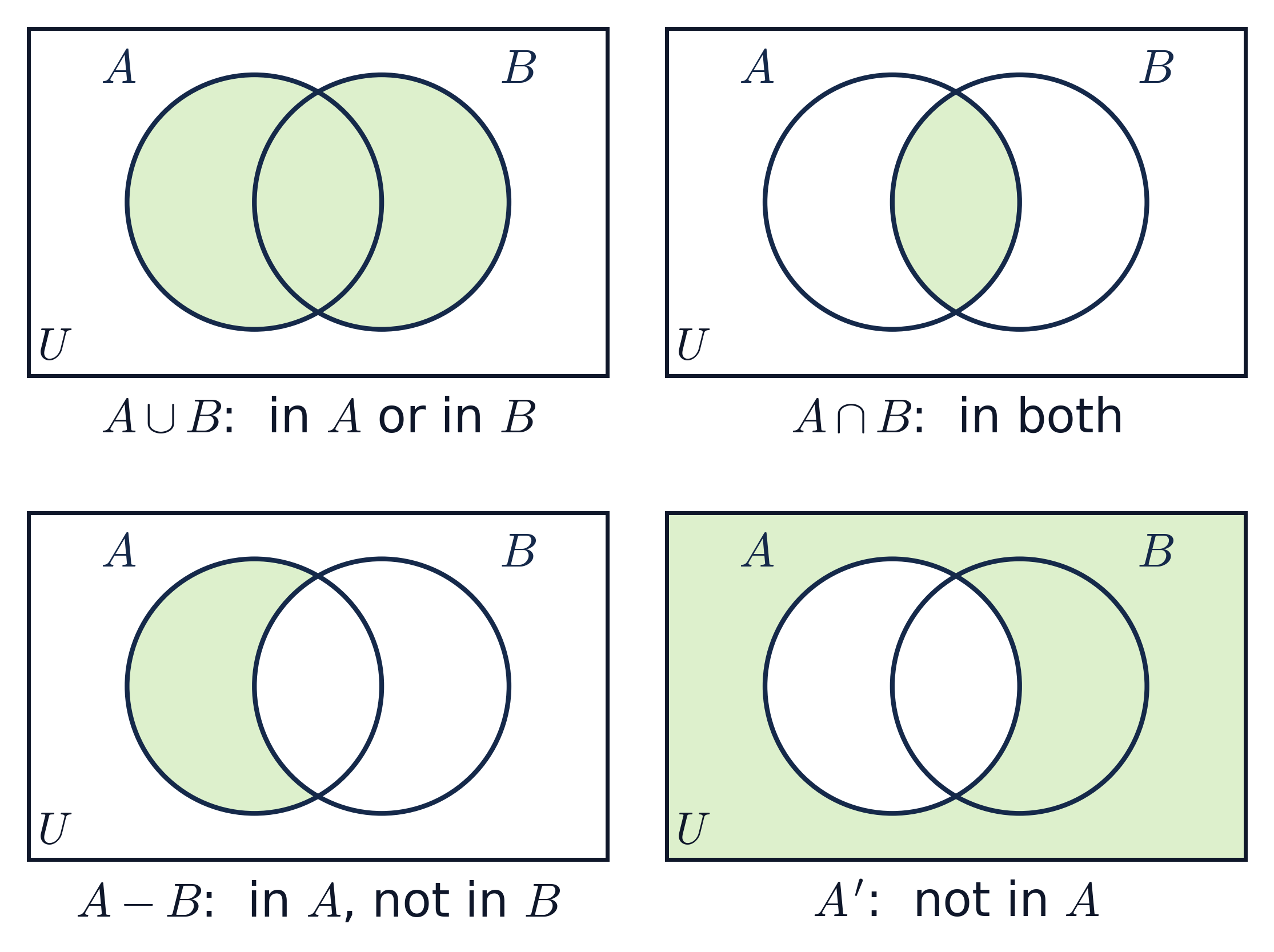
Two sets with no common element are called disjoint: A \cap B = \phi.
In a Venn diagram a rectangle stands for U and a circle for each set. Two overlapping circles make four separate regions.
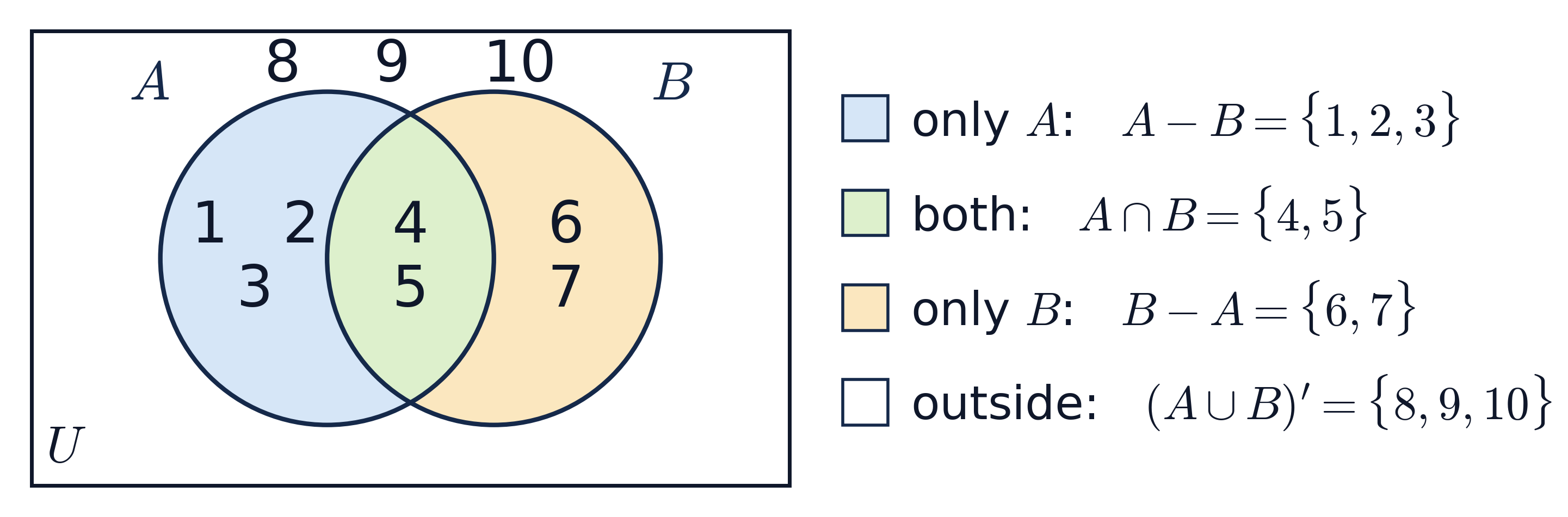
De Morgan's laws. (A \cup B)' = A' \cap B' and (A \cap B)' = A' \cup B'. In words: "not in A or B" is the same as "not in A and not in B". In the example both sides of the first law are \{8, 9, 10\}, the region outside both circles.
5. Counting with sets
When we add n(A) and n(B), the common elements are counted twice. So we take them away once:
n(A \cup B) = n(A) + n(B) - n(A \cap B)
In the example: 7 = 5 + 4 - 2.
| To find | Use |
|---|---|
| In at least one of A, B | n(A \cup B) = n(A) + n(B) - n(A \cap B) |
| Only in A | n(A) - n(A \cap B) |
| In exactly one of A, B | n(A) + n(B) - 2\,n(A \cap B) |
| In neither | n(U) - n(A \cup B) |
For three sets:
n(A \cup B \cup C) = n(A) + n(B) + n(C) - n(A \cap B) - n(B \cap C) - n(C \cap A) + n(A \cap B \cap C)
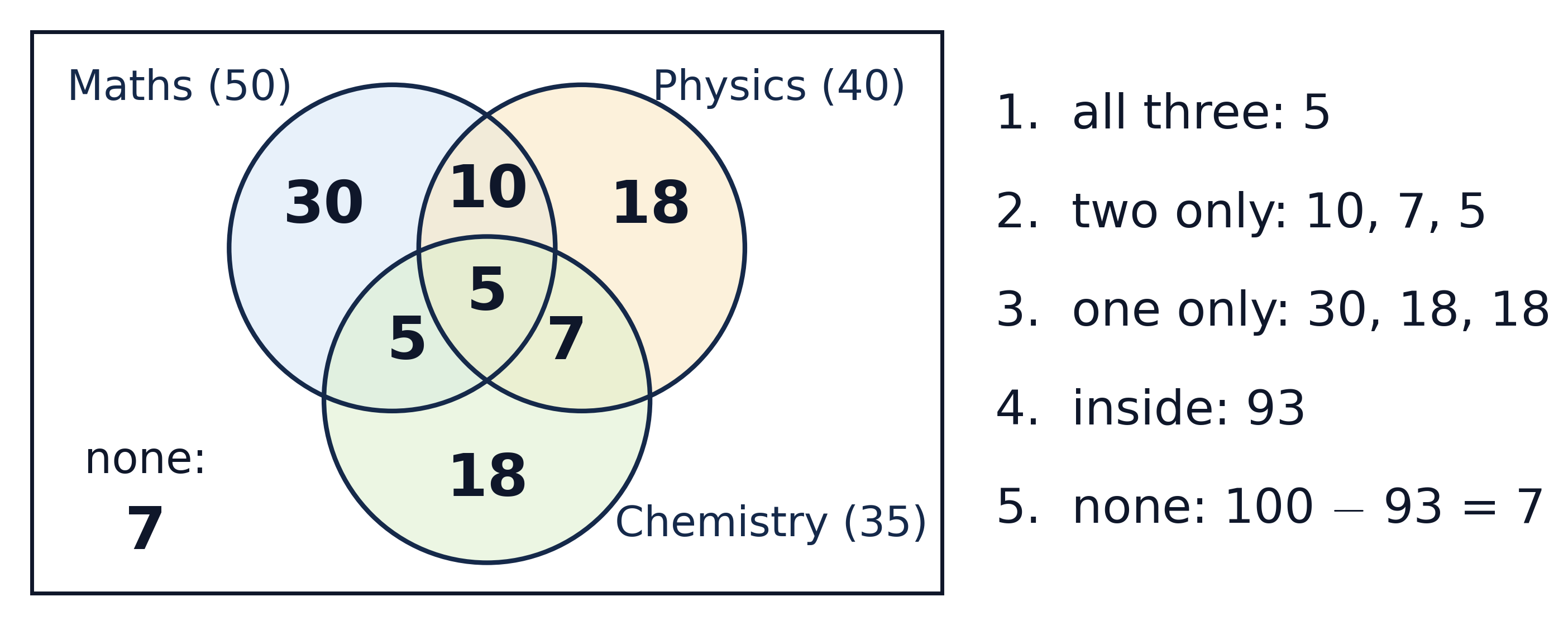
A way of thinking that is faster than the formula. Add the sizes of the sets. In this total, a person who is in one set is counted once, a person in two sets is counted twice, and a person in all three is counted three times. The last real question below is solved in two lines this way.
In a word problem, "30 like tea" means the whole tea circle, including those who also like coffee. "30 like only tea" means the part of the tea circle outside the coffee circle. Read for the word "only".
Worked examples
Example 1. Say whether each set is null, singleton, finite or infinite: (i) \{x \in \mathbb{N} : 2x = 5\}; (ii) \{x \in \mathbb{Z} : x^2 = 4\}; (iii) \{x \in \mathbb{R} : 1 < x < 2\}.
(i) 2x = 5 gives x = 2.5, which is not a natural number. The set is null. (ii) The set is \{-2, 2\}: finite, with two elements. (iii) There are endlessly many real numbers between 1 and 2, such as 1.5, 1.05, 1.005. The set is infinite.
Example 2. In a group of 60 people, 35 drink tea, 30 drink coffee and 10 drink both. How many drink neither? How many drink exactly one of the two?
At least one: 35 + 30 - 10 = 55. Neither: 60 - 55 = 5.
Only tea: 35 - 10 = 25. Only coffee: 30 - 10 = 20. Exactly one: 25 + 20 = 45.
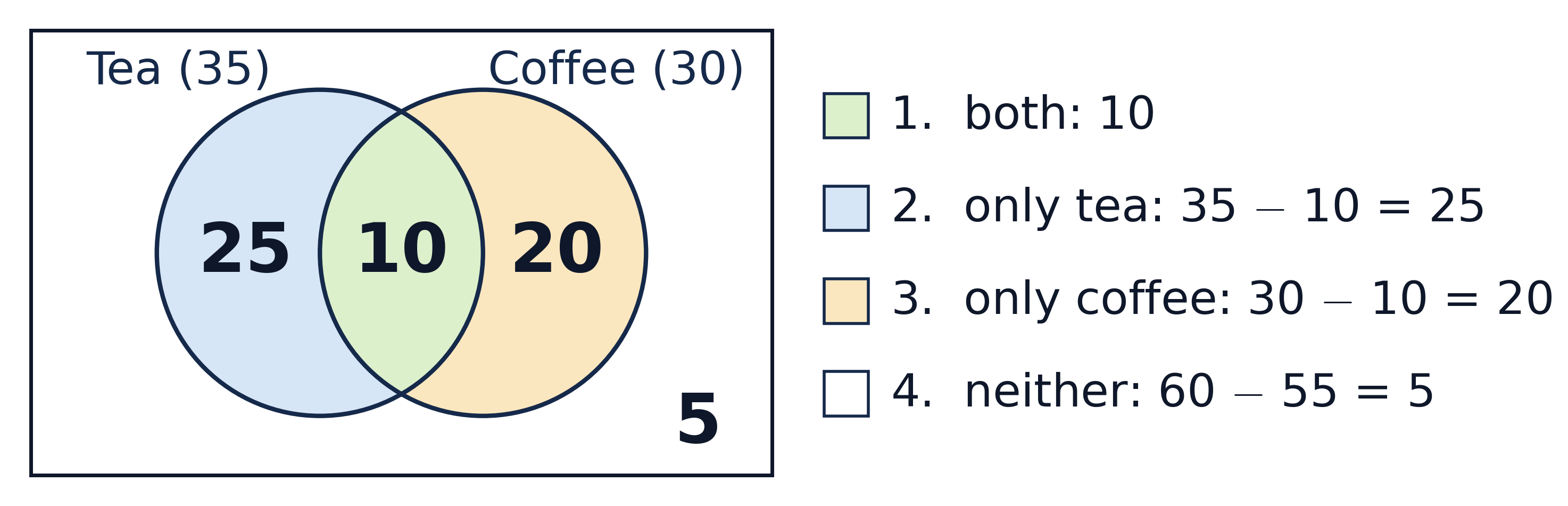
Fill such a diagram from the middle (the overlap) outwards.
Example 3. In a class of 100 students, 50 study Mathematics, 40 study Physics and 35 study Chemistry. 15 study Mathematics and Physics, 12 study Physics and Chemistry, 10 study Mathematics and Chemistry, and 5 study all three. How many study none of the three?
50 + 40 + 35 - 15 - 12 - 10 + 5 = 93 study at least one. So 100 - 93 = 7 study none.
Example 4. In a survey of 80 people, 55 read a Hindi newspaper and 45 read an English newspaper. What is the least number that must read both?
n(H \cap E) = 55 + 45 - n(H \cup E) = 100 - n(H \cup E). The union cannot be more than the 80 people surveyed. So the number reading both is at least 100 - 80 = 20.
From the real papers
The first three questions are from CDS II 2026. The answers agree with the provisional official key; the final key had not been published when this lesson was written. Try each for 72 seconds before reading the solution.
CDS II 2026, Q31. Consider the following statements: I. The set of all birds living on the Earth is an infinite set. II. The set of all real numbers between 0 and 10 is a finite set. Which of the statements given above is/are correct?
(a) I only (b) II only (c) Both I and II (d) Neither I nor II
Solution. The birds alive on the Earth are very many, but a count of them would come to an end. That set is finite, so I is wrong. Between 0 and 10 there are endlessly many real numbers (1, 1.1, 1.01, ...). That set is infinite, so II is wrong. Answer (d).
CDS II 2026, Q32. Consider the following sets: I. The set of even prime numbers II. \{x \in \mathbb{R} : x^3 + 1 = 0\} III. \{n \in \mathbb{Z} : n^2 < 1\} How many of the above are null sets?
(a) None (b) One (c) Two (d) All the three
Solution. Look for one element in each. I contains 2, the only even prime. II contains -1, because (-1)^3 + 1 = 0. III contains 0, because 0^2 = 0 < 1. Each set has an element, so none is a null set. Answer (a).
CDS II 2026, Q33. Consider the following statements: I. If A is a subset of U and U is the Universal set, then the complement of the set A is also a subset of U. II. The complement of a Universal set is a singleton set. Which of the statements given above is/are correct?
(a) I only (b) II only (c) Both I and II (d) Neither I nor II
Solution. The complement of A is made of the elements of U that are not in A. Every one of them is in U, so it is a subset of U: I is correct. The complement of U has no element at all. It is the null set, not a set with one element: II is wrong. Answer (a).
One more, from CDS II 2024. No official key was published; the answer is our own working.
CDS II 2024, Q98. In a class of 160 students, each of them opt at least one language from among English, Hindi and Sanskrit. It is found that 130 students opt English, 120 students Hindi and 110 Sanskrit. If the students opt either only one language or all three languages, then what is the number of students who study all three languages?
(a) 40 (b) 60 (c) 80 (d) 100
Solution. Let t students take all three. The other 160 - t take exactly one. Add the three counts: 130 + 120 + 110 = 360. In this total a one-language student is counted once and a three-language student three times. So 360 = (160 - t) + 3t = 160 + 2t, which gives t = 100. Check: English only 30, Hindi only 20, Sanskrit only 10, all three 100; total 160. Answer (d).
Practice questions in the exam style
These two questions are our own. They are not from a real paper.
Practice 1. In a group of 120 people, 70 speak Hindi, 60 speak English and 20 speak neither. How many speak both languages?
(a) 10 (b) 20 (c) 30 (d) 40
Solution. At least one language: 120 - 20 = 100. Then 100 = 70 + 60 - n(\text{both}), so n(\text{both}) = 30. Answer (c).
Practice 2. Consider the following statements: I. The set of all prime numbers less than 100 is a finite set. II. \{x \in \mathbb{N} : x + 5 = 2\} is a null set. Which of the statements given above is/are correct?
(a) I only (b) II only (c) Both I and II (d) Neither I nor II
Solution. There are 25 primes below 100, so I is correct. x + 5 = 2 gives x = -3, which is not a natural number, so the set has no element and II is correct. Answer (c).
Mistakes that cost marks
- Calling a very large set infinite. If the count would end, the set is finite, however large it is.
- Forgetting which numbers are allowed. \{x \in \mathbb{N} : x^2 = 4\} has one element. \{x \in \mathbb{Z} : x^2 = 4\} has two. Read the letter after \in.
- Taking \{0\} as the null set. \{0\} has one element, the number 0. It is a singleton set. The null set has no element.
- Counting the overlap twice. n(A \cup B) is not n(A) + n(B) unless the sets are disjoint. Take away n(A \cap B) once for "at least one" and twice for "exactly one".
Quick check
Do these without help. Answers are at the end.
- A = \{1, 2, 3, 4\} and B = \{3, 4, 5, 6\}. Find A \cup B, A \cap B and A - B.
- Is \{x \in \mathbb{Z} : x^2 = 2\} a null set?
- How many subsets does the set \{a, b, c, d\} have?
- U = \{1, 2, \dots, 8\}, A = \{2, 4, 6, 8\} and B = \{1, 2, 3, 4\}. Find (A \cup B)'.
- In a class of 50 students, 30 play hockey and 25 play football. Every student plays at least one of the two. How many play exactly one?
Read and watch more, free
The NCERT books for Classes 6 to 10 and the NIOS secondary course do not teach sets. The Class 11 book does; its first chapter is enough for this exam.
| What | Where | Language |
|---|---|---|
| Textbook | NCERT Class 11 Mathematics, Chapter 1 Sets · Hindi edition | English, Hindi |
| Open textbook, read on the web | OpenStax Contemporary Mathematics (Chapter 1, sets and Venn diagrams) | English |
| The real papers | UPSC previous question papers | English, Hindi |
| Video, numbered classes | Chandigarh Career Group: CDS advance maths by Sandeep Brar (the class on set theory) | Hinglish |
| Video, one long lesson | Defence Wallah CDS / AFCAT: Quantitative Aptitude CDS 2024 (the lesson on set theory, about 2 hours) | Hinglish |
| Video, with statistics and logarithms | Defence Wallah CDS / AFCAT: Maths for CDS 1, 2025 (the lesson on set theory, statistics and logarithm) | Hinglish |
The videos were chosen from their titles, length and views; they have not yet been watched by a teacher.
Answers to the quick check
- A \cup B = \{1, 2, 3, 4, 5, 6\}, A \cap B = \{3, 4\}, A - B = \{1, 2\}.
- Yes. x^2 = 2 gives x = \sqrt{2} or -\sqrt{2}, and neither is an integer.
- 2^4 = 16.
- A \cup B = \{1, 2, 3, 4, 6, 8\}, so (A \cup B)' = \{5, 7\}.
- Both: 30 + 25 - 50 = 5. Exactly one: 50 - 5 = 45.
Next chapter: Sequences: AP, GP and the three means.