Why this chapter matters. This chapter gave 8 questions in the 6 papers from CDS I 2024 to CDS II 2026, in five of those six papers. Each one is a tower, a pole, a hill or a bridge seen at an angle of 30^\circ, 45^\circ or 60^\circ, or at angles written as \alpha and \beta, or with the tangent of the angle given as a fraction. The paper printed no figure for any of the eight. Every one is solved with your own clear drawing and the tangent of an angle.
What you will be able to do
- Draw the figure for a height-and-distance question and mark the angle of elevation or depression in the right place.
- Find a height or a distance from one right-angled triangle.
- Solve the standard two-triangle problems: two points on the same side, two points on opposite sides, complementary angles, and a point vertically above another.
Before you start you should know: the meaning of \sin, \cos and \tan in a right-angled triangle (Chapter A4-1), and their values at 30^\circ, 45^\circ and 60^\circ with the complementary-angle rule (Chapter A4-2).
1. The words
- The line of sight is the straight line from the eye of the observer to the object.
- The angle of elevation is the angle between the horizontal and the line of sight when the object is above the observer.
- The angle of depression is the angle between the horizontal and the line of sight when the object is below the observer.
Both angles are measured from the horizontal, never from the vertical.
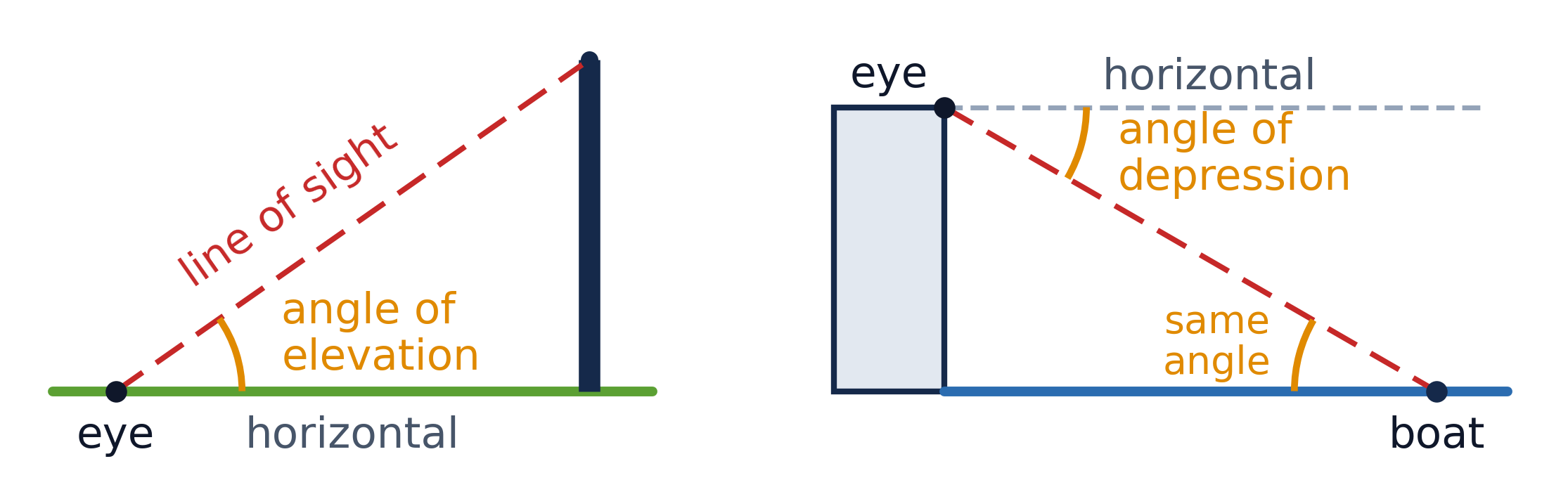
One fact saves time. If A looks down at B with an angle of depression \theta, then B looks up at A with an angle of elevation \theta (alternate angles between parallel horizontal lines). So you can move an angle of depression from the top of the figure to the bottom.
The paper also says "a tower subtends an angle of 60^\circ at a point A". It means: the angle at A between the lines to the foot and to the top of the tower is 60^\circ. If A is on the level of the foot, this is the angle of elevation of the top.
2. The one tool
A vertical object, the level ground and the line of sight make a right-angled triangle. In it,
\tan\theta = \frac{\text{height}}{\text{horizontal distance}}
So height = distance \times \tan\theta, and distance = height \times \cot\theta.
| \theta | 30^\circ | 45^\circ | 60^\circ |
|---|---|---|---|
| \tan\theta | \dfrac{1}{\sqrt{3}} | 1 | \sqrt{3} |
| \cot\theta | \sqrt{3} | 1 | \dfrac{1}{\sqrt{3}} |
For an answer in decimals use \sqrt{3} \approx 1.732 and \frac{1}{\sqrt{3}} \approx 0.577.
Two other wordings use the same triangle.
- A shadow. The shadow lies on the ground, so it is the horizontal distance, and the angle of elevation of the sun is \theta. If the shadow of a pole is \sqrt{3} times its height, then \tan\theta = \frac{1}{\sqrt{3}} and the sun is at 30^\circ.
- A slant length. If the question gives the line of sight itself, a ladder, or the string of a kite, use sine: height = slant length \times \sin\theta. A kite on 100 m of string at 60^\circ is 100 \times \frac{\sqrt{3}}{2} = 50\sqrt{3} \approx 86.6 m high.
3. The standard figures
Most questions are one of these five. Here h is the height of the tower.
| Figure | What is given | Result |
|---|---|---|
| One point | Distance d from the foot, elevation \theta | h = d\tan\theta |
| Two points on the same side, in line with the foot | They are d apart; elevations \alpha (far point) and \beta (near point) | d = h(\cot\alpha - \cot\beta) |
| Two points on opposite sides | They are d apart; elevations \alpha and \beta | d = h(\cot\alpha + \cot\beta) |
| Two points at distances a and b from the foot, same line | The two elevations add up to 90^\circ | h^2 = ab |
| A point Q at height k vertically above a point P on the ground | Elevation \alpha of the top from P; depression \beta of the foot from Q | h = k\tan\alpha\cot\beta |
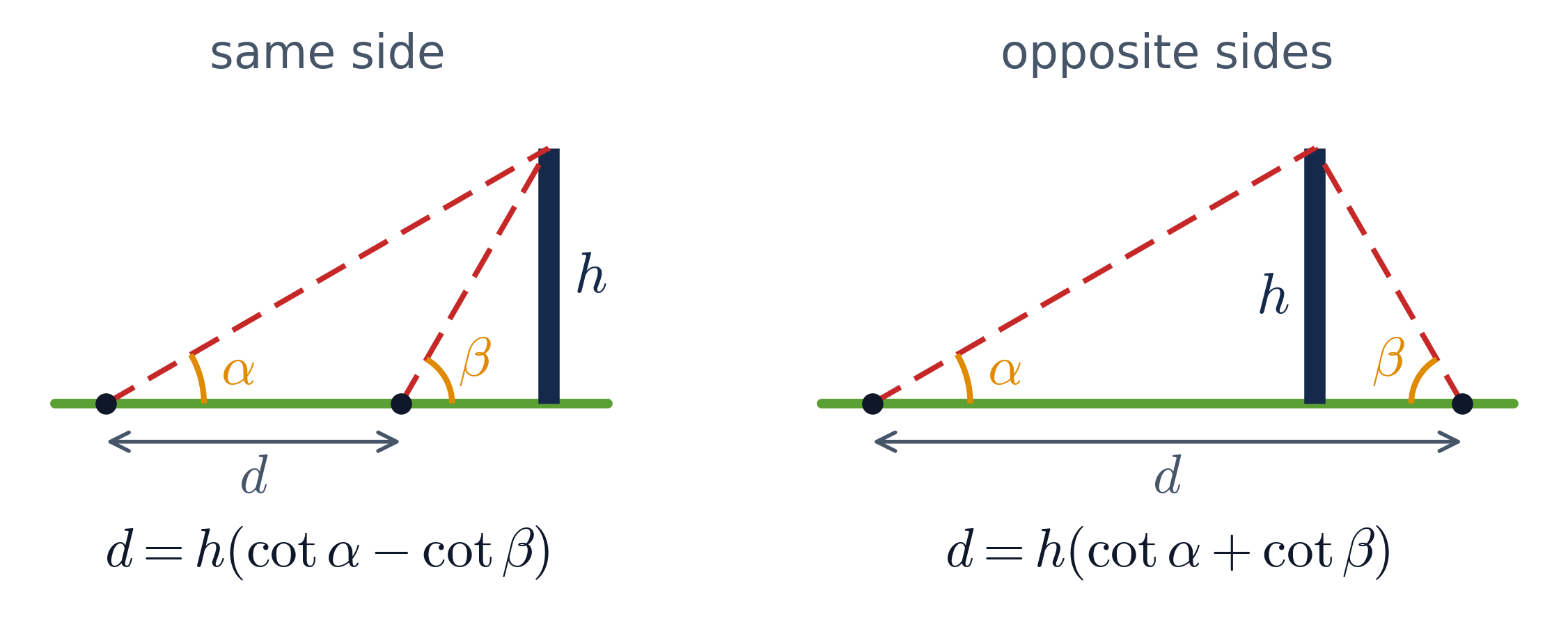
Each result comes from one idea: the distance of a point from the foot is h\cot(\text{its angle}). On the same side the two distances are subtracted. On opposite sides they are added.
The commonest numbers are 30^\circ and 60^\circ. On the same side, d = h\left(\sqrt{3} - \frac{1}{\sqrt{3}}\right) = \frac{2h}{\sqrt{3}}, so h = \frac{\sqrt{3}}{2}d. On opposite sides, d = h\left(\sqrt{3} + \frac{1}{\sqrt{3}}\right) = \frac{4h}{\sqrt{3}}.
The method for every question. Draw your own figure first: the ground, each tower as a vertical line, a dotted horizontal line through the eye of the observer, and each angle marked from a horizontal line. Then write one \tan equation for each right-angled triangle, and remove the length you do not want.
Worked examples
Example 1. From a point 30 m from the foot of a tower, the angle of elevation of its top is 30^\circ. Find the height.
h = 30\tan 30^\circ = \dfrac{30}{\sqrt{3}} = 10\sqrt{3} m, about 17.3 m.
Example 2. The angle of elevation of the top of a tower is 30^\circ. After walking 40 m towards the tower, it is 60^\circ. Find the height.
Let the second point be x m from the foot. Then h = x\tan 60^\circ = \sqrt{3}x and h = (x + 40)\tan 30^\circ = \dfrac{x + 40}{\sqrt{3}}. So 3x = x + 40, x = 20 and h = 20\sqrt{3} m. The result of section 3 gives the same at once: h = \frac{\sqrt{3}}{2} \times 40 = 20\sqrt{3}.
Example 3. From the top of a cliff 60 m high, the angle of depression of a boat is 30^\circ. The boat sails straight towards the cliff until the angle of depression is 60^\circ. How far has it sailed?
Move each angle of depression down to the boat. The distance of the boat from the foot of the cliff is 60\cot 30^\circ = 60\sqrt{3} m at first, and 60\cot 60^\circ = \frac{60}{\sqrt{3}} = 20\sqrt{3} m at the end. It has sailed 60\sqrt{3} - 20\sqrt{3} = 40\sqrt{3} m, about 69.3 m.
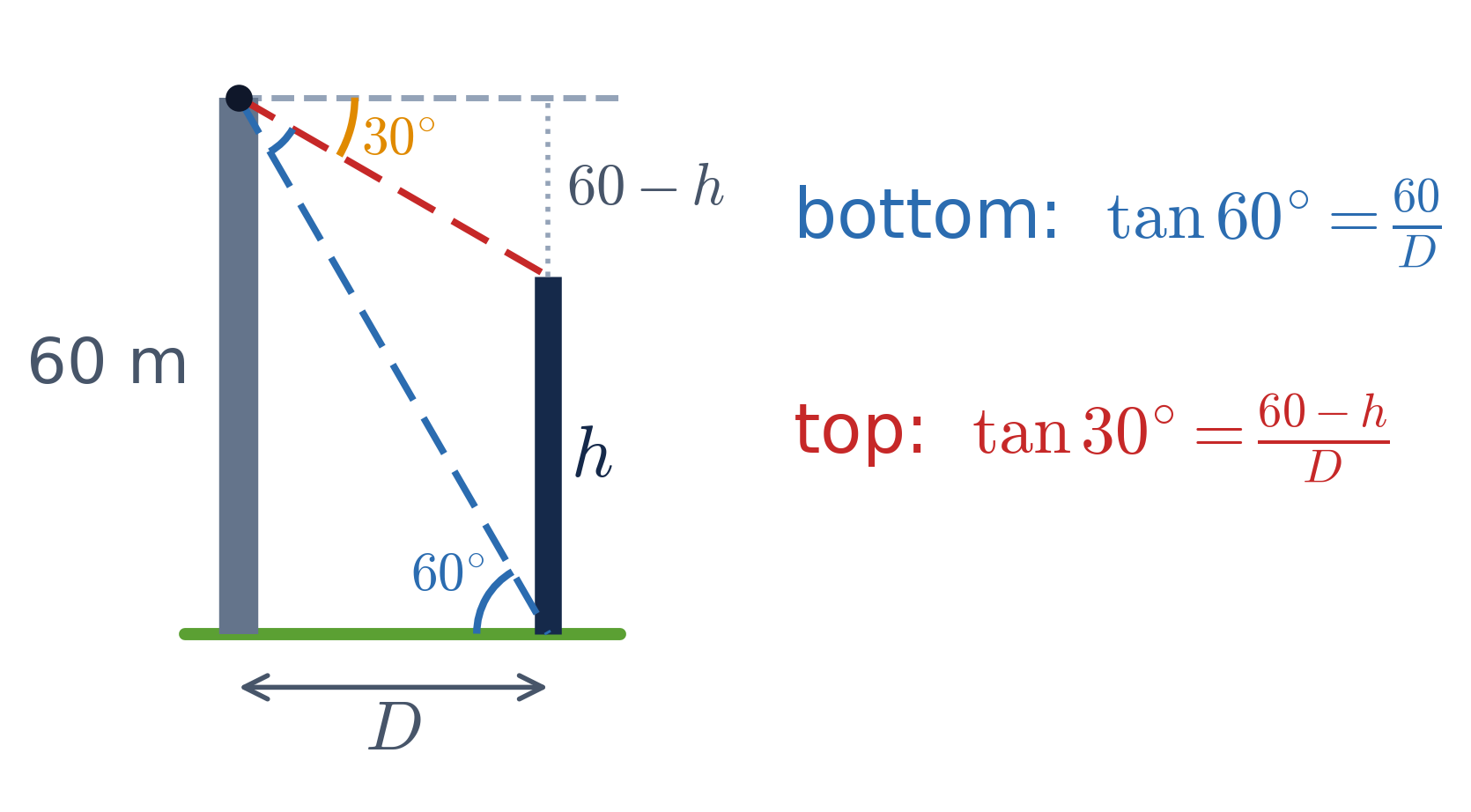
Example 4. From the top of a building 60 m high, the angles of depression of the top and the bottom of a tower are 30^\circ and 60^\circ. Find the height of the tower.
The bottom of the tower is 60 m below the observer: \tan 60^\circ = \dfrac{60}{D}, so D = \dfrac{60}{\sqrt{3}} = 20\sqrt{3} m. The top of the tower is 60 - h below the observer: 60 - h = D\tan 30^\circ = 20\sqrt{3} \times \dfrac{1}{\sqrt{3}} = 20. So h = 40 m.
From the real papers
Try each for 72 seconds before reading the solution. The first two questions are from CDS I 2024 and CDS I 2025 (Series A), and the answers agree with the final official key.
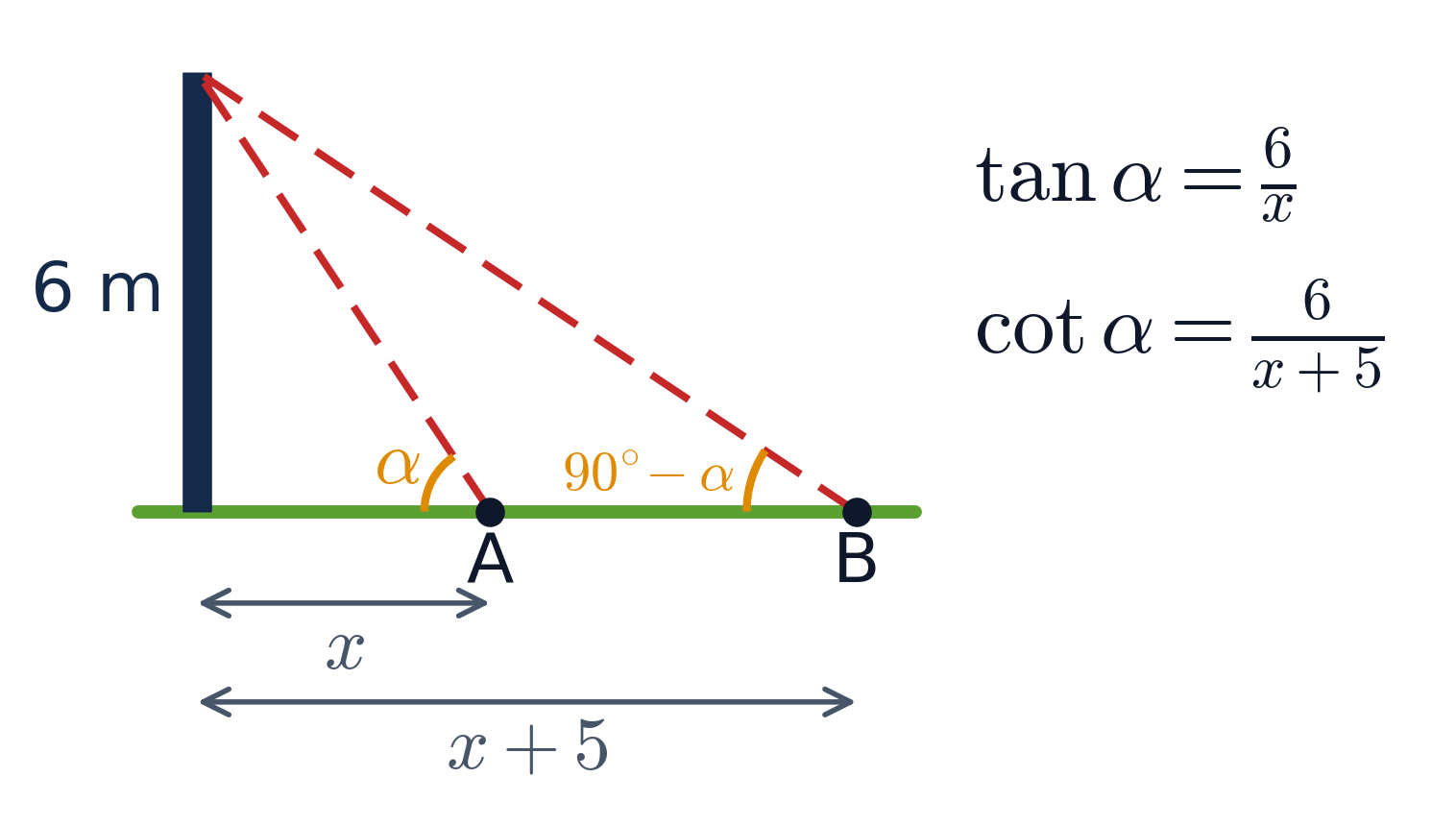
CDS I 2024, Q53. The angles of elevation of the top of a tower from two points A and B at a distance of x m and (x + 5) m from the base of the tower of height 6 m and in the same straight line with it are complementary. What is the value of x?
(a) 4 m (b) 5 m (c) 6 m (d) 9 m
Solution. Let the angles be \alpha and 90^\circ - \alpha. Then \tan\alpha = \frac{6}{x} and \tan(90^\circ - \alpha) = \cot\alpha = \frac{6}{x + 5}. Multiply: \tan\alpha \times \cot\alpha = 1, so \frac{36}{x(x + 5)} = 1. Then x^2 + 5x - 36 = 0, that is (x + 9)(x - 4) = 0, and x = 4. This is the fourth line of the table: h^2 = ab, and 6^2 = 4 \times 9. Answer (a).
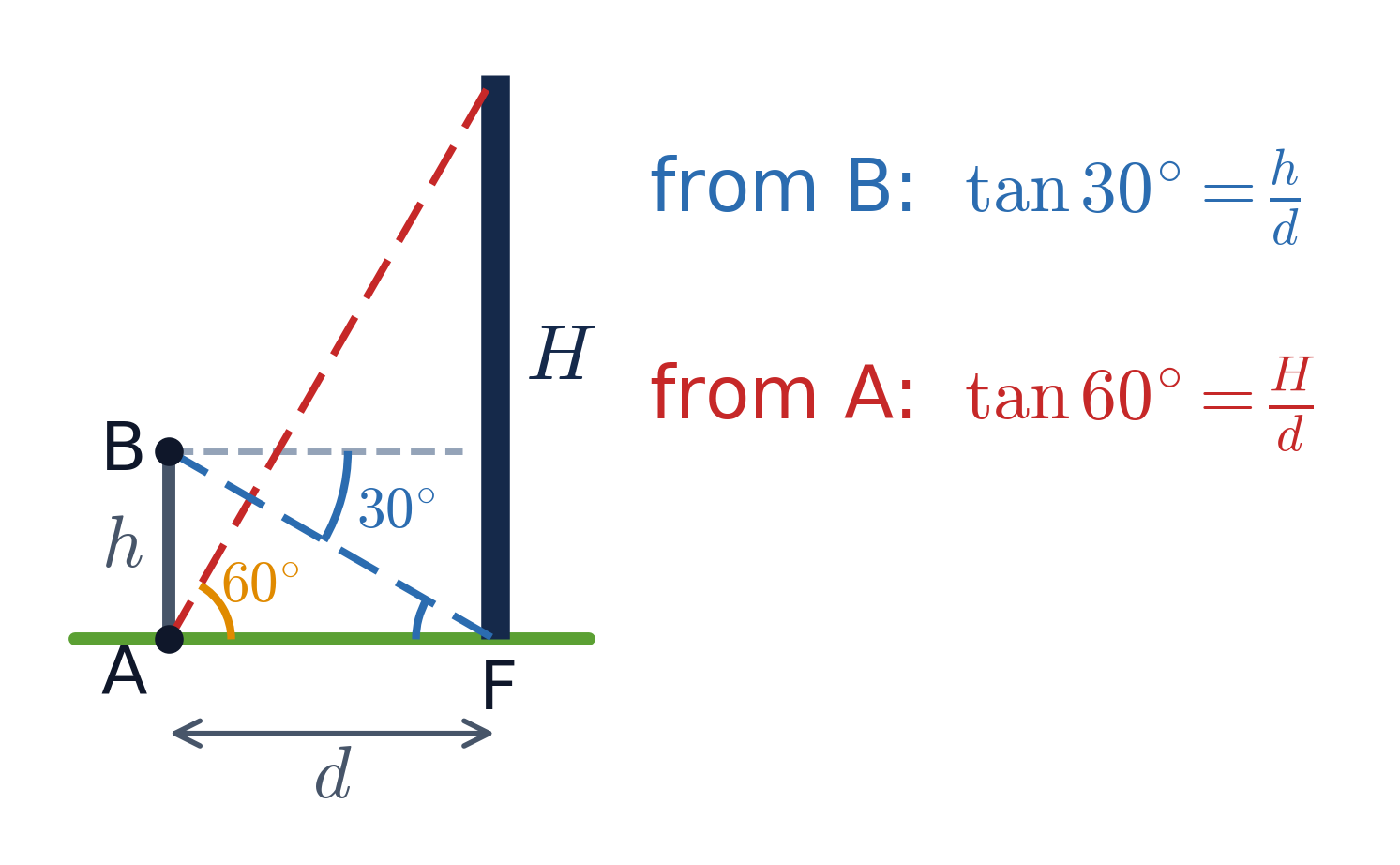
CDS I 2025, Q25. A tower subtends an angle 60° at a point A on the same level as the foot of the tower. B is a point vertically above A and AB = h. The angle of depression of the foot of the tower, measured from B is 30°. What is the height of the tower?
(a) 2h (b) 2.5h (c) 3h (d) 3.5h
Solution. Let F be the foot of the tower, d its distance from A, and H the height of the tower. From B: the foot is h below and d away, so \tan 30^\circ = \frac{h}{d} and d = \sqrt{3}h. From A: \tan 60^\circ = \frac{H}{d}, so H = \sqrt{3}d = \sqrt{3} \times \sqrt{3}h = 3h. Answer (c).
From the 2026 papers: the official key is still provisional
The next three questions are from CDS I 2026 and CDS II 2026. Our working agrees with the provisional key; the final key had not been published when this lesson was written.
CDS I 2026, Q44. At a point on level ground, the tangent of the angle of elevation of the top of a tower is found to be \frac{5}{6}. On walking 70 m towards the tower, the tangent of the angle of elevation of the top of the tower is found to be \frac{9}{8}. What is the height of the tower?
(a) 225 m (b) 270 m (c) 300 m (d) 330 m
Solution. Distance from the foot = height \div tangent. The first distance is \frac{6h}{5} and the second is \frac{8h}{9}. Their difference is the 70 m walked: \frac{6h}{5} - \frac{8h}{9} = \frac{14h}{45} = 70, so h = 225 m. Check: the distances are 270 m and 200 m, and \frac{225}{270} = \frac{5}{6}, \frac{225}{200} = \frac{9}{8}. Answer (a).
CDS I 2026, Q45. Two persons are on diametrically opposite sides of a tower. They measure the angles of elevation of the top of the tower as 30° and 60° respectively. If the height of the tower is 100 m, what is the approximate distance between the two persons?
(a) 220 m (b) 225 m (c) 230 m (d) 235 m
Solution. Opposite sides, so the distances add: 100\cot 30^\circ + 100\cot 60^\circ = 100\sqrt{3} + \frac{100}{\sqrt{3}} \approx 173.2 + 57.7 = 230.9 m. The nearest option is 230 m. Answer (c).
CDS II 2026, Q44. A person walking along a straight road observes that at two consecutive kilometer-stones the angles of elevation of a hill in front of him are 30° and 60° respectively. What is the height of the hill?
(a) 3\sqrt{3} km (b) 2\sqrt{3} km (c) \sqrt{3} km (d) \frac{\sqrt{3}}{2} km
Solution. The two stones are on the same side and 1 km apart, with angles 30^\circ and 60^\circ. By section 3, h = \frac{\sqrt{3}}{2}d = \frac{\sqrt{3}}{2} km. In full: \sqrt{3}h - \frac{h}{\sqrt{3}} = 1, so \frac{2h}{\sqrt{3}} = 1. Answer (d).
From CDS II 2024: no official key was published; the answer is our own working
CDS II 2024, Q46. A vertical pole of length 80 m is situated on the horizontal plane. The base of the pole is at P. There are two points A and B such that P, A, B are on the same straight line. Let the angles of elevation of top of the pole from A and B be \alpha and \beta (\alpha > \beta) respectively. If PA = 64 m and AB = 36 m, then what is (\alpha + \beta) equal to?
(a) 60^\circ (b) 90^\circ (c) 120^\circ (d) 135^\circ
Solution. The larger angle belongs to the nearer point, so A is nearer and PB = 64 + 36 = 100 m. Then \tan\alpha = \frac{80}{64} = \frac{5}{4} and \tan\beta = \frac{80}{100} = \frac{4}{5}. The product is 1, so the angles are complementary (Chapter A4-2, section 2): \alpha + \beta = 90^\circ. Check with the table: 80^2 = 64 \times 100. Answer (b).
Every one of the six is a figure from the table of section 3. None needed more than two \tan equations.
Mistakes that cost marks
- Measuring the angle from the vertical. Elevation and depression are both measured from the horizontal line through the eye.
- Putting the angle of depression inside the triangle at the top. The angle inside the triangle at the top is 90^\circ - \theta. Move the angle of depression down to the object by alternate angles and work there.
- Using \tan with a slant length. A ladder, a kite string or "the distance of the plane from the observer" is the hypotenuse. Use sine or cosine.
- Adding where you should subtract. Same side: the distances from the foot are subtracted. Opposite sides: they are added. A drawing settles it.
Quick check
Do these without help. Answers are at the end.
- From a point 20 m from the foot of a tower, the angle of elevation of the top is 60^\circ. Find the height.
- A ladder 10 m long leans on a wall and makes 60^\circ with the ground. How high does it reach, and how far is its foot from the wall?
- From two points 3 m and 12 m from the foot of a pole, on the same line, the angles of elevation of the top are complementary. Find the height.
- From the top of a tower 50 m high, the angle of depression of a car is 45^\circ. How far is the car from the foot of the tower?
- Two men stand on opposite sides of a tower 30 m high. They see its top at 45^\circ and 60^\circ. How far apart are they?
Read and watch more, free
The NCERT chapter is the closest match to this lesson. The NIOS lesson is listed from its title only.
| What | Where | Language |
|---|---|---|
| Textbook | NCERT Class 10 Mathematics, Chapter 9 Some Applications of Trigonometry · Hindi edition | English, Hindi |
| Self-study notes | NIOS Secondary Mathematics (211), Lesson 23 Trigonometric Ratios of Some Special Angles · Hindi edition | English, Hindi |
| Practice with answers | NCERT Exemplar Class 10, Unit 8 Trigonometry · Hindi edition | English, Hindi |
| Short videos with practice | Khan Academy, NCERT Math Class 10 (the heights and distances unit) · in Hindi | English, Hindi |
| The real papers | UPSC previous question papers | English, Hindi |
| Video, numbered classes | Chandigarh Career Group: CDS advance maths by Sandeep Brar (the three height and distance classes) | Hinglish |
| Video, a full CDS course | R.S SIR: Maths Playlist for CDS 2025 (the height and distance lesson) | Hindi and Hinglish |
| Video, one long lesson with past questions | The Journey Extraordinary: Maths For CDS 2 2026 (the height and distance lesson) | Hinglish |
The videos were chosen from their titles, length and views; they have not yet been watched by a teacher.
Answers to the quick check
- h = 20\tan 60^\circ = 20\sqrt{3} m, about 34.6 m.
- Height = 10\sin 60^\circ = 5\sqrt{3} m, about 8.7 m. Distance of the foot = 10\cos 60^\circ = 5 m.
- h^2 = 3 \times 12 = 36, so h = 6 m.
- \tan 45^\circ = 1, so the distance equals the height: 50 m.
- 30\cot 45^\circ + 30\cot 60^\circ = 30 + \frac{30}{\sqrt{3}} = 30 + 10\sqrt{3} m, about 47.3 m.
Next chapter: Lines, angles and parallel lines.