Why this chapter matters. This is a small chapter. It gave 1 question in the 6 papers from CDS I 2024 to CDS II 2026 (CDS II 2025, Q74, on complementary angles). But the syllabus lists "lines and angles", "properties of angles at a point" and "parallel lines", so a direct question can come in any paper. More important, every other geometry chapter stands on this one. The geometry unit gave 95 questions in these six papers, about 16 a paper, and many of them use an alternate angle, a linear pair or a vertically opposite angle somewhere in the working. The real question is solved below, and five practice questions in the same style follow it.
What you will be able to do
- Name the kinds of angle, and find the complement and the supplement of an angle.
- Use the three facts about angles at a point: linear pair, vertically opposite angles, angles round a point.
- Name and use the angle pairs made when a line cuts two parallel lines.
- Find an angle at a bend between two parallel lines by drawing one more parallel line.
Before you start you should know: how to solve a linear equation in one unknown, and how to divide a quantity in a given ratio (Chapter A2-5).
1. The words
A line runs without end in both directions. A ray starts at a point and runs without end in one direction. A line segment has two end points and a length. A plane is a flat surface that runs without end, like a table top with no edges. All the figures of this unit are plane figures: they lie in one plane.
Points on one line are collinear. Three or more lines through one point are concurrent. Two lines in a plane either cross at exactly one point or never meet. Lines in a plane that never meet are parallel.
An angle is made by two rays from one point, called the vertex. It is measured in degrees: a full turn is 360^\circ.
| Kind of angle | Size |
|---|---|
| Acute | more than 0^\circ, less than 90^\circ |
| Right | exactly 90^\circ |
| Obtuse | more than 90^\circ, less than 180^\circ |
| Straight | exactly 180^\circ |
| Reflex | more than 180^\circ, less than 360^\circ |
Two lines that cross at 90^\circ are perpendicular.
2. Complementary and supplementary angles
Two angles are complementary when they add up to 90^\circ. Two angles are supplementary when they add up to 180^\circ.
| Of an angle x | Of 35^\circ | |
|---|---|---|
| Complement | 90^\circ - x | 55^\circ |
| Supplement | 180^\circ - x | 145^\circ |
The usual question gives a relation between an angle and its complement or supplement. Write the angle as x, write the relation as an equation, and solve.
An angle is twice its complement. Then x = 2(90 - x), so 3x = 180 and x = 60^\circ. Check: the complement is 30^\circ, and 60 is twice 30.
One fact saves time. The supplement of an angle is always 90^\circ more than its complement, because (180 - x) - (90 - x) = 90.
3. Angles at a point
Linear pair. When a ray stands on a straight line, the two angles beside it add up to 180^\circ. They are called a linear pair.
Vertically opposite angles. When two straight lines cross, they make four angles. The angles opposite each other are equal.
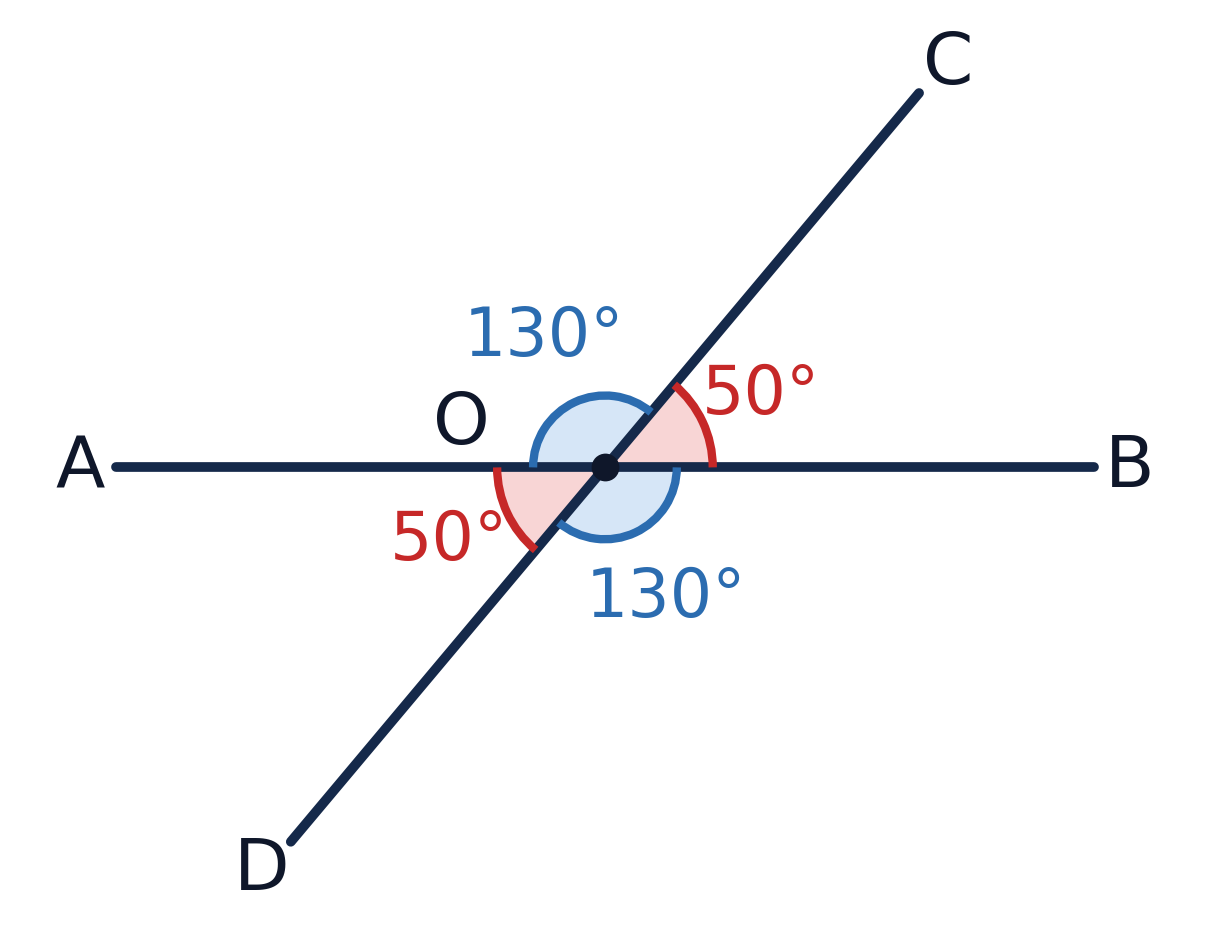
Why. In the figure, \angle COB + \angle COA = 180^\circ (linear pair on the line AB). Also \angle COA + \angle AOD = 180^\circ (linear pair on the line CD). Take away the common angle COA: \angle COB = \angle AOD.
So when two lines cross, one angle gives all four. If one is 50^\circ, the four are 50^\circ, 130^\circ, 50^\circ, 130^\circ.
Angles round a point. All the angles round a point add up to 360^\circ. If four angles round a point are in the ratio 1 : 2 : 3 : 4, there are 10 parts, each part is 36^\circ, and the angles are 36^\circ, 72^\circ, 108^\circ and 144^\circ.
The bisectors of a linear pair are perpendicular. A bisector cuts an angle into two equal parts. If the two angles of a linear pair are 70^\circ and 110^\circ, their halves are 35^\circ and 55^\circ, and the angle between the two bisectors is 35^\circ + 55^\circ = 90^\circ. This is always so, because half of 180^\circ is 90^\circ.
4. Parallel lines and a transversal
A line that cuts two or more lines is called a transversal. It makes eight angles with two lines. In the figure the lines l and m are parallel. Small arrow heads on two lines are the mark for "parallel".
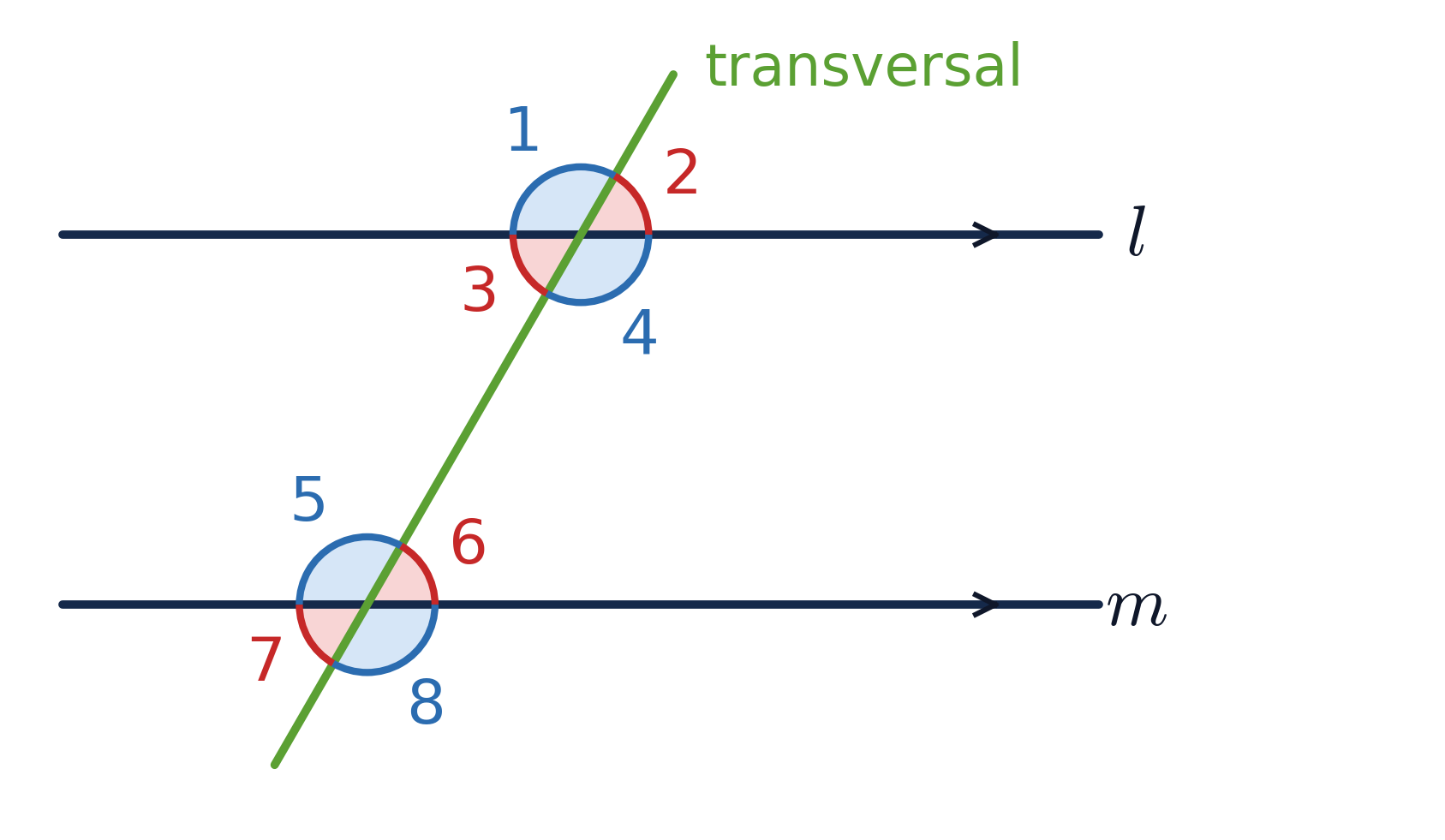
| Name of the pair | Pairs in the figure | If the lines are parallel |
|---|---|---|
| Corresponding angles (same position at each crossing) | 1 and 5, 2 and 6, 3 and 7, 4 and 8 | equal |
| Alternate interior angles (between the lines, on opposite sides of the transversal) | 3 and 6, 4 and 5 | equal |
| Alternate exterior angles (outside the lines, on opposite sides) | 1 and 8, 2 and 7 | equal |
| Co-interior angles (between the lines, on the same side) | 3 and 5, 4 and 6 | add up to 180^\circ |
A quick way to see them: alternate angles sit in a letter Z, corresponding angles in a letter F, and co-interior angles in a letter C or U.
If \angle 2 = 60^\circ in the figure, then \angle 3 = 60^\circ (vertically opposite), \angle 6 = 60^\circ (corresponding to 2) and \angle 7 = 60^\circ. Each of the other four is 180^\circ - 60^\circ = 120^\circ. So with parallel lines, one angle gives all eight, and there are only two sizes: x and 180^\circ - x.
The rule also works backwards. If one pair of corresponding angles is equal, or one pair of alternate angles is equal, or one pair of co-interior angles adds up to 180^\circ, then the two lines are parallel. This is how a question asks you to show, or to decide, that two lines are parallel.
Two more facts:
- Lines parallel to the same line are parallel to each other.
- In a plane, two lines perpendicular to the same line are parallel to each other.
5. A bend between two parallel lines
Many questions put a bent line between two parallel lines and ask for the angle at the bend. Draw one more parallel line through the bend.
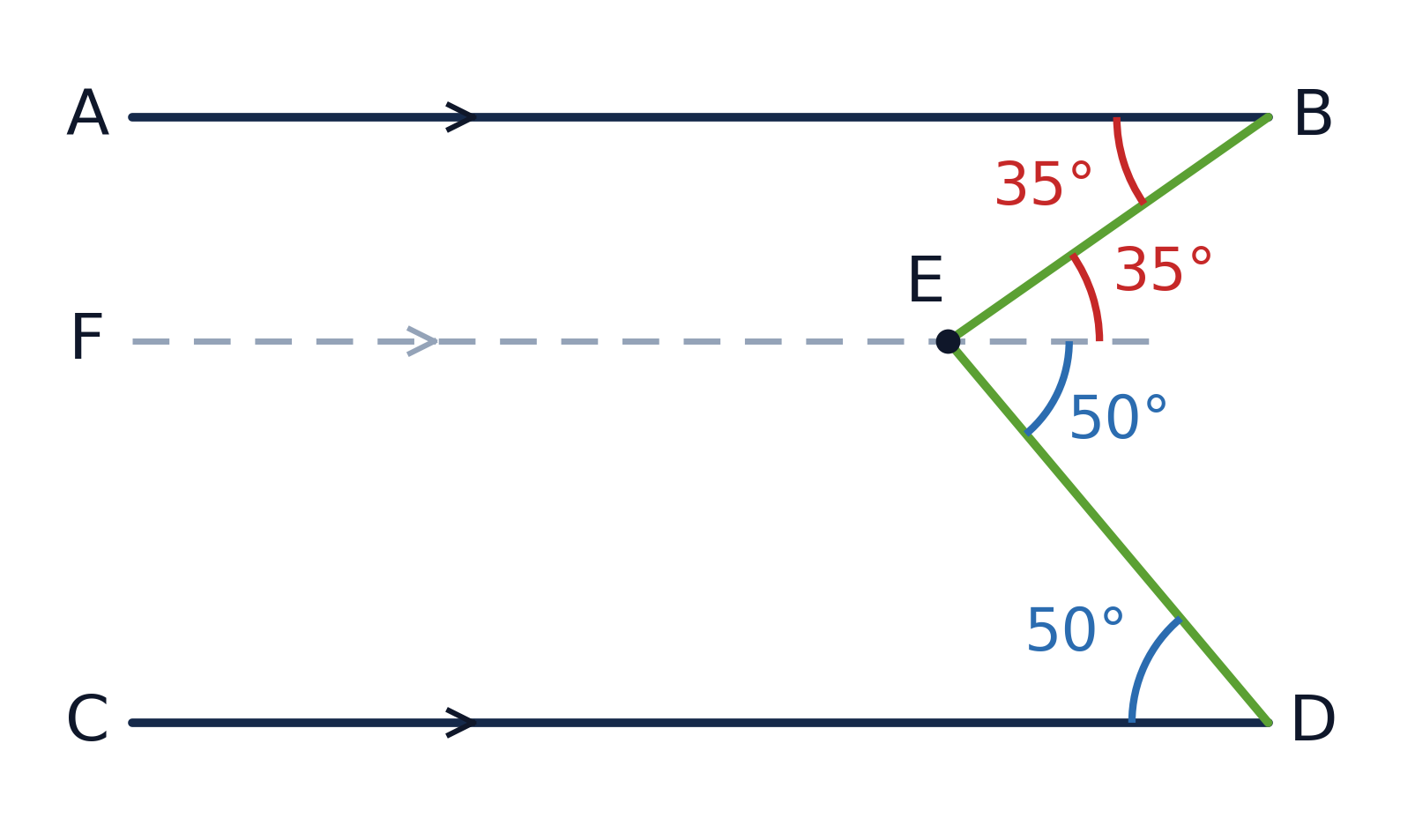
In the figure, AB \parallel CD, \angle ABE = 35^\circ and \angle CDE = 50^\circ. The dashed line through E is parallel to both. The upper part of the angle at E equals \angle ABE (alternate angles), and the lower part equals \angle CDE (alternate angles). So
\angle BED = 35^\circ + 50^\circ = 85^\circ
Rule. When the bend points away from the given angles, as here, the angle at the bend is the sum of the two angles.
The same extra line proves the best-known fact in geometry. Draw a line through one corner of a triangle, parallel to the opposite side. The alternate angles show that the three angles of the triangle fill a straight angle. So the angles of a triangle add up to 180^\circ. Chapter A5-2 starts from this.
Worked examples
Example 1. An angle is 24^\circ more than its complement. Find the angle and its supplement.
Let the angle be x. Then x = (90 - x) + 24, so 2x = 114 and x = 57^\circ. Check: the complement is 33^\circ, and 57 - 33 = 24. The supplement is 180^\circ - 57^\circ = 123^\circ.
Example 2. Two straight lines cross. Two vertically opposite angles are (3x + 10)^\circ and (5x - 30)^\circ. Find all four angles.
Vertically opposite angles are equal: 3x + 10 = 5x - 30, so 2x = 40 and x = 20. Each of these angles is 70^\circ. Each of the other two is 180^\circ - 70^\circ = 110^\circ.
Example 3. A transversal cuts two parallel lines. The two co-interior angles on one side are in the ratio 2 : 3. Find them.
Co-interior angles add up to 180^\circ. There are 5 parts, so one part is 36^\circ. The angles are 72^\circ and 108^\circ.
From the real papers
Only one question on this chapter is in the six papers captured so far. It is from CDS II 2025 (Series A) and the answer agrees with the final official key. Try it for 72 seconds before reading the solution.
CDS II 2025, Q74. An angle \theta is exactly one-fourth of its complementary angle. What is the value of angle \theta?
(a) 12^\circ (b) 15^\circ (c) 18^\circ (d) 20^\circ
Solution. The complement of \theta is 90^\circ - \theta. So \theta = \frac{1}{4}(90^\circ - \theta). Multiply by 4: 4\theta = 90^\circ - \theta, so 5\theta = 90^\circ and \theta = 18^\circ. Check: the complement is 72^\circ, and one-fourth of 72 is 18. Answer (c).
A faster way: the angle and its complement are in the ratio 1 : 4, so the angle is \frac{1}{5} of 90^\circ.
Practice questions in the exam style
These five questions are our own. They are not from a real paper. They cover the parts of the syllabus that the six papers did not ask directly.
Practice 1. The supplement of an angle is three times its complement. What is the angle?
(a) 30^\circ (b) 45^\circ (c) 60^\circ (d) 75^\circ
Solution. 180 - x = 3(90 - x), so 180 - x = 270 - 3x, 2x = 90 and x = 45^\circ. Check: the supplement is 135^\circ and the complement is 45^\circ. Answer (b).
Practice 2. Two rays stand at one point of a straight line, on the same side of it. The three angles so formed on that side are in the ratio 2 : 3 : 4. What is the largest of them?
(a) 60^\circ (b) 72^\circ (c) 80^\circ (d) 90^\circ
Solution. The three angles fill a straight angle, so they add up to 180^\circ. There are 9 parts, so one part is 20^\circ. The angles are 40^\circ, 60^\circ and 80^\circ. Answer (c).
Practice 3. A transversal cuts two lines l and m. Consider the following statements:
I. If a pair of alternate interior angles are equal, then l is parallel to m.
II. If a pair of co-interior angles are equal, then l is parallel to m.
Which of the statements given above is/are correct?
(a) I only (b) II only (c) Both I and II (d) Neither I nor II
Solution. Statement I is the rule of section 4 used backwards. It is correct. Statement II is not correct: co-interior angles must add up to 180^\circ, not be equal. If both are 70^\circ, their sum is 140^\circ and the lines meet. (They would be parallel only if both were 90^\circ.) Answer (a).
Practice 4. PQ and RS are parallel lines and T is a point between them. \angle QPT = 28^\circ and \angle SRT = 47^\circ, with the bend at T pointing away from both angles as in the figure of section 5. What is \angle PTR?
(a) 19^\circ (b) 75^\circ (c) 105^\circ (d) 285^\circ
Solution. Draw the line through T parallel to PQ. The angle at the bend is the sum of the two alternate angles: 28^\circ + 47^\circ = 75^\circ. Answer (b).
Practice 5. A Question is given followed by two Statements I and II. Consider the Question and the Statements.
Question: Two straight lines cross at a point and make four angles. What is the size of the angle x, one of the four?
Statement-I: The angle vertically opposite to x is 70^\circ.
Statement-II: An angle adjacent to x is 110^\circ.
Which one of the following is correct in respect of the above Question and the Statements?
(a) The Question can be answered by using one of the Statements alone, but cannot be answered using the other Statement alone (b) The Question can be answered by using either Statement alone (c) The Question can be answered by using both the Statements together, but cannot be answered using either Statement alone (d) The Question can be answered even without using any of the Statements
Solution. Statement I alone: vertically opposite angles are equal, so x = 70^\circ. Statement II alone: adjacent angles here are a linear pair, so x = 180^\circ - 110^\circ = 70^\circ. Each statement alone is enough. Answer (b).
Mistakes that cost marks
- Mixing up complement and supplement. Complement goes with 90^\circ, supplement with 180^\circ. A way to remember: C comes before S in the alphabet, and 90 comes before 180.
- Making co-interior angles equal. Corresponding angles are equal. Alternate angles are equal. Co-interior angles add up to 180^\circ.
- Using the angle rules when the lines are not parallel. Corresponding and alternate angles are equal only for parallel lines. Look for the word "parallel" or the arrow marks before you use them. Vertically opposite angles and linear pairs need no parallel lines.
- Reading the wrong angle at a bend. \angle ABE is the angle at B, the middle letter. Mark the given angles on a quick sketch before you add or subtract.
Quick check
Do these without help. Answers are at the end.
- An angle is two-thirds of its supplement. Find the angle.
- Two straight lines cross. One of the four angles is four times another. Find all four angles.
- A transversal cuts two parallel lines and one of the eight angles is 65^\circ. What is the angle alternate to it? What is the angle co-interior with it?
- AB \parallel CD and E is between them as in the figure of section 5. \angle ABE = 32^\circ and \angle CDE = 41^\circ. Find \angle BED.
- Four angles round a point are 2x, 3x, 4x and 90^\circ. Find x and the three unknown angles.
Read and watch more, free
The current NCERT books teach this chapter in Classes 6 and 7. The NIOS lesson is the fullest single source, and the Class 9 Exemplar unit has multiple-choice questions with answers.
| What | Where | Language |
|---|---|---|
| Textbook, kinds of angle | NCERT Class 6 Ganita Prakash, Chapter 2 Lines and Angles · Hindi edition | English, Hindi |
| Textbook, parallel lines and a transversal | NCERT Class 7 Ganita Prakash, Chapter 5 Parallel and Intersecting Lines · Hindi edition | English, Hindi |
| Self-study notes | NIOS Secondary Mathematics (211), Lesson 10 Lines and Angles · Hindi edition | English, Hindi |
| Practice with answers | NCERT Exemplar Class 9, Unit 6 Lines and Angles · Hindi edition | English, Hindi |
| Short videos with practice | Khan Academy, NCERT Math Class 9 (the lines and angles unit) | English |
| The real papers | UPSC previous question papers | English, Hindi |
| Video, numbered classes | Chandigarh Career Group: CDS advance maths by Sandeep Brar (the first of the geometry and mensuration classes) | Hinglish |
| Video, a full CDS course | R.S SIR: Maths Playlist for CDS 2025 (the eight geometry lessons, about 55 minutes each) | Hindi and Hinglish |
| Video, whole geometry in six lessons | Defence Wallah CDS / AFCAT: Quantitative Aptitude CDS 2024 (the geometry lessons, about 2 hours each) | Hinglish |
The videos were chosen from their titles, length and views; they have not yet been watched by a teacher.
Answers to the quick check
- x = \frac{2}{3}(180 - x), so 3x = 360 - 2x and x = 72^\circ. Check: the supplement is 108^\circ, and two-thirds of 108 is 72.
- The two different angles are a linear pair: x + 4x = 180, so x = 36. The angles are 36^\circ, 144^\circ, 36^\circ, 144^\circ.
- The alternate angle is 65^\circ. The co-interior angle is 180^\circ - 65^\circ = 115^\circ.
- 32^\circ + 41^\circ = 73^\circ.
- 2x + 3x + 4x + 90 = 360, so 9x = 270 and x = 30. The angles are 60^\circ, 90^\circ and 120^\circ.
Next chapter: Triangles: sides and angles, inequality, congruence.