Why this chapter matters. This chapter gave 14 questions in the 6 papers from CDS I 2024 to CDS II 2026. That is about 2 a paper, and each of the two 2026 papers had 4. Seven of the 14 use one picture: the perpendicular from the centre cuts a chord in half, and a right triangle appears. Four are about a cyclic quadrilateral. Two use the angle at the centre or the angle in a semicircle. One uses two chords that cross. Several come as "which of the statements is correct" or as "is the statement enough" questions. Tangents are kept for the next chapter.
What you will be able to do
- Find a chord, a radius or a distance from the centre with one right triangle.
- Use the three angle facts: the angle at the centre is double, angles on the same arc are equal, the angle in a semicircle is 90^\circ.
- Use the two facts about a cyclic quadrilateral.
- Use the rule for two chords that cross: AP \times PB = CP \times PD.
Before you start you should know: Pythagoras' theorem and the triples 3-4-5, 5-12-13, 8-15-17 and 7-24-25 (Chapter A5-3), the angle sum of a triangle and the isosceles triangle (Chapter A5-2), and parallel lines (Chapter A5-1).
1. The words
A circle is the set of all points at one fixed distance, the radius, from a fixed point, the centre.
| Word | Meaning |
|---|---|
| Chord | A line segment joining two points of the circle |
| Diameter | A chord through the centre. It is the longest chord, and its length is twice the radius |
| Arc | A part of the circle. Two points A and B cut the circle into a shorter minor arc and a longer major arc |
| Segment | The region between a chord and its arc. A chord cuts the circle into a minor segment and a major segment |
| Semicircle | Half the circle, cut off by a diameter |
| Concyclic points | Points that lie on one circle |
2. A chord and the centre
This is the most useful fact in the chapter.
The perpendicular from the centre to a chord bisects the chord. The other way round is also true: the line from the centre to the midpoint of a chord is perpendicular to the chord.
So every chord gives a right triangle. Its three sides are the radius r, the distance d of the chord from the centre, and half the chord:
r^2 = d^2 + \left(\frac{\text{chord}}{2}\right)^2
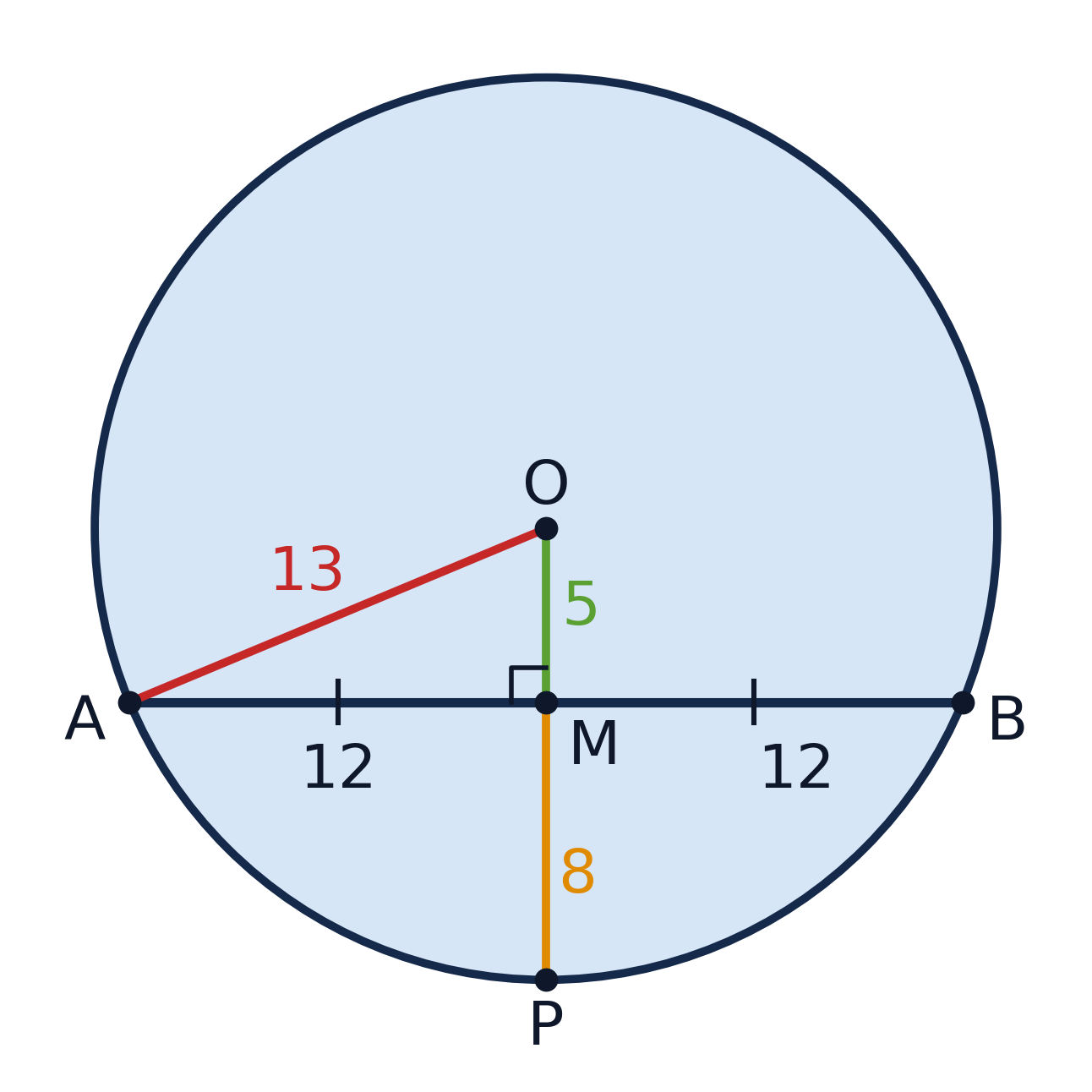
In the figure the radius is 13 and the chord is 24. Half the chord is 12, so d = \sqrt{13^2 - 12^2} = \sqrt{25} = 5.
Three more facts come from the same picture.
- Equal chords are at equal distances from the centre. A longer chord is nearer to the centre. In a circle of radius 10, a chord of 16 is at distance 6 and a chord of 12 is at distance 8.
- The same line passes through the middle of the arc. In the figure, the line OM produced meets the minor arc at its midpoint P. The length MP is called the height of the segment. Here it is r - d = 13 - 5 = 8.
- Chord and height give the radius. If the height of the minor segment is h, then d = r - h, and the right triangle gives
\left(\frac{\text{chord}}{2}\right)^2 = h(2r - h)
Check with the figure: 8 \times (26 - 8) = 8 \times 18 = 144 = 12^2.
Two parallel chords. Find the distance of each chord from the centre. If the chords are on opposite sides of the centre, add the two distances. If they are on the same side, subtract. Read the question to see which case it is. If it does not say, there are two answers.
3. Angles made by an arc
Take an arc AB. Join its ends to the centre O, and to a point C on the rest of the circle. The arc makes the angle AOB at the centre and the angle ACB at the circle.
| Fact | In symbols |
|---|---|
| The angle at the centre is twice the angle at the circle | \angle AOB = 2\angle ACB |
| Angles on the same arc (in the same segment) are equal | \angle ACB = \angle ADB |
| The angle in a semicircle is a right angle | if AB is a diameter, \angle ACB = 90^\circ |
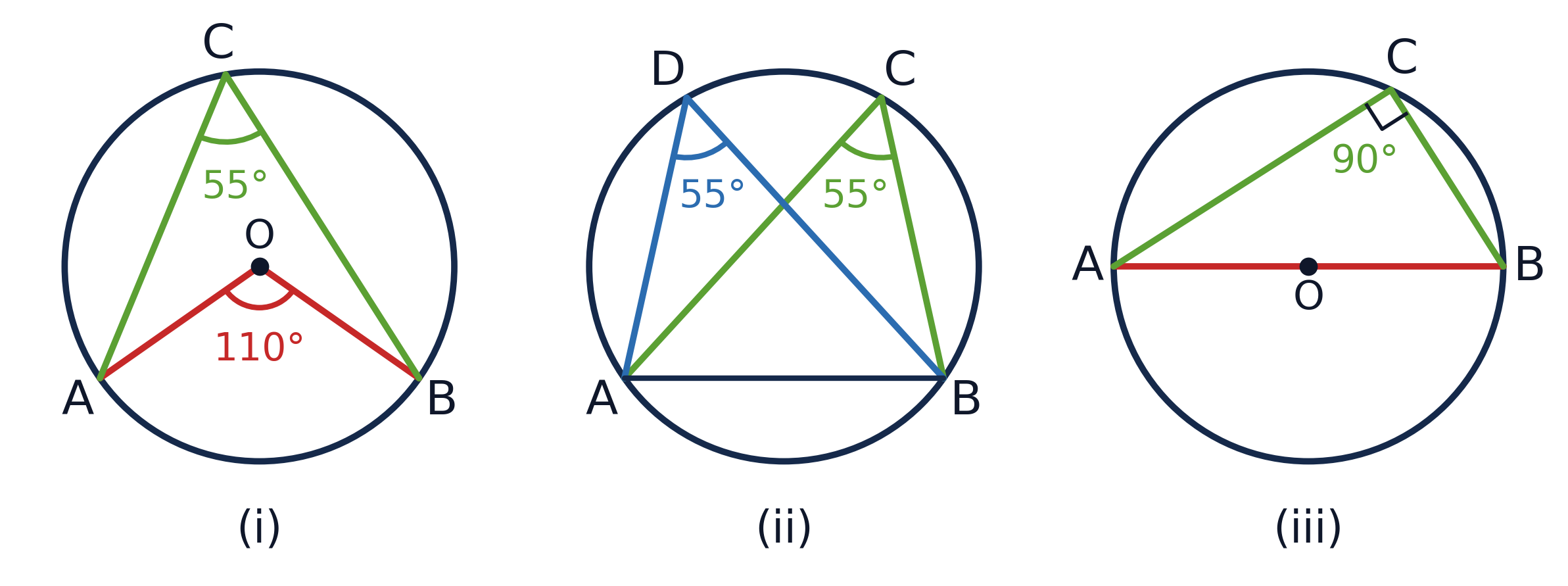
The second and third facts follow from the first. Every angle on the same arc is half of the same angle at the centre. A diameter makes 180^\circ at the centre, so it makes 90^\circ at the circle.
The third fact also works backwards. If a chord makes a right angle at a point of the circle, the chord is a diameter. So the hypotenuse of a right triangle is a diameter of the circle through its three corners.
When the point is on the minor arc. In the first circle of the figure, C is on the major arc and the angle is 55^\circ. A point on the minor arc AB, on the other side of the chord, sees AB at 180^\circ - 55^\circ = 125^\circ. So an obtuse angle at the circle tells you the point is on the minor arc. For example, if the angle at the circle is 130^\circ, the angle AOB is not 260^\circ. It is 360^\circ - 260^\circ = 100^\circ. The quick way: 2 \times (180^\circ - 130^\circ) = 100^\circ.
One more fact is used with radii: OA and OB are equal, so the triangle OAB is isosceles and its angles at A and B are equal.
4. The cyclic quadrilateral
A quadrilateral is cyclic when its four corners lie on one circle.
| Fact | In symbols |
|---|---|
| Opposite angles add up to 180^\circ | \angle A + \angle C = 180^\circ and \angle B + \angle D = 180^\circ |
| An exterior angle equals the interior opposite angle | if AB is produced to E, \angle CBE = \angle D |
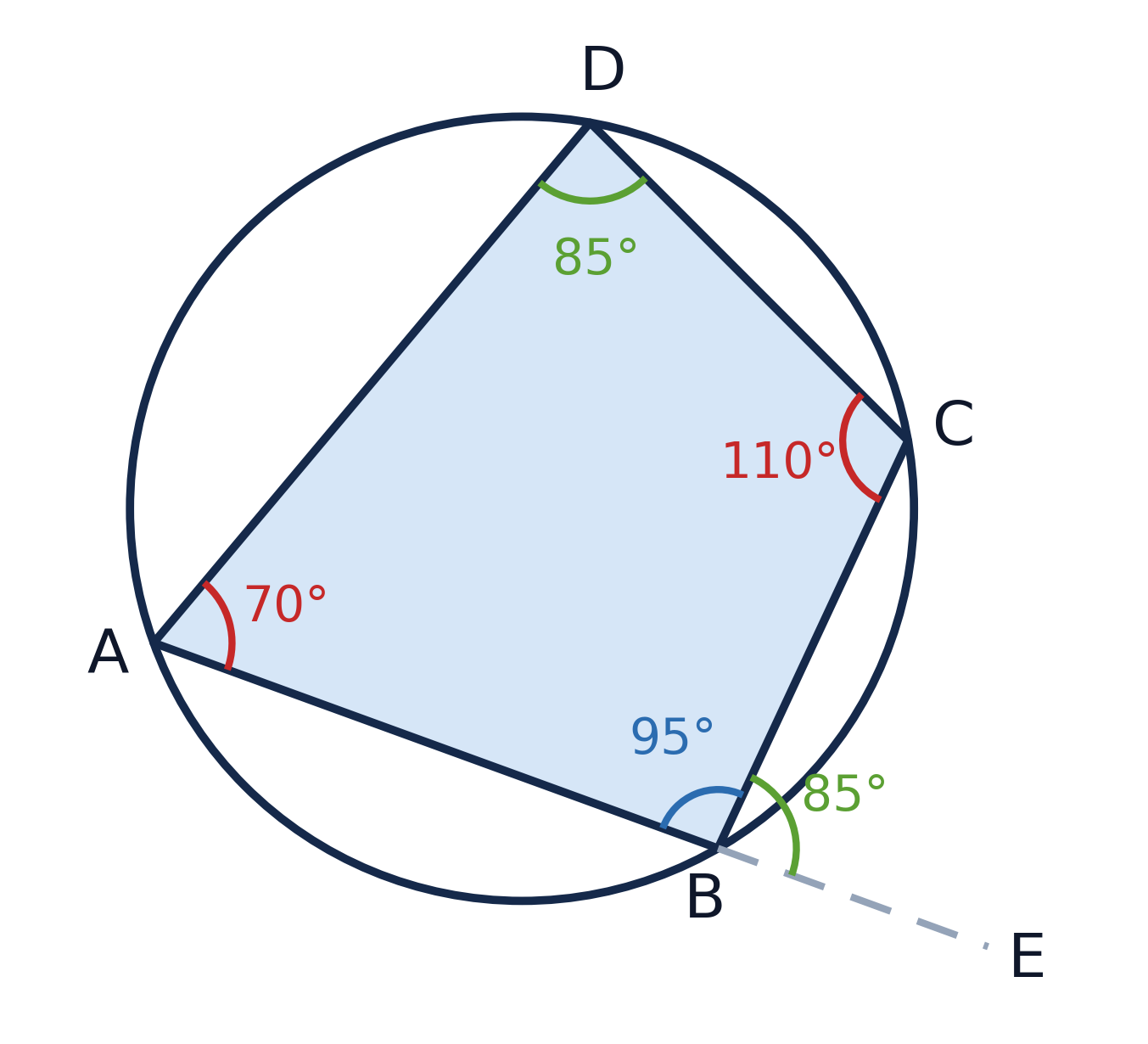
Why. The angles at A and C stand on the two arcs BD, which together make the whole circle. So the two angles at the centre add up to 360^\circ, and the angles at A and C add up to half of that. The second fact follows from the first: \angle CBE and \angle D are both 180^\circ - \angle ABC.
The first fact also works backwards: if the opposite angles of a quadrilateral add up to 180^\circ, it is cyclic. So every rectangle is cyclic. A parallelogram is cyclic only if it is a rectangle.
In a question, write the two equations \angle A + \angle C = 180^\circ and \angle B + \angle D = 180^\circ first. Opposite angles are not equal, and angles next to each other do not have to add up to 180^\circ.
5. Two chords that cross
If two chords AB and CD of a circle cross at a point P inside the circle, then
AP \times PB = CP \times PD
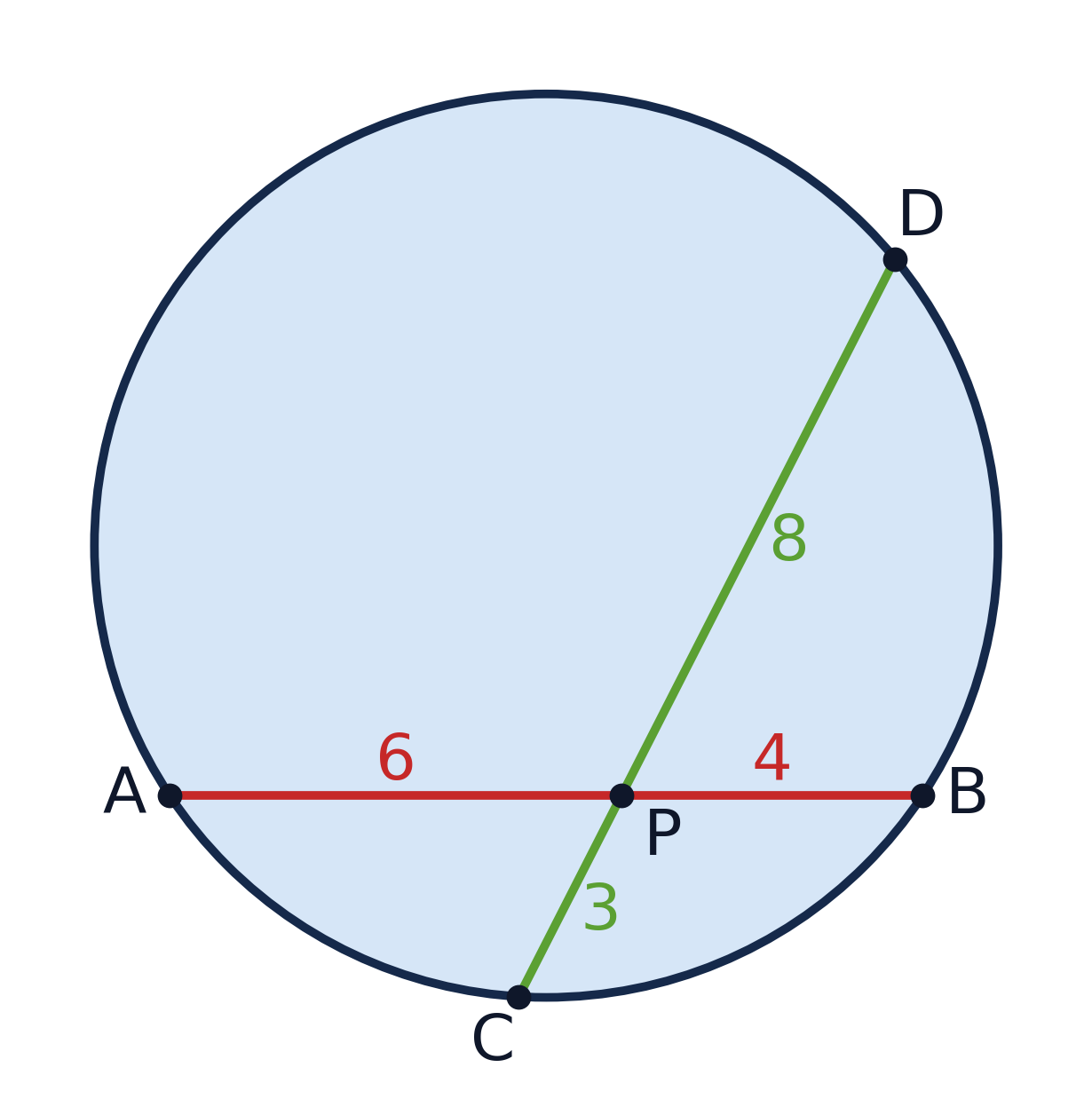
In the figure, 6 \times 4 = 24 and 3 \times 8 = 24.
Why. Join AC and BD. The angles at A and D stand on the same arc BC, so they are equal. The angles at P are vertically opposite. So the triangles APC and DPB are similar, and \frac{AP}{DP} = \frac{CP}{BP}.
Every chord through P gives the same product. Take the diameter through P: its two parts are r + OP and r - OP. So for a point P inside the circle:
AP \times PB = r^2 - OP^2
The same rule holds when the two chords are produced and meet at a point P outside the circle: PA \times PB = PC \times PD, with every length measured from P. For example, if PA = 3, PB = 12 and PC = 4, then PD = 9. The next chapter uses this with a tangent.
Worked examples
Example 1. A chord of length 30 cm is drawn in a circle of radius 17 cm. Find its distance from the centre and the height of the minor segment.
Half the chord is 15. So d = \sqrt{17^2 - 15^2} = \sqrt{64} = 8 cm. The height of the minor segment is 17 - 8 = 9 cm.
Example 2. Two parallel chords of lengths 16 cm and 12 cm are drawn in a circle of radius 10 cm. Find the distance between them.
The chord of 16 is at distance \sqrt{10^2 - 8^2} = 6 cm from the centre. The chord of 12 is at distance \sqrt{10^2 - 6^2} = 8 cm. If the chords are on opposite sides of the centre, they are 6 + 8 = 14 cm apart. If they are on the same side, they are 8 - 6 = 2 cm apart.
Example 3. O is the centre of a circle and \angle AOB = 110^\circ. Find the angle that the chord AB makes at a point on the major arc, and at a point on the minor arc.
On the major arc the angle is half of 110^\circ, which is 55^\circ. On the minor arc it is 180^\circ - 55^\circ = 125^\circ.
Example 4. ABCD is a cyclic quadrilateral and AB is a diameter of the circle. If \angle ADC = 125^\circ, find \angle BAC.
Opposite angles add up to 180^\circ, so \angle ABC = 180^\circ - 125^\circ = 55^\circ. AB is a diameter, so the angle in the semicircle, \angle ACB, is 90^\circ. In triangle ABC, \angle BAC = 180^\circ - 90^\circ - 55^\circ = 35^\circ.
Example 5. P is a point 5 cm from the centre of a circle of radius 9 cm. A chord AB passes through P and AP = 7 cm. Find PB.
AP \times PB = r^2 - OP^2 = 81 - 25 = 56. So PB = 56 \div 7 = 8 cm.
From the real papers
These six questions are from the Elementary Mathematics papers (Series A). The first three are from CDS I 2025 and CDS II 2025, and the answers agree with the final official key. The last three are from the 2026 papers, where the official key is still provisional; our answers agree with it. Try each for 72 seconds before reading the solution.
CDS I 2025, Q12. C is the centre of a circle of radius 20 cm. AB is a chord of length 32 cm. E is a point on AB such that CE = 13 cm. What is AE \times EB equal to?
(a) 231 square cm (b) 256 square cm (c) 272 square cm (d) 297 square cm
Solution. By section 5, AE \times EB = r^2 - CE^2 = 400 - 169 = 231. Answer (a).
The long way gives the same: let M be the midpoint of AB. Then AM = 16 and CM = \sqrt{20^2 - 16^2} = 12. In the right triangle CME, ME = \sqrt{13^2 - 12^2} = 5. So the two parts are 16 + 5 = 21 and 16 - 5 = 11, and 21 \times 11 = 231.
CDS II 2025, Q65. In a circle of radius 14 cm, APB is a shorter arc and P is the midpoint of the arc. Let C be the midpoint of the chord AB and PC = 7 cm. What is the length of the chord AP?
(a) 3 \cdot 5 cm (b) 7 cm (c) 10 \cdot 5 cm (d) 14 cm
Solution. Let O be the centre. The line from O to the midpoint C of the chord passes through the midpoint P of the arc (section 2). So OC = OP - PC = 14 - 7 = 7 cm. In the right triangle OCA, AC^2 = 14^2 - 7^2 = 147. In the right triangle ACP, AP^2 = AC^2 + PC^2 = 147 + 49 = 196. So AP = 14 cm. Answer (d).
CDS II 2025, Q87. A Question is given followed by two Statements I and II. Consider the Question and the Statements.
Question: AB and CD are chords of a circle intersecting at P. If AP \times PB = 48 square units, then what is CP \times PD equal to?
Statement-I: AP = 8 units
Statement-II: CP = 10 units
Which one of the following is correct in respect of the above Question and the Statements?
(a) The Question can be answered by using one of the Statements alone, but cannot be answered using the other Statement alone (b) The Question can be answered by using either Statement alone (c) The Question can be answered by using both the Statements together, but cannot be answered using either Statement alone (d) The Question can be answered even without using any of the Statements
Solution. For two chords that cross, CP \times PD = AP \times PB = 48 square units. Neither statement is needed. Answer (d).
CDS I 2026, Q52. Let O be the centre of a circle. Let A, B and C lie on the circle such that \angle ABC = 153°. What is the value of \angle AOC?
(a) 54° (b) 52° (c) 39° (d) 27°
Solution. The angle at B is obtuse, so B is on the minor arc AC (section 3). A point on the major arc sees AC at 180^\circ - 153^\circ = 27^\circ. The angle at the centre is twice that: \angle AOC = 54^\circ. Answer (a). (Provisional key.)
CDS II 2026, Q51. In a cyclic quadrilateral ABCD, \angle A = (4x + 3)°, \angle B = (3y + 9)°, \angle C = (4y - 3)°, \angle D = (5x - 10)°. What is \angle A + \angle B equal to?
(a) 200° (b) 190° (c) 180° (d) 170°
Solution. Opposite angles add up to 180^\circ. From A and C: 4x + 3 + 4y - 3 = 180, so x + y = 45. From B and D: 3y + 9 + 5x - 10 = 180, so 5x + 3y = 181. Put y = 45 - x: 5x + 135 - 3x = 181, so x = 23 and y = 22. Then \angle A = 95^\circ and \angle B = 75^\circ. Their sum is 170^\circ. Answer (d). (Provisional key.)
CDS II 2026, Q57. The chord of a circle is 20 cm and the height of the minor segment is 5 cm. What is the diameter of the circle?
(a) 24 cm (b) 25 cm (c) 26 cm (d) 30 cm
Solution. Half the chord is 10 and h = 5. By section 2, 10^2 = 5 \times (2r - 5), so 2r - 5 = 20 and 2r = 25 cm. Answer (b). (Provisional key.)
In all six, the first step was to name the fact. After that the working was two or three lines.
Mistakes that cost marks
- Putting the whole chord in the right triangle. The triangle has half the chord. For a chord of 24 in a circle of radius 13, use 12: d = 5.
- Doubling an obtuse angle. If the angle at the circle is 153^\circ, the angle at the centre is not 306^\circ. Take 180^\circ - 153^\circ = 27^\circ first, then double: 54^\circ.
- Taking opposite angles of a cyclic quadrilateral as equal. They add up to 180^\circ. They are equal only when both are 90^\circ.
- Giving one answer for two parallel chords. If the question does not say which side of the centre the chords are on, there are two distances: the sum and the difference.
- Adding the parts of a chord. The rule for crossing chords is about products: AP \times PB = CP \times PD.
Quick check
Do these without help. Answers are at the end.
- A chord is 7 cm from the centre of a circle of radius 25 cm. How long is the chord?
- A chord of a circle is 8 cm long and the height of its minor segment is 2 cm. Find the radius.
- O is the centre of a circle. C is a point on the major arc AB and \angle ACB = 40^\circ. Find \angle AOB and \angle OAB.
- In a cyclic quadrilateral ABCD, \angle A = 3x and \angle C = 2x. Find the two angles.
- Chords AB and CD cross at P inside a circle. AP = 9 cm, PB = 4 cm and P is the midpoint of CD. Find CD.
Read and watch more, free
The new NCERT Class 9 book and two NIOS lessons teach this chapter. The Class 9 Exemplar unit has multiple-choice questions with answers.
| What | Where | Language |
|---|---|---|
| Textbook, chords and angles | NCERT Class 9 Ganita Manjari, Chapter 5 "I'm Up and Down, and Round and Round" · Hindi edition | English, Hindi |
| Self-study notes, chords | NIOS Secondary Mathematics (211), Lesson 15 Circles · Hindi edition | English, Hindi |
| Self-study notes, angles | NIOS Secondary Mathematics (211), Lesson 16 Angles in a Circle and Cyclic Quadrilateral · Hindi edition | English, Hindi |
| Practice with answers | NCERT Exemplar Class 9, Unit 10 Circles · Hindi edition | English, Hindi |
| Short videos with practice | Khan Academy, NCERT Math Class 9 (the circles unit) | English |
| An open textbook, circle theorems | Siyavula, Mathematics Grade 11 (the chapter on Euclidean geometry) | English |
| The real papers | UPSC previous question papers | English, Hindi |
| Video, numbered classes | Chandigarh Career Group: CDS advance maths by Sandeep Brar (the geometry and mensuration classes) | Hinglish |
| Video, a full CDS course | R.S SIR: Maths Playlist for CDS 2025 (the eight geometry lessons, about 55 minutes each) | Hindi and Hinglish |
| Video, a crash course with circles | Unacademy Defence Gurukul: CDS 1 2025 Maths Crash Course (the circles lesson, about 1 hour) | Hinglish |
The videos were chosen from their titles, length and views; they have not yet been watched by a teacher.
Answers to the quick check
- Half the chord is \sqrt{25^2 - 7^2} = \sqrt{576} = 24 cm, so the chord is 48 cm.
- Half the chord is 4, so 4^2 = 2 \times (2r - 2). Then 2r - 2 = 8 and r = 5 cm.
- \angle AOB = 2 \times 40^\circ = 80^\circ. Triangle OAB is isosceles, so \angle OAB = \frac{180^\circ - 80^\circ}{2} = 50^\circ.
- 3x + 2x = 180^\circ, so x = 36^\circ. \angle A = 108^\circ and \angle C = 72^\circ.
- CP \times PD = 9 \times 4 = 36 and CP = PD, so CP = 6 cm and CD = 12 cm.
Next chapter: Tangents, two circles, incircle and circumcircle.