Why this chapter matters. This chapter gave 10 questions in the 6 papers from CDS I 2024 to CDS II 2026. That is between one and two a paper on average. Six of the 10 use one fact, the angle bisector theorem: the bisector of an angle of a triangle cuts the opposite side in the ratio of the other two sides. One asks for the angle between two bisectors. One asks for the sum of the squares of the three medians. Two are about the point where the altitudes meet. So the bisector theorem comes first in this lesson's weight, and the four centres are given as one table to learn.
What you will be able to do
- Tell a median, an altitude, an angle bisector and a perpendicular bisector apart, and name the point where each set of three meets.
- Use the centroid's 2 : 1 rule and the formula for the sum of the squares of the medians.
- Use the angle bisector theorem in both directions, and find where the incentre lies on a bisector.
- Find the angle that a side makes at the incentre, the orthocentre and the circumcentre.
Before you start you should know: the angle sum of a triangle and the rules of congruence (Chapter A5-2), and Pythagoras and similar triangles (Chapter A5-3).
1. Four kinds of line, four centres
Each kind of line can be drawn in three ways in a triangle, one for each corner or side. Each set of three lines passes through one point. Lines through one point are called concurrent.
| Line | What it is | The three meet at | The centre is |
|---|---|---|---|
| Median | joins a corner to the midpoint of the opposite side | centroid, G | the balancing point of the triangle |
| Altitude | from a corner, perpendicular to the opposite side | orthocentre, H | |
| Angle bisector | cuts the angle at a corner into two equal parts | incentre, I | the same distance from the three sides |
| Perpendicular bisector | through the midpoint of a side, perpendicular to it | circumcentre, O | the same distance from the three corners |
The incentre is the centre of the circle that touches the three sides (the incircle). The circumcentre is the centre of the circle through the three corners (the circumcircle). Chapter A5-8 works with these circles.
Where the centres lie.
| Triangle | Centroid and incentre | Orthocentre | Circumcentre |
|---|---|---|---|
| Acute-angled | inside | inside | inside |
| Right-angled | inside | at the corner of the right angle | at the midpoint of the hypotenuse |
| Obtuse-angled | inside | outside | outside |
In a right-angled triangle, then, the circumcentre is the midpoint of the hypotenuse. So the median to the hypotenuse is half the hypotenuse. In the 6, 8, 10 triangle it is 5.
2. Medians and the centroid
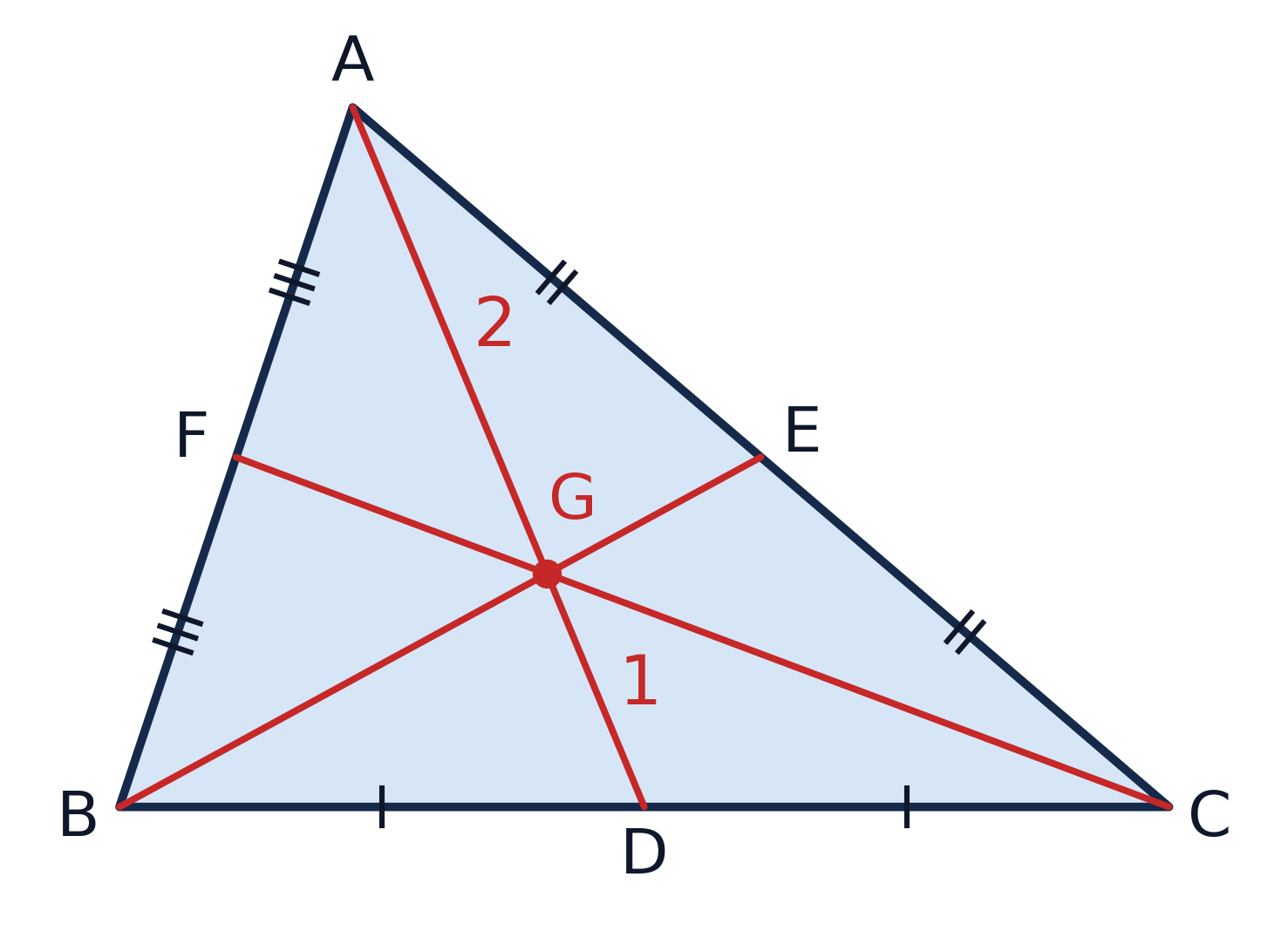
- The 2 : 1 rule. The centroid divides each median in the ratio 2 : 1, with the longer part towards the corner. So AG = \frac{2}{3}AD and GD = \frac{1}{3}AD.
- Areas. A median cuts the triangle into two triangles of equal area, because they have equal bases and the same height. The three medians together cut it into six small triangles of equal area.
- Lengths. If AD is the median to BC, then
AB^2 + AC^2 = 2\left(AD^2 + BD^2\right)
This is called Apollonius' theorem. Writing it for all three medians and adding gives the result that the paper asked:
\text{sum of squares of the medians} = \frac{3}{4} \times \text{sum of squares of the sides}
Check with 6, 8, 10. The median to the hypotenuse is 5. The other two are \sqrt{8^2 + 3^2} = \sqrt{73} and \sqrt{6^2 + 4^2} = \sqrt{52}, by Pythagoras. The sum of squares is 25 + 73 + 52 = 150, and \frac{3}{4}(36 + 64 + 100) = 150.
3. The angle bisector theorem
The bisector of an angle of a triangle divides the opposite side in the ratio of the sides that contain the angle. If AD bisects angle A and meets BC at D, then
\frac{BD}{DC} = \frac{AB}{AC}
The part next to B goes with the side AB. The part next to C goes with the side AC.
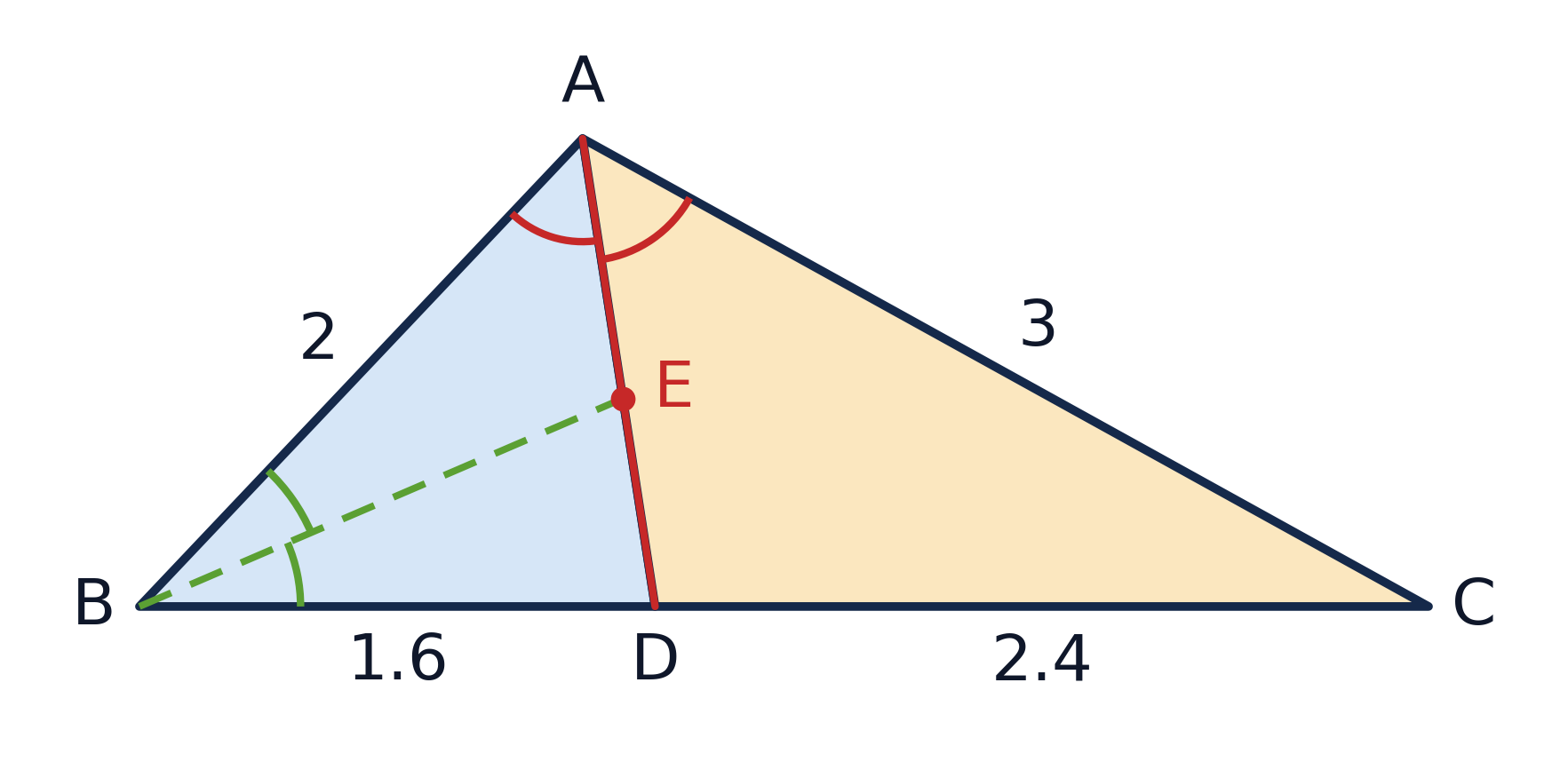
In the figure AB = 2, AC = 3 and BC = 4. So BD : DC = 2 : 3. There are 5 parts in 4, so BD = \frac{2}{5} \times 4 = 1.6 and DC = 2.4.
Why. Every point of the bisector is the same distance from the two arms of the angle. So D is the same distance from AB and from AC. Triangles ABD and ACD then have equal heights on the bases AB and AC, so their areas are as AB : AC. But the same two triangles have a common height from A on the line BC, so their areas are also as BD : DC. The two ratios are equal.
This reason gives one more result: the bisector cuts the triangle into two parts whose areas are as AB : AC.
The theorem works backwards. If a point D on BC has \frac{BD}{DC} = \frac{AB}{AC}, then AD bisects angle A.
The incentre on the bisector. In the figure the bisector of angle B meets AD at E. Use the theorem in triangle ABD: AE : ED = AB : BD = 2 : 1.6 = 5 : 4. The point E is the incentre, and in general the incentre divides the bisector from A in the ratio
AI : ID = (AB + AC) : BC
Here (2 + 3) : 4 = 5 : 4.
A bisector is not a median. It reaches the midpoint of the opposite side only when the two sides are equal.
4. Three angles at the three centres
Let the angle at A be known. The side BC makes these angles at the centres:
| Centre | Angle | For A = 70^\circ |
|---|---|---|
| Incentre I | \angle BIC = 90^\circ + \dfrac{A}{2} | 125^\circ |
| Orthocentre H (in an acute-angled triangle) | \angle BHC = 180^\circ - A | 110^\circ |
| Circumcentre O (for an acute angle A) | \angle BOC = 2A | 140^\circ |
Why the first one. In triangle BIC the angles at B and C are \frac{B}{2} and \frac{C}{2}. So \angle BIC = 180^\circ - \frac{B + C}{2}. Since B + C = 180^\circ - A, this is 180^\circ - 90^\circ + \frac{A}{2} = 90^\circ + \frac{A}{2}.
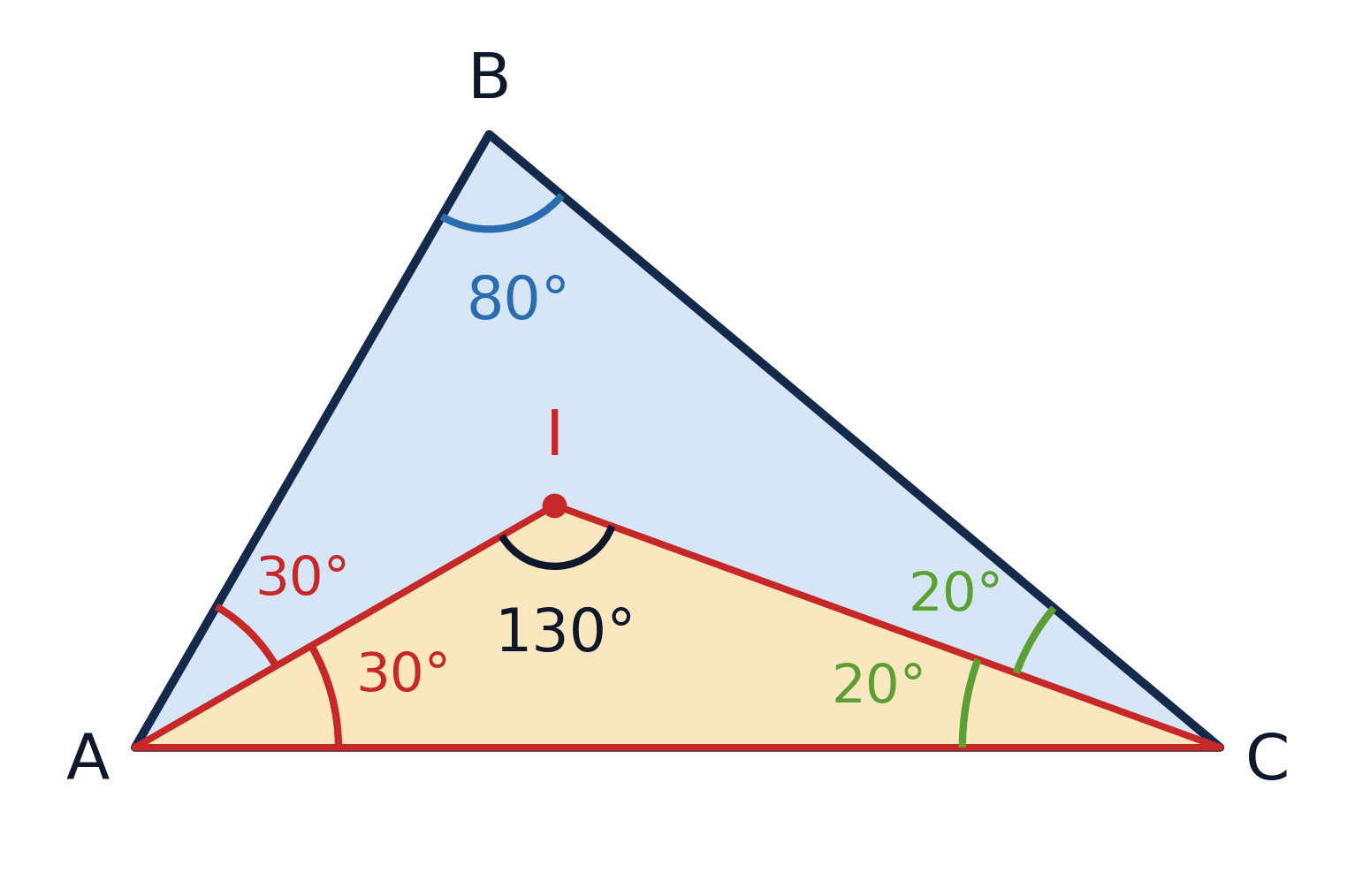
In the figure the bisectors of A and C meet at I, and the angle left out is B = 80^\circ. So \angle AIC = 90^\circ + 40^\circ = 130^\circ. The angle at the incentre is always obtuse.
5. Altitudes and the orthocentre
An altitude is a height of the triangle. The area is \frac{1}{2} \times \text{side} \times \text{altitude on that side}, whichever side is taken. So the longer the side, the shorter its altitude: sides of 6 and 9 have altitudes in the ratio 9 : 6 = 3 : 2.
Questions on the orthocentre are solved with right triangles, because every altitude makes two of them.
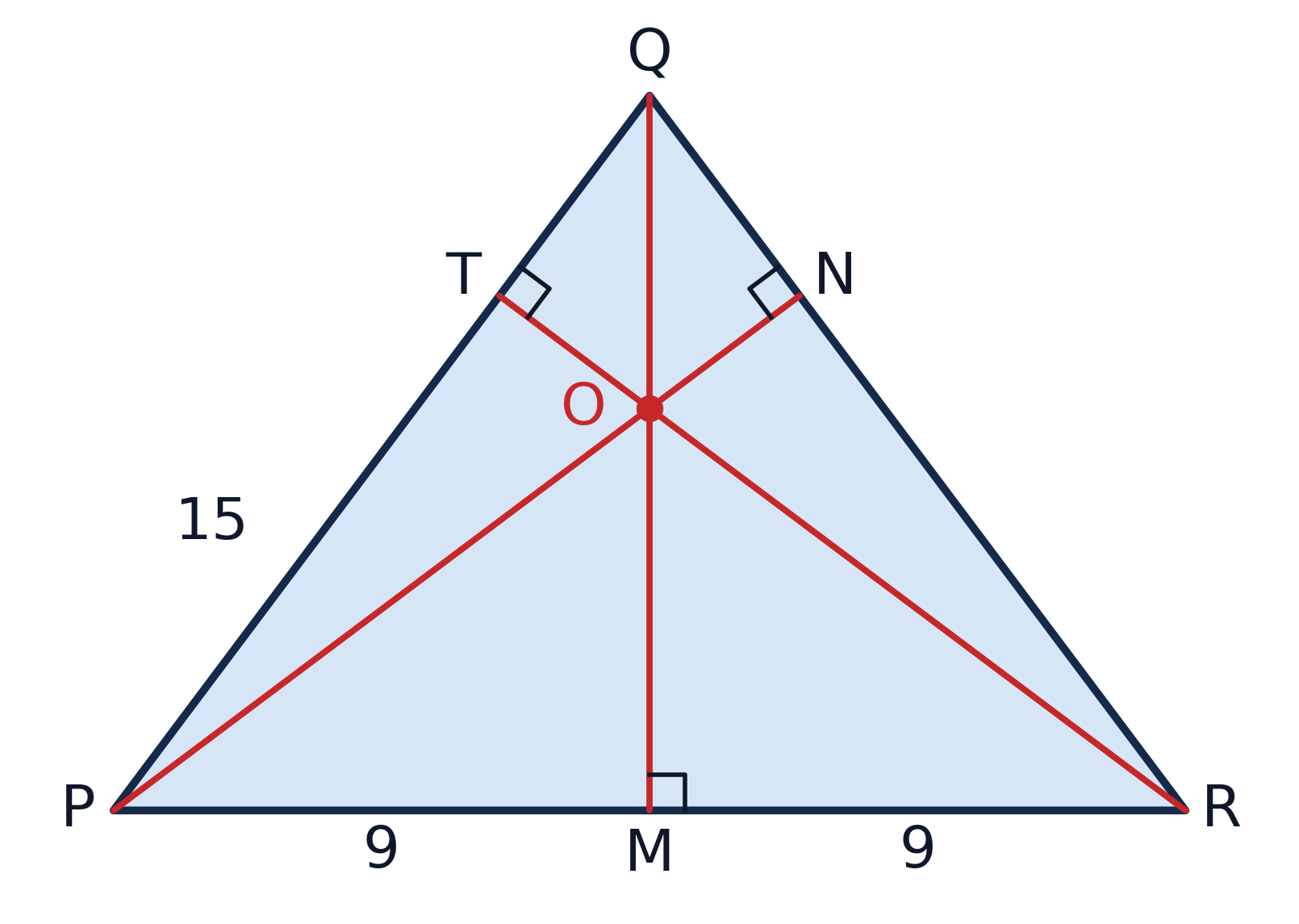
In the figure QP = QR = 15 and PR = 18. The triangle is isosceles, so the altitude QM meets PR at its midpoint: PM = 9 and QM = \sqrt{15^2 - 9^2} = 12. A real question below asks where the orthocentre lies on QM.
6. Isosceles and equilateral triangles
In an isosceles triangle, the median, the altitude and the angle bisector from the top corner are one and the same line. All four centres lie on it.
In an equilateral triangle of side a, all four centres are the same point. Every median is also an altitude, of length \frac{\sqrt{3}}{2}a. By the 2 : 1 rule the centre is \frac{2}{3} of this from each corner and \frac{1}{3} of it from each side:
\text{circumradius } R = \frac{a}{\sqrt{3}}, \qquad \text{inradius } r = \frac{a}{2\sqrt{3}}, \qquad R = 2r
With side 6: the height is 3\sqrt{3}, R = 2\sqrt{3} and r = \sqrt{3}.
In every other triangle the orthocentre H, the centroid G and the circumcentre O lie on one straight line, with HG = 2 \times GO.
Worked examples
Example 1. In a triangle ABC of area 60 square cm, the median AD is 12 cm long and G is the centroid. Find AG, GD and the area of triangle GBC.
AG = \frac{2}{3} \times 12 = 8 cm and GD = 4 cm. The six small triangles made by the medians have area 10 square cm each. Triangle GBC is two of them: 20 square cm.
Example 2. In a triangle ABC, AB = 6 cm, AC = 9 cm and BC = 10 cm. The bisector of angle A meets BC at D, and I is the incentre. Find BD, DC and AI : ID.
BD : DC = 6 : 9 = 2 : 3. There are 5 parts in 10, so BD = 4 cm and DC = 6 cm. AI : ID = (6 + 9) : 10 = 3 : 2.
Example 3. In an acute-angled triangle ABC, \angle A = 70^\circ. Find the angle BIC at the incentre and the angle BHC at the orthocentre.
\angle BIC = 90^\circ + 35^\circ = 125^\circ. \angle BHC = 180^\circ - 70^\circ = 110^\circ.
Example 4. The sides of a triangle are 4 cm, 6 cm and 8 cm. Find the sum of the squares of its medians.
The sum of the squares of the sides is 16 + 36 + 64 = 116. The sum of the squares of the medians is \frac{3}{4} \times 116 = 87.
From the real papers
The first four questions are from CDS I 2025 (Series A), and the answers agree with the final official key. The fifth is from CDS II 2026, whose key is still provisional; our answer agrees with it. The sixth is from CDS II 2024, which has no official key. Try each for 72 seconds before reading the solution.
CDS I 2025, Q15. In a triangle ABC, the bisector of angle A cuts BC at D. If AB + AC = 10 cm and BD : DC = 3 : 1, then what is the length of AC?
(a) 2.5 cm (b) 6 cm (c) 7.5 cm (d) 8 cm
Solution. By the bisector theorem AB : AC = BD : DC = 3 : 1. Divide 10 cm in the ratio 3 : 1: AB = 7.5 cm and AC = 2.5 cm. Option (c) is AB, not AC. Answer (a).
CDS I 2025, Q14. In a triangle ABC, AB = 2 cm, BC = 4 cm and AC = 3 cm. The bisector of angle A meets BC at D and the bisector of angle B meets AD at E. What is AE : ED equal to?
(a) 5 : 4 (b) 5 : 3 (c) 4 : 3 (d) 3 : 2
Solution. This is the figure of section 3. First, BD : DC = AB : AC = 2 : 3, so BD = \frac{2}{5} \times 4 = 1.6 cm. Now use the theorem again in triangle ABD, where BE bisects angle B: AE : ED = AB : BD = 2 : 1.6 = 5 : 4. The short way: (AB + AC) : BC = 5 : 4. Answer (a).
CDS I 2025, Q18. The measure of an angle formed by the bisectors of the angles A and C of the triangle ABC is 130°. What is the measure of the angle B?
(a) 65° (b) 75° (c) 80° (d) 85°
Solution. The bisectors of A and C meet at the incentre, and the angle there is 90^\circ + \frac{B}{2}, because B is the angle left out (section 4). So 90^\circ + \frac{B}{2} = 130^\circ, which gives \frac{B}{2} = 40^\circ and B = 80^\circ. Answer (c).
CDS I 2025, Q74. The sides of a triangle are k, 1.5k and 2.25k. What is the sum of the squares of its medians?
(a) 359k^2/64 (b) 379k^2/64 (c) 389k^2/64 (d) 399k^2/64
Solution. Write the sides as k, \frac{3}{2}k and \frac{9}{4}k. The sum of their squares is k^2 + \frac{9}{4}k^2 + \frac{81}{16}k^2 = \frac{16 + 36 + 81}{16}k^2 = \frac{133}{16}k^2. The sum of the squares of the medians is \frac{3}{4} of this: \frac{399}{64}k^2. Answer (d).
For the next two (02) items that follow: PQR is a triangle such that QP = QR = 15 cm and PR = 18 cm. PN, QM and RT are the altitudes of the triangle which intersect at O.
CDS II 2026, Q90. What is the ratio of QO to OM?
(a) 11 : 9 (b) 11 : 8 (c) 25 : 27 (d) 7 : 9
Solution. This is the figure of section 5, where PM = MR = 9 and QM = 12. In the right triangle PNR, the angle NPR is 90^\circ minus the angle R. In the right triangle QMR, the angle MQR is also 90^\circ minus the angle R. So the right triangles PMO and QMR have the same angles and are similar: \frac{OM}{PM} = \frac{MR}{QM}. This gives OM = \frac{9 \times 9}{12} = 6.75 cm and QO = 12 - 6.75 = 5.25 cm. The ratio is 5.25 : 6.75 = 7 : 9. Answer (d). (Provisional key.)
From CDS II 2024: no official key was published; the answer is our own working
CDS II 2024, Q27. In a triangle ABC, D is a point on BC. If AB \cdot DC = AC \cdot BD, \angle BAD = \alpha and \angle CAD = \beta then which one of the following is correct?
(a) \alpha = \beta (b) \alpha = 2\beta (c) 2\alpha = \beta (d) 2\alpha = 3\beta
Solution. Rearrange the given product: \frac{BD}{DC} = \frac{AB}{AC}. So D divides BC in the ratio of the other two sides. By the bisector theorem used backwards, AD bisects the angle A. The two parts are equal. Answer (a).
Three of these six are the bisector theorem and nothing else.
Mistakes that cost marks
- Turning the 2 : 1 rule round. The longer part of the median is towards the corner. AG = \frac{2}{3}AD, not \frac{1}{3}AD.
- Matching the wrong side in the bisector theorem. BD goes with AB and DC goes with AC. Mark the equal angles on a sketch and read the sides next to each part.
- Treating a bisector as a median. The bisector of angle A does not reach the midpoint of BC unless AB = AC.
- Mixing the three angle rules. Incentre: 90^\circ + \frac{A}{2}. Orthocentre: 180^\circ - A. Circumcentre: 2A. The half angle belongs to the bisectors.
Quick check
Do these without help. Answers are at the end.
- A median of a triangle is 15 cm long. How far is the centroid from the corner at one end of it, and from the midpoint at the other end?
- In a triangle ABC, AB = 8 cm, AC = 12 cm and BC = 15 cm. The bisector of angle A meets BC at D. Find BD and DC.
- In a triangle ABC, \angle A = 50^\circ and I is the incentre. Find \angle BIC.
- The legs of a right-angled triangle are 10 cm and 24 cm. Find the radius of its circumcircle. Where is its orthocentre?
- The sides of a triangle are 6 cm, 8 cm and 10 cm. Find the sum of the squares of its medians, and the length of the shortest median.
Read and watch more, free
The current NCERT books have no chapter on the four centres. The NIOS lesson on concurrent lines is the free source for them. The angle bisector theorem follows from similar triangles, which NCERT Class 10 teaches, but the theorem itself gets little space there; for it, this lesson and the past papers are the material.
| What | Where | Language |
|---|---|---|
| Self-study notes, the four centres | NIOS Secondary Mathematics (211), Lesson 12 Concurrent Lines · Hindi edition | English, Hindi |
| Textbook, altitudes | NCERT Class 7 Ganita Prakash, Chapter 7 A Tale of Three Intersecting Lines, section 7.4 · Hindi edition | English, Hindi |
| Textbook, similar triangles | NCERT Class 10 Mathematics, Chapter 6 Triangles · Hindi edition | English, Hindi |
| Practice with answers | NCERT Exemplar Class 10, Unit 6 Triangles · Hindi edition | English, Hindi |
| The real papers | UPSC previous question papers | English, Hindi |
| Video, numbered classes | Chandigarh Career Group: CDS advance maths by Sandeep Brar (the geometry and mensuration classes) | Hinglish |
| Video, a full CDS course | R.S SIR: Maths Playlist for CDS 2025 (the eight geometry lessons, about 55 minutes each) | Hindi and Hinglish |
| Video, past questions | The Journey Extraordinary: Maths For CDS 2 2026 (the geometry lesson with past questions, about 3 hours 20 minutes) | Hinglish |
The videos were chosen from their titles, length and views; they have not yet been watched by a teacher.
Answers to the quick check
- \frac{2}{3} \times 15 = 10 cm from the corner and 5 cm from the midpoint.
- BD : DC = 8 : 12 = 2 : 3. There are 5 parts in 15, so BD = 6 cm and DC = 9 cm.
- 90^\circ + 25^\circ = 115^\circ.
- The hypotenuse is 26 cm, and the circumcentre is its midpoint, so the radius is 13 cm. The orthocentre is at the corner of the right angle.
- \frac{3}{4}(36 + 64 + 100) = 150. The shortest median is the one to the longest side, the hypotenuse: 5 cm.
Next chapter: Quadrilaterals: parallelogram, rectangle, square, rhombus, trapezium.