Why this chapter matters. This chapter gave 4 questions in the 6 papers from CDS I 2024 to CDS II 2026. Two of the four asked for the possible length of a diagonal of a quadrilateral, which is the triangle inequality used twice. One asked for the sign of an expression in the three sides, which is the triangle inequality again. One was an "is the statement enough" question on the angle sum. No question in the six papers asked directly about congruence. But the syllabus lists "sides and angles of a triangle" and "congruency of triangles", and the questions on similar triangles, centres of a triangle and quadrilaterals use congruence as a step. All four real questions are solved below.
What you will be able to do
- Use the angle sum and the exterior angle of a triangle.
- Link sides and angles: equal sides face equal angles, and the longer side faces the larger angle.
- Decide whether three lengths make a triangle, and find the range of a third side or of a diagonal.
- Name the five rules of congruence and reject the two that are not rules.
Before you start you should know: the angle facts of Chapter A5-1 (linear pair, alternate angles), and how to solve a simple inequation such as x - 3 < 7 (Chapter A3-6).
1. The angles of a triangle
Angle sum. The three angles of a triangle add up to 180^\circ.
Exterior angle. Produce one side of a triangle (make it longer). The angle between the produced side and the next side is an exterior angle. It is equal to the sum of the two interior angles that do not touch it.
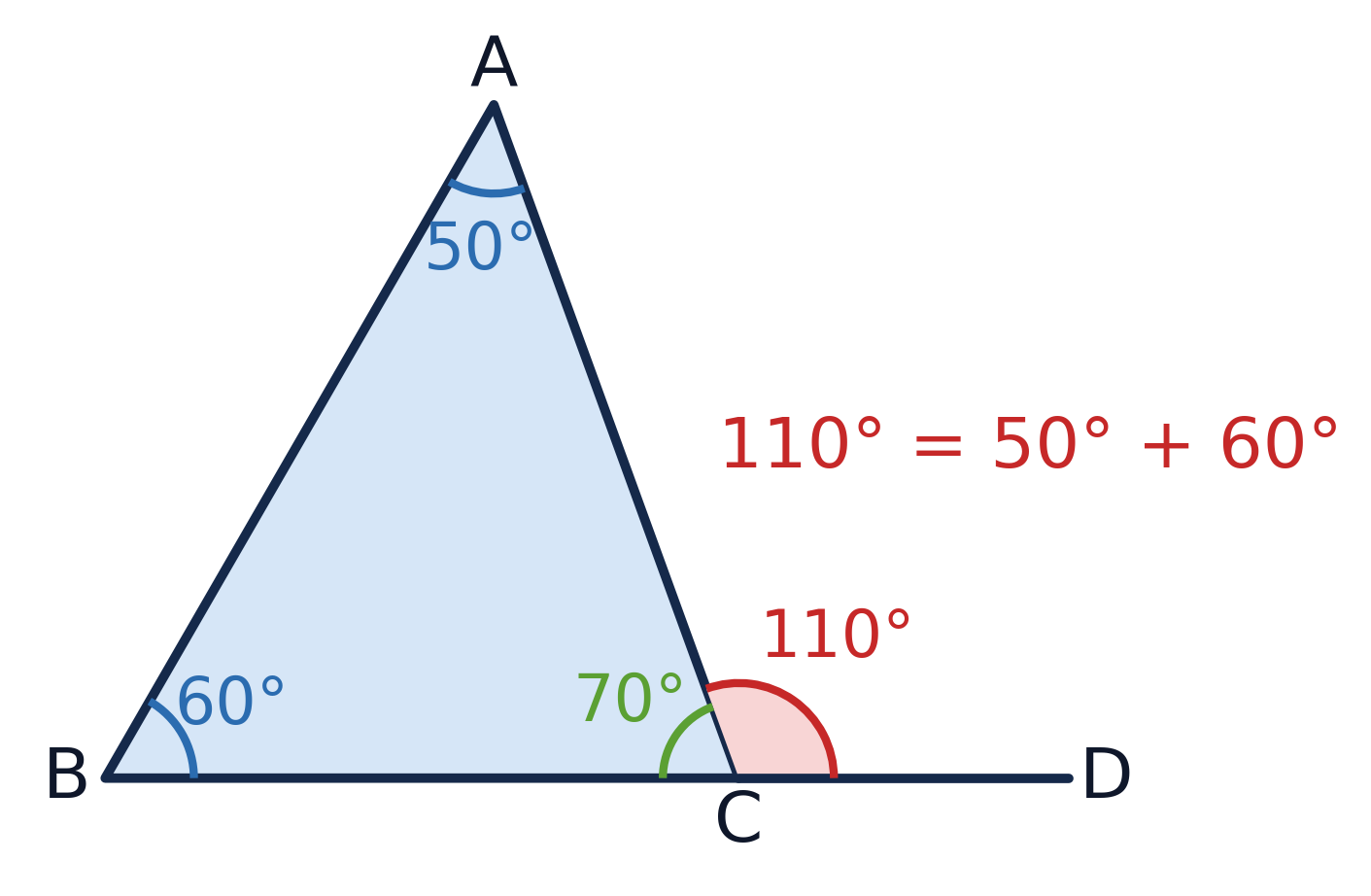
Why. In the figure, \angle ACD + 70^\circ = 180^\circ (linear pair), and 50^\circ + 60^\circ + 70^\circ = 180^\circ (angle sum). So \angle ACD = 50^\circ + 60^\circ = 110^\circ.
Three facts follow at once.
- A triangle can have at most one right angle or obtuse angle. Two right angles would leave 0^\circ for the third.
- If one angle of a triangle is equal to the sum of the other two, that angle is 90^\circ. (The three add up to 180^\circ, so the large one is half of it.)
- The three exterior angles, one at each corner, add up to 360^\circ. For the figure: 130^\circ + 120^\circ + 110^\circ = 360^\circ.
A triangle is acute-angled if all three angles are acute, right-angled if one is 90^\circ, and obtuse-angled if one is obtuse.
2. Sides and angles together
| Kind of triangle | Sides | Angles |
|---|---|---|
| Scalene | all three different | all three different |
| Isosceles | two equal | the two angles facing the equal sides are equal |
| Equilateral | all three equal | each is 60^\circ |
The rule for the isosceles triangle works both ways. Equal sides face equal angles, and equal angles face equal sides. If the angle between the equal sides is 40^\circ, each of the other two is \frac{180^\circ - 40^\circ}{2} = 70^\circ.
The longer side faces the larger angle. In any triangle, the longest side is opposite the largest angle, and the shortest side is opposite the smallest angle. The rule also works both ways.
In a triangle ABC with \angle A = 50^\circ and \angle B = 70^\circ, the third angle is \angle C = 60^\circ. The largest angle is B, so the longest side is the one facing B, which is AC. The shortest side is BC, facing A.
In a right-angled triangle the right angle is the largest angle, so the hypotenuse is the longest side.
3. The triangle inequality
The sum of any two sides of a triangle is greater than the third side. The reason is simple: the straight path from one corner to another is shorter than the path through the third corner.
Written for sides a, b, c:
a + b > c, \qquad b + c > a, \qquad c + a > b
Two uses come from it.
Use 1: do three lengths make a triangle? Test only the longest: it must be less than the sum of the other two.
- 4, 5, 8: 8 < 4 + 5. Yes.
- 4, 5, 9: 9 = 4 + 5. No. The three would lie flat on one line.
- 4, 5, 10: 10 > 9. No.
Use 2: the range of the third side. If two sides are a and b, the third side c lies between their difference and their sum:
\text{difference} < c < \text{sum}
With sides 7 and 12, the third side satisfies 5 < c < 19. If it must be a whole number, it is one of 6, 7, ..., 18. That is 13 values.
The inequality also gives signs. Since q + r > p, the expression p - q - r is always negative for the sides of a triangle. A real question below uses this.
4. A diagonal of a quadrilateral
A diagonal cuts a quadrilateral into two triangles, and the diagonal is a side of both. So it must satisfy the triangle inequality twice. Find the range from each triangle, and keep the part that is common to both.
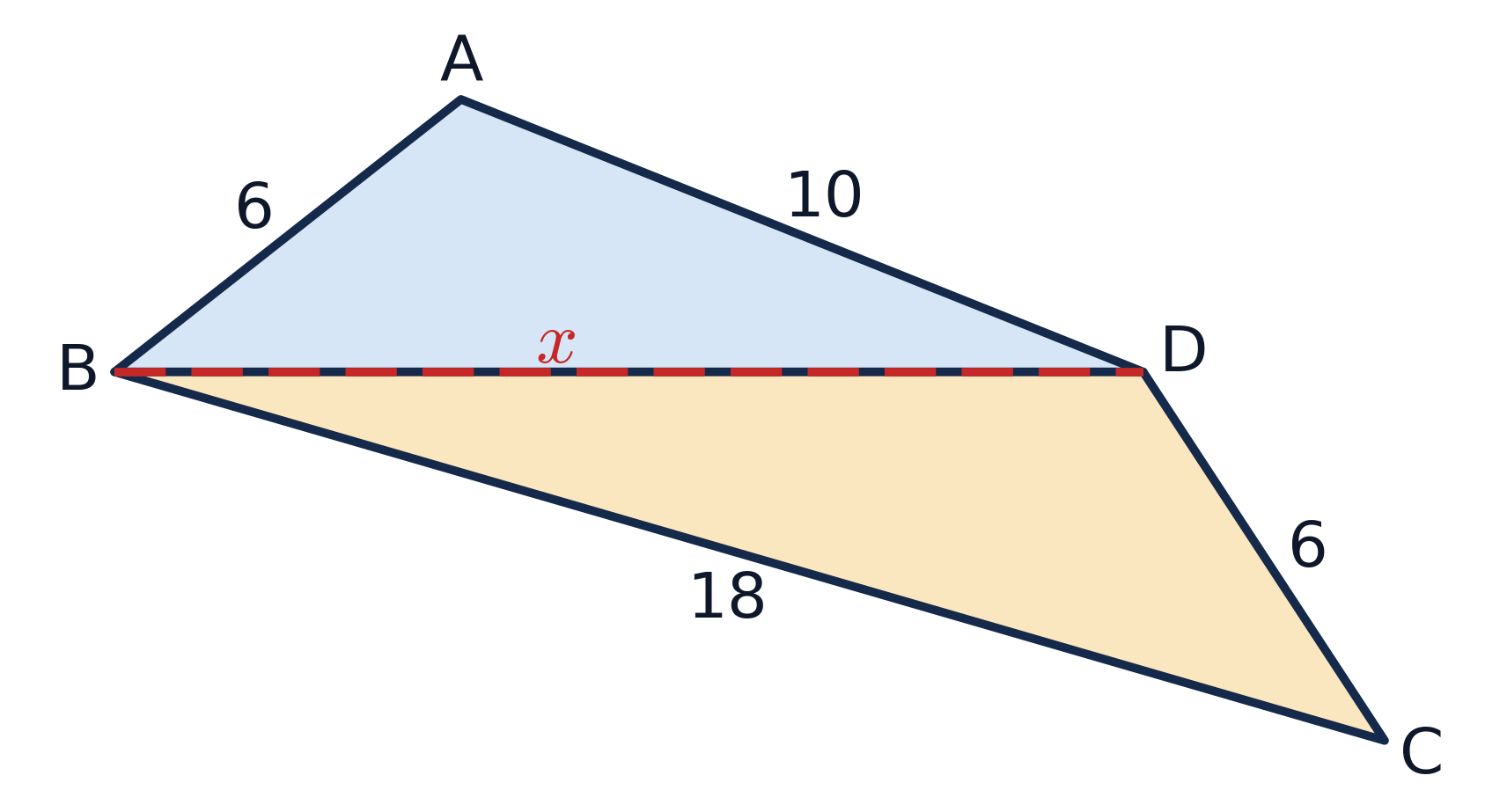
In the figure, AB = 6, BC = 18, CD = 6, DA = 10 and BD = x.
- In triangle ABD the other sides are 6 and 10, so 4 < x < 16.
- In triangle BCD the other sides are 18 and 6, so 12 < x < 24.
Both must hold, so 12 < x < 16. This is CDS I 2024, Q48, given below. CDS II 2025 asked the same figure again with one number changed.
5. Congruent triangles
Two triangles are congruent when they have the same shape and the same size: one can be placed exactly on the other. Then all six parts match, three sides and three angles. The sign is \cong.
We do not need to check all six. Three well-chosen parts are enough.
| Rule | What must be equal |
|---|---|
| SSS | the three sides |
| SAS | two sides and the angle between them |
| ASA | two angles and the side between them |
| AAS | two angles and a side not between them (the matching side in each) |
| RHS | in right-angled triangles: the hypotenuse and one other side |
Two sets of three parts are not rules.
- AAA. Three equal angles give the same shape but not the same size. A small and a large equilateral triangle both have angles of 60^\circ. Such triangles are similar (Chapter A5-3), not congruent.
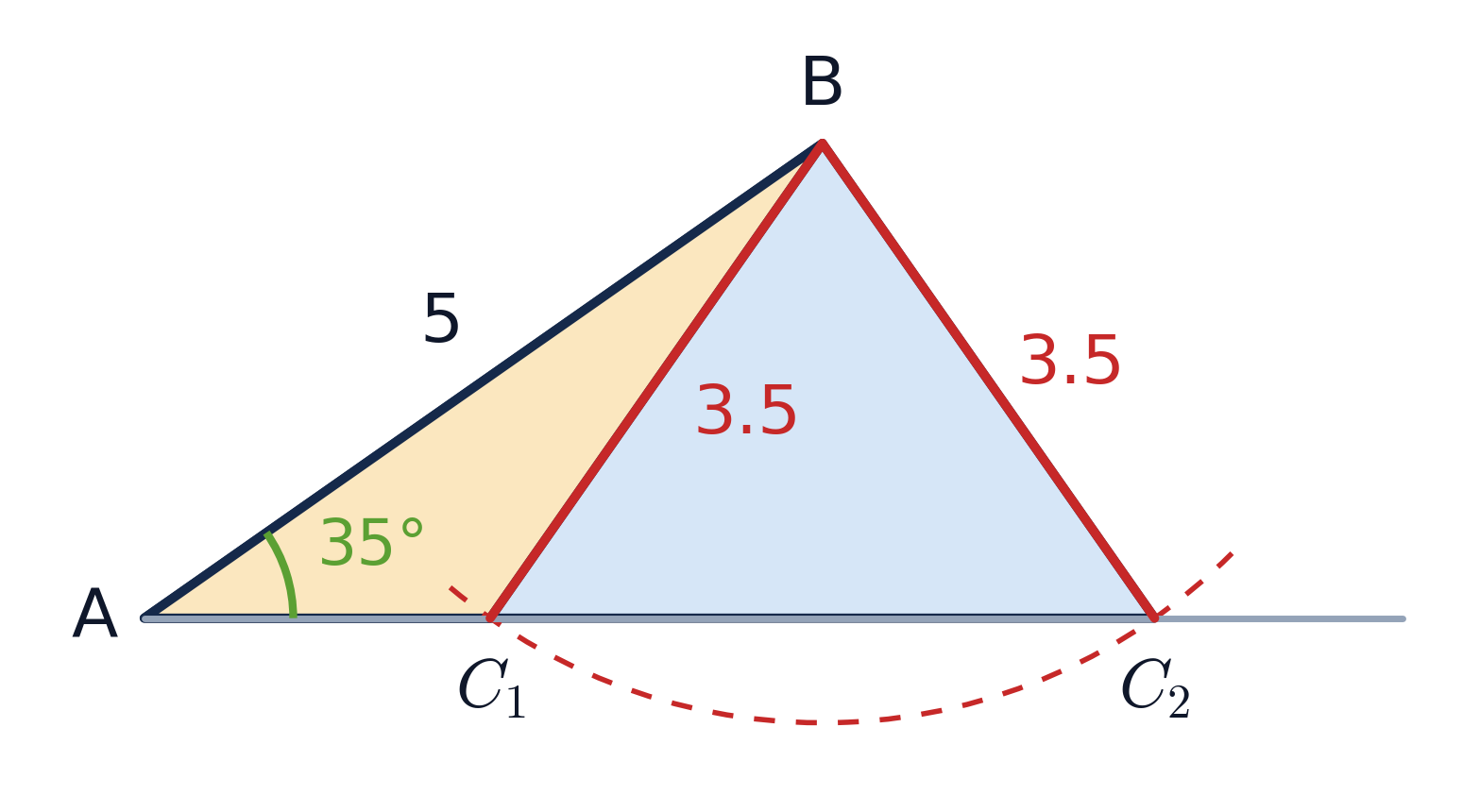
- SSA. Two sides and an angle that is not between them. The figure shows two different triangles with \angle A = 35^\circ, AB = 5 and BC = 3.5.
The order of the letters matters. \triangle ABC \cong \triangle PQR says that A matches P, B matches Q and C matches R. So AB = PQ, BC = QR, CA = RP, and \angle A = \angle P, and so on. These are called the corresponding parts.
Two results that come from congruence are used again and again in this unit.
- In an isosceles triangle, the line from the top corner to the midpoint of the base is perpendicular to the base and also bisects the top angle. (The two halves are congruent by SSS.)
- If one line bisects two angles of a figure from corner to corner, the two halves are congruent by ASA.
Worked examples
Example 1. The angles of a triangle are in the ratio 2 : 3 : 4. Find them, and the exterior angle at the largest.
There are 9 parts in 180^\circ, so one part is 20^\circ. The angles are 40^\circ, 60^\circ and 80^\circ. The exterior angle at the largest is the sum of the other two: 40^\circ + 60^\circ = 100^\circ.
Example 2. In a triangle ABC, AB = AC. The side CB is produced beyond B, and the exterior angle there is 110^\circ. Find the three angles and name the shortest side.
\angle B = 180^\circ - 110^\circ = 70^\circ. Since AB = AC, the angles facing these sides are equal: \angle C = \angle B = 70^\circ. Then \angle A = 180^\circ - 140^\circ = 40^\circ. The smallest angle is A, so the shortest side is the one facing it, BC.
Example 3. Two sides of a triangle are 7 cm and 12 cm. The third side is a whole number of centimetres. How many values can it take?
12 - 7 < c < 12 + 7, so 5 < c < 19. The values are 6 to 18, which is 18 - 5 = 13 values. (For whole-number sides the count is always twice the smaller side, minus 1: here 2 \times 7 - 1 = 13.)
Example 4. In triangles ABC and PQR, AB = PQ and \angle B = \angle Q. Which one of these extra facts does not make the triangles congruent: BC = QR, \angle A = \angle P, \angle C = \angle R, AC = PR?
BC = QR gives two sides and the angle between them: SAS. \angle A = \angle P gives two angles and the side between them: ASA. \angle C = \angle R gives two angles and a matching side: AAS. AC = PR gives two sides and an angle not between them: SSA, which is not a rule. The answer is AC = PR.
From the real papers
The first three questions are from CDS I 2024 and CDS II 2025 (Series A), and the answers agree with the final official key. Try each for 72 seconds before reading the solution.
CDS I 2024, Q48. In a quadrilateral ABCD, AB = 6 cm, BC = 18 cm, CD = 6 cm and DA = 10 cm. If the diagonal BD = x, then which one of the following is correct?
(a) 8 < x < 12 (b) 12 < x < 16 (c) 16 < x < 18 (d) 18 < x < 20
Solution. This is the figure of section 4. In triangle ABD, 10 - 6 < x < 10 + 6, so 4 < x < 16. In triangle BCD, 18 - 6 < x < 18 + 6, so 12 < x < 24. Both together: 12 < x < 16. Answer (b).
CDS II 2025, Q88. A Question is given followed by two Statements I and II. Consider the Question and the Statements.
Question: In a quadrilateral ABCD, AB = 6 units, BC = 18 units, CD = 6 units, DA = 9 units. What is the length of diagonal BD?
Statement-I: The length of BD is an integer greater than 13.
Statement-II: The length of BD is an even integer.
Which one of the following is correct in respect of the above Question and the Statements?
(a) The Question can be answered by using one of the Statements alone, but cannot be answered using the other Statement alone (b) The Question can be answered by using either Statement alone (c) The Question can be answered by using both the Statements together, but cannot be answered using either Statement alone (d) The Question can be answered even without using any of the Statements
Solution. In triangle ABD: 9 - 6 < BD < 9 + 6, so 3 < BD < 15. In triangle BCD: 12 < BD < 24. Together, 12 < BD < 15. The only integers in this range are 13 and 14. Statement I leaves only 14. Statement II leaves only 14. Each statement alone gives the answer. Answer (b).
CDS II 2025, Q84. A Question is given followed by two Statements I and II. Consider the Question and the Statements.
Question: In a triangle ABC, \angle A = \angle B - \angle C. Is angle A acute?
Statement-I: ABC is not an obtuse-angled triangle.
Statement-II: Angle C is acute.
Which one of the following is correct in respect of the above Question and the Statements?
(a) The Question can be answered by using one of the Statements alone, but cannot be answered using the other Statement alone (b) The Question can be answered by using either Statement alone (c) The Question can be answered by using both the Statements together, but cannot be answered using either Statement alone (d) The Question can be answered even without using any of the Statements
Solution. The given relation says \angle B = \angle A + \angle C. One angle is the sum of the other two, so it is 90^\circ (section 1). The triangle is right-angled at B. The other two angles add up to 90^\circ, so each of them is less than 90^\circ. Angle A is acute, and we have used neither statement. Answer (d).
From CDS II 2024: no official key was published; the answer is our own working
CDS II 2024, Q32. If p, q and r are the lengths (in cm) of the sides of a right-angled triangle, then (p - q - r)(q - r - p)(r - p - q) is always
(a) Positive only (b) Negative only (c) Non-positive only (d) Non-negative only
Solution. By the triangle inequality, q + r > p, so p - q - r is negative. In the same way q - r - p and r - p - q are negative. The product of three negative numbers is negative, and it is never zero because no bracket is zero. Check with 3, 4, 5: (-6) \times (-4) \times (-2) = -48. The right angle is not needed: this is true for every triangle. Answer (b).
Practice questions in the exam style
These two questions are our own. They are not from a real paper. They cover congruence and the exterior angle, which the six papers did not ask directly.
Practice 1. In triangles ABC and DEF, AB = DE and BC = EF. Consider the following statements:
I. If \angle B = \angle E, then the triangles are congruent.
II. If \angle A = \angle D, then the triangles are congruent.
Which of the statements given above is/are correct?
(a) I only (b) II only (c) Both I and II (d) Neither I nor II
Solution. The angle between AB and BC is \angle B, and the angle between DE and EF is \angle E. So statement I is SAS and is correct. In statement II the angle is not between the two sides. That is SSA, and the figure of section 5 shows it can give two different triangles. Answer (a).
Practice 2. The side BC of a triangle ABC is produced to D. If \angle ACD = 115^\circ and \angle B is two-thirds of \angle A, then what is \angle A?
(a) 46^\circ (b) 65^\circ (c) 69^\circ (d) 72^\circ
Solution. The exterior angle is the sum of the two opposite interior angles: \angle A + \frac{2}{3}\angle A = 115^\circ. So \frac{5}{3}\angle A = 115^\circ and \angle A = 69^\circ. Check: \angle B = 46^\circ, \angle C = 180^\circ - 115^\circ = 65^\circ, and 69 + 46 + 65 = 180. Answer (c).
Mistakes that cost marks
- Giving only half of the range. With sides 7 and 12 the third side is less than 19, but it is also more than 5. Write both ends: difference, then sum.
- Counting the ends. 5 < c < 19 does not include 5 or 19. Lengths 5, 7 and 12 lie flat on a line and make no triangle.
- Adding the wrong angles for an exterior angle. The exterior angle equals the sum of the two interior angles that are away from it, not the one beside it.
- Using SSA or AAA as a rule of congruence. In SAS the angle must be between the two sides. Three equal angles give the same shape only.
Quick check
Do these without help. Answers are at the end.
- The angles of a triangle are (x + 10)^\circ, (2x - 20)^\circ and (3x - 50)^\circ. Find them.
- An exterior angle of a triangle is 130^\circ and one of the two opposite interior angles is 55^\circ. Find the other.
- Two sides of a triangle are 5 cm and 9 cm. The third side is a whole number of centimetres. How many values can it take?
- Which of these sets of lengths make a triangle: (3, 4, 8), (4, 5, 9), (5, 6, 10)?
- In a triangle PQR, PQ = 7 cm, QR = 9 cm and RP = 5 cm. Which angle is the largest, and which is the smallest?
Read and watch more, free
The current NCERT books teach this chapter in Class 7. The NIOS lesson on congruence is the fullest free source, and the Class 9 Exemplar unit has multiple-choice questions with answers.
| What | Where | Language |
|---|---|---|
| Textbook, kinds of triangle | NCERT Class 7 Ganita Prakash, Chapter 7 A Tale of Three Intersecting Lines · Hindi edition | English, Hindi |
| Textbook, congruence | NCERT Class 7 Ganita Prakash Part II, Chapter 1 Geometric Twins · Hindi edition | English, Hindi |
| Self-study notes | NIOS Secondary Mathematics (211), Lesson 11 Congruence of Triangles · Hindi edition | English, Hindi |
| Practice with answers | NCERT Exemplar Class 9, Unit 7 Triangles · Hindi edition | English, Hindi |
| Short videos with practice | Khan Academy, NCERT Math Class 9 (the triangles unit) | English |
| The real papers | UPSC previous question papers | English, Hindi |
| Video, numbered classes | Chandigarh Career Group: CDS advance maths by Sandeep Brar (the geometry and mensuration classes) | Hinglish |
| Video, a full CDS course | R.S SIR: Maths Playlist for CDS 2025 (the eight geometry lessons, about 55 minutes each) | Hindi and Hinglish |
| Video, whole geometry in six lessons | Defence Wallah CDS / AFCAT: Quantitative Aptitude CDS 2024 (the geometry lessons, about 2 hours each) | Hinglish |
The videos were chosen from their titles, length and views; they have not yet been watched by a teacher.
Answers to the quick check
- (x + 10) + (2x - 20) + (3x - 50) = 180, so 6x - 60 = 180 and x = 40. The angles are 50^\circ, 60^\circ and 70^\circ.
- 130^\circ - 55^\circ = 75^\circ.
- 4 < c < 14, so the values are 5 to 13. That is 9 values.
- Only (5, 6, 10). For the others, 3 + 4 < 8 and 4 + 5 = 9.
- The largest angle faces the longest side QR, so it is \angle P. The smallest faces the shortest side RP, so it is \angle Q.
Next chapter: Similar triangles, Pythagoras and the right triangle.