Why this chapter matters. This chapter gave 5 questions in the 6 papers from CDS I 2024 to CDS II 2026. That is nearly one in every paper. Four of the five are about the interior and exterior angles of a regular polygon: "the difference between them is 144^\circ, how many sides?" The fifth cuts the corners of a square to make a regular octagon. The syllabus does not name polygons, but the papers ask them. The whole chapter rests on one fact: the exterior angles of any polygon add up to 360^\circ. With it, each of these questions takes less than a minute.
What you will be able to do
- Find the sum of the interior angles of a polygon with any number of sides.
- Go from an angle of a regular polygon to its number of sides, and back, through the exterior angle.
- Count the diagonals of a polygon.
- Use the two regular polygons the papers like: the hexagon and the octagon.
Before you start you should know: a linear pair adds up to 180^\circ (Chapter A5-1), the angles of a triangle add up to 180^\circ (Chapter A5-2), and the sides of a right triangle with two 45^\circ angles are in the ratio 1 : 1 : \sqrt{2} (Chapter A5-3).
1. The words
A polygon is a closed figure with straight sides. A triangle has 3 sides and a quadrilateral has 4. After that the names follow the number of sides:
| Sides | 5 | 6 | 7 | 8 | 9 | 10 | 12 |
|---|---|---|---|---|---|---|---|
| Name | pentagon | hexagon | heptagon | octagon | nonagon | decagon | dodecagon |
A polygon is convex when every interior angle is less than 180^\circ, so no corner points inwards. All polygons in this chapter are convex.
A polygon is regular when all its sides are equal and all its angles are equal. An equilateral triangle and a square are regular. A rhombus has equal sides but is not regular, because its angles are not all equal. A rectangle has equal angles but is not regular, because its sides are not all equal.
A polygon with n sides has n corners (vertices) and n interior angles.
2. The sum of the interior angles
Take one corner of the polygon and join it to every other corner. The polygon is cut into triangles. The figure shows a hexagon cut into 4 triangles.
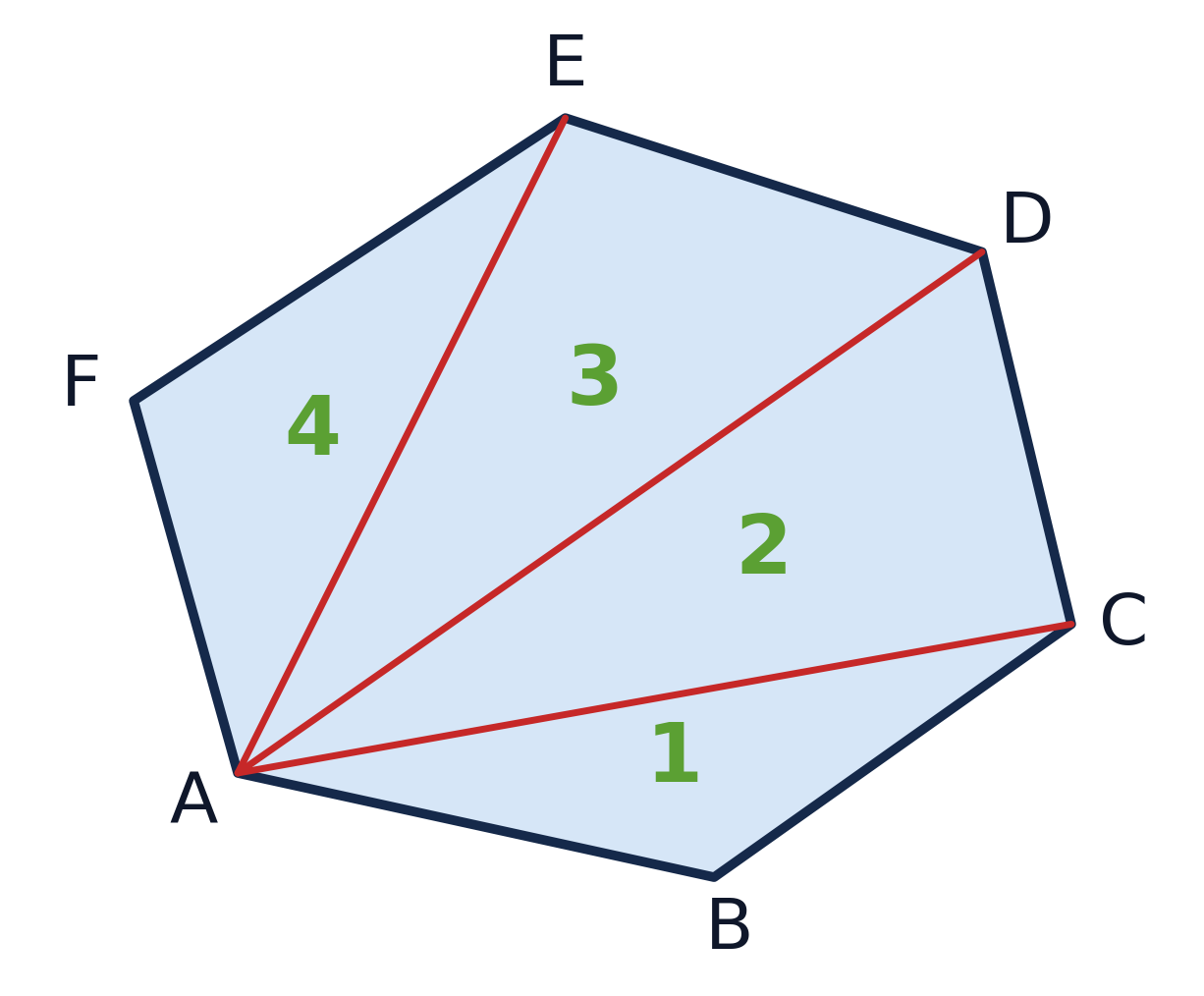
A polygon with n sides is cut into n - 2 triangles in this way. The angles of the triangles together make up the angles of the polygon. Each triangle has 180^\circ. So:
\text{Sum of the interior angles} = (n - 2) \times 180^\circ
| Sides n | 3 | 4 | 5 | 6 | 8 | 10 |
|---|---|---|---|---|---|---|
| Sum of interior angles | 180^\circ | 360^\circ | 540^\circ | 720^\circ | 1080^\circ | 1440^\circ |
Each extra side adds 180^\circ.
Example: four angles of a pentagon are 100^\circ, 110^\circ, 120^\circ and 95^\circ. They add up to 425^\circ. The sum must be 540^\circ, so the fifth angle is 540^\circ - 425^\circ = 115^\circ.
This formula is true for every convex polygon, regular or not.
3. The exterior angles add up to 360 degrees
Produce one side of a polygon beyond a corner. The angle between this produced side and the next side is an exterior angle. At every corner the interior angle and the exterior angle form a linear pair:
\text{interior angle} + \text{exterior angle} = 180^\circ
Walk once round the polygon. At each corner you turn through the exterior angle. When you are back at the start you face the same way as before, so you have made one full turn. That is why:
\text{Sum of the exterior angles} = 360^\circ
This is true for any convex polygon.
The sum does not depend on the number of sides. It is 360^\circ for a triangle and 360^\circ for a polygon of 100 sides.
In a regular polygon all the exterior angles are equal. So for a regular polygon with n sides:
\text{each exterior angle} = \frac{360^\circ}{n}
n = \frac{360^\circ}{\text{exterior angle}}
\text{each interior angle} = 180^\circ - \frac{360^\circ}{n}
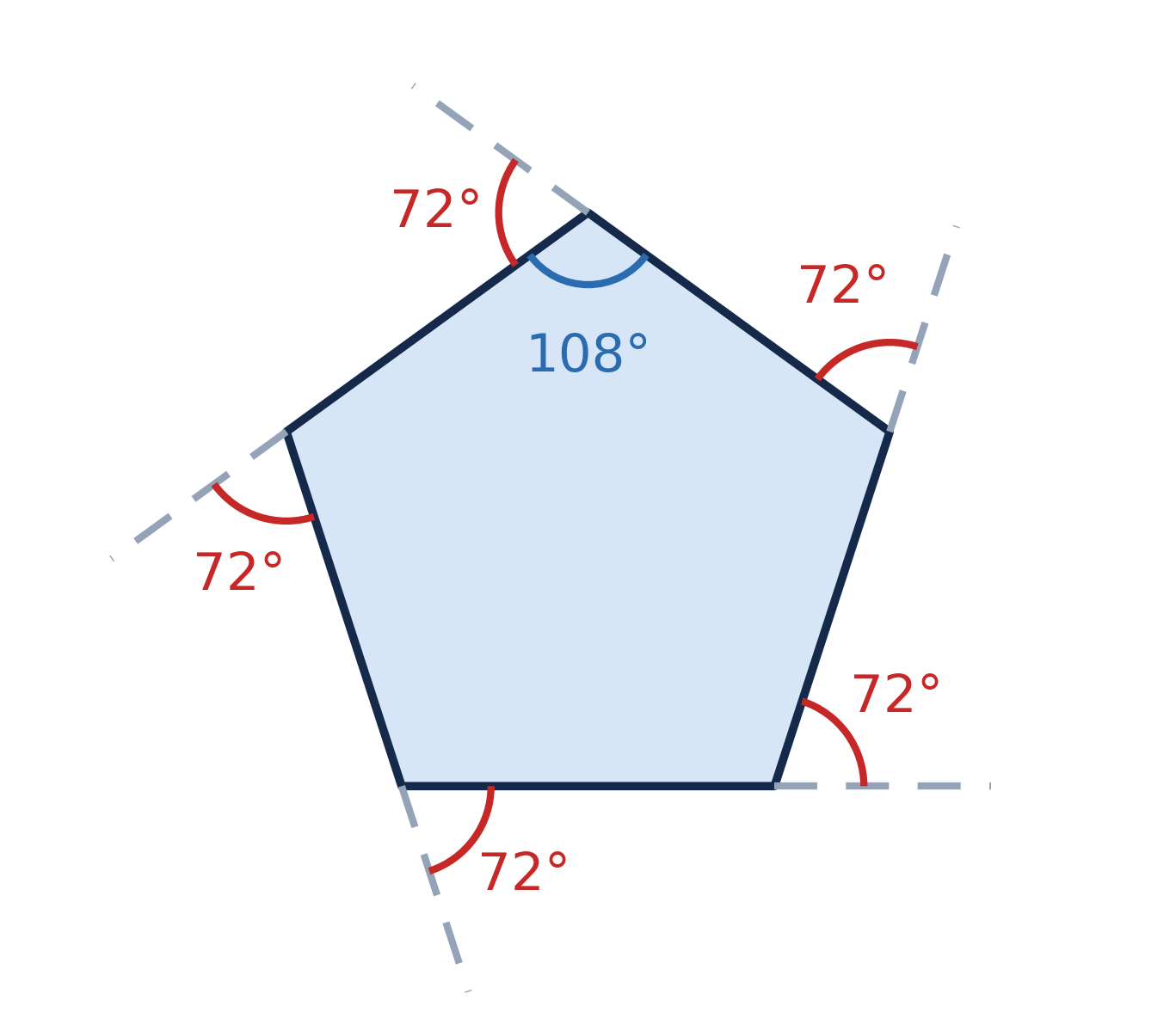
For the regular pentagon in the figure, each exterior angle is 360^\circ \div 5 = 72^\circ and each interior angle is 180^\circ - 72^\circ = 108^\circ.
| Regular polygon, sides | 3 | 4 | 5 | 6 | 8 | 9 | 10 | 12 |
|---|---|---|---|---|---|---|---|---|
| Each exterior angle | 120^\circ | 90^\circ | 72^\circ | 60^\circ | 45^\circ | 40^\circ | 36^\circ | 30^\circ |
| Each interior angle | 60^\circ | 90^\circ | 108^\circ | 120^\circ | 135^\circ | 140^\circ | 144^\circ | 150^\circ |
The working rule for the exam: always go through the exterior angle. If the question gives an interior angle, subtract it from 180^\circ first. Then divide 360 by the result.
Example: each interior angle of a regular polygon is 140^\circ. The exterior angle is 40^\circ, so the polygon has 360 \div 40 = 9 sides.
Two facts follow, and both have been asked.
- The number of sides is a whole number. So an angle can be the exterior angle of a regular polygon only if it divides 360 exactly. An angle of 50^\circ cannot, because 360 \div 50 = 7.2.
- The smallest polygon is the triangle. So the largest exterior angle of a regular polygon is 120^\circ, and the smallest interior angle is 60^\circ. As the number of sides grows, the exterior angle gets smaller and the interior angle gets closer to 180^\circ.
4. When the question gives a sum, a difference or a ratio
The interior angle and the exterior angle always add up to 180^\circ. If a question gives one more fact about the two angles, you have two facts and two unknowns.
A difference. Suppose the interior angle is 60^\circ more than the exterior angle. Then
\text{interior} + \text{exterior} = 180^\circ
\text{interior} - \text{exterior} = 60^\circ
Subtract the second from the first: twice the exterior angle is 120^\circ. The exterior angle is 60^\circ and the polygon has 360 \div 60 = 6 sides. In short:
\text{exterior angle} = \frac{180^\circ - \text{difference}}{2}
A ratio. Suppose interior : exterior = 3 : 2. The two angles share 180^\circ in 5 parts, so one part is 36^\circ. The exterior angle is 72^\circ and the polygon has 5 sides.
Which angle is larger? For a triangle the exterior angle (120^\circ) is larger than the interior angle (60^\circ). For a square they are equal. For 5 sides or more the interior angle is the larger one. So when a question says "the difference is 144^\circ", take the interior angle as the larger.
5. Diagonals
A diagonal joins two corners that are not next to each other. From one corner you can draw a diagonal to every corner except itself and its two neighbours. That is n - 3 diagonals from each corner. There are n corners, and this counts every diagonal twice, once from each end. So:
\text{Number of diagonals} = \frac{n(n - 3)}{2}
A quadrilateral has \frac{4 \times 1}{2} = 2, a pentagon \frac{5 \times 2}{2} = 5, a hexagon \frac{6 \times 3}{2} = 9 and an octagon \frac{8 \times 5}{2} = 20.
6. Two regular polygons to know well
The regular hexagon. Join the centre to the six corners. The angle at the centre is 360^\circ \div 6 = 60^\circ in each part, so each part is an equilateral triangle. A regular hexagon of side a is six equilateral triangles of side a.
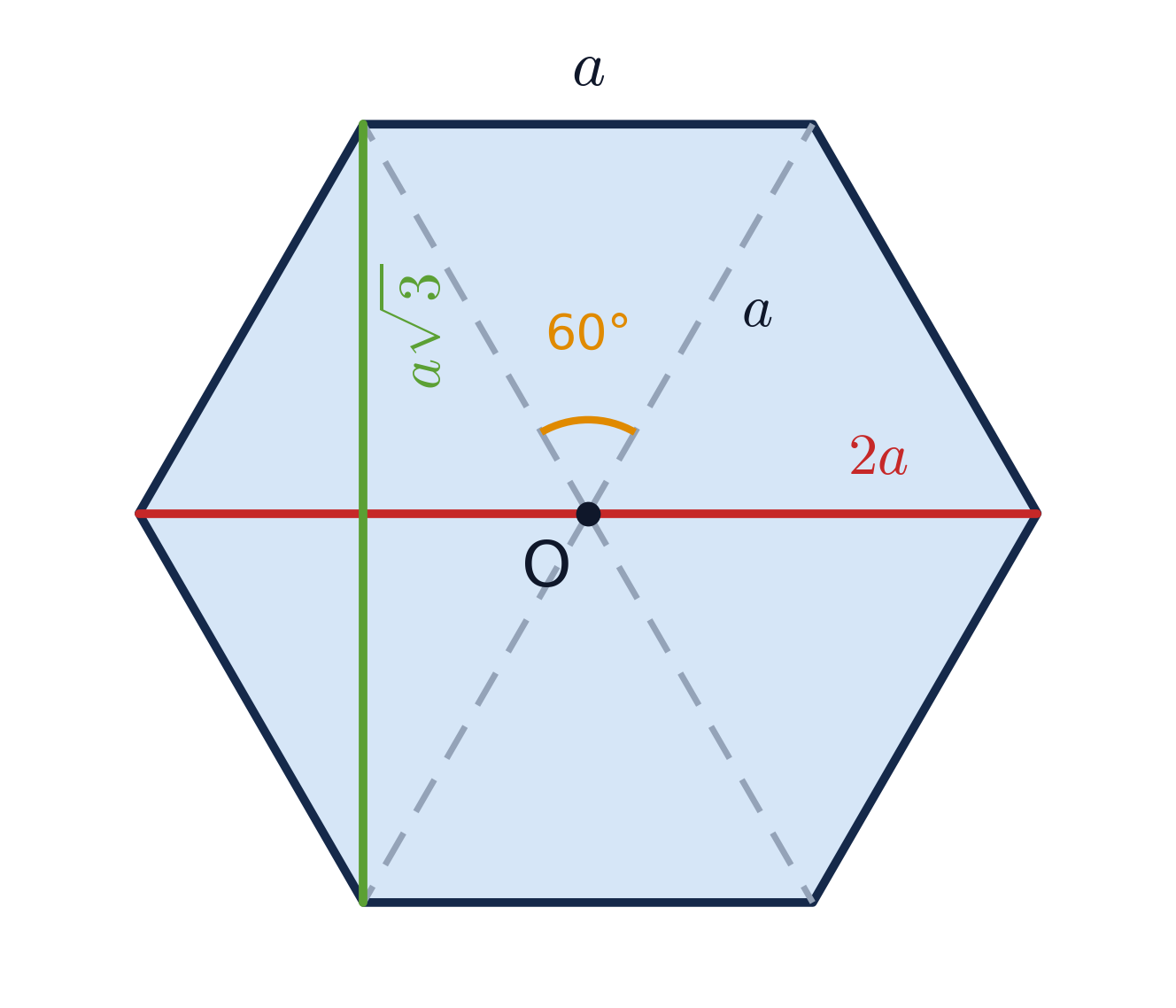
| Regular hexagon of side a | Value |
|---|---|
| Distance from the centre to a corner | a |
| Long diagonal (through the centre) | 2a |
| Short diagonal, and the distance between opposite sides | a\sqrt{3} |
| Area | 6 \times \dfrac{\sqrt{3}}{4}a^2 = \dfrac{3\sqrt{3}}{2}a^2 |
The regular octagon cut from a square. Cut the same small right triangle from each corner of a square. If the cuts are the right size, a regular octagon is left.
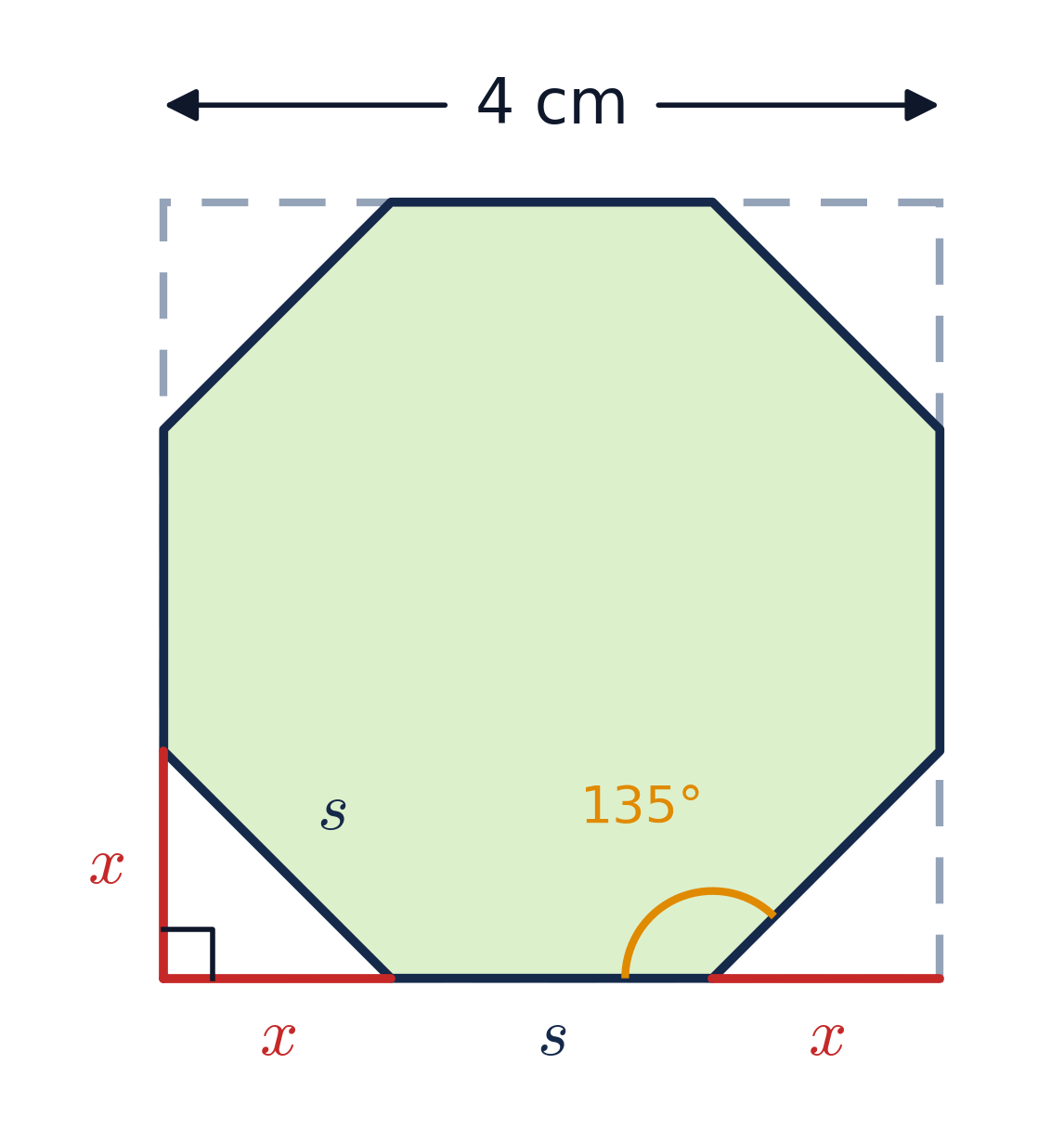
Let the side of the octagon be s and each cut length be x. The cut triangle has two 45^\circ angles, and its longest side is a side of the octagon. So s = x\sqrt{2}, which gives x = \frac{s}{\sqrt{2}}. Along one side of the square, of length L:
x + s + x = L \quad\text{so}\quad s\sqrt{2} + s = L
s = \frac{L}{\sqrt{2} + 1} = L(\sqrt{2} - 1)
The last step multiplies the top and the bottom by \sqrt{2} - 1, because (\sqrt{2} + 1)(\sqrt{2} - 1) = 1. The side of the octagon is a little more than 0.41 of the side of the square.
Worked examples
Example 1. Each interior angle of a regular polygon is 156^\circ. How many sides does it have?
Go through the exterior angle: 180^\circ - 156^\circ = 24^\circ. The number of sides is 360 \div 24 = 15.
Example 2. The interior angles of a polygon add up to 1620^\circ. How many sides and how many diagonals does it have?
(n - 2) \times 180 = 1620 gives n - 2 = 9, so n = 11. The number of diagonals is \frac{11 \times 8}{2} = 44.
Example 3. Each interior angle of a regular polygon is four times its exterior angle. Find the number of sides and the interior angle.
The two angles share 180^\circ in the ratio 4 : 1, which is 5 parts. One part is 36^\circ, so the exterior angle is 36^\circ. The number of sides is 360 \div 36 = 10. The interior angle is 4 \times 36^\circ = 144^\circ.
Example 4. A regular polygon has 54 diagonals. What is each interior angle?
\frac{n(n - 3)}{2} = 54 gives n(n - 3) = 108. Look for two numbers 3 apart with product 108: 12 \times 9 = 108, so n = 12. Each exterior angle is 360^\circ \div 12 = 30^\circ and each interior angle is 150^\circ.
Example 5. A regular hexagon has side 6 cm. Find its area, its long diagonal and its short diagonal.
Area = \frac{3\sqrt{3}}{2} \times 6^2 = 54\sqrt{3} square cm, which is about 93.5 square cm. The long diagonal is 2 \times 6 = 12 cm. The short diagonal is 6\sqrt{3} cm.
From the real papers
All five captured questions are given here. The first three are from CDS I 2024 and CDS II 2025 (Series A), and the answers agree with the final official key. The fourth is from CDS II 2026, where the official key is still provisional; our answer agrees with it. Try each for 72 seconds before reading the solution.
CDS I 2024, Q6. If the difference between the interior and exterior angles of a regular polygon is 144°, then what is the number of sides of the polygon?
(a) 12 (b) 16 (c) 18 (d) 20
Solution. The two angles add up to 180^\circ and differ by 144^\circ. So twice the exterior angle is 180^\circ - 144^\circ = 36^\circ, and the exterior angle is 18^\circ. The number of sides is 360 \div 18 = 20. Answer (d).
CDS II 2025, Q70. Consider the following angles:
I. 4^\circ
II. 5^\circ
III. 6^\circ
IV. 8^\circ
How many of the above can be the exterior angle of a regular polygon?
(a) One (b) Two (c) Three (d) All four
Solution. An exterior angle of a regular polygon is \frac{360^\circ}{n}, so it must divide 360 exactly. 360 \div 4 = 90, 360 \div 5 = 72, 360 \div 6 = 60 and 360 \div 8 = 45. All four give a whole number of sides. Answer (d).
CDS II 2025, Q73. The difference between an interior angle and an exterior angle of a regular polygon is 120^\circ. What is the number of sides of the polygon?
(a) 9 (b) 10 (c) 11 (d) 12
Solution. Twice the exterior angle is 180^\circ - 120^\circ = 60^\circ, so the exterior angle is 30^\circ. The number of sides is 360 \div 30 = 12. Check: the interior angle is 150^\circ, and 150^\circ - 30^\circ = 120^\circ. Answer (d).
CDS II 2026, Q59. A square of side length 4 cm has its corners cut away in such a manner so as to form a regular octagon. What is the length of the side of the octagon? (Take \sqrt{2} = 1.41)
(a) 1·00 cm (b) 1·64 cm (c) 1·68 cm (d) 1·72 cm
Solution. By section 6, s = L(\sqrt{2} - 1) = 4 \times (1.41 - 1) = 4 \times 0.41 = 1.64 cm. Answer (b). (Provisional key.)
Without the formula: each cut length is \frac{s}{\sqrt{2}}, so \frac{s}{\sqrt{2}} + s + \frac{s}{\sqrt{2}} = 4, which is s(\sqrt{2} + 1) = 4.
A question from CDS II 2024 (no official key was published; the answer is our own working)
CDS II 2024, Q95. The ratio of sum of interior angles to sum of exterior angles of a regular polygon of n sides is \frac{7}{2}. What is the measure of an interior angle of polygon?
(a) 110^\circ (b) 120^\circ (c) 130^\circ (d) 140^\circ
Solution. The interior angles add up to (n - 2) \times 180^\circ and the exterior angles to 360^\circ. Their ratio is \frac{(n - 2) \times 180}{360} = \frac{n - 2}{2}. This equals \frac{7}{2}, so n - 2 = 7 and n = 9. Each exterior angle is 360^\circ \div 9 = 40^\circ and each interior angle is 140^\circ. Answer (d).
Three of the five were the same question in different numbers: find the exterior angle, then divide 360 by it.
Mistakes that cost marks
- Giving the sum when the question asks for one angle. (n - 2) \times 180^\circ is the sum of all the interior angles. For one angle of a regular polygon, divide by n, or better, use 180^\circ - \frac{360^\circ}{n}.
- Dividing 360 by the interior angle. n = \frac{360^\circ}{\text{exterior angle}}. If the interior angle is 150^\circ, the polygon has 360 \div 30 = 12 sides, not 360 \div 150.
- Thinking the exterior angles grow with the number of sides. Their sum is 360^\circ for every convex polygon. Only the sum of the interior angles grows.
- Using the regular polygon formulas for a polygon that is not regular. The two sums hold for every convex polygon. "Each exterior angle = \frac{360^\circ}{n}" holds only when the polygon is regular.
- Cutting a third of each side to make an octagon. The cut is x = \frac{s}{\sqrt{2}}, which is less than s. The three parts of the side of the square are not equal.
Quick check
Do these without help. Answers are at the end.
- What is the sum of the interior angles of a polygon with 9 sides?
- Each exterior angle of a regular polygon is 15^\circ. How many sides does it have?
- Can 100^\circ be an interior angle of a regular polygon? Can 165^\circ?
- The interior angle of a regular polygon is 100^\circ more than its exterior angle. How many sides does it have?
- How many diagonals does a decagon have?
Read and watch more, free
The current NCERT books do not have a chapter on the angles of a polygon. The older Class 8 book has, and its files are still on the NCERT site. The CDS playlists teach polygons inside their geometry lessons.
| What | Where | Language |
|---|---|---|
| Textbook, angle sum of a polygon | NCERT Class 8 Mathematics (the older book), Chapter 3 Understanding Quadrilaterals · Hindi edition | English, Hindi |
| Textbook, quadrilaterals | NCERT Class 8 Ganita Prakash Part I, Chapter 4 Quadrilaterals · Hindi edition | English, Hindi |
| Self-study notes, quadrilaterals | NIOS Secondary Mathematics (211), Lesson 13 Quadrilaterals · Hindi edition | English, Hindi |
| Short videos with practice | Khan Academy, NCERT Math Class 8 (it follows the older Class 8 book) | English |
| The real papers | UPSC previous question papers | English, Hindi |
| Video, numbered classes | Chandigarh Career Group: CDS advance maths by Sandeep Brar (the geometry and mensuration classes) | Hinglish |
| Video, a full CDS course | R.S SIR: Maths Playlist for CDS 2025 (the eight geometry lessons, about 55 minutes each) | Hindi and Hinglish |
| Video, geometry with past questions | The Journey Extraordinary: Maths For CDS 2 2026 (the geometry lesson, 3 hours 22 minutes) | Hinglish |
The videos were chosen from their titles, length and views; they have not yet been watched by a teacher.
Answers to the quick check
- (9 - 2) \times 180^\circ = 1260^\circ.
- 360 \div 15 = 24 sides.
- For 100^\circ the exterior angle would be 80^\circ, and 360 \div 80 = 4.5 is not a whole number: no. For 165^\circ the exterior angle is 15^\circ, and 360 \div 15 = 24: yes, a regular polygon of 24 sides.
- Twice the exterior angle is 180^\circ - 100^\circ = 80^\circ, so the exterior angle is 40^\circ and the polygon has 360 \div 40 = 9 sides.
- \frac{10 \times 7}{2} = 35.
Next chapter: Circles: chords, arcs, angles and cyclic quadrilaterals.