Why this chapter matters. This chapter gave 10 questions in the 6 papers from CDS I 2024 to CDS II 2026. That is between one and two a paper on average. Eight of the 10 came as "is the statement enough" questions, so the paper is testing whether you know the properties, not whether you can calculate. By our sorting, three are about the diagonals of a rhombus, three join the midpoints of the sides of a figure, three use the properties of a parallelogram, a trapezium or a kite, and one is about the diagonal of a rectangle. Most are answered in one line from the table of diagonals in section 3.
What you will be able to do
- Place a parallelogram, rectangle, rhombus, square, trapezium and kite in one family and say what each adds.
- Say at once what the diagonals of each figure do: bisect each other, are equal, or cross at right angles.
- Use the right triangle inside a rhombus and the diagonal of a rectangle or square.
- Say what figure the midpoints of the sides make, and what its area is.
Before you start you should know: angles made by parallel lines (Chapter A5-1), the rules of congruence (Chapter A5-2), and Pythagoras, similar triangles and the midpoint line of a triangle (Chapter A5-3).
1. The family of quadrilaterals
A quadrilateral has four sides. A diagonal cuts it into two triangles, so its four angles add up to 360^\circ. If the angles are in the ratio 2 : 3 : 4 : 6, there are 15 parts of 24^\circ each, and the angles are 48^\circ, 72^\circ, 96^\circ and 144^\circ.
| Figure | What makes it |
|---|---|
| Trapezium | one pair of opposite sides parallel |
| Parallelogram | both pairs of opposite sides parallel |
| Rectangle | a parallelogram with a right angle (then all four are right angles) |
| Rhombus | a parallelogram with all four sides equal |
| Square | a rectangle and a rhombus at the same time |
| Kite | two pairs of equal sides, the equal sides being next to each other |
Each figure keeps every property of the one it is built from. So a square has every property of a rectangle, of a rhombus and of a parallelogram.
2. The parallelogram
In every parallelogram:
- opposite sides are equal and parallel;
- opposite angles are equal;
- two angles next to each other add up to 180^\circ (they are co-interior angles);
- the diagonals bisect each other: each cuts the other into two equal parts;
- each diagonal cuts the parallelogram into two congruent triangles.
If one angle is twice the angle next to it, then 2x + x = 180^\circ, and the angles are 120^\circ, 60^\circ, 120^\circ, 60^\circ.
To show that a quadrilateral is a parallelogram, any one of these is enough: both pairs of opposite sides are equal; both pairs of opposite angles are equal; the diagonals bisect each other; or one pair of opposite sides is both equal and parallel.
Sides and diagonals. In a parallelogram with sides a and b and diagonals d_1 and d_2:
d_1^2 + d_2^2 = 2\left(a^2 + b^2\right)
3. Rectangle, rhombus and square: what the diagonals do
This table answers most of the real questions. Learn it by its two special columns.
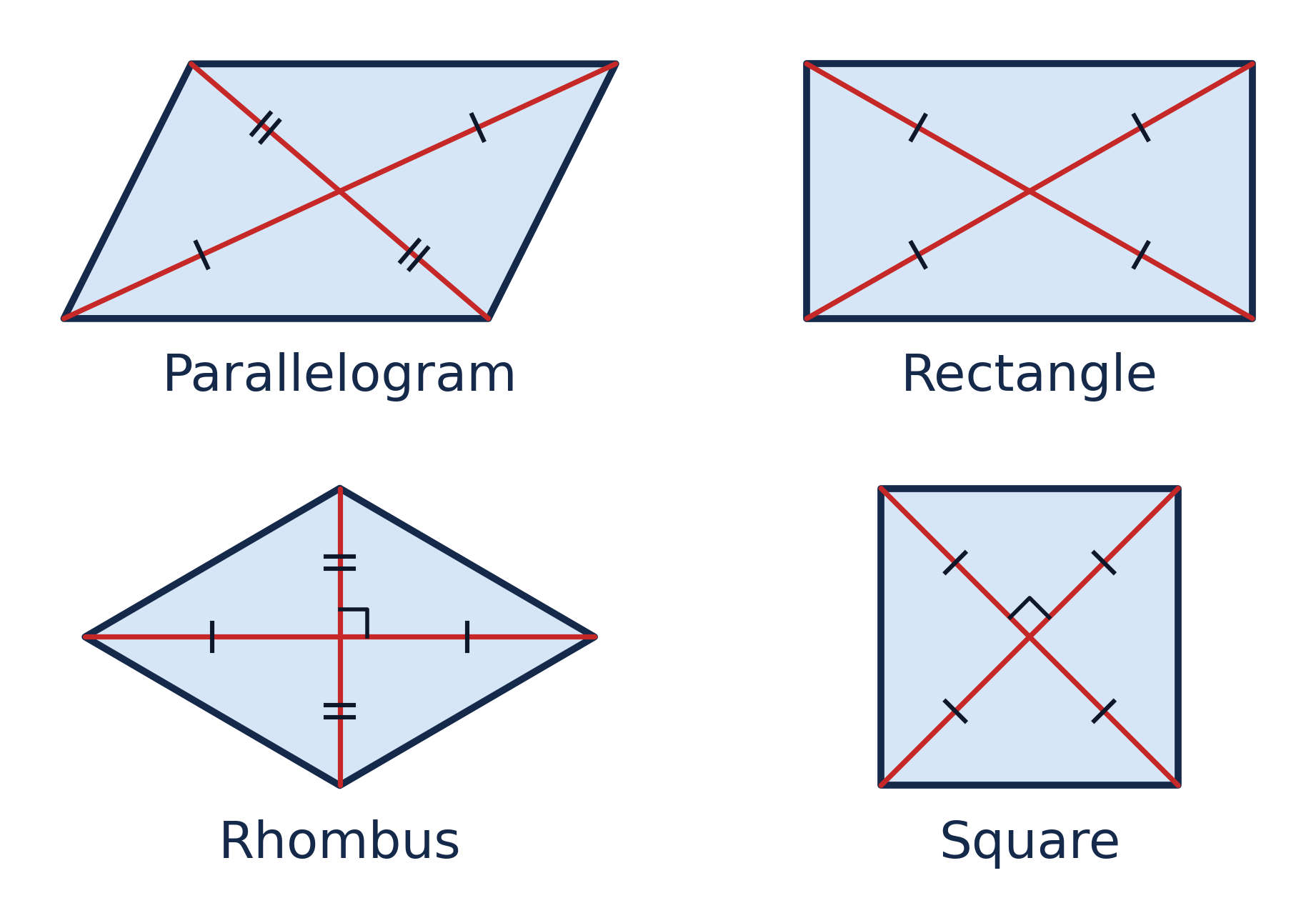
| Figure | Diagonals bisect each other | Diagonals are equal | Diagonals cross at right angles |
|---|---|---|---|
| Parallelogram | yes | no | no |
| Rectangle | yes | yes | no |
| Rhombus | yes | no | yes |
| Square | yes | yes | yes |
Equal diagonals come from the right angles of the rectangle. Diagonals at right angles come from the equal sides of the rhombus. The diagonals of a rhombus and of a square also bisect the angles at the corners.
Rectangle and square. A diagonal is the hypotenuse of a right triangle made by two sides. For a rectangle with sides l and b, d^2 = l^2 + b^2. A rectangle of 6 by 8 has diagonal 10. A square of side a has diagonal a\sqrt{2}.
Rhombus. The diagonals cut the rhombus into four equal right triangles. The legs of each are half the diagonals, and the hypotenuse is the side.
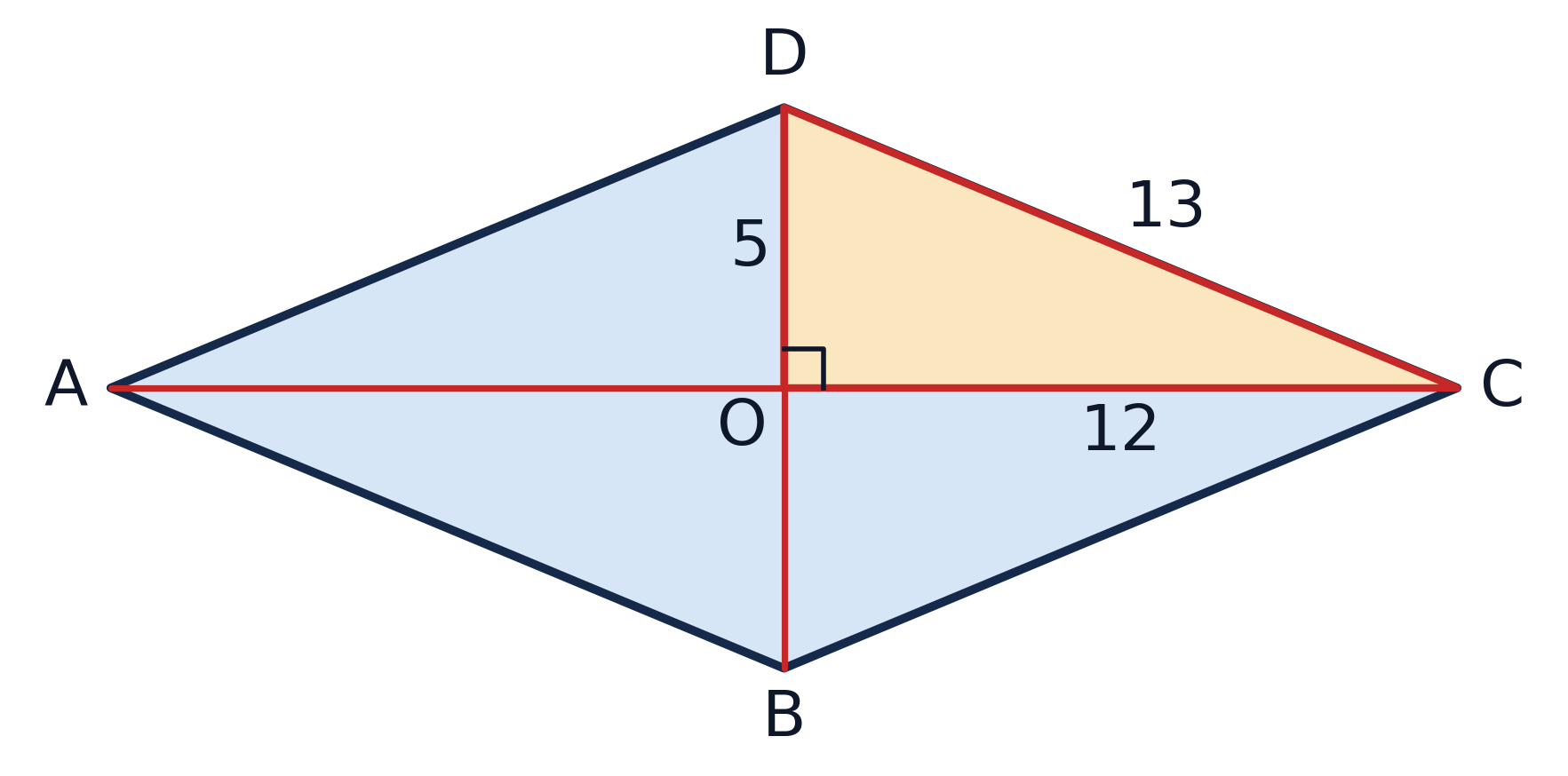
\left(\frac{d_1}{2}\right)^2 + \left(\frac{d_2}{2}\right)^2 = (\text{side})^2, \qquad \text{so} \qquad d_1^2 + d_2^2 = 4 \times (\text{side})^2
In the figure the diagonals are 24 and 10. The half diagonals are 12 and 5, so the side is 13. The area of a rhombus is \frac{1}{2} d_1 d_2: here \frac{1}{2} \times 24 \times 10 = 120.
A rhombus with a diagonal equal to its side. That diagonal cuts the rhombus into two equilateral triangles. The angles of the rhombus are 60^\circ and 120^\circ, and the other diagonal is \sqrt{3} times the side.
4. Trapezium and kite
Trapezium. Let AB \parallel DC. On each of the other two sides, the two angles add up to 180^\circ: \angle A + \angle D = 180^\circ and \angle B + \angle C = 180^\circ. The line joining the midpoints of the two sides that are not parallel is parallel to AB and DC, and its length is half of their sum.
An isosceles trapezium has its two non-parallel sides equal. Then the two angles on each parallel side are equal, the diagonals are equal, and each pair of opposite angles adds up to 180^\circ.
Take care with this pair of facts: AB \parallel DC and AD = BC. A parallelogram fits them, and so does an isosceles trapezium. One more fact is needed to tell which.
Kite. Let AB = AD and CB = CD. The diagonal AC cuts the kite into two congruent triangles (SSS). So AC bisects the angles at A and C, and it cuts the other diagonal BD in half at right angles. This works backwards too: if a diagonal of a quadrilateral bisects the angles at both its ends, the two halves are congruent (ASA) and the figure is a kite.
5. Joining the midpoints
In a triangle. The line joining the midpoints of two sides is parallel to the third side and half of it (Chapter A5-3). Joining all three midpoints cuts the triangle into four congruent triangles, each a quarter of the area.
In a quadrilateral. Join the midpoints of the four sides in order.
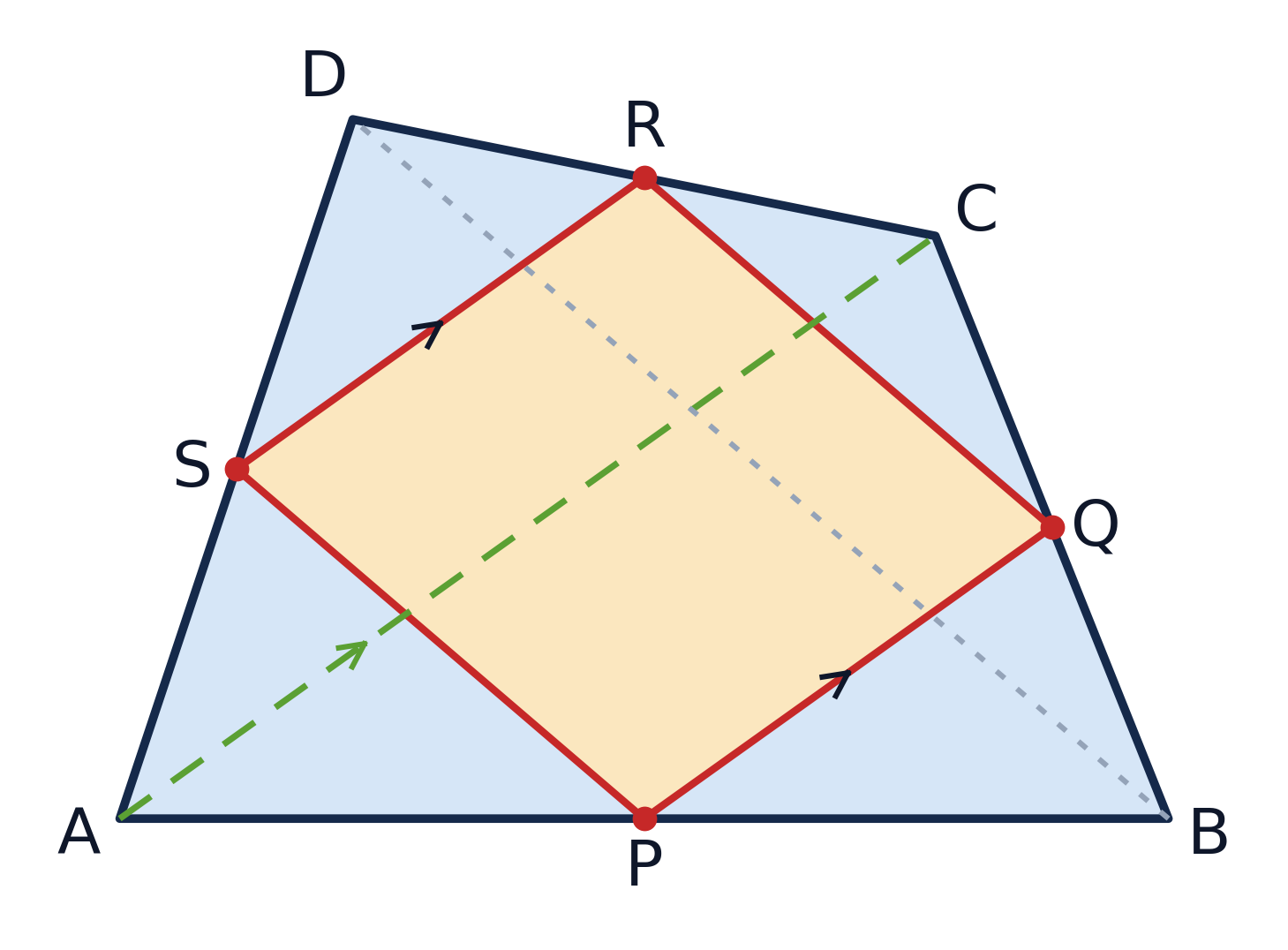
In the figure, PQ joins the midpoints of two sides of triangle ABC, so PQ is parallel to AC and half of it. In triangle ADC, SR is also parallel to AC and half of it. So PQ and SR are equal and parallel, and
- PQRS is always a parallelogram, whatever the shape of ABCD;
- its sides are parallel to the diagonals of ABCD and half as long;
- its area is half the area of ABCD.
The kind of parallelogram depends on the diagonals of ABCD:
| Diagonals of the outer figure | Midpoint figure | So for |
|---|---|---|
| equal | rhombus | a rectangle, an isosceles trapezium |
| at right angles | rectangle | a rhombus, a kite |
| equal and at right angles | square | a square |
A rectangle of 8 by 6 has diagonals of 10. Its midpoint figure is a rhombus of side 5 and area \frac{1}{2} \times 48 = 24.
6. A corner joined to the midpoint of a side
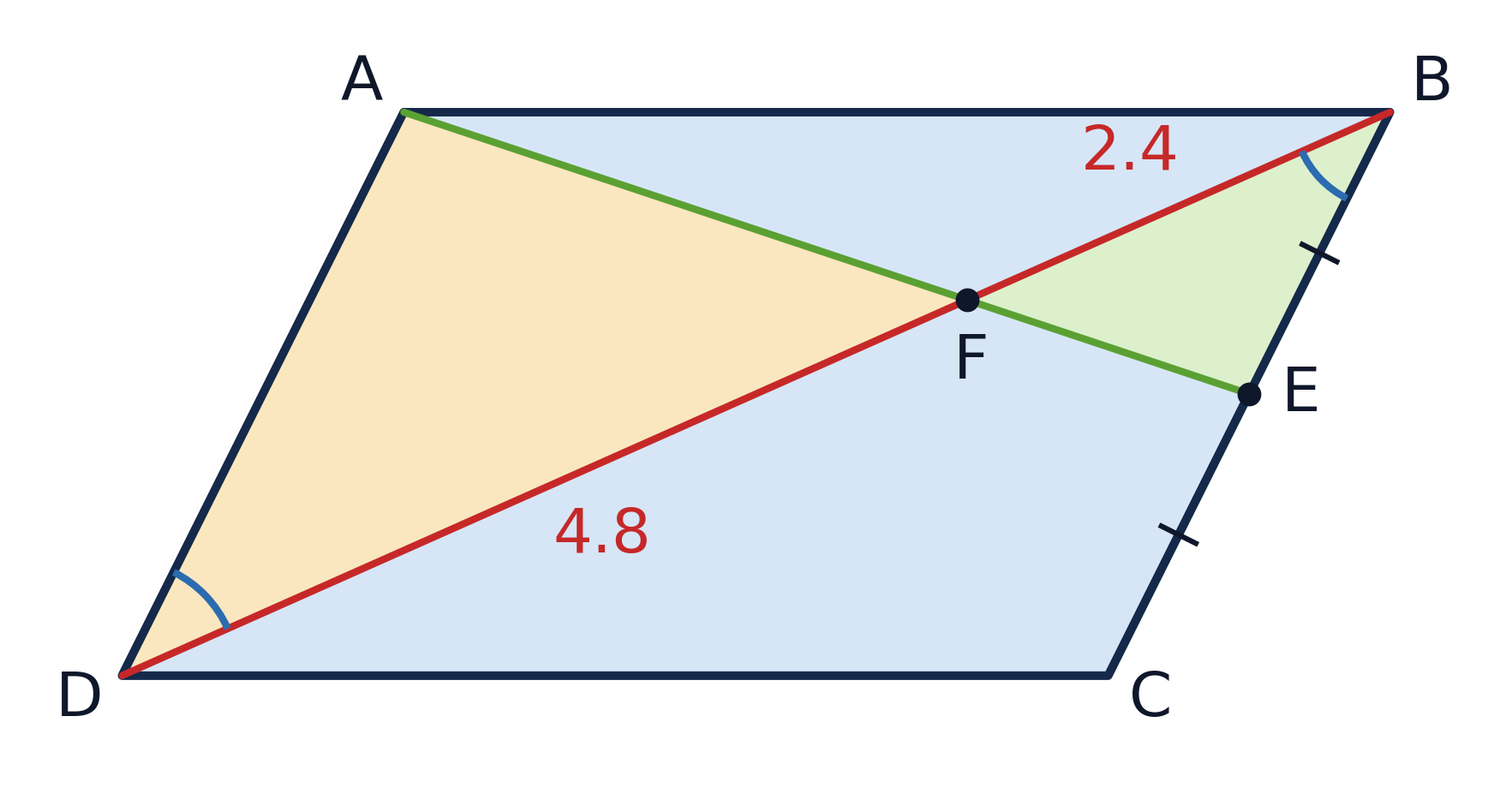
In a parallelogram ABCD, let E be the midpoint of BC, and let AE cross the diagonal BD at F. Since BC \parallel AD, triangles BFE and DFA are similar: the angles at F are vertically opposite and the marked angles are alternate. The scale factor is \frac{BE}{DA} = \frac{1}{2}. So
BF : FD = 1 : 2, \qquad BF = \frac{1}{3}BD
Whenever two lines cross between two parallel sides, look for this pair of similar triangles.
Worked examples
Example 1. The diagonals of a rhombus are 10 cm and 24 cm. Find its side, its perimeter and its area.
The half diagonals are 5 and 12, so the side is 13 cm. The perimeter is 52 cm. The area is \frac{1}{2} \times 10 \times 24 = 120 square cm.
Example 2. The sides of a parallelogram are 7 cm and 9 cm and one diagonal is 8 cm. Find the other diagonal.
d_1^2 + d_2^2 = 2(49 + 81) = 260. So d_2^2 = 260 - 64 = 196 and d_2 = 14 cm.
Example 3. The midpoints of the sides of a rhombus with diagonals 10 cm and 24 cm are joined in order. What figure is formed, and what is its area?
The diagonals of a rhombus cross at right angles, so the midpoint figure is a rectangle. Its sides are half the diagonals: 5 cm and 12 cm. Its area is 60 square cm, which is half of the area of the rhombus, 120 square cm.
From the real papers
The first four questions are from CDS I 2024 and CDS II 2025 (Series A), and the answers agree with the final official key. The fifth is from CDS I 2026, whose key is still provisional; our answer agrees with it. Try each for 72 seconds before reading the solution.
CDS I 2024, Q68. (One of ten questions of this kind in the paper.)
Question : What is the ratio of the lengths of diagonals of a rhombus?
Statement-I : One diagonal of the rhombus is equal to its side.
Statement-II : The longer diagonal of the rhombus is equal to \sqrt{3} times its side.
(a) The Question can be answered by one of the Statements alone, but not by the other. (b) The Question can be answered by either Statement alone. (c) The Question can be answered by using both the Statements together, but cannot be answered by using either Statement alone. (d) The Question cannot be answered even by using both Statements together.
Solution. For a rhombus of side s, d_1^2 + d_2^2 = 4s^2 (section 3). Statement I: d_1 = s gives d_2^2 = 3s^2, so d_2 = \sqrt{3}s and the ratio is 1 : \sqrt{3}. Statement II: d_2 = \sqrt{3}s gives d_1^2 = s^2, the same ratio. Each statement alone is enough. Answer (b).
CDS I 2024, Q70. (One of the same ten questions.)
P, Q, R, S are the mid-points of sides AB, BC, CD, DA respectively of a quadrilateral ABCD.
Question : What is the difference in the area of the quadrilateral ABCD and the area of the quadrilateral PQRS?
Statement-I : Area of the quadrilateral ABCD is 100 square unit.
Statement-II : Area of the quadrilateral PQRS is 50 square unit.
(a) The Question can be answered by one of the Statements alone, but not by the other. (b) The Question can be answered by either Statement alone. (c) The Question can be answered by using both the Statements together, but cannot be answered by using either Statement alone. (d) The Question cannot be answered even by using both Statements together.
Solution. The midpoint figure has half the area of the quadrilateral (section 5). So the difference is half the area of ABCD, which is also the area of PQRS. Statement I alone gives 100 - 50 = 50. Statement II alone gives 100 - 50 = 50. Answer (b).
CDS II 2025, Q69. Let X, Y and Z be the midpoints of the sides BC, CA and AB of a triangle ABC respectively. Consider the following statements:
I. The quadrilateral AZXY is a parallelogram.
II. The area of the quadrilateral AZXY is half of the area of the triangle ABC.
Which of the statements given above is/are correct?
(a) I only (b) II only (c) Both I and II (d) Neither I nor II
Solution. ZX joins the midpoints of AB and BC, so it is parallel to AC, that is, to AY. XY joins the midpoints of BC and CA, so it is parallel to AB, that is, to AZ. Both pairs of opposite sides are parallel: I is correct. The three midpoint lines cut the triangle into four congruent triangles, and AZXY is made of two of them: II is correct. Answer (c).
CDS II 2025, Q90. A Question is given followed by two Statements I and II. Consider the Question and the Statements.
Question: The diagonals of a rhombus ABCD are in the ratio 5 : 12. Is one of the diagonals equal to side of the rhombus?
Statement-I: The sum of the diagonals = 34 cm.
Statement-II: The length of a side = 13 cm.
Which one of the following is correct in respect of the above Question and the Statements?
(a) The Question can be answered by using one of the Statements alone, but cannot be answered using the other Statement alone (b) The Question can be answered by using either Statement alone (c) The Question can be answered by using both the Statements together, but cannot be answered using either Statement alone (d) The Question can be answered even without using any of the Statements
Solution. Let the diagonals be 5k and 12k. The half diagonals are 2.5k and 6k, so the side is \sqrt{6.25k^2 + 36k^2} = 6.5k. This is equal to neither 5k nor 12k, whatever k is. The answer to the question is "no", and no statement was used. Answer (d).
CDS I 2026, Q54. Let ABCD be a parallelogram and E be the midpoint of BC. The diagonal BD and line segment AE intersects at F. If BF = 2·4 cm, then what is BD equal to?
(a) 6·0 cm (b) 6·4 cm (c) 7·2 cm (d) 8·4 cm
Solution. This is the figure of section 6. Triangles BFE and DFA are similar with scale factor \frac{BE}{DA} = \frac{1}{2}, so FD = 2 \times 2.4 = 4.8 cm and BD = 2.4 + 4.8 = 7.2 cm. (The paper prints the decimal point as a raised dot.) Answer (c). (Provisional key.)
In a "is the statement enough" question, first see how far the question goes with no statement at all. In CDS II 2025 Q90 it goes all the way.
Mistakes that cost marks
- Giving every parallelogram the diagonals of a square. The diagonals of a parallelogram only bisect each other. They are equal only in a rectangle, and at right angles only in a rhombus.
- Using whole diagonals in the rhombus triangle. The legs of the right triangle are the half diagonals. Diagonals of 10 and 24 give a side of 13, not 26.
- Calling the midpoint figure of a rhombus a rhombus. It is a rectangle. The midpoint figure of a rectangle is a rhombus. The names change over.
- Taking "one pair of sides parallel and the other pair equal" as a parallelogram. It may be an isosceles trapezium. For a parallelogram the same pair must be equal and parallel.
Quick check
Do these without help. Answers are at the end.
- Two angles of a parallelogram that are next to each other differ by 40^\circ. Find all four angles.
- A rhombus has side 10 cm and one diagonal 12 cm. Find the other diagonal and the area.
- The diagonal of a square is 8 cm. Find its side and its area.
- The area of a quadrilateral is 84 square cm. The midpoints of its sides are joined in order. What kind of figure is formed, and what is its area?
- A rhombus has side 6 cm and one angle of 60^\circ. Find its two diagonals.
Read and watch more, free
The NCERT books teach the properties of each figure. The midpoint figure and its area get little space in those books; for them, this lesson and the past papers are the material.
| What | Where | Language |
|---|---|---|
| Textbook, the kinds of quadrilateral | NCERT Class 8 Ganita Prakash Part I, Chapter 4 Quadrilaterals · Hindi edition | English, Hindi |
| Textbook, parallelograms | NCERT Class 9 Ganita Manjari Part II, Chapter 12 Quadrilaterals | English |
| Self-study notes | NIOS Secondary Mathematics (211), Lesson 13 Quadrilaterals · Hindi edition | English, Hindi |
| Practice with answers | NCERT Exemplar Class 9, Unit 8 Quadrilaterals · Hindi edition | English, Hindi |
| Short videos with practice | Khan Academy, NCERT Math Class 9 (the quadrilaterals unit) | English |
| The real papers | UPSC previous question papers | English, Hindi |
| Video, numbered classes | Chandigarh Career Group: CDS advance maths by Sandeep Brar (the geometry and mensuration classes) | Hinglish |
| Video, a full CDS course | R.S SIR: Maths Playlist for CDS 2025 (the eight geometry lessons, about 55 minutes each) | Hindi and Hinglish |
| Video, whole geometry in six lessons | Defence Wallah CDS / AFCAT: Quantitative Aptitude CDS 2024 (the geometry lessons, about 2 hours each) | Hinglish |
The videos were chosen from their titles, length and views; they have not yet been watched by a teacher.
Answers to the quick check
- x + (x + 40) = 180, so x = 70. The angles are 70^\circ, 110^\circ, 70^\circ, 110^\circ.
- Half of the known diagonal is 6. The other half diagonal is \sqrt{10^2 - 6^2} = 8, so the other diagonal is 16 cm. Area = \frac{1}{2} \times 12 \times 16 = 96 square cm.
- Side = \frac{8}{\sqrt{2}} = 4\sqrt{2} cm. Area = 32 square cm.
- A parallelogram, of area 42 square cm.
- The diagonal facing the 60^\circ angle cuts off an equilateral triangle, so it is 6 cm. The other is \sqrt{3} \times 6 = 6\sqrt{3} cm.
Next chapter: Polygons and their angles.