Why this chapter matters. This chapter gave 23 questions in the 6 papers from CDS I 2024 to CDS II 2026. That is about 4 a paper on average, the second largest count in geometry. By our sorting, 8 are about circles that touch each other or sit in a corner, 6 are about the circle inside a triangle (the incircle), 5 use a tangent and its radius, and 4 are about the circle through the corners of a triangle (the circumcircle). Many come in sets of two or three questions on one figure. Almost every one starts the same way: join the centre to the point where the circle touches, and a right angle appears.
What you will be able to do
- Use the two tangent facts: a tangent is perpendicular to the radius, and the two tangents from a point are equal.
- Find the distance between the centres of two circles that touch, and the length of a common tangent.
- Find the radius of the incircle of any triangle, and quickly for a right triangle and an equilateral triangle.
- Find the radius of the circumcircle, and quickly for the same two triangles.
Before you start you should know: the chord and angle facts of a circle (Chapter A5-7), Pythagoras' theorem and its triples (Chapter A5-3), the incentre and circumcentre of a triangle (Chapter A5-4), and how to find the area of a triangle from its base and height. Heron's formula is used once; it is taught fully in Chapter A6-1.
1. A tangent and its radius
A tangent is a line that touches a circle at exactly one point, the point of contact. A line that cuts the circle at two points is a secant.
Fact 1. A tangent is perpendicular to the radius at the point of contact.
Fact 2. From a point outside a circle, two tangents can be drawn, and they are equal in length.
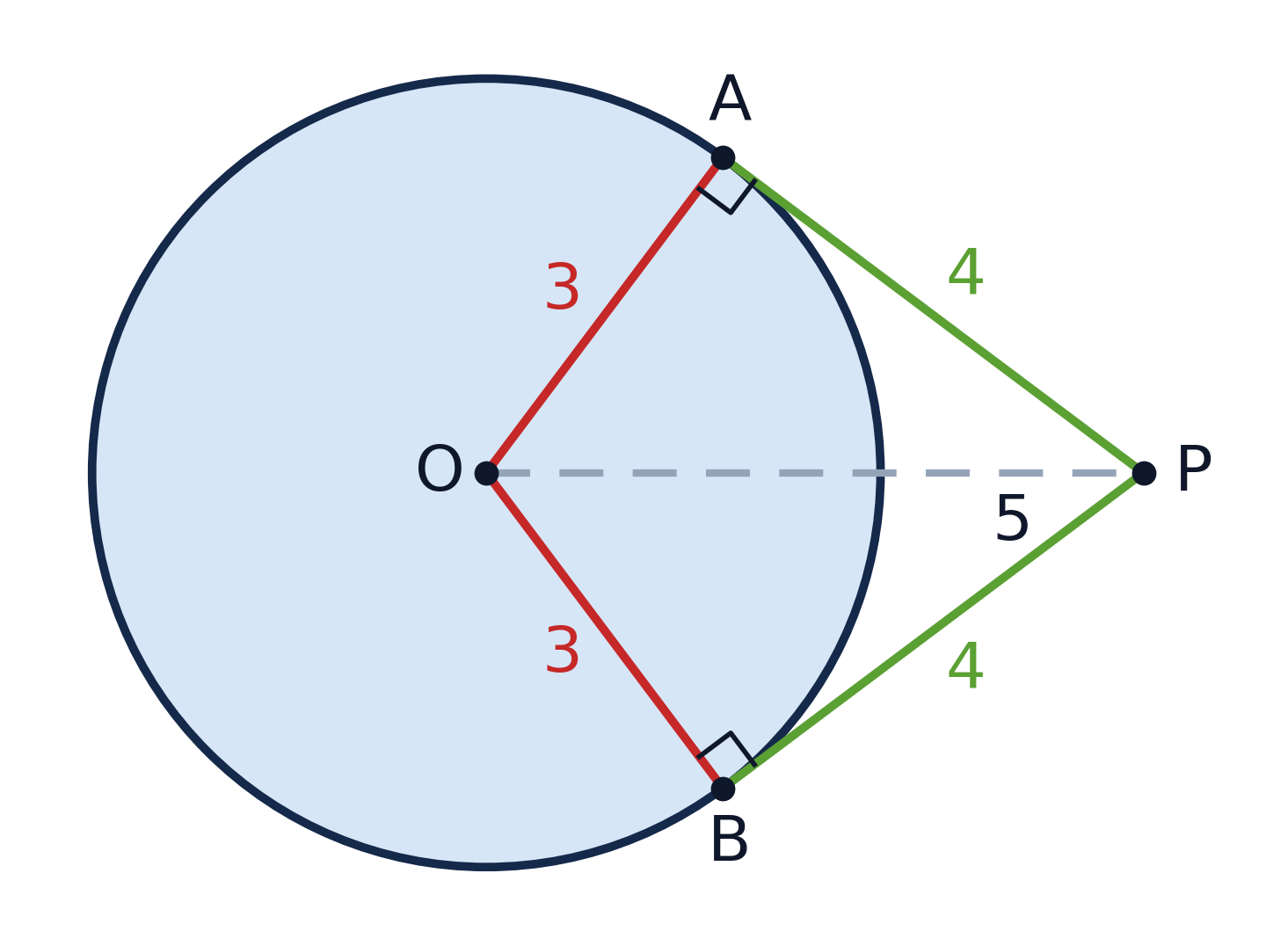
The triangle OAP has a right angle at A. So if P is at distance d from the centre of a circle of radius r:
\text{length of the tangent} = \sqrt{d^2 - r^2}
In the figure, \sqrt{5^2 - 3^2} = 4.
The figure OAPB has more to give.
- The line OP bisects the angle APB and the angle AOB.
- The angles at A and B are 90^\circ each. So the other two angles add up to 180^\circ: \angle APB + \angle AOB = 180^\circ. If the tangents meet at 60^\circ, the angle AOB is 120^\circ.
- OP is perpendicular to the chord AB and bisects it.
A quadrilateral drawn round a circle. If a circle touches all four sides of a quadrilateral ABCD, mark the two equal tangents at each corner. Adding them up gives:
AB + CD = BC + DA
The sums of opposite sides are equal.
2. A tangent with a chord, and with a secant
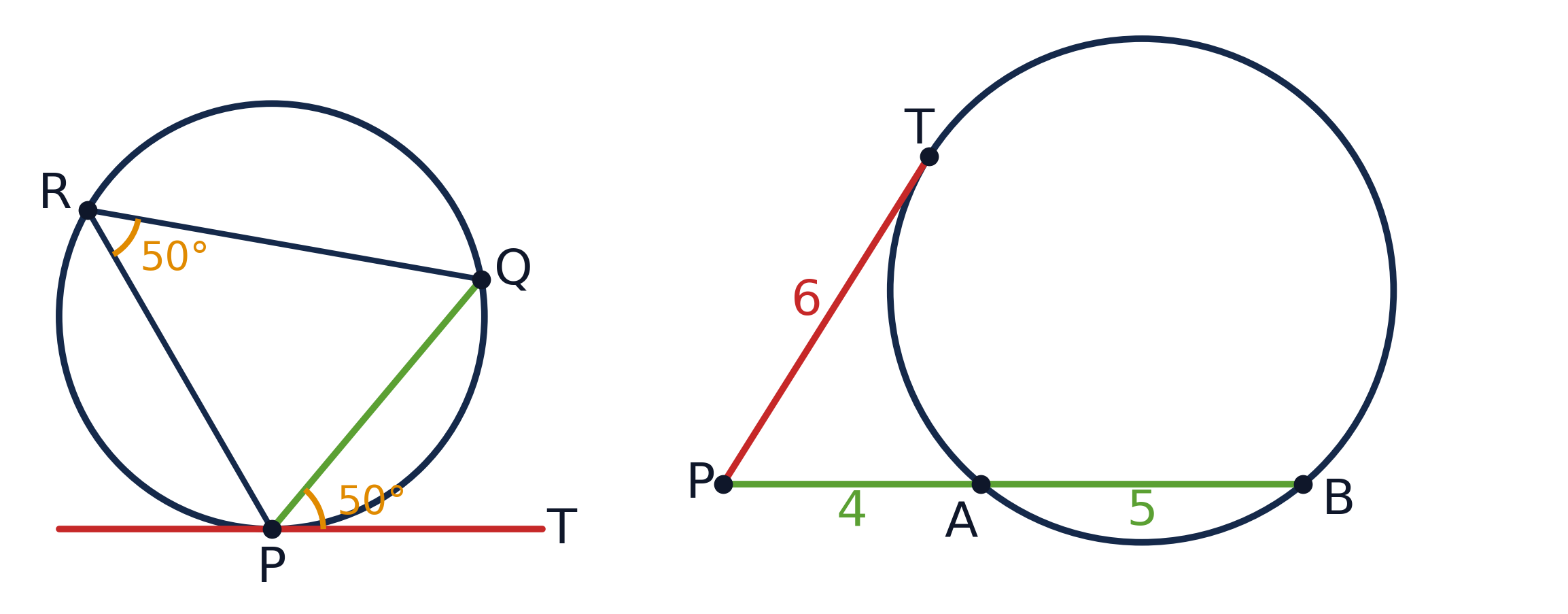
The angle between a tangent and a chord. Draw a chord PQ from the point of contact P. The angle between the tangent and the chord is equal to the angle that the chord makes at any point of the circle on the other side of the chord. This is called the alternate segment rule. In the left drawing both angles are 50^\circ.
It follows that the angle at the centre is twice the angle between the tangent and the chord: here \angle POQ = 100^\circ.
A tangent and a secant from the same point. If PT is a tangent and a line from P cuts the circle at A and B, then
PT^2 = PA \times PB
In the right drawing, PA = 4 and PB = 4 + 5 = 9, so PT^2 = 36 and PT = 6. Both lengths are measured from P.
3. Two circles
Let the radii be R and r, with R the larger, and let the centres be d apart.
| How the circles lie | Distance between centres | Common tangents |
|---|---|---|
| Apart, not touching | d > R + r | 4 |
| Touching from outside (externally) | d = R + r | 3 |
| Cutting at two points | R - r < d < R + r | 2 |
| Touching from inside (internally) | d = R - r | 1 |
| One inside the other, not touching | d < R - r | 0 |
When two circles touch, the two centres and the point of contact lie on one straight line. This is the first line to draw in every question about touching circles.
The length of a common tangent. Join each centre to its point of contact. Both radii are perpendicular to the tangent, so they are parallel. Draw a line from the centre of the small circle parallel to the tangent. A right triangle appears.
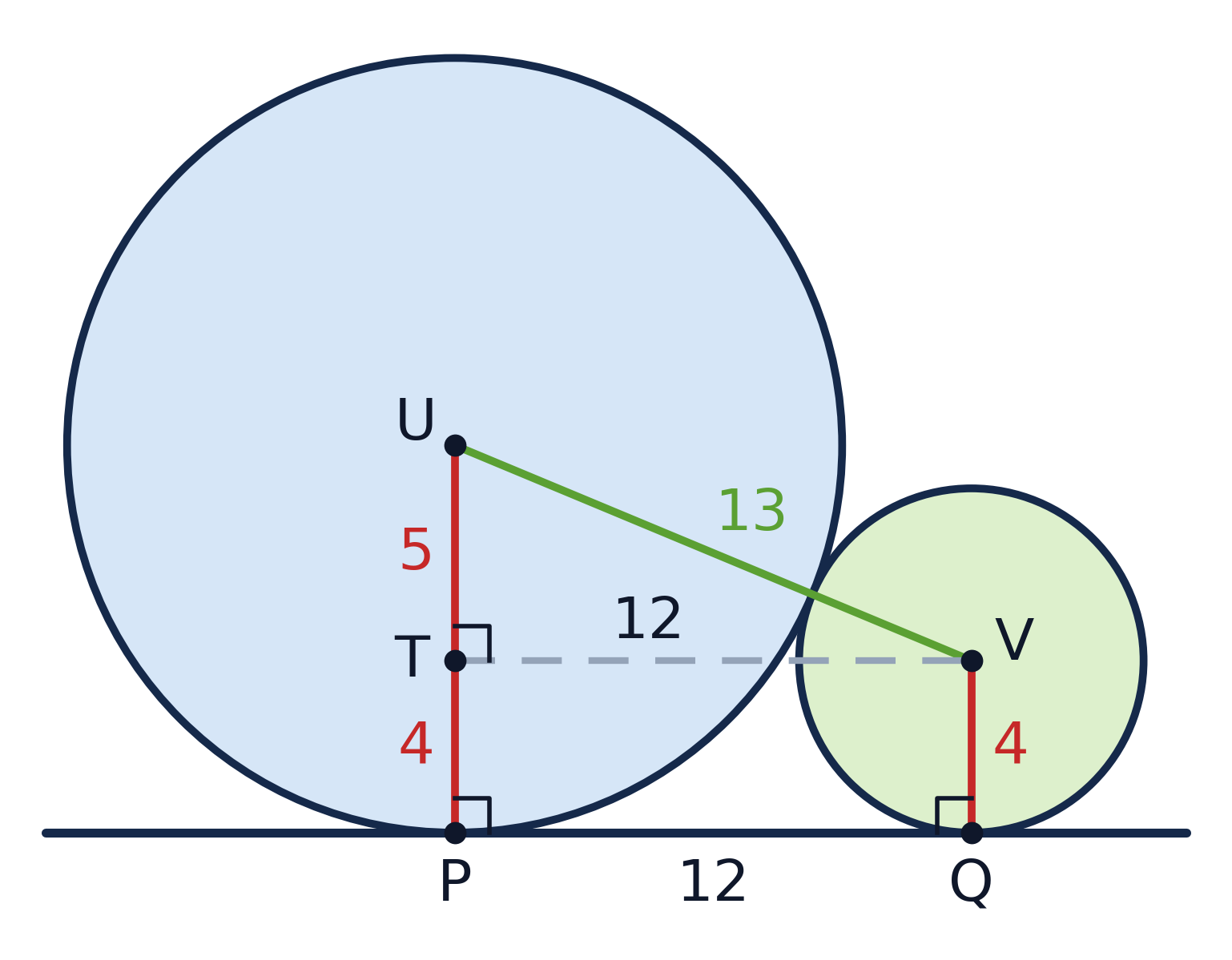
In the figure, the hypotenuse is UV = 9 + 4 = 13, one side is UT = 9 - 4 = 5, and the other side is the common tangent: \sqrt{13^2 - 5^2} = 12.
| Common tangent | Length |
|---|---|
| Direct (both circles on the same side of it) | \sqrt{d^2 - (R - r)^2} |
| Transverse (it passes between the circles) | \sqrt{d^2 - (R + r)^2} |
| Direct, when the circles touch externally | 2\sqrt{Rr} |
Check the last line with the figure: 2\sqrt{9 \times 4} = 12.
A circle in a corner. A circle that touches two lines has its centre on the bisector of the angle between them. Its centre is at distance r from each line. If the two lines meet at a right angle, the centre is at distance r\sqrt{2} from the corner, because it is the far corner of a square of side r.
Three equal circles that touch each other. Their centres form an equilateral triangle of side 2r.
4. The incircle of a triangle
The incircle is the circle inside a triangle that touches all three sides. Its centre is the incentre, where the angle bisectors meet (Chapter A5-4). Its radius is the inradius, written r.
Join the incentre to the three corners. The triangle is cut into three small triangles, each with height r. Adding their areas gives area = \frac{1}{2} r \times perimeter. With s for half the perimeter:
r = \frac{\text{Area}}{s}
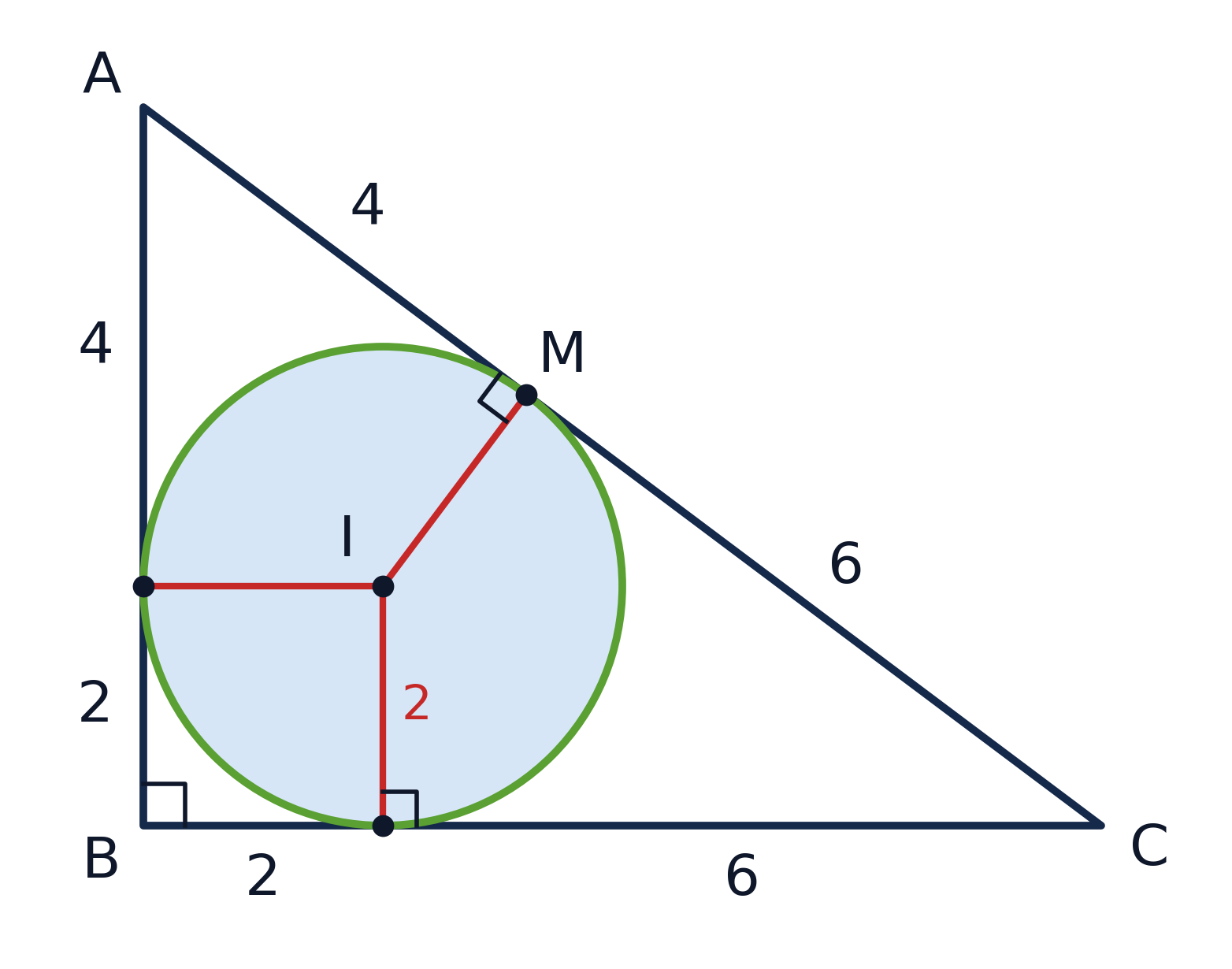
For the triangle with sides 6, 8, 10 the area is 24 and s = 12, so r = 2.
Right triangle. In the figure, the two tangents from the right-angle corner B, with the two radii, make a square of side r. So the tangents from A are 6 - r and those from C are 8 - r, and together they make the hypotenuse: (6 - r) + (8 - r) = 10. In general, with a and b for the two shorter sides and c for the hypotenuse:
r = \frac{a + b - c}{2}
The tangents from the corners. In any triangle, the tangent from a corner to the incircle has length s minus the opposite side. In the figure: 12 - 10 = 2 from B, 12 - 8 = 4 from A and 12 - 6 = 6 from C.
5. The circumcircle of a triangle
The circumcircle passes through the three corners. Its centre is the circumcentre, where the perpendicular bisectors of the sides meet. Its radius is the circumradius, written R. For a triangle with sides a, b, c:
R = \frac{abc}{4 \times \text{Area}}
Right triangle. The angle in a semicircle is 90^\circ, so the hypotenuse is a diameter. The circumcentre is the midpoint of the hypotenuse and
R = \frac{\text{hypotenuse}}{2}
Equilateral triangle. The incentre, the circumcentre and the centroid are the same point. It is one third of the way up the height h = \frac{\sqrt{3}}{2}a.
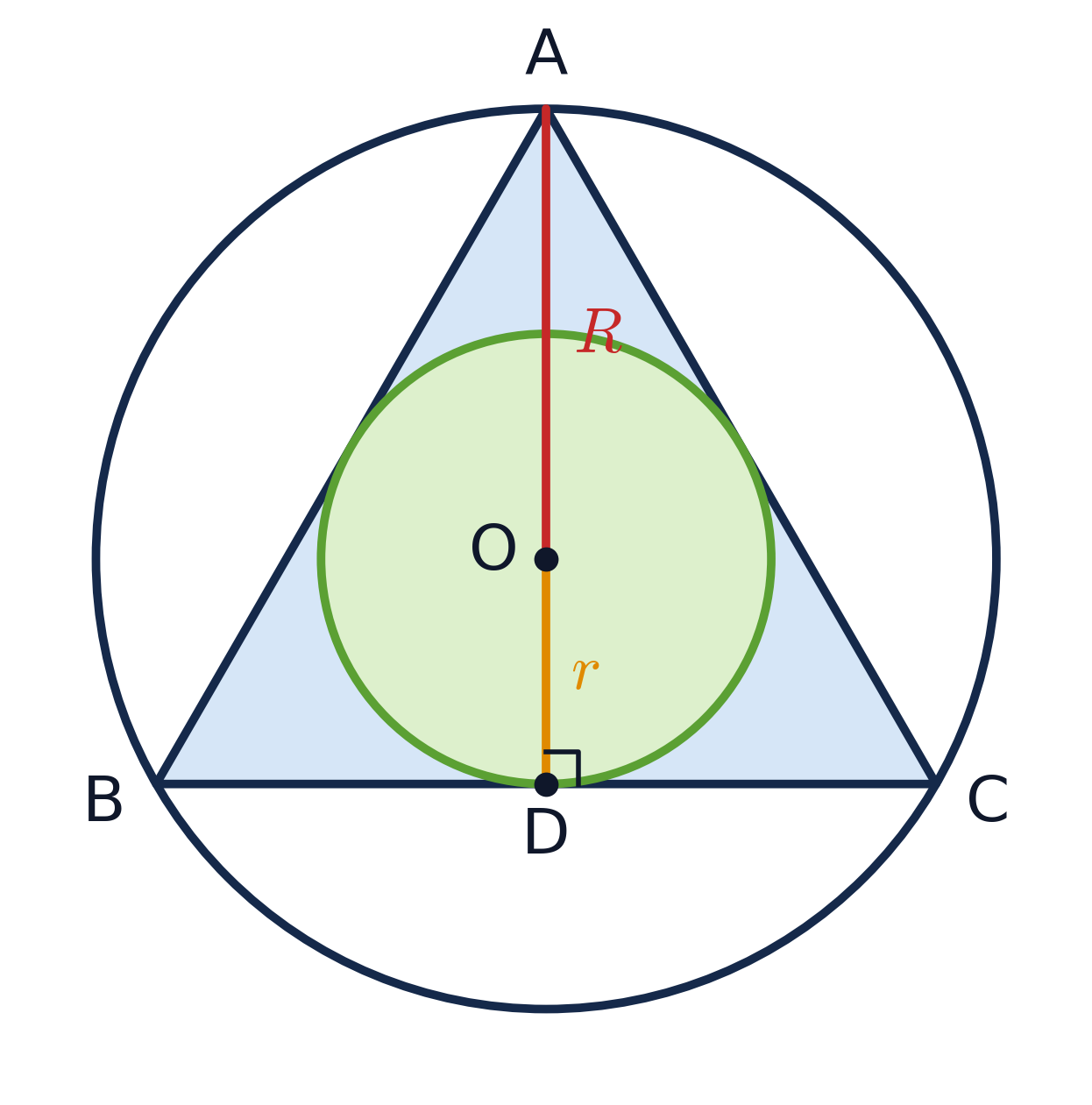
| Triangle | Inradius r | Circumradius R |
|---|---|---|
| Any triangle | \dfrac{\text{Area}}{s} | \dfrac{abc}{4 \times \text{Area}} |
| Right triangle, hypotenuse c | \dfrac{a + b - c}{2} | \dfrac{c}{2} |
| Equilateral triangle, side a | \dfrac{h}{3} = \dfrac{a}{2\sqrt{3}} | \dfrac{2h}{3} = \dfrac{a}{\sqrt{3}} |
In an equilateral triangle R = 2r.
Worked examples
Example 1. P is 13 cm from the centre O of a circle of radius 5 cm. PA and PB are the tangents from P. Find PA and the area of the quadrilateral OAPB.
PA = \sqrt{13^2 - 5^2} = 12 cm. The quadrilateral is two right triangles with sides 5 and 12 about the right angle. Its area is 2 \times \frac{1}{2} \times 5 \times 12 = 60 square cm.
Example 2. A tangent touches a circle with centre O at P. A chord PQ makes 50^\circ with the tangent. Find \angle OPQ and \angle POQ.
The radius OP is perpendicular to the tangent, so \angle OPQ = 90^\circ - 50^\circ = 40^\circ. OP and OQ are radii, so \angle OQP = 40^\circ as well, and \angle POQ = 180^\circ - 80^\circ = 100^\circ. This is twice 50^\circ, as section 2 says.
Example 3. Two circles of radii 11 cm and 4 cm have their centres 25 cm apart. Find the lengths of the direct and the transverse common tangents.
Direct: \sqrt{25^2 - (11 - 4)^2} = \sqrt{625 - 49} = 24 cm. Transverse: \sqrt{25^2 - (11 + 4)^2} = \sqrt{625 - 225} = 20 cm.
Example 4. Three circles of radius 3 cm touch each other. Find the radius of the smallest circle that encloses all three.
The centres form an equilateral triangle of side 6 cm. The centre of the large circle is the centre of this triangle, at distance \frac{6}{\sqrt{3}} = 2\sqrt{3} cm from each corner (the circumradius of the triangle). From there the large circle must reach the far edge of a small circle, which is one more radius away. So its radius is 2\sqrt{3} + 3 cm, about 6.46 cm.
Example 5. A triangle has sides 13 cm, 14 cm and 15 cm. Find its inradius and its circumradius.
s = 21. By Heron's formula the area is \sqrt{21 \times 8 \times 7 \times 6} = \sqrt{7056} = 84 square cm. So r = \frac{84}{21} = 4 cm and R = \frac{13 \times 14 \times 15}{4 \times 84} = \frac{2730}{336} = 8.125 cm.
From the real papers
These six questions are from the Elementary Mathematics papers of CDS I 2024, CDS I 2025 and CDS II 2025 (Series A). The answers agree with the final official key. Try each for 72 seconds before reading the solution.
CDS I 2025, Q55. This question belongs to a set of two, which begins: "Consider the following for the next two (02) items that follow : A circle M of radius 8 cm touches externally with another circle N of radius 16 cm. Let P, Q be the points where the common tangent touches the circles M and N respectively."
What is the length of the common tangent PQ?
(a) 16 cm (b) 16\sqrt{2} cm (c) 24 cm (d) 24\sqrt{2} cm
Solution. The circles touch externally, so the direct common tangent is 2\sqrt{Rr} = 2\sqrt{16 \times 8} = 2\sqrt{128} = 16\sqrt{2} cm. Answer (b).
By the right triangle: the centres are 16 + 8 = 24 apart and the radii differ by 8, so PQ = \sqrt{24^2 - 8^2} = \sqrt{512} = 16\sqrt{2}.
CDS I 2025, Q54. This question belongs to another set of two, which begins: "Consider the following for the next two (02) items that follow : ABC is a triangle right-angled at B. The perimeter of the triangle is 24 cm and the difference between the sum of the perpendicular sides and the hypotenuse is 4 cm."
A circle is inscribed in the triangle. What is its radius?
(a) 1 cm (b) 1.5 cm (c) 2 cm (d) 2.5 cm
Solution. For a right triangle r = \frac{a + b - c}{2}. The question gives a + b - c = 4 directly. So r = 2 cm. Answer (c).
Check: a + b + c = 24 and a + b - c = 4 give c = 10 and a + b = 14. The triangle is 6, 8, 10, with area 24 and s = 12, so r = \frac{24}{12} = 2.
CDS I 2025, Q73. A circle is inscribed in an equilateral triangle. The radius of the circle is 2 cm. What is the area of the triangle?
(a) 12\sqrt{3} square cm (b) 12 square cm (c) 9\sqrt{3} square cm (d) 9 square cm
Solution. The inradius is one third of the height, so the height is 6 cm. From \frac{\sqrt{3}}{2}a = 6, the side is a = \frac{12}{\sqrt{3}} = 4\sqrt{3} cm. Area = \frac{1}{2} \times 4\sqrt{3} \times 6 = 12\sqrt{3} square cm. Answer (a).
CDS I 2024, Q49. In a quarter circle of radius R, a circle of radius r is inscribed. What is the ratio of R to r?
(a) (\sqrt{2} + 1) : 1 (b) (\sqrt{3} + 1) : 1 (c) 3 : 2 (d) 5 : 4
Solution. A quarter circle has two straight edges that meet at a right angle at its corner. The small circle touches both edges, so its centre is r\sqrt{2} from the corner (section 3). It also touches the arc from inside. So the corner, the small centre and the point of contact on the arc are in one line, and R = r\sqrt{2} + r. Then R : r = (\sqrt{2} + 1) : 1. Answer (a).
CDS I 2024, Q67. This question belongs to a set of ten, which begins: "Consider the following for the next ten (10) items that follow : Each item contains a Question followed by two Statements. Answer each item using the following instructions : Choose option (a) If the Question can be answered by one of the Statements alone, but not by the other. (b) If the Question can be answered by either Statement alone. (c) If the Question can be answered by using both the Statements together, but cannot be answered by using either Statement alone. (d) If the Question cannot be answered even by using both Statements together."
A circle touches all the four sides AB, BC, CD, DA of a quadrilateral ABCD.
Question : What is the perimeter of the quadrilateral?
Statement-I : AB + DC = 10 cm
Statement-II : AD + BC = 10 cm
Solution. For a quadrilateral drawn round a circle, AB + CD = BC + DA (section 1). If either sum is 10 cm, the other is also 10 cm and the perimeter is 20 cm. Each statement alone answers the question. Answer (b).
CDS II 2025, Q85. A Question is given followed by two Statements I and II. Consider the Question and the Statements.
Question: In a triangle ABC right angled at B, AC = 20 cm. What is the circum-radius of the triangle?
Statement-I: AB = 12 cm
Statement-II: BC = 16 cm
Which one of the following is correct in respect of the above Question and the Statements?
(a) The Question can be answered by using one of the Statements alone, but cannot be answered using the other Statement alone (b) The Question can be answered by using either Statement alone (c) The Question can be answered by using both the Statements together, but cannot be answered using either Statement alone (d) The Question can be answered even without using any of the Statements
Solution. The right angle is at B, so AC is the hypotenuse and a diameter of the circumcircle. R = \frac{20}{2} = 10 cm. Neither statement is needed. Answer (d).
Four of the six were answered by one line of the table in section 5 or the table in section 3.
Mistakes that cost marks
- Taking the tangent as the hypotenuse. The right angle is at the point of contact. The hypotenuse is the line from the centre to the outside point: tangent = \sqrt{d^2 - r^2}, not \sqrt{d^2 + r^2}.
- Adding the radii for circles that touch internally. Externally the centres are R + r apart. Internally they are R - r apart.
- Using R - r for the transverse tangent. The direct tangent uses the difference of the radii. The transverse tangent uses the sum.
- Mixing up the two radii of an equilateral triangle. The inradius is the smaller one: r = \frac{h}{3} and R = \frac{2h}{3}.
- Using r = \frac{a + b - c}{2} for a triangle that is not right-angled. For any other triangle use r = \frac{\text{Area}}{s}.
Quick check
Do these without help. Answers are at the end.
- A point is 25 cm from the centre of a circle of radius 7 cm. How long is the tangent from the point to the circle?
- Two tangents from a point P touch a circle with centre O at A and B. If \angle APB = 70^\circ, find \angle AOB.
- Two circles of radii 9 cm and 16 cm touch externally. Find the length of their direct common tangent.
- Find the inradius and the circumradius of the triangle with sides 9 cm, 12 cm and 15 cm.
- Find the inradius and the circumradius of an equilateral triangle of side 12 cm.
Read and watch more, free
NCERT Class 10 teaches the two tangent facts. The NIOS lesson adds secants. The incircle and circumcircle formulas are collected in this lesson; the NCERT books do not give them in one place.
| What | Where | Language |
|---|---|---|
| Textbook, tangents | NCERT Class 10 Mathematics, Chapter 10 Circles · Hindi edition | English, Hindi |
| Self-study notes | NIOS Secondary Mathematics (211), Lesson 17 Secants, Tangents and their Properties · Hindi edition | English, Hindi |
| Practice with answers | NCERT Exemplar Class 10, Unit 9 Circles · Hindi edition | English, Hindi |
| Short videos with practice | Khan Academy, NCERT Math Class 10 (the circles unit) · in Hindi | English, Hindi |
| An open textbook, tangent theorems | Siyavula, Mathematics Grade 11 (the chapter on Euclidean geometry) | English |
| The real papers | UPSC previous question papers | English, Hindi |
| Video, numbered classes | Chandigarh Career Group: CDS advance maths by Sandeep Brar (the geometry and mensuration classes) | Hinglish |
| Video, a full CDS course | R.S SIR: Maths Playlist for CDS 2025 (the eight geometry lessons, about 55 minutes each) | Hindi and Hinglish |
| Video, geometry with past questions | The Journey Extraordinary: Maths For CDS 2 2026 (the geometry lesson, 3 hours 22 minutes) | Hinglish |
The videos were chosen from their titles, length and views; they have not yet been watched by a teacher.
Answers to the quick check
- \sqrt{25^2 - 7^2} = \sqrt{576} = 24 cm.
- \angle AOB = 180^\circ - 70^\circ = 110^\circ.
- 2\sqrt{9 \times 16} = 2 \times 12 = 24 cm.
- 9^2 + 12^2 = 15^2, so it is a right triangle. r = \frac{9 + 12 - 15}{2} = 3 cm and R = \frac{15}{2} = 7.5 cm.
- r = \frac{12}{2\sqrt{3}} = 2\sqrt{3} cm and R = \frac{12}{\sqrt{3}} = 4\sqrt{3} cm.
Next chapter: Loci.