Why this chapter matters. This chapter gave 0 questions in the 6 papers from CDS I 2024 to CDS II 2026. Not one of the 600 questions in those papers asked for a locus. But the syllabus lists "Loci" as the last line of Geometry, so a question can come in any paper. This lesson is short for that reason. It gives the six standard loci in one table, and ends with practice questions of our own in the exam style.
What you will be able to do
- Say what a locus is, and test whether a point belongs to it.
- Name the six standard loci at sight.
- Find where the centre of a circle must lie when the circle has to pass through given points or touch given lines.
- Count the points that satisfy two conditions at once.
Before you start you should know: the perpendicular bisector of a segment and the bisector of an angle (Chapter A5-4), the chord facts of a circle (Chapter A5-7), and the tangent facts (Chapter A5-8).
1. What a locus is
A locus is the set of all points that satisfy a given condition. The plural is loci. You can also think of it as the path of a point that moves while obeying a rule.
The tip of the minute hand of a clock is always at the same distance from the centre of the clock. Its path is a circle. So the locus of a point at a fixed distance from a fixed point is a circle.
A figure is the locus only if every point of it satisfies the condition, and no other point does.
All loci in this chapter are in a plane, that is, on a flat sheet.
2. The six standard loci
| The condition on the point | Its locus |
|---|---|
| At a fixed distance r from a fixed point O | The circle with centre O and radius r |
| At a fixed distance d from a fixed line | Two lines parallel to the fixed line, one on each side, at distance d |
| Equidistant from two fixed points A and B | The perpendicular bisector of AB |
| Equidistant from two lines that cross | The two bisectors of the angles between the lines |
| Equidistant from two parallel lines | The parallel line midway between them |
| The segment AB is seen from the point at a right angle | The circle with AB as diameter, leaving out A and B |
"Equidistant from" means "at the same distance from". The distance from a point to a line is always measured along the perpendicular.
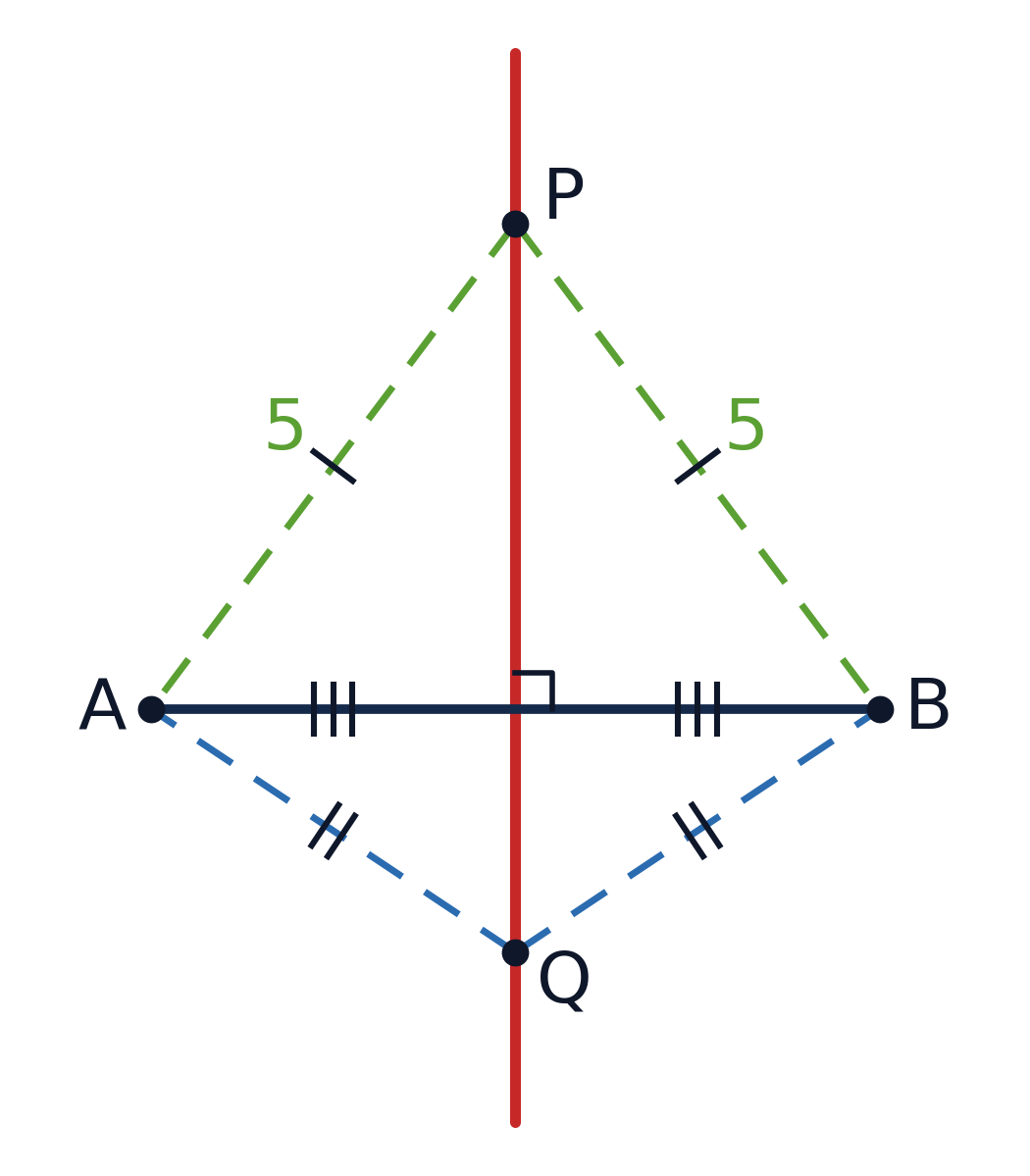
Two fixed points. In the figure, P is 5 from A and 5 from B, and Q is also at equal distances from A and B. Both lie on the perpendicular bisector of AB.
Two lines that cross. The locus is a pair of lines, not one line. The two bisectors are at right angles to each other. In the figure, the point P on one bisector is 2 from the line l and 2 from the line m.
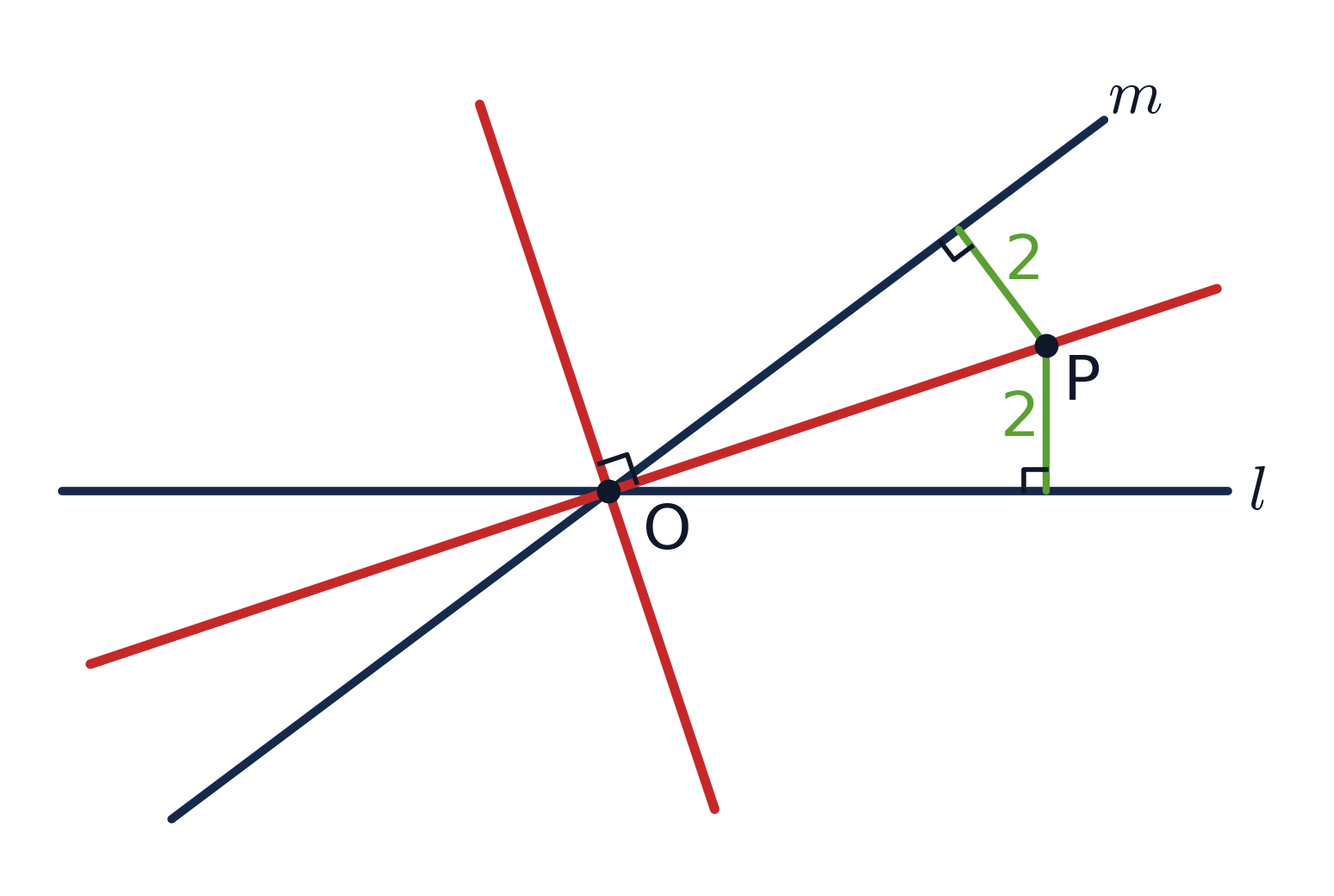
If the point must stay inside one angle, the locus is only the bisector of that angle.
A right angle. The last line of the table is the "angle in a semicircle" fact of Chapter A5-7, read backwards.
3. Where the centre of a circle can be
Many locus questions ask for the locus of the centre of a circle. Each one is a line of the table in section 2.
| The circle must | Locus of its centre |
|---|---|
| pass through two fixed points A and B | The perpendicular bisector of AB |
| touch two lines that cross | The bisectors of the angles between the lines |
| have radius r and touch a fixed line | Two lines parallel to the fixed line at distance r |
| touch two parallel lines | The parallel line midway between them |
A wheel of radius 35 cm rolls along a flat road. Its centre stays 35 cm above the road, so the centre moves along a straight line parallel to the road.
4. Two conditions at once
A point that must satisfy two conditions lies on both loci. So it is a point where the two loci meet.
- Equidistant from the three corners of a triangle. The point is on the perpendicular bisector of AB and on the perpendicular bisector of BC. These meet at one point, the circumcentre.
- Inside a triangle and equidistant from its three sides. The point is on two angle bisectors. They meet at one point, the incentre.
Counting points. How many points are 3 cm from a line l and also 5 cm from a point P of l?
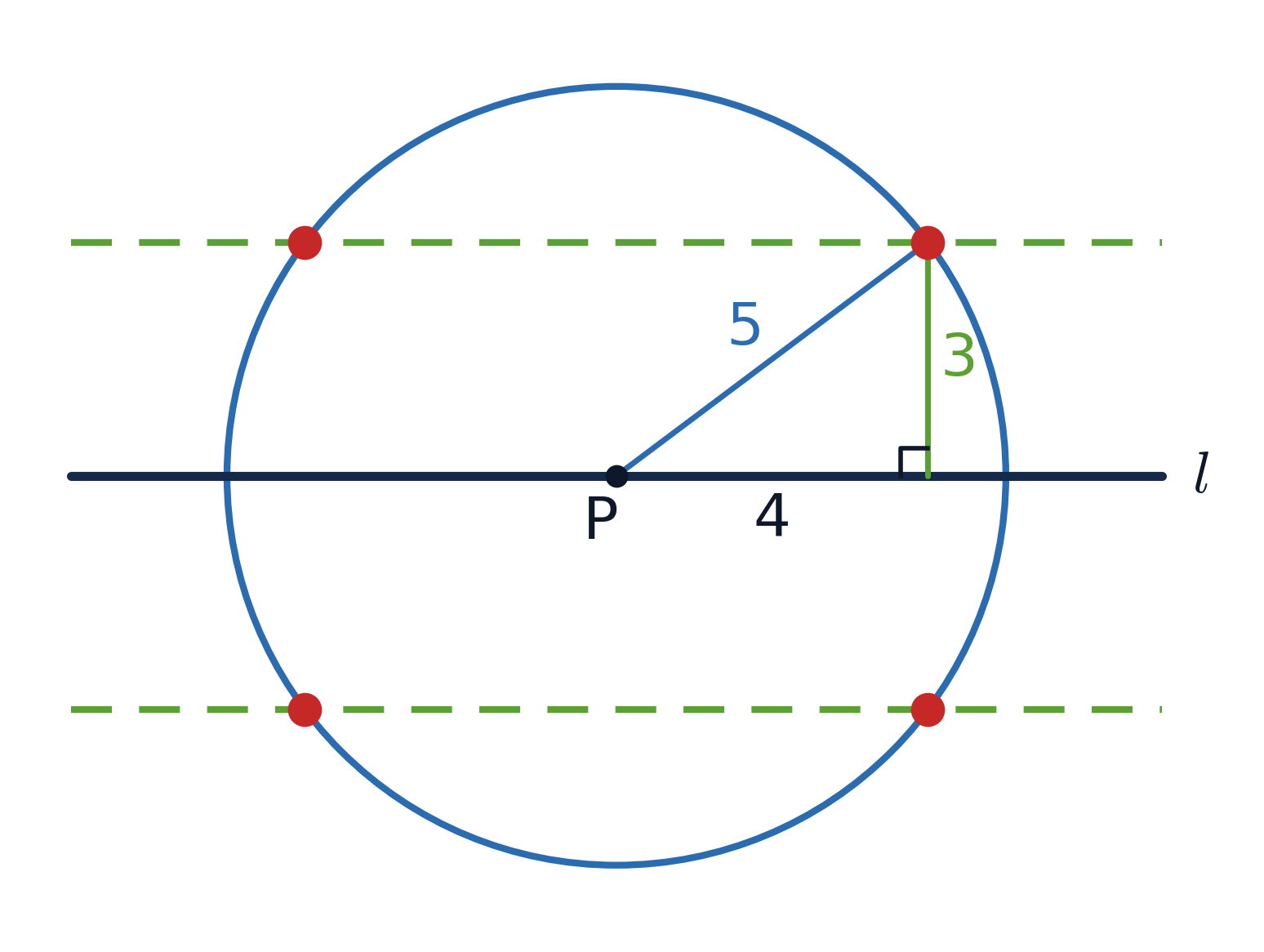
The first locus is a pair of parallel lines, 3 cm above and 3 cm below l. The second is a circle of radius 5 cm with centre P. The circle is wide enough to cut each parallel line twice. So there are 4 points.
If the second distance were 3 cm, the circle would only touch each parallel line: 2 points. If it were 2 cm, the circle would not reach the lines: no point.
Worked examples
Example 1. A circle has radius 5 cm. Find the locus of the midpoints of all its chords of length 8 cm.
Half of each chord is 4 cm. The midpoint of a chord is the foot of the perpendicular from the centre, so its distance from the centre is \sqrt{5^2 - 4^2} = 3 cm. Every such midpoint is 3 cm from the centre. The locus is the circle of radius 3 cm with the same centre.
Example 2. Three villages are at the corners of a triangle with sides 6 km, 8 km and 10 km. A well is to be dug at the same distance from all three. Where is it, and how far from each village?
The point equidistant from three corners is the circumcentre. Here 6^2 + 8^2 = 10^2, so the triangle is right-angled, and the circumcentre is the midpoint of the longest side. The well is 5 km from each village.
From the real papers
There is no real question to show. The six papers from CDS I 2024 to CDS II 2026 did not ask a question on loci. The questions below are our own.
Practice questions in the exam style
These four questions are our own. They are not from a real paper. Try each for 72 seconds before reading the solution.
Practice 1. A circle of radius 3 cm moves in a plane so that it always touches a fixed line l. What is the locus of its centre?
(a) A circle of radius 3 cm (b) A line perpendicular to l (c) One line parallel to l (d) Two lines parallel to l
Solution. The radius to the point of contact is perpendicular to l, so the centre is always 3 cm from l. The circle can be on either side of the line. Answer (d).
Practice 2. AB is a fixed line segment. A point P moves so that \angle APB = 90^\circ. What is the locus of P?
(a) The perpendicular bisector of AB (b) The circle with AB as diameter, leaving out A and B (c) The circle with centre A and radius AB (d) A line parallel to AB
Solution. A chord that makes a right angle at a point of the circle is a diameter. Answer (b).
Practice 3. Consider the following statements:
I. The locus of a point equidistant from two lines that cross is a single straight line.
II. The locus of the centre of a circle that passes through two fixed points is a straight line.
Which of the statements given above is/are correct?
(a) I only (b) II only (c) Both I and II (d) Neither I nor II
Solution. Statement I is not correct: the locus is two lines, the bisectors of both pairs of angles. Statement II is correct: it is the perpendicular bisector of the segment joining the two points. Answer (b).
Practice 4. P is a point on a line l. How many points in the plane are 4 cm from l and 5 cm from P?
(a) 1 (b) 2 (c) 3 (d) 4
Solution. The points 4 cm from l lie on two parallel lines. The points 5 cm from P lie on a circle of radius 5 cm. Since 5 is more than 4, the circle cuts each parallel line at two points. Answer (d).
Mistakes that cost marks
- Giving one line where there are two. Points at a fixed distance from a line lie on two parallel lines. Points equidistant from two crossing lines lie on two bisectors.
- Mixing up the two bisectors. Equidistant from two points: the perpendicular bisector of the segment joining them. Equidistant from two lines: the bisectors of the angles between them.
- Counting without drawing. For two conditions, draw both loci and count where they meet. The answer changes with the lengths: 4, 2 or 0 in the example of section 4.
Quick check
Do these without help. Answers are at the end.
- What is the locus of a point that is always 4 cm from a fixed point O?
- Two parallel lines are 6 cm apart. What is the locus of a point equidistant from them?
- A circle moves so that it always touches both arms of a fixed angle. What is the locus of its centre?
- P is a point on a line l. How many points are 2 cm from l and 2 cm from P?
- A circle has radius 13 cm. What is the locus of the midpoints of its chords of length 24 cm?
Read and watch more, free
The NCERT books for Classes 6 to 10 and NIOS Secondary Mathematics have no chapter on loci, and we found no CDS playlist with a lesson of that name. The lessons below teach the bisectors and circles that the loci are made of.
| What | Where | Language |
|---|---|---|
| Textbook, circles through given points | NCERT Class 9 Ganita Manjari, Chapter 5 "I'm Up and Down, and Round and Round" · Hindi edition | English, Hindi |
| Self-study notes, the bisectors of a triangle | NIOS Secondary Mathematics (211), Lesson 12 Concurrent Lines · Hindi edition | English, Hindi |
| Self-study notes, circles | NIOS Secondary Mathematics (211), Lesson 15 Circles · Hindi edition | English, Hindi |
| The real papers | UPSC previous question papers | English, Hindi |
| Video, numbered classes | Chandigarh Career Group: CDS advance maths by Sandeep Brar (the geometry and mensuration classes) | Hinglish |
| Video, a full CDS course | R.S SIR: Maths Playlist for CDS 2025 (the eight geometry lessons, about 55 minutes each) | Hindi and Hinglish |
The videos were chosen from their titles, length and views; they have not yet been watched by a teacher.
Answers to the quick check
- The circle with centre O and radius 4 cm.
- The line parallel to both, midway between them, 3 cm from each.
- The bisector of the angle.
- 2 points. The circle of radius 2 cm with centre P only touches each of the two parallel lines.
- Half the chord is 12 cm, and \sqrt{13^2 - 12^2} = 5. The locus is the circle of radius 5 cm with the same centre.
Next chapter: Area and perimeter of triangles; Heron's formula.