Why this chapter matters. This chapter gave 28 questions in the 6 papers from CDS I 2024 to CDS II 2026. That is between four and five a paper on average (from 3 to 8), the most of any geometry chapter. By our sorting, 11 of the 28 use Pythagoras' theorem, often twice in one figure: two poles, a point on a side, a chain of right triangles. Seven are about the perpendicular drawn from the right angle to the hypotenuse. Nine use similar triangles: a line parallel to a side, two crossing lines, a square inside a triangle, or the ratio of areas. One uses the equilateral triangle. Several come as "which of the statements is correct" or as "is the statement enough" questions. Almost every one is short once you see which right triangle or which pair of similar triangles to use.
What you will be able to do
- Use Pythagoras' theorem and its converse, and know the common whole-number right triangles on sight.
- Use the 45^\circ-45^\circ-90^\circ and 30^\circ-60^\circ-90^\circ triangles and the height of an equilateral triangle.
- Find similar triangles in a figure and use the ratio of their sides and of their areas.
- Find the perpendicular on the hypotenuse of a right triangle and the two parts it makes.
Before you start you should know: the angle facts of Chapter A5-1, the rules of congruence (Chapter A5-2), ratio and proportion (Chapter A2-5), and the identity a^2 - b^2 = (a - b)(a + b) (Chapter A3-1).
1. Pythagoras' theorem and its converse
In a right-angled triangle the side opposite the right angle is the hypotenuse. It is the longest side. The other two sides are often called the legs.
(\text{hypotenuse})^2 = (\text{one leg})^2 + (\text{other leg})^2
Read the question for where the right angle is. "Right-angled at B" means that AC is the hypotenuse.
The converse. If the square of the longest side equals the sum of the squares of the other two, the triangle is right-angled, and the right angle faces the longest side. The same test sorts every triangle. Let c be the longest side.
| Compare | The triangle is | Example |
|---|---|---|
| c^2 = a^2 + b^2 | right-angled | 6, 8, 10: 100 = 36 + 64 |
| c^2 < a^2 + b^2 | acute-angled | 5, 6, 7: 49 < 61 |
| c^2 > a^2 + b^2 | obtuse-angled | 4, 5, 8: 64 > 41 |
Whole-number right triangles. Learn these. The paper uses them again and again, so that the square root comes out exactly.
| Basic set | Sets made from it |
|---|---|
| 3, 4, 5 | 6, 8, 10 · 9, 12, 15 · 12, 16, 20 · 15, 20, 25 |
| 5, 12, 13 | 10, 24, 26 |
| 8, 15, 17 | |
| 7, 24, 25 | 0.7, 2.4, 2.5 |
| 20, 21, 29 | |
| 9, 40, 41 |
A quick tool. Pythagoras can be written as h^2 - b^2 = p^2, and the left side factorises: (h - b)(h + b) = p^2. Suppose one leg is 16 and the hypotenuse is 2 more than the other leg. Then 2(h + b) = 256, so h + b = 128. With h - b = 2 this gives h = 65 and b = 63.
2. Two special right triangles
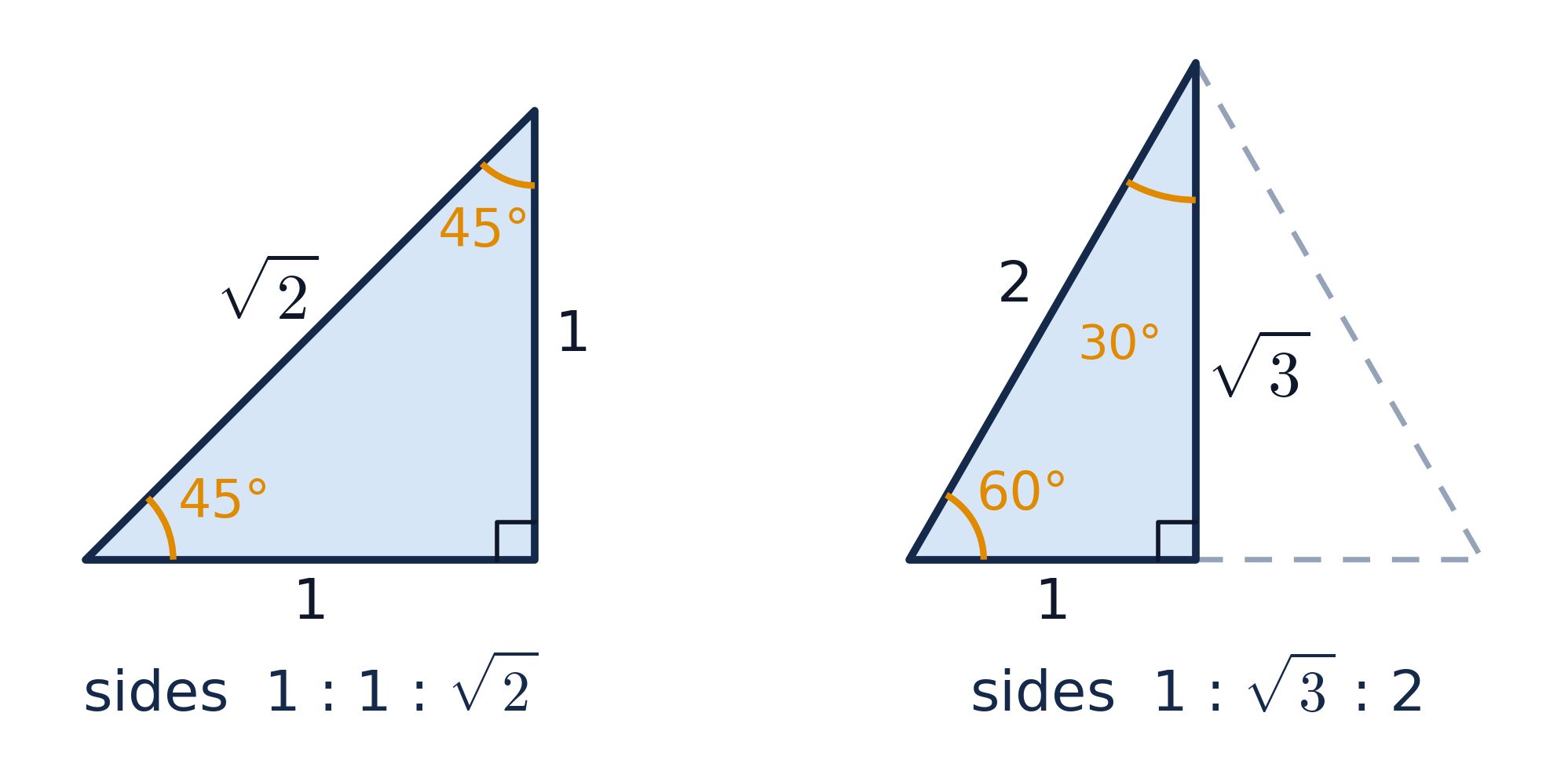
| Triangle | Sides (shortest first) | Where it comes from |
|---|---|---|
| 45^\circ-45^\circ-90^\circ | 1 : 1 : \sqrt{2} | half of a square, cut by a diagonal |
| 30^\circ-60^\circ-90^\circ | 1 : \sqrt{3} : 2 | half of an equilateral triangle, cut by its height |
Three facts follow.
- The diagonal of a square is \sqrt{2} times its side. A square of side 5 has diagonal 5\sqrt{2}.
- In a 30^\circ-60^\circ-90^\circ triangle, the side facing 30^\circ is half the hypotenuse.
- An equilateral triangle of side a has height \frac{\sqrt{3}}{2}a and area \frac{\sqrt{3}}{4}a^2. With side 6, the height is 3\sqrt{3}.
3. Using Pythagoras twice
Many questions have two right triangles that share a side. Write Pythagoras for each and subtract, so that the shared side goes out.
Two poles. Draw a level line from the top of the shorter pole to the taller pole. It makes a right triangle. Its upright side is the difference of the heights, and its level side is the distance between the poles. Towers of 23 m and 11 m that stand 9 m apart have tops \sqrt{12^2 + 9^2} = 15 m apart.
A point on a leg. Let the triangle be right-angled at C and let P be a point on BC. Then triangles ACB and ACP are both right-angled at C, with the common leg AC. Example 2 below shows the method.
An altitude of any triangle. Let AD be perpendicular to BC. Then AD^2 = AB^2 - BD^2 and also AD^2 = AC^2 - CD^2. So
AB^2 - AC^2 = BD^2 - CD^2
Both sides factorise as a difference of two squares. A real question below is built on this line.
4. Similar triangles
Two triangles are similar when they have the same shape. Their angles are equal, pair by pair, and their sides are in one fixed ratio. That ratio is the scale factor k. The sign is \sim. Congruent triangles are similar triangles with k = 1.
Tests. Any one of these is enough.
| Test | What to check |
|---|---|
| AA | two angles of one are equal to two angles of the other |
| SAS | two pairs of sides in the same ratio, and the angle between them equal |
| SSS | all three pairs of sides in the same ratio |
AA is the test used most. Two pictures give it at once.
Picture 1: a line parallel to one side.
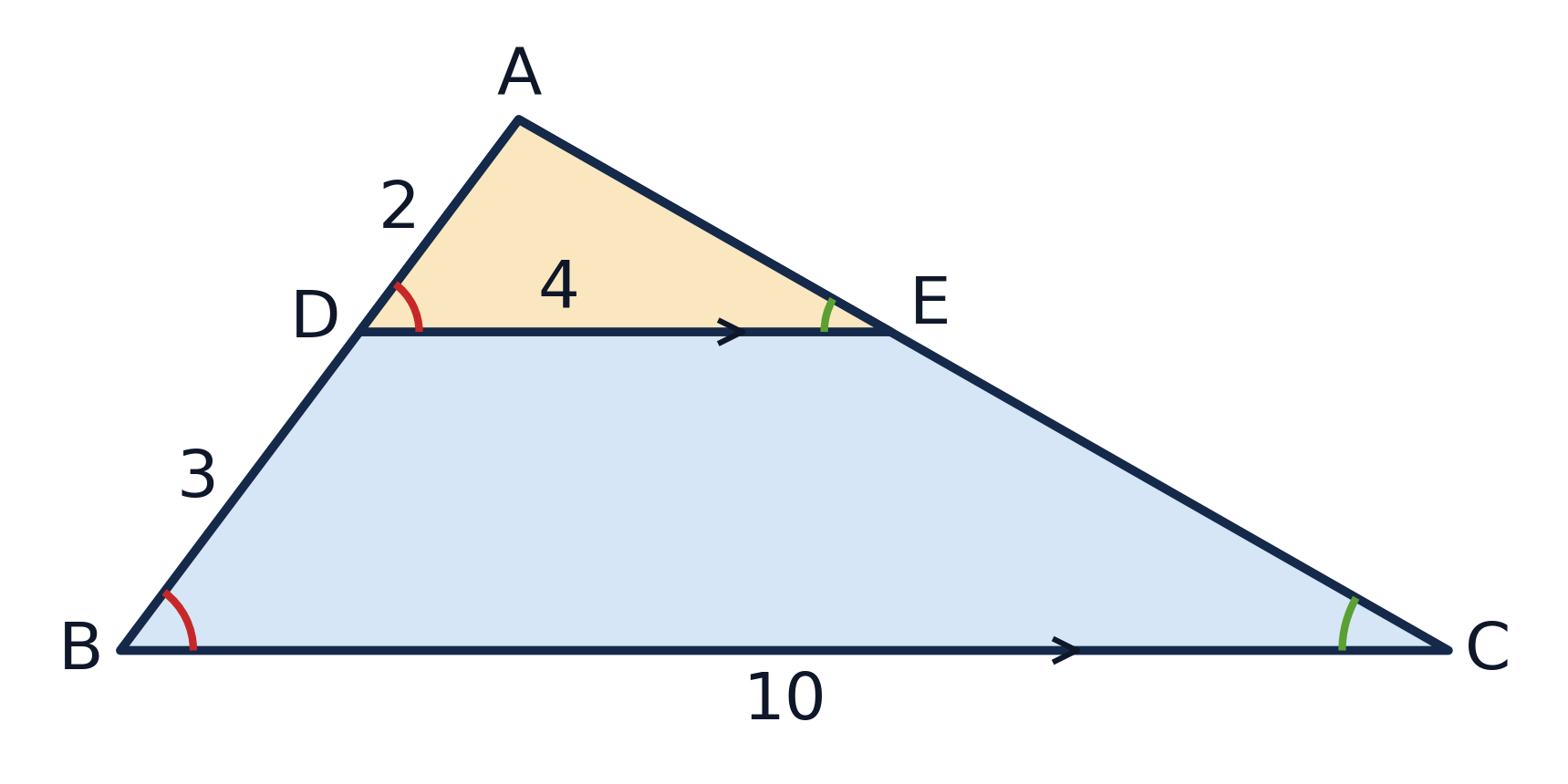
In the figure DE \parallel BC. The angles at D and B are corresponding angles, so they are equal, and so are the angles at E and C. So \triangle ADE \sim \triangle ABC, and
\frac{AD}{AB} = \frac{AE}{AC} = \frac{DE}{BC} = \frac{2}{5}
Take care: DE goes with the whole side. \frac{DE}{BC} = \frac{AD}{AB}, not \frac{AD}{DB}.
The same parallel line also cuts the two sides in the same ratio: \frac{AD}{DB} = \frac{AE}{EC}. Here each is \frac{2}{3}. This is called the basic proportionality theorem. When D and E are the midpoints, k = \frac{1}{2}: the line joining the midpoints of two sides is parallel to the third side and half of it.
Picture 2: two lines crossing between parallel lines. If AB \parallel CD and the lines AD and BC cross at M, then triangles ABM and DCM are similar. The angles at M are vertically opposite, and the angles at A and D are alternate angles.
Write the letters in matching order. In \triangle ADE \sim \triangle ABC, A matches A, D matches B and E matches C. Then the ratios can be read off without a mistake.
5. What grows by k and what grows by k^2
If two similar triangles have scale factor k:
| Quantity | Ratio |
|---|---|
| Sides, heights, medians, angle bisectors, perimeters | k |
| Areas | k^2 |
In the figure of section 4, k = \frac{2}{5}. So area ADE : area ABC = 4 : 25, and the part DBCE below the line is \frac{21}{25} of the whole triangle.
If two similar triangles have equal areas, then k^2 = 1, so k = 1 and the triangles are congruent.
6. The perpendicular on the hypotenuse
This one figure gave seven of the 28 questions.
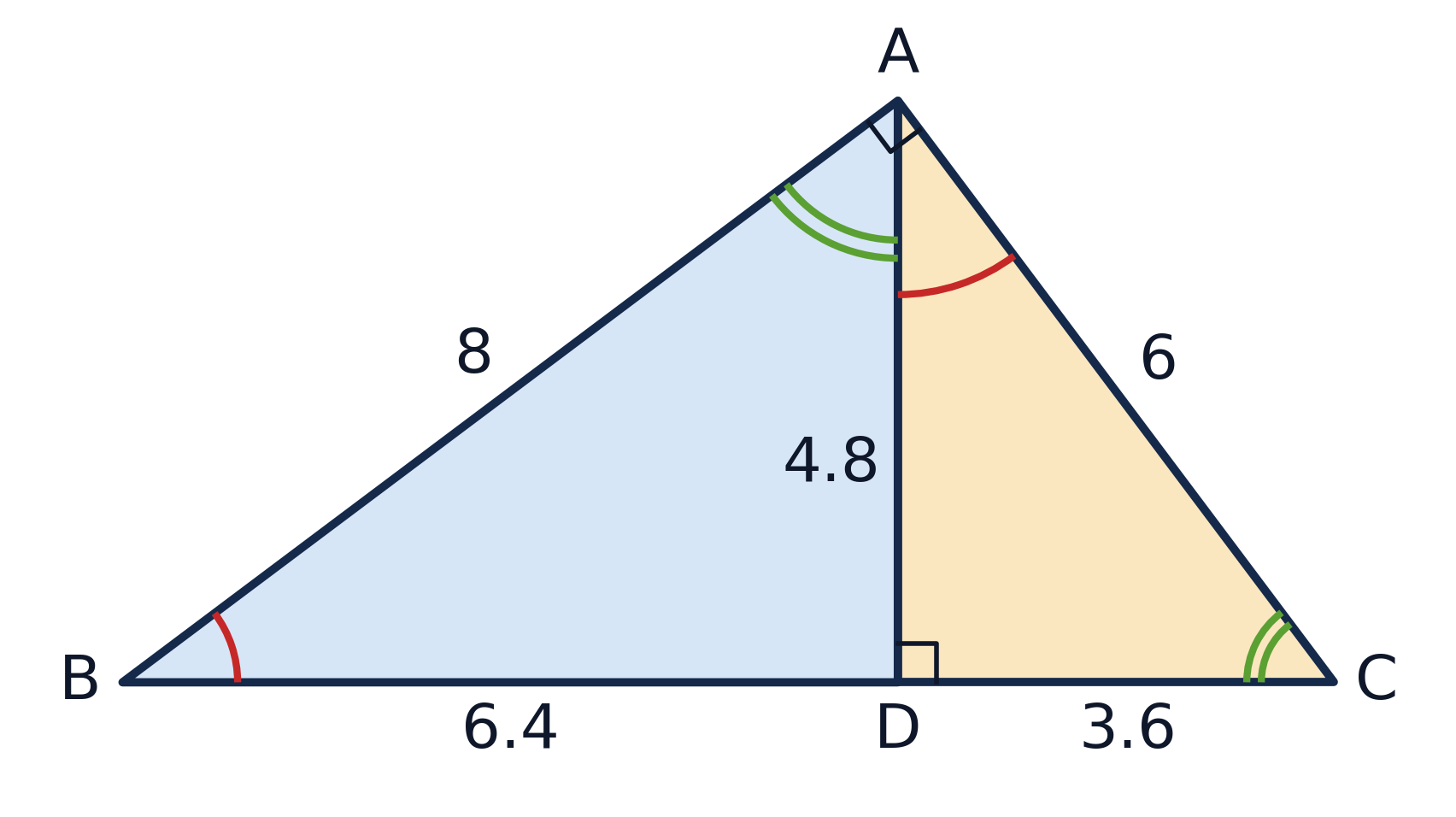
Let the triangle be right-angled at A, and let AD be perpendicular to the hypotenuse BC. The angle at B and the angle DAC are equal, because each is 90^\circ minus the angle C. So the two small triangles and the whole triangle all have the same angles:
\triangle DBA \sim \triangle DAC \sim \triangle ABC
Four results come from this. Each is checked on the figure.
| Result | Check with 6, 8, 10 |
|---|---|
| AD = \dfrac{AB \times AC}{BC} | \frac{8 \times 6}{10} = 4.8 |
| AD^2 = BD \times DC | 4.8^2 = 23.04 = 6.4 \times 3.6 |
| AB^2 = BD \times BC and AC^2 = DC \times BC | 64 = 6.4 \times 10 and 36 = 3.6 \times 10 |
| BD : DC = AB^2 : AC^2 | 6.4 : 3.6 = 64 : 36 |
The first result is the fastest to see from the area. The area is \frac{1}{2} \times AB \times AC, and it is also \frac{1}{2} \times BC \times AD. In words: perpendicular \times hypotenuse = product of the legs.
7. Two results worth remembering
Lines crossing between two poles. Poles of heights a and b stand on level ground. A line joins the top of each to the foot of the other. The lines cross at height
h = \frac{ab}{a + b}
The distance between the poles does not matter.
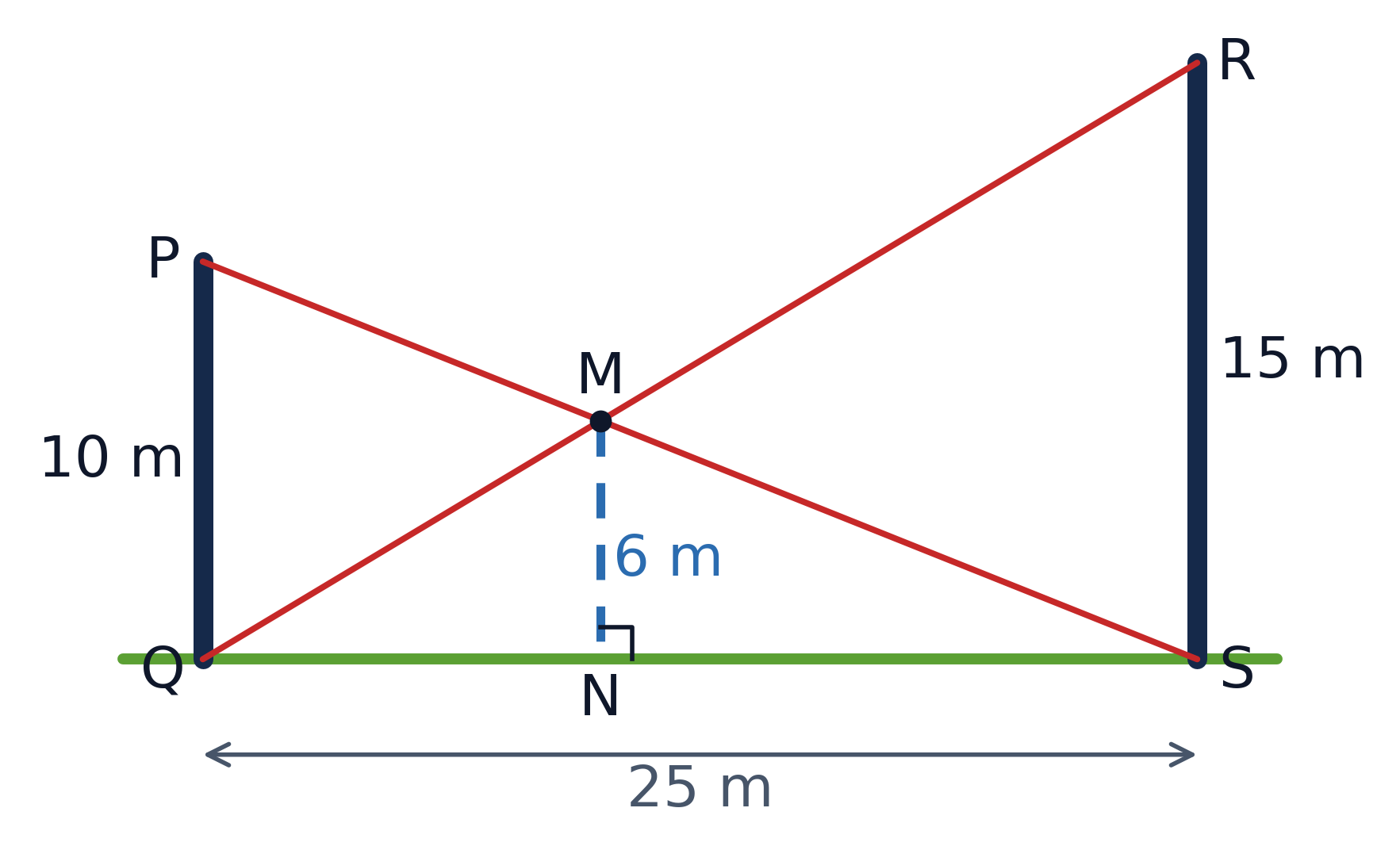
Why. In the figure MN is parallel to both poles. From triangle QSR: \frac{MN}{RS} = \frac{QN}{QS}. From triangle SQP: \frac{MN}{PQ} = \frac{NS}{QS}. Add the two: \frac{h}{b} + \frac{h}{a} = \frac{QN + NS}{QS} = 1. So h = \frac{ab}{a + b}. For 10 m and 15 m, h = \frac{150}{25} = 6 m.
The largest square in a right triangle. The largest square sits in the corner of the right angle, with its opposite corner on the hypotenuse. If the legs are a and b, its side is given by the same formula:
s = \frac{ab}{a + b}
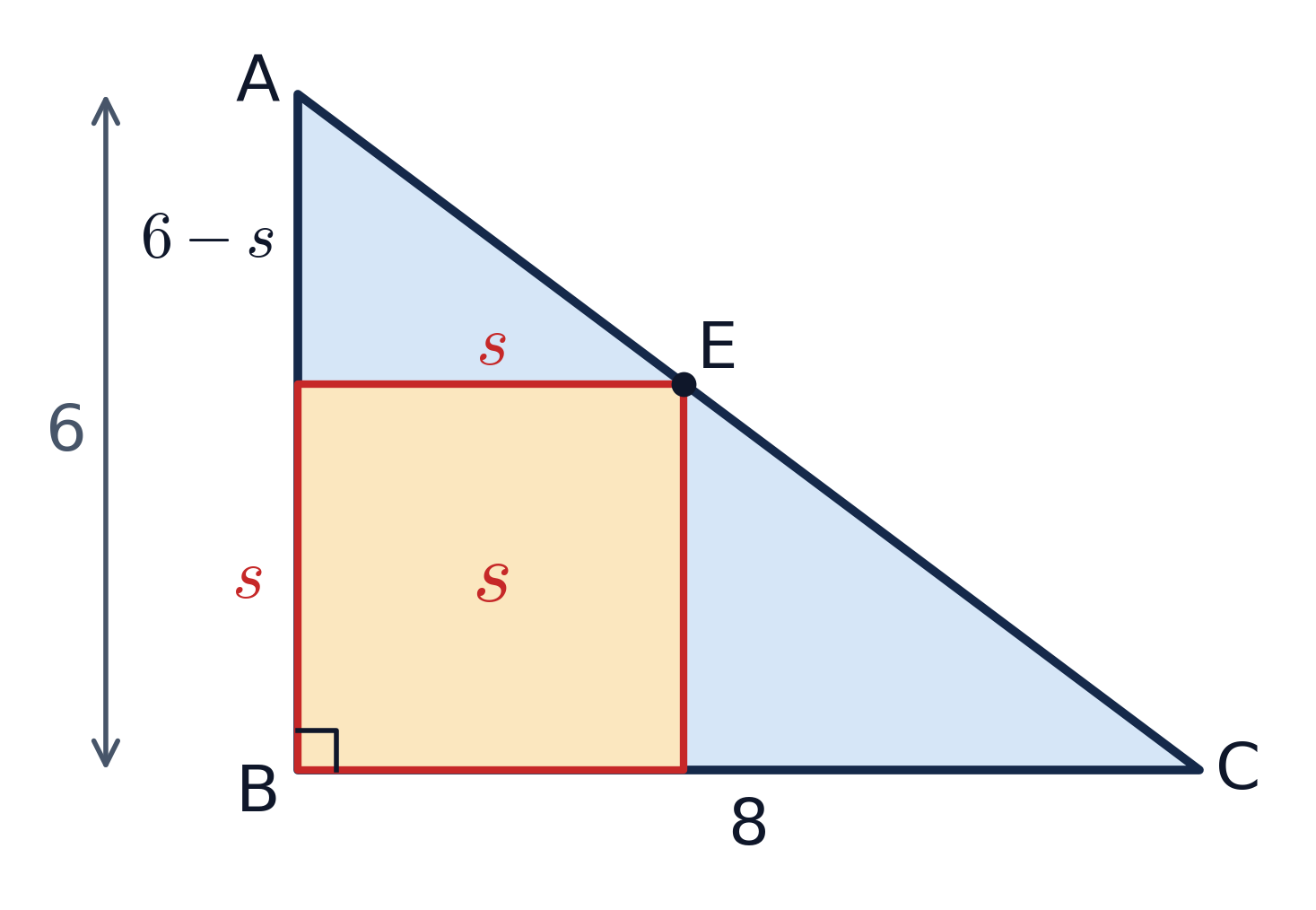
Why. The small triangle above the square is similar to the whole triangle (picture 1 of section 4). So \frac{6 - s}{s} = \frac{6}{8}, which gives 48 - 8s = 6s and s = \frac{24}{7}.
Worked examples
Example 1. One leg of a right triangle is 8 cm. The hypotenuse is 2 cm longer than the other leg. Find both.
(h - b)(h + b) = 8^2 = 64 and h - b = 2, so h + b = 32. Adding and subtracting: h = 17 and b = 15. This is the set 8, 15, 17.
Example 2. ABC is right-angled at C. P is the midpoint of BC. If AB = 13 cm and AP = \sqrt{61} cm, find the perimeter of triangle ABC.
In triangle ACB: AC^2 + BC^2 = 169. In triangle ACP, where PC = \frac{BC}{2}: AC^2 + \frac{BC^2}{4} = 61. Subtract: \frac{3}{4}BC^2 = 108, so BC^2 = 144 and BC = 12. Then AC^2 = 169 - 144 = 25 and AC = 5. The perimeter is 5 + 12 + 13 = 30 cm.
Example 3. In a triangle ABC, D is on AB and E is on AC with DE \parallel BC. AD = 3 cm, DB = 6 cm and BC = 12 cm. Find DE, and the ratio of the area of triangle ADE to the area of DBCE.
AB = 9, so k = \frac{AD}{AB} = \frac{1}{3}. Then DE = \frac{1}{3} \times 12 = 4 cm. The areas of ADE and ABC are as 1 : 9. So DBCE is 8 parts when ADE is 1 part. The ratio is 1 : 8.
Example 4. The legs of a right triangle are 5 cm and 12 cm. Find the perpendicular on the hypotenuse and the two parts into which it cuts the hypotenuse.
The hypotenuse is 13. Perpendicular = \frac{5 \times 12}{13} = \frac{60}{13} cm. The part next to the leg 5 is \frac{5^2}{13} = \frac{25}{13} cm, and the part next to the leg 12 is \frac{144}{13} cm. Check: \frac{25}{13} + \frac{144}{13} = 13.
Example 5. (a) The diagonal of a square is 10 cm. Find its side. (b) The height of an equilateral triangle is 6 cm. Find its side.
(a) Side = \frac{10}{\sqrt{2}} = 5\sqrt{2} cm. (b) \frac{\sqrt{3}}{2}a = 6, so a = \frac{12}{\sqrt{3}} = 4\sqrt{3} cm.
From the real papers
These six questions are from the Elementary Mathematics papers of CDS I 2024, CDS I 2025 and CDS II 2025 (Series A). The answers agree with the final official key. Try each for 72 seconds before reading the solution.
CDS II 2025, Q68. Two poles are situated 24 m apart and their heights differ by 10 m. What is the distance between their tips?
(a) 25 m (b) 26 m (c) 30 m (d) Cannot be determined due to insufficient data
Solution. The level side is 24 and the upright side is the difference of heights, 10. This is the set 10, 24, 26: \sqrt{24^2 + 10^2} = \sqrt{676} = 26 m. The heights themselves are not needed. Answer (b).
Consider the following for the next two (02) items that follow : ABC is a triangle right-angled at A. Further, AB = 8 cm, BC = 10 cm. D is the point on BC such that AD is perpendicular to BC.
CDS I 2025, Q65. What is AD equal to?
(a) 4.8 cm (b) 5.0 cm (c) 5.2 cm (d) 5.4 cm
Solution. This is the figure of section 6. The right angle is at A, so BC is the hypotenuse and AC = \sqrt{10^2 - 8^2} = 6 cm. Perpendicular \times hypotenuse = product of the legs: AD \times 10 = 8 \times 6, so AD = 4.8 cm. Answer (a).
CDS I 2025, Q66. What is ratio of area of triangle ADC to area of triangle ADB?
(a) 7 : 15 (b) 9 : 16 (c) 2 : 3 (d) 3 : 4
Solution. The two triangles have the same height AD, so their areas are as their bases DC : DB. By section 6, DC : DB = AC^2 : AB^2 = 36 : 64 = 9 : 16. Check: DC = 3.6 and DB = 6.4. Answer (b).
CDS II 2025, Q66. Two poles of heights 10 m and 15 m are 25 m apart. What is the height of the point of intersection of the lines joining the tip of each pole to the foot of the other pole?
(a) 4 \cdot 8 m (b) 5 m (c) 6 m (d) 6 \cdot 4 m
Solution. This is the first result of section 7: h = \frac{ab}{a + b} = \frac{10 \times 15}{10 + 15} = 6 m. The 25 m is not needed. (The paper prints the decimal point as a raised dot: option (a) is 4.8 m.) Answer (c).
CDS I 2024, Q13. ABC is a right-angled triangle, right-angled at B such that AB = 6 cm and BC = 8 cm. What is the perimeter of the square inscribed in the triangle ABC with maximum area?
(a) 24/7 cm (b) 96/7 cm (c) 24 cm (d) 32 cm
Solution. This is the second result of section 7. The side of the square is s = \frac{6 \times 8}{6 + 8} = \frac{24}{7} cm, so its perimeter is 4s = \frac{96}{7} cm. Option (a) is the side, not the perimeter. Answer (b).
CDS II 2025, Q61. Let AD be the altitude of a triangle ABC. If (AB + AC) = p, (AB - AC) = q and (BD - CD) = r, then what is BC equal to?
(a) qr/p (b) pr/q (c) pq/r (d) p+q-r
Solution. By section 3, AB^2 - AC^2 = BD^2 - CD^2. Factorise both sides: (AB + AC)(AB - AC) = (BD + CD)(BD - CD). With D on the side BC, BD + CD = BC. So pq = BC \times r and BC = \frac{pq}{r}. Check with the triangle of sides 15, 13 and 14, where BD = 9 and CD = 5: p = 28, q = 2, r = 4 and \frac{28 \times 2}{4} = 14. Answer (c).
Not one of the six needed a long calculation. Each needed the right triangle, chosen quickly.
Mistakes that cost marks
- Taking the wrong side as the hypotenuse. The hypotenuse faces the right angle. In "right-angled at A, AB = 8, BC = 10" the hypotenuse is BC, and the third side is 6, not \sqrt{164}.
- Matching the parallel line with a part of the side. With DE \parallel BC, \frac{DE}{BC} = \frac{AD}{AB}. The ratio \frac{AD}{DB} is equal to \frac{AE}{EC}, not to \frac{DE}{BC}.
- Giving the ratio of areas as k. Lengths go as k, areas as k^2. If the sides are as 2 : 5, the areas are as 4 : 25.
- Adding the heights of two poles. The distance between the tops uses the difference of the heights. And where the crossing lines meet does not depend on the distance between the poles.
Quick check
Do these without help. Answers are at the end.
- A triangle has sides 10 cm, 24 cm and 26 cm. What is its area?
- The legs of a right triangle are 9 cm and 12 cm. Find the perpendicular on the hypotenuse.
- In a triangle ABC, DE \parallel BC with D on AB and E on AC. AD = 4 cm, AB = 10 cm and the area of triangle ABC is 50 square cm. Find the area of triangle ADE.
- Two poles of heights 12 m and 4 m stand on level ground. Lines join the top of each to the foot of the other. At what height do the lines cross?
- Two poles of heights 9 m and 17 m stand 15 m apart. Find the distance between their tops.
Read and watch more, free
NCERT Class 10 teaches similar triangles well, and the new Class 8 book has a chapter on the theorem of Pythagoras. The perpendicular on the hypotenuse and the two results of section 7 get little space in those books; for them, this lesson and the past papers are the material.
| What | Where | Language |
|---|---|---|
| Textbook, similar triangles | NCERT Class 10 Mathematics, Chapter 6 Triangles · Hindi edition | English, Hindi |
| Textbook, Pythagoras | NCERT Class 8 Ganita Prakash Part II, Chapter 2 The Baudhayana-Pythagoras Theorem · Hindi edition | English, Hindi |
| Self-study notes | NIOS Secondary Mathematics (211), Lesson 14 Similarity of Triangles · Hindi edition | English, Hindi |
| Practice with answers | NCERT Exemplar Class 10, Unit 6 Triangles · Hindi edition | English, Hindi |
| Short videos with practice | Khan Academy, NCERT Math Class 10 (the triangles unit) · in Hindi | English, Hindi |
| The real papers | UPSC previous question papers | English, Hindi |
| Video, numbered classes | Chandigarh Career Group: CDS advance maths by Sandeep Brar (the geometry and mensuration classes) | Hinglish |
| Video, a full CDS course | R.S SIR: Maths Playlist for CDS 2025 (the eight geometry lessons, about 55 minutes each) | Hindi and Hinglish |
| Video, past questions | The Journey Extraordinary: Maths For CDS 2 2026 (the geometry lesson with past questions, about 3 hours 20 minutes) | Hinglish |
The videos were chosen from their titles, length and views; they have not yet been watched by a teacher.
Answers to the quick check
- 10^2 + 24^2 = 676 = 26^2, so it is right-angled with legs 10 and 24. Area = \frac{1}{2} \times 10 \times 24 = 120 square cm.
- The hypotenuse is 15. Perpendicular = \frac{9 \times 12}{15} = 7.2 cm.
- k = \frac{4}{10} = \frac{2}{5}, so the areas are as 4 : 25. Area of ADE = \frac{4}{25} \times 50 = 8 square cm.
- h = \frac{12 \times 4}{12 + 4} = 3 m.
- The difference of heights is 8 m. \sqrt{8^2 + 15^2} = 17 m.
Next chapter: Medians, altitudes, bisectors and the four centres of a triangle.