Why this chapter matters. This chapter gave 22 questions in the 6 papers from CDS I 2024 to CDS II 2026. That is three or four in every paper. About six give the perimeter of a right-angled triangle and one more fact, and ask for the area. About five need Heron's formula, which gives the area from the three sides. Three give two sides and the angle between them. The rest ask about parts of a triangle: the triangle cut off by an altitude or a median, the triangle made by joining mid-points, or sides found from the ratio of the altitudes. Every one of them is a use of "half base times height".
What you will be able to do
- Find the area of a triangle from a base and its height, from three sides (Heron's formula), or from two sides and the angle between them.
- Use the short results for the right-angled, equilateral and isosceles triangle.
- Find the area of a right-angled triangle from its perimeter and hypotenuse without finding the sides.
- Compare the areas of triangles that share a height or a base, and find sides from the ratio of the altitudes.
Before you start you should know: Pythagoras' theorem and the common right-angled triangles such as 3, 4, 5 (Chapter A5-3), what a median and an altitude are (Chapter A5-4), the values of \sin 30^\circ, \sin 45^\circ and \sin 60^\circ (Chapter A4-2), and the identity (p + q)^2 = p^2 + q^2 + 2pq (Chapter A3-1).
1. Perimeter, and area from base and height
The perimeter of a triangle is the sum of its three sides. The area is
\text{Area} = \frac{1}{2} \times \text{base} \times \text{height}
The height (or altitude) is the perpendicular distance from the opposite corner to the base, or to the base produced. In a triangle with an obtuse angle the height can fall outside the triangle. The formula does not change.
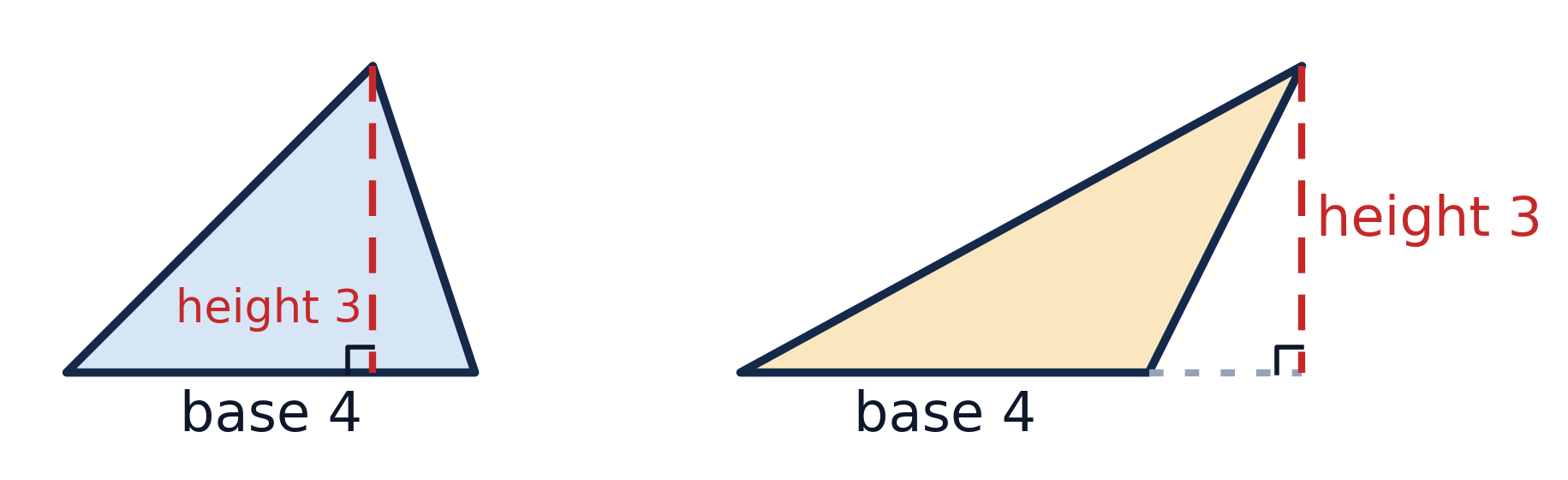
A triangle with base 8 cm and height 5 cm has area \frac{1}{2} \times 8 \times 5 = 20 square cm.
Any side can be the base. Each side has its own height, and all three products give the same area. So, if the sides are a, b, c and the heights on them are h_a, h_b, h_c:
a\,h_a = b\,h_b = c\,h_c = 2 \times \text{Area}
Two uses follow.
- Find a height. Height on a side = \dfrac{2 \times \text{Area}}{\text{that side}}.
- A longer side has a shorter height. The sides are in the ratio \dfrac{1}{h_a} : \dfrac{1}{h_b} : \dfrac{1}{h_c}. For example, a triangle of area 60 with sides 10, 15 and 20 has heights 12, 8 and 6.
2. The right-angled triangle
The two sides that make the right angle are a base and a height. So
\text{Area} = \frac{1}{2} \times \text{product of the two perpendicular sides}
For the triangle 6, 8, 10 the area is \frac{1}{2} \times 6 \times 8 = 24.
The height on the hypotenuse. Take the hypotenuse as base. The area is the same, so
\text{height on the hypotenuse} = \frac{\text{product of the two perpendicular sides}}{\text{hypotenuse}}
For 6, 8, 10 this is \frac{48}{10} = 4.8.
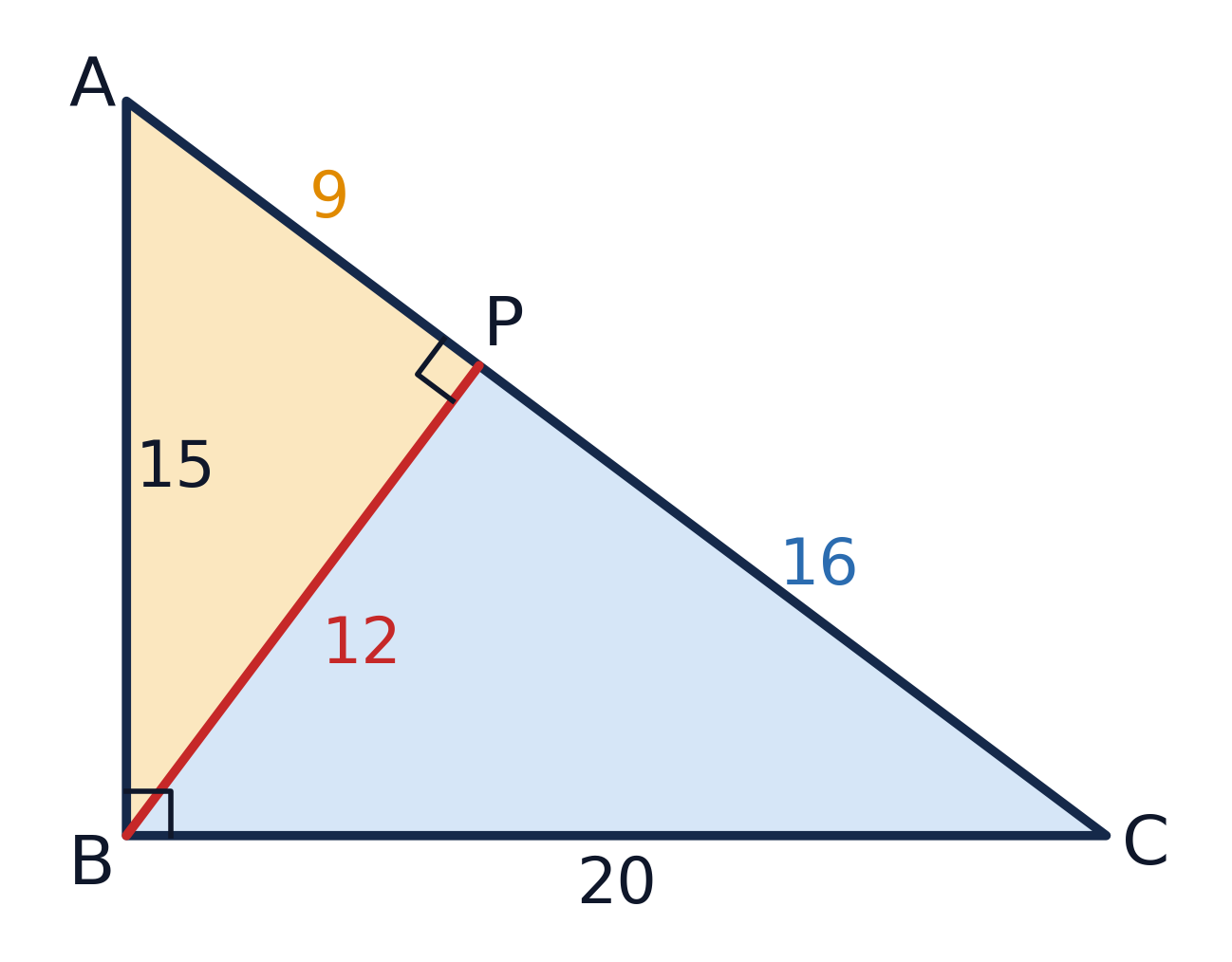
In the figure the sides are 15, 20, 25. The height on the hypotenuse is \frac{15 \times 20}{25} = 12. Pythagoras in the small triangle PAB gives AP = \sqrt{15^2 - 12^2} = 9, so PC = 25 - 9 = 16.
Look for a right angle first. If the squares of two sides add up to the square of the third, the triangle is right-angled. Then the area takes one line. Keep these sets in memory: 3, 4, 5; 5, 12, 13; 8, 15, 17; 7, 24, 25; 20, 21, 29; 9, 40, 41; 11, 60, 61; and their multiples, such as 6, 8, 10 and 15, 20, 25.
Perimeter and hypotenuse known. Let the perpendicular sides be p and q and the hypotenuse h. Then p^2 + q^2 = h^2 and (p + q)^2 = p^2 + q^2 + 2pq. So 2pq = (p + q)^2 - h^2, and
\text{Area} = \frac{pq}{2} = \frac{(p + q)^2 - h^2}{4}
Check with 6, 8, 10: \frac{14^2 - 10^2}{4} = \frac{96}{4} = 24. You do not need p and q separately.
3. Equilateral and isosceles triangles
In an equilateral triangle of side a, the height cuts the base into two halves. By Pythagoras the height is \sqrt{a^2 - \frac{a^2}{4}} = \frac{\sqrt{3}}{2}a. So
\text{height} = \frac{\sqrt{3}}{2}\,a, \qquad \text{Area} = \frac{\sqrt{3}}{4}\,a^2
For side 6: height 3\sqrt{3} and area 9\sqrt{3}.
In an isosceles triangle the height on the unequal side also cuts that side into two halves. For sides 5, 5 and 6: half the base is 3, the height is \sqrt{5^2 - 3^2} = 4, and the area is \frac{1}{2} \times 6 \times 4 = 12.
4. Three sides known: Heron's formula
Let the sides be a, b, c. Half the perimeter is called the semi-perimeter, s = \dfrac{a + b + c}{2}. Then
\text{Area} = \sqrt{s(s - a)(s - b)(s - c)}
For sides 13, 14, 15: s = 21, and s - a, s - b, s - c are 8, 7, 6. The area is \sqrt{21 \times 8 \times 7 \times 6} = \sqrt{7056} = 84.
Do not multiply out. Break the numbers into factors and pair them: 21 \times 8 \times 7 \times 6 = (3 \times 7) \times (2 \times 4) \times 7 \times (2 \times 3) = 7^2 \times 3^2 \times 2^2 \times 4. The square root is 7 \times 3 \times 2 \times 2 = 84.
A check: (s - a) + (s - b) + (s - c) = s. Here 8 + 7 + 6 = 21.
5. Two sides and the angle between them
Let two sides be b and c and let the angle between them be A.
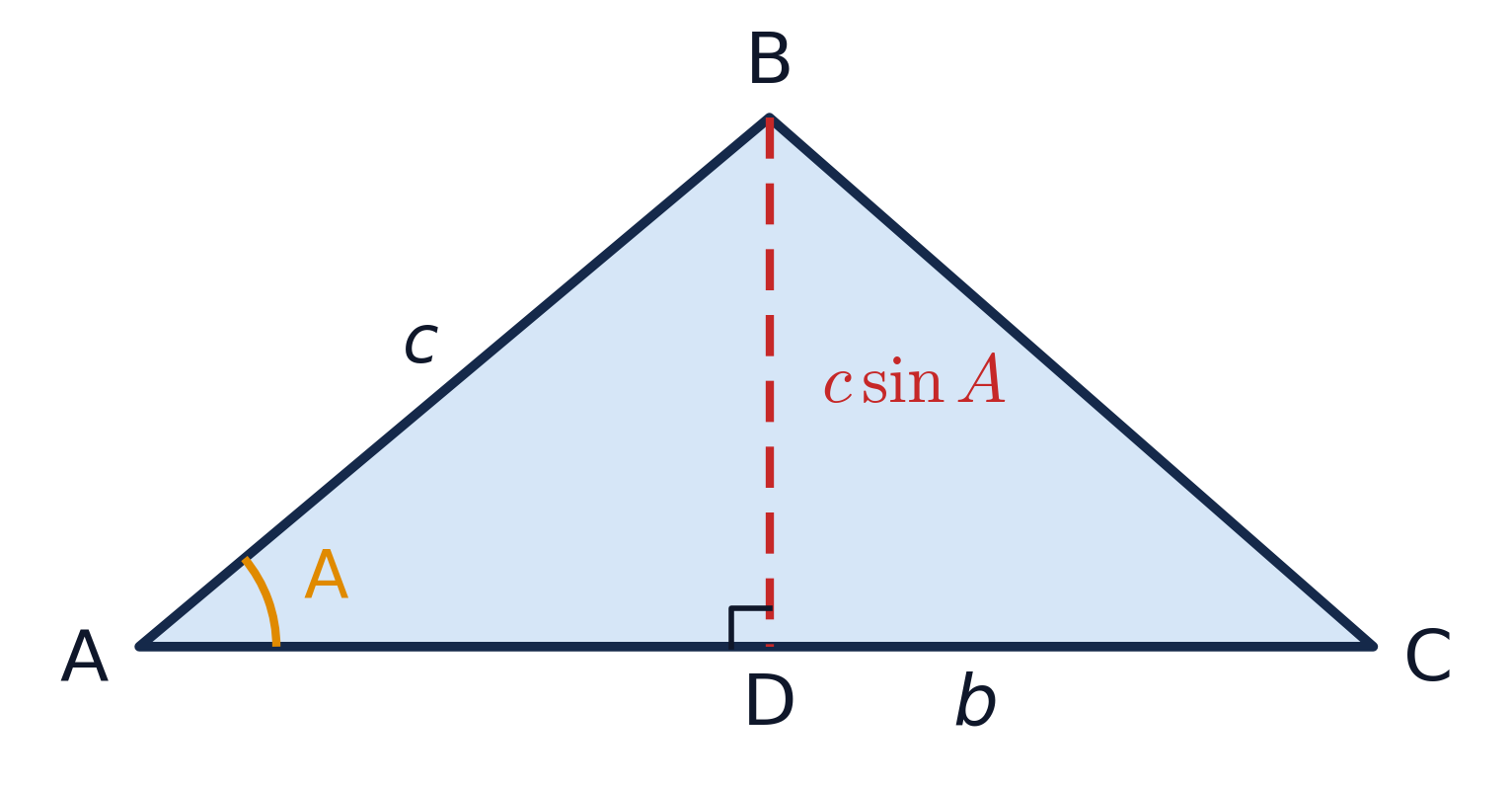
In the right-angled triangle ABD, \sin A = \dfrac{BD}{c}, so the height is BD = c \sin A. Therefore
\text{Area} = \frac{1}{2}\,b\,c\,\sin A
In words: half the product of two sides, times the sine of the angle between them. For sides 8 and 6 with 30^\circ between them, the area is \frac{1}{2} \times 8 \times 6 \times \frac{1}{2} = 12. When the angle is 90^\circ, \sin 90^\circ = 1 and the formula becomes the right-angle rule of section 2.
The formula also works backwards. If the area and the two sides are given, it gives \sin A.
6. Comparing areas without finding them
| Fact | Why |
|---|---|
| Triangles with the same height have areas in the ratio of their bases | the factor \frac{1}{2} \times height is common |
| Triangles on the same base have areas in the ratio of their heights | the factor \frac{1}{2} \times base is common |
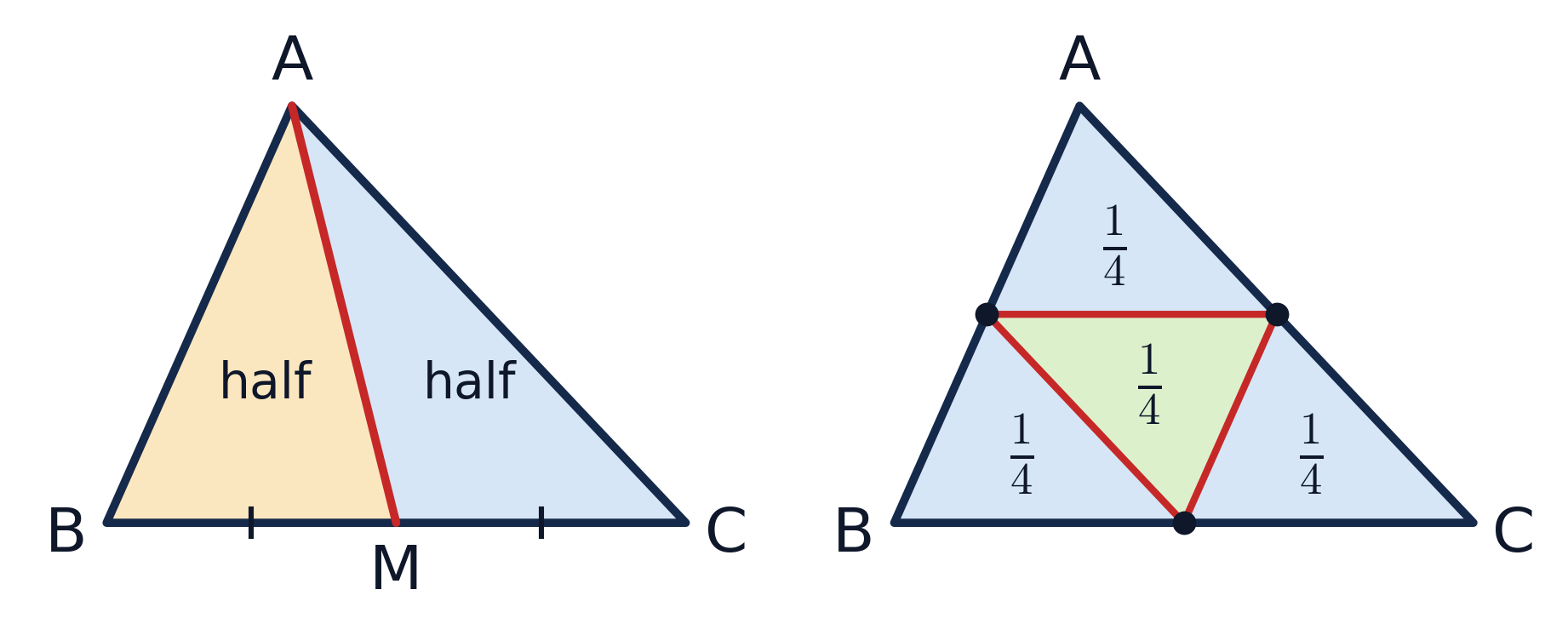
| A median cuts a triangle into two triangles of equal area | equal bases, same height |
| Joining the mid-points of the three sides makes four triangles, each with one-fourth of the area | each has sides half as long as the big triangle |
| Similar triangles have areas in the ratio of the squares of matching sides | base and height both grow by the same factor |
Example for the last line: the triangles 6, 8, 10 and 9, 12, 15 have sides in the ratio 2 : 3. Their areas are 24 and 54, in the ratio 4 : 9.
The formulas in one table
| Known | Area |
|---|---|
| base and its height | \frac{1}{2} \times \text{base} \times \text{height} |
| right-angled triangle, perpendicular sides p and q | \frac{1}{2}pq |
| right-angled triangle, p + q and hypotenuse h | \frac{(p + q)^2 - h^2}{4} |
| equilateral triangle, side a | \frac{\sqrt{3}}{4}a^2 (height \frac{\sqrt{3}}{2}a) |
| three sides a, b, c | \sqrt{s(s - a)(s - b)(s - c)} with s = \frac{a + b + c}{2} |
| two sides b, c and the angle A between them | \frac{1}{2}bc \sin A |
Worked examples
Example 1. The sides of a triangle are 13 cm, 14 cm and 15 cm. Find its area and the height on the side of 14 cm.
By section 4, s = 21 and the area is \sqrt{21 \times 8 \times 7 \times 6} = 84 square cm. The height on the side of 14 cm is \frac{2 \times 84}{14} = 12 cm.
Example 2. The perimeter of an equilateral triangle is 36 cm. Find its area and its height.
The side is 36 \div 3 = 12 cm. Area = \frac{\sqrt{3}}{4} \times 12^2 = 36\sqrt{3} square cm. Height = \frac{\sqrt{3}}{2} \times 12 = 6\sqrt{3} cm.
Example 3. The perimeter of a right-angled triangle is 40 cm and its hypotenuse is 17 cm. Find the area.
The two perpendicular sides add up to 40 - 17 = 23. By section 2, the area is \frac{23^2 - 17^2}{4} = \frac{529 - 289}{4} = \frac{240}{4} = 60 square cm. (The sides are 8, 15, 17, and \frac{1}{2} \times 8 \times 15 = 60.)
Example 4. Two sides of a triangle are 10 cm and 16 cm. (i) The angle between them is 60^\circ. Find the area. (ii) If the area were 40 square cm, what would the sine of that angle be?
(i) Area = \frac{1}{2} \times 10 \times 16 \times \sin 60^\circ = 80 \times \frac{\sqrt{3}}{2} = 40\sqrt{3} square cm.
(ii) 40 = \frac{1}{2} \times 10 \times 16 \times \sin A = 80 \sin A, so \sin A = \frac{1}{2}.
Example 5. The altitudes of a triangle are in the ratio 2 : 3 : 4 and its perimeter is 26 cm. Find the sides and the area.
The sides are in the ratio \frac{1}{2} : \frac{1}{3} : \frac{1}{4}. Multiply by 12: the ratio is 6 : 4 : 3. The 13 parts make 26 cm, so one part is 2 cm and the sides are 12, 8 and 6 cm. For the area use Heron's formula: s = 13, and the area is \sqrt{13 \times 1 \times 5 \times 7} = \sqrt{455}, which is about 21.3 square cm.
From the real papers
These six questions are from the Elementary Mathematics papers of CDS I 2024, CDS I 2025 and CDS II 2025 (Series A). The answers agree with the final official key. Try each for 72 seconds before reading the solution.
CDS I 2024, Q41. In a right-angled triangle ABC, AB = 15 cm, BC = 20 cm and AC = 25 cm. Further, BP is the perpendicular on AC. What is the difference in the area of triangles PAB and PCB?
(a) 40 square cm (b) 42 square cm (c) 45 square cm (d) 48 square cm
Solution. This is the triangle in the second figure. AC is the longest side, so the right angle is at B. The height on the hypotenuse is BP = \frac{15 \times 20}{25} = 12. Then AP = \sqrt{15^2 - 12^2} = 9 and PC = 25 - 9 = 16. The two triangles have the same height, 12. Their areas are \frac{1}{2} \times 9 \times 12 = 54 and \frac{1}{2} \times 16 \times 12 = 96. The difference is 42 square cm. Answer (b).
CDS I 2025, Q16. In a triangle ABC, AB + BC = 7.1 cm, BC + CA = 12.1 cm and CA + AB = 7.2 cm. What is the area of the triangle?
(a) 3 square cm (b) 32 square cm (c) 33 square cm (d) 3.3 square cm
Solution. Add the three lines. Each side is counted twice, so twice the perimeter is 7.1 + 12.1 + 7.2 = 26.4 and the perimeter is 13.2 cm. Subtract each line from 13.2: CA = 6.1, AB = 1.1, BC = 6. Look for a right angle: 1.1^2 + 6^2 = 1.21 + 36 = 37.21 = 6.1^2. (It is the set 11, 60, 61 divided by 10.) So the area is \frac{1}{2} \times 1.1 \times 6 = 3.3 square cm. Answer (d).
CDS I 2025, Q57. Consider the following for the next two (02) items that follow : The perimeter of a triangle ABC is 105 cm. The altitudes AD, BE and CF are in the ratio 3 : 5 : 6.
What is AB : BC : CA equal to?
(a) 10 : 6 : 5 (b) 5 : 10 : 6 (c) 6 : 5 : 3 (d) 3 : 5 : 6
Solution. A side and the altitude on it have a fixed product, so the sides are in the ratio of 1 over the altitudes. AD falls on BC, BE on CA and CF on AB. So BC : CA : AB = \frac{1}{3} : \frac{1}{5} : \frac{1}{6}. Multiply by 30: BC : CA : AB = 10 : 6 : 5. In the order asked, AB : BC : CA = 5 : 10 : 6. Answer (b). The trap is option (a), which has the right numbers in the wrong order. (The next question, Q58, asked for the area. The sides are 25, 50 and 30 cm, and Heron's formula gives about 285 square cm.)
CDS II 2025, Q67. ABC is a triangle right angled at B. Further, (AB + BC) exceeds AC by 10 units. If the perimeter of the triangle is 60 units, then what is the area of the triangle?
(a) 75 square units (b) 100 square units (c) 125 square units (d) 150 square units
Solution. Let AB + BC = k and the hypotenuse AC = h. Then k - h = 10 and k + h = 60, so k = 35 and h = 25. By section 2, the area is \frac{35^2 - 25^2}{4} = \frac{1225 - 625}{4} = 150 square units. (The sides are 15, 20, 25.) Answer (d). CDS I 2025 Q53 was the same question with other numbers.
CDS II 2025, Q71. In a triangle ABC, \angle A = 30^\circ, AB = 7 cm and AC = 12 cm. What is the area of the triangle ABC?
(a) 21 cm^2 (b) 21\sqrt{3} cm^2 (c) 42 cm^2 (d) 42\sqrt{3} cm^2
Solution. AB and AC meet at A, so 30^\circ is the angle between the two given sides. Area = \frac{1}{2} \times 7 \times 12 \times \sin 30^\circ = 42 \times \frac{1}{2} = 21 cm^2. Answer (a).
CDS II 2025, Q89. A Question is given followed by two Statements I and II. Consider the Question and the Statements.
Question: ABC is an isosceles triangle with AB = AC = 10 units. If the area of the triangle is 48 square units, then what is the length of the base BC?
Statement-I: The length of BC is an even integer.
Statement-II: The height of the triangle is greater than the length of half of the base.
Which one of the following is correct in respect of the above Question and the Statements?
(a) The Question can be answered by using one of the Statements alone, but cannot be answered using the other Statement alone (b) The Question can be answered by using either Statement alone (c) The Question can be answered by using both the Statements together, but cannot be answered using either Statement alone (d) The Question can be answered even without using any of the Statements
Solution. Let half the base be x and the height from A be y. Pythagoras gives x^2 + y^2 = 100. The area gives \frac{1}{2} \times 2x \times y = 48, so xy = 48. Then (x + y)^2 = 100 + 96 = 196 and (x - y)^2 = 100 - 96 = 4. So x and y are 6 and 8 in some order. The base is 12 (height 8) or 16 (height 6): two triangles fit, so the Question cannot be answered without a Statement. Statement I: 12 and 16 are both even, so it does not decide. Statement II: the height is more than half the base, so y = 8, x = 6 and the base is 12. Statement II alone is enough and Statement I alone is not. Answer (a).
In four of the six, a right-angled triangle did the work. Train the eye to see one.
Mistakes that cost marks
- Using a side that is not the height. The height must be perpendicular to the base. In the triangle 5, 5, 6 the area is \frac{1}{2} \times 6 \times 4 = 12, not \frac{1}{2} \times 6 \times 5.
- Using the perimeter in place of s in Heron's formula. s is half the perimeter. For 13, 14, 15 it is 21, not 42.
- Taking an angle that is not between the two sides. In \frac{1}{2}bc \sin A, the angle A is where sides b and c meet. If the angle given is somewhere else, find the height another way.
- Sides in the same ratio as the altitudes. The longest side has the shortest altitude. Altitudes 3 : 5 : 6 give sides \frac{1}{3} : \frac{1}{5} : \frac{1}{6}, that is 10 : 6 : 5. Then match each side to its letter.
Quick check
Do these without help. Answers are at the end.
- Find the area of a triangle with sides 9 cm, 10 cm and 17 cm.
- The area of an equilateral triangle is 25\sqrt{3} square cm. Find its side and its height.
- The perpendicular sides of a right-angled triangle are 7 cm and 24 cm. Find the height on the hypotenuse.
- Two sides of a triangle are 8 cm and 5 cm and the angle between them is 45^\circ. Find the area.
- The sides of a triangle are 20 cm, 21 cm and 29 cm. Find the area of the triangle made by joining the mid-points of its sides.
Read and watch more, free
The new NCERT Class 9 book teaches the area of a triangle and Heron's formula in one chapter. The NIOS lesson covers all the plane figures of this unit. No school book teaches the perimeter-and-hypotenuse method of section 2; for that, use this lesson and the past papers.
| What | Where | Language |
|---|---|---|
| Textbook, triangle area and Heron's formula | NCERT Class 9 Ganita Manjari, Chapter 6 Measuring Space: Perimeter and Area · Hindi edition | English, Hindi |
| Textbook, the first ideas | NCERT Class 6 Ganita Prakash, Chapter 6 Perimeter and Area · Hindi edition | English, Hindi |
| Self-study notes | NIOS Secondary Mathematics (211), Lesson 20 Perimeters and Area of Plane Figures · Hindi edition | English, Hindi |
| Practice with answers | NCERT Exemplar Class 9, Unit 12 Heron's Formula · Hindi edition | English, Hindi |
| Short videos with practice | Khan Academy, NCERT Math Class 9 (the Heron's formula unit) | English |
| The real papers | UPSC previous question papers | English, Hindi |
| Video, numbered classes | Chandigarh Career Group: CDS advance maths by Sandeep Brar (the geometry and mensuration classes) | Hinglish |
| Video, a full CDS course | R.S SIR: Maths Playlist for CDS 2025 (the eight mensuration lessons, about 55 minutes each) | Hindi and Hinglish |
| Video, one long lesson with past questions | The Journey Extraordinary: Maths For CDS 2 2026 (the 2-D mensuration lesson, about 4 hours) | Hinglish |
The videos were chosen from their titles, length and views; they have not yet been watched by a teacher.
Answers to the quick check
- s = 18, and 18 \times 9 \times 8 \times 1 = 1296 = 36^2. Area 36 square cm.
- \frac{\sqrt{3}}{4}a^2 = 25\sqrt{3} gives a^2 = 100, so the side is 10 cm. The height is \frac{\sqrt{3}}{2} \times 10 = 5\sqrt{3} cm.
- The hypotenuse is 25 cm. Height = \frac{7 \times 24}{25} = 6.72 cm.
- \frac{1}{2} \times 8 \times 5 \times \sin 45^\circ = 20 \times \frac{1}{\sqrt{2}} = 10\sqrt{2} square cm.
- 20^2 + 21^2 = 841 = 29^2, so the triangle is right-angled and its area is \frac{1}{2} \times 20 \times 21 = 210. The mid-point triangle has one-fourth of this: 52.5 square cm.
Next chapter: Area of rectangles, parallelograms, rhombus, trapezium; split-up figures and the field book.