Why this chapter matters. This chapter gave 20 questions in the 6 papers from CDS I 2024 to CDS II 2026. Eleven of them came in one paper, CDS I 2024, which had many shaded-figure questions. The other five papers gave one to three each. (One of the 20 was later dropped by UPSC.) About six ask for the arc, area or perimeter of a sector. About six need a segment, which is a sector with a triangle taken away. The rest are shaded regions made of circles and semicircles, a ring between two circles, a wheel, or a circle fitted to a square or a triangle. Each one is found by adding and taking away a few standard pieces.
What you will be able to do
- Find the circumference and area of a circle, a semicircle, a quadrant and a ring.
- Find the arc length, area and perimeter of a sector, with the angle in degrees or in radians.
- Find the area of a segment as "sector minus triangle".
- Find a shaded area by adding and taking away circles, sectors, triangles and squares.
Before you start you should know: the parts of a circle and the fact that a perpendicular from the centre cuts a chord in half (Chapter A5-7), degrees and radians (Chapter A4-1), and the area of a triangle, including \frac{1}{2}ab \sin C (Chapter A6-1).
1. Circumference and area
For a circle of radius r and diameter d = 2r:
\text{Circumference} = 2\pi r = \pi d, \qquad \text{Area} = \pi r^2
The number \pi is a little more than 3.14. Use the value the question gives: \frac{22}{7} or 3.14. If it gives none, look at the options. If they contain \pi, leave \pi in your answer.
When \pi = \frac{22}{7}, the question nearly always uses a radius that is a multiple of 7. These values are worth knowing.
| Radius | 3.5 | 7 | 10.5 | 14 | 21 | 28 |
|---|---|---|---|---|---|---|
| Circumference | 22 | 44 | 66 | 88 | 132 | 176 |
| Area | 38.5 | 154 | 346.5 | 616 | 1386 | 2464 |
Changing the size. The circumference grows as the radius; the area grows as the square of the radius. If the radius is doubled, the circumference is doubled and the area becomes 4 times. Two circles with radii in the ratio 2 : 3 have areas in the ratio 4 : 9.
Wheels. In one full turn a wheel moves forward by its circumference. So the number of turns is the distance divided by the circumference.
2. Semicircle and quadrant
| Figure | Area | Perimeter |
|---|---|---|
| Semicircle (half a circle) | \frac{1}{2}\pi r^2 | \pi r + 2r |
| Quadrant (quarter of a circle) | \frac{1}{4}\pi r^2 | \frac{1}{2}\pi r + 2r |
The perimeter has a curved part and a straight part. The straight part is the diameter of the semicircle, or the two radii of the quadrant. For r = 7 and \pi = \frac{22}{7}: the semicircle has area 77 and perimeter 22 + 14 = 36. The quadrant has area 38.5 and perimeter 11 + 14 = 25.
3. The ring between two circles
Two circles with the same centre are called concentric. If their radii are R and r, the ring between them has
\text{Area} = \pi R^2 - \pi r^2 = \pi (R^2 - r^2) = \pi (R + r)(R - r)
For R = 10 and r = 4: \frac{22}{7} \times 14 \times 6 = 264.
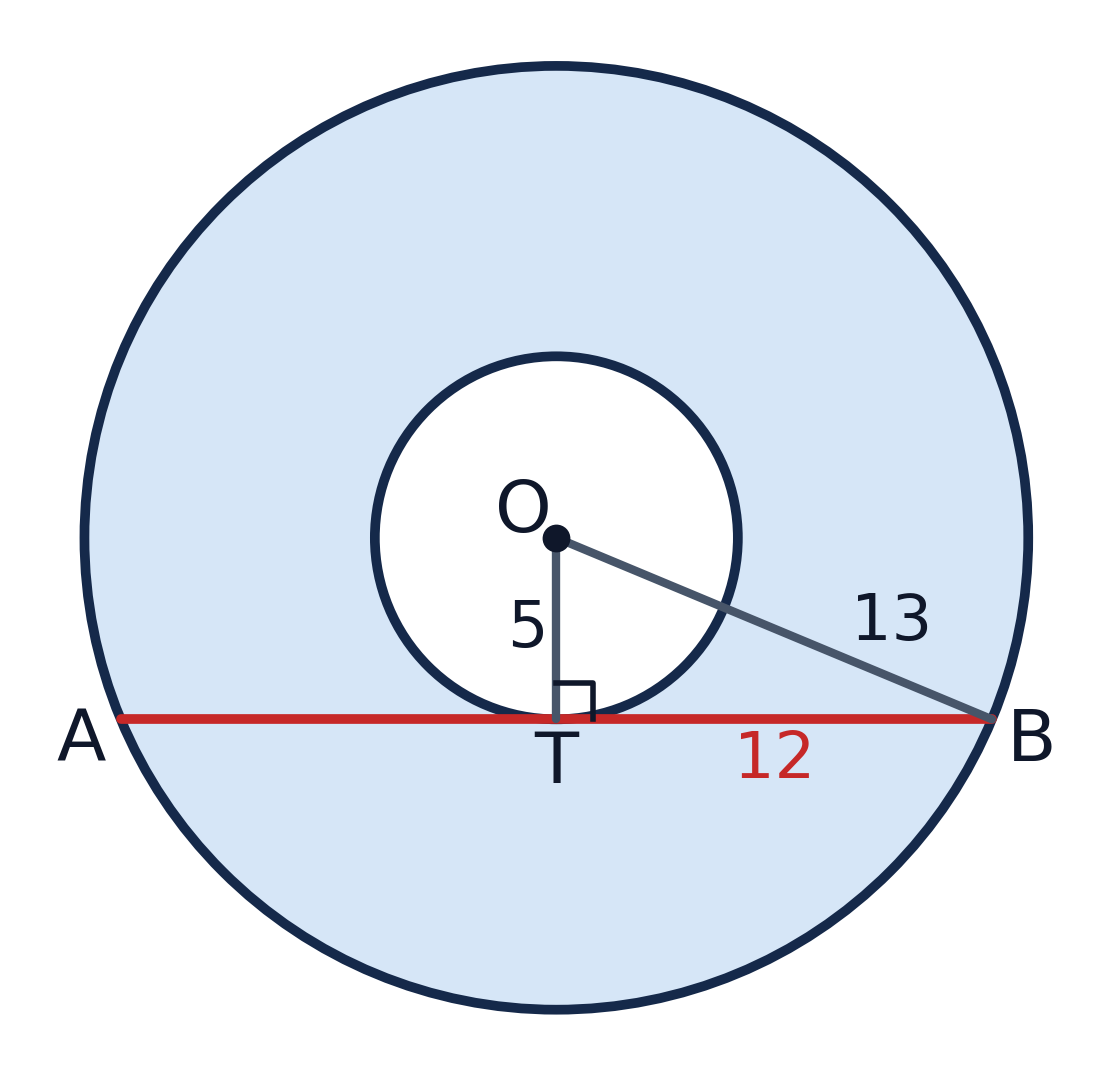
A chord of the outer circle that touches the inner circle. In the figure, OT is perpendicular to the chord and cuts it in half. Pythagoras in triangle OTB gives
R^2 - r^2 = (\text{half the chord})^2
So the area of the ring is \pi \times (\text{half the chord})^2. You do not need R or r. In the figure, half the chord is 12 and the ring has area 144\pi.
4. Sector
A sector is the part of a circle between two radii, like a slice of a round cake. If the angle at the centre is \theta degrees, the sector is the fraction \frac{\theta}{360} of the whole circle. This fraction applies to the arc and to the area.
\text{Arc} = \frac{\theta}{360} \times 2\pi r, \qquad \text{Area of sector} = \frac{\theta}{360} \times \pi r^2
\text{Perimeter of sector} = \text{arc} + 2r
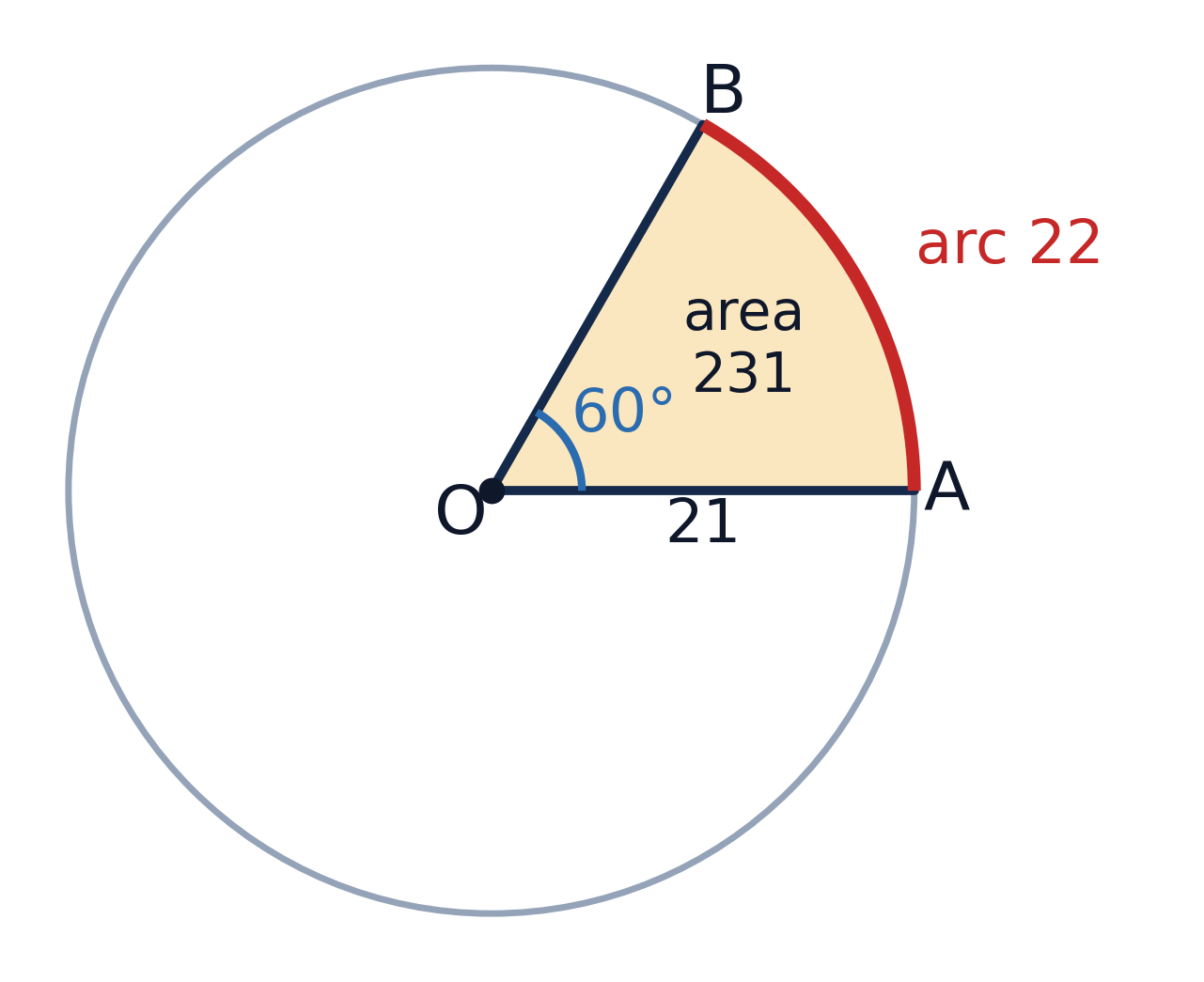
In the figure, 60^\circ is one-sixth of 360^\circ. With \pi = \frac{22}{7}, the arc is \frac{1}{6} \times 132 = 22, the area is \frac{1}{6} \times 1386 = 231, and the perimeter is 22 + 42 = 64.
Find the fraction first: 30^\circ is \frac{1}{12}, 45^\circ is \frac{1}{8}, 60^\circ is \frac{1}{6}, 72^\circ is \frac{1}{5}, 90^\circ is \frac{1}{4}, 120^\circ is \frac{1}{3}.
Two more forms of the same result:
- Area from the arc: area of sector = \frac{1}{2} \times \text{arc} \times r. Check: \frac{1}{2} \times 22 \times 21 = 231.
- Angle in radians: if the angle is \theta radians, then arc = r\theta and area = \frac{1}{2} r^2 \theta. For r = 10 and \theta = 1.5 radians, the arc is 15 and the area is 75.
The hands of a clock, a swinging pendulum, a slice of a pie chart and a horse tied to a peg all make sectors.
5. Segment
A chord cuts a circle into two segments. The smaller one is the minor segment and the larger one is the major segment.
\text{Minor segment} = \text{sector} - \text{triangle}, \qquad \text{Major segment} = \text{circle} - \text{minor segment}
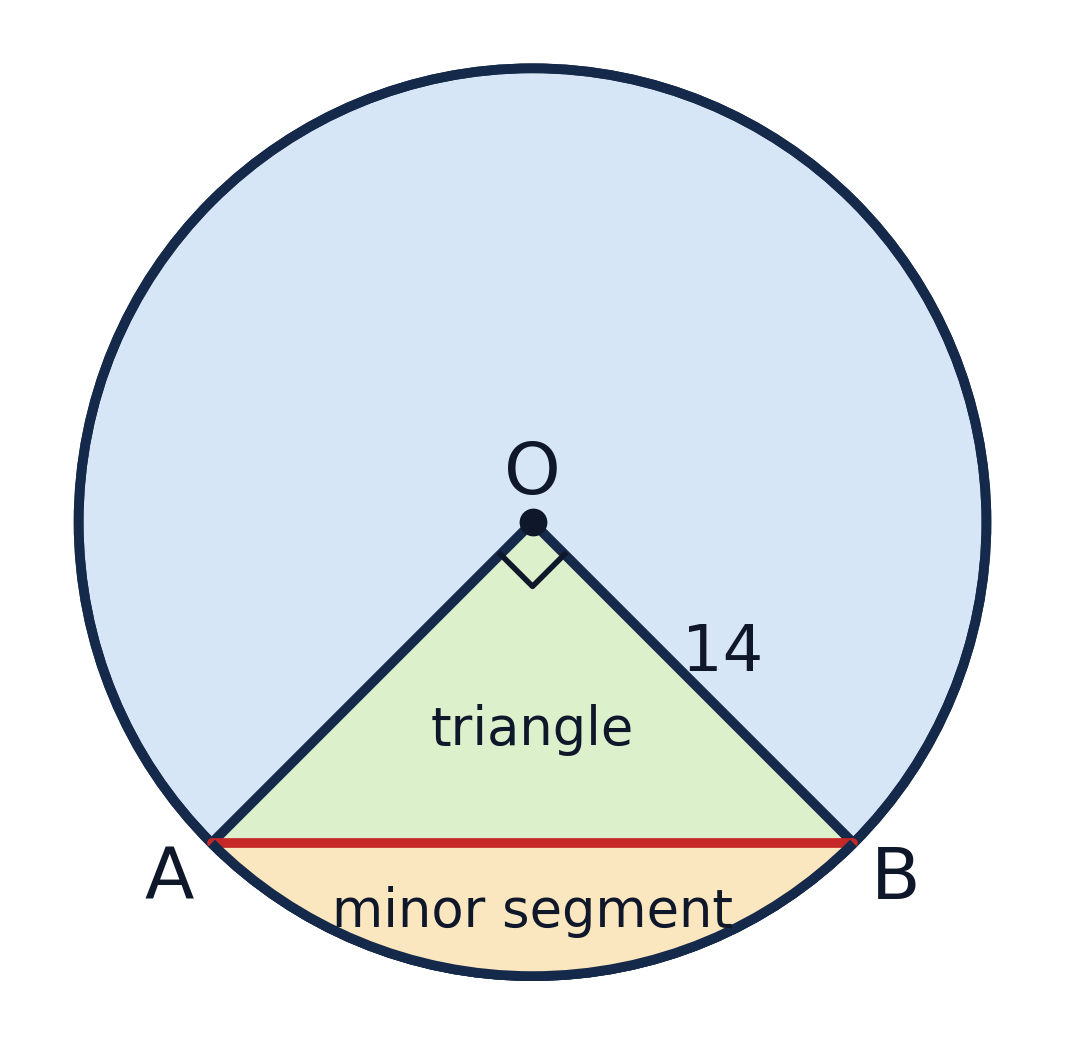
The triangle has two sides equal to r with the angle \theta between them. Its area is \frac{1}{2} r^2 \sin\theta. Three angles come up again and again.
| Angle at the centre | Triangle | Minor segment |
|---|---|---|
| 60^\circ | equilateral, \frac{\sqrt{3}}{4} r^2 | r^2 \left( \frac{\pi}{6} - \frac{\sqrt{3}}{4} \right) |
| 90^\circ | right-angled, \frac{1}{2} r^2 | r^2 \left( \frac{\pi}{4} - \frac{1}{2} \right) |
| 120^\circ | \frac{\sqrt{3}}{4} r^2 | r^2 \left( \frac{\pi}{3} - \frac{\sqrt{3}}{4} \right) |
In the figure, r = 14 and the angle is 90^\circ. Sector = \frac{1}{4} \times 616 = 154. Triangle = \frac{1}{2} \times 14 \times 14 = 98. Minor segment = 154 - 98 = 56. Major segment = 616 - 56 = 560.
(For 120^\circ: draw the perpendicular from O to the chord. It makes two right-angled triangles with angles 30, 60 and 90 degrees. The height is \frac{r}{2} and the chord is \sqrt{3}\,r, so the triangle is \frac{1}{2} \times \sqrt{3}\,r \times \frac{r}{2}.)
6. Circles with squares, and wires
- Circle inside a square (touching all four sides): diameter of the circle = side of the square. In a square of side 14, the circle has radius 7 and area 154. The area left over is 196 - 154 = 42.
- Square inside a circle (corners on the circle): diagonal of the square = diameter of the circle. In a circle of radius r the square has area \frac{(2r)^2}{2} = 2r^2.
- A wire bent from one shape to another keeps its length. Put the two perimeters equal. The areas will differ.
- A shaded region. Write it as (whole pieces added) minus (whole pieces taken away) before you calculate. Often \pi stays as a common factor until the last line.
Worked examples
Example 1. The diameter of a wheel is 70 cm. How many full turns does it make in travelling 1.1 km? (Take \pi = \frac{22}{7}.)
Circumference = \frac{22}{7} \times 70 = 220 cm. The distance is 1.1 km = 110000 cm. Number of turns = 110000 \div 220 = 500.
Example 2. A sector of a circle of radius 21 cm has an angle of 60^\circ. Find its arc, area and perimeter. (Take \pi = \frac{22}{7}.)
This is the sector in the second figure. The fraction is \frac{1}{6}. Arc = \frac{1}{6} \times 132 = 22 cm. Area = \frac{1}{6} \times 1386 = 231 square cm. Perimeter = 22 + 21 + 21 = 64 cm.
Example 3. A chord of a circle of radius 6 cm subtends 60^\circ at the centre. Find the area of the minor segment.
Sector = \frac{1}{6} \times \pi \times 36 = 6\pi. The triangle is equilateral with side 6: area \frac{\sqrt{3}}{4} \times 36 = 9\sqrt{3}. Segment = 6\pi - 9\sqrt{3} square cm, which is about 3.26.
Example 4. The circumferences of two concentric circles are 88 cm and 132 cm. Find the area of the ring between them. (Take \pi = \frac{22}{7}.)
From the table, the radii are 14 cm and 21 cm. Area = \frac{22}{7} \times (21 + 14)(21 - 14) = \frac{22}{7} \times 35 \times 7 = 770 square cm.
Example 5. A wire in the shape of a circle of radius 28 cm is bent into a square. Which shape has the greater area, and by how much? (Take \pi = \frac{22}{7}.)
Length of wire = 2 \times \frac{22}{7} \times 28 = 176 cm. Side of the square = 176 \div 4 = 44 cm, so its area is 1936 square cm. The circle has area \frac{22}{7} \times 28^2 = 2464 square cm. The circle is greater by 2464 - 1936 = 528 square cm. (For a given perimeter, the circle holds more area than any other shape.)
From the real papers
These six questions are from the Elementary Mathematics papers (Series A). The first five agree with the final official key. The last agrees with the provisional key of CDS II 2026. Try each for 72 seconds before reading the solution.
CDS I 2024, Q40. What is the area of the region between two concentric circles, if the length of a chord of the outer circle touching the inner circle at a particular point of its circumference is 14 cm? (Take \pi = \frac{22}{7})
(a) 154 square cm (b) 144 square cm (c) 132 square cm (d) Cannot be determined due to insufficient data
Solution. By section 3, the area of the ring is \pi \times (\text{half the chord})^2 = \frac{22}{7} \times 7^2 = 154 square cm. The two radii are not known and are not needed. Answer (a). Option (d) is the trap.
CDS I 2024, Q72. Consider the following for the next two (02) items that follow : In a pie-diagram (with radius 7 cm), the central angles of the sectors are in the ratio 2 : 3 : 7 : 5 : 1. (Take \pi = \frac{22}{7})
If p is the perimeter of the smallest sector, then what is the value of 9p?
(a) 142 cm (b) 148 cm (c) 156 cm (d) 221 cm
Solution. The parts add up to 2 + 3 + 7 + 5 + 1 = 18. The smallest sector is \frac{1}{18} of the circle. Its arc is \frac{1}{18} \times 44 = \frac{22}{9} cm. Its perimeter is p = \frac{22}{9} + 7 + 7. So 9p = 22 + 126 = 148 cm. Answer (b). (The question before it, Q71, asked for the areas of the smallest and largest sectors together: \frac{1 + 7}{18} \times 154 = \frac{616}{9} square cm.)
CDS I 2024, Q99. Consider the following for the next two (02) items that follow : Let ABCD be the diameter of a circle of radius 6 cm. The lengths AB, BC and CD are equal. Semi-circles are drawn with AB and BD as diameters as shown in the figure given below.
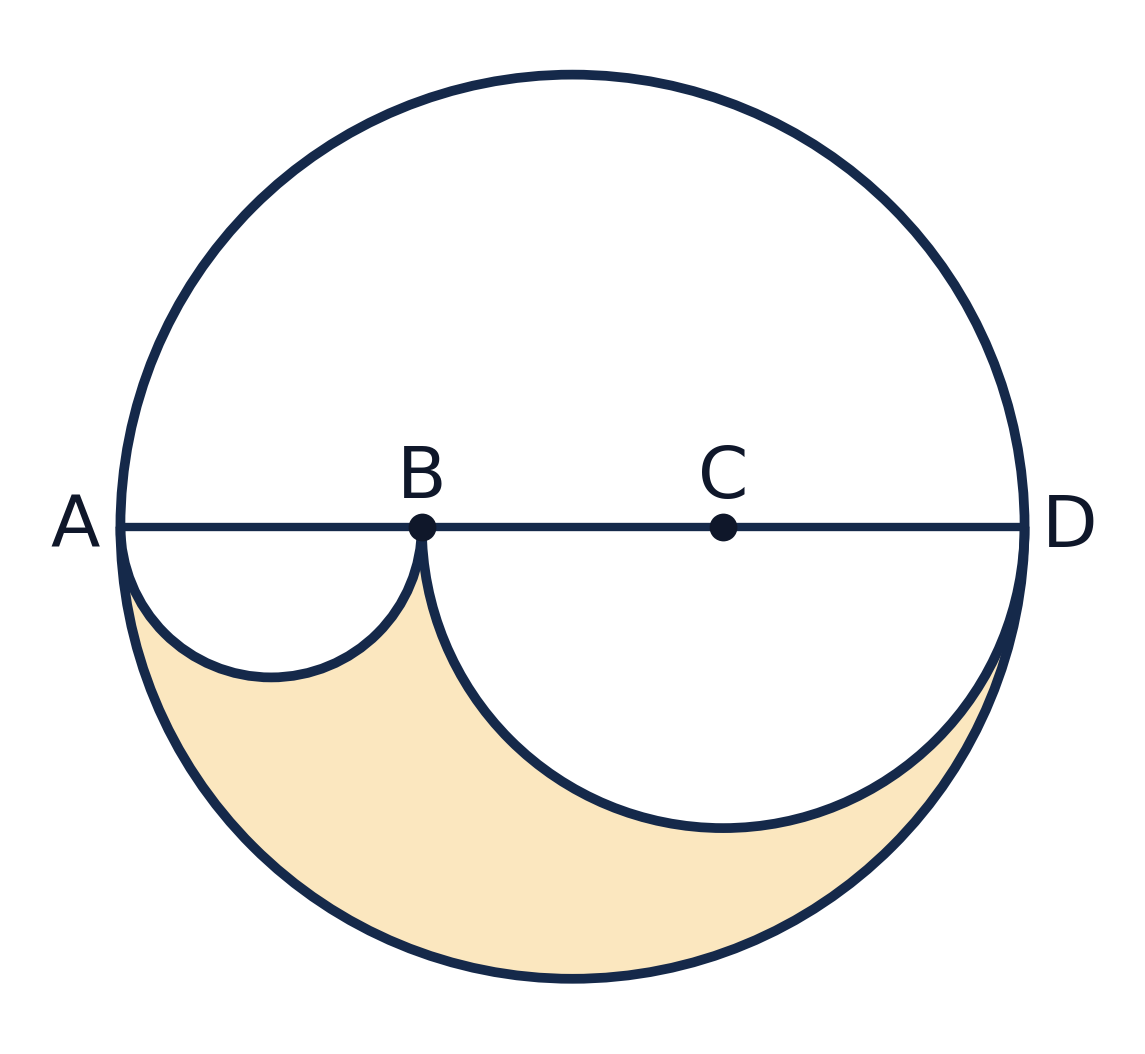
What is the ratio of the area of the shaded region to that of the non-shaded region?
(a) 2 : 7 (b) 2 : 5 (c) 3 : 5 (d) 5 : 8
Solution. The diameter is 12 cm, so AB = BC = CD = 4 cm. The semicircle on AB has radius 2. The semicircle on BD has radius 4. Shaded = lower half of the big circle minus the two semicircles = \frac{1}{2}\pi (6^2 - 2^2 - 4^2) = \frac{1}{2}\pi \times 16 = 8\pi. The whole circle is 36\pi, so the non-shaded part is 28\pi. Ratio = 8 : 28 = 2 : 7. Answer (a). (The next question, Q100, asked for the perimeter of the shaded region. It is three semicircular arcs: 6\pi + 2\pi + 4\pi = 12\pi cm.)
CDS I 2025, Q84. An arc AB of a circle subtends an angle x radian at the centre O. If the area of the sector AOB is equal to half of the square of length of arc AB, then what is x equal to?
(a) 1/4 (b) 1/2 (c) 1 (d) 2
Solution. In radians, arc = rx and area of sector = \frac{1}{2} r^2 x. The condition is \frac{1}{2} r^2 x = \frac{1}{2}(rx)^2 = \frac{1}{2} r^2 x^2. Divide both sides by \frac{1}{2} r^2 x, which is not zero: x = 1. Answer (c).
CDS II 2025, Q76. A pendulum swings through an angle of 30^\circ and its end describes an arc of length 55 cm. What is the length of the pendulum? (Take \pi = 22/7)
(a) 90 cm (b) 100 cm (c) 105 cm (d) 110 cm
Solution. The end of the pendulum moves on a circle whose radius is the length L of the pendulum. 30^\circ is \frac{1}{12} of a full turn, so the whole circumference would be 12 \times 55 = 660 cm. Then 2 \times \frac{22}{7} \times L = 660 gives L = 660 \times \frac{7}{44} = 105 cm. Answer (c).
CDS II 2026, Q53. A chord of a circle makes an angle of 90° at the centre of the circle. If the area of the major segment is k times the area of the minor segment, then what is the value of k? (Take \pi = \frac{22}{7})
(a) 8 (b) 9 (c) 10 (d) 11
Solution. Minor segment = r^2 \left( \frac{\pi}{4} - \frac{1}{2} \right) = r^2 \left( \frac{11}{14} - \frac{7}{14} \right) = \frac{2}{7} r^2. The circle is \frac{22}{7} r^2, so the major segment is \frac{22}{7} r^2 - \frac{2}{7} r^2 = \frac{20}{7} r^2. So k = 20 \div 2 = 10. Answer (c). The third figure, with r = 14, shows the same result: 560 is 10 times 56.
In each of the six, the first step was to name the pieces: a ring, a fraction of a circle, a sector minus a triangle.
Mistakes that cost marks
- Leaving out the straight edges of a perimeter. The perimeter of a sector is arc + 2r. The perimeter of a semicircle is \pi r + 2r, not \pi r.
- Using the diameter as the radius. "A wheel of diameter 70 cm" has r = 35. Read the word before you put the number in \pi r^2.
- Taking the sector for the segment. The segment is the sector minus the triangle. For r = 14 and 90^\circ, the sector is 154 but the segment is 56.
- Using a value of \pi that the question did not give. If it says 3.14, do not use \frac{22}{7}: the options are often close enough for the wrong value to pick the wrong one.
Quick check
Do these without help. Take \pi = \frac{22}{7}. Answers are at the end.
- The circumference of a circle is 132 cm. Find its area.
- Find the area and the perimeter of a quadrant of a circle of radius 14 cm.
- A sector has radius 6 cm and an arc of length 5 cm. Find its area.
- A chord subtends 90^\circ at the centre of a circle of radius 14 cm. Find the area of the minor segment.
- The largest possible circle is cut from a square sheet of side 14 cm. Find the area of the sheet that is left.
Read and watch more, free
The NCERT Class 10 chapter is short and is exactly on sectors and segments. The new Class 9 book treats circumference, arc and area. The NIOS lesson covers all plane figures in one place.
| What | Where | Language |
|---|---|---|
| Textbook, sector and segment | NCERT Class 10 Mathematics, Chapter 11 Areas Related to Circles · Hindi edition | English, Hindi |
| Textbook, circumference, arc length and area | NCERT Class 9 Ganita Manjari, Chapter 6 Measuring Space: Perimeter and Area (sections 6.2, 6.4 and 6.10) · Hindi edition | English, Hindi |
| Self-study notes | NIOS Secondary Mathematics (211), Lesson 20 Perimeters and Area of Plane Figures · Hindi edition | English, Hindi |
| Practice with answers | NCERT Exemplar Class 10, Unit 11 Areas Related to Circles · Hindi edition | English, Hindi |
| Short videos with practice | Khan Academy, NCERT Math Class 10 (the areas related to circles unit) · in Hindi | English, Hindi |
| The real papers | UPSC previous question papers | English, Hindi |
| Video, numbered classes | Chandigarh Career Group: CDS advance maths by Sandeep Brar (the geometry and mensuration classes) | Hinglish |
| Video, a full CDS course | R.S SIR: Maths Playlist for CDS 2025 (the eight mensuration lessons, about 55 minutes each) | Hindi and Hinglish |
| Video, one long lesson with past questions | The Journey Extraordinary: Maths For CDS 2 2026 (the 2-D mensuration lesson, about 4 hours) | Hinglish |
The videos were chosen from their titles, length and views; they have not yet been watched by a teacher.
Answers to the quick check
- 2 \times \frac{22}{7} \times r = 132 gives r = 21 cm. Area = \frac{22}{7} \times 441 = 1386 square cm.
- Area = \frac{1}{4} \times 616 = 154 square cm. Perimeter = \frac{1}{4} \times 88 + 14 + 14 = 50 cm.
- \frac{1}{2} \times \text{arc} \times r = \frac{1}{2} \times 5 \times 6 = 15 square cm.
- Sector = \frac{1}{4} \times 616 = 154. Triangle = \frac{1}{2} \times 14 \times 14 = 98. Segment = 56 square cm.
- The circle has radius 7 cm and area 154 square cm. Left over: 196 - 154 = 42 square cm.
Next chapter: Cube and cuboid.