Why this chapter matters. This chapter gave 10 questions in the 6 papers from CDS I 2024 to CDS II 2026: at least one in every paper, and three in CDS I 2025. Three melt one shape and make another: a plate into a bead, a sphere into a wire, a ball into many small balls. Three cut a sphere with a flat plane, as a bowl or a pot, and ask for the radius of the circle made. Two compare a hemisphere with a cone or a cylinder. One drops a sphere into water, and one asks for the surface of a slice. Two formulas and one right-angled triangle answer all ten.
What you will be able to do
- Find the volume and surface area of a sphere and a hemisphere.
- Say how surface and volume change when the radius changes.
- Solve melting and recasting questions by putting two volumes equal, and count the pieces made.
- Find the radius of the circle made when a sphere is cut by a flat plane.
Before you start you should know: the volume of a cylinder and a cone (Chapter A6-5), the units of volume (Chapter A6-4), Pythagoras' theorem (Chapter A5-3), and the cubes of the numbers 1 to 10 (for example 7^3 = 343 and 9^3 = 729).
1. The sphere
A sphere is a perfectly round ball. Every point of its surface is at the same distance r, the radius, from the centre.
\text{Volume} = \frac{4}{3}\pi r^3, \qquad \text{Surface area} = 4\pi r^2
For r = 3: volume \frac{4}{3}\pi \times 27 = 36\pi and surface 4\pi \times 9 = 36\pi. For r = 7 and \pi = \frac{22}{7}: surface 4 \times 154 = 616 and volume \frac{4}{3} \times \frac{22}{7} \times 343 = \frac{4312}{3} = 1437\frac{1}{3}.
The surface of a sphere is exactly 4 times the area of the circle through its centre.
2. The hemisphere
A hemisphere is half a sphere. A solid hemisphere has two faces: the curved one and a flat circle.
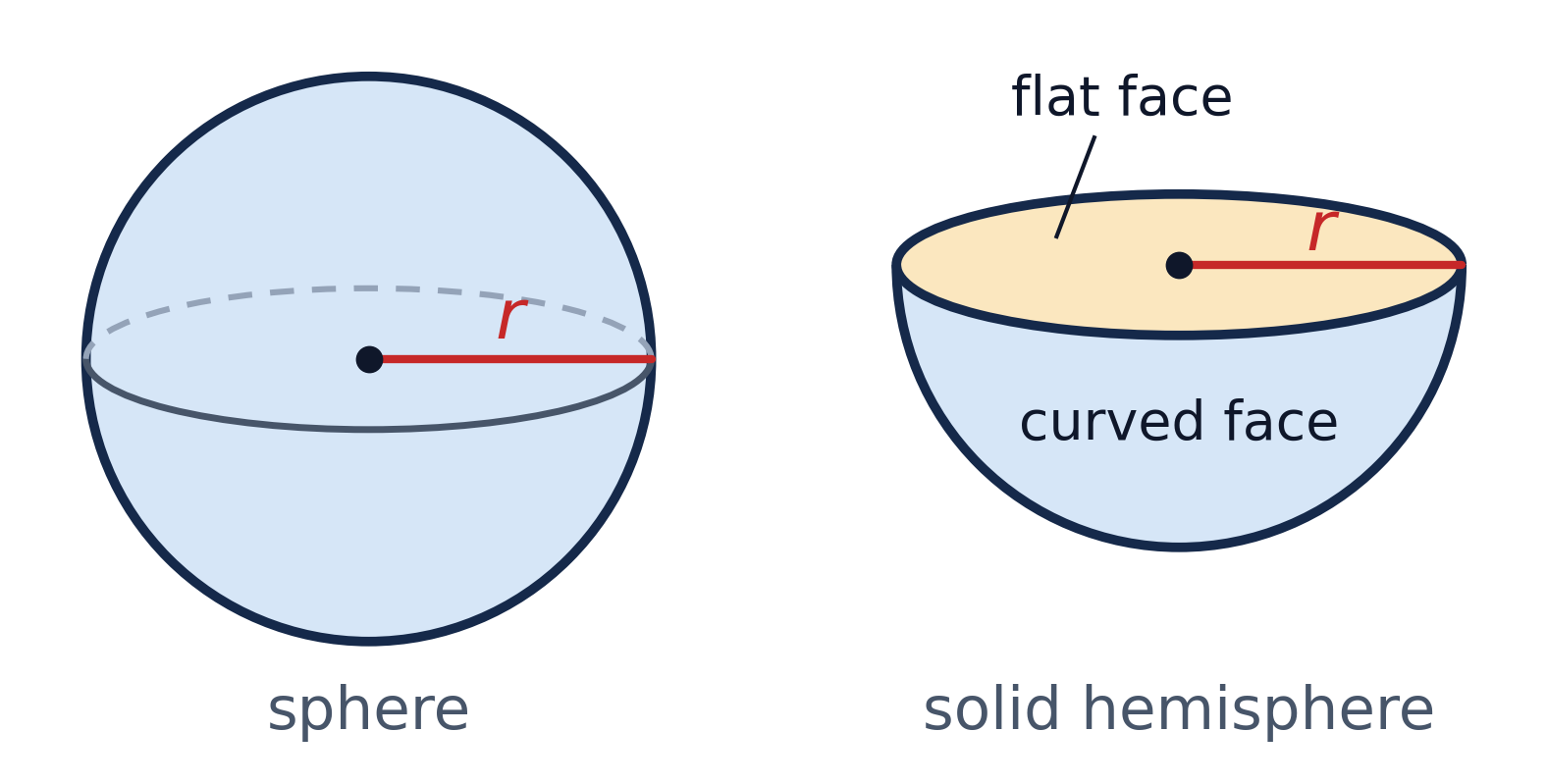
\text{Volume} = \frac{2}{3}\pi r^3, \qquad \text{Curved surface} = 2\pi r^2, \qquad \text{Total surface} = 2\pi r^2 + \pi r^2 = 3\pi r^2
For r = 7 and \pi = \frac{22}{7}: volume 718\frac{2}{3}, curved surface 308, total surface 462.
Read the question: a bowl is open and has only the curved surface. A solid hemisphere has the flat face as well. The height of a hemisphere is its radius.
A hollow sphere (a shell) with outer radius R and inner radius r has material \frac{4}{3}\pi (R^3 - r^3). For R = 5 and r = 4 this is \frac{4}{3}\pi \times 61 = \frac{244\pi}{3}.
3. When the radius changes
Surface goes as r^2 and volume as r^3.
| Radius multiplied by | Surface multiplied by | Volume multiplied by |
|---|---|---|
| 2 | 4 | 8 |
| 3 | 9 | 27 |
| k | k^2 | k^3 |
It works backwards too. If two spheres have volumes in the ratio 8 : 27, their radii are in the ratio 2 : 3 and their surfaces in the ratio 4 : 9.
4. Melting and recasting
When a solid is melted and made into another shape, its volume does not change. Its surface does. Write
\text{volume before} = \text{volume after}
and solve for the unknown length. Keep \pi as a letter on both sides: it nearly always cancels.
| Solid | Volume |
|---|---|
| Cuboid | lbh |
| Cylinder (also a wire, a pipe, a coin, a well) | \pi r^2 h |
| Cone | \frac{1}{3}\pi r^2 h |
| Sphere | \frac{4}{3}\pi r^3 |
| Hemisphere | \frac{2}{3}\pi r^3 |
A sphere into a cone. A sphere of radius 6 is recast as a cone of radius 6. Then \frac{4}{3}\pi \times 216 = \frac{1}{3}\pi \times 36 \times h, so 864 = 36h and h = 24.
How many pieces? Number = volume of the big solid \div volume of one small piece. A sphere of radius 6 makes \left(\frac{6}{2}\right)^3 = 27 balls of radius 2. For spheres you need only the cube of the ratio of the radii.
The surface grows. The 27 small balls have a total surface of 27 \times 4\pi \times 4 = 432\pi. The big sphere had 4\pi \times 36 = 144\pi. The surface has become 3 times. In general, when a sphere is made into n equal balls, the total surface is multiplied by the cube root of n.
Cone, hemisphere, cylinder. Take the three on equal bases of radius r and each of height r.
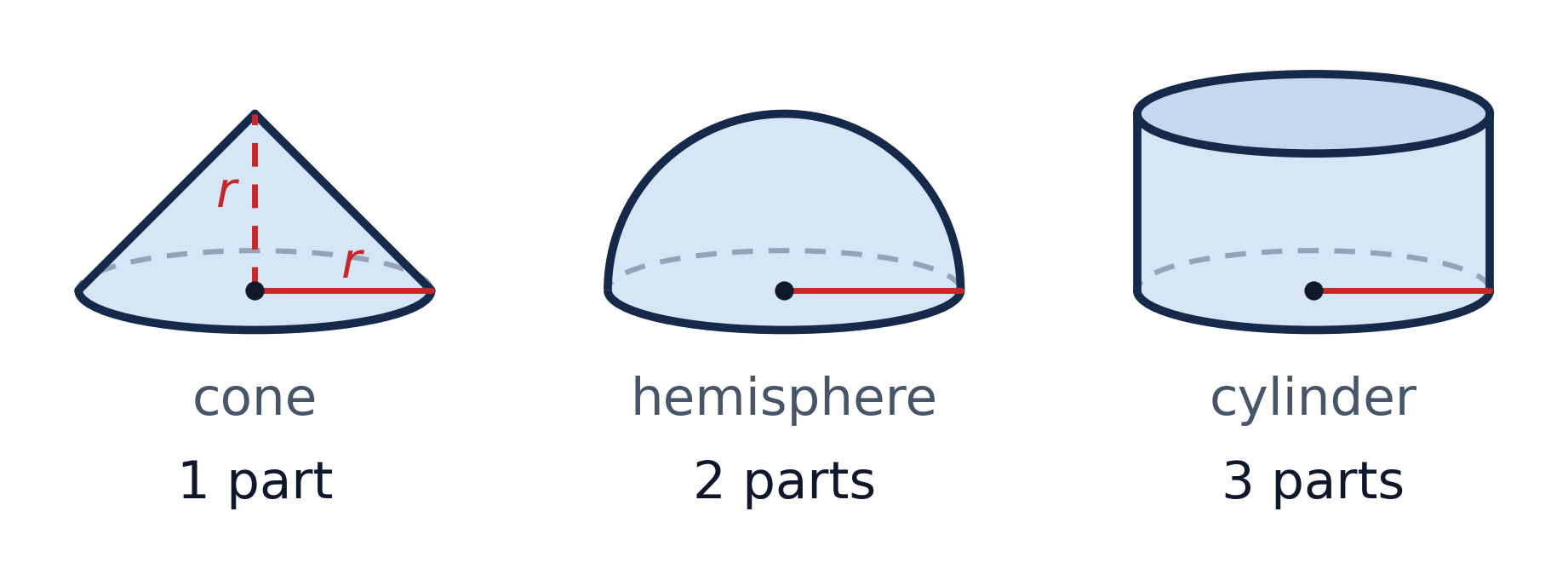
Their volumes are \frac{1}{3}\pi r^3, \frac{2}{3}\pi r^3 and \pi r^3: the ratio is 1 : 2 : 3.
5. A solid dropped into water
A solid that is fully under water pushes up its own volume of water. In a cylindrical vessel of radius R:
\text{rise of the level} = \frac{\text{volume of the solid}}{\pi R^2}
A sphere of radius 3 cm in a vessel of radius 6 cm raises the level by \frac{36\pi}{36\pi} = 1 cm.
6. A sphere cut by a flat plane
Any flat cut through a sphere is a circle. The cut through the centre gives the largest circle, with the radius of the sphere. A cut away from the centre gives a smaller circle.
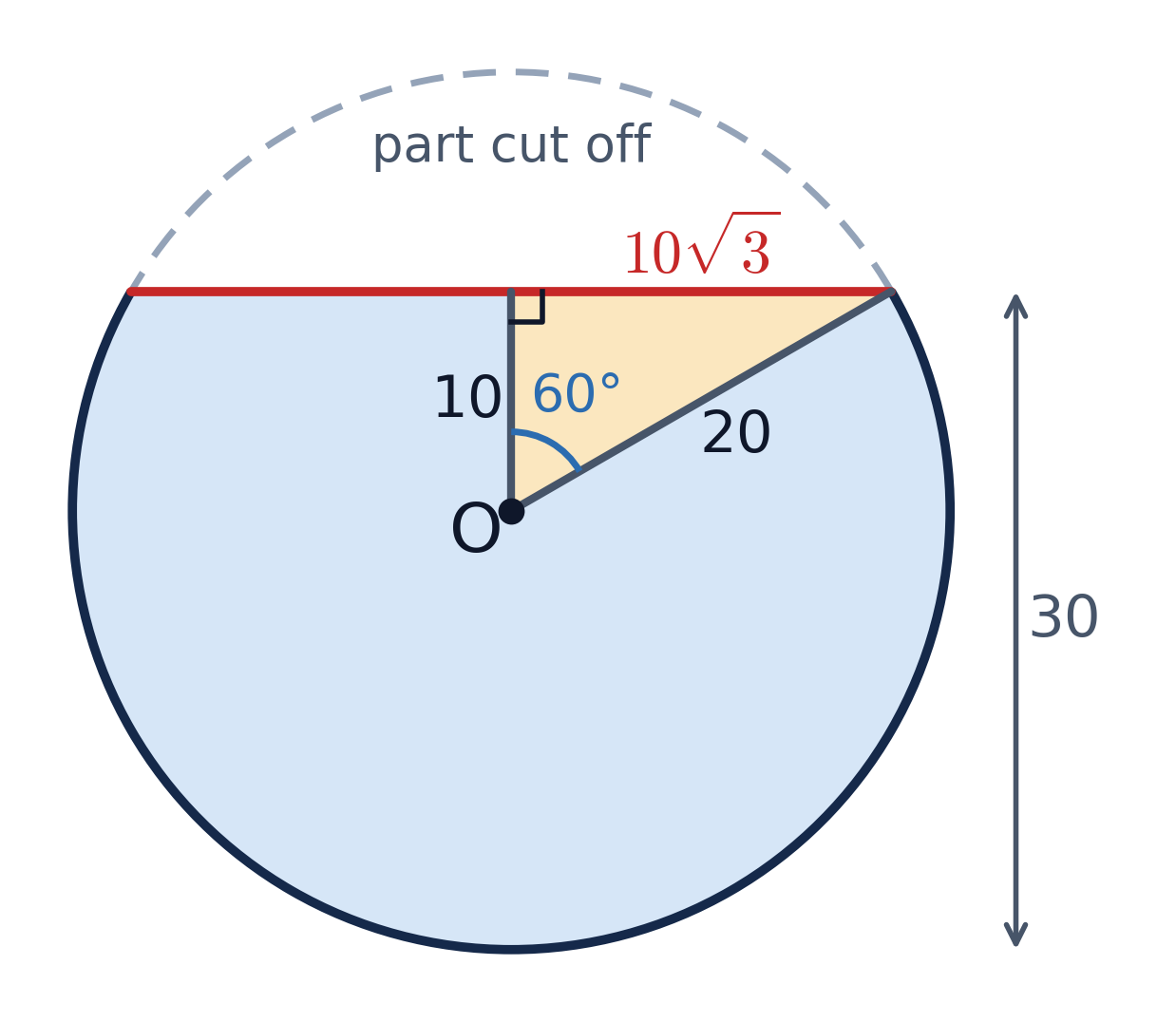
Let the sphere have radius R, and let the cut be at distance p from the centre. Join the centre to the middle of the cut and to a point on its rim. This makes a right-angled triangle with hypotenuse R, so the circle has radius a where
a^2 = R^2 - p^2
In the figure, R = 20 and p = 10, so a = \sqrt{400 - 100} = 10\sqrt{3}.
Bowl and pot questions give a depth or a height in place of p. Find p first:
- Water of depth d in a round bowl of radius R: the water surface is R - d below the centre, so p = R - d.
- A pot of height H cut from a sphere of radius R (with H more than R): the rim is H - R above the centre, so p = H - R.
Worked examples
Example 1. Find the surface area and the volume of a sphere of radius 21 cm. (Take \pi = \frac{22}{7}.)
Surface = 4 \times \frac{22}{7} \times 441 = 5544 square cm. Volume = \frac{4}{3} \times \frac{22}{7} \times 9261 = 38808 cubic cm.
Example 2. Find the volume and the total surface of a solid hemisphere of radius 7 cm. (Take \pi = \frac{22}{7}.)
Volume = \frac{2}{3} \times \frac{22}{7} \times 343 = \frac{2156}{3} = 718\frac{2}{3} cubic cm. Total surface = 3 \times \frac{22}{7} \times 49 = 462 square cm.
Example 3. A metal sphere of radius 6 cm is melted and made into balls of radius 2 cm. How many balls are made?
The radii are in the ratio 3 : 1, so the volumes are in the ratio 27 : 1. There are 27 balls.
Example 4. A sphere of radius 3 cm is dropped into a cylindrical vessel of radius 6 cm that is partly filled with water, and goes fully under. By how much does the water rise?
Volume of the sphere = \frac{4}{3}\pi \times 27 = 36\pi. Base of the vessel = \pi \times 36. Rise = \frac{36\pi}{36\pi} = 1 cm.
Example 5. A sphere of radius 13 cm is cut by a plane 5 cm from its centre. Find the area of the circle made. How deep is the smaller of the two pieces?
a^2 = 13^2 - 5^2 = 144, so the circle has radius 12 cm and area 144\pi square cm. The smaller piece reaches from the cut to the surface: its depth is 13 - 5 = 8 cm.
From the real papers
These six questions are from the Elementary Mathematics papers (Series A). The first four agree with the final official key. The last two agree with the provisional key of CDS I 2026. Try each for 72 seconds before reading the solution.
CDS I 2024, Q38. From a circular metal plate of radius 7 cm and thickness 0·16 mm, a sector is cut off containing an angle 150°. The remaining piece is moulded into a spherical bead of radius r. What is the value of r in cm?
(a) 0·35 (b) 0·7 (c) 1·05 (d) 1·4
Solution. The piece left is a sector of 360^\circ - 150^\circ = 210^\circ, which is \frac{7}{12} of the plate. Its thickness is 0.16 mm = 0.016 cm. Volume before = \frac{7}{12} \times \pi \times 49 \times 0.016. Volume after = \frac{4}{3}\pi r^3. Cancel \pi: r^3 = \frac{3}{4} \times \frac{7}{12} \times 49 \times 0.016 = \frac{7 \times 49 \times 0.016}{16} = 343 \times 0.001 = 0.343. So r = 0.7 cm. Answer (b). The two things to see: the thickness is in millimetres, and \pi cancels.
CDS I 2025, Q13. The inside of a bowl is part of a sphere. When water is put into the bowl to a depth d, the water surface becomes a circle of radius 2d. What is the radius of the sphere?
(a) 2.5d (b) 2.75d (c) 3d (d) 3.25d
Solution. Let the radius of the sphere be R. The water surface is p = R - d from the centre, and the circle has radius 2d. By section 6, (2d)^2 = R^2 - (R - d)^2 = 2Rd - d^2. So 4d^2 + d^2 = 2Rd, and R = \frac{5d}{2} = 2.5d. Answer (a).
CDS I 2025, Q59. Consider the following for the next two (02) items that follow : A pot is made from a hollow sphere of inner radius 20 cm by cutting its upper portion horizontally. The height of the pot is 30 cm.
What is the inner radius of the circular opening of the pot so formed?
(a) 10\sqrt{2} cm (b) 15 cm (c) 10\sqrt{3} cm (d) 12 cm
Solution. This is the third figure. The pot is 30 cm high and the centre is 20 cm above the bottom, so the rim is p = 30 - 20 = 10 cm above the centre. The opening has radius \sqrt{20^2 - 10^2} = \sqrt{300} = 10\sqrt{3} cm. Answer (c). (The next question, Q60, asked for the angle between the vertical through the centre and the line from the centre to the rim. Its cosine is \frac{10}{20} = \frac{1}{2}, so the angle is 60^\circ, that is \frac{\pi}{3}.)
CDS II 2025, Q78. A right circular cone and a hemisphere have equal base and equal volume. What is the ratio of the height of the cone to the radius of the hemisphere?
(a) 1 : 1 (b) 1 : 2 (c) 2 : 1 (d) 3 : 2
Solution. Equal bases mean the same radius r. Then \frac{1}{3}\pi r^2 h = \frac{2}{3}\pi r^3. Cancel \frac{1}{3}\pi r^2: h = 2r. The ratio is 2 : 1. Answer (c). (Section 4 says the same: with height r the cone is half the hemisphere, so it needs twice the height.)
CDS I 2026, Q58. A sphere of diameter 14 cm is dropped into a cylindrical vessel partly filled with water. The radius of the vessel is 14 cm. If the sphere is completely submerged in water, then how much will the level of water rise?
(a) \frac{7}{3} cm (b) \frac{8}{3} cm (c) \frac{14}{3} cm (d) \frac{16}{3} cm
Solution. The sphere has radius 7 cm (the question gives the diameter). Its volume is \frac{4}{3}\pi \times 343. The base of the vessel is \pi \times 196. Rise = \frac{4 \times 343}{3 \times 196} = \frac{1372}{588} = \frac{7}{3} cm. Answer (a).
CDS I 2026, Q61. The diameter of a copper solid sphere is 6 cm. The sphere is melted and recast into a wire. If the diameter of the wire is 0·5 cm, then what is the length of the wire?
(a) 5·24 m (b) 5·36 m (c) 5·76 m (d) 5·96 m
Solution. The sphere has radius 3 cm: volume \frac{4}{3}\pi \times 27 = 36\pi. The wire is a cylinder of radius 0.25 cm = \frac{1}{4} cm and length L: volume \pi \times \frac{1}{16} \times L. So \frac{L}{16} = 36 and L = 576 cm = 5.76 m. Answer (c).
In four of the six, \pi cancelled and was never given a value. In three, a diameter or a unit had to be changed first.
Mistakes that cost marks
- Mixing up the two formulas. Volume has r^3 and \frac{4}{3}. Surface has r^2 and 4. A volume must come out in cubic units.
- Total surface of a solid hemisphere as 2\pi r^2. That is only the curved face. With the flat face it is 3\pi r^2.
- Putting surfaces equal in a melting question. Melting keeps the volume. The surface changes.
- Using the depth of a bowl as the distance from the centre. The distance from the centre to the cut is R - d, not d.
Quick check
Do these without help. Answers are at the end.
- The surface area of a sphere is 616 square cm. Find its radius and its volume. (Take \pi = \frac{22}{7}.)
- A sphere of radius 9 cm is melted and recast into a cylinder of radius 9 cm. Find the height of the cylinder.
- How many balls of radius 1 cm can be made from a metal sphere of radius 5 cm?
- The volumes of two spheres are in the ratio 8 : 27. Find the ratio of their surface areas.
- A sphere of radius 10 cm is cut by a plane 6 cm from its centre. Find the radius of the circle made.
Read and watch more, free
The new NCERT Class 9 book treats the sphere and hemisphere in its chapter on solids, and the Class 10 chapter joins them to cylinders and cones. The NIOS lesson is the fullest single source. School books do not teach the cut sphere of section 6 as a topic; for that, use this lesson and the past papers.
| What | Where | Language |
|---|---|---|
| Textbook, spheres and hemispheres | NCERT Class 9 Ganita Manjari Part II, Chapter 14 Math of Space | English (the Hindi edition of Part II was not yet on the NCERT site in October 2026) |
| Textbook, solids joined together | NCERT Class 10 Mathematics, Chapter 12 Surface Areas and Volumes · Hindi edition | English, Hindi |
| Self-study notes | NIOS Secondary Mathematics (211), Lesson 21 Surface Area and Volume of Solid Figures · Hindi edition | English, Hindi |
| Practice with answers | NCERT Exemplar Class 9, Unit 13 Surface Areas and Volumes · Hindi edition | English, Hindi |
| More practice, with recasting | NCERT Exemplar Class 10, Unit 12 Surface Areas and Volumes · Hindi edition | English, Hindi |
| The real papers | UPSC previous question papers | English, Hindi |
| Video, numbered classes | Chandigarh Career Group: CDS advance maths by Sandeep Brar (the geometry and mensuration classes) | Hinglish |
| Video, a full CDS course | R.S SIR: Maths Playlist for CDS 2025 (the eight mensuration lessons, about 55 minutes each) | Hindi and Hinglish |
| Video, mensuration in four long lessons | Defence Wallah CDS / AFCAT: Quantitative Aptitude CDS 2024 (the mensuration lessons, about 2 hours each) | Hinglish |
The videos were chosen from their titles, length and views; they have not yet been watched by a teacher.
Answers to the quick check
- 4 \times \frac{22}{7} \times r^2 = 616 gives r^2 = 49 and r = 7 cm. Volume = \frac{4}{3} \times \frac{22}{7} \times 343 = 1437\frac{1}{3} cubic cm.
- \frac{4}{3}\pi \times 729 = \pi \times 81 \times h gives 972 = 81h, so h = 12 cm.
- \left(\frac{5}{1}\right)^3 = 125 balls.
- The radii are in the ratio 2 : 3, so the surfaces are in the ratio 4 : 9.
- \sqrt{10^2 - 6^2} = 8 cm.
Next chapter: Collecting and tabulating data; frequency distributions.