Why this chapter matters. This chapter gave 18 questions in the 6 papers from CDS I 2024 to CDS II 2026: three a paper. About six are on volume with a change of units: rain on a hectare, water taken out of a tank, the weight of a box of given thickness, a box folded from a sheet. About five ask for a surface area. About four use the diagonal, as "the longest pole that fits in the room". The rest are a percentage change in volume and puzzles in which the sides are whole numbers. The formulas are few. The marks are lost on units and on reading the question.
What you will be able to do
- Find the volume, total surface area, area of the four walls and diagonal of a cuboid and a cube.
- Change between cubic centimetres, cubic metres, litres and kilolitres, and find a weight from a volume.
- Find the material in a box with thick walls, and the volume of an open box folded from a sheet.
- Say what happens to surface and volume when sides are changed, or when cubes are cut and joined.
Before you start you should know: the area of a rectangle and a square (Chapter A6-2), Pythagoras' theorem (Chapter A5-3), and how to turn a percentage increase into a multiplying factor (Chapter A2-1).
1. The cuboid
A cuboid is a box with six rectangular faces. Call its length l, breadth b and height h.
\text{Volume} = l \times b \times h = \text{area of the base} \times \text{height}
\text{Total surface area} = 2(lb + bh + hl)
\text{Area of the four walls} = 2(l + b) \times h
The six faces come in three equal pairs, which gives the second formula. The four walls are the faces that stand upright. Their area is the perimeter of the floor times the height. It is also called the lateral surface area.
For a cuboid 4 by 3 by 12: volume 144, total surface area 2(12 + 36 + 48) = 192, four walls 2 \times 7 \times 12 = 168.
The diagonal. The longest straight line inside a cuboid joins two opposite corners. Its length is
\text{Diagonal} = \sqrt{l^2 + b^2 + h^2}
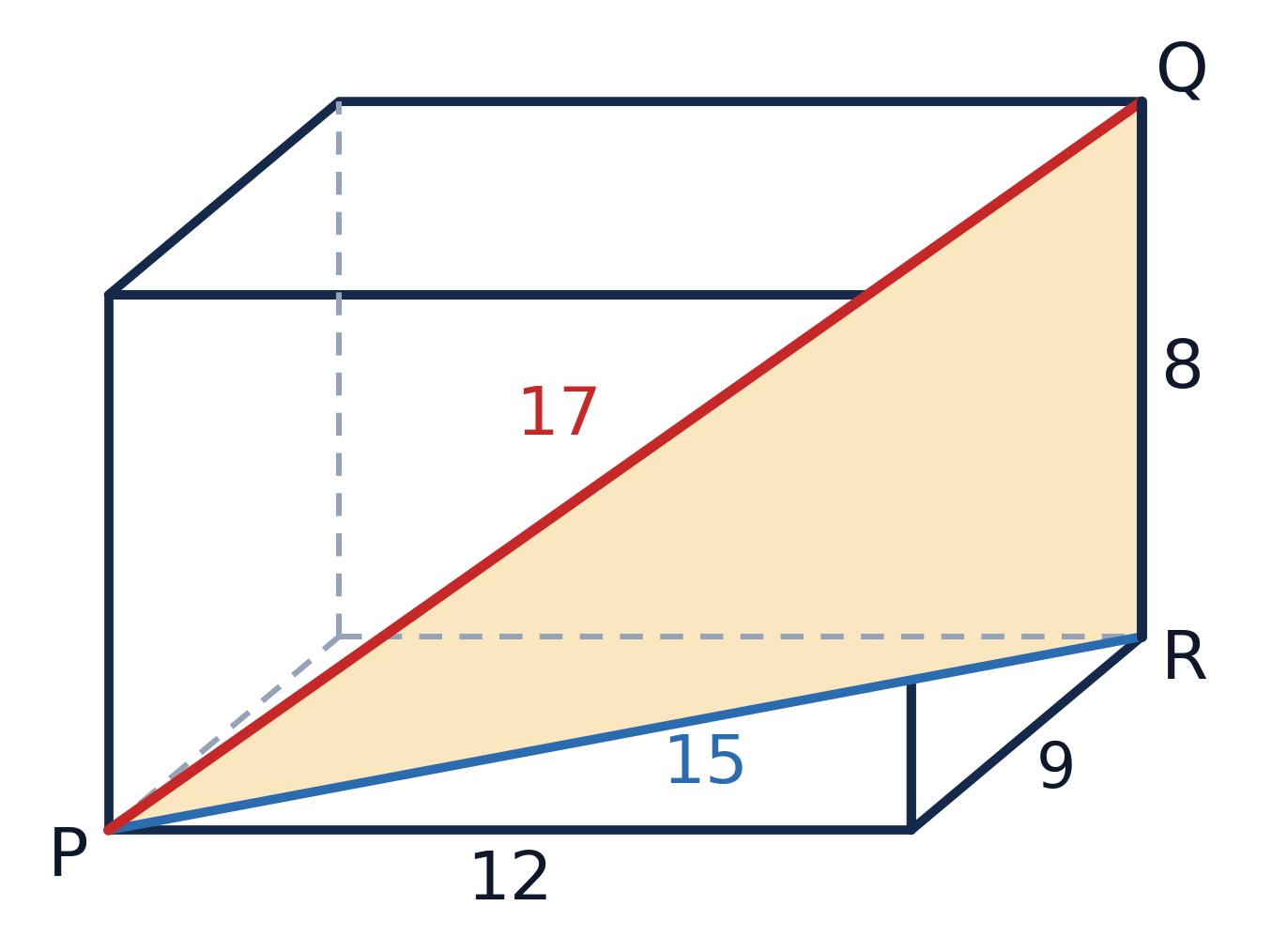
The figure shows why. The floor diagonal is PR = \sqrt{l^2 + b^2}. The edge RQ stands at right angles to the floor, so triangle PRQ is right-angled at R, and PQ^2 = PR^2 + h^2. With 12, 9 and 8: the floor diagonal is 15 and the diagonal of the cuboid is \sqrt{225 + 64} = 17.
Questions call the diagonal "the longest pole that can be placed in the room" or "the greatest distance between two points in the hall". The longest pole that can lie on the floor is the floor diagonal.
2. The cube
A cube is a cuboid with all edges equal, say a.
| Quantity | Formula | For a = 5 |
|---|---|---|
| Volume | a^3 | 125 |
| Total surface area | 6a^2 | 150 |
| Area of four walls | 4a^2 | 100 |
| Diagonal of a face | a\sqrt{2} | 5\sqrt{2} |
| Diagonal of the cube | a\sqrt{3} | 5\sqrt{3} |
3. Units, capacity and weight
Most wrong answers in this chapter come from units. Change every length to the same unit before you multiply.
| Fact | Use |
|---|---|
| 1 cubic metre = 100 \times 100 \times 100 = 1{,}000{,}000 cubic cm (ten lakh) | the factor is a million, not a hundred |
| 1 litre = 1000 cubic cm | a cube of side 10 cm holds 1 litre |
| 1 cubic metre = 1000 litres = 1 kilolitre (kL) | tanks and reservoirs |
| 1 hectare = 100 \text{ m} \times 100 \text{ m} = 10{,}000 square m | fields and rainfall |
| 1 cubic cm of water weighs 1 gram; 1 cubic metre of water weighs 1000 kg = 1 metric tonne | weight of water |
| a material of 2000 kg per cubic metre weighs 2 grams per cubic cm | divide by 1000 |
A tank 3 m by 2 m by 1.5 m holds 3 \times 2 \times 1.5 = 9 cubic metres, which is 9000 litres.
Water level. When water is added to or taken from a tank with upright sides, the change in volume is
\text{change in volume} = \text{area of the base} \times \text{rise or fall of the level}
Rain. "Rainfall of 40 cm" means that the rain would stand 40 cm deep on flat ground. Volume of rain = area of the ground \times depth.
4. When the sides change
The volume is a product of three lengths, so the multiplying factors multiply. If the length, breadth and height go up by 10%, 20% and 50%, the volume is multiplied by 1.1 \times 1.2 \times 1.5 = 1.98. That is a rise of 98%, not of 80%.
If every side is multiplied by k, each area is multiplied by k^2 and the volume by k^3. Doubling every side makes the surface 4 times and the volume 8 times. Raising each edge of a cube by 20% raises its surface by 44% (1.2^2 = 1.44) and its volume by 72.8% (1.2^3 = 1.728).
5. Boxes
A box with thick walls. Material = outer volume - inner volume. To go from inside to outside, add the thickness once for each wall crossed: twice along the length, twice along the breadth. For the height, add the bottom, and add the lid only if the box is closed.
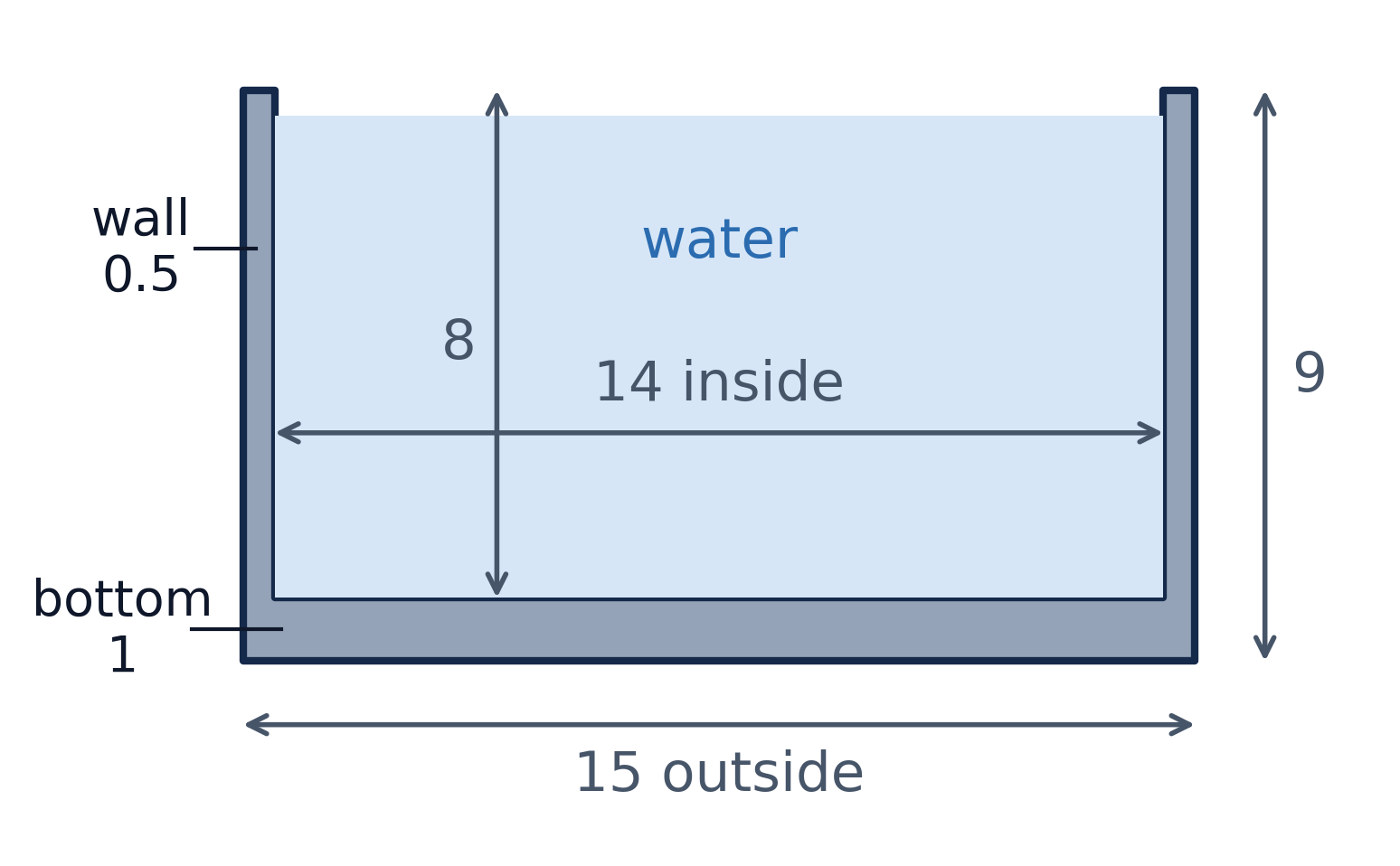
In the figure, the inside is 14 by 10 by 8 (the breadth of 10 is not seen). The walls are 0.5 thick and the bottom is 1 thick. The outside is 14 + 0.5 + 0.5 = 15 long, 10 + 0.5 + 0.5 = 11 broad and 8 + 1 = 9 high. Material = 15 \times 11 \times 9 - 14 \times 10 \times 8 = 1485 - 1120 = 365.
An open box folded from a sheet. Cut a square of side x from each corner of a sheet L by B and fold up the four flaps.
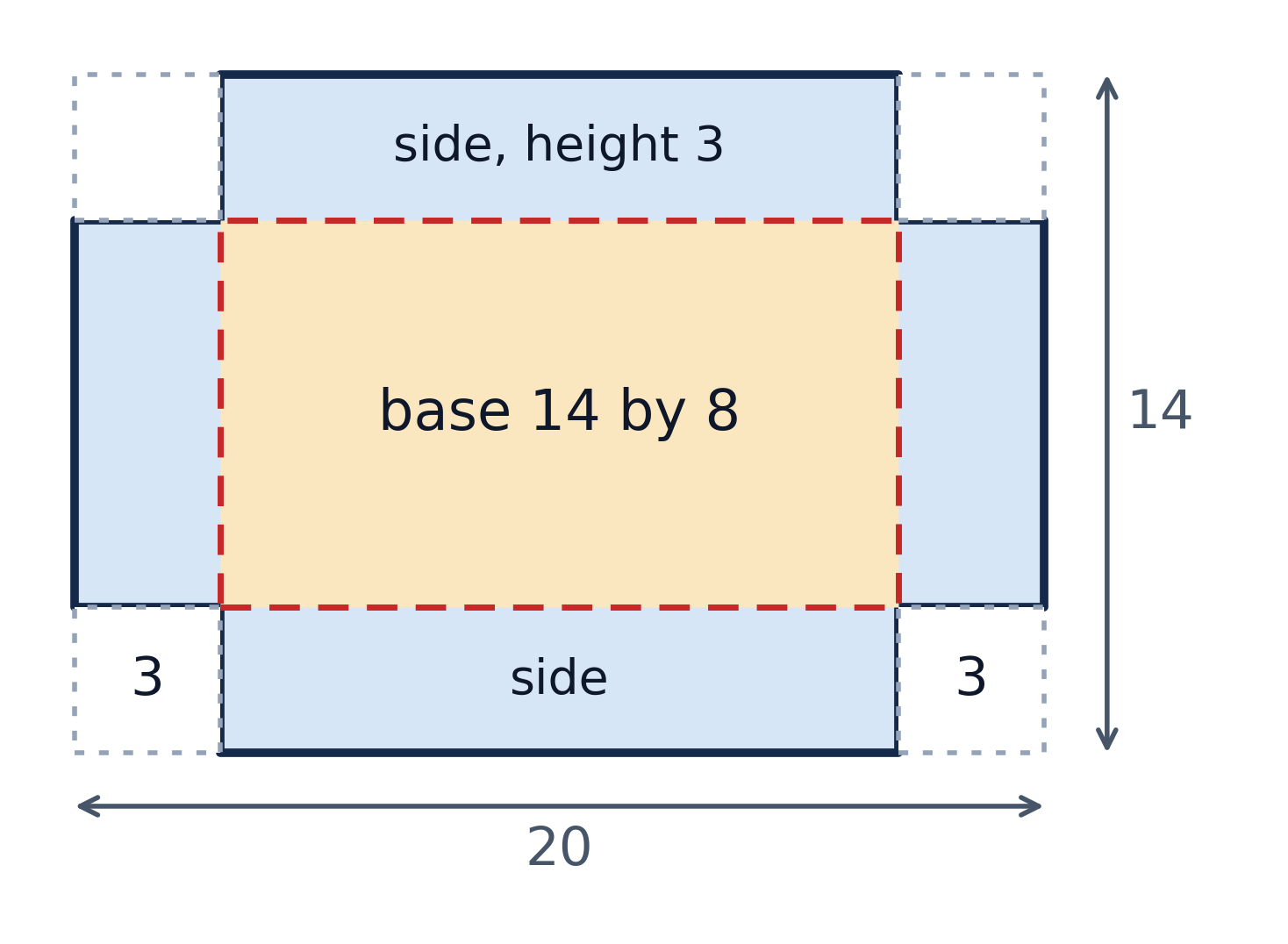
The box has length L - 2x, breadth B - 2x and height x. In the figure, the sheet 20 by 14 with corners of side 3 gives a box 14 by 8 by 3, of volume 336.
6. Cutting and joining
- How many small pieces? Number = big volume \div small volume, when nothing is wasted. A cube of side 6 cm cuts into \frac{216}{8} = 27 cubes of side 2 cm.
- Cutting makes new surface. Those 27 small cubes have a total surface of 27 \times 24 = 648 square cm. The big cube had only 216. Cutting a cube into cubes of one-third the edge makes the total surface 3 times.
- Joining hides surface. When two faces are stuck together, both are lost from the surface.
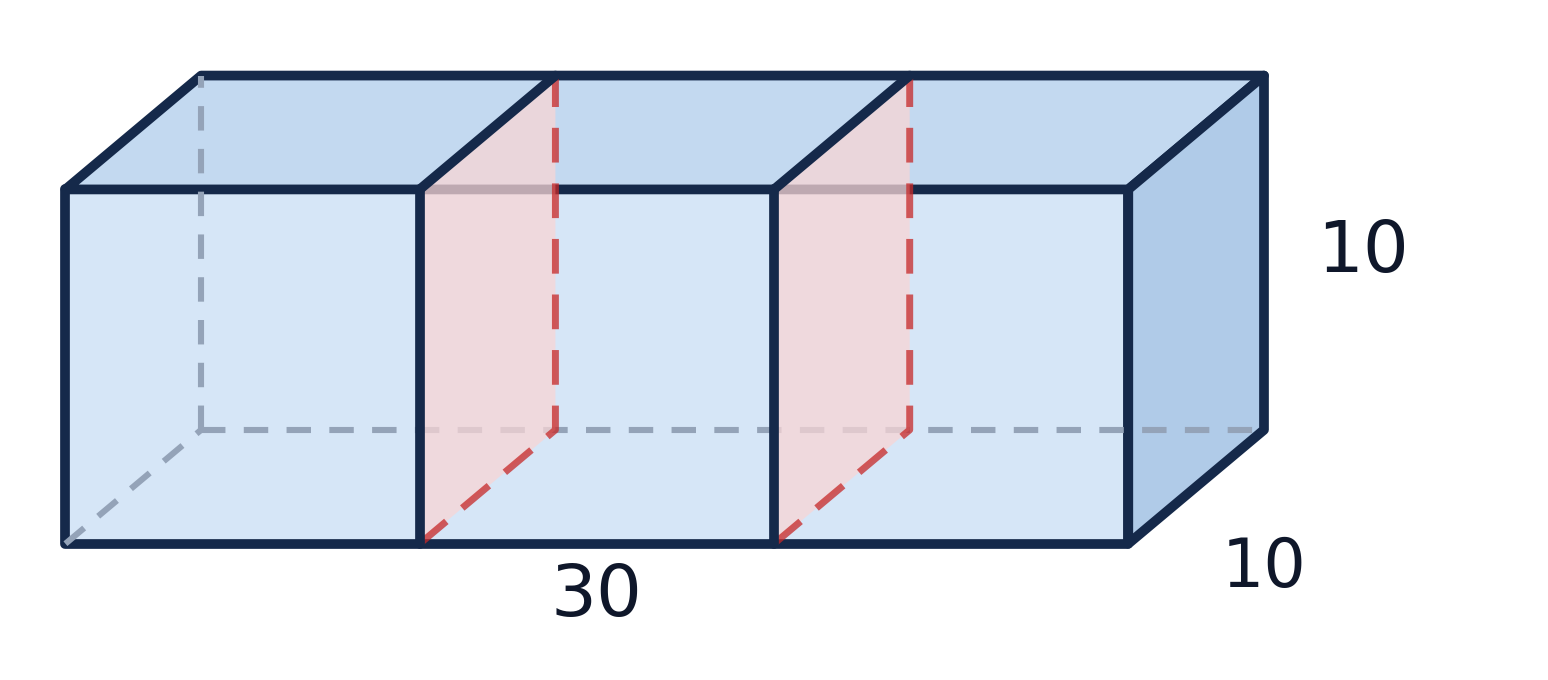
Three cubes of side 10 have a total surface of 3 \times 600 = 1800. Joined in a row they make a cuboid 30 by 10 by 10, with surface 2(300 + 100 + 300) = 1400. The difference, 400, is the four hidden faces. In general, N cubes of edge a in a row have surface (4N + 2)a^2.
- Melting and recasting keeps the volume the same. Chapter A6-6 takes this further.
Worked examples
Example 1. A room is 12 m long, 9 m broad and 8 m high. Find its volume, the area of its four walls, and the length of the longest pole that can be placed in it.
Volume = 12 \times 9 \times 8 = 864 cubic m. Four walls = 2(12 + 9) \times 8 = 336 square m. Longest pole = \sqrt{144 + 81 + 64} = \sqrt{289} = 17 m. This is the cuboid in the first figure.
Example 2. The total surface area of a cube is 150 square cm. Find its volume and its diagonal.
6a^2 = 150 gives a^2 = 25 and a = 5 cm. Volume = 125 cubic cm. Diagonal = 5\sqrt{3} cm.
Example 3. A tank is 2.5 m long, 2 m broad and 1.2 m deep. (i) How many litres does it hold? (ii) It is full, and 1500 litres are taken out. By how much does the water level fall?
(i) Volume = 2.5 \times 2 \times 1.2 = 6 cubic m = 6000 litres.
(ii) 1500 litres = 1.5 cubic m. The base is 2.5 \times 2 = 5 square m. Fall = 1.5 \div 5 = 0.3 m = 30 cm.
Example 4. A closed wooden box measures 30 cm by 20 cm by 16 cm on the outside. The wood is 1 cm thick everywhere. Find the volume of wood.
The box is closed, so take off 2 cm from each measurement: the inside is 28 by 18 by 14. Outer volume = 30 \times 20 \times 16 = 9600. Inner volume = 28 \times 18 \times 14 = 7056. Wood = 9600 - 7056 = 2544 cubic cm.
Example 5. A cube of side 6 cm is cut into cubes of side 2 cm. By how much does the total surface area increase?
There are 27 small cubes (section 6). Their surface is 27 \times 6 \times 2^2 = 648 square cm. The surface of the big cube was 6 \times 6^2 = 216 square cm. The increase is 648 - 216 = 432 square cm.
From the real papers
These six questions are from the Elementary Mathematics papers of CDS I 2024, CDS I 2025 and CDS II 2025 (Series A). The answers agree with the final official key. Try each for 72 seconds before reading the solution.
CDS I 2024, Q37. A cube whose edge is 14 cm long has on each of its faces a circle of 7 cm radius painted yellow. What is the total area of unpainted surface? (Take \pi = \frac{22}{7})
(a) 126 square cm (b) 189 square cm (c) 252 square cm (d) 315 square cm
Solution. One face is 14 \times 14 = 196 square cm. The circle on it is \frac{22}{7} \times 49 = 154 square cm. Unpainted on one face: 196 - 154 = 42. A cube has 6 faces: 6 \times 42 = 252 square cm. Answer (c).
CDS I 2024, Q56. The length, breadth and height of a cuboid are increased by 10%, 20% and 50% respectively. What is the percentage increase in volume of the cuboid?
(a) 100% (b) 99% (c) 98% (d) 50%
Solution. The factors multiply: 1.1 \times 1.2 = 1.32 and 1.32 \times 1.5 = 1.98. The volume is 1.98 times the old one, an increase of 98%. Answer (c).
CDS I 2025, Q61. Consider the following for the next two (02) items that follow : A hall is of length l, breadth b and height h. The maximum distance between any two points (say P and Q) inside the hall is 14 m, whereas the maximum distance between two points (say P and R) on the floor is 6\sqrt{5} m.
What is h equal to?
(a) 3.5 m (b) 4 m (c) 4.5 m (d) 5 m
Solution. The greatest distance inside the hall is the diagonal of the cuboid: l^2 + b^2 + h^2 = 14^2 = 196. The greatest distance on the floor is the floor diagonal: l^2 + b^2 = (6\sqrt{5})^2 = 180. Subtract: h^2 = 16, so h = 4 m. Answer (b). (The next question, Q62, asked for the cosine of the angle at P between PQ and PR. In the right-angled triangle PRQ of the first figure it is \frac{PR}{PQ} = \frac{6\sqrt{5}}{14} = \frac{3\sqrt{5}}{7}.)
CDS I 2025, Q63. Consider the following for the next two (02) items that follow : The sides of an open box are 0.5 cm thick and bottom is 1 cm thick. The internal length, breadth and depth are respectively 14 cm, 10 cm and 8 cm. It is completely filled with water.
If the material weighs 2000 kg per cubic metre, then what is the weight of the material used in the construction of the box?
(a) 360 gm (b) 365 gm (c) 720 gm (d) 730 gm
Solution. This is the box of section 5. Outside it is 15 by 11 by 9, so the material is 1485 - 1120 = 365 cubic cm. Now 2000 kg per cubic metre is 2 gm per cubic cm. Weight = 365 \times 2 = 730 gm. Answer (d). Option (b) is the volume, not the weight. (The next question, Q64, asked for the weight of the box with the water: the water is 1120 cubic cm and weighs 1120 gm, so the total is 730 + 1120 = 1850 gm = 1.850 kg.)
CDS I 2025, Q67. Consider the following for the next two (02) items that follow : The annual rainfall at a place is 40 cm. The weight of water is 1 metric tonne per cubic meter.
What is the volume of rainfall in cubic meter per hectare?
(a) 40 (b) 400 (c) 4000 (d) 40000
Solution. One hectare is 10,000 square m. The depth is 40 cm = 0.4 m. Volume = 10000 \times 0.4 = 4000 cubic m. Answer (c). (The next question, Q68, asked for the weight of this water: 4000 metric tonnes.)
CDS II 2025, Q64. The length, breadth and height of a cuboid are consecutive integers. If the volume of the cuboid is 336 cubic units, then what is the total surface area of the cuboid?
(a) 288 square units (b) 292 square units (c) 296 square units (d) Cannot be determined due to insufficient data
Solution. The product of three consecutive integers is close to the cube of the middle one. 7^3 = 343 is just above 336, so try 6, 7, 8: 6 \times 7 \times 8 = 336. Total surface area = 2(42 + 56 + 48) = 2 \times 146 = 292 square units. Answer (b).
None of the six needed a formula beyond sections 1 to 3. Four of them were decided by a unit, a factor or a word in the question.
Mistakes that cost marks
- Mixing units. A depth of 40 cm on an area in square metres must go in as 0.4 m. And 1 cubic metre is 1,000,000 cubic cm (ten lakh), not 100.
- Adding percentage changes. 10%, 20% and 50% on the three sides do not give 80%. Multiply the factors: 1.1 \times 1.2 \times 1.5 = 1.98.
- Adding the thickness once. A wall of thickness 0.5 cm on each side adds 1 cm to the length. An open box has a bottom but no lid, so its height grows by the bottom only.
- Taking the floor diagonal for the diagonal of the room. On the floor it is \sqrt{l^2 + b^2}. In the room it is \sqrt{l^2 + b^2 + h^2}.
Quick check
Do these without help. Answers are at the end.
- A cuboid is 6 cm by 3 cm by 2 cm. Find its diagonal and its total surface area.
- The volume of a cube is 343 cubic cm. Find its total surface area.
- A hall is 10 m long, 8 m broad and 4 m high. Find the area of its four walls.
- A rainfall of 5 cm falls on a field of 2 hectares. Find the volume of water in cubic metres.
- The length, breadth and height of a cuboid are increased by 10%, 10% and 20%. Find the percentage increase in its volume.
Read and watch more, free
The new NCERT Class 9 book has one chapter on all the solids of this unit. The Class 10 chapter adds solids joined together. The NIOS lesson is the fullest single source. School books do not drill the unit changes of section 3; for that, use this lesson and the past papers.
| What | Where | Language |
|---|---|---|
| Textbook, cuboids and cubes first | NCERT Class 9 Ganita Manjari Part II, Chapter 14 Math of Space | English (the Hindi edition of Part II was not yet on the NCERT site in October 2026) |
| Textbook, solids joined together | NCERT Class 10 Mathematics, Chapter 12 Surface Areas and Volumes · Hindi edition | English, Hindi |
| Self-study notes | NIOS Secondary Mathematics (211), Lesson 21 Surface Area and Volume of Solid Figures · Hindi edition | English, Hindi |
| Practice with answers | NCERT Exemplar Class 9, Unit 13 Surface Areas and Volumes · Hindi edition | English, Hindi |
| Short videos with practice | Khan Academy, NCERT Math Class 9 (the surface areas and volumes unit) | English |
| The real papers | UPSC previous question papers | English, Hindi |
| Video, numbered classes | Chandigarh Career Group: CDS advance maths by Sandeep Brar (the geometry and mensuration classes) | Hinglish |
| Video, a full CDS course | R.S SIR: Maths Playlist for CDS 2025 (the eight mensuration lessons, about 55 minutes each) | Hindi and Hinglish |
| Video, mensuration in four long lessons | Defence Wallah CDS / AFCAT: Quantitative Aptitude CDS 2024 (the mensuration lessons, about 2 hours each) | Hinglish |
The videos were chosen from their titles, length and views; they have not yet been watched by a teacher.
Answers to the quick check
- Diagonal = \sqrt{36 + 9 + 4} = \sqrt{49} = 7 cm. Total surface area = 2(18 + 6 + 12) = 72 square cm.
- a^3 = 343 gives a = 7 cm. Total surface area = 6 \times 49 = 294 square cm.
- 2(10 + 8) \times 4 = 144 square m.
- Area = 20{,}000 square m and depth = 0.05 m. Volume = 20000 \times 0.05 = 1000 cubic m.
- 1.1 \times 1.1 \times 1.2 = 1.452, so the increase is 45.2%.
Next chapter: Cylinder and cone (with frustum).