Why this chapter matters. This chapter gave 18 questions in the 6 papers from CDS I 2024 to CDS II 2026: three a paper. (One of the 18 was later dropped by UPSC.) About six use the area of a parallelogram, a rhombus or a kite, from two sides and an angle or from the diagonals. About seven are on squares and rectangles: a square inside a square, the largest rectangle for a given perimeter, a triangle cut out of a square. Three need the area of a trapezium, and two ask for the overlap of two rectangles. No question in these six papers used a field book, but the syllabus names it, so section 6 teaches it briefly.
What you will be able to do
- Find the area and perimeter of a rectangle, square, parallelogram, rhombus, kite and trapezium, and choose the formula that fits the data.
- Use the diagonals: the diagonal of a rectangle and a square, and half the product of the diagonals for a rhombus or a kite.
- Find the area of a path, a border or a figure made of simple pieces, by adding or by taking away.
- Read a field book and find the area of the field.
Before you start you should know: the properties of the parallelogram, rectangle, rhombus and trapezium (Chapter A5-5), the area of a triangle in all its forms (Chapter A6-1), and Pythagoras' theorem (Chapter A5-3).
1. Rectangle and square
For a rectangle of length l and breadth b:
\text{Area} = lb, \qquad \text{Perimeter} = 2(l + b), \qquad \text{Diagonal} = \sqrt{l^2 + b^2}
A rectangle 8 cm by 6 cm has area 48 square cm, perimeter 28 cm and diagonal \sqrt{64 + 36} = 10 cm.
For a square of side a:
\text{Area} = a^2, \qquad \text{Perimeter} = 4a, \qquad \text{Diagonal} = a\sqrt{2}
So the area of a square is also \dfrac{(\text{diagonal})^2}{2}. A square with diagonal 10 cm has area \frac{100}{2} = 50 square cm. You do not need the side.
Same perimeter, different area. Take a perimeter of 40. The square 10 by 10 has area 100. The rectangle 12 by 8 has area 96. The square always has the greater area, and the gap is exact:
\left(\frac{l + b}{2}\right)^2 - lb = \left(\frac{l - b}{2}\right)^2
Here 100 - 96 = 4 = \left(\frac{12 - 8}{2}\right)^2. Two results follow. For a fixed perimeter, the rectangle of greatest area is the square. For a fixed area, the rectangle of least perimeter is the square.
2. Parallelogram
\text{Area} = \text{base} \times \text{height}
The height is the perpendicular distance between the base and the opposite side. It is not the slant side.
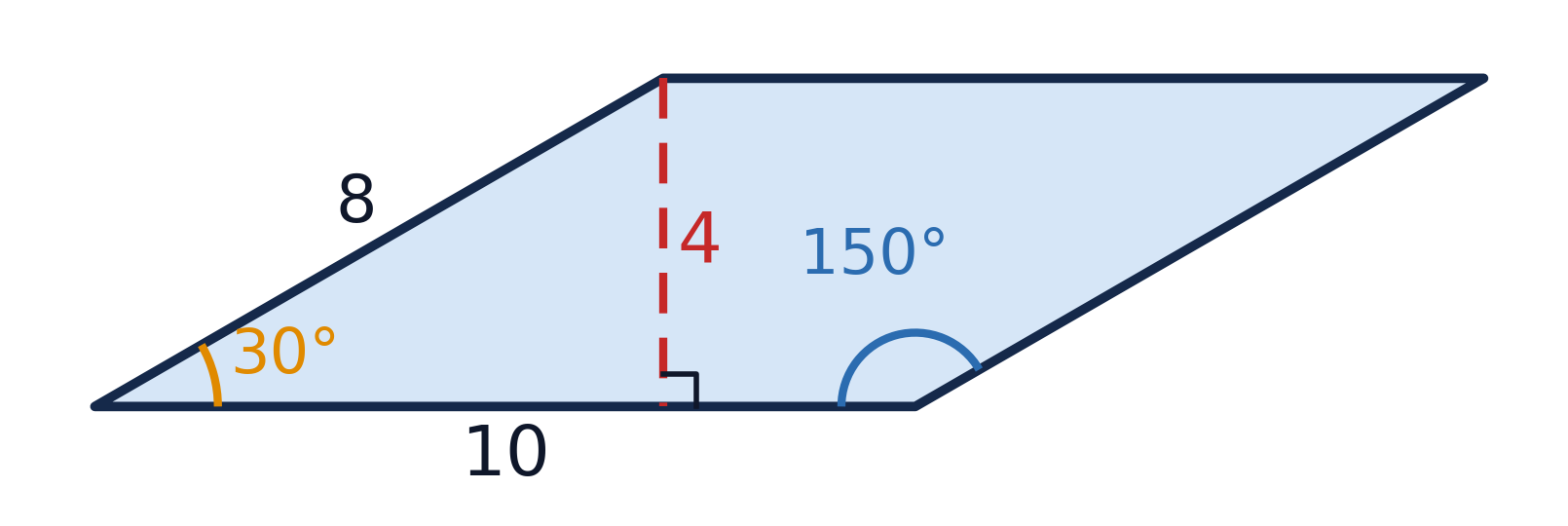
If two adjacent sides a and b and the angle \theta between them are known, the height on side a is b \sin\theta. So
\text{Area} = ab \sin\theta
In the figure, the height is 8 \sin 30^\circ = 4 and the area is 10 \times 4 = 40.
If the angle given is obtuse. Two neighbouring angles of a parallelogram add up to 180^\circ. If the angle given is 150^\circ, the next angle is 30^\circ. Use the acute one: both give the same height. (In the language of trigonometry, \sin 150^\circ = \sin 30^\circ.)
A diagonal cuts a parallelogram into two triangles of equal area. This is why the triangle formula \frac{1}{2}ab \sin\theta of Chapter A6-1 is half of this one.
3. Rhombus and kite
A rhombus is a parallelogram with four equal sides. Its diagonals cut each other in half at right angles. They make four equal right-angled triangles.
\text{Area of a rhombus} = \frac{1}{2} \times d_1 \times d_2, \qquad (\text{side})^2 = \left(\frac{d_1}{2}\right)^2 + \left(\frac{d_2}{2}\right)^2
Here d_1 and d_2 are the diagonals. For diagonals 24 and 10: area \frac{1}{2} \times 24 \times 10 = 120, and the side is \sqrt{12^2 + 5^2} = 13.
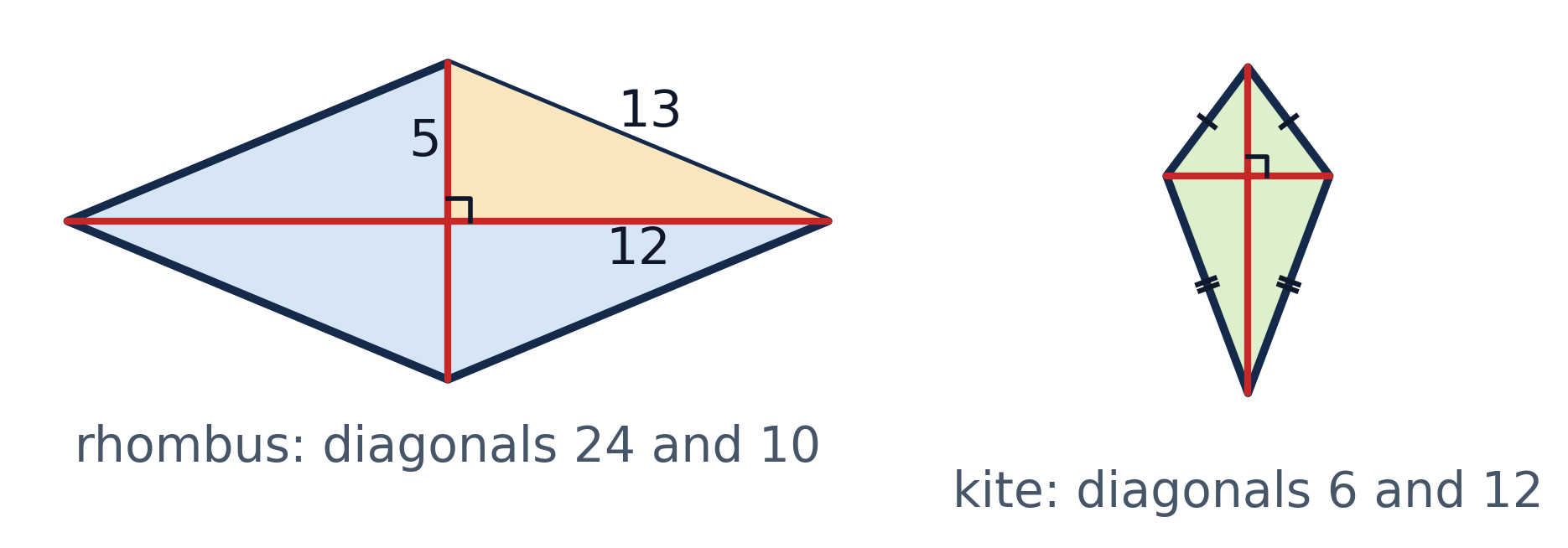
The same area formula holds for a kite (two pairs of equal sides next to each other) and for any quadrilateral whose diagonals cross at right angles. The reason: one diagonal cuts the figure into two triangles on that diagonal as base, and their two heights add up to the other diagonal.
A rhombus is also a parallelogram, so its area is base \times height as well. A square is a rhombus: its area \frac{1}{2}d \times d is the result of section 1.
4. Trapezium
A trapezium has one pair of parallel sides, a and b. Its height h is the distance between them.
\text{Area} = \frac{1}{2}(a + b) \times h
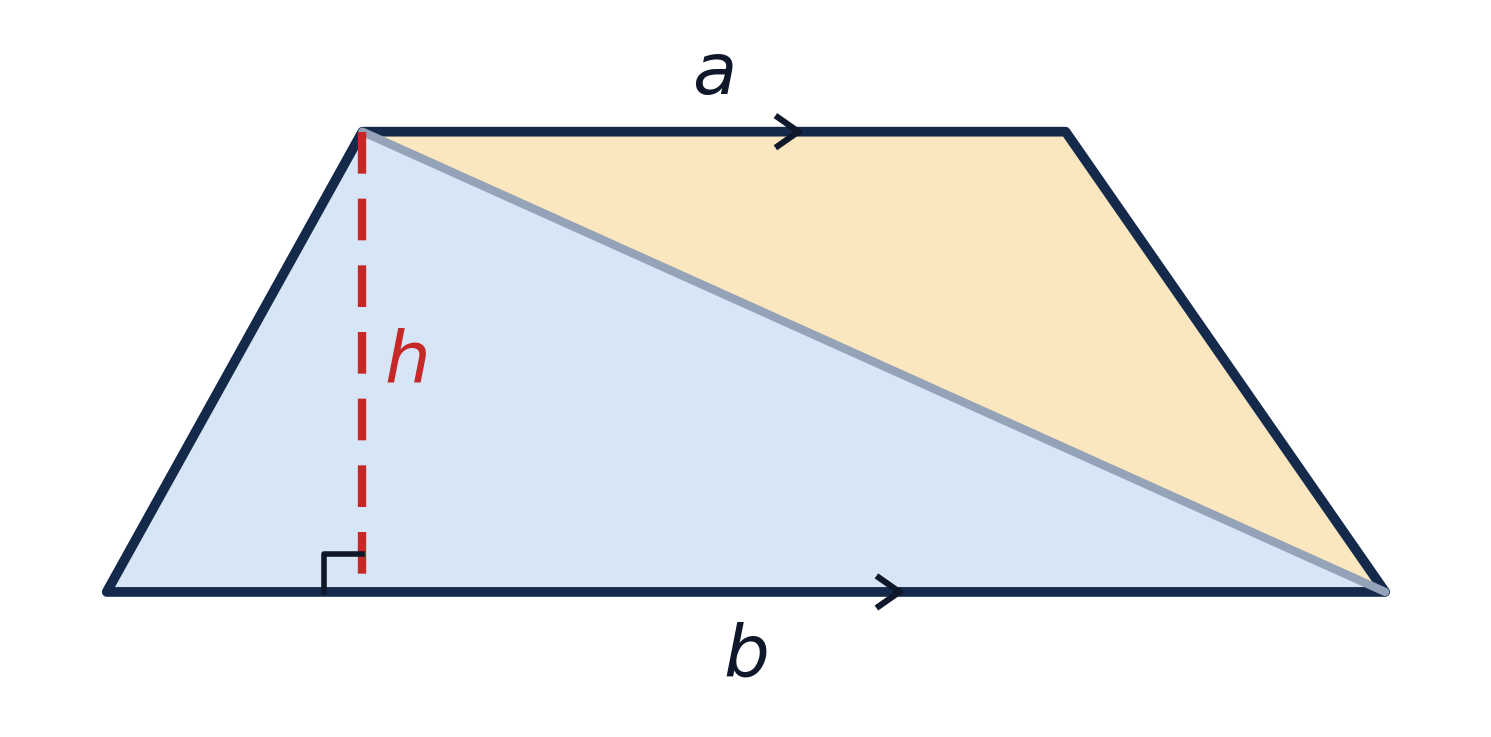
The figure shows why: the two triangles have areas \frac{1}{2}ah and \frac{1}{2}bh. For parallel sides 10 and 6 and height 5, the area is \frac{1}{2} \times 16 \times 5 = 40.
If the height is not given, drop perpendiculars from the ends of the shorter parallel side and use Pythagoras (Example 4).
5. Paths and borders
Find these by taking away, not by adding strips.
- Path all round, outside. A lawn 30 m by 20 m has a path 2 m wide round it. The outer rectangle is 34 m by 24 m, because the path adds its width twice to each side. Path = 34 \times 24 - 30 \times 20 = 216 square m.
- Path all round, inside. The inner rectangle is 26 m by 16 m. Path = 600 - 26 \times 16 = 184 square m.
- Two roads crossing, each parallel to a side. With roads 2 m wide: 2 \times 30 + 2 \times 20 - 2 \times 2 = 96 square m. The small square where they cross is counted twice, so take it away once.
6. Split-up figures and the field book
A figure with many sides is cut into triangles, rectangles and trapeziums. Find each piece and add. Or put the figure in a rectangle and take away the corners (Example 5). Use whichever needs fewer pieces.
A field book is the way a surveyor records a field. A straight base line is measured across the field, here from A to D. At some points along it, the surveyor measures the distance straight out, at right angles, to a corner of the field. These distances are called offsets. The record is read from the bottom up: the middle column is the distance from A along the base line, and the side columns are the offsets to the left and to the right.
| Left of the base line | Along AD, in metres | Right of the base line |
|---|---|---|
| To D: 200 | ||
| 60 to E | 140 | |
| 100 | 50 to C | |
| 40 | 30 to B | |
| From A |
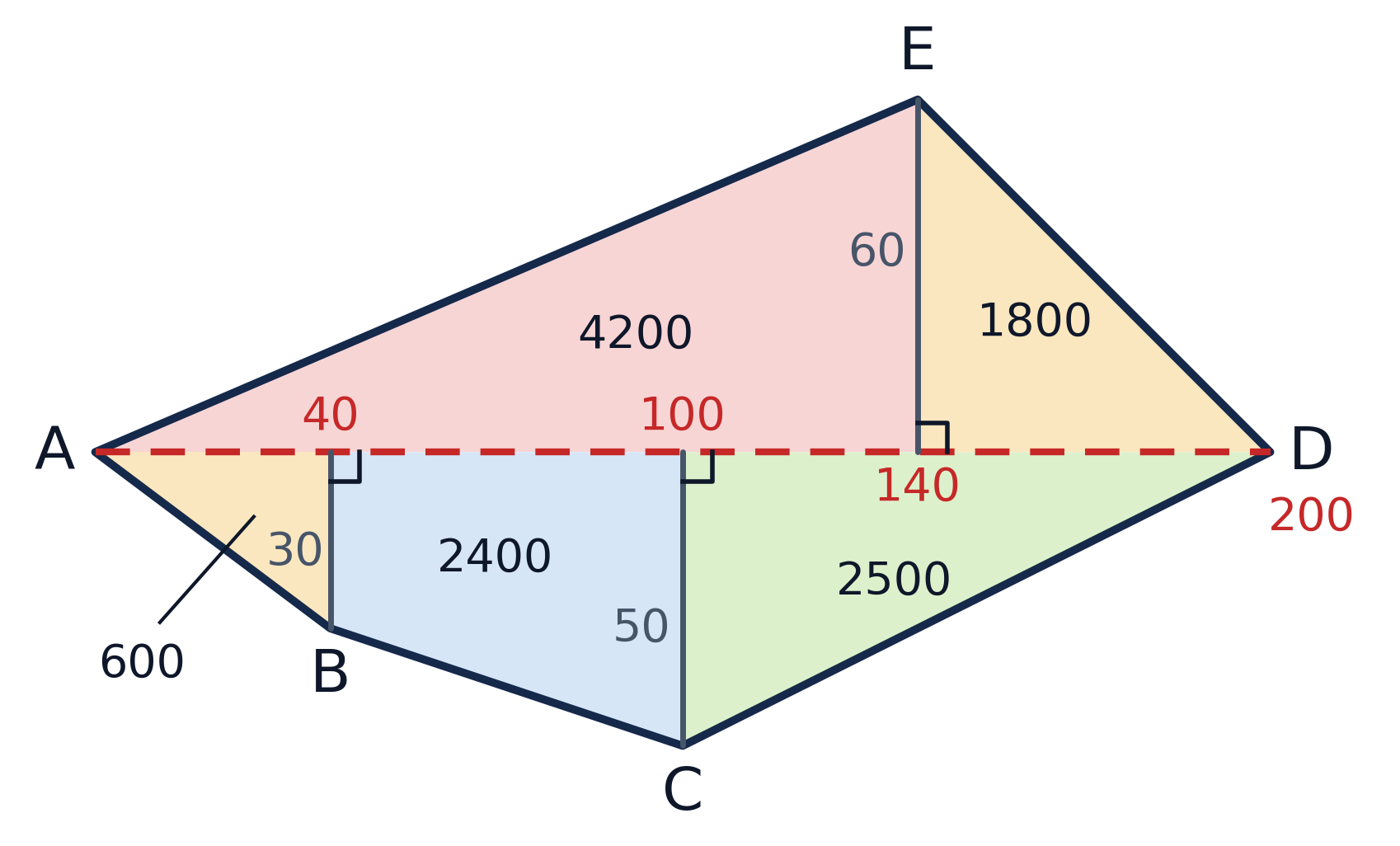
Draw a rough sketch. The base line and the offsets cut the field into right-angled triangles and trapeziums. The parallel sides of each trapezium are two offsets, and its height is the distance between them along the base line.
| Piece | Working | Area (square m) |
|---|---|---|
| Triangle from A to B | \frac{1}{2} \times 40 \times 30 | 600 |
| Trapezium between B and C | \frac{1}{2}(30 + 50) \times (100 - 40) | 2400 |
| Triangle from C to D | \frac{1}{2} \times (200 - 100) \times 50 | 2500 |
| Triangle from A to E | \frac{1}{2} \times 140 \times 60 | 4200 |
| Triangle from E to D | \frac{1}{2} \times (200 - 140) \times 60 | 1800 |
| Whole field | 11500 |
The formulas in one table
| Figure | Area | Also useful |
|---|---|---|
| Rectangle | lb | perimeter 2(l + b); diagonal \sqrt{l^2 + b^2} |
| Square | a^2 or \frac{1}{2}(\text{diagonal})^2 | perimeter 4a; diagonal a\sqrt{2} |
| Parallelogram | base \times height, or ab \sin\theta | neighbouring angles add up to 180^\circ |
| Rhombus, kite | \frac{1}{2}d_1 d_2 | rhombus: (\text{side})^2 = \left(\frac{d_1}{2}\right)^2 + \left(\frac{d_2}{2}\right)^2 |
| Trapezium | \frac{1}{2}(a + b)h | a, b are the parallel sides |
Worked examples
Example 1. The perimeter of a rectangle is 46 cm and its diagonal is 17 cm. Find its area.
l + b = 23 and l^2 + b^2 = 17^2 = 289. From (l + b)^2 = l^2 + b^2 + 2lb: 529 = 289 + 2lb, so lb = 120 square cm. (The sides are 15 and 8.) This is the method of Chapter A6-1, section 2.
Example 2. The adjacent sides of a parallelogram are 12 cm and 9 cm, and one of its angles is 120^\circ. Find the area, and the height on the side of 12 cm.
The neighbouring angle is 60^\circ. Height on the 12 cm side = 9 \sin 60^\circ = \frac{9\sqrt{3}}{2} cm. Area = 12 \times \frac{9\sqrt{3}}{2} = 54\sqrt{3} square cm.
Example 3. The perimeter of a rhombus is 52 cm and one diagonal is 24 cm. Find the area.
The side is 52 \div 4 = 13 cm. Half the known diagonal is 12. Half the other diagonal is \sqrt{13^2 - 12^2} = 5, so the other diagonal is 10 cm. Area = \frac{1}{2} \times 24 \times 10 = 120 square cm.
Example 4. The parallel sides of a trapezium are 10 cm and 22 cm. Each of the other two sides is 10 cm. Find the area.
Drop perpendiculars from the ends of the shorter side. They cut the longer side into 6, 10 and 6, because (22 - 10) \div 2 = 6. The height is \sqrt{10^2 - 6^2} = 8 cm. Area = \frac{1}{2}(10 + 22) \times 8 = 128 square cm.
Example 5. ABCD is a square of side 12 cm. M is the mid-point of AB, and N is the point on BC with BN = 4 cm. Find the area of triangle DMN.
Take away the three corner triangles from the square. Triangle ADM has perpendicular sides 12 and 6: area 36. Triangle MBN has 6 and 4: area 12. Triangle NCD has 8 and 12: area 48. So triangle DMN = 144 - 36 - 12 - 48 = 48 square cm.
From the real papers
These six questions are from the Elementary Mathematics papers (Series A). The first four agree with the final official key. The last two agree with the provisional keys of CDS I 2026 and CDS II 2026. Try each for 72 seconds before reading the solution.
CDS I 2024, Q50. In a quadrilateral ABCD, AB = BC and CD = DA; AC and BD are diagonals such that AC = 6 cm and BD = 12 cm. What is the area of the quadrilateral?
(a) 24 square cm (b) 30 square cm (c) 36 square cm (d) 40 square cm
Solution. Two pairs of equal sides next to each other: ABCD is a kite, the one in the second figure. Its diagonals cross at right angles. Area = \frac{1}{2} \times 6 \times 12 = 36 square cm. Answer (c).
CDS I 2025, Q17. The adjacent sides of a parallelogram are 10 cm and 8 cm and the angle between them is 150°. What is the area of the parallelogram?
(a) 40\sqrt{3} square cm (b) 40 square cm (c) 20\sqrt{3} square cm (d) 20 square cm
Solution. This is the parallelogram in the first figure. The neighbouring angle is 30^\circ, so the height on the 10 cm side is 8 \sin 30^\circ = 4 cm. Area = 10 \times 4 = 40 square cm. Answer (b). Option (d) is the area of the triangle, half of this.
CDS I 2025, Q56. Consider the following for the next two (02) items that follow : A circle M of radius 8 cm touches externally with another circle N of radius 16 cm. Let P, Q be the points where the common tangent touches the circles M and N respectively.
If U, V are the centres of the circles M and N respectively, then what is the area of the quadrilateral formed by the points P, Q, V and U?
(a) 192\sqrt{2} square cm (b) 192 square cm (c) 96\sqrt{2} square cm (d) 96 square cm
Solution. A radius drawn to the point of contact is perpendicular to the tangent. So UP = 8 and VQ = 16 are both perpendicular to PQ. They are parallel, and PQVU is a trapezium with height PQ. To find PQ, draw a line from U parallel to PQ to meet VQ. It makes a right-angled triangle with hypotenuse UV = 8 + 16 = 24 and one side 16 - 8 = 8. So PQ = \sqrt{24^2 - 8^2} = \sqrt{512} = 16\sqrt{2} cm. Area = \frac{1}{2}(8 + 16) \times 16\sqrt{2} = 192\sqrt{2} square cm. Answer (a).
CDS II 2025, Q86. A Question is given followed by two Statements I and II. Consider the Question and the Statements.
Question: ABCD is a parallelogram with \angle ABC = 60^\circ. If the area of the parallelogram is 7\sqrt{3} square units, then what is the perimeter of the parallelogram?
Statement-I: The lengths of the sides AB and DA are prime numbers.
Statement-II: The lengths of the sides are natural numbers each greater than 1 unit.
Which one of the following is correct in respect of the above Question and the Statements?
(a) The Question can be answered by using one of the Statements alone, but cannot be answered using the other Statement alone (b) The Question can be answered by using either Statement alone (c) The Question can be answered by using both the Statements together, but cannot be answered using either Statement alone (d) The Question can be answered even without using any of the Statements
Solution. Area = AB \times BC \times \sin 60^\circ = 7\sqrt{3}, so AB \times BC = 7\sqrt{3} \div \frac{\sqrt{3}}{2} = 14. Many pairs of lengths have product 14, so the Question alone is not enough. Statement I: DA = BC, and two primes with product 14 must be 2 and 7. The perimeter is 2(2 + 7) = 18. Statement II: two natural numbers greater than 1 with product 14 must again be 2 and 7. The perimeter is 18. Either Statement alone is enough. Answer (b).
CDS I 2026, Q62. A square and a rectangle have the same perimeter p and their areas differ by q units. What is the square of the difference between the length and breadth of the rectangle?
(a) 1·5q (b) 2q (c) 2·5q (d) 4q
Solution. The side of the square is \frac{l + b}{2}, so its area is \left(\frac{l + b}{2}\right)^2. By section 1, the gap between the two areas is q = \left(\frac{l - b}{2}\right)^2 = \frac{(l - b)^2}{4}. So (l - b)^2 = 4q. Check with the square 10 by 10 and the rectangle 12 by 8: q = 4 and (12 - 8)^2 = 16. Answer (d).
CDS II 2026, Q52. The area of a rhombus is 720 \text{cm}^2 and the sum of its diagonals is 98 cm. What is the perimeter of the rhombus?
(a) 160 cm (b) 164 cm (c) 168 cm (d) 172 cm
Solution. \frac{1}{2}d_1 d_2 = 720, so d_1 d_2 = 1440. Then d_1^2 + d_2^2 = (d_1 + d_2)^2 - 2d_1 d_2 = 98^2 - 2880 = 9604 - 2880 = 6724. The side satisfies (\text{side})^2 = \frac{d_1^2 + d_2^2}{4} = 1681, so the side is 41 cm. Perimeter = 4 \times 41 = 164 cm. Answer (b). You did not need the diagonals themselves (they are 80 and 18).
Two of the six turned on the same identity, (x + y)^2 = x^2 + y^2 + 2xy. Keep it ready whenever a sum and a product appear together.
Mistakes that cost marks
- Using the slant side as the height of a parallelogram. Sides 10 and 8 with 30^\circ between them give area 10 \times 8 \times \sin 30^\circ = 40, not 80.
- Forgetting the half for a rhombus or a kite. The area is \frac{1}{2}d_1 d_2. The product d_1 d_2 is the area of the rectangle drawn round it.
- Adding the path width once. A path of width 2 m all round a lawn 30 m by 20 m makes the outer rectangle 34 m by 24 m, not 32 m by 22 m.
- Using the side in place of the height of a trapezium. The height is the perpendicular distance between the parallel sides. Find it by Pythagoras if it is not given.
Quick check
Do these without help. Answers are at the end.
- The diagonal of a square is 10 cm. Find its area.
- The adjacent sides of a parallelogram are 14 cm and 10 cm and the angle between them is 30^\circ. Find the area.
- The diagonals of a rhombus are 16 cm and 30 cm. Find its area and its perimeter.
- The parallel sides of a trapezium are 13 cm and 7 cm and the distance between them is 6 cm. Find the area.
- A rectangular hall 40 m by 30 m has a strip 2.5 m wide all round, inside it. Find the area of the strip.
Read and watch more, free
The current NCERT Class 8 book has one chapter on these areas. The older Class 8 chapter, still on the NCERT server, has more drill. The NIOS lesson is the fullest single source. School books no longer teach the field book in detail; for that, use section 6 of this lesson.
| What | Where | Language |
|---|---|---|
| Textbook, rectangle, parallelogram, rhombus, trapezium | NCERT Class 8 Ganita Prakash Part II, Chapter 7 Area · Hindi edition | English, Hindi |
| Textbook, the older chapter with more practice | NCERT Class 8 Mathematics (older book), Chapter 9 Mensuration · Hindi edition | English, Hindi |
| Self-study notes | NIOS Secondary Mathematics (211), Lesson 20 Perimeters and Area of Plane Figures · Hindi edition | English, Hindi |
| Practice with answers | NCERT Exemplar Class 8, Unit 11 Mensuration · Hindi edition | English, Hindi |
| Short videos with practice | Khan Academy, NCERT Math Class 8 (the mensuration unit) | English |
| The real papers | UPSC previous question papers | English, Hindi |
| Video, numbered classes | Chandigarh Career Group: CDS advance maths by Sandeep Brar (the geometry and mensuration classes) | Hinglish |
| Video, a full CDS course | R.S SIR: Maths Playlist for CDS 2025 (the eight mensuration lessons, about 55 minutes each) | Hindi and Hinglish |
| Video, one long lesson with past questions | The Journey Extraordinary: Maths For CDS 2 2026 (the 2-D mensuration lesson, about 4 hours) | Hinglish |
The videos were chosen from their titles, length and views; they have not yet been watched by a teacher.
Answers to the quick check
- \frac{10^2}{2} = 50 square cm.
- 14 \times 10 \times \sin 30^\circ = 70 square cm.
- Area = \frac{1}{2} \times 16 \times 30 = 240 square cm. Side = \sqrt{8^2 + 15^2} = 17 cm, so the perimeter is 68 cm.
- \frac{1}{2}(13 + 7) \times 6 = 60 square cm.
- The inner rectangle is 35 m by 25 m. Strip = 40 \times 30 - 35 \times 25 = 1200 - 875 = 325 square m.
Next chapter: Circle: circumference, area, sector and segment.