Why this chapter matters. This chapter gave 10 questions in the 6 papers from CDS I 2024 to CDS II 2026: CDS I 2025 had four, and two of the papers had none. (One of the 10 was later dropped by UPSC.) Five are on the cone: its volume or its canvas when the angle at the vertex is given, or a tent. Two are on the cylinder, two on the frustum, and one moves earth from a well into a cone. The formulas must be known by heart; the question then turns on finding the radius, the height and the slant height from what is given.
What you will be able to do
- Find the curved surface, total surface and volume of a cylinder and a cone.
- Find the radius, height and slant height of a cone from one another, or from the angle at the vertex.
- Find the slant height, surface and volume of a frustum, and see it as a large cone with a small cone cut off.
- Solve questions where a volume stays the same: water poured into a tank, earth spread into a heap.
Before you start you should know: the circumference and area of a circle (Chapter A6-3), Pythagoras' theorem and similar triangles (Chapter A5-3), the sine and cosine of 30, 45 and 60 degrees (Chapter A4-2), and the units of volume (Chapter A6-4).
1. The cylinder
A right circular cylinder has two equal circular ends and stands upright, like a tin or a pipe. Let its radius be r and its height h.
\text{Volume} = \pi r^2 h
\text{Curved surface} = 2\pi r h, \qquad \text{Total surface} = 2\pi r h + 2\pi r^2 = 2\pi r (r + h)
The volume is the area of the base times the height, as for a cuboid.
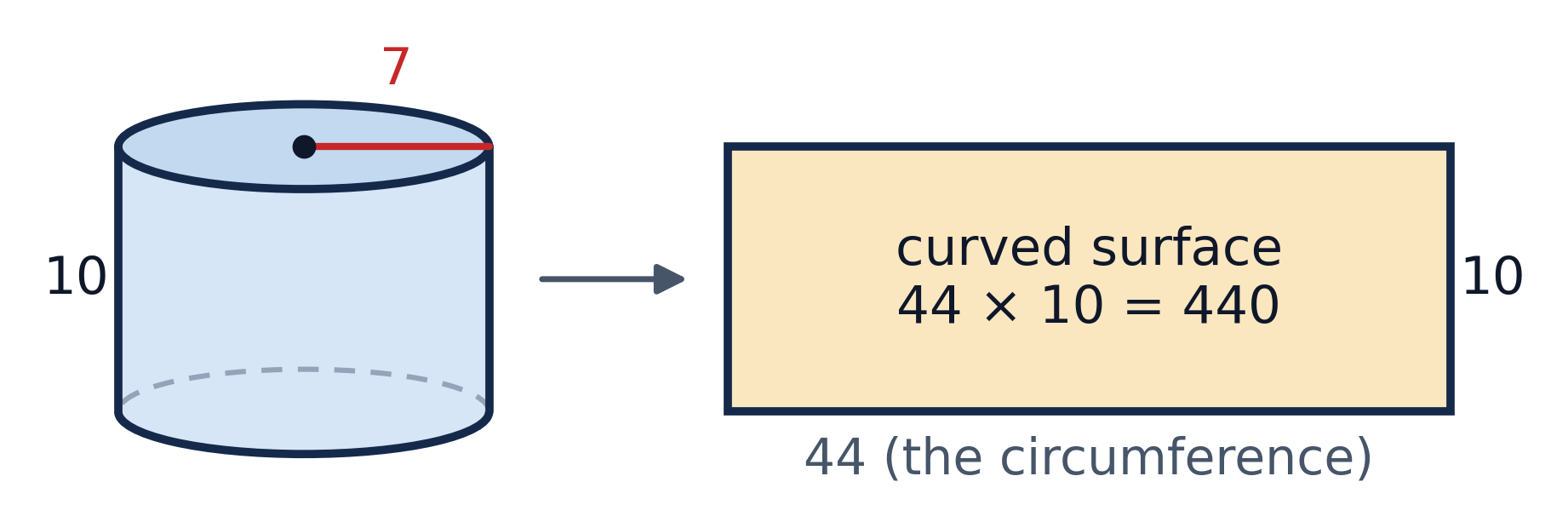
The figure shows where the curved surface comes from. Cut the curved surface along its height and open it flat. It becomes a rectangle whose sides are the circumference 2\pi r and the height h. For r = 7, h = 10 and \pi = \frac{22}{7}: curved surface 440, total surface 440 + 2 \times 154 = 748, volume 154 \times 10 = 1540.
Two uses:
- A pipe (a hollow cylinder) with outer radius R and inner radius r has material \pi (R^2 - r^2) h. This is the ring of Chapter A6-3 times the length.
- Water in a cylindrical tank. Rise of the level = volume poured in \div area of the base, \pi r^2.
2. The cone
A right circular cone has a circular base and a point, the vertex, straight above the centre of the base. Besides the radius r and the height h it has a slant height l, measured along the sloping side from the vertex to the edge of the base.
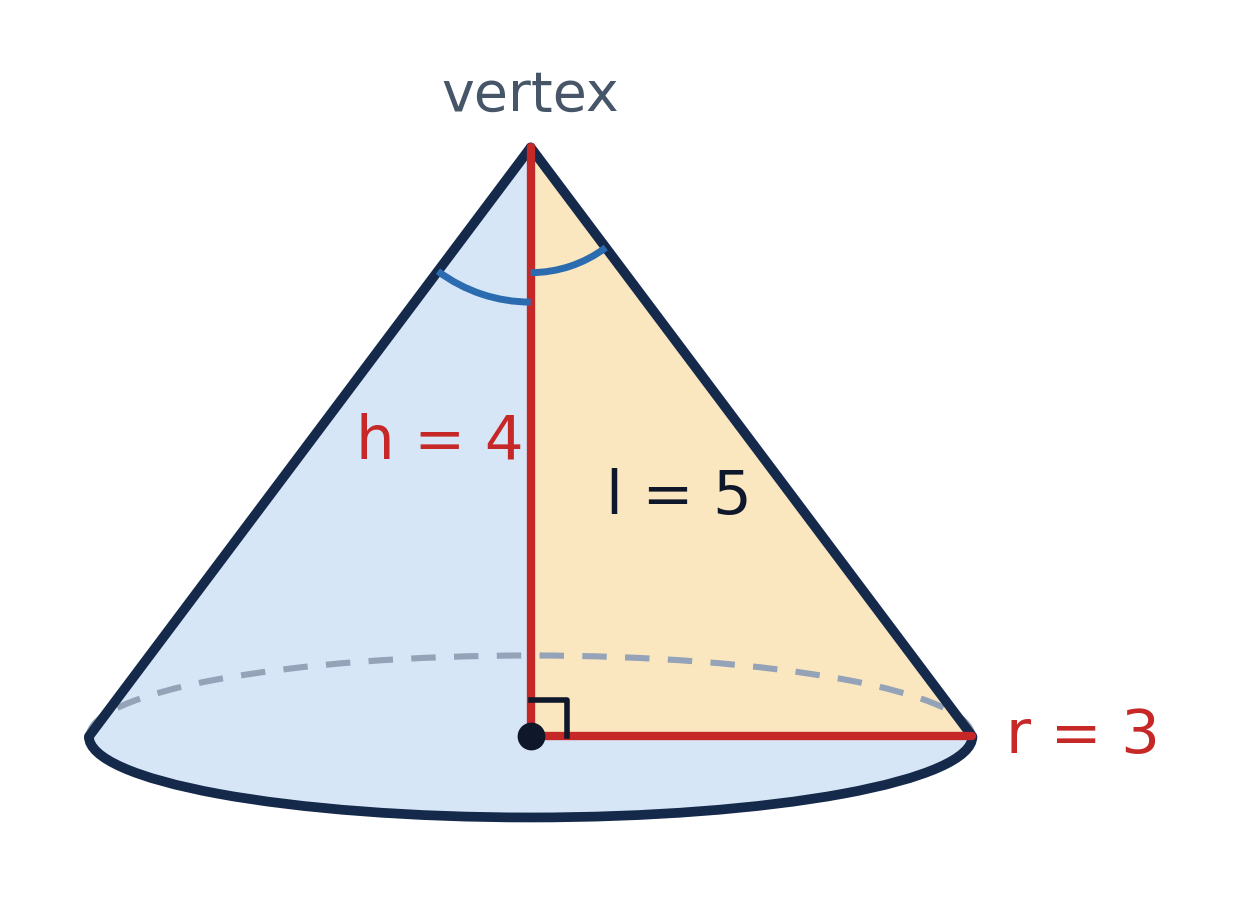
The radius, height and slant height make a right-angled triangle, so
l^2 = r^2 + h^2
\text{Volume} = \frac{1}{3}\pi r^2 h
\text{Curved surface} = \pi r l, \qquad \text{Total surface} = \pi r l + \pi r^2 = \pi r (l + r)
For r = 3 and h = 4: l = 5, volume \frac{1}{3}\pi \times 9 \times 4 = 12\pi, curved surface 15\pi, total surface 24\pi.
Volume uses h. Curved surface uses l. This is the commonest slip in the chapter. The canvas of a conical tent is its curved surface.
A cone is one-third of a cylinder. A cone and a cylinder on the same base and of the same height have volumes in the ratio 1 : 3.
The angle at the vertex. Cut the cone through its vertex and the centre of its base. The cut face is an isosceles triangle with base 2r, height h and equal sides l. The height cuts the angle at the vertex into two halves. In the right-angled triangle of the figure, with half the vertex angle called \alpha:
r = l \sin\alpha, \qquad h = l \cos\alpha
| Angle at the vertex | Half of it | Radius | Height |
|---|---|---|---|
| 60^\circ | 30^\circ | \frac{1}{2}l | \frac{\sqrt{3}}{2}l |
| 90^\circ | 45^\circ | \frac{1}{\sqrt{2}}l | \frac{1}{\sqrt{2}}l |
| 120^\circ | 60^\circ | \frac{\sqrt{3}}{2}l | \frac{1}{2}l |
When the angle at the vertex is 60^\circ the cut face is an equilateral triangle: l = 2r and h = \sqrt{3}\,r.
3. When the measurements change
The volume of a cylinder or a cone has r^2 and h in it. So doubling the radius alone makes the volume 4 times. Doubling the height alone makes it 2 times. Doubling both makes it 8 times.
4. The frustum
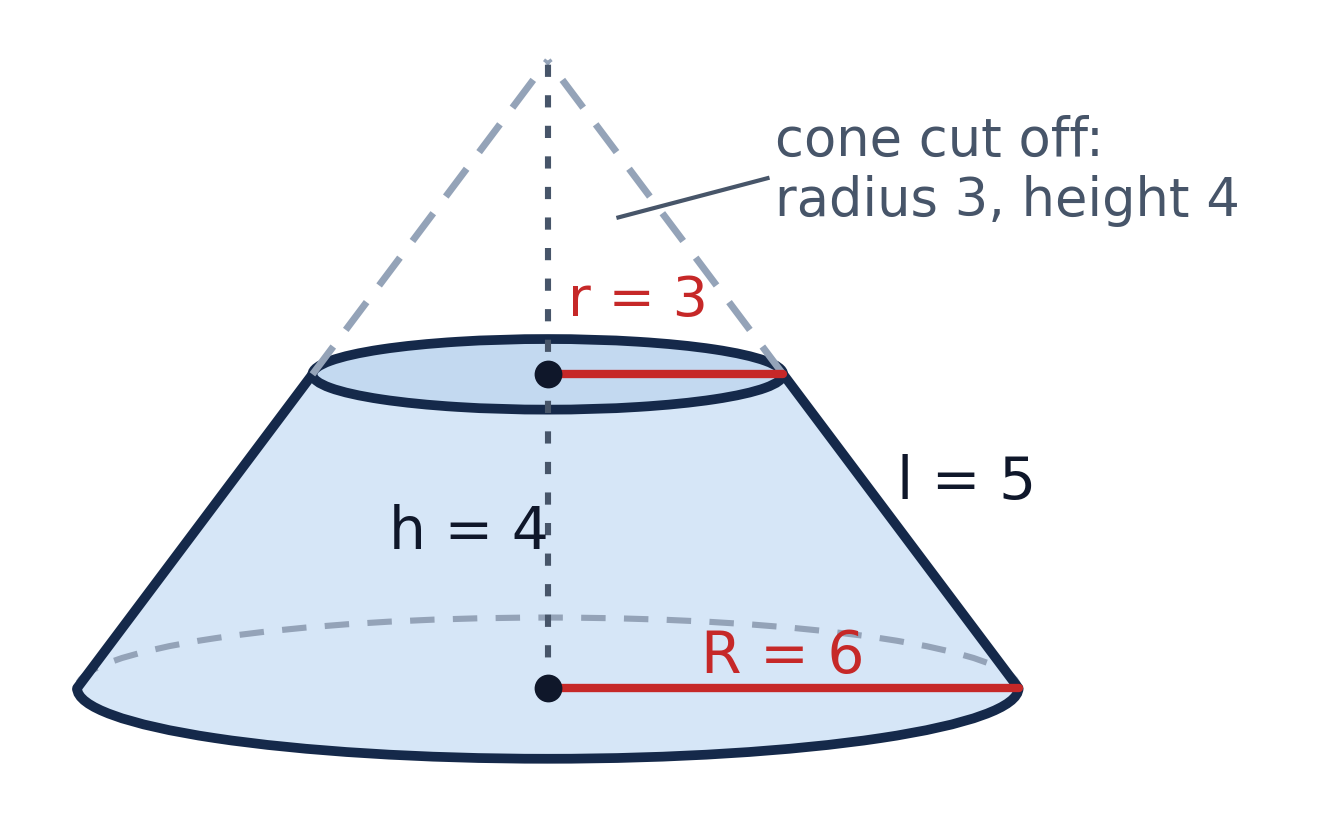
Cut a cone by a plane parallel to its base and take away the small cone at the top. What is left is a frustum, the shape of a bucket. It has two circular ends of radii R and r, a height h and a slant height l.
l^2 = h^2 + (R - r)^2
\text{Volume} = \frac{1}{3}\pi h \,(R^2 + r^2 + Rr)
\text{Curved surface} = \pi (R + r)\, l
The total surface adds the two ends: \pi (R + r) l + \pi R^2 + \pi r^2.
For R = 6, r = 3 and h = 4: l = \sqrt{16 + 9} = 5, volume \frac{1}{3}\pi \times 4 \times (36 + 9 + 18) = 84\pi, curved surface \pi \times 9 \times 5 = 45\pi, total surface 45\pi + 36\pi + 9\pi = 90\pi.
The frustum as a difference. The small cone cut off is similar to the whole cone: its radius and height are in the same ratio. In the figure the whole cone has radius 6 and height 8, and the small cone has radius 3 and height 4. Whole cone = \frac{1}{3}\pi \times 36 \times 8 = 96\pi. Small cone = \frac{1}{3}\pi \times 9 \times 4 = 12\pi. Frustum = 96\pi - 12\pi = 84\pi, as before.
If the small cone has \frac{1}{2} the height of the whole cone, it has \left(\frac{1}{2}\right)^3 = \frac{1}{8} of its volume. The frustum is the other \frac{7}{8}.
The formulas in one table
| Solid | Volume | Curved surface | Total surface |
|---|---|---|---|
| Cylinder | \pi r^2 h | 2\pi r h | 2\pi r (r + h) |
| Cone, with l^2 = r^2 + h^2 | \frac{1}{3}\pi r^2 h | \pi r l | \pi r (l + r) |
| Frustum, with l^2 = h^2 + (R - r)^2 | \frac{1}{3}\pi h (R^2 + r^2 + Rr) | \pi (R + r) l | curved +\ \pi R^2 + \pi r^2 |
Worked examples
Example 1. A cylinder has radius 7 cm and height 10 cm. Find its curved surface, total surface and volume. (Take \pi = \frac{22}{7}.)
Curved surface = 2 \times \frac{22}{7} \times 7 \times 10 = 440 square cm. Total surface = 2 \times \frac{22}{7} \times 7 \times (7 + 10) = 748 square cm. Volume = \frac{22}{7} \times 49 \times 10 = 1540 cubic cm.
Example 2. A cone has radius 6 cm and height 8 cm. Find its slant height, curved surface and volume.
l = \sqrt{36 + 64} = 10 cm. Curved surface = \pi \times 6 \times 10 = 60\pi square cm. Volume = \frac{1}{3}\pi \times 36 \times 8 = 96\pi cubic cm.
Example 3. A conical tent is 24 m high and its base has radius 7 m. How much canvas does it need? If the canvas is 5 m wide, what length is needed? (Take \pi = \frac{22}{7}.)
l = \sqrt{49 + 576} = \sqrt{625} = 25 m. Canvas = \frac{22}{7} \times 7 \times 25 = 550 square m. Length = 550 \div 5 = 110 m.
Example 4. A bucket is a frustum with radii 6 cm and 3 cm and height 4 cm. Find its slant height and its volume.
This is the frustum of section 4: l = 5 cm and volume = \frac{1}{3}\pi \times 4 \times 63 = 84\pi cubic cm.
Example 5. A cone of radius 6 cm and height 12 cm is cut by a plane parallel to its base, half-way up. Find the volumes of the two parts.
The small cone at the top has radius 3 and height 6: volume \frac{1}{3}\pi \times 9 \times 6 = 18\pi. The whole cone is \frac{1}{3}\pi \times 36 \times 12 = 144\pi. The frustum is 144\pi - 18\pi = 126\pi cubic cm. The two parts are in the ratio 1 : 7.
From the real papers
These six questions are from the Elementary Mathematics papers (Series A). The first four agree with the final official key. The last two agree with the provisional key of CDS II 2026. Try each for 72 seconds before reading the solution.
CDS I 2025, Q52. Consider the following for the next two (02) items that follow : A frustum of a right cone has a top of diameter 2k, bottom of diameter 2.5k and height k.
What is the volume of the frustum?
(a) 61\pi k^3/48 (b) 59\pi k^3/48 (c) 57\pi k^3/48 (d) 53\pi k^3/48
Solution. The question gives diameters. The radii are r = k and R = 1.25k = \frac{5k}{4}, and h = k. Volume = \frac{1}{3}\pi k \left( \frac{25k^2}{16} + k^2 + \frac{5k^2}{4} \right) = \frac{\pi k^3}{3} \times \frac{25 + 16 + 20}{16} = \frac{61\pi k^3}{48}. Answer (a). (The other question of this pair, Q51, was dropped by UPSC.)
CDS I 2025, Q69. Consider the following for the next two (02) items that follow : The angle at the vertex of a conical body is 120°.
What is the ratio of the radius of the conical body to its slant height?
(a) 1 : 2 (b) \sqrt{3} : 1 (c) \sqrt{3} : 2 (d) \sqrt{2} : 1
Solution. Half the angle at the vertex is 60^\circ. By section 2, \frac{r}{l} = \sin 60^\circ = \frac{\sqrt{3}}{2}. So r : l = \sqrt{3} : 2. Answer (c). Option (a) is \sin 30^\circ, which is the answer for an angle of 60^\circ at the vertex.
CDS I 2025, Q70. Consider the following for the next two (02) items that follow : The angle at the vertex of a conical body is 120°.
If the sum of slant height, height and radius is (9 + 3\sqrt{3}) cm, then what is the volume of the cone?
(a) 27\pi cubic cm (b) 18\sqrt{3}\pi cubic cm (c) 24\pi cubic cm (d) 27\sqrt{3}\pi cubic cm
Solution. From the table, r = \frac{\sqrt{3}}{2}l and h = \frac{1}{2}l. The sum is l + \frac{l}{2} + \frac{\sqrt{3}}{2}l = \frac{(3 + \sqrt{3})\,l}{2}. The sum given is 9 + 3\sqrt{3} = 3(3 + \sqrt{3}). So \frac{l}{2} = 3 and l = 6 cm. Then h = 3 cm and r = 3\sqrt{3} cm. Volume = \frac{1}{3}\pi \times 27 \times 3 = 27\pi cubic cm. Answer (a).
CDS II 2025, Q62. The sum of the height and the radius of a right circular cylinder is 21 cm, and the radius is less than the height. If the curved surface area of the cylinder is 616 cm^2, then what is the volume of the cylinder? (Take \pi = 22/7)
(a) 1078 cm^3 (b) 1617 cm^3 (c) 1927 cm^3 (d) 2156 cm^3
Solution. 2\pi r h = 616 gives rh = 616 \times \frac{7}{44} = 98. Also r + h = 21. Two numbers with sum 21 and product 98 are 7 and 14. The radius is the smaller, so r = 7 and h = 14. Volume = \frac{22}{7} \times 49 \times 14 = 2156 cm^3. Answer (d). The words "the radius is less than the height" decide which of 7 and 14 is the radius.
CDS II 2026, Q56. A well is dug with a diameter of 3·5 m and 16 m depth. The earth soil so excavated is spread in the form of a right circular cone of radius 7 m. What is the height of the cone?
(a) 1·5 m (b) 2 m (c) 2·5 m (d) 3 m
Solution. The earth keeps its volume. The well is a cylinder of radius 1.75 m: volume = \pi \times 1.75^2 \times 16 = \pi \times 3.0625 \times 16 = 49\pi cubic m. The cone has volume \frac{1}{3}\pi \times 49 \times h. So \frac{49\pi h}{3} = 49\pi and h = 3 m. Answer (d). \pi cancelled, so its value was never needed.
CDS II 2026, Q60. A tall cylindrical reservoir kept vertically is 20 m in diameter. Water is poured into it at the rate of 264 \text{m}^3 per hour. What is the rate at which the water level rises in the reservoir per minute? (Take \pi = \frac{22}{7})
(a) 1·0 cm (b) 1·2 cm (c) 1·4 cm (d) 14 cm
Solution. The radius is 10 m, so the base is \frac{22}{7} \times 100 = \frac{2200}{7} square m. In one minute \frac{264}{60} = 4.4 cubic m enters. Rise = 4.4 \div \frac{2200}{7} = \frac{4.4 \times 7}{2200} = 0.014 m = 1.4 cm. Answer (c).
Three of the six gave a diameter where the formula needs a radius. Halve it before anything else.
Mistakes that cost marks
- Using the height in the curved surface of a cone. Curved surface is \pi r l with the slant height. For r = 3, h = 4 it is 15\pi, not 12\pi.
- Forgetting the one-third. A cone is \frac{1}{3}\pi r^2 h. Without the \frac{1}{3} you have found the cylinder.
- Putting a diameter where a radius belongs. "Top of diameter 2k" means r = k.
- Using the whole angle at the vertex. The right-angled triangle inside the cone has half the vertex angle. For 120^\circ at the vertex, use 60^\circ.
Quick check
Do these without help. Answers are at the end.
- The curved surface of a cylinder of height 6 cm is 264 square cm. Find its radius and its volume. (Take \pi = \frac{22}{7}.)
- A cone has radius 5 cm and slant height 13 cm. Find its volume.
- A cylinder and a cone have the same base and the same height. The volume of the cylinder is 90 cubic cm. Find the volume of the cone.
- A frustum has radii 5 cm and 2 cm and height 4 cm. Find its curved surface.
- 154 cubic m of water is poured into a cylindrical tank of radius 7 m. By how much does the level rise? (Take \pi = \frac{22}{7}.)
Read and watch more, free
The new NCERT Class 9 book treats the cylinder and the cone in its chapter on solids. The NIOS lesson is the fullest single source. For the frustum, use section 4 of this lesson.
| What | Where | Language |
|---|---|---|
| Textbook, cylinder and cone | NCERT Class 9 Ganita Manjari Part II, Chapter 14 Math of Space | English (the Hindi edition of Part II was not yet on the NCERT site in October 2026) |
| Textbook, solids joined together | NCERT Class 10 Mathematics, Chapter 12 Surface Areas and Volumes · Hindi edition | English, Hindi |
| Self-study notes | NIOS Secondary Mathematics (211), Lesson 21 Surface Area and Volume of Solid Figures · Hindi edition | English, Hindi |
| Practice with answers | NCERT Exemplar Class 10, Unit 12 Surface Areas and Volumes · Hindi edition | English, Hindi |
| Short videos with practice | Khan Academy, NCERT Math Class 10 (the surface areas and volumes unit) · in Hindi | English, Hindi |
| The real papers | UPSC previous question papers | English, Hindi |
| Video, numbered classes | Chandigarh Career Group: CDS advance maths by Sandeep Brar (the geometry and mensuration classes) | Hinglish |
| Video, a full CDS course | R.S SIR: Maths Playlist for CDS 2025 (the eight mensuration lessons, about 55 minutes each) | Hindi and Hinglish |
| Video, mensuration in four long lessons | Defence Wallah CDS / AFCAT: Quantitative Aptitude CDS 2024 (the mensuration lessons, about 2 hours each) | Hinglish |
The videos were chosen from their titles, length and views; they have not yet been watched by a teacher.
Answers to the quick check
- 2 \times \frac{22}{7} \times r \times 6 = 264 gives r = 7 cm. Volume = \frac{22}{7} \times 49 \times 6 = 924 cubic cm.
- h = \sqrt{169 - 25} = 12 cm. Volume = \frac{1}{3}\pi \times 25 \times 12 = 100\pi cubic cm.
- One-third of 90: 30 cubic cm.
- l = \sqrt{16 + 9} = 5 cm. Curved surface = \pi \times (5 + 2) \times 5 = 35\pi square cm.
- The base is \frac{22}{7} \times 49 = 154 square m. Rise = 154 \div 154 = 1 m.
Next chapter: Sphere and hemisphere; melting and recasting.