Why this chapter matters. This chapter drew 17 real questions in the seven papers from NDA II 2023 to NDA II 2026, the largest share of the unit. They ask for a vector perpendicular to two given vectors, for the area of a parallelogram or a triangle, and for short expansions that use \vec{a} \times \vec{a} = \vec{0} and \vec{b} \times \vec{a} = -\vec{a} \times \vec{b}. Six of them are solved in section 7.
What you will be able to do
- Find \vec{a} \times \vec{b} from components with a determinant.
- Expand cross products without components, using three short rules.
- Find the unit vectors perpendicular to two vectors, and the area of a parallelogram or a triangle.
- Use the link between the cross product and the dot product: |\vec{a} \times \vec{b}|^2 + (\vec{a} \cdot \vec{b})^2 = |\vec{a}|^2|\vec{b}|^2.
Before you start you should know: components and magnitude (Chapter M7-1), the dot product (Chapter M7-2), and how to expand a 3 × 3 determinant (Chapter M2-2).
1. What the cross product is
The cross product (or vector product) of two vectors is
\vec{a} \times \vec{b} = |\vec{a}|\,|\vec{b}|\sin\theta\;\hat{n}
Here \theta is the angle between the vectors, from 0 to \pi, and \hat{n} is the unit vector perpendicular to both \vec{a} and \vec{b}. Its direction is given by the right-hand rule: curl the fingers of your right hand from \vec{a} towards \vec{b}, and the thumb points along \hat{n}.
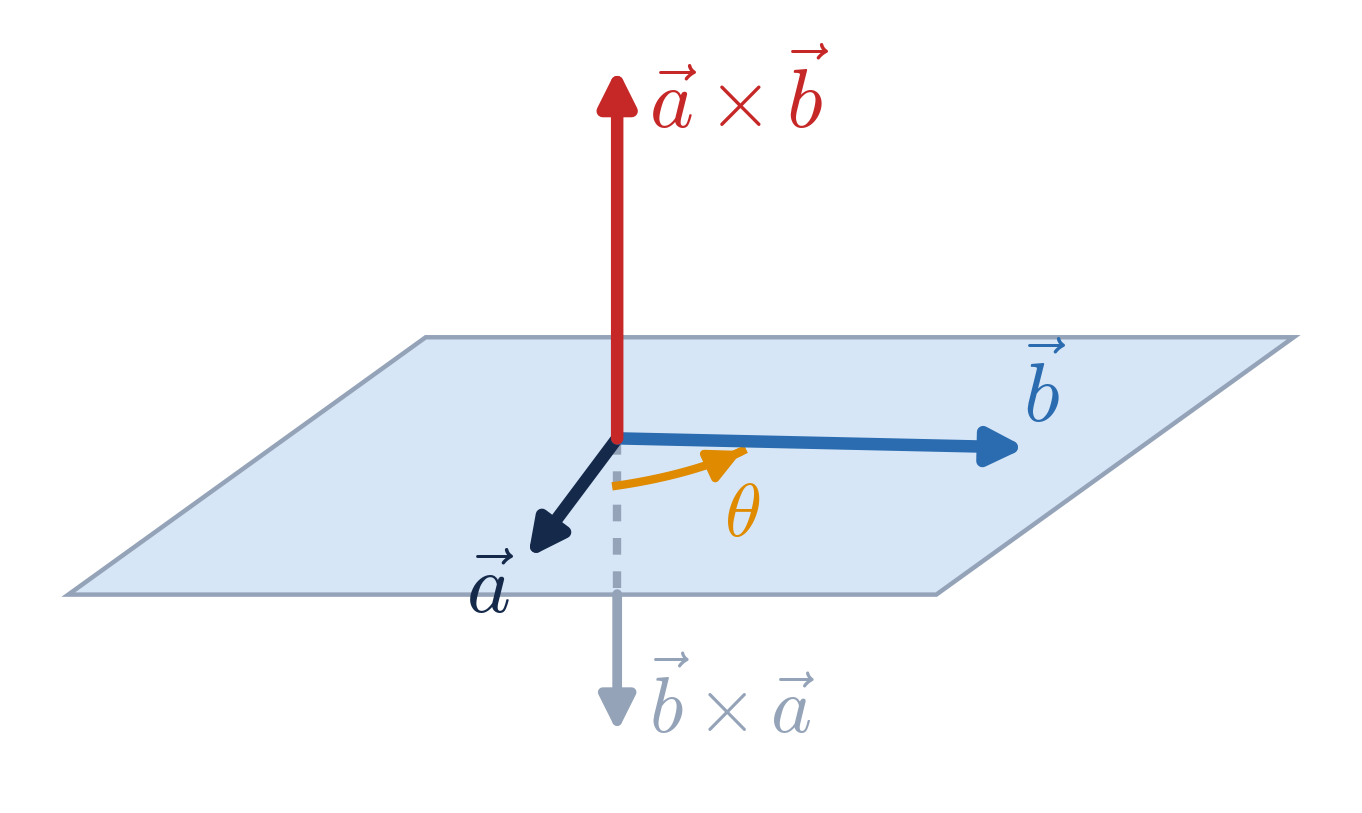
Two things to hold on to:
- The answer is a vector, and it is perpendicular to both \vec{a} and \vec{b}.
- Its magnitude is |\vec{a} \times \vec{b}| = |\vec{a}|\,|\vec{b}|\sin\theta.
2. The unit vectors along the axes
Go round the cycle \hat{i} \to \hat{j} \to \hat{k} \to \hat{i}. Two neighbours in this order give the next one:
\hat{i} \times \hat{j} = \hat{k}, \qquad \hat{j} \times \hat{k} = \hat{i}, \qquad \hat{k} \times \hat{i} = \hat{j}
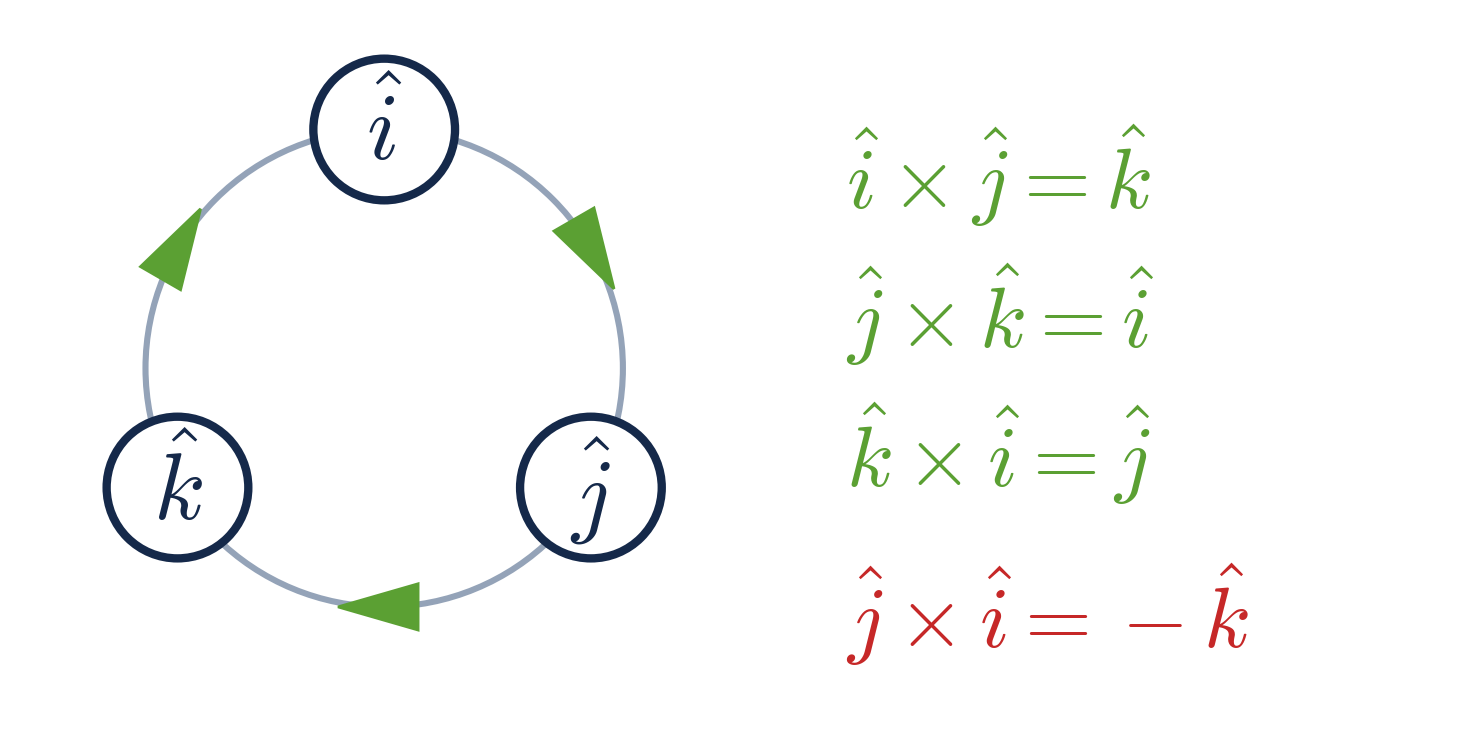
Against the order, the sign changes: \hat{j} \times \hat{i} = -\hat{k}. A vector crossed with itself gives the zero vector: \hat{i} \times \hat{i} = \hat{j} \times \hat{j} = \hat{k} \times \hat{k} = \vec{0}.
3. The cross product in components
For \vec{a} = a_1\hat{i} + a_2\hat{j} + a_3\hat{k} and \vec{b} = b_1\hat{i} + b_2\hat{j} + b_3\hat{k}, write a determinant with \hat{i}, \hat{j}, \hat{k} in the first row, the components of \vec{a} in the second and the components of \vec{b} in the third. Expand along the first row:
\vec{a} \times \vec{b} = \begin{vmatrix} \hat{i} & \hat{j} & \hat{k} \\ a_1 & a_2 & a_3 \\ b_1 & b_2 & b_3 \end{vmatrix} = (a_2b_3 - a_3b_2)\hat{i} - (a_1b_3 - a_3b_1)\hat{j} + (a_1b_2 - a_2b_1)\hat{k}
For example, with \vec{a} = \hat{i} + \hat{j} + \hat{k} and \vec{b} = \hat{i} + 2\hat{j} + 3\hat{k}:
\vec{a} \times \vec{b} = (3 - 2)\hat{i} - (3 - 1)\hat{j} + (2 - 1)\hat{k} = \hat{i} - 2\hat{j} + \hat{k}
Check with the dot product: (\hat{i} - 2\hat{j} + \hat{k}) \cdot \vec{a} = 1 - 2 + 1 = 0 and (\hat{i} - 2\hat{j} + \hat{k}) \cdot \vec{b} = 1 - 4 + 3 = 0. The answer is perpendicular to both, as it must be. This check takes ten seconds and catches most slips.
4. The rules
| Rule | In symbols |
|---|---|
| Changing the order changes the sign | \vec{b} \times \vec{a} = -(\vec{a} \times \vec{b}) |
| A vector crossed with itself is zero | \vec{a} \times \vec{a} = \vec{0} |
| Non-zero vectors are parallel exactly when their cross product is zero | \vec{a} \times \vec{b} = \vec{0} |
| Brackets open as usual, but keep the order of the vectors | \vec{a} \times (\vec{b} + \vec{c}) = \vec{a} \times \vec{b} + \vec{a} \times \vec{c} |
| A number can be taken outside | (\lambda\vec{a}) \times \vec{b} = \lambda(\vec{a} \times \vec{b}) |
| Link with the dot product | \lvert \vec{a} \times \vec{b} \rvert^2 + (\vec{a} \cdot \vec{b})^2 = \lvert \vec{a} \rvert^2 \lvert \vec{b} \rvert^2 |
The last rule holds because \sin^2\theta + \cos^2\theta = 1.
Keep the two tests apart: dot product zero means perpendicular; cross product zero means parallel.
5. What the cross product measures
| To find | Use |
|---|---|
| A vector perpendicular to both \vec{a} and \vec{b} | \vec{a} \times \vec{b}, or any number times it |
| The unit vectors perpendicular to both (there are two) | \pm\dfrac{\vec{a} \times \vec{b}}{\lvert \vec{a} \times \vec{b} \rvert} |
| Area of a parallelogram with adjacent sides \vec{a} and \vec{b} | \lvert \vec{a} \times \vec{b} \rvert |
| Area of a triangle with two sides \vec{a} and \vec{b} | \dfrac{1}{2}\lvert \vec{a} \times \vec{b} \rvert |
| Area of triangle ABC | \dfrac{1}{2}\lvert \overrightarrow{AB} \times \overrightarrow{AC} \rvert |
| Area of a parallelogram with diagonals \vec{d_1} and \vec{d_2} | \dfrac{1}{2}\lvert \vec{d_1} \times \vec{d_2} \rvert |
| The sine of the angle between \vec{a} and \vec{b} | \sin\theta = \dfrac{\lvert \vec{a} \times \vec{b} \rvert}{\lvert \vec{a} \rvert \lvert \vec{b} \rvert} |
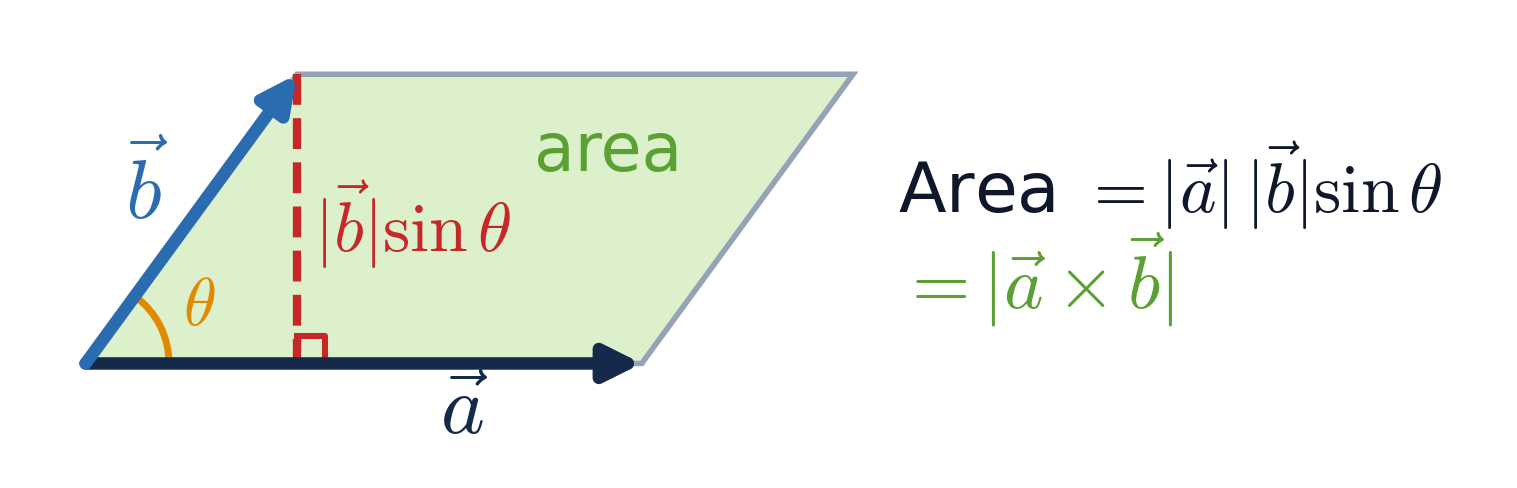
The picture shows why: the base is |\vec{a}| and the height is |\vec{b}|\sin\theta.
6. Worked examples
Example 1. Find \vec{a} \times \vec{b} and the area of the parallelogram with adjacent sides \vec{a} = 2\hat{i} + \hat{j} + 3\hat{k} and \vec{b} = 3\hat{i} + 5\hat{j} - 2\hat{k}.
\vec{a} \times \vec{b} = \begin{vmatrix} \hat{i} & \hat{j} & \hat{k} \\ 2 & 1 & 3 \\ 3 & 5 & -2 \end{vmatrix} = (-2 - 15)\hat{i} - (-4 - 9)\hat{j} + (10 - 3)\hat{k} = -17\hat{i} + 13\hat{j} + 7\hat{k}
Area = |\vec{a} \times \vec{b}| = \sqrt{289 + 169 + 49} = \sqrt{507} = 13\sqrt{3} square units.
Example 2. Find the unit vectors perpendicular to both \vec{a} = \hat{i} + \hat{j} + \hat{k} and \vec{b} = \hat{i} + 2\hat{j} + 3\hat{k}.
From section 3, \vec{a} \times \vec{b} = \hat{i} - 2\hat{j} + \hat{k}, with magnitude \sqrt{1 + 4 + 1} = \sqrt{6}. The unit vectors are \pm\dfrac{1}{\sqrt{6}}(\hat{i} - 2\hat{j} + \hat{k}).
Example 3. Find the area of the triangle with vertices A(1, 1, 1), B(1, 2, 3) and C(2, 3, 1).
\overrightarrow{AB} = \hat{j} + 2\hat{k} and \overrightarrow{AC} = \hat{i} + 2\hat{j}. Then
\overrightarrow{AB} \times \overrightarrow{AC} = \begin{vmatrix} \hat{i} & \hat{j} & \hat{k} \\ 0 & 1 & 2 \\ 1 & 2 & 0 \end{vmatrix} = (0 - 4)\hat{i} - (0 - 2)\hat{j} + (0 - 1)\hat{k} = -4\hat{i} + 2\hat{j} - \hat{k}
Its magnitude is \sqrt{16 + 4 + 1} = \sqrt{21}, so the area is \dfrac{1}{2}\sqrt{21} square units.
Example 4. |\vec{a}| = 2, |\vec{b}| = 5 and \vec{a} \cdot \vec{b} = 6. Find |\vec{a} \times \vec{b}|.
|\vec{a} \times \vec{b}|^2 = |\vec{a}|^2|\vec{b}|^2 - (\vec{a} \cdot \vec{b})^2 = 100 - 36 = 64, so |\vec{a} \times \vec{b}| = 8.
Example 5. Find \lambda and \mu if (2\hat{i} + 6\hat{j} + 27\hat{k}) \times (\hat{i} + \lambda\hat{j} + \mu\hat{k}) = \vec{0}.
A zero cross product means the vectors are parallel, so their components are in the same ratio: \dfrac{2}{1} = \dfrac{6}{\lambda} = \dfrac{27}{\mu}. Hence \lambda = 3 and \mu = \dfrac{27}{2}.
7. From the real papers
Try each question for 75 seconds before reading the solution.
NDA II 2025, Q68. What is the area of the parallelogram whose sides are represented by the vectors \hat{i} + 2\hat{j} + 3\hat{k} and 2\hat{i} + \hat{j} + 2\hat{k}?
(a) \frac{1}{2}\sqrt{26} square units (b) \frac{1}{2}\sqrt{27} square units (c) \sqrt{26} square units (d) \sqrt{27} square units
Solution. \vec{a} \times \vec{b} = (4 - 3)\hat{i} - (2 - 6)\hat{j} + (1 - 4)\hat{k} = \hat{i} + 4\hat{j} - 3\hat{k}. Its magnitude is \sqrt{1 + 16 + 9} = \sqrt{26}. Answer (c).
NDA I 2025, Q70. Let \vec{a}, \vec{b}, (\vec{a} \times \vec{b}) be unit vectors. What is (\vec{a} \cdot \vec{b}) equal to?
(a) 0 (b) 1/2 (c) 1 (d) 3
Solution. |\vec{a} \times \vec{b}| = 1 \times 1 \times \sin\theta = 1, so \sin\theta = 1 and \theta = 90^\circ. Then \vec{a} \cdot \vec{b} = \cos 90^\circ = 0. Answer (a).
NDA II 2025, Q67. How many of the following can be a vector perpendicular to both the vectors 2\hat{i} - \hat{j} + \hat{k} and \hat{i} + \hat{j} + 3\hat{k}? I. 4\hat{i} + 5\hat{j} - 3\hat{k} II. -8\hat{i} - 10\hat{j} + 6\hat{k} III. \frac{1}{50}(-4\hat{i} - 5\hat{j} + 3\hat{k}) Select the correct answer.
(a) None (b) One (c) Two (d) All three
Solution. The cross product is (-3 - 1)\hat{i} - (6 - 1)\hat{j} + (2 + 1)\hat{k} = -4\hat{i} - 5\hat{j} + 3\hat{k}. Every non-zero multiple of it is also perpendicular to both. Vector I is -1 times it, II is 2 times it and III is \dfrac{1}{50} times it. Answer (d).
NDA II 2023, Q92. If (\vec{a} \times \vec{b})^2 + (\vec{a} \cdot \vec{b})^2 = 144 and |\vec{b}| = 4, then what is the value of |\vec{a}|?
(a) 3 (b) 4 (c) 5 (d) 6
Solution. The left side is |\vec{a}|^2|\vec{b}|^2 (the last rule of section 4). So 16|\vec{a}|^2 = 144, |\vec{a}|^2 = 9 and |\vec{a}| = 3. Answer (a).
NDA I 2024, Q69. For any vector \vec{r}, what is (\vec{r} \cdot \hat{i})(\vec{r} \times \hat{i}) + (\vec{r} \cdot \hat{j})(\vec{r} \times \hat{j}) + (\vec{r} \cdot \hat{k})(\vec{r} \times \hat{k}) equal to?
(a) \vec{0} (b) \vec{r} (c) 2\vec{r} (d) 3\vec{r}
Solution. Let \vec{r} = x\hat{i} + y\hat{j} + z\hat{k}. The three dot products are x, y and z. So the expression is x(\vec{r} \times \hat{i}) + y(\vec{r} \times \hat{j}) + z(\vec{r} \times \hat{k}) = \vec{r} \times (x\hat{i} + y\hat{j} + z\hat{k}) = \vec{r} \times \vec{r} = \vec{0}. Answer (a).
NDA II 2026, Q69. Let \vec{a} and \vec{b} be unit vectors inclined at 30^\circ. What is the area of the parallelogram whose sides are represented by the vectors \vec{a} + 3\vec{b} and 3\vec{a} + \vec{b}?
(a) 8\sqrt{3} square units (b) 8 square units (c) 4\sqrt{3} square units (d) 4 square units
Solution. Expand, keeping the order: (\vec{a} + 3\vec{b}) \times (3\vec{a} + \vec{b}) = 3(\vec{a} \times \vec{a}) + \vec{a} \times \vec{b} + 9(\vec{b} \times \vec{a}) + 3(\vec{b} \times \vec{b}) = \vec{a} \times \vec{b} - 9(\vec{a} \times \vec{b}) = -8(\vec{a} \times \vec{b}). Now |\vec{a} \times \vec{b}| = 1 \times 1 \times \sin 30^\circ = \dfrac{1}{2}, so the area is 8 \times \dfrac{1}{2} = 4. Answer (d).
8. Mistakes that cost marks
- Writing \vec{a} \times \vec{b} = \vec{b} \times \vec{a}. Changing the order changes the sign. In an expansion, never swap two vectors without putting a minus.
- Losing the minus on the \hat{j} term. The middle term of the determinant carries a minus sign, as in every 3 × 3 expansion. Check the answer with a dot product.
- Forgetting the half. A parallelogram with sides \vec{a}, \vec{b} has area |\vec{a} \times \vec{b}|. A triangle has half of that.
- Giving one unit vector where there are two. The unit vectors perpendicular to \vec{a} and \vec{b} are +\hat{n} and -\hat{n}. And divide by the magnitude: \vec{a} \times \vec{b} itself is usually not a unit vector.
9. Quick check
Do these without help. Answers are at the end.
- What is \hat{i} \times \hat{k}?
- Find (\hat{i} + 2\hat{j} + 2\hat{k}) \times (2\hat{i} + \hat{j} - 2\hat{k}).
- Find the area of the triangle with two sides \hat{i} - \hat{j} and \hat{j} - \hat{k}.
- |\vec{a}| = 4, |\vec{b}| = 3 and the angle between them is 30^\circ. Find |\vec{a} \times \vec{b}|.
- Find (\hat{i} + 2\hat{j} + 3\hat{k}) \times (2\hat{i} + 4\hat{j} + 6\hat{k}) without a determinant.
10. Read and watch more, free
| What | Where | Language |
|---|---|---|
| Textbook | NCERT Class 12 Mathematics, Chapter 10 Vector Algebra (the section on the vector product) · Hindi edition | English, Hindi |
| Self-study notes | NIOS Mathematics, Lesson 34 Vectors · Hindi edition | English, Hindi |
| Textbook, more examples | OpenStax Calculus Volume 3, Chapter 2 Vectors in Space (the section on the cross product) | English |
| Video, the whole unit for NDA in five classes | Chandigarh Career Group: Vector class 1 to 5 (the first five videos of the playlist) | Hinglish (judged from the titles) |
| Video, the whole unit in one class | Defence Wallah: VECTORS in One Shot (in the Fast Track 2021 playlist, about 2 hours) | Hinglish |
| Video, taught in English, harder than NDA level | Vedantu JEE English: Vector Algebra and 3D Geometry (the last video of the playlist, about 5 hours) | English |
The videos were chosen from their titles, length and views; they have not yet been watched by a teacher.
Answers to the quick check
- -\hat{j}. It is against the order of the cycle, since \hat{k} \times \hat{i} = \hat{j}.
- (-4 - 2)\hat{i} - (-2 - 4)\hat{j} + (1 - 4)\hat{k} = -6\hat{i} + 6\hat{j} - 3\hat{k}.
- The cross product is (1 - 0)\hat{i} - (-1 - 0)\hat{j} + (1 - 0)\hat{k} = \hat{i} + \hat{j} + \hat{k}, with magnitude \sqrt{3}. The area is \dfrac{\sqrt{3}}{2} square units.
- 4 \times 3 \times \sin 30^\circ = 6.
- \vec{0}. The second vector is twice the first, so the two are parallel.
Next chapter: Vectors at work: force, moment and geometry.